Proceedings of the 2019 Conference on Empirical Methods in Natural Language Processing 4568
Aspect-based Sentiment Classification with Aspect-specific Graph
Convolutional Networks
Chen Zhang
Beijing Institute of Technology Beijing, China
Qiuchi Li University of Padua
Padua, Italy
Dawei Song∗
Beijing Institute of Technology Beijing, China
Abstract
Due to their inherent capability in semantic alignment of aspects and their context words, attention mechanism and Convolutional Neu-ral Networks (CNNs) are widely applied for aspect-based sentiment classification. How-ever, these models lack a mechanism to ac-count for relevant syntactical constraints and long-range word dependencies, and hence may mistakenly recognize syntactically irrelevant contextual words as clues for judging aspect sentiment. To tackle this problem, we pro-pose to build a Graph Convolutional Network (GCN) over the dependency tree of a sentence to exploit syntactical information and word dependencies. Based on it, a novel aspect-specific sentiment classification framework is raised. Experiments on three benchmarking collections illustrate that our proposed model has comparable effectiveness to a range of state-of-the-art models1, and further demon-strate that both syntactical information and long-range word dependencies are properly captured by the graph convolution structure.
1 Introduction
Aspect-based (also known as aspect-level) ment classification aims at identifying the senti-ment polarities of aspects explicitly given in sen-tences. For example, in a comment about a laptop saying “From the speed to the multi-touch gestures this operating system beats Windows easily.”, the sentiment polarities for two aspectsoperating sys-tem and Windows are positive and negative, re-spectively. Generally, this task is formulated as predicting the polarity of a provided (sentence, as-pect) pair.
Given the inefficiency of manual feature refine-ment (Jiang et al., 2011), early works of
aspect-∗Corresponding author. 1
Code and preprocessed datasets are available at
https://github.com/GeneZC/ASGCN.
based sentiment classification are mainly based on neural network methods (Dong et al., 2014; Vo and Zhang,2015). Ever sinceTang et al.(2016a) pointed out the challenge of modelling semantic relatedness between context words and aspects, at-tention mechanism coupled with Recurrent Neu-ral Networks (RNNs) (Bahdanau et al.,2014; Lu-ong et al., 2015; Xu et al., 2015) starts to play a critical role in more recent models (Wang et al., 2016; Tang et al., 2016b; Yang et al., 2017;Liu and Zhang, 2017; Ma et al., 2017; Huang et al., 2018).
While attention-based models are promising, they are insufficient to capture syntactical depen-dencies between context words and the aspect within a sentence. Consequently, the current attention mechanism may lead to a given as-pect mistakenly attending to syntactically un-related context words as descriptors(Limitation 1). Look at a concrete example “Its size is ideal and the weight is acceptable.”. Attention-based models often identifyacceptableas a descriptor of the aspectsize, which is in fact not the case. In or-der to address the issue, He et al.(2018) imposed some syntactical constraints on attention weights, but the effect of syntactical structure was not fully exploited.
staff should be a bit more friendly” with staff as the aspect, a CNN-based model may make an in-correct prediction by detecting more friendly as the descriptive phrase, disregarding the impact of should bewhich is two words away but reverses the sentiment.
In this paper, we aim to tackle the two lim-itations identified above by using Graph Con-volutional Networks (GCNs) (Kipf and Welling, 2017). GCN has a multi-layer architecture, with each layer encoding and updating the representa-tion of nodes in the graph using features of imme-diate neighbors. Through referring to syntactical dependency trees, a GCN is potentially capable of drawing syntactically relevant words to the target aspect, and exploiting long-range multi-word re-lations and syntactical information with GCN lay-ers. GCNs have been deployed on document-word relationships (Yao et al., 2018) and tree struc-tures (Marcheggiani and Titov,2017;Zhang et al., 2018), but how they can be effectively used in aspect-based sentiment classification is yet to be explored.
To fill the gap, this paper proposes an Aspect-specific Graph Convolutional Network (ASGCN), which, to the best of our knowledge, is the first GCN-based model for aspect-based sentiment classification. ASGCN starts with a bidirectional Long Short-Term Memory network (LSTM) layer to capture contextual information regarding word orders. In order to obtain aspect-specific features, a multi-layered graph convolution structure is im-plemented on top of the LSTM output, followed by a masking mechanism that filters out non-aspect words and keeps solely high-level non- aspect-specific features. The aspect-aspect-specific features are fed back to the LSTM output for retrieving infor-mative features with respect to the aspect, which are then used to predict aspect-based sentiment.
Experiments on three benchmarking datasets show that ASGCN effectively addresses both lim-itations of the current aspect-based sentiment clas-sification approaches, and outperforms a range of state-of-the-art models.
Our contributions are as follows:
• We propose to exploit syntactical dependency structures within a sentence and resolve the long-range multi-word dependency issue for aspect-based sentiment classification.
• We posit that Graph Convolutional Network (GCN) is suitable for our purpose, and
pro-ܐଵିଵܐଶିଵܐଷିଵܐସିଵܐହିଵܐିଵܐିଵ
ܐଵ ܐ
ଶ
ܐ
ଷ
ܐ
ସ
ܐ
ହ
ܐ
ܐ
Linear
T
ransform
ation
Adjacent
Sum
m
ation
[image:2.595.345.486.66.218.2]& Nonlinearity
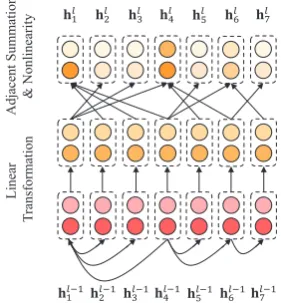
Figure 1: An example of GCN layer.
pose a novel Aspect-specific GCN model. To our best knowledge, this is the first investiga-tion in this direcinvestiga-tion.
• Extensive experiment results verify the im-portance of leveraging syntactical informa-tion and long-range word dependencies, and demonstrate the effectiveness of our model in capturing and exploiting them in aspect-based sentiment classification.
2 Graph Convolutional Networks
GCNs can be considered as an adaptation of the conventional CNNs for encoding local informa-tion of unstructured data. For a given graph with
knodes, an adjacency matrix2 A ∈ Rk×k is ob-tained through enumerating the graph. For conve-nience, we denote the output of thel-th layer for nodeiashli, whereh0i represents the initial state of nodei. For anL-layer GCN,l ∈ [1,2,· · ·, L]
andhLi is the final state of nodei. The graph con-volution operated on the node representation can be written as:
hl
i=σ(
k
j=1
AijWlhl−1
j +bl) (1)
whereWlis a linear transformation weight,blis a bias term, and σ is a nonlinear function, e.g. ReLU. For a better illustration, an example of GCN layer is shown in Figure1.
As the graph convolution process only encodes information of immediate neighbors, a node in the graph can only be influenced by the neighbour-ing nodes withinL steps in an L-layer GCN. In
2Aij
indicates whether thei-th token is adjacent to the
this way, the graph convolution over the depen-dency tree of a sentence provides syntactical con-straints for an aspect within the sentence to iden-tify descriptive words based on syntactical dis-tances. Moreover, GCN is able to deal with the circumstances where the polarity of an aspect is described by non-consecutive words, as GCN over dependency tree will gather the non-consecutive words into a smaller scope and aggregate their fea-tures properly with graph convolution. Therefore, we are inspired to adopt GCN to leverage syntac-tical information and long-range word dependen-cies for aspect-based sentiment classification.
3 Aspect-specific Graph Convolutional Network
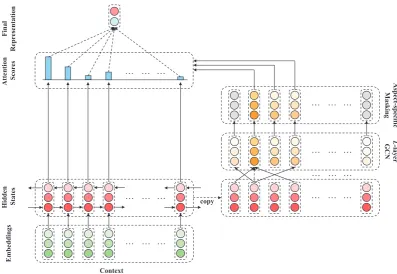
Figure2gives an overview of ASGCN. The com-ponents of ASGCN will be introduced separately in the rest of the section.
3.1 Embedding and Bidirectional LSTM
Given an-word sentencec={wc
1, wc2,· · · , wcτ+1
,· · · , wcτ+m,· · ·, wn−c 1, wcn} containing a
cor-responding m-word aspect starting from the
(τ + 1)-th token, we embed each word to-ken into a low-dimensional real-valued vector space (Bengio et al., 2003) with embedding matrix E ∈ R|V|×de, where |V| is the size of vocabulary andde denotes the dimensionality of word embeddings. With the word embeddings of the sentence, a bidirectional LSTM is con-structed to produce hidden state vectors Hc =
{hc
1,hc2,· · ·,hcτ+1,· · · ,hcτ+m,· · ·,hcn−1,hcn},
where hct ∈ R2dh represents the hidden state vector at time steptfrom the bidirectional LSTM, and dh is the dimensionality of a hidden state vector output by an unidirectional LSTM.
3.2 Obtaining Aspect-oriented Features
Different from general sentiment classification, aspect-based sentiment classification targets at judging sentiments from the view of aspects, and thus calls for an aspect-oriented feature extraction strategy. In this study, we obtain aspect-oriented features by applying multi-layer graph convolu-tion over the syntactical dependency tree of a sen-tence, and imposing an aspect-specific masking layer on its top.
3.2.1 Graph Convolution over Dependency Trees
Aiming to address the limitations of existing ap-proaches (as discussed in previous sections), we leverage a graph convolutional network over de-pendency trees of sentences. Specifically, af-ter the dependency tree3 of the given sentence is constructed, we first attain an adjacency matrix
A ∈ Rn×n according to the words in the
sen-tence. It is important to note that dependency trees are directed graphs. While GCNs generally do not consider directions, they could be adapted to the direction-aware scenario. Accordingly, we pro-pose two variants of ASGCN, i.e. ASGCN-DG on dependency graphs which are un-directional, and ASGCN-DT concerning dependency trees which are directional. Practically, the only difference between ASGCN-DG and ASGCN-DT lies in their adjacency matrices: The adjacency matrix of ASGCN-DT is much more sparse than that of ASGCN-DG. Such setting is in accordance with the phenomenon that parents nodes are broadly influenced by their children nodes. Furthermore, following the idea of self-looping in Kipf and Welling (2017), each word is manually set adja-cent to itself, i.e. the diagonal values ofAare all ones.
The ASGCN variants are performed in a multi-layer fashion, on top of the bidirectional LSTM output in Section 3.1, i.e. H0 = Hc to make nodes aware of context (Zhang et al.,2018). Then the representation of each node is updated with graph convolution operation with normalization factor (Kipf and Welling,2017) as below:
˜
hl
i =
n
j=1
AijWlgl−1
j (2)
hl
i = ReLU(˜hli/(di+ 1) +bl) (3)
wheregjl−1 ∈R2dh is thej-th token’s representa-tion evolved from the preceding GCN layer while
hl
i ∈ R2dh is the product of current GCN layer,
anddi = n
j=1Aij is degree of thei-th token in
the tree. The weightsWland biasblare trainable parameters.
It is worth noting that we do not havehli imme-diately fed into successive GCN layer, but conduct a position-aware transformation in the first place:
gl
i=F(hli) (4)
3
… … … … … …
Context
Hidden States Attention Scor
es
Embeddings
… … … …
… … … … … …
… … …
L
-layer
GCN
Aspect-specific
Mask
ing
Final
Repr
esentation
[image:4.595.98.496.59.333.2]copy
Figure 2: Overview of aspect-specific graph convolutional network.
where F(·) is a function assigning position weights, widely adopted by previous works (Li et al.,2018;Tang et al.,2016b;Chen et al.,2017), for augmenting the importance of context words close to the aspect. By doing so we aim at re-ducing the noise and bias that may have natu-rally arisen from the dependency parsing process. Specifically, the functionF(·)is:
qi = ⎧ ⎪ ⎨ ⎪ ⎩
1−τ+1−i
n 1≤i < τ+ 1 0 τ+ 1≤i≤τ +m
1−i−τ−mn τ+m < i≤n
(5)
F(hl
i) =qihli (6)
whereqi ∈ Ris the position weight toi-th token.
The final outcome of theL-layer GCN isHL =
{hL
1,hL2,· · · ,hLτ+1,· · ·,hLτ+m,· · · ,hLn−1,hLn},
hL
t ∈R2dh.
3.2.2 Aspect-specific Masking
In this layer, we mask out hidden state vectors of non-aspect words and keep the aspect word states unchanged:
hL
t =0 1≤t < τ + 1, τ +m < t≤n (7)
The outputs of this zero-masking layer are the aspect-oriented featuresHLmask={0,· · ·,hLτ+1,
· · ·,hL
τ+m,· · · ,0}. Through graph convolution,
these features HLmask have perceived contexts around the aspect in such a way that considers both syntactical dependencies and long-range multi-word relations.
3.3 Aspect-aware Attention
Based on the aspect-oriented features, a refined representation of the hidden state vectors Hc is produced via a novel retrieval-based attention mechanism. The idea is to retrieve significant features that are semantically relevant to the as-pect words from the hidden state vectors, and ac-cordingly set a retrieval-based attention weight for each context word. In our implementation, the at-tention weights are computed as below:
βt= n
i=1
hc
t hLi =
τ+m
i=τ+1
hc
t hLi (8)
αt=
exp(βt) n
i=1exp(βi)
(9)
r= n
t=1
αthct (10)
3.4 Sentiment Classification
Having obtained the representationr, it is then fed into a fully-connected layer, followed by a soft-max normalization layer to yield a probability dis-tributionp∈Rdpover polarity decision space:
p= softmax(Wpr+bp) (11)
wheredpis the same as the dimensionality of sen-timent labels whileWp ∈Rdp×2dh andbp ∈Rdp are the learned weight and bias, respectively.
3.5 Training
This model is trained by the standard gradient de-scent algorithm with the cross-entropy loss and
L2-regularization:
Loss =− (c,pˆ)∈C
logppˆ+λΘ2 (12)
where C denotes the collection of data sets, pˆis the label andppˆmeans the pˆ-th element ofp,Θ represents all trainable parameters, andλis the co-efficient ofL2-regularization.
4 Experiments
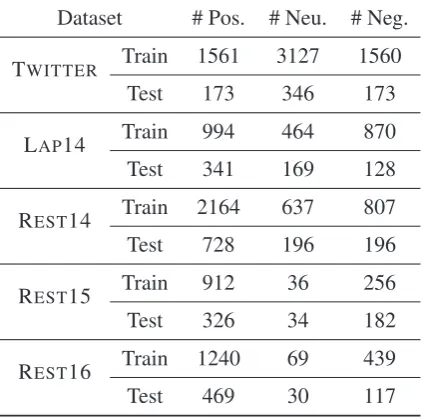
4.1 Datasets and Experimental Settings Our experiments are conducted on five datasets: one (TWITTER) is originally built byDong et al. (2014) containing twitter posts, while the other four (LAP14, REST14, REST15, REST16) are
respectively from SemEval 2014 task 4 (Pontiki et al.,2014), SemEval 2015 task 12 (Pontiki et al., 2015) and SemEval 2016 task 5 (Pontiki et al., 2016), consisting of data from two categories, i.e. laptop and restaurant. Following previous work (Tang et al., 2016b), we remove samples with conflicting4polarities or without explicit as-pects in the sentences in REST15 and REST16. The statistics of datasets are reported in Table1.
For all our experiments, 300-dimensional pre-trained GloVe vectors (Pennington et al., 2014) are used to initialize word embeddings. All model weights are initialized with uniform distribution. The dimensionality of hidden state vectors is set to 300. We use Adam as the optimizer with a
4
An opinion target is associated with different sentiment polarities.
Dataset # Pos. # Neu. # Neg.
TWITTER Train 1561 3127 1560
Test 173 346 173
LAP14 Train 994 464 870
Test 341 169 128
REST14 Train 2164 637 807
Test 728 196 196
REST15 Train 912 36 256
Test 326 34 182
REST16 Train 1240 69 439
[image:5.595.311.523.64.273.2]Test 469 30 117
Table 1: Dataset statistics.
learning rate of 0.001. The coefficient of L2 -regularization is 105 and batch size is 32. More-over, the number of GCN layers is set to 2, which is the best-performing depth in pilot studies.
The experimental results are obtained by aver-aging 3 runs with random initialization, where Ac-curacy and Macro-Averaged F1 are adopted as the evaluation metrics. We also carry out paired t-test on both Accuracy and Macro-Averaged F1 to verify whether the improvements achieved by our models over the baselines are significant.
4.2 Models for Comparison
In order to comprehensively evaluate the two variants of our model, namely, ASGCN-DG and ASGCN-DT, we compare them with a range of baselines and state-of-the-art models, as listed be-low:
• SVM (Kiritchenko et al.,2014) is the model which has won SemEval 2014 task 4 with conventional feature extraction methods.
• LSTM (Tang et al.,2016a) uses the last hid-den state vector of LSTM to predict senti-ment polarity.
• MemNet (Tang et al.,2016b) considers con-texts as external memories and benefits from a multi-hop architecture.
• AOA (Huang et al.,2018) borrows the idea of attention-over-attention from the field of ma-chine translation.
Model TWITTER LAP14 REST14 REST15 REST16
Acc. F1 Acc. F1 Acc. F1 Acc. F1 Acc. F1
SVM 63.40 63.30 70.49 N/A 80.16 N/A N/A N/A N/A N/A
LSTM 69.56 67.70 69.28 63.09 78.13 67.47 77.37 55.17 86.80 63.88
MemNet 71.48 69.90 70.64 65.17 79.61 69.64 77.31 58.28 85.44 65.99
AOA 72.30 70.20 72.62 67.52 79.97 70.42 78.17 57.02 87.50 66.21
IAN 72.50 70.81 72.05 67.38 79.26 70.09 78.54 52.65 84.74 55.21
TNet-LF 72.98 71.43 74.61 70.14 80.42 71.03 78.47 59.47 89.07 70.43
ASCNN 71.05 69.45 72.62 66.72 81.73 73.10 78.47 58.90 87.39 64.56
ASGCN-DT 71.53 69.68 74.14† 69.24† 80.86‡ 72.19‡ 79.34†‡ 60.78†‡ 88.69† 66.64† ASGCN-DG 72.15† 70.40† 75.55†‡ 71.05†‡ 80.77‡ 72.02‡ 79.89†‡ 61.89†‡ 88.99† 67.48†
Table 2: Model comparison results (%). Average accuracy and macro-F1 score over 3 runs with random initial-ization. The best two results with each dataset are in bold. The results withare retrieved from the original papers and the results withare retrieved fromDong et al. (2014). The marker†refersp < 0.05by comparing with ASCNN in paired t-test and the marker‡refersp <0.05by comparing with TNet-LF in paired t-test.
• TNet-LF (Li et al., 2018) puts forward Context-Preserving Transformation (CPT) to preserve and strengthen the informative part of contexts.
In order to examine to what degrees GCN would outperform CNN, we also involve a model named ASCNN in the experiment, which replaces 2-layer GCN with 2-layer CNN in ASGCN5.
4.3 Results
As is shown in Table2, ASGCN-DG consistently outperforms all compared models on LAP14 and REST15 datasets, and achieves comparable results on TWITTERand REST16 datasets compared with
baseline TNet-LF and on REST14 compared with ASCNN. The results demonstrate the effective-ness of ASGCN-DG and the insufficiency of di-rectly integrating syntax information into attention mechanism as in He et al. (2018). Meanwhile, ASGCN-DG performs better than ASGCN-DT by a large margin on TWITTER, LAP14, Rest15 and REST16 datasets. And ASGCN-DT’s result is lower than TNet-LF’s on LAP14. A
possi-ble reason is that the information from parents nodes is as important as that from children nodes, so treating dependency trees as directed graphs leads to information loss. Additionally, ASGCN-DG outperforms ASCNN on all datasets except REST14, illustrating ASGCN is better at capturing long-range word dependencies, while to some ex-tent ASCNN shows an impact brought by aspect-specific masking. We suspect REST14 dataset is
5
In order to ensure the length of input and output is con-sistent, kernel length is set to 3 and padding is 1.
not so sensitive to syntactic information. More-over, the sentences from TWITTERdataset are less grammatical, restricting the efficacy. We conjec-ture this is likely the reason why ASGCN-DG and ASGCN-DT get sub-optimal results on TWITTER
dataset.
4.4 Ablation Study
To further examine the level of benefit that each component of ASGCN brings to the performance, an ablation study is performed on ASGCN-DG. The results are shown in Table3. We also present the results of BiLSTM+Attn as a baseline, which uses two LSTMs for the aspect and the context re-spectively.
First, removal of position weights (i.e. ASGCN-DG w/o pos.) leads to performance drops on LAP14, REST15 and REST16 datasets but performance boosts on TWITTERand REST14
datasets. Recall the main results on REST14 dataset, we conclude that the integration of posi-tion weights is not helpful to reduce noise of user generated contents if syntax is not crucial for the data. Moreover, after we get rid of aspect-specific masking (i.e. ASGCN-DG w/o masking), the model could not keep as competitive as TNet-LF. This verifies the significance of aspect-specific masking.
Compared with ASGCN-DG, ASGCN-DG w/o GCN (i.e. preserving position weights and aspect-specific masking, but without using GCN layers) is much less powerful on all five datasets except F1 metric on TWITTER dataset. However,
BiL-Model TWITTER LAP14 REST14 REST15 REST16 Acc. F1 Acc. F1 Acc. F1 Acc. F1 Acc. F1
BiLSTM+Attn 71.24 69.55 72.83 67.82 79.85 70.03 78.97 58.18 87.28 68.18 ASGCN-DG 72.15 70.40 75.55 71.05 80.77 72.02 79.89 61.89 88.99 67.48
[image:7.595.311.515.511.664.2]ASGCN-DG w/o pos. 72.69 70.59 73.93 69.63 81.22 72.94 79.58 61.55 88.04 66.63 ASGCN-DG w/o mask 72.64 70.63 72.05 66.56 79.02 68.29 77.80 57.51 86.36 61.41 ASGCN-DG w/o GCN 71.92 70.63 73.51 68.83 79.40 69.43 79.40 61.18 87.55 66.19
Table 3: Ablation study results (%). Accuracy and macro-F1 scores are the average value over 3 runs with random initialization.
STM+Attn on all datasets except REST14 dataset, due to the strength of the aspect-specific masking mechanism.
Thus it could be concluded that GCN con-tributes to ASGCN to a considerable extent since GCN captures syntatic word dependencies and long-range word relations at the same time. Nev-ertheless, the GCN does not work well as expected on the datasets not sensitive to syntax informa-tion, as we have seen in TWITTER and REST14
datasets.
4.5 Case Study
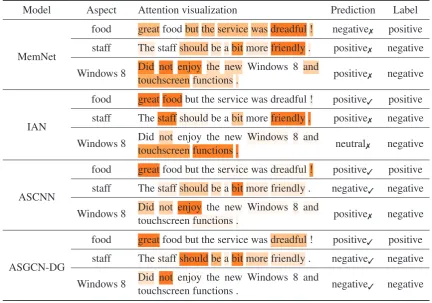
To better understand how ASGCN works, we present a case study with several testing examples. Particularly, we visualize the attention scores of-fered by MemNet, IAN, ASCNN and ASGCN-DG in Table 4, along with their predictions on these examples and the corresponding ground truth labels.
The first sample “great food but the service was dreadful!” has two aspects within one sentence, which may hinder attention-based models from aligning the aspects with their relevant descrip-tive words precisely. The second sample sentence “The staff should be a bit more friendly.” uses a subjunctive word “should”, bringing extra diffi-culty in detecting implicit semantics. The last ex-ample contains negation in the sentence, that can easily lead models to make wrong predictions.
MemNet fails in all three presented samples. While IAN is capable of differing modifiers for distinct aspects, it fails to infer sentiment polari-ties of sentences with special styles. Armed with position weights, ASCNN correctly predicts the label for the second sample as the phrase should be is close to the aspect staff, but failed for the third one with a longer-range word dependency. Our ASGCN-DG correctly handles all the three
samples, implying that GCN effectively integrates syntactic dependency information into an enriched semantic representation. In particular, ASGCN-DG makes correct predictions on the second and the third sample, both having a seemingly biased focus. This shows ASGCN’s capability of captur-ing long-range multi-word features.
5 Discussion
5.1 Investigation on the Impact of GCN Layers
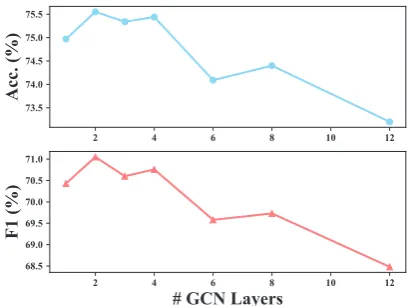
As ASGCN involves anL-layer GCN, we investi-gate the effect of the layer numberLon the final performance of ASGCN-DG. Basically, we vary the value ofLin the set{1,2,3,4,6,8,12}and check the corresponding Accuracy and Macro-Averaged F1 of ASGCN-DG on the LAP14 dataset. The re-sults are illustrated in Figure3.
Figure 3: Effect of the number of GCN layers. Accu-racy and macro-F1 scores are the average value over 3 runs with random initialization.
sec-Model Aspect Attention visualization Prediction Label
MemNet
food great food but the service was dreadful ! negative positive
staff The staff should be a bit more friendly . positive negative
Windows 8 Did not enjoy the new Windows 8 and
touchscreen functions . positive negative
IAN
food great food but the service was dreadful ! positive positive
staff The staff should be a bit more friendly . positive negative
Windows 8 Did not enjoy the new Windows 8 and
touchscreen functions . neutral negative
ASCNN
food great food but the service was dreadful ! positive positive
staff The staff should be a bit more friendly . negative negative
Windows 8 Did not enjoy the new Windows 8 and
touchscreen functions . positive negative
ASGCN-DG
food great food but the service was dreadful ! positive positive
staff The staff should be a bit more friendly . negative negative
Windows 8 Did not enjoy the new Windows 8 and
[image:8.595.82.515.63.366.2]touchscreen functions . negative negative
Table 4: Case study. Visualization of attention scores from MemNet, IAN, ASCNN and ASGCN-DG on test-ing examples, along with their predictions and correspondtest-ingly, golden labels. The markerindicates correct prediction while the markerindicates incorrect prediction.
tion. Moreover, a dropping trend on both metrics is present asL increases. For largeL, especially when L equals to 12, ASGCN-DG basically be-comes more difficult to train due to large amount of parameters.
5.2 Investigation on the Effect of Multiple Aspects
In the datasets, there might exist multiple aspect terms in one sentence. Thus, we intend to measure whether such phenomena would affect the effec-tiveness of ASGCN. We divide the training sam-ples in LAP14 and REST14 datasets into different groups based on the number of aspect terms in the sentences and compute the training accuracy dif-ferences between these groups. It is worth noting that the samples with more than 7 aspect terms are removed as outliers because the sizes of these sam-ples are too small for any meaningful comparison. It can be seen in Figure 4 that when the num-ber of aspects in the sentences is more than 3, the accuracy becomes fluctuated, indicating a low ro-bustness in capturing multiple-aspect correlations and suggesting the need of modelling multi-aspect
Figure 4: Accuracy versus the number of aspects (# Aspects) in the sentences.
dependencies in future work.
6 Related Work
[image:8.595.312.516.447.602.2](RC-NNs) (Lai et al., 2015), has achieved promising performances in sentiment analysis. However, the importance but lack of an effective mechanism of leveraging dependency trees for capturing dis-tant relations of words has also been recognized. Tai et al. (2015) showed that LSTM with depen-dency trees or constituency trees outperformed CNNs. Dong et al.(2014) presented an adaptive recursive neural network using dependency trees, which achieved competitive results compared with strong baselines. More recent research showed that general dependency-based models are diffi-cult to achieve comparable results to the attention-based models, as dependency trees are not capable of catching long-term contextualized semantic in-formation properly. Our work overcomes this lim-itation by adopting Graph convolutional networks (GCNs) (Kipf and Welling,2017) .
GCN has recently attracted a growing attention in the area of artificial intelligence and has been applied to Natural Language Processing (NLP). Marcheggiani and Titov(2017) claimed that GCN could be considered as a complement to LSTM, and proposed a GCN-based model for semantic role labeling. Vashishth et al.(2018) and Zhang et al. (2018) used graph convolution over depen-dency trees in document dating and relation classi-fication, respectively. Yao et al.(2018) introduced GCN to text classification utilizing document-word and document-word-document-word relations, and gained im-provements over various state-of-the-art methods. Our work investigates the effect of dependency trees in depth via graph convolution, and develops aspect-specific GCN model that integrates with the LSTM architecture and attention mechanism for more effective aspect-based sentiment classifi-cation.
7 Conclusions and Future Work
We have re-examined the challenges encountering existing models for aspect-specific sentiment clas-sification, and pointed out the suitability of graph convolutional network (GCN) for tackling these challenges. Accordingly, we have proposed a novel network to adopt GCN for aspect-based sen-timent classification. Experimental results have indicated that GCN brings benefit to the overall performance by leveraging both syntactical infor-mation and long-range word dependencies.
This study may be further improved in the fol-lowing aspects. First, the edge information of the
syntactical dependency trees, i.e. the label of each edge, is not exploited in this work. We plan to de-sign a specific graph neural network that takes into consideration the edge labels. Second, domain knowledge can be incorporated. Last but not least, the ASGCN model may be extended to simultane-ously judge sentiments of multiple aspects by cap-turing dependencies between the aspects words.
Acknowledgments
This work is supported by The National Key Research and Development Program of China (grant No. 2018YFC0831704), Natural Science Foundation of China (grant No. U1636203, 61772363), Major Project of Zhejiang Lab (grant No. 2019DH0ZX01), and the European Unions Horizon 2020 Research and Innovation Pro-gramme under the Marie Skodowska-Curie grant agreement No. 721321.
References
Dzmitry Bahdanau, Kyunghyun Cho, and Yoshua Ben-gio. 2014. Neural machine translation by jointly learning to align and translate. arXiv preprint arXiv:1409.0473.
Yoshua Bengio, R´ejean Ducharme, Pascal Vincent, and Christian Jauvin. 2003. A neural probabilistic lan-guage model. Journal of Machine Learning Re-search, 3:1137–1155.
Peng Chen, Zhongqian Sun, Lidong Bing, and Wei Yang. 2017. Recurrent attention network on mem-ory for aspect sentiment analysis. InProceedings of the 2017 Conference on Empirical Methods in Nat-ural Language Processing, pages 452–461.
Li Dong, Furu Wei, Chuanqi Tan, Duyu Tang, Ming Zhou, and Ke Xu. 2014. Adaptive recursive neural network for target-dependent twitter sentiment clas-sification. InProceedings of the 52nd annual meet-ing of the association for computational lmeet-inguistics (volume 2: Short papers), volume 2, pages 49–54.
Chuang Fan, Qinghong Gao, Jiachen Du, Lin Gui, Ruifeng Xu, and Kam-Fai Wong. 2018. Convolution-based memory network for aspect-based sentiment analysis. InThe 41st International ACM SIGIR Conference on Research & Develop-ment in Information Retrieval, pages 1161–1164. ACM.
Binxuan Huang, Yanglan Ou, and Kathleen M Car-ley. 2018. Aspect level sentiment classification with attention-over-attention neural networks. In
International Conference on Social Computing, Behavioral-Cultural Modeling and Prediction and Behavior Representation in Modeling and Simula-tion, pages 197–206. Springer.
Long Jiang, Mo Yu, Ming Zhou, Xiaohua Liu, and Tiejun Zhao. 2011. Target-dependent twitter senti-ment classification. InProceedings of the 49th An-nual Meeting of the Association for Computational Linguistics: Human Language Technologies-Volume 1, pages 151–160. Association for Computational Linguistics.
Rie Johnson and Tong Zhang. 2015. Semi-supervised convolutional neural networks for text categoriza-tion via region embedding. InAdvances in neural information processing systems, pages 919–927.
Yoon Kim. 2014. Convolutional neural networks for sentence classification. InProceedings of the 2014 Conference on Empirical Methods in Natural Lan-guage Processing (EMNLP), pages 1746–1751.
Thomas N. Kipf and Max Welling. 2017. Semi-supervised classification with graph convolutional networks. InInternational Conference on Learning Representations (ICLR).
Svetlana Kiritchenko, Xiaodan Zhu, Colin Cherry, and Saif Mohammad. 2014. Nrc-canada-2014: Detect-ing aspects and sentiment in customer reviews. In
Proceedings of the 8th International Workshop on Semantic Evaluation (SemEval 2014), pages 437– 442.
Siwei Lai, Liheng Xu, Kang Liu, and Jun Zhao. 2015. Recurrent convolutional neural networks for text classification. InTwenty-ninth AAAI conference on artificial intelligence.
Xin Li, Lidong Bing, Wai Lam, and Bei Shi. 2018. Transformation networks for target-oriented senti-ment classification. InProceedings of the 56th An-nual Meeting of the Association for Computational Linguistics (Volume 1: Long Papers), pages 946– 956.
Jiangming Liu and Yue Zhang. 2017. Attention mod-eling for targeted sentiment. InProceedings of the 15th Conference of the European Chapter of the As-sociation for Computational Linguistics: Volume 2, Short Papers, pages 572–577.
Thang Luong, Hieu Pham, and Christopher D Man-ning. 2015. Effective approaches to attention-based neural machine translation. In Proceedings of the 2015 Conference on Empirical Methods in Natural Language Processing, pages 1412–1421.
Dehong Ma, Sujian Li, Xiaodong Zhang, and Houfeng Wang. 2017. Interactive attention networks for aspect-level sentiment classification. In Proceed-ings of the 26th International Joint Conference
on Artificial Intelligence, pages 4068–4074. AAAI Press.
Diego Marcheggiani and Ivan Titov. 2017. Encoding sentences with graph convolutional networks for se-mantic role labeling. In Proceedings of the 2017 Conference on Empirical Methods in Natural Lan-guage Processing, pages 1506–1515.
Jeffrey Pennington, Richard Socher, and Christopher Manning. 2014. Glove: Global vectors for word representation. InProceedings of the 2014 confer-ence on empirical methods in natural language pro-cessing (EMNLP), pages 1532–1543.
Maria Pontiki, Dimitris Galanis, Haris Papageor-giou, Ion Androutsopoulos, Suresh Manandhar, AL-Smadi Mohammad, Mahmoud Al-Ayyoub, Yanyan Zhao, Bing Qin, Orph´ee De Clercq, et al. 2016. Semeval-2016 task 5: Aspect based sentiment anal-ysis. InProceedings of the 10th international work-shop on semantic evaluation (SemEval-2016), pages 19–30.
Maria Pontiki, Dimitris Galanis, Haris Papageorgiou, Suresh Manandhar, and Ion Androutsopoulos. 2015. Semeval-2015 task 12: Aspect based sentiment anal-ysis. InProceedings of the 9th International Work-shop on Semantic Evaluation (SemEval 2015), pages 486–495.
Maria Pontiki, Dimitris Galanis, John Pavlopoulos, Harris Papageorgiou, Ion Androutsopoulos, and Suresh Manandhar. 2014. Semeval-2014 task 4: As-pect based sentiment analysis. InProceedings of the 8th International Workshop on Semantic Evaluation (SemEval 2014), pages 27–35.
Kai Sheng Tai, Richard Socher, and Christopher D Manning. 2015. Improved semantic representations from tree-structured long short-term memory net-works. In Proceedings of the 53rd Annual Meet-ing of the Association for Computational LMeet-inguistics and the 7th International Joint Conference on Natu-ral Language Processing (Volume 1: Long Papers), volume 1, pages 1556–1566.
Duyu Tang, Bing Qin, Xiaocheng Feng, and Ting Liu. 2016a. Effective lstms for target-dependent sen-timent classification. In Proceedings of COLING 2016, the 26th International Conference on Compu-tational Linguistics: Technical Papers, pages 3298– 3307.
Duyu Tang, Bing Qin, and Ting Liu. 2016b. Aspect level sentiment classification with deep memory net-work. In Proceedings of the 2016 Conference on Empirical Methods in Natural Language Process-ing, pages 214–224.
Duy-Tin Vo and Yue Zhang. 2015. Target-dependent twitter sentiment classification with rich automatic features. InTwenty-Fourth International Joint Con-ference on Artificial Intelligence.
Yequan Wang, Minlie Huang, Li Zhao, et al. 2016. Attention-based lstm for aspect-level sentiment clas-sification. InProceedings of the 2016 Conference on Empirical Methods in Natural Language Process-ing, pages 606–615.
Kelvin Xu, Jimmy Ba, Ryan Kiros, Kyunghyun Cho, Aaron Courville, Ruslan Salakhudinov, Rich Zemel, and Yoshua Bengio. 2015. Show, attend and tell: Neural image caption generation with visual atten-tion. InInternational conference on machine learn-ing, pages 2048–2057.
Wei Xue and Tao Li. 2018. Aspect based sentiment analysis with gated convolutional networks. In Pro-ceedings of the 56th Annual Meeting of the Associa-tion for ComputaAssocia-tional Linguistics (Volume 1: Long Papers), pages 2514–2523.
Min Yang, Wenting Tu, Jingxuan Wang, Fei Xu, and Xiaojun Chen. 2017. Attention based lstm for target dependent sentiment classification. InThirty-First AAAI Conference on Artificial Intelligence.
Liang Yao, Chengsheng Mao, and Yuan Luo. 2018. Graph convolutional networks for text classification.
arXiv preprint arXiv:1809.05679.