Proceedings of the 2019 Conference on Empirical Methods in Natural Language Processing 3376
Adapting Meta Knowledge Graph Information for
Multi-Hop Reasoning over Few-Shot Relations
Xin Lv1,2,3, Yuxian Gu1, Xu Han1,2, Lei Hou1,2,3∗, Juanzi Li1,2,3, Zhiyuan Liu1,2 1Department of Computer Science and Technology, Tsinghua University
2KIRC, Institute for Artificial Intelligence, Tsinghua University 3Beijing National Research Center for Information Science and Technology
{lv-x18,gu-yx17,hanxu17}@mails.tsinghua.edu.cn
{houlei,lijuanzi,liuzy}@tsinghua.edu.cn
Abstract
Multi-hop knowledge graph (KG) reasoning is an effective and explainable method for pre-dicting the target entity via reasoning paths in query answering (QA) task. Most pre-vious methods assume that every relation in KGs has enough training triples, regardless of those few-shot relations which cannot pro-vide sufficient triples for training robust rea-soning models. In fact, the performance of existing multi-hop reasoning methods drops significantly on few-shot relations. In this paper, we propose a meta-based multi-hop reasoning method (Meta-KGR), which adopts meta-learning to learn effective meta parame-ters from high-frequency relations that could quickly adapt to few-shot relations. We eval-uate Meta-KGR on two public datasets sam-pled from Freebase and NELL, and the exper-imental results show that Meta-KGR outper-forms the current state-of-the-art methods in few-shot scenarios. Our code and datasets can be obtained fromhttps://github.com/ THU-KEG/MetaKGR.
1 Introduction
Recently, large-scale knowledge graphs (KGs) have been demonstrated to be beneficial for many NLP tasks like query answering (QA). A triple query for QA is generally formalized as(es, rq,?), where es is the source entity and rq is the query relation. For example, given a language query “What is the nationality of Mark Twain?”, we can transform it into(Mark Twain,nationality,?)
and then search the target entity America from KGs as the answer. However, as many KGs are constructed automatically and face serious incom-pleteness problems (Bordes et al.,2013), it is often hard to directly get target entities for queries.
To alleviate this issue, some knowledge graph embedding methods (Bordes et al., 2013;
∗
Corresponding Author
0 2000 4000 6000 8000 10000
Relation frequency 0
200 400 600 800
[image:1.595.311.524.229.361.2]Number
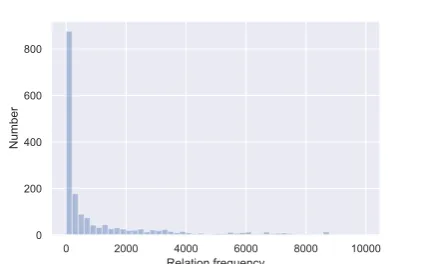
Figure 1: The histogram of relation frequency in the real-world knowledge graph Wikidata.
Dettmers et al.,2018) have been proposed to
em-bed entities and relations into semantic spaces to capture inner connections, and then use the learned embeddings for final predictions. Al-though these embedding-based methods have shown strong abilities in predicting target entities for queries, they only give answers and lack inter-pretability for their decisions (Lin et al.,2018). In order to make models more intuitive, Das et al.
(2018) and Lin et al. (2018) propose multi-hop reasoning methods, which leverage the symbolic compositionality of relations in KGs to achieve explainable reasoning results. For example, when queried with (Mark Twain,nationality,?), multi-hop reasoning models can give not only the target entity America but also multi-hop ex-plainable paths (Mark Twain,bornIn,Florida) ∧
(Florida,locatedIn,America)as well.
Most previous work assumes that there are enough triples to train an effective and robust rea-soning models for each relation in KGs. However, as shown in Figure 1, a large portion of KG re-lations are actually long-tail (Xiong et al., 2018;
Han et al., 2018) and only contain few triples,
previous multi-hop reasoning models, e.g., MIN-ERVA (Das et al.,2018) and MultiHop (Lin et al.,
2018), on these few-shot relations will drop sig-nificantly. Note that, there are some knowledge graph embedding models (Xiong et al., 2018;
Shi and Weninger, 2018; Xie et al., 2016) that
can deal with zero-shot or one-shot relations, but they still have two main drawbacks: (1) they are embedding-based models and lack interpretabil-ity; (2) they focus on zero-shot or one-shot rela-tions, which is a little far away from real-world scenes. In fact, even for people, it is hard to grasp new knowledge with almost no examples. There-fore, few-shot multi-hop reasoning is a quite im-portant and practical problem that has not yet been fully resolved.
In this paper, we propose a meta-based algo-rithm for multi-hop reasoning (Meta-KGR) to ad-dress the above problems, which is explainable and effective for few-shot relations. Specifically, in Meta-KGR, we regard triple queries with the same relation r in KGs as a task. For each task, we adopt reinforcement learning (RL) to train an agent to search target entities and reasoning paths. Similar to previous meta-learning method MAML (Finn et al.,2017), we use tasks of high-frequency relations to capture meta information, which includes common features among different tasks. Then, the meta information can be rapidly adapted to the tasks of few-shot relations, by pro-viding a good starting point to train their specific reasoning agents. In experiments, we evaluate Meta-KGR on two datasets sampled from Free-base and NELL, and the experimental results show that Meta-KGR outperforms the current state-of-the-art multi-hop reasoning methods in few-shot scenarios.
2 Problem Formulation
We formally define a KGG = {E,R,F}, where
EandRdenote the entity and relation sets respec-tively.F ={(es, r, eo)} ⊆ E × R × Eis the triple set, wherees, eo ∈ Eare entities andr ∈ Ris a re-lation between them. In this paper, if the number of triples mentioning a relation r is smaller than the specific thresholdK,ris considered as a few-shot relation, otherwise, it is a normal relation.
Given a query(es, rq,?), whereesis the source entity and rq is the few-shot relation, the goal of few-shot multi-hop reasoning is to predict the right entityeo for this query. Different from the
previ-ous knowledge graph embedding work, multi-hop reasoning also gives a reasoning path fromestoeo overGto illustrate the whole reasoning process.
3 Related Work
Knowledge Graph Embedding (Bordes et al.,
2013; Yang et al., 2015; Dettmers et al., 2018)
aims to embed entities and relations into low-dimensional spaces, and then uses embeddings to define a score functionf(es, r, eo)to evaluate the probability that a triple is true. Recently, several models (Xie et al.,2016;Shi and Weninger,2018) incorporate additional entity descriptions to learn embeddings for unseen entities, which can be seen as zero-shot scenarios.Xiong et al.(2018) predict new facts under a challenging setting where only one training triple for a given relation r is avail-able, which can be seen as a one-shot scenario. Although these models are effective, they lack in-terpretability for their decisions.
Multi-Hop Reasoningover KGs aims to learn
symbolic inference rules from relational paths in
G and has been formulated as sequential deci-sion problems in recent years. DeepPath (Xiong
et al., 2017) first applies RL to search
reason-ing paths in KGs for a given query, which in-spires much later work (e.g., MINERVA (Das
et al.,2018) and DIVA (Chen et al.,2018)).
Be-cause it is hard to train an RL model, Reinforce-Walk (Shen et al.,2018) proposes to solve the re-ward sparsity problem using off-policy learning. MultiHop (Lin et al.,2018) further extends MIN-ERVA with reward shaping and action dropout, achieveing the state-of-the-art performance. These reasoning methods are intuitive and explainable. However, all of them have a weak performance in few-shot scenarios. In addition to multi-hop rea-soning over KGs, there are also some multi-hop QA methods in recent years. Yang et al. (2018) proposes a high quality dataset, which greatly pro-motes the development of this field. After that, many methods like CogQA (Ding et al.,2019) and DFGN (Xiao et al.,2019) are also proposed.
Meta-Learning tries to solve the problem of
“fast adaptation on a new training task”. It has been proved to be very successful on few-shot task
(Lake et al.,2015;Gu et al.,2018). Previous
Meta-Learning
Fast Adaptation rLra
<latexit sha1_base64="(null)">(null)</latexit><latexit sha1_base64="(null)">(null)</latexit><latexit sha1_base64="(null)">(null)</latexit><latexit sha1_base64="(null)">(null)</latexit><latexit sha1_base64="(null)">(null)</latexit><latexit sha1_base64="(null)">(null)</latexit><latexit sha1_base64="(null)">(null)</latexit><latexit sha1_base64="(null)">(null)</latexit><latexit sha1_base64="(null)">(null)</latexit><latexit sha1_base64="(null)">(null)</latexit><latexit sha1_base64="(null)">(null)</latexit><latexit sha1_base64="(null)">(null)</latexit><latexit sha1_base64="(null)">(null)</latexit><latexit sha1_base64="(null)">(null)</latexit><latexit sha1_base64="(null)">(null)</latexit><latexit sha1_base64="(null)">(null)</latexit><latexit sha1_base64="(null)">(null)</latexit><latexit sha1_base64="(null)">(null)</latexit><latexit sha1_base64="(null)">(null)</latexit><latexit sha1_base64="(null)">(null)</latexit><latexit sha1_base64="(null)">(null)</latexit><latexit sha1_base64="(null)">(null)</latexit><latexit sha1_base64="(null)">(null)</latexit><latexit sha1_base64="(null)">(null)</latexit><latexit sha1_base64="(null)">(null)</latexit><latexit sha1_base64="(null)">(null)</latexit><latexit sha1_base64="(null)">(null)</latexit><latexit sha1_base64="(null)">(null)</latexit><latexit sha1_base64="(null)">(null)</latexit><latexit sha1_base64="(null)">(null)</latexit><latexit sha1_base64="(null)">(null)</latexit>
rLrb<latexit sha1_base64="(null)">(null)</latexit><latexit sha1_base64="(null)">(null)</latexit><latexit sha1_base64="(null)">(null)</latexit><latexit sha1_base64="(null)">(null)</latexit>
rLrc
<latexit sha1_base64="(null)">(null)</latexit><latexit sha1_base64="(null)">(null)</latexit><latexit sha1_base64="(null)">(null)</latexit><latexit sha1_base64="(null)">(null)</latexit>
✓
<latexit sha1_base64="(null)">(null)</latexit><latexit sha1_base64="(null)">(null)</latexit><latexit sha1_base64="(null)">(null)</latexit><latexit sha1_base64="(null)">(null)</latexit>
✓⇤
<latexit sha1_base64="(null)">(null)</latexit>
<latexit sha1_base64="(null)">(null)</latexit>
<latexit sha1_base64="(null)">(null)</latexit>
<latexit sha1_base64="(null)">(null)</latexit>
✓r1
<latexit sha1_base64="(null)">(null)</latexit>
<latexit sha1_base64="(null)">(null)</latexit>
<latexit sha1_base64="(null)">(null)</latexit>
<latexit sha1_base64="(null)">(null)</latexit>
✓r2
<latexit sha1_base64="(null)">(null)</latexit>
<latexit sha1_base64="(null)">(null)</latexit>
<latexit sha1_base64="(null)">(null)</latexit>
<latexit sha1_base64="(null)">(null)</latexit>
✓r3
<latexit sha1_base64="(null)">(null)</latexit>
<latexit sha1_base64="(null)">(null)</latexit>
<latexit sha1_base64="(null)">(null)</latexit>
[image:3.595.309.528.92.237.2]<latexit sha1_base64="(null)">(null)</latexit>
Figure 2: Meta-learning.
few-shot multi-hop reasoning. To the best of our knowledge, this work is the first research on few-shot learning for multi-hop reasoning.
4 Model
The main idea of MAML is to use a set of tasks to learn well-initialized parameters θ∗ for a new
task with few training examples. When applied to few-shot multi-hop reasoning, triple queries with the same relation r are considered as a task Tr. We use triples with normal relations to find well-initialized parametersθ∗ and train new models on triples with few-shot relations from the found ini-tial parameters. As shown in Figure2, we can eas-ily fast adapt to new models with parametersθr1,
θr2 orθr3 for few-shot relationr1,r2orr3. The learning framework of Meta-KGR can be divided into two parts: (1) relation-specific learn-ing; (2) meta-learning. Relation-specific learning aims to learn a REINFORCE model with param-eters θr for a specific relation r (task) to search target entities and reasoning paths. Meta-learning is based on relation-specific learning and is used to learn a meta-model with parametersθ∗. We will introduce these two parts in the following sections.
4.1 Relation-Specific Learning
For each query relation rq ∈ R, we learn a relation-specific multi-hop reasoning agent to search for reasoning paths and target entities over
G, which is based on the on-policy RL approach proposed byLin et al.(2018).
4.1.1 Reinforcement Learning Formulation
The search process overGcan be seen as a Markov Decision Process (MDP): We express G as a di-rected graph, with entities and relations as nodes and edges respectively. When given a query and its answer(es, rq, eo), we expect the agent forrqcan start from the source entity es and walk through several edges to reach the target entity eo. More specifically, the MDP is defined as follows.
States The state of the t-th time step is
de-fined as a tuplest = (rq, es,eˆt), whererq is the
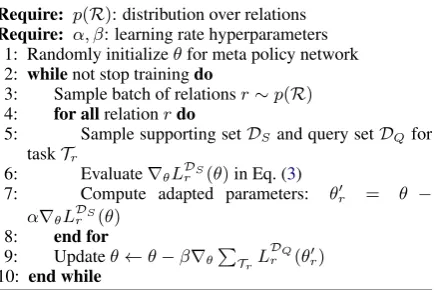
Algorithm 1Meta-Learning for multi-hop
reason-ing over knowledge graphs
Require: p(R): distribution over relations
Require: α, β: learning rate hyperparameters
1: Randomly initializeθfor meta policy network
2: whilenot stop trainingdo
3: Sample batch of relationsr∼p(R)
4: for allrelationrdo
5: Sample supporting setDSand query setDQfor
taskTr
6: Evaluate∇θL
DS
r (θ)in Eq. (3)
7: Compute adapted parameters: θ0r = θ −
α∇θL
DS
r (θ)
8: end for
9: Updateθ←θ−β∇θPTrL
DQ
r (θr0)
10: end while
query relation,esis the source entity andˆetis the current entity overG.
Actions The action space At for a given
state st includes all outgoing edges and next en-tities of eˆt. Formally, At = {(rt+1,eˆt+1)|
(ˆet, rt+1,ˆet+1) ∈ G}. We add a self-loop edge to everyAt, which is similar to a “STOP” action.
Transition For the state st, if the agent
se-lects an action(rt+1,ˆet+1)∈ At, the state will be changed to st+1 = (rq, es,eˆt+1). The transition function is defined as δ(st,At) = (rq, es,ˆet+1). In this paper, we unroll the search overG up to a fixed number of time stepsT, and finally achieve the statesT = (rq, es,ˆeT).
Rewards The rewardR(sT|rq, es)will be1
if the agent finally stops at the right entity, i.e.,
ˆ
eT = eo, otherwise it will get an embedding-based reward f(es, rq,ˆeT), where f is a score function from knowledge graph embedding meth-ods to measure the probability over(es, rq,eˆt).
4.1.2 Policy Network
To solve the above MDP problem, we need a model which has policy to choose actions at each state. Specifically, different from normal RL prob-lems, we apply a policy network considering the search history overG. Formally, after embedding all entities and relations inGase∈Rdandr∈Rd respectively, each actionat = (rt+1,eˆt+1) ∈ At is represented as at = [rt+1;ˆet+1]. We use an LSTM to encode the search path,
ht=LSTM(ht−1,at−1). (1)
Then, we represent the action space by stacking all actions inAtasAt ∈ R|At|×2d. The parame-terized policy network is defined as,
πθ(at|st) =softmax(At(W2ReLU(W1[ˆet;ht;rq]))),
Model FB15K-237 NELL-995
MRR Hits@1 Hits@10 MRR Hits@1 Hits@10
NeuralLP 10.2 7.0 14.8 17.9 4.8 35.1
NTP-λ 21.0 17.4 30.8 15.5 10.2 33.4
MINERVA 30.5 28.4 34.1 20.1 16.2 28.3
MultiHop(DistMult) 38.1 38.1 50.3 20.0 14.5 30.6
MultiHop(ConvE) 42.7 36.7 53.3 23.1 17.8 32.9
Meta-KGR(DistMult) 45.8 40.3 58.0 24.8 19.7 34.5
Meta-KGR(ConvE) 46.9 41.2 58.8 25.3 19.7 34.7
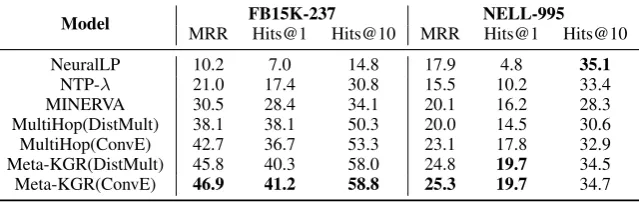
Table 1: Experimental results for link prediction. The MRR, Hits@1 and Hits@10 metrics are multiplied by 100.
whereπθ(at|st)is the probability distribution over all actions inAt.
4.1.3 Loss Function
Given a query relationrand a batch of triples set
Dwith relationr, the overall loss for this relation-specific policy network is defined as:
LDr(θ) =−E(es,r,eo)∈DEa1,...,aT−1∈πθ[R(sT|es, r)].
(3)
4.2 Meta-Learning
In meta-learning, we aim to learn well-initialized parametersθ∗, such that small changes in the pa-rameters will produce significant improvements on the loss function of any task (Finn et al.,2017). Formally, we consider a meta policy network with parametersθ. When adapting to a new task
Tr, the parameters of the model becomeθr0. Fol-lowing MAML, the updated parameterθr0 is com-puted using one or more gradient descent updates on taskTr. For example, assuming a single gradi-ent step is taken with the learning rateα
θ0r=θ−α∇θLDrS(θ), (4)
where DS is a supporting set randomly sampled from the triples belonging toTr. After the relation-specific parametersθ0r is learned, we evaluateθ0r
on the query setDQbelonging toTr, which is sam-pled like DS. The gradient computed from this evaluation can be used to update the meta policy network with parameters θ. Usually, we will go over many tasks in a batch and update θ as fol-lows:
θ=θ−β∇θ X
Tr
LDQ
r (θr0), (5)
where β is the meta-learning rate. We detail the meta-learning algorithm in Algorithm1.
After previous meta-learning steps, Meta-KGR can fast adapt to a relation-specific policy network for every few-shot relation by using θ as well-initialized parametersθ∗.
Dataset #Ent #Rel #Triples
FB15k-237 (normal) 14,448 200 268,039
FB15k-237 (few-shot) 3,078 37 4,076
NELL-995 (normal) 63,524 170 115,454
[image:4.595.140.460.64.165.2]NELL-995 (few-shot) 2,951 30 2,680
Table 2: Statistics of datasets.
5 Experiments
5.1 Datasets
We use two typical datasets FB15K-237
(Toutanova et al., 2015) and NELL-995 (Xiong
et al., 2017) for training and evaluation.
Specif-ically, we set K = 137 and K = 114to select few-shot relations from FB15K-237 and NELL-995 respectively. Besides, we rebuild NELL-NELL-995 to generate few-shot relations in valid and test set. Statistics are given separately for normal relations and few-shot relations in Table2.
5.2 Baselines
We compare with four multi-hop reasoning mod-els in experiments: (1) Neural Logical Program-ming (NerualLP) (Yang et al.,2017); (2) NTP-λ
(Rockt¨aschel and Riedel, 2017); (3) MINERVA
(Das et al., 2018) and (4) MultiHop (Lin et al.,
2018). For MultiHop and our model, we use both DistMult (Yang et al.,2015) and ConvE (Dettmers
et al.,2018) as the reward function to create two
different model variations, which are labeled in parentheses in Table1.
5.3 Link Prediction
Given a query(es, rq,?), link prediction for QA aims to give a ranking list of candidate entities from the KG. Following previous work (Dettmers
et al.,2018;Lin et al.,2018), we use two
Threshold MultiHop Meta-KGR
MRR Hits@1 MRR Hits@1
K= 1 20.8 16.9 22.3 19.3
K= 5 25.7 20.8 29.6 26.6
K= 10 29.1 25.0 31.3 27.2
[image:5.595.82.279.64.134.2]K=max 42.7 36.7 46.9 41.2
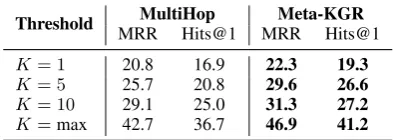
Table 3: Experimental results for robustness analysis.
Evaluation results on two datasets are shown in Table 1. From the table, we can conclude that: (1) Our models outperform previous work in most cases, which means meta parameters learned from high-frequency relations can adapt to few-shot re-lations well. (2) ConvE is better than DistMult when used as the reward function in our mod-els. This indicates that more effective knowl-edge graph embedding methods may provide fine-grained rewards for training multi-hop reasoning models. (3) Compared with NELL-995, FB15K-237 is denser. Our models perform well on both datasets, which demonstrates Meta-KGR can ac-commodate different types of KGs.
5.4 Robustness Analysis
We can use different frequency thresholds K to select few-shot relations. In this section, we will study the impact ofK on the performance of our model. In our experiments, some triples will be removed until every few-shot relation has only
K triples. We do link prediction experiments on FB15K-237 and use ConvE as our reward func-tion. The final results are shown in Table3. K =
max means we use the whole datasets in Table2
and do not remove any triples. From Table3we can see our model is robust toK and outperforms MultiHop in every case.
6 Conclusion
In this paper, we propose a meta-learning based model named Meta-KGR for multi-hop rea-soning over few-shot relations of knowledge graphs. Meta-KGR uses training triples with high-frequency relations to find well-initialized param-eters and fast adapt to few-shot relations. The meta information learned from high-frequency relations is helpful for few-shot relations. In experiments, our models achieve good performance on few-shot relations and outperform previous work in most cases. Some empirical analysis also demonstrates that our models are robust and generalized to dif-ferent types of knowledge graphs.
Acknowledgments
The work is supported by NSFC key projects (U1736204, 61533018, 61661146007), Ministry of Education and China Mobile Joint Fund (MCM20170301), and THUNUS NExT Co-Lab.
References
Antoine Bordes, Nicolas Usunier, Alberto Garcia-Duran, Jason Weston, and Oksana Yakhnenko. 2013. Translating embeddings for modeling multi-relational data. InNIPS.
Wenhu Chen, Wenhan Xiong, Xifeng Yan, and William Yang Wang. 2018. Variational knowledge graph reasoning. InNAACL.
Rajarshi Das, Shehzaad Dhuliawala, Manzil Zaheer, Luke Vilnis, Ishan Durugkar, Akshay Krishna-murthy, Alex Smola, and Andrew McCallum. 2018. Go for a walk and arrive at the answer: Reasoning over paths in knowledge bases using reinforcement learning. InICLR.
Tim Dettmers, Pasquale Minervini, Pontus Stenetorp, and Sebastian Riedel. 2018. Convolutional 2d knowledge graph embeddings. InAAAI.
Ming Ding, Chang Zhou, Qibin Chen, Hongxia Yang, and Jie Tang. 2019. Cognitive graph for multi-hop reading comprehension at scale. InACL.
Chelsea Finn, Pieter Abbeel, and Sergey Levine. 2017. Model-agnostic meta-learning for fast adaptation of deep networks. InICML.
Jiatao Gu, Yong Wang, Yun Chen, Victor OK Li, and Kyunghyun Cho. 2018. Meta-learning for low-resource neural machine translation. InEMNLP.
Xu Han, Hao Zhu, Pengfei Yu, Ziyun Wang, Yuan Yao, Zhiyuan Liu, and Maosong Sun. 2018. Fewrel: A large-scale supervised few-shot relation classifi-cation dataset with state-of-the-art evaluation. In EMNLP.
Brenden M Lake, Ruslan Salakhutdinov, and Joshua B Tenenbaum. 2015. Human-level concept learning through probabilistic program induction. Science, 350(6266):1332–1338.
Xi Victoria Lin, Richard Socher, and Caiming Xiong. 2018. Multi-hop knowledge graph reasoning with reward shaping. InEMNLP.
Tim Rockt¨aschel and Sebastian Riedel. 2017. End-to-end differentiable proving. InNIPS.
Baoxu Shi and Tim Weninger. 2018. Open-world knowledge graph completion. InAAAI.
Kristina Toutanova, Danqi Chen, Patrick Pantel, Hoi-fung Poon, Pallavi Choudhury, and Michael Gamon. 2015. Representing text for joint embedding of text and knowledge bases. InEMNLP.
Yunxuan Xiao, Yanru Qu, Lin Qiu, Hao Zhou, Lei Li, Weinan Zhang, and Yong Yu. 2019. Dynamically fused graph network for multi-hop reasoning. In ACL.
Ruobing Xie, Zhiyuan Liu, Jia Jia, Huanbo Luan, and Maosong Sun. 2016. Representation learning of knowledge graphs with entity descriptions. InAAAI.
Wenhan Xiong, Thien Hoang, and William Yang Wang. 2017. Deeppath: A reinforcement learning method for knowledge graph reasoning. InEMNLP.
Wenhan Xiong, Mo Yu, Shiyu Chang, Xiaoxiao Guo, and William Yang Wang. 2018. One-shot relational learning for knowledge graphs. InEMNLP.
Bishan Yang, Wen-tau Yih, Xiaodong He, Jianfeng Gao, and Li Deng. 2015. Embedding entities and relations for learning and inference in knowledge bases. InICLR.
Fan Yang, Zhilin Yang, and William W Cohen. 2017. Differentiable learning of logical rules for knowl-edge base reasoning. InNIPS.