Learning Subjective Nouns using Extraction Pattern Bootstrapping
∗Ellen Riloff
School of Computing
University of Utah
Salt Lake City, UT 84112
[email protected]
Janyce Wiebe
Department of Computer Science
University of Pittsburgh
Pittsburgh, PA 15260
[email protected]
Theresa Wilson
Intelligent Systems Program
University of Pittsburgh
Pittsburgh, PA 15260
[email protected]
Abstract
We explore the idea of creating a subjectiv-ity classifier that uses lists of subjective nouns learned by bootstrapping algorithms. The goal of our research is to develop a system that can distinguish subjective sentences from ob-jective sentences. First, we use two bootstrap-ping algorithms that exploit extraction patterns to learn sets of subjective nouns. Then we train a Naive Bayes classifier using the subjec-tive nouns, discourse features, and subjectivity clues identified in prior research. The boot-strapping algorithms learned over 1000 subjec-tive nouns, and the subjectivity classifier per-formed well, achieving 77% recall with 81% precision.
1
Introduction
Many natural language processing applications could benefit from being able to distinguish between factual and subjective information. Subjective remarks come in a variety of forms, including opinions, rants, allega-tions, accusaallega-tions, suspicions, and speculation. Ideally, information extraction systems should be able to distin-guish between factual information (which should be ex-tracted) and non-factual information (which should be discarded or labeled as uncertain). Question answering systems should distinguish between factual and specula-tive answers. Multi-perspecspecula-tive question answering aims to present multiple answers to the user based upon specu-lation or opinions derived from different sources.
Multi-∗This work was supported in part by the National Sci-ence Foundation under grants IIS-0208798 and IRI-9704240. The data preparation was performed in support of the North-east Regional Reseach Center (NRRC) which is sponsored by the Advanced Research and Development Activity (ARDA), a U.S. Government entity which sponsors and promotes research of import to the Intelligence Community which includes but is not limited to the CIA, DIA, NSA, NIMA, and NRO.
document summarization systems need to summarize dif-ferent opinions and perspectives. Spam filtering systems must recognize rants and emotional tirades, among other things. In general, nearly any system that seeks to iden-tify information could benefit from being able to separate factual and subjective information.
Subjective language has been previously studied in fields such as linguistics, literary theory, psychology, and content analysis. Some manually-developed knowledge resources exist, but there is no comprehensive dictionary of subjective language.
Meta-Bootstrapping (Riloff and Jones, 1999) and Basilisk (Thelen and Riloff, 2002) are bootstrapping al-gorithms that use automatically generated extraction pat-terns to identify words belonging to a semantic cate-gory. We hypothesized that extraction patterns could also identify subjective words. For example, the pat-tern “expressed<direct object>” often extracts
subjec-tive nouns, such as “concern”, “hope”, and “support”. Furthermore, these bootstrapping algorithms require only a handful of seed words and unannotated texts for train-ing; no annotated data is needed at all.
In this paper, we use the Meta-Bootstrapping and Basilisk algorithms to learn lists of subjective nouns from a large collection of unannotated texts. Then we train a subjectivity classifier on a small set of annotated data, using the subjective nouns as features along with some other previously identified subjectivity features. Our ex-perimental results show that the subjectivity classifier performs well (77% recall with 81% precision) and that the learned nouns improve upon previous state-of-the-art subjectivity results (Wiebe et al., 1999).
2
Subjectivity Data
2.1 The Annotation Scheme
The scheme was inspired by work in linguistics and literary theory on subjectivity, which focuses on how opinions, emotions, etc. are expressed linguistically in context (Banfield, 1982). The scheme is more detailed and comprehensive than previous ones. We mention only those aspects of the annotation scheme relevant to this paper.
The goal of the annotation scheme is to identify and characterize expressions of private states in a sentence.
Private state is a general covering term for opinions,
eval-uations, emotions, and speculations (Quirk et al., 1985). For example, in sentence (1) the writer is expressing a negative evaluation.
(1) “The time has come, gentlemen, for Sharon, the
as-sassin, to realize that injustice cannot last long.”
Sentence (2) reflects the private state of Western coun-tries. Mugabe’s use of “overwhelmingly” also reflects a private state, his positive reaction to and characterization of his victory.
(2) “Western countries were left frustrated and impotent
after Robert Mugabe formally declared that he had over-whelmingly won Zimbabwe’s presidential election.”
Annotators are also asked to judge the strength of each private state. A private state can have low, medium, high or extreme strength.
2.2 Corpus and Agreement Results
Our data consists of English-language versions of foreign news documents from FBIS, the U.S. Foreign Broadcast Information Service. The data is from a variety of publi-cations and countries. The annotated corpus used to train and test our subjectivity classifiers (the experiment
cor-pus) consists of 109 documents with a total of 2197
sen-tences. We used a separate, annotated tuning corpus of 33 documents with a total of 698 sentences to establish some experimental parameters.1
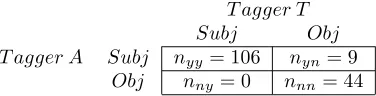
Each document was annotated by one or both of two annotators, A and T. To allow us to measure interanno-tator agreement, the annointeranno-tators independently annotated the same 12 documents with a total of 178 sentences. We began with a strict measure of agreement at the sentence level by first considering whether the annotator marked any private-state expression, of any strength, anywhere in the sentence. If so, the sentence should be subjective. Otherwise, it is objective. Table 1 shows the contingency table. The percentage agreement is 88%, and theκvalue is 0.71.
1
The annotated data will be available to U.S. government contractors this summer. We are working to resolve copyright issues to make it available to the wider research community.
T agger T
Subj Obj
[image:2.612.334.524.71.122.2]T agger A Subj nyy= 112 nyn= 16 Obj nny = 6 nnn= 44
Table 1: Agreement for sentence-level annotations
T agger T
Subj Obj
T agger A Subj nyy= 106 nyn= 9 Obj nny = 0 nnn= 44
Table 2: Agreement for sentence-level annotations, low-strength cases removed
One would expect that there are clear cases of objec-tive sentences, clear cases of subjecobjec-tive sentences, and borderline sentences in between. The agreement study supports this. In terms of our annotations, we define a sentence as borderline if it has at least one private-state expression identified by at least one annotator, and all strength ratings of private-state expressions are low. Table 2 shows the agreement results when such border-line sentences are removed (19 sentences, or 11% of the agreement test corpus). The percentage agreement in-creases to 94% and theκvalue increases to 0.87.
As expected, the majority of disagreement cases in-volve low-strength subjectivity. The annotators consis-tently agree about which are the clear cases of subjective sentences. This leads us to define the gold-standard that we use in our experiments. A sentence is subjective if it contains at least one private-state expression of medium or higher strength. The second class, which we call
ob-jective, consists of everything else. Thus, sentences with
only mild traces of subjectivity are tossed into the objec-tive category, making the system’s goal to find the clearly subjective sentences.
3
Using Extraction Patterns to Learn
Subjective Nouns
In the last few years, two bootstrapping algorithms have been developed to create semantic dictionaries by ex-ploiting extraction patterns: Meta-Bootstrapping (Riloff and Jones, 1999) and Basilisk (Thelen and Riloff, 2002).
Extraction patterns were originally developed for
infor-mation extraction tasks (Cardie, 1997). They represent lexico-syntactic expressions that typically rely on shal-low parsing and syntactic role assignment. For example, the pattern “<subject>was hired” would apply to sen-tences that contain the verb “hired” in the passive voice. The subject would be extracted as the hiree.
[image:2.612.336.524.157.205.2]“truck” is a VEHICLE and “seashore” is a LOCATION). Both algorithms begin with unannotated texts and seed words that represent a semantic category. A bootstrap-ping process looks for words that appear in the same ex-traction patterns as the seeds and hypothesizes that those words belong to the same semantic class. The principle behind this approach is that words of the same semantic class appear in similar pattern contexts. For example, the phrases “lived in” and “traveled to” will co-occur with many noun phrases that representLOCATIONS.
In our research, we want to automatically identify words that are subjective. Subjective terms have many different semantic meanings, but we believe that the same contextual principle applies to subjectivity. In this sec-tion, we briefly overview these bootstrapping algorithms and explain how we used them to generate lists of subjec-tive nouns.
3.1 Meta-Bootstrapping
The Meta-Bootstrapping (“MetaBoot”) process (Riloff and Jones, 1999) begins with a small set of seed words that represent a targeted semantic category (e.g., 10 words that represent LOCATIONS) and an unannotated corpus. First, MetaBoot automatically creates a set of ex-traction patterns for the corpus by applying and instanti-ating syntactic templates. This process literally produces thousands of extraction patterns that, collectively, will ex-tract every noun phrase in the corpus. Next, MetaBoot computes a score for each pattern based upon the num-ber of seed words among its extractions. The best pat-tern is saved and all of its extracted noun phrases are automatically labeled as the targeted semantic category.2 MetaBoot then re-scores the extraction patterns, using the original seed words as well as the newly labeled words, and the process repeats. This procedure is called mutual
bootstrapping.
A second level of bootstrapping (the “meta-” boot-strapping part) makes the algorithm more robust. When the mutual bootstrapping process is finished, all nouns that were put into the semantic dictionary are re-evaluated. Each noun is assigned a score based on how many different patterns extracted it. Only the five best nouns are allowed to remain in the dictionary. The other entries are discarded, and the mutual bootstrapping pro-cess starts over again using the revised semantic dictio-nary.
3.2 Basilisk
Basilisk (Thelen and Riloff, 2002) is a more recent boot-strapping algorithm that also utilizes extraction patterns to create a semantic dictionary. Similarly, Basilisk be-gins with an unannotated text corpus and a small set of
2
Our implementation of Meta-Bootstrapping learns individ-ual nouns (vs. noun phrases) and discards capitalized words.
seed words for a semantic category. The bootstrapping process involves three steps. (1) Basilisk automatically generates a set of extraction patterns for the corpus and scores each pattern based upon the number of seed words among its extractions. This step is identical to the first step of Meta-Bootstrapping. Basilisk then puts the best patterns into a Pattern Pool. (2) All nouns3extracted by a pattern in the Pattern Pool are put into a Candidate Word Pool. Basilisk scores each noun based upon the set of patterns that extracted it and their collective association with the seed words. (3) The top 10 nouns are labeled as the targeted semantic class and are added to the dictio-nary. The bootstrapping process then repeats, using the original seeds and the newly labeled words.
The main difference between Basilisk and Meta-Bootstrapping is that Basilisk scores each noun based on collective information gathered from all patterns that extracted it. In contrast, Meta-Bootstrapping identifies a single best pattern and assumes that everything it ex-tracted belongs to the same semantic class. The second level of bootstrapping smoothes over some of the prob-lems caused by this assumption. In comparative experi-ments (Thelen and Riloff, 2002), Basilisk outperformed Meta-Bootstrapping. But since our goal of learning sub-jective nouns is different from the original intent of the algorithms, we tried them both. We also suspected they might learn different words, in which case using both al-gorithms could be worthwhile.
3.3 Experimental Results
The Meta-Bootstrapping and Basilisk algorithms need seed words and an unannotated text corpus as input. Since we did not need annotated texts, we created a much larger training corpus, the bootstrapping corpus, by gath-ering 950 new texts from the FBIS source mentioned in Section 2.2. To find candidate seed words, we auto-matically identified 850 nouns that were positively corre-lated with subjective sentences in another data set. How-ever, it is crucial that the seed words occur frequently in our FBIS texts or the bootstrapping process will not get off the ground. So we searched for each of the 850 nouns in the bootstrapping corpus, sorted them by fre-quency, and manually selected 20 high-frequency words that we judged to be strongly subjective. Table 3 shows the 20 seed words used for both Meta-Bootstrapping and Basilisk.
We ran each bootstrapping algorithm for 400 itera-tions, generating 5 words per iteration. Basilisk gener-ated 2000 nouns and Meta-Bootstrapping genergener-ated 1996 nouns.4 Table 4 shows some examples of extraction
pat-3Technically, each head noun of an extracted noun phrase. 4
cowardice embarrassment hatred outrage
crap fool hell slander
[image:4.612.336.518.70.115.2]delight gloom hypocrisy sigh disdain grievance love twit dismay happiness nonsense virtue
Table 3: Subjective Seed Words
Extraction Patterns Examples of Extracted Nouns
expressed<dobj> condolences, hope, grief, views, worries, recognition indicative of<np> compromise, desire, thinking inject<dobj> vitality, hatred
reaffirmed<dobj> resolve, position, commitment voiced<dobj> outrage, support, skepticism,
disagreement, opposition, concerns, gratitude, indignation show of<np> support, strength, goodwill,
solidarity, feeling
[image:4.612.77.297.71.133.2]<subject>was shared anxiety, view, niceties, feeling
Table 4: Extraction Pattern Examples
terns that were discovered to be associated with subjec-tive nouns.
Meta-Bootstrapping and Basilisk are semi-automatic lexicon generation tools because, although the bootstrap-ping process is 100% automatic, the resulting lexicons need to be reviewed by a human.5 So we manually re-viewed the 3996 words proposed by the algorithms. This process is very fast; it takes only a few seconds to classify each word. The entire review process took approximately 3-4 hours. One author did this labeling; this person did not look at or run tests on the experiment corpus.
Strong Subjective Weak Subjective
tyranny scum aberration plague smokescreen bully allusion risk apologist devil apprehensions drama barbarian liar beneficiary trick belligerence pariah resistant promise condemnation venom credence intrigue sanctimonious diatribe distortion unity exaggeration mockery eyebrows failures repudiation anguish inclination tolerance insinuation fallacies liability persistent antagonism evil assault trust atrocities genius benefit success denunciation goodwill blood spirit exploitation injustice controversy slump humiliation innuendo likelihood sincerity ill-treatment revenge peaceful eternity sympathy rogue pressure rejection
Table 5: Examples of Learned Subjective Nouns
5
This is because NLP systems expect dictionaries to have high integrity. Even if the algorithms could achieve 90% ac-curacy, a dictionary in which 1 of every 10 words is defined incorrectly would probably not be desirable.
B M B∩M B∪M
StrongSubj 372 192 110 454 WeakSubj 453 330 185 598 Total 825 522 295 1052
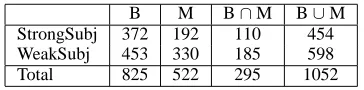
Table 6: Subjective Word Lexicons after Manual Review (B=Basilisk, M=MetaBootstrapping)
0.2 0.3 0.4 0.5 0.6 0.7 0.8 0.9 1
0 200 400 600 800 1000 1200 1400 1600 1800 2000
% of Words Subjective
Number of Words Generated ’Basilisk’
’MetaBoot’
Figure 1: Accuracy during Bootstrapping
We classified the words as StrongSubjective,
WeakSub-jective, or Objective. Objective terms are not subjective at
all (e.g., “chair” or “city”). StrongSubjective terms have strong, unambiguously subjective connotations, such as “bully” or “barbarian”. WeakSubjective was used for
three situations: (1) words that have weak subjective con-notations, such as “aberration” which implies something out of the ordinary but does not evoke a strong sense of judgement, (2) words that have multiple senses or uses, where one is subjective but the other is not. For example, the word “plague” can refer to a disease (objective) or an onslaught of something negative (subjective), (3) words that are objective by themselves but appear in idiomatic expressions that are subjective. For example, the word “eyebrows” was labeled WeakSubjective because the ex-pression “raised eyebrows” probably occurs more often in our corpus than literal references to “eyebrows”. Ta-ble 5 shows examples of learned words that were classi-fied as StrongSubjective or WeakSubjective.
[image:4.612.321.530.164.313.2] [image:4.612.75.295.469.654.2]accu-rate. After 1000 words, accuracy dropped to about 28% for MetaBoot, but Basilisk was still performing reason-ably well at 53%. Although 53% accuracy is not high for a fully automatic process, Basilisk depends on a human to review the words so 53% accuracy means that the hu-man is accepting every other word, on average. Thus, the reviewer’s time was still being spent productively even after 1000 words had been hypothesized.
Table 6 shows the size of the final lexicons created by the bootstrapping algorithms. The first two columns show the number of subjective terms learned by Basilisk and Meta-Bootstrapping. Basilisk was more prolific, gen-erating 825 subjective terms compared to 522 for Meta-Bootstrapping. The third column shows the intersection between their word lists. There was substantial overlap, but both algorithms produced many words that the other did not. The last column shows the results of merging their lists. In total, the bootstrapping algorithms produced 1052 subjective nouns.
4
Creating Subjectivity Classifiers
To evaluate the subjective nouns, we trained a Naive Bayes classifier using the nouns as features. We also in-corporated previously established subjectivity clues, and added some new discourse features. In this section, we describe all the feature sets and present performance re-sults for subjectivity classifiers trained on different com-binations of these features. The threshold values and fea-ture representations used in this section are the ones that produced the best results on our separate tuning corpus.
4.1 Subjective Noun Features
We defined four features to represent the sets of subjec-tive nouns produced by the bootstrapping algorithms.
BA-Strong: the set of StrongSubjective nouns generated by Basilisk
BA-Weak: the set of WeakSubjective nouns generated by Basilisk
MB-Strong: the set of StrongSubjective nouns generated by Meta-Bootstrapping
MB-Weak: the set of WeakSubjective nouns generated by Meta-Bootstrapping
For each set, we created a three-valued feature based on the presence of 0, 1, or≥2 words from that set. We used the nouns as feature sets, rather than define a separate feature for each word, so the classifier could generalize over the set to minimize sparse data problems. We will refer to these as the SubjNoun features.
4.2 Previously Established Features
Wiebe, Bruce, & O’Hara (1999) developed a machine learning system to classify subjective sentences. We ex-perimented with the features that they used, both to com-pare their results to ours and to see if we could benefit from their features. We will refer to these as the WBO features.
WBO includes a set of stems positively correlated with the subjective training examples (subjStems) and a set of stems positively correlated with the objective training examples (objStems). We defined a three-valued feature for the presence of 0, 1, or≥2 members ofsubjStems
in a sentence, and likewise forobjStems. For our exper-iments,subjStemsincludes stems that appear≥7 times in the training set, and for which the precision is 1.25 times the baseline word precision for that training set.
objStemscontains the stems that appear≥7 times and for which at least 50% of their occurrences in the training set are in objective sentences. WBO also includes a bi-nary feature for each of the following: the presence in the sentence of a pronoun, an adjective, a cardinal number, a modal other than will, and an adverb other than not.
We also added manually-developed features found by other researchers. We created 14 feature sets represent-ing some classes from (Levin, 1993; Ballmer and Bren-nenstuhl, 1981), some Framenet lemmas with frame ele-ment experiencer (Baker et al., 1998), adjectives manu-ally annotated for polarity (Hatzivassiloglou and McKe-own, 1997), and some subjectivity clues listed in (Wiebe, 1990). We represented each set as a three-valued feature based on the presence of 0, 1, or≥2 members of the set. We will refer to these as the manual features.
4.3 Discourse Features
We created discourse features to capture the density of clues in the text surrounding a sentence. First, we com-puted the average number of subjective clues and objec-tive clues per sentence, normalized by sentence length. The subjective clues,subjClues, are all sets for which 3-valued features were defined above (exceptobjStems). The objective clues consist only ofobjStems. For sen-tence S, let ClueRatesubj(S) = |
subjClues in S| |S| and ClueRateobj(S) = |
objStems in S|
|S| . Then we define AvgClueRatesubj to be the average of ClueRate(S) over all sentencesSand similarly forAvgClueRateobj. Next, we characterize the number of subjective and objective clues in the previous and next sentences as: higher-than-expected (high), lower-than-expected (low), or expected (medium). The value forClueRatesubj(S) is high ifClueRatesubj(S)≥AvgClueRatesubj∗1.3;
low ifClueRatesubj(S)≤AvgClueRatesubj/1.3;
Using these definitions we created four features:
ClueRatesubj for the previous and following sen-tences, and ClueRateobj for the previous and follow-ing sentences. We also defined a feature for sentence length. LetAvgSentLenbe the average sentence length.
SentLen(S)is high iflength(S)≥AvgSentLen∗1.3;
low iflength(S)≤AvgSentLen/1.3; and medium
oth-erwise.
4.4 Classification Results
We conducted experiments to evaluate the performance of the feature sets, both individually and in various com-binations. Unless otherwise noted, all experiments in-volved training a Naive Bayes classifier using a particu-lar set of features. We evaluated each classifier using 25-fold cross validation on the experiment corpus and used pairedt-tests to measure significance at the 95% confi-dence level. As our evaluation metrics, we computed ac-curacy (Acc) as the percentage of the system’s classifica-tions that match the gold-standard, and precision (Prec) and recall (Rec) with respect to subjective sentences.
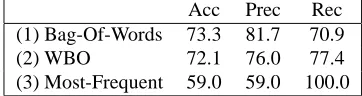
[image:6.612.94.275.341.389.2]Acc Prec Rec (1) Bag-Of-Words 73.3 81.7 70.9 (2) WBO 72.1 76.0 77.4 (3) Most-Frequent 59.0 59.0 100.0
Table 7: Baselines for Comparison
Table 7 shows three baseline experiments. Row (3) represents the common baseline of assigning every sen-tence to the most frequent class. The Most-Frequent baseline achieves 59% accuracy because 59% of the sen-tences in the gold-standard are subjective. Row (2) is a Naive Bayes classifier that uses the WBO features, which performed well in prior research on sentence-level subjectivity classification (Wiebe et al., 1999). Row (1) shows a Naive Bayes classifier that uses unigram bag-of-words features, with one binary feature for the absence or presence in the sentence of each word that appeared during training. Pang et al. (2002) reported that a similar experiment produced their best results on a related clas-sification task. The difference in accuracy between Rows (1) and (2) is not statistically significant (Bag-of-Word’s higher precision is balanced by WBO’s higher recall).
Next, we trained a Naive Bayes classifier using only the SubjNoun features. This classifier achieved good precision (77%) but only moderate recall (64%). Upon further inspection, we discovered that the subjective nouns are good subjectivity indicators when they appear, but not every subjective sentence contains one of them. And, relatively few sentences contain more than one, making it difficult to recognize contextual effects (i.e., multiple clues in a region). We concluded that the
ap-propriate way to benefit from the subjective nouns is to use them in tandem with other subjectivity clues.
Acc Prec Rec
(1) 76.1 81.3 77.4 WBO+SubjNoun+ manual+discourse (2) 74.3 78.6 77.8 WBO+SubjNoun (3) 72.1 76.0 77.4 WBO
Table 8: Results with New Features
Table 8 shows the results of Naive Bayes classifiers trained with different combinations of features. The ac-curacy differences between all pairs of experiments in Table 8 are statistically significant. Row (3) uses only the WBO features (also shown in Table 7 as a baseline). Row (2) uses the WBO features as well as the SubjNoun features. There is a synergy between these feature sets: using both types of features achieves better performance than either one alone. The difference is mainly precision, presumably because the classifier found more and better combinations of features. In Row (1), we also added the manual and discourse features. The discourse features explicitly identify contexts in which multiple clues are found. This classifier produced even better performance, achieving 81.3% precision with 77.4% recall. The 76.1% accuracy result is significantly higher than the accuracy results for all of the other classifiers (in both Table 8 and Table 7).
Finally, higher precision classification can be obtained by simply classifying a sentence as subjective if it con-tains any of the StrongSubjective nouns. On our data, this method produces 87% precision with 26% recall. This approach could support applications for which precision is paramount.
5
Related Work
Several types of research have involved document-level subjectivity classification. Some work identifies inflam-matory texts (e.g., (Spertus, 1997)) or classifies reviews as positive or negative ((Turney, 2002; Pang et al., 2002)). Tong’s system (Tong, 2001) generates sentiment
time-lines, tracking online discussions and creating graphs of
arti-cles that are not editorials or reviews) were subjective. Some previous work has focused explicitly on learn-ing subjective words and phrases. (Hatzivassiloglou and McKeown, 1997) describes a method for identifying the
semantic orientation of words, for example that beauti-ful expresses positive sentiments. Researchers have
fo-cused on learning adjectives or adjectival phrases (Tur-ney, 2002; Hatzivassiloglou and McKeown, 1997; Wiebe, 2000) and verbs (Wiebe et al., 2001), but no previous work has focused on learning nouns. A unique aspect of our work is the use of bootstrapping methods that ex-ploit extraction patterns. (Turney, 2002) used patterns representing part-of-speech sequences, (Hatzivassiloglou and McKeown, 1997) recognized adjectival phrases, and (Wiebe et al., 2001) learned N-grams. The extraction patterns used in our research are linguistically richer pat-terns, requiring shallow parsing and syntactic role assign-ment.
In recent years several techniques have been developed for semantic lexicon creation (e.g., (Hearst, 1992; Riloff and Shepherd, 1997; Roark and Charniak, 1998; Cara-ballo, 1999)). Semantic word learning is different from subjective word learning, but we have shown that Meta-Bootstrapping and Basilisk could be successfully applied to subjectivity learning. Perhaps some of these other methods could also be used to learn subjective words.
6
Conclusions
This research produced interesting insights as well as per-formance results. First, we demonstrated that weakly supervised bootstrapping techniques can learn subjec-tive terms from unannotated texts. Subjecsubjec-tive features learned from unannotated documents can augment or en-hance features learned from annotated training data us-ing more traditional supervised learnus-ing techniques. Sec-ond, Basilisk and Meta-Bootstrapping proved to be use-ful for a different task than they were originally intended. By seeding the algorithms with subjective words, the ex-traction patterns identified expressions that are associated with subjective nouns. This suggests that the bootstrap-ping algorithms should be able to learn not only general semantic categories, but any category for which words appear in similar linguistic phrases. Third, our best sub-jectivity classifier used a wide variety of features. Sub-jectivity is a complex linguistic phenomenon and our evi-dence suggests that reliable subjectivity classification re-quires a broad array of features.
References
C. Baker, C. Fillmore, and J. Lowe. 1998. The berkeley framenet project. In Proceedings of the COLING-ACL.
T. Ballmer and W. Brennenstuhl. 1981. Speech Act
Clas-sification: A Study in the Lexical Analysis of English Speech Activity Verbs. Springer-Verlag.
A. Banfield. 1982. Unspeakable Sentences. Routledge and Kegan Paul, Boston.
S. Caraballo. 1999. Automatic Acquisition of a Hypernym-Labeled Noun Hierarchy from Text. In
Proceedings of the 37th Annual Meeting of the Asso-ciation for Computational Linguistics, pages 120–126.
C. Cardie. 1997. Empirical Methods in Information Ex-traction. AI Magazine, 18(4):65–79.
V. Hatzivassiloglou and K. McKeown. 1997. Predicting the semantic orientation of adjectives. In ACL-EACL
1997.
M. Hearst. 1992. Automatic acquisition of hyponyms from large text corpora. In Proc. of the 14th
Interna-tional Conference on ComputaInterna-tional Linguistics.
J. Karlgren and D. Cutting. 1994. Recognizing text gen-res with simple metrics using discriminant analysis. In
COLING-94.
B. Kessler, G. Nunberg, and H. Schutze. 1997. Auto-matic detection of text genre. In Proc. ACL-EACL-97.
Beth Levin. 1993. English Verb Classes and Alter-nations: A Preliminary Investigation. University of
Chicago Press, Chicago.
B. Pang, L. Lee, and S. Vaithyanathan. 2002. Thumbs up? sentiment classification using machine learning techniques. In Proceedings of the 2002 Conference on
Empirical Methods in Natural Language Processing.
R. Quirk, S. Greenbaum, G. Leech, and J. Svartvik. 1985.
A Comprehensive Grammar of the English Language.
Longman, New York.
E. Riloff and R. Jones. 1999. Learning Dictionaries for Information Extraction by Multi-Level Bootstrapping. In Proceedings of the 16th National Conference on
Ar-tificial Intelligence.
E. Riloff and J. Shepherd. 1997. A Corpus-Based Ap-proach for Building Semantic Lexicons. In
Proceed-ings of the Second Conference on Empirical Methods in Natural Language Processing, pages 117–124.
B. Roark and E. Charniak. 1998. Noun-phrase Co-occurrence Statistics for Semi-automatic Seman-tic Lexicon Construction. In Proceedings of the 36th
Annual Meeting of the Association for Computational Linguistics, pages 1110–1116.
E. Spertus. 1997. Smokey: Automatic recognition of hostile messages. In Proc. IAAI.
M. Thelen and E. Riloff. 2002. A Bootstrapping Method for Learning Semantic Lexicons Using Extraction Pa ttern Contexts. In Proceedings of the 2002 Conference
R. Tong. 2001. An operational system for detecting and tracking opinions in on-line discussion. In SIGIR 2001
Workshop on Operational Text Classification.
P. Turney. 2002. Thumbs Up or Thumbs Down? Seman-tic Orientation Applied to Unsupervised Classification of Reviews. In Proceedings of the 40th Annual
Meet-ing of the Association for Computational LMeet-inguistics.
J. Wiebe, R. Bruce, and T. O’Hara. 1999. Development and use of a gold standard data set for subjectivity clas-sifications. In Proc. 37th Annual Meeting of the Assoc.
for Computational Linguistics (ACL-99).
J. Wiebe, T. Wilson, and M. Bell. 2001. Identifying col-locations for recognizing opinions. In Proc. ACL-01
Workshop on Collocation: Computational Extraction, Analysis, and Exploitation, July.
J. Wiebe. 1990. Recognizing Subjective Sentences: A
Computational Investigation of Narrative Text. Ph.D.
thesis, State University of New York at Buffalo.
J. Wiebe. 2000. Learning subjective adjectives from cor-pora. In 17th National Conference on Artificial