Creating POS Tagging and Dependency Parsing Experts
via Topic Modeling
Atreyee Mukherjee
Indiana University
Sandra K¨ubler
Indiana University
Matthias Scheutz
Tufts University
Abstract
Part of speech (POS) taggers and depen-dency parsers tend to work well on ho-mogeneous datasets but their performance suffers on datasets containing data from different genres. In our current work, we investigate how to create POS tagging and dependency parsing experts for het-erogeneous data by employing topic mod-eling. We create topic models (using Latent Dirichlet Allocation) to determine genres from a heterogeneous dataset and then train an expert for each of the gen-res. Our results show that the topic mod-eling experts reach substantial improve-ments when compared to the general ver-sions. For dependency parsing, the im-provement reaches 2 percent points over the full training baseline when we use two topics.
1 Introduction
POS tagging and dependency parsing perform well when trained and tested on datasets that are predominantly in the same text domain. However, there is decrease in accuracy for heterogeneous datasets, i.e., for datasets that consist of a mix-ture of data from different domains. Our current work focuses on improving POS tagging and de-pendency parsing for such heterogeneous datasets from a variety of different genres by creating ex-perts for automatically detected topics. In our case, the datasets consist of newspaper reports on the one hand and biomedical extracts on the other. For determining the topic of a sentence, we use Latent Dirichlet Allocation (LDA), which finds the latent topic structure in a document. In our case, a document to be clustered consists of a sin-gle sentence. We then assign each sentence to
the most likely topic, for both training and test sentences. We consequently train an expert for each topic and then use this expert to POS tag and parse the test sentences belonging to this topic. We assume that the topics detected by the topic modeler do not only pertain to lexical differences, which can be beneficial for the POS tagger and the parser, but also to syntactic phenomena. Thus, one topic may focus on “incomplete” sentences, such as headlines in a newspaper.
Our work is related to domain adaptation since the aim is to improve (morpho-)syntactic analy-sis for different domains. However, our approach can be regarded as a more general approach to the problem of domains as it is based on automati-cally determining the genres present in the dataset. Thus, no manual work is involved.
Our results show small to considerable im-provements over a competitive baseline of using the full training set. For POS tagging, there is an improvement of 0.3 percent points over the full training set. For dependency parsing, the gain is more pronounced: almost 2% over the full train-ing set.
The remainder of the paper is structured as fol-lows: Section 2 discusses our research questions and section 3 the related work in the area. Sec-tion 4 describes the setup for our experiments, and section 5 shows the experimental results. We draw our conclusions in Section 6.
2 Research Questions
Our aim is to create POS tagging and parsing ex-perts for heterogeneous datasets, with sentences from different genres. For example, the dataset might be a mixture of newspaper articles, blogs, financial reports, research papers and even spe-cialized texts such as biomedical research papers and law texts. We create experts such that each
expert would learn specific information about its own genre. We determine these experts by per-forming topic modeling on sentences and then train an expert on the sentences of the topic. We group sentences based on their most probable topic. To test our hypothesis that topic modeling can serve to group sentences into topics, we create a mixed dataset from the financial domain (using the Penn Treebank (Marcus et al., 1994)) and from the biomedical domain (using the GENIA Corpus (Tateisi and Tsujii, 2004)) such that the new hand-crafted corpus consists of sentences from both do-mains in equal measure. Consequently, there is a clear difference in the genres in our corpus, and we have gold standard topic information.
We perform topic modeling on training and test data simultaneously: We assign a test sentence to the topic with the highest probability. This means that we currently simplify the problem of assign-ing new sentences to topics. In the future, we plan to assign new sentences to topics based their similarity to sentences in the topics created dur-ing traindur-ing, followdur-ing the work by Plank and van Noord (2011).
Our current research focuses on answering the following questions for POS tagging and parsing tasks:
Question 1: Does Topic Modeling Detect Topics?
In this question, we investigate whether an unsu-pervised topic modeler can detect topics in a het-erogeneous corpus. We use our artificially created heterogeneous corpus containing sentences from the Wall Street Journal (WSJ) section of the Penn Treebank (Marcus et al., 1994) and from the GE-NIA Corpus (Tateisi and Tsujii, 2004) and take their original corpus as the gold standard topic. We assume that a good split into the known top-ics, financial news and biomedical abstracts, will also improve POS tagging and parsing accuracy. If we assume two topics, we should be able to see a clear distinction between WSJ and GENIA sen-tences. I.e., for each topic, we should have a clear correspondence of its sentences to either WSJ or GENIA. We thus calculate the percentage of sen-tences in a given topic that belong to GENIA and expect that one topic should have a high percent-age and the other one a low percentpercent-age. We also experiment with a larger number of topics, to see if we can profit from a finer grained topic
defini-tion. However, this advantage will be offset by a smaller training set since we split into more sets.
Question 2: Does POS Tagging Benefit from Using Topics?
In this question, we examine whether the perfor-mance of POS tagging improves if we create ex-perts based on the topics detected by the topic modeler. Thus, we use the topics created for the previous sections and train a POS tagging expert on the training part of each topic. We then use the expert to tag the test sentences from this topic. In this setting, we can see if the experts can ef-fectively handle the data sparseness caused by di-viding the training set into multiple experts. We experiment with one setting in which we use topic modeling as hard clustering, i.e., we assign each sentence to the topic for which the topic modeler gave the highest probability. We also experiment with soft clustering, in which we add each sen-tence to all topics, weighted by its probability dis-tribution.
Question 3: Does Dependency Parsing Benefit from the Topics?
Here, we investigate the effects of using topic modeling experts for dependency parsing. We first use gold POS tags in order to abstract away from POS tagging quality. In a second step, we in-vestigate the interaction between POS tagging and parsing experts. I.e., we are interested in whether dependency parsing can profit from using the POS tags that were determined by the POS tagging ex-perts. This allows us to determine whether inte-grating POS information given by the POS experts can improve dependency parsing or whether there is no interaction between the two levels.
Question 4: What do the Experts Learn?
In this question, we will analyze the results from question 3 in more detail to investigate how the topic modeling experts improve parsing re-sults. We are interested in whether there are spe-cific types of sentences or dependencies that are grouped by the topic models, so that the pars-ing experts focus on a specific subset of syntactic properties.
3 Related Work
parsing experts to that of the previous work done in the area. However, our work is comparable to domain adaptation since we create experts to tag and parse heterogeneous datasets. The work in this is area is largely driven by the unavailability of examples from the target domain. Our work focuses on creating experts using topic modeling which will be able to tag and parse target domain sentences belonging to a specific topic. Compared to POS tagging, there has been significant work on domain adaptation in dependency parsing.
Dredze et al. (2007) found that problems in do-main adaptation are compounded by differences in the annotation schemes between the treebanks. Blitzer et al. (2006) experimented with structural correspondence learning (SCL), which focuses on finding frequently occurring pivot features that oc-cur commonly across domains in the unlabeled data but equally characterize source and target domains. Similar to our work, Blitzer et al. used the WSJ as the source and MEDLINE ab-stracts as the target domain. They established that SCL reaches better results in both POS tagging and parsing than supervised and semi-supervised learning even when there is no training data avail-able in the target domain.
For POS tagging, Clark et al. (2003) applied an agreement-based and a baseline co-training method by using a Markov model tagger and a maximum entropy tagger. In case of the baseline, all the sentences from one tagger are added to train the other whereas in the agreement-based method, both taggers have to reach to the same decision for a sentence to be added to the training. K¨ubler and Baucom (2011) used a similar concept but with three different taggers and showed that selecting sentences as well as sequences of words for which all taggers agree yield the highest gains. Sagae and Tsujii (2007) emulate a single iteration of co-training by using MaxEnt and SVM, selecting the sentences where both models agreed and adding these sentences to the training set. Their approach reached the highest results on the domain adapta-tion task of CoNLL 2007 (Nivre et al., 2007).
In the CoNLL 2007 shared task on domain adaptation for dependency parsing, Attardi et al. (2007) used a tree revision method that corrects the mistakes caused by the base parser for the target domain. Later, Kawahara and Uchimoto (2008) employed a single parser approach using a second order MST parser and combining labeled
data from the known domain with unlabeled data of the new domain by simple concatenation and judging the efficacy of the resulting most reliable parses. Finkel and Manning (2009) devised a new model for named entity recognition as well as de-pendency parsing by using hierarchical Bayesian prior. This is influenced by the notion that differ-ent domains may have differdiffer-ent features specific to each domain. However, instead of applying a constant prior over all the parameters, a hierarchi-cal Bayesian global is used. This enables shar-ing of information across domains but also allows to override this information if there is ample evi-dence.
McClosky et al. (2010) designed the problem as “multiple source parse adaptation”, in which a parser was trained on multiple domains and learned the statistics as well as domain differences which affects the parser accuracy. Their parser outperformed the state-of-the-art baselines. This approach is similar to our work as we create ex-perts based on topics, and each expert learns the specifics of the particular topic with which it is as-sociated.
The closest approach to ours is the one by Plank and van Noord (2011), who employ a similar idea of using topic modeling for creating parsing ex-perts. However, their task is to determine in a do-main adaption setting which sentences of an out-of-domain training set are the most similar to the test set. Thus, they create a specialized training set for every document they need to parse while we create more general experts. In the work by Plank and van Noord (2011), the topic distribution in a document is used as features for their similar-ity metrics.
4 Experimental Setup
4.1 Data Sets
For our experiments, we use the Wall Street Jour-nal (WSJ) section of the Penn Treebank (Marcus et al., 1994) and the GENIA Corpus (Tateisi and Tsujii, 2004). Both corpora use the Penn Tree-bank POS tagset (Santorini, 1990) with minor dif-ferences: The tagset used in GENIA is based on the Penn Treebank tagset, but it uses the tags for proper names and symbols only in very restricted contexts.
from Medline, and it is annotated on different lin-guistic levels, including POS tags, syntax, coref-erence, and events, among others. We use GENIA 1.0 trees (Ohta et al., 2002) created in the Penn Treebank format1. Both treebanks were converted
to dependencies using pennconverter (Johansson and Nugues, 2007).
For our experiments, we need a balanced data set, both for the training and the test set. Since GENIA is rather small and since there is no stan-dard data split for GENIA, we decided to extract the last 850 sentences for the test set. The remain-ing 17 181 sentences are used for trainremain-ing. For WSJ, we chose the same number of sentences for both training and the test set, the training sentences are selected randomly from sections 02-21 and the test sentences from section 22.
4.2 Topic Modeling
Probabilistic topic modeling is a class of algo-rithms which detects the thematic structure in a large volume of documents. Topic modeling is un-supervised, i.e., it does not require annotated doc-uments (Blei, 2012) but rather discovers similarity between documents. Latent Dirichlet Allocation (LDA) is one of the topic modeling algorithms. It is a generative probabilistic model that approxi-mates the underlying hidden topical structure of a collection of texts based on the distribution of words in the documents (Blei et al., 2003).
We use the topic modeling toolkit MAL-LET (McCallum, 2002). The topic modeler in MALLET implements Latent Dirichlet Allocation (LDA), clustering documents into a predefined number of topics. As a result, it provides differ-ent types of information such as:
• Topic keys: The highest ranked words per topic with their probabilities;
• Document topics: The topic distribution for each document (i.e., the probability that a document belongs to a given topic); and
• Topic state, which correlates all words and topics.
For our experiments, we use sentences as docu-ments. Based on the document topic information, we then group the sentences into topics. We col-lect all sentences from the training and test set, cluster them via the MALLET topic modeler, and
1http://nlp.stanford.edu/ mcclosky/biomedical.html
determine for which expert(s) the sentence is rel-evant. There are several ways of determining the best expert, see below. Then, we separate the tences for each expert into training and test sen-tences, based on the previously determined data splits (see above).
We can determine experts based on hard or soft clustering decisions: For hard clustering, the sen-tences are assigned to hard topics, based on the topic that has the highest probability in that sen-tence. I.e., if for sentencesx, MALLET lists the
topict1 as the topic with the highest probability,
then sx is added to the data set of topic t1. In
other words, the data set of topict1 consists of all
sentences for which MALLET showed topict1 as
the most likely topic. This means that the data set sizes vary between topics.
For soft clustering experiments, we utilize the entire topic distribution of a sentence by weight-ing sentences in the trainweight-ing data based on their topic distribution. We simulate weighting training sentences by adding multiple copies to the train-ing files of the experts. Thus, for 2-topic experi-ments, a sentence with 80% probability for topic 1 will be included 8 times in the expert for topic 1 and 2 times in the expert for topic 2, rounding up small percentages so that every sentence will be added to every expert at least once. Thus, we use a more fine grained topic model while mitigating data sparseness, but we risk adding non-typical / irrelevant sentences to experts.
4.3 POS Tagging
For part of speech tagging, we use the TnT (Tri-grams’n’Tags) tagger (Brants, 2000). TnT is based on a second order Markov Model and has an elab-orate model for guessing the POS tags for un-known words. We use TnT mainly because of its speed and because it allows the manual inspection of the trained models (emission and transition fre-quencies).
4.4 Dependency Parsing
For the parsing experiments, we used the depen-dency parser of the MATE Tools2, a Java
imple-mentation of a graph-based parser (Bohnet, 2010).
4.5 Evaluation
We used the script tnt-diff that is part of TnT to evaluate the POS tagging results and the
2 topics 10 topics T. % in train %in test % in train % in test
1 0.71 0.71 0.48 0.52 2 97.99 98.6 98.58 98.35
3 1.16 0.73
4 94.87 97.14
5 0.17 0
6 0.28 0.29
7 99.47 99.12
8 98.93 100
9 98.92 99.33
10 94.85 95.35
Table 1: Distribution of sentences from the WSJ+GENIA data set given 2 and 10 topics (showing the percentage of GENIA sentences per topic).
CoNLL shared task evaluation script3for
evaluat-ing the parsevaluat-ing results.
4.6 Baselines
We use two baselines: For the first baseline, we take the complete training set when no topic mod-eling is performed. Note that this is a very com-petitive baseline since the topic modeling experts have access to considerably smaller amounts of training data. In order to avoid differences in accu-racy resulting from different training set sizes, we create a second baseline by splitting the sentences randomly into the same number of groups as the number of topics, while maintaining the equal dis-tribution of WSJ and GENIA sentences. I.e., we assume the same number of random “topics”, all of the same size. Thus, in the 2-topic setting with the genres, we create two separate training sets, each containing half of the WSJ training set and half of the GENIA one. In this setting, we test all experts on the whole test set and average over the results.
5 Experimental Results
5.1 Does Topic Modeling Detect Topics?
Here we investigate whether LDA can separate the sentences into meaningful topics. Table 1 shows the distribution of sentences in the training and test set into different topics when we assume 2 or 10 topics. These results indicate that the topic mod-eler separates topics very efficiently. For the
2-3http://ilk.uvt.nl/conll/software/eval.pl
[image:5.595.322.508.62.144.2]Accuracy Setting 2 topics 10 topics Full training set 96.69 Random split 96.41 95.48 Topic model 96.95 96.38 Soft Clustering 96.8 96.88
Table 2: Results of the POS tagging experiments.
topic experiments, a clear split is evident as the majority of the GENIA sentences are clustered in topic 2; the misclassified sentences constitute less than 1%. For the 10-topic experiments, we notice that topics 2, 4, 7, 8, 9, and 10 contain mainly GE-NIA sentences while the remaining topics cover mainly WSJ sentences. In both settings, the error rate is between 0.2% and 5%, i.e., we obtain a dis-tinct split between GENIA and WSJ, which should give us a good starting point for the following ex-periments.
5.2 POS Tagging Experts
In this section, we investigate whether the POS tagger can benefit from using topic modeling, i.e., whether POS tagging results can be improved by training experts for genres provided by topic mod-eling. We compare the topic modeling approach to our two baselines for the 2-topic and 10-topic setting. We also perform a soft clustering exper-iment, in which each sentence is added to every topic, weighted by its probability (see section 4.2). The results in Table 2 show that if we assume a 2-topic setting, the experts perform better than both baselines, i.e., the model trained on the full training set and the model with randomly chosen “topics”. The 2-topic expert model reaches an ac-curacy of 96.95%, which is slightly higher than the full training set accuracy of 96.69%. We know that the 2-topic setting provides a clear separation between WSJ and GENIA (Table 1). Thus, this setting outperforms the full training set using a smaller amount of training data. There is also an increase of 0.54 percent points over the accuracy of the 2 random split setting.
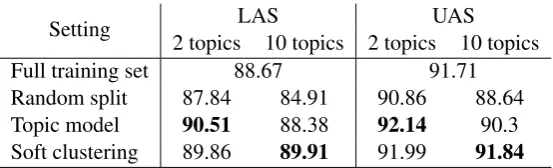
[image:5.595.72.306.62.229.2]Setting 2 topics 10 topics 2 topics 10 topicsLAS UAS Full training set 88.67 91.71 Random split 87.84 84.91 90.86 88.64 Topic model 90.51 88.38 92.14 90.3 Soft clustering 89.86 89.91 91.99 91.84
Table 3: Results of the dependency parsing experiments using gold POS tags.
set. This can be attributed to the reduced size of the training set for the experts.
Since training set size is a detrimental factor for the larger number of topics, we also conducted an experiment where we used soft clustering so that every sentence is represented in every topic, but to a different degree. The last row in table 2 reports the results of this experiment. We notice that the 2-topic experts cannot benefit from the soft clus-tering. Since the separation between WSJ and GE-NIA is very clearly defined for the 2-topic exper-iments, the advantage of having a larger training set is outweighed by too many irrelevant exam-ples from the other topic. However, the 10-topic model profits from the soft clustering, which in-dicates that soft clustering can alleviate the data sparseness problem of the POS tagging experts for larger numbers of topics. A more detailed analy-sis of the POS tagging results (on a slightly dif-ferent data split), see (Mukherjee et al., 2016). This work includes an experiment showing that the POS tagging experts also increase performance for the WSJ corpus only, showing that POS tagging experts also perform better on more homogeneous collections, i.e., they adjust to less obvious differ-ences between sentdiffer-ences.
5.3 Dependency Parsing Experts 5.3.1 Using Gold POS Tags
We now look into the parsing experiments using gold standard POS tags. The choice of gold POS tags allows us to focus on the contribution of the topic modeling experts on parsing results.
The results of the experiments are shown in Ta-ble 3, for 2-topic and 10-topic settings and in com-parison to the two baselines, for the hard and soft clustering experiments. The hard clustering re-sults indicate that the 2-topic expert model reaches an improvement over the baseline using the full training set for both the labeled attachment score (LAS) and the unlabeled attachment score (UAS). We find an increase of around 2% over the baseline
for LAS, and an increase of 0.43% for UAS. How-ever, for the 10-topic setting, both the LAS and the UAS are slightly lower than the baseline. For LAS, the difference is 0.29 percent points while for UAS, the difference is 1.41 percent points. This shows that the gain in LAS and UAS is off-set by the reduced training off-set, parallel to the re-sults for POS tagging. Both the 2-topic and the 10-topic experts outperform the random split baseline (which uses similar training set sizes), with a gain of more than 3 percent points.
The soft clustering results show the same trends as in the POS tagging experiments: For the 2-topic setting, soft clustering outperforms the full base-line by 1.19 percent points. But it does not exceed the hard clustering results. In the 10-topic set-ting, soft clustering outperforms the full baseline as well as the hard clustering setting. This is be-cause sentences with a 50% probability of belong-ing to topic 1 and a 40% probability for topic 3 need to be considered to belong to both topics. This result also shows that this method effectively handles the training data sparsity in the 10-topic setting.
5.3.2 Using the POS Tagger
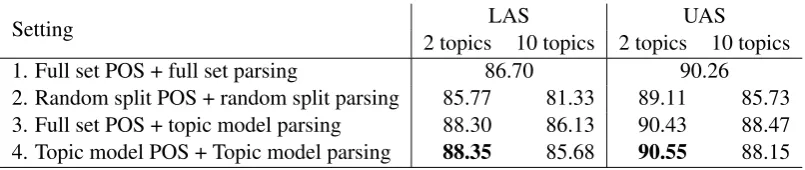
In section 5.3, we use the gold standard POS tags in the POS tags. In this section, we explore the results of using POS tags from the POS tagger TnT as the input for the parser. This gives rise to four major scenarios:
1. The full training set is used for POS tagging and for parsing (full baseline).
2. Random splits are used for parsing and POS tagging. I.e., the POS tagger and parser are trained on random splits (random baseline).
3. Topic models are used for training the parser, but TnT is trained on the whole training set.
Setting 2 topics 10 topics 2 topics 10 topicsLAS UAS 1. Full set POS + full set parsing 86.70 90.26 2. Random split POS + random split parsing 85.77 81.33 89.11 85.73 3. Full set POS + topic model parsing 88.30 86.13 90.43 88.47 4. Topic model POS + Topic model parsing 88.35 85.68 90.55 88.15
Table 4: Results of the dependency parsing experiments using TnT POS tags.
Sentence FulltextLAS 2-topicLAS Phyllis Kyle, Stephenson Newport News , Va . 0 25.00 But volume rose only to 162 million shares from 143 million Friday . 46.15 61.54 Fidelity , for example , prepared ads several months ago in case of a
market plunge . 47.06 82.35
CALL IT un-advertising . 50.00 75.00
( See related story : ” And Bills to Make Wishes Come True ” – WSJ
Oct. 17 , 1989 . 52.38 61.90
Table 5: Comparison of LAS for the sentences with the lowest LAS in the fulltext setting.
We use the random split case as the lower base-line for these experiments and the full training set as the more competitive baseline. Table 4 shows the results.
Table 4 shows that in the 2-topic setting, us-ing topic modelus-ing experts on the POS level as well as on the parsing level reaches the highest re-sults with an improvement of around 2% in LAS in comparison to the full baseline parser, from 86.70% to 88.35%. The gain in UAS is consid-erably smaller: The topic modeling expert reaches 90.55% as opposed to 90.26% for the full baseline. In contrast, the topic modeling setting for the 10-topic setting outperforms the random baseline but does not reach the full baseline, thus mirroring the trends we have seen before.
When we compare the experiments where we use the full POS tagging baseline along with topic model parsing experts (row 3 in table 4) to the full topic model (row 4), we see that the latter model reaches only very minimal gains by using the topic modeling POS tagger when we use 2 topics, and we have a negative trend when we use 10 topics. I.e. the overall quality of the POS tagger is more important than its specialization. Thus, even if the topic model POS tagger outperforms its full base-line, the learned adaptations only have a minimal effect on parsing accuracy.
5.4 Analysis of Results
We now have a closer look at the results pre-sented for the parsing experiments using gold POS tags in section 5.3.1. The results show that the 2-topic parsing experts outperform the general parser trained on the full training set by almost 2 percent points. We looked at the 5 sentences that had the lowest LAS when we used the gen-eral parser. These sentences are shown in table 5, along with their LAS for both settings. The table clearly shows that the topic expert parsers reach a much higher LAS across all these sentences, and the highest increase reaches 35 percent points. We also see that there are two headlines among these sentences. They are different in their syntactic patterns from other sentences and thus difficult to parse. For this reason, we decided to have a closer at all “incomplete” sentences, i.e., sentences that do not have verbs, as an approximation of head-lines. We found that of the 1 310 sentences in the training set, 437 were grouped into topic 1, the other 873 sentences in topic 2. In the test set, we had 65 such sentences, 15 in topic 1 and 50 in topic 2. For the sentences in topic 1, we calculate an LAS of 76.54, for the ones in topic 2 an LAS of 89.91. These results show that the parser expert for topic 2 has adapted substantially better to the syntax of such untypical sentences than the parser expert for topic 1.
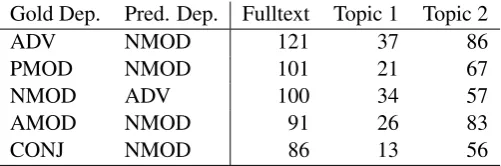
Gold Dep. Pred. Dep. Fulltext Topic 1 Topic 2
ADV NMOD 121 37 86
PMOD NMOD 101 21 67
NMOD ADV 100 34 57
AMOD NMOD 91 26 83
[image:8.595.174.425.62.145.2]CONJ NMOD 86 13 56
Table 6: The 5 most frequent dependency label confusions of the full baseline parser.
full baseline parser. The 5 most frequent combina-tions are shown in table 6, with their frequencies in the test sentences of the two topics. These num-bers show that the topic 1 expert is much better adapted to these confusion sets, resulting in lower error rates than the topic 2. This shows very dra-matically that the two topics learn different pat-terns.
6 Conclusion and Future Work
In these experiments, we have shown that we can improve parsing results on heterogeneous domains by using unsupervised topic modeling to separate the data into different topics. We can then train POS tagging and parsing experts on the individ-ual topics, which show an increased accuracy in comparison to their counterparts trained on the whole, heterogenous training set. We can mitigate the data sparsity resulting from having to split the training set into different topics by assigning every sentence to every topic but weighting their impor-tance to a topic by the probabilities of the topic modeler. We also showed that while the POS tag-ger and the dependency parser individually profit from the split into topic experts, the combination of topic expert POS tagger and parser does not improve over using a POS tagger trained on the whole data set. We will have to investigate the reasons for this behavior in future work.
We will also investigate methods of how to as-sign test sentences to topics without having to re-run the topic modeler on the whole data set.
References
Giuseppe Attardi, Felice Dell’Orletta, Maria Simi, Atanas Chanev, and Massimiliano Ciaramita. 2007. Multilingual dependency parsing and domain adap-tation using DeSR. In Proceedings of the CoNLL Shared Task Session of EMNLP-CoNLL 2007, pages 1112–1118.
David M. Blei, Andrew Y. Ng, and Michael I. Jordan.
2003. Latent dirichlet allocation. Journal of Ma-chine Learning Research, 3:993–1022.
David M. Blei. 2012. Probabilistic topic models. Communications of the ACM, 55(4):77–84.
John Blitzer, Ryan McDonald, and Fernando Pereira. 2006. Domain adaptation with structural correspon-dence learning. InProceedings of the Conference on Empirical Methods in Natural Language Processing (EMNLP), pages 120–128, Sydney, Australia. Bernd Bohnet. 2010. Top accuracy and fast
depen-dency parsing is not a contradiction. InProceedings of the 23rd International Conference on Computa-tional Linguistics (COLING), pages 89–97, Beijing, China.
Thorsten Brants. 2000. TnT–a statistical part-of-speech tagger. In Proceedings of the 1st Confer-ence of the North American Chapter of the Asso-ciation for Computational Linguistics and the 6th Conference on Applied Natural Language Process-ing (ANLP/NAACL), pages 224–231, Seattle, WA. Stephen Clark, James Curran, and Miles Osborne.
2003. Bootstrapping POS-taggers using unlabelled data. InProceedings of the Seventh Conference on Natural Language Learning (CoNLL), Edmonton, Canada.
Mark Dredze, John Blitzer, Partha Pratim Taluk-dar, Kuzman Ganchev, Jo˜ao Graca, and Fernando Pereira. 2007. Frustratingly hard domain adap-tation for dependency parsing. In Proceedings of the CoNLL Shared Task Session of EMNLP-CoNLL 2007, pages 1051–1055, Prague, Czech Republic. Jenny Rose Finkel and Christopher D. Manning. 2009.
Hierarchical Bayesian domain adaptation. In Pro-ceedings of Human Language Technologies: The 2009 Annual Conference of the North American Chapter of the Association for Computational Lin-guistics (HLT-NAACL), pages 602–610.
Richard Johansson and Pierre Nugues. 2007. Ex-tended constituent-to-dependency conversion for English. InProceedings of NODALIDA 2007, pages 105–112, Tartu, Estonia.
Sandra K¨ubler and Eric Baucom. 2011. Fast domain adaptation for part of speech tagging for dialogues. In Proceedings of the International Conference on Recent Advances in NLP (RANLP), Hissar, Bulgaria. Mitchell Marcus, Grace Kim, Mary Ann Marcinkiewicz, Robert MacIntyre, Ann Bies, Mark Ferguson, Karen Katz, and Britta Schas-berger. 1994. The Penn Treebank: Annotating predicate argument structure. In Proceedings of the ARPA Human Language Technology Workshop, HLT 94, pages 114–119, Plainsboro, NJ.
Andrew Kachites McCallum. 2002. Mal-let: A machine learning for language toolkit. http://mallet.cs.umass.edu.
David McClosky, Eugene Charniak, and Mark John-son. 2010. Automatic domain adaptation for pars-ing. InHuman Language Technologies: The 2010 Annual Conference of the North American Chap-ter of the Association for Computational Linguistics, pages 28–36. Association for Computational Lin-guistics.
Atreyee Mukherjee, Sandra K¨ubler, and Matthias Scheutz. 2016. POS tagging experts via topic mod-eling. InProceedings of the 13th International Con-ference on Natural Language Processing (ICON), Varanasi, India.
Joakim Nivre, Johan Hall, Sandra K¨ubler, Ryan Mc-Donald, Jens Nilsson, Sebastian Riedel, and Deniz Yuret. 2007. The CoNLL 2007 shared task on de-pendency parsing. In Proceedings of the CoNLL 2007 Shared Task. Joint Conference on Empirical Methods in Natural Language Processing and Com-putational Natural Language Learning (EMNLP-CoNLL, pages 915–932, Prague, Czech Republic. Tomoko Ohta, Yuka Tateisi, and Jin-Dong Kim. 2002.
The GENIA corpus: An annotated research abstract corpus in molecular biology domain. In Proceed-ings of the Second International Conference on Hu-man Language Technology Research, pages 82–86, San Francisco, CA.
Barbara Plank and Gertjan van Noord. 2011. Effective measures of domain similarity for parsing. In Pro-ceedings of the 49th Annual Meeting of the Associ-ation for ComputAssoci-ational Linguistics: Human Lan-guage Technologies, pages 1566–1576, Portland, OR.
Kenji Sagae and Jun’ichi Tsujii. 2007. Dependency parsing and domain adaptation with LR models and parser ensembles. In Proceedings of the CoNLL Shared Task Session of EMNLP-CoNLL 2007, vol-ume 2007, pages 1044–1050, Prague, Czech Repub-lic.
Beatrice Santorini. 1990. Part-of-speech tagging guidelines for the Penn Treebank Project. Depart-ment of Computer and Information Science, Univer-sity of Pennsylvania, 3rd Revision, 2nd Printing.