Proceedings of the 2019 Conference on Empirical Methods in Natural Language Processing 6376
Embedding Lexical Features via Tensor Decomposition
for Small Sample Humor Recognition
Zhenjie Zhao1∗ Andrew Cattle1∗ Evangelos E. Papalexakis2† Xiaojuan Ma1 1Department of Computer Science & Engineering, HKUST
2 Department of Computer Science & Engineering, University of California, Riverside
{zzhaoao, acattle}@connect.ust.hk,[email protected],[email protected]
Abstract
We propose a novel tensor embedding method that can effectively extract lexical features for humor recognition. Specifically, we use word-word co-occurrence to encode the contextual content of documents, and then decompose the tensor to get corresponding vector repre-sentations. We show that this simple method can capture features of lexical humor effec-tively for continuous humor recognition. In particular, we achieve a distance of 0.887 on a global humor ranking task, comparable to the top performing systems from SemEval 2017 Task 6B (Potash et al.,2017) but without the need for any external training corpus. In ad-dition, we further show that this approach is also beneficial for small sample humor recog-nition tasks through a semi-supervised label propagation procedure, which achieves about 0.7 accuracy on the 16000 One-Liners ( Mi-halcea and Strapparava,2005) andPun of the Day(Yang et al.,2015) humour classification datasets using only 10% of known labels.
1 Introduction
Recognizing humor automatically is an impor-tant step for natural human-computer interaction (Shahaf et al., 2015). While early works tend to frame humor recognition as a binary classifica-tion task (Mihalcea and Strapparava, 2005;Yang et al.,2015), the last few years have seen the emer-gence of humor recognition as a pairwise relative ranking task (Cattle and Ma,2016;Shahaf et al.,
2015). In addition to pairwise ranking, SemEval 2017 Task 6 also includes a global ranking sub-task. However, the majority of submissions build
∗
Zhenjie Zhao and Andrew Cattle contributed equally to this work.
†E. Papalexakis was supported by a UCR-China collab-oration grant by the Bourns College of Engineering at UCR, and by the National Science Foundation CDSE Grant no. OAC-1808591
global rankings using a series of pairwise compar-isons (Potash et al.,2017). OnlyYan and Pedersen
(2017) attempt to predict global rankings directly, ranking documents inversely to their probability according to an n-gram language model.
State-of-the-art humor recognition algorithms usually require a considerable amount of training data with labels to learn effective features (Yang et al., 2015). However, such data are difficult to obtain – especially fine-grained humor anno-tations. First, the humor judgments differ from individual to individual. Thus, collecting percep-tually consistent human labels is expensive and time-consuming. Second, fine-grained degrees of humor add a further challenge. Therefore, meth-ods on small sample learning or even unsupervised rule-based methods merit investigation.
In this paper, considering the importance of lexical information for humor recognition (Radev et al., 2015), we propose a tensor decomposition method to capture the contextual nuances of a cor-pus. This allows us to model the lexical similar-ity of sentences regardless of the size of the cor-pus. In this way, we can rank the degree of hu-mor effectively via lexical centrality (Radev et al.,
The contributions of this paper are: 1) we pro-pose a tensor embedding method to model the lexical features of documents, which can cap-ture lexical similarity effectively regardless of the size of the corpus, 2) we show that the lex-ical features can be used effectively for fine-grained humor ranking and small sample humor recognition. Our implementation is open-sourced, and can be found at https://github.com/ zhaozj89/TensorEmbeddingNLP.
2 Related Work
2.1 Humor Feature Extraction
Modeling and learning humor features are crit-ical for automatic humor recognition. Previous works tend to use a combination of phonolog-ical, stylistic, semantic, and content-based tures. Phonological features include acoustic fea-tures extracted from sitcom audio tracks ( Bert-ero and Fung, 2016) and “phonetic embeddings” generated using a character-to-phoneme LSTM encoder-decoder (Donahue et al., 2017). Stylis-tic features include alliteration, rhyming, negative sentiment, and adult slang (Mihalcea and Strappa-rava,2005) as well as emotional scenarios (Reyes et al., 2012). Semantic features range from at-tempts to measure incongruity (Cattle and Ma,
2018;Shahaf et al.,2015;Yang et al.,2015) to the use of word embeddings as inputs to neural models (Bertero and Fung,2016; Donahue et al., 2017). Content-based approaches include word frequency (Mihalcea and Strapparava,2005), n-gram proba-bility (Yan and Pedersen, 2017), and lexical cen-trality (Radev et al.,2015).
Centrality is based on the observation that hu-morous responses to common stimuli tend to cluster around a small number of core jokes (Radev et al., 2015; Shahaf et al., 2015), with more central documents benefiting from “wis-dom of the crowd”. While most humor fea-tures involve making population-level inferences based on document-level features, centrality is instead population-level feature directly. Radev et al.(2015) calculate their centrality feature us-ing LexRank, a graph-based text summarization method (Erkan and Radev,2004). Compared with more traditional lexical similarity measures like tf-idf, this method is better suited to short humor texts due to their short lengths leading to sparse vector representations (Erkan and Radev,2004).
2.2 Small Sample Humor Recognition
Once the humor features have been extracted, the next step is training a machine learning model to make predictions. Although learning-based meth-ods have shown significant performance improve-ment recently (Yang et al.,2015), one of their main bottlenecks is the lack of appropriate training cor-pora. While previous works have employed data crawled from websites (Mihalcea and Strapparava,
2005;Yang et al.,2015), Twitter (Cattle and Ma,
2016;Reyes et al.,2012), sitcom subtitles (Bertero and Fung,2016;Purandare and Litman,2006), or the New Yorker Cartoon Caption Contest (Radev et al.,2015;Shahaf et al.,2015), these datasets are generally not released publicly. Owing to the diffi-culty in obtaining fine-grained labeled humor data, it is critical to study how to recognize humor by a small training sample or even without labeled data.
3 Method
3.1 Tensor Embedding
Contextual patterns of words can be used to measure lexical similarity for humor recogni-tion. State-of-the-art learning-based approaches like doc2vec (Le and Mikolov,2014) or sent2vec (Pagliardini et al., 2018) usually require a large amount of data. This is difficult to obtain for hu-mor recognition. We propose to use a novel ten-sor decomposition method to obtain lexical fea-tures of short humor texts. To capture lexical similarity for humor recognition, we propose to represent the tensor through a novel word-word co-occurrence method, which has only been ex-plored in the context of fake news detection ( Hos-seinimotlagh and Papalexakis, 2018). Consider-ing a corpus D = {s1, s2, . . . , sD} with D
sen-tences, we first build a vocabulary for it, namely,
w1, w2, . . . , wV, whereV is the number of words. For each sentence s in D, we count the
word-word co-occurrence in a small window H, and build a frequency matrix Ws ∈ ZV×V, whereZ
denotes the set of integers. In particular,Ws(i, j)
indicates the frequency that wordwi andwj co-occur inswithin the windowH. In this way, we can capture the lexical patterns of sin Ws. We then stack all Ws as a three-dimensional tensor
W ∈ ZV×V×D. The objective of tensor
Prompt
Average Christmas Shakespeare Bad Job Break Up Broadway Cereal
Our system 0.909 1.000 0.909 0.909 0.727 0.909 0.887 (±0.113)
Duluth 0.818 0.909 1.000 0.636 1.000 0.909 0.872 (±0.137)
TakeLab 0.909 0.909 1.000 0.818 1.000 0.818 0.908 (±0.081)
QUB 0.818 0.909 0.818 1.000 1.000 0.909 0.924 (±0.081)
[image:3.595.89.509.60.135.2]SVNIT 0.818 1.000 0.909 1.000 1.000 0.818 0.938 (±0.089)
Table 1: The results of our lexical centrality system using tensor embeddings along with the top four SemEval 2017 Task 6B systems reproduced fromPotash et al.(2017). Prompt names refer to specific prompts from the SemEval 2017 Task 6 evaluation set.
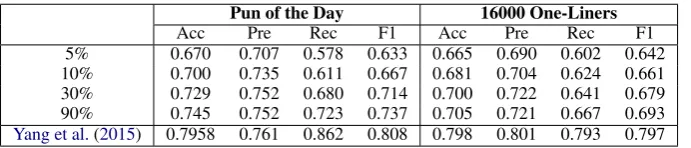
Pun of the Day 16000 One-Liners Acc Pre Rec F1 Acc Pre Rec F1 5% 0.670 0.707 0.578 0.633 0.665 0.690 0.602 0.642 10% 0.700 0.735 0.611 0.667 0.681 0.704 0.624 0.661 30% 0.729 0.752 0.680 0.714 0.700 0.722 0.641 0.679 90% 0.745 0.752 0.723 0.737 0.705 0.721 0.667 0.693
Yang et al.(2015) 0.7958 0.761 0.862 0.808 0.798 0.801 0.793 0.797
Table 2: The results of our label propagation system. XX% refers to XX% of the data used as training and (100-XX)% as test. Baseline results reproduced fromYang et al.(2015)
that:
ˆ
W =
R
∑
r=1
vr⊗vr⊗dr, (1)
where vr ∈ RV, dr ∈ RD, R is the
pre-defined rank parameter, and⊗is the outer product,
namely, vr⊗vr⊗dr being a three-dimensional
tensor, and
vr⊗vr⊗dr(i, j, k) =vr(i) ⋅vr(j) ⋅dr(k). (2)
With the tensor decomposition, we can find low-rank embeddings of sentences that capture the similarity of contextual patterns ( Hosseinimot-lagh and Papalexakis, 2018). In particular, C = [d1,d2, . . . ,dR] ∈ RD×R, where thes-row ofC
is the embedding vector of sentence s. The Eu-clidean distance of embeddings is used to measure the similarity of two sentences.
3.2 Lexical Centrality
We use lexical centrality to rank the degree of humor (Radev et al., 2015). While Radev et al.
(2015) utilize a graph-based definition of cen-trality, we instead take a vector-space approach. Given the decomposed C = [cT1,cT2, . . . ,cTD]T,
we compute a centroid as the averagemof all sen-tence vectors of a corpus:
m=
1
D
D
∑
k=1
ck. (3)
The Euclidean distance to the center is then taken as an indicator of the degree of humor. In other words, given two sentences s1 and s2 and their embeddings x1 and x2, d(m,x1) < d(m,x2)impliess1is funnier thans2.
3.3 Label Propagation
With the lexical similarity captured by tensor em-beddings, we can build a similarity graph, and use a label propagation algorithm (Zhou et al.,2003) for semi-supervised humor recognition. In this way, we can use only a small portion of labeled data to predict the remaining unlabeled data ef-fectively (Zhou et al., 2003). In particular, with the tensor embeddings, we first find theKnearest neighbors of each data point, and build a similar-ity graphG. We then form an affinity matrixW,
whereWij =1ifiandjare connected, otherwise, Wij =0. Afterwards, we iterate:
F(t+1) =αW F(t) + (1−α)Y, (4)
and can get the resultsF∗
as the limit of this se-quence. Equation (4) means we propagate the labels of each data point to its neighbors in a weighted average way, where α is the ratio of propagating labels each iteration. For each point
xi, its label isyi=arg maxj≤cFij∗.
4 Experiment
[image:3.595.129.475.190.264.2]method of CANDECOMP/PARAFAC tensor de-composition (Sidiropoulos et al.,2017) is used to calculate the low-rank sentence embeddings as im-plemented in the Matlab tensor toolbox1.
4.1 Global Humor Ranking
To show the effectiveness of the lexical central-ity of our tensor embedding method, we conduct an experiment on SemEval 2017 Task 6B (Potash et al., 2017) consisting of tweeted responses to specific thematic prompts generated as part of a TV show. For each prompt, the writing staff of the show pick a top 10 and an overall winner. These humor judgments are used as gold standard labels. Tensor embeddings and centroids are computed on a per-prompt basis and responses are ranked ac-cording to their distance from the centroid. We run a grid search procedure to determine the opti-mal rank value as100, the window size as5. For evaluation, we adopt the same edit distance-based metric used inPotash et al.(2017).
The results of our lexical centrality system us-ing tensor embeddus-ings is shown in Table1, where the official results of other state-of-the-art systems are taken fromPotash et al. (2017). Our system outperforms all but the Duluth (Yan and Peder-sen, 2017) system in the official results for Se-mEval 2017 Task 6B (Potash et al.,2017), making our performance equivalent to second place. It is notable that our system can perform well on the
Broadway prompt, where other methods usually fail. Moreover, because our system does not have a learning procedure, the performance is more sta-ble than others.
4.2 Binary Humor Classification
To show the effectiveness of label propagation of our tensor embedding method for small sam-ple humor recognition, we conduct an experiment on two humor classification datasets16000 One-Liners(Mihalcea and Strapparava,2005) andPun of the Day(Yang et al.,2015). Similarly, we run a grid search procedure to find optimal parameters, and set the rank as 10, window size as 5, neighbor number as 50,αas 0.2.F(0)is set as a zero
ma-trix initially. For each dataset, we randomly select 5%, 10%, 30%, and 90%of the data for training. We run a 10-fold procedure, and report the average accuracy, precision, recall, and F1 score values.
The results of humor classification are shown in
1
www.tensortoolbox.org
Table2. Our own implementation ofYang et al.
(2015) is included as a baseline. WhileYang et al.
(2015) uses a large portion of data for training and combine different features, we find that at simi-lar portion of training data (90%), the results of our method are comparable to it. In addition, with only a small portion of training data, our method still achieves good results.
4.3 Discussion
4.3.1 Lexical Centrality
The most notable aspect of our tensor embed-ding/lexical centrality approach is how little train-ing data our system requires. Our system’s un-supervised nature means that we do not need to use the 106 training prompts included with the SemEval 2017 Task 6 dataset. Our results are obtained exclusively using the six evaluation prompts. By comparison, almost all the systems reported inPotash et al.(2017) take a supervised approach and make full use of the training set. Furthermore, since we consider prompts one-at-a-time and since each prompt only contains ap-proximately 100 responses, we are able to achieve a state-of-the-art performance with 100 training documents. The only system reported in Potash et al. (2017) to take an unsupervised approach is Duluth (Yan and Pedersen,2017). Like ours, their results are obtained without using the training set. However, their system uses an n-gram language model trained on a 6.2GB subset of the News Commentary Corpus and the News Crawl Corpus. Similarly, most other systems use some form of external training corpora for training word embed-dings, phoneme models, semantic models, and so on.
Another advantage of our approach is the ease of interpretability, in contrast to neural-based state-of-the-art baselines. Because our lexical fea-ture is in an Euclidean space, we can compare and rank humor level more easily. Tweets labeled as “overall winners” exhibited a smaller mean dis-tance from their respective centroids (0.848) than those labeled as “merely in the top 10” (0.942). These tweets then in turn exhibited smaller dis-tances than those labeled as “not in the top 10” (1.00). A one-way ANOVA test gives mild evi-dence that overall winners are drawn from a dif-ferent distribution than tweets not in the top 10 (p = 0.106). This slight result is likely due to
dataset. Finally, ad hoc analysis of tweets with dis-tances>2revealed these to be mostly “not in the
top 10”.
4.3.2 Label Propagation
Although the semi-supervised framework pro-vides a good alternative for small sample humor recognition, our method still cannot achieve a state-of-the-art performance with the same portion of training data. There is still space to improve the method; for example, by modeling not only the lexical similarity, but also other features, such as word association (Cattle and Ma, 2016), and the like, that are important for humor recognition. In addition, label propagation cannot handle unbal-anced data well. Adding prior knowledge of the ratio of labels, e.g., the unbalanced SemEval 2017 Task 6 dataset, also deserves further investigation.
5 Conclusion
In this paper, we show the importance of lexi-cal features for small sample humor recognition. We propose a tensor embedding method to capture the lexical similarity effectively. Without training data, on SemEval 2017 Task 6B, we can achieve a relatively good result. Under a semi-supervised framework, the tensor embedding method can also achieve pretty good results for small sample hu-mor classification. It is interesting to further inves-tigate a unified tensor embedding model to com-bine not only lexical, but also other features that are important for the sense of humor.
References
Dario Bertero and Pascale Fung. 2016. A long short-term memory framework for predicting humor in di-alogues. In 2016 Conference of the North Ameri-can Chapter of the Association for Computational Linguistics: Human Language Technologies, 2016-Proceedings of the Conference, pages 130–135.
Andrew Cattle and Xiaojuan Ma. 2016. Effects of se-mantic relatedness between setups and punchlines in twitter hashtag games. In Proceedings of the Workshop on Computational Modeling of People’s Opinions, Personality, and Emotions in Social Me-dia (PEOPLES), pages 70–79, Osaka, Japan. The COLING 2016 Organizing Committee.
Andrew Cattle and Xiaojuan Ma. 2018. Recogniz-ing humour usRecogniz-ing word associations and humour an-chor extraction. In Proceedings of the 27th Inter-national Conference on Computational Linguistics, pages 1849–1858, Santa Fe, New Mexico, USA. As-sociation for Computational Linguistics.
David Donahue, Alexey Romanov, and Anna Rumshisky. 2017. HumorHawk at SemEval-2017 task 6: Mixing meaning and sound for humor recog-nition. In Proceedings of the 11th International Workshop on Semantic Evaluation (SemEval-2017), pages 98–102, Vancouver, Canada. Association for Computational Linguistics.
G¨unes Erkan and Dragomir R Radev. 2004. Lexrank: Graph-based lexical centrality as salience in text summarization. Journal of Artificial Intelligence Research, 22:457–479.
Seyedmehdi Hosseinimotlagh and Evangelos E Pa-palexakis. 2018. Unsupervised content-based iden-tification of fake news articles with tensor decom-position ensembles. In WSDM 2018 Workshop on Misinformation and Misbehavior Mining on the Web (MIS2).
Quoc Le and Tomas Mikolov. 2014.Distributed repre-sentations of sentences and documents. In Proceed-ings of the 31st International Conference on Inter-national Conference on Machine Learning - Volume 32, ICML’14, pages II–1188–II–1196. JMLR.org.
Rada Mihalcea and Carlo Strapparava. 2005. Making computers laugh: Investigations in automatic humor recognition. In Proceedings of the Conference on Human Language Technology and Empirical Meth-ods in Natural Language Processing, pages 531– 538. Association for Computational Linguistics.
Matteo Pagliardini, Prakhar Gupta, and Martin Jaggi. 2018. Unsupervised Learning of Sentence Embed-dings using Compositional n-Gram Features. In
NAACL 2018 - Conference of the North American Chapter of the Association for Computational Lin-guistics.
Peter Potash, Alexey Romanov, and Anna Rumshisky. 2017.SemEval-2017 task 6: #HashtagWars: Learn-ing a sense of humor. In Proceedings of the 11th International Workshop on Semantic Evalu-ation (SemEval-2017), pages 49–57, Vancouver, Canada. Association for Computational Linguistics.
Amruta Purandare and Diane Litman. 2006. Hu-mor: Prosody analysis and automatic recognition for F*R*I*E*N*D*S*. InProceedings of the 2006 Conference on Empirical Methods in Natural Lan-guage Processing, EMNLP ’06, pages 208–215. As-sociation for Computational Linguistics.
Dragomir R. Radev, Amanda Stent, Joel R. Tetreault, Aasish Pappu, Aikaterini Iliakopoulou, Agustin Chanfreau, Paloma de Juan, Jordi Vallmitjana, Ale-jandro Jaimes, Rahul Jha, and Robert Mankoff. 2015. Humor in collective discourse: Unsupervised funniness detection in the new yorker cartoon cap-tion contest. CoRR, abs/1506.08126.
Dafna Shahaf, Eric Horvitz, and Robert Mankoff. 2015. Inside jokes: Identifying humorous cartoon captions. InProceedings of the 21th ACM SIGKDD International Conference on Knowledge Discovery and Data Mining, KDD ’15, pages 1065–1074, New York, NY, USA. ACM.
Nicholas D. Sidiropoulos, Lieven De Lathauwer, Xiao Fu, Kejun Huang, Evangelos E. Papalexakis, and Christos Faloutsos. 2017. Tensor decomposition for signal processing and machine learning. IEEE Transactions on Signal Processing, 65(13):3551– 3582.
Xinru Yan and Ted Pedersen. 2017.Duluth at semeval-2017 task 6: Language models in humor detec-tion. In Proceedings of the 11th International Workshop on Semantic Evaluation (SemEval-2017), pages 384–388, Vancouver, Canada. Association for Computational Linguistics.
Diyi Yang, Alon Lavie, Chris Dyer, and Eduard Hovy. 2015. Humor recognition and humor anchor extrac-tion. InProceedings of the 2015 Conference on Em-pirical Methods in Natural Language Processing, pages 2367–2376, Lisbon, Portugal. Association for Computational Linguistics.
Dengyong Zhou, Olivier Bousquet, Thomas Navin Lal, Jason Weston, and Bernhard Sch¨olkopf. 2003.