Proceedings of the 2019 Conference on Empirical Methods in Natural Language Processing and the 9th International Joint Conference on Natural Language Processing, pages 5831–5837,
5831
Quantity doesn’t buy quality syntax with neural language models
Marten van Schijndel Cornell University
Aaron Mueller Johns Hopkins University
Tal Linzen
Johns Hopkins University
Abstract
Recurrent neural networks can learn to predict upcoming words remarkably well on average; in syntactically complex contexts, however, they often assign unexpectedly high probabil-ities to ungrammatical words. We investigate to what extent these shortcomings can be miti-gated by increasing the size of the network and the corpus on which it is trained. We find that gains from increasing network size are min-imal beyond a certain point. Likewise, ex-panding the training corpus yields diminishing returns; we estimate that the training corpus would need to be unrealistically large for the models to match human performance. A com-parison to GPT and BERT, Transformer-based models trained on billions of words, reveals that these models perform even more poorly than our LSTMs in some constructions. Our results make the case for more data efficient architectures.
1 Introduction
Recurrent neural network language models (LMs) can learn to predict upcoming words with remark-ably low perplexity (Mikolov et al., 2010; Joze-fowicz et al., 2016; Radford et al., 2019). This overall success has motivated targeted paradigms that measure whether the LM’s predictions reflect a correct analysis of sentence structure. One such evaluation strategy compares the probability as-signed by the LM to a minimal pair of sentences differing only in grammaticality (Linzen et al., 2016). In the following example, the LM is ex-pected to assign a higher probability to the sen-tence when the verb agrees in number with the subject(1a)than when it does not(1b):
(1) a. The author laughs. b. *The author laugh.
RNN LMs have been shown to favor the
grammat-ical variant in the vast majority of cases sampled at random from a corpus (Linzen et al.,2016), but their accuracy decreases in the presence of dis-tracting nouns intervening between the head of the subject and the verb, especially when those nouns are in relative clauses (Marvin and Linzen,2018). Can we hope to address these deficits by train-ing larger and larger networks on larger and larger corpora, relying on the “unreasonable effective-ness” of massive datasets (Halevy et al.,2009) and computational power?1Or would architectural ad-vances be necessary to improve our LMs’ syntac-tic representations (Kuncoro et al.,2018)?
This paper takes a first step towards address-ing this question. We train 125 RNN LMs with long short-term memory (LSTM, Hochreiter and Schmidhuber,1997) units, systematically varying the size of the training corpus and the dimension-ality of the models’ hidden layer, and track the re-lationship between these parameters and the per-formance of the models on agreement dependen-cies in a range of syntactic constructions (Marvin and Linzen,2018). We also compare our RNNs’ accuracy to that of GPT (Radford et al.,2018) and BERT (Devlin et al., 2019), Transformer-based LMs trained on very large corpora.
We find that model capacity does not consis-tently improve performance beyond a minimum threshold. Increased corpus size likewise has a moderate and inconsistent effect on accuracy. We estimate that even if training data yielded con-sistent improvements, an unreasonable amount of data would be required to match human accuracy. We conclude that reliable and data-efficient learn-ing of syntax is likely to require external supervi-sion signals or a stronger inductive bias than that provided by RNNs and Transformers.
1http://www.incompleteideas.net/
2 Language models
Architecture: All of the models we trained con-sisted of two LSTM layers. We trained models with 100, 200, 400, 800 or 1600 units in each hidden layer. Input and output weights were tied during training (Press and Wolf,2017;Inan et al., 2017); consequently, the input embedding had the same dimensionality as the hidden layers.
Training data: We trained networks of each size on 2M, 10M, 20M, 40M and 80M words (2M = 2 million). We extracted five disjoint sec-tions of the WikiText-103 corpus (Merity et al., 2016) for each corpus size;2 in total, we trained 125 models (5 layer sizes × 5 corpus sizes× 5 corpus subsets).3 We used the WikiText-103 vali-dation set for valivali-dation.
Vocabulary: To ensure comparability across different models trained on different data, we used the same vocabulary for all the models we trained. The vocabulary consisted of an intersection of the 400k word GloVe vocabulary (Pennington et al., 2014) with the 50k words used by GRNN (see be-low); the resulting vocabulary had 28,438 words.
GRNN: We also report the syntactic perfor-mance of a publicly available LSTM LM (Gulor-dava et al.,2018, henceforth GRNN). This trained model has been the focus of a considerable amount of analysis work in the past year. The model has two layers of 650 units each, and was trained on 80M words.
Comparison with Transformers: Finally, we report results from two publicly available LMs based on non-recurrent self-attention (Transform-ers; Vaswani et al., 2017): GPT (Radford et al., 2018) and BERT (Devlin et al., 2019). Both of these models have been argued to learn powerful syntactic representations (Goldberg, 2019; Wolf, 2019). We compare our results to those reported byWolf(2019) on a similar challenge set for these two Transformer models.4
2
We made each of the 40M- and 80M-token training sets as disjoint as possible, but since Wikitext-103 only contains 103M tokens, it was not possible to make them wholly dis-joint using Wikitext-103 as the mother corpus.
3Each model was initialized randomly and was trained to
convergence with a dropout of 0.2 using a batch size of 20, backpropagating error for 35 observations. An initial learning rate of 20 was gradually annealed.
4The comparison is not exact because the Transformers
were evaluated based on the rank of the two target verbs given the prefix, and the LSTMs based on the total log-probability
GPT is a 12-layer Transformer with 110 million parameters (compared to GRNN’s 39 million pa-rameters); it was trained on 1 billion words. BERT has a similar architecture to GPT,5 with three dif-ferences: it is bidirectional, it was trained on 3.3 billion words, and it has a different training objec-tive than the typical LM: it attempts to predict a single masked word in a sentence given the words both before and after the target word. For compa-rability to the LSTMs and GPT, we examine the agreement performance of BERT when only the words before the target are given (in contrast to the bidirectional tests reported byGoldberg 2019). 3 Evaluation
We tested each trained model on the constructions from theMarvin and Linzen(2018) challenge set, which is based on the agreement paradigm de-scribed in the introduction.6 We replaced the verbs used byMarvin and Linzen with the high-frequency verbs is/are, was/were and has/have. This was done to ensure that even the models trained on smaller corpora will have had exposure to both forms of the verb in question.
We performed statistical tests of our hypothe-ses using Bayes factors, which quantify the sup-port the data provide for a more complex model compared to a simpler one (Rouder et al.,2009). We computed two-sample Bayes factors using ttestBF from the BayesFactor R package (Morey and Rouder,2018) using default settings. Our null hypothesis was that there is no differ-ence in accuracy between the two sets of models in question (e.g., all models with 400 units per layer compared to all models with 800 units per layer). The magnitude of the resulting Bayes factorKcan be interpreted as follows (Jeffreys,1961): K <1 indicates that there is no difference in accuracy be-tween the two model groups, and K > 10 pro-vides strong evidence that the model groups obtain different accuracies.
4 Results
Increasing model size improved syntactic predic-tion accuracy up to 400 units per layer; further
in-of the sentence (including the final period); in addition,Wolf
(2019) did not modify the dataset to use only high frequency verbs, as we describe in Section3.
5BERT Base showed more accurate syntactic predictions
than BERT Large (Goldberg,2019), which has more param-eters, so we only consider BERT Base.
6https://github.com/BeckyMarvin/LM_
Corpus size Layer size
2M→10M 5508.8 100→200 768.5
10M→20M 0.1 200→400 63.5
20M→40M 12.9 400→800 0.2
[image:3.595.77.288.63.137.2]40M→80M 0.2 800→1600 0.1
Table 1: Strength of evidence for improvements in agreement prediction accuracy as a result of increasing corpus size averaging across layer size (left) or layer size averaging across corpus size (right), as quantified by Bayes factors. Boldfaced Bayes factors indicate strong evidence of improvement.
creases in model size had no effect (see Table 1 for the statistical tests). Increasing the amount of training data impacted accuracy in an inconsistent way. Training on 10M tokens produced general improvements across all constructions compared to 2M tokens. Doubling the corpus to 20M did not affect accuracy, but doubling it again to 40M did. There was no evidence of further improvement be-tween 40M and 80M words.
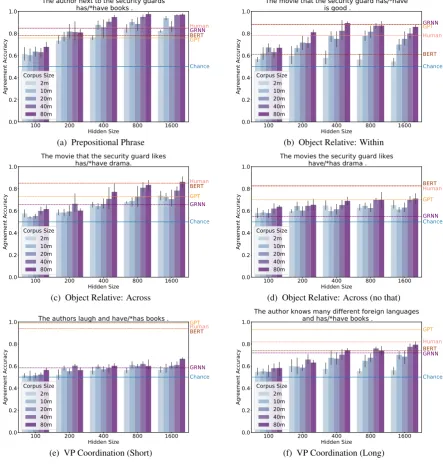
In the remainder of this section we analyze the effect of increasing model size and training cor-pus size on the models’ predictions for each con-struction in the data set.7A subset of the results is shown in Fig.1; for the full results, see Figs.3,4 and5in the Appendix.
Local number agreement: All models trained on 10M words or more obtained perfect or near-perfect accuracy (mean>99%) in the cases where the verb was adjacent to its subject: simple agree-ment (the author has/*have books) and agreement within a sentential complement (the mechanics said the author has/*have books). When trained on 2M words, the models performed slightly worse, but their accuracy was still very high (mean 95.6%), regardless of model size. Overall, we con-clude that the plurality of specific nouns and the generalization that a verb has to agree with a noun can be learned very quickly.
Attractors: Agreement across subject relative clauses (the author that likes the guards has/*have books) and across prepositional phrases (the au-thor next to the guards has/*have books; Fig.1a) benefited from increasing the hidden layer size to 400, but showed little improvement when hidden 7See Table2in the Appendix for a Bayes factor analysis
of the improvement in each construction for each amount of training data.
layer size was increased further. Accuracy in these constructions consistently improved as the amount of training data increased.
Object relative clauses: Expanding the train-ing corpus improved local agreementwithin ob-ject relative clauses (the movies that the guard has/*have are good; Fig.1b) for all model sizes, but only improved agreementacrossthose clauses (the movie that the guards like has/*have drama; Fig. 1c) in models with larger hidden layers. Larger hidden layers improved accuracy in object relatives only when a relativizer was present, and only up to about 80% accuracy. When a sentence lacked an overt relativizer (the movies the secu-rity guard has/*have are good; Fig.1d), all mod-els performed poorly, with accuracy levelling off around 70%.
Coordination: Perhaps surprisingly, all LSTM LMs struggled with agreement in a coordinated verb phrase (the authors laugh and have/*has books; Fig.1e), even though this construction does not include distracting nouns between the subject and the second verb. In larger models trained on more data, accuracy was higher when the second verb was further from the subject (the authors know many different languages and have/*has books; Fig.1f).
Training on more than 10M tokens did not im-prove accuracy in short VP coordination, even when the amount of data was multiplied by eight (10M→80M:K <1), unlike coordination across long VPs, which benefited from additional data (10M → 80M: K > 90). These results further challenge the assumption that increased amounts of training data will lead to adequately abstract syntactic representations: RNNs show a limited ability to generalize from instances of a construc-tion that have longer constituents to instances with shorter constituents.
100 200 400 800 1600 Hidden Size 0.0 0.2 0.4 0.6 0.8 1.0 Agreement Accuracy Chance GRNN GPT BERT Human
The author next to the security guards has/*have books .
Corpus Size 2m 10m 20m 40m 80m
(a) Prepositional Phrase
100 200 400 800 1600
Hidden Size 0.0 0.2 0.4 0.6 0.8 1.0 Agreement Accuracy Chance GRNN GPT BERT Human
The movie that the security guard has/*have is good .
Corpus Size 2m 10m 20m 40m 80m
(b) Object Relative: Within
100 200 400 800 1600
Hidden Size 0.0 0.2 0.4 0.6 0.8 1.0 Agreement Accuracy Chance GRNN GPT BERT Human
The movie that the security guard likes has/*have drama. Corpus Size 2m 10m 20m 40m 80m
(c) Object Relative: Across
100 200 400 800 1600
Hidden Size 0.0 0.2 0.4 0.6 0.8 1.0 Agreement Accuracy Chance GRNN GPT BERT Human
The movies the security guard likes have/*has drama .
Corpus Size 2m 10m 20m 40m 80m
(d) Object Relative: Across (no that)
100 200 400 800 1600
Hidden Size 0.0 0.2 0.4 0.6 0.8 1.0 Agreement Accuracy Chance GRNN GPT BERT Human
The authors laugh and have/*has books .
Corpus Size 2m 10m 20m 40m 80m
(e) VP Coordination (Short)
100 200 400 800 1600
Hidden Size 0.0 0.2 0.4 0.6 0.8 1.0 Agreement Accuracy Chance GRNN GPT BERT Human
The author knows many different foreign languages and has/*have books .
Corpus Size 2m 10m 20m 40m 80m
[image:4.595.81.525.69.535.2](f) VP Coordination (Long)
Figure 1: LSTM agreement performance in several syntactic constructions. The solid horizontal line indicates chance performance. The dashed lines show the performance of GPT and BERT as reported byWolf(2019), the performance of humans as reported byMarvin and Linzen (2018), and the performance of GRNN. Error bars reflect standard deviation across the five models in each category.
Transformers: Despite having more parameters and having been trained on significantly larger cor-pora, the two Transformer models performed ei-ther as well as or more poorly than our LSTMs in seven of the ten subject-verb agreement condi-tions. BERT underperformed GPT in several con-ditions despite having been trained on three times as many tokens as GPT.8
8Goldberg (2019) reports much better results using a
setup in which BERT has access to both left and right
con-5 How much data would be enough?
How much training data would be required for an LSTM LM to perform at a human level (as re-ported byMarvin and Linzen 2018) in the
GRNN GPT BERT 100
104 108 1012 1016 1020 1024 1028 1032
Reflexives
Obj Rel Within (no that)
Obj Rels Across VP Coord (long) VP Coord (short)
(a) Human-like GRNN GPT BERT 100
1012 1024 1036 1048 1060 1072 1084 1096
Subj Rel/Prep/Sent Comp Obj Rels/VP Coord (long) Obj Rel Within (no that) VP Coord (short)
Reflexives/
Obj Rel Across (no that)
[image:5.595.74.288.58.335.2](b) 99.99%
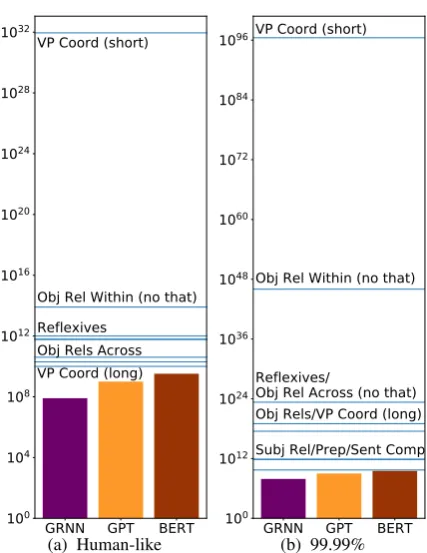
Figure 2: Lines depict number of training tokens needed for LSTMs to achieve human-like (left) or 99.99% accuracy (right) in each syntactic agreement condition, according to our estimates. Bars depict the amount of data on which each model was trained.
tions in which our models do not already perform at a human level? As a conservative estimate, we measured the error reduction achieved by doubling the data from 20M to 40M tokens (the largest error reduction we observed beyond 2M→10M).9 Un-der the assumption that each subsequent doubling of training data would produce the same percent error reduction, we predicted the amount of data required to obtain human-like and 99.99% accu-racy (see Fig.2).10 We found that every remain-ing construction would require over 10 billion to-kens to achieve human-like performance, and most would require trillions of tokens to achieve perfect accuracy – an impractically large amount of train-ing data, especially for these relatively simple syn-tactic phenomena.
9See Tables3and4in the Appendix for data requirements
estimated from other error reduction rates.
10
Human performance on this task is well known to be far from perfect, with error rates approaching 25% in some con-texts (Bock and Miller,1991). While modeling human errors is of considerable interest to cognitive scientists (Linzen and Leonard,2018), we believe that in most applied contexts it is desirable for the model to make no errors at all.
6 Discussion
We have investigated the effect of network size and training corpus size on the quality of the syntactic representations of LSTM LMs, as mea-sured by agreement prediction accuracy. Increased model size had limited benefits; models with 400 hidden units performed significantly better than smaller models, but further increases in network size had no effect. The limited effect of net-work size is consistent with previous findings on sequence labeling tasks (Reimers and Gurevych, 2017;Greff et al.,2017). We have also shown that increasing the amount of training data is unlikely to result in human-like accuracy in all cases.
We found a striking difference in agreement ac-curacy between short and long coordinated verb phrases: performance on short phrases was poorer. While RNNs are known to struggle with general-izing short patterns to longer sequences, this pat-tern constitutes a failure to generalize to shorter sequences (cf.Trask et al.,2018); techniques for improving longer distance dependency learning in LMs (e.g.,Trinh et al.,2018;Dai et al.,2019) are unlikely to mitigate this deficit. This suggests that challenge sets should include materials that can be used to ascertain whether the model’s syntac-tic representations are robust to syntacsyntac-tically irrel-evant factors such as constituent length.
References
Geoff Bacon and Terry Regier. 2019. Does BERT agree? Evaluating knowledge of structure depen-dence through agreement relations. Technical re-port, UC Berkeley.
Alexei Baevski, Sergei Edunov, Yinhan Liu, Luke Zettlemoyer, and Michael Auli. 2019. Cloze-driven pretraining of self-attention networks. Technical re-port, Facebook AI Research.
Kathryn Bock and Carol A. Miller. 1991. Broken
agreement.Cognitive Psychology, 23(1):45–93.
Zihang Dai, Zhilin Yang, Yiming Yang, Jaime Car-bonell, Quoc V. Le, and Ruslan Salakhutdinov. 2019. Transformer-XL: Attentive language mod-els beyond a fixed-length context. Technical report, Carnegie Mellon University.
Jacob Devlin, Ming-Wei Chang, Kenton Lee, and Kristina Toutanova. 2019. BERT: Pre-training of deep bidirectional transformers for language
under-standing. InProceedings of the 2019 Annual
Con-ference of the North American Chapter of the Asso-ciation for Computational Linguistics. Association for Computational Linguistics.
´
Emile Enguehard, Yoav Goldberg, and Tal Linzen. 2017. Exploring the syntactic abilities of RNNs with multi-task learning. InProceedings of the 21st Conference on Computational Natural Language Learning (CoNLL 2017), pages 3–14. Association for Computational Linguistics.
Yoav Goldberg. 2019. Assessing BERT’s syntactic abilities. Technical report, Bar Ilan University.
Klaus Greff, Rupesh K. Srivastava, Jan Koutn´ık, Bas R. Steunebrink, and J¨urgen Schmidhuber. 2017.
LSTM: A search space odyssey. IEEE
Transac-tions on Neural Networks and Learning Systems, 28(10):2222–2232.
Kristina Gulordava, Piotr Bojanowski, Edouard Grave, Tal Linzen, and Marco Baroni. 2018. Colorless green recurrent networks dream hierarchically. In Proceedings of the 2018 Annual Conference of the North American Chapter of the Association for Computational Linguistics. Association for Compu-tational Linguistics.
Alon Halevy, Peter Norvig, and Fernando Pereira. 2009. The unreasonable effectiveness of data. IEEE Intelligent Systems, 24(2):8–12.
Sepp Hochreiter and J¨urgen Schmidhuber. 1997. Long short-term memory. Neural Computation, 9(8):1735–1780.
Hakan Inan, Khashayar Khosravi, and Richard Socher. 2017. Tying word vectors and word classifiers: A loss framework for language modeling. In Yoshua Bengio and Yann LeCun, editors, Proceedings of
the Fifth International Conference on Learning Rep-resentations. International Conference on Learning Representations.
Harold Jeffreys. 1961. Theory of Probability, 3rd edi-tion. Oxford University Press, Oxford.
Rafal Jozefowicz, Oriol Vinyals, Mike Schuster, Noam
Shazeer, and Yonghui Wu. 2016. Exploring
the limits of language modeling. arXiv preprint arXiv:1602.02410.
Adhiguna Kuncoro, Chris Dyer, John Hale, Dani Yo-gatama, Stephen Clark, and Phil Blunsom. 2018. LSTMs can learn syntax-sensitive dependencies well, but modeling structure makes them better. In Proceedings of the 2018 Annual Meeting of the Association for Computational Linguistics, pages 1426–1436. Association for Computational Linguis-tics.
Adhiguna Kuncoro, Chris Dyer, Laura Rimell, Stephen Clark, and Phil Blunsom. 2019. Scalable syntax-aware language models using knowledge
distilla-tion. InProceedings of the 57th Annual Meeting
of the Association for Computational Linguistics, pages 3472–3484, Florence, Italy. Association for Computational Linguistics.
Tal Linzen, Emmanuel Dupoux, and Yoav Goldberg. 2016. Assessing the ability of LSTMs to learn
syntax-sensitive dependencies. Transactions of the
Association for Computational Linguistics, 4:521– 535.
Tal Linzen and Brian Leonard. 2018. Distinct pat-terns of syntactic agreement errors in recurrent
net-works and humans. InProceedings of the 2018
An-nual Meeting of the Cognitive Science Society, pages 690–695. Cognitive Science Society.
Rebecca Marvin and Tal Linzen. 2018. Targeted
syn-tactic evaluation of language models. In Ellen
Riloff, David Chiang, Julia Hockenmaier, and Jun’ichi Tsujii, editors, Proceedings of the 2018 Conference on Empirical Methods in Natural Lan-guage Processing, pages 1192–1202. Association for Computational Linguistics.
Stephen Merity, Caiming Xiong, James Bradbury, and Richard Socher. 2016. Wikitext-103. Technical re-port, Salesforce.
Tomas Mikolov, Martin Karafi´at, Lukas Burget, Jan Cernock`y, and Sanjeev Khudanpur. 2010. Recur-rent neural network based language model. In Pro-ceedings of the 11th Annual Conference of the In-ternational Speech Communication Association (IN-TERSPEECH 2010), pages 1045–1048, Makuhari, Chiba, Japan.
Jeffrey Pennington, Richard Socher, and Christo-pher D. Manning. 2014. GloVe: Global vectors for
word representation. InProceedings of EMNLP.
Ofir Press and Lior Wolf. 2017. Using the output
em-bedding to improve language models. In
Proceed-ings of the 2017 Annual Conference of the European Chapter of the Association for Computational Lin-guistics. Association for Computational Linguistics.
Alec Radford, Karthik Narasimhan, Tim Salimans, and Ilya Sutskever. 2018. Improving language under-standing by generative ptraining. Technical re-port, OpenAI.
Alec Radford, Jeffrey Wu, Rewon Child, David Luan, Dario Amodei, and Ilya Sutskever. 2019. Language models are unsupervised multitask learners. Techni-cal report, OpenAI.
Nils Reimers and Iryna Gurevych. 2017. Reporting score distributions makes a difference: Performance study of LSTM-networks for sequence tagging. In Martha Palmer, Rebecca Hwa, and Sebastian Riedel, editors,Proceedings of the 2017 Conference on Em-pirical Methods in Natural Language Processing, pages 338–348. Association for Computational Lin-guistics.
Jeffrey N. Rouder, Paul L. Speckman, Dongchu Sun, Richard D. Morey, and Geoffrey Iverson. 2009. Bayesian t-tests for accepting and rejecting the null hypothesis. Psychonomic Bulletin & Review, 16(2):225–237.
Andrew Trask, Felix Hill, Scott E Reed, Jack Rae, Chris Dyer, and Phil Blunsom. 2018. Neural arithmetic logic units. In S. Bengio, H. Wallach, H. Larochelle, K. Grauman, N. Cesa-Bianchi, and R. Garnett, editors,Advances in Neural Information Processing Systems 31, pages 8035–8044. Curran Associates, Inc.
Trieu H. Trinh, Andrew M. Dai, Minh-Thang Luong, and Quoc V. Le. 2018. Learning longer-term
depen-dencies in RNNs with auxiliary losses. In
Proceed-ings of the 35th International Conference on Ma-chine Learning, pages 4965–4974. PMLR 80.
Ashish Vaswani, Noam Shazeer, Niki Parmar, Jakob Uszkoreit, Llion Jones, Aidan N Gomez, Łukasz Kaiser, and Illia Polosukhin. 2017. Attention is all you need. In I. Guyon, U. V. Luxburg, S. Bengio, H. Wallach, R. Fergus, S. Vishwanathan, and R. Gar-nett, editors, Advances in Neural Information Pro-cessing Systems 30, pages 5998–6008. Curran As-sociates, Inc.
Ethan Wilcox, Peng Qian, Richard Futrell, Miguel Ballesteros, and Roger Levy. 2019. Structural su-pervision improves learning of non-local
grammat-ical dependencies. InProceedings of the 2019
An-nual Conference of the North American Chapter of the Association for Computational Linguistics. As-sociation for Computational Linguistics.