Abstract—It is proved: kinematic chain with two degrees of freedom containing the closed loop and only one input link is definable. The proof is carried out on basis of statics lows. The closed loop imposes additional constraint on the kinematic chain and transforms it in mechanism with one input. Such mechanism has the property of force adaptation to variable technological loading. Gear adaptive transfer in form closed gear differential contains input carrier, closed loop and output carrier. At constant input power the output carrier possesses an angular speed which inverse to a torque. Such gear adaptive transfer has constant engagement of tooth wheels and provides variable transfer ratio (as variator) without any control. Laws of interrelation of force and kinematic parameters are resulted. Assembly drawing of adaptive gear transfer is presented. The developed transfer permits creation of adaptive transfer boxes of cars, drilling rigs, manipulators, rudder air scoops and others.
Index Terms—adaptation, closed loop, gear transfer.
I. INTRODUCTION
Smooth and adjustable process of start from a place, stepless achievement of working speed, constructive simplicity and reliability of a demanded motion mode are the basic priorities of creation of transmissions of cars and the special hard loaded machines.
The most widespread transmissions with stepped transfer boxes provide the stepped law of change of the torque. Manual control in a stepped transfer box is difficult and imperfect. The automatic hydraulic control system of hydro dynamical transfer is more perfect and better carries out switching. However the law of change of the driving torque remains the stepped. Besides, the essential lacks are inherent in hydrodynamic automatic transfer box: 1. Extreme complexity of a design. 2. The imperfection of a control system leading backlog or advancing of switching of transfers. 3. Rather low efficiency because of use of the hydro transformer.
Modern stepless transfers in form a wedge belt variators are capable to change smoothly the transfer ratio and the torque. However change of the transfer ratio occurs in narrow limits, and transfers have low reliability because of use of friction as the functional factor.
Recently were developed the not switched gear boxes of transfers with constant engagement of gear wheels.
Not switched continuous-leveling transmission is known [1]. This transmission is executed in the form of the hydrodynamic converter and the differential mechanism.
Manuscript received January 21, 2010. This work was supported in part by the Institute of Mechanics and Science Engineering of NAN RK.
K. S. Ivanov is with the Kazakh National Technical University, 050026, Isaev st. 28, ap.3, Almaty, Kazakhstan, (corresponding author to provide phone: +358-727-3797930; e-mail: [email protected]).
The transmission has the next lacks: low efficiency because the hydrodynamic converter is using, a small range of change of speed and low reliability at start-up. It leads to necessity to use the additional mechanisms of a free course complicating a design and worsening quality of transfer work.
The device of transfer of energy with continuously variable transfer ratio [2] is known. This device is executed in the form of the differential mechanism with two degrees of freedom. It contains a starting link and a brake. The lacks of the device are: it is not automatic, has low loading ability and reliability, low efficiency.
In the paper the goal is set - to prove theoretically an opportunity of creation mechanical gear stepless transfer box providing smooth change of transfer ratio, simple on a design, reliable in work and highly effective. For achievement the goal is offered to use the adaptive mechanism with two degrees of freedom at presence at it only one input.
The basic opportunity of adaptation of a kinematic chain to variable loading is based on introduction of an additional degree of freedom. For example, if on the lever the slider with the applied force of resistance is placed then the change of slider position on the lever will provide an opportunity of adaptation to variable force of resistance at constant motive force. However introduction of an additional degree of freedom demands additional control. According to terminology of theoretical mechanics «the least number of parameters which are necessary to get the system possible position is called as number of its independent generalized coordinates» [3]. The additional generalized coordinate should provide an additional degree of freedom. In the theory of mechanisms and machines the concept « initial link» corresponds to concept «generalized coordinate» [4]. The kinematic chain has definability, if number of degrees of freedom is equal to number of initial links.
The kinematic chain with two degrees of freedom at presence of one input should contain one more initial part with the generalized coordinate.
However earlier [5, 6, 7] on the basis of a principle of virtual works it has been shown that in that specific case a kinematic chain with two degrees of freedom with the mobile closed loop, having only one input, is in equilibrium and is definable. Hence, such chain having an input link can create one more initial link with the generalized coordinate.
The arbitrary kinematic chain (for example the chain containing structural group of two links instead of a loop) does not possess such ability. According to theoretical mechanics [3] - “At absence of full definiteness of motion the principle of virtual works can not take a place”. It is necessary to recognize: the additional generalized coordinate takes place if the kinematic chain has additional constraint between parameters.
The purposeof the scientific paper: to prove existence of unknown law in the theory of mechanisms and machines - a kinematic chain with two degrees of freedom containing the four-bar closed loop at presence of one input imposes
The Simplest Automatic Transfer Box
additional constraint and provides definiteness of motion of all links.
In works [5, 6, 7] it is shown, that such chain realizes the force adaptation to variable external loading. Patents of Kazakhstan on an adaptive gear transfer [8, 9] are received.
Researches are executed for a kinematic chain with ideal constraints on the basis of use of equilibrium conditions of statics.
II. THEORETICAL BASES OF FORCE ADAPTATION
Force adaptation is a property of a kinematic chain to provide motion of an output link with a speed, inversely proportional loading, at constant input force.
The theory of force adaptation is based on the theorem of equilibrium of a kinematic chain with the closed loop.
Theorem. Mobile four bar closed loop is in equilibrium if active forces are enclosed to non-adjacent links of a loop.
Any active forces are passed to a loop by means of translational moving links.
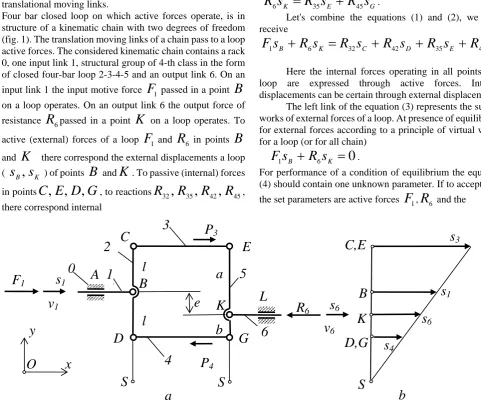
[image:2.595.45.527.291.697.2]Four bar closed loop on which active forces operate, is in structure of a kinematic chain with two degrees of freedom (fig. 1). The translation moving links of a chain pass to a loop active forces. The considered kinematic chain contains a rack 0, one input link 1, structural group of 4-th class in the form of closed four-bar loop 2-3-4-5 and an output link 6. On an input link 1 the input motive force
F
1 passed in a pointB
on a loop operates. On an output link 6 the output force of resistanceR
6passed in a pointK
on a loop operates. To active (external) forces of a loopF
1 andR
6 in pointsB
andK
there correspond the external displacements a loop (s
B,
s
K ) of pointsB
andK
. To passive (internal) forces in pointsC
,
E
,
D
,
G
, to reactionsR
32,
R
35,
R
42,
R
45, there correspond internalFig. 1a Kinematic chain with two degrees of freedom displacements of a loop, displacements
s
C,
s
E,
s
D,
s
G of pointsC
,
E
,
D
,
G
.S
- instant center of speeds.For the proof of the theorem we shall express internal forces of a loop through external forces.
As into loop links 2 and 5to which active forces are enclosed, are not adjacent for each of these links internal forces
R
32,
R
35,
R
42,
R
45 are expressed through active forcesF
1 andR
6 by means of conditions of statics.That the closed loop was in equilibrium, it is necessary, that conditions of equilibrium were observed both for external forces and for internal forces.
At any external forces internal forces separately on a link 3 and on a link 4 will not correspond to conditions of statics. However in the closed loop at motion of its links there is an interaction of works of forces.
Let's make for non-adjacent links of 2 and 5 conditions of equilibrium by a principle of virtual works.
For a link 2
D C
B
R
s
R
s
s
F
1
32
42 . (1) For a link 5G E
K
R
s
R
s
s
R
6
35
45 . (2) Let's combine the equations (1) and (2), we shall receiveG E
D C
K
B
R
s
R
s
R
s
R
s
R
s
s
F
1
6
32
42
35
45 . (3)Here the internal forces operating in all points of a loop are expressed through active forces. Internal displacements can be certain through external displacements.
The left link of the equation (3) represents the sum of works of external forces of a loop. At presence of equilibrium for external forces according to a principle of virtual works for a loop (or for all chain)
0
6 1
s
B
R
s
K
F
. (4) For performance of a condition of equilibrium the equation (4) should contain one unknown parameter. If to accept, that the set parameters are active forcesF
1,R
6 and theFig. 1b Picture of displacements of kinematic chain
generalized coordinate
s
Bfrom the equation (4) it is possible to define external displacements
K.P
3P
4S
s
3S
v
6D,G
6
S
D
s
6s
1K
l
l
b
a
e
R
6
2
C
B
v
1F
1A
E
0
1
3
4
5
L
s
6C,E
K
s
4s
1B
O
x
y
G
The right link of the equation (3) represents the sum of works of internal forces of a loop. As in the right link of the equation internal forces are certain through known external forces, internal displacements are certain through external displacements observance of a condition (4) will lead also to observance of equality to zero of works of internal forces on possible internal displacements
0
45 35
42
32
s
C
R
s
D
R
s
E
R
s
G
R
. (5) It means that the condition of equilibrium (4) forexternal parameters of a loop provides also performance of a condition of equilibrium (5) for internal parameters of a loop. As equilibrium of external and internal forces acting on a loop mobile four bar the closed loop is in equilibrium if active forces are enclosed to non-adjacent links of a loop, as was to be shown takes place.
The formula (4) or the corresponding formula (5) defines additional to conditions of statics the differential
constraint which the closed loop imposes on motion of links. This constraint provides transformation of a kinematic chain with two degrees of freedom and with one input in the mechanism.
In the equation (5) according to a picture of displacements (fig. 1 b) we shall accept
s
C
s
E
s
3,
s
D
s
G
s
4. We shall receive in view of signs on works0
4 45 3 35 4 42 3
32
R
s
R
s
R
s
R
s
.In view of 45
54 35
53 42
24 32
23
R
,
R
R
,
R
R
,
R
R
R
we shall receive
0
)
(
)
(
R
23
R
53s
3
R
24
R
54s
4
. Or 424 54 3
53
23
)
(
)
(
R
R
s
R
R
s
.Let's designate
R
23
R
53
P
3,
R
54
R
24
P
4 - the total internal forces acting on links 3 and 4. Then the equation of equilibrium for internal forces of a loop will become4 4 3 3
s
P
s
P
. (6) Hence, in the closed loop equilibrium of works of internal forces, instead of forces takes place.From the formula (4) in view of a sign on works follows 6
1
s
/
R
F
s
K
B . Or in view of time6 1
v
/
R
F
v
K
B . (7) Herev
B,
v
K - speeds of pointsB
,
K
.The formula (7) characterizes effect of force adaptation of a kinematic chain with the closed loop: at constant parameters of input force
F
1,
v
B output speedv
K is in return proportional dependence on variable force of resistanceR
6.On the basis of the proved theorem it is possible to create gear adaptive transfer with constant engagement of cogwheels.
III. DESCRIPTION OF AN ADAPTIVE GEAR TRANSFER
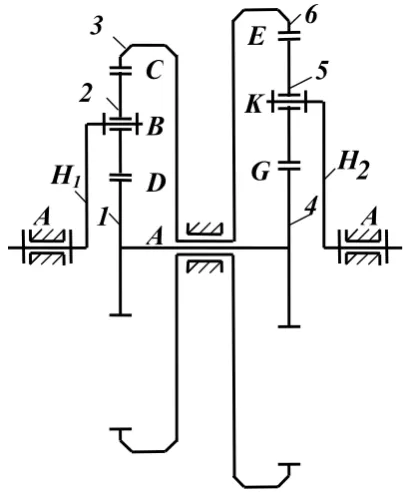
Gear adaptive transfer (fig. 2) looks like the differential gear mechanism. Transfer contains input carrier
H
1, the input satellite 2, the block of the central cogwheels with external teeth 1 - 4, the block of the central cogwheels with internal teeth 3 - 6, the output satellite 5 and output carrier2
[image:3.595.323.525.157.404.2]H
. Cogwheels 4-1, 2, 3-6, 5 are forming the closed loop.Fig. 2 The scheme of gear adaptive transfer The interrelation of kinematic and force parameters of the mechanism (additional constraint) is defined by a principle of virtual works (or powers) under formulas (1 ) - (5) which correspond accepted on fig. 1 and fig. 2 designations.
In formulas (1) – (5) operating forces can be expressed through the moments enclosed to links of the gear mechanism, and linear displacements to express through angular displacements of links of the gear mechanism:
,
/
,
/
1 6 2 21
1
M
Hr
HR
M
Hr
HF
,
/
,
/
3 42 24 24 423 23
32
R
M
r
R
R
M
r
R
,
/
,
/
6 42 24 24 453 53
35
R
M
r
R
R
M
r
R
,
,
,
2 2 3 31
1
r
s
r
s
r
s
B
H H K
H H C
,
,
,
1 1 4 46
6
r
s
r
s
r
s
s
B
D
E
G
Where the symbol
M
designates the external moment, the symbol
designates the rotation angle of link, the symbolr
designates radius of a link, and the surprise index at these symbols means a link (for example,M
H1 - the moment on a linkH
1,
H1 - the rotation angle of the link1
H
,r
H1 - radius of the linkH
1), the surprise index for cutting torques (internal moments)M
means numbers of links in a transfer direction of the moment (for example,23
M
- the moment passed from a link 2 on link 3).A
A
G
K
E
A
D
С
B
1
4
6
H2
H
12
3
After substitution of these values in formulas (4), (5) we shall receive
0
2 2 1
1 H
H H
H
M
M
. (8)0
4 54 6
53 1
24 3
23
M
M
M
M
. (9)The formula (8) or the corresponding formula (9) defines the differential constraint additional to conditions of a statics which the closed loop imposes on motion of links. This constraint provides transformation of a kinematic chain with two degrees of freedom and with one input in the mechanism. In the equation (9) for blocks of wheels 1-4 and 3-6 it is considered
4
1,
6
3. We shall receive in view of signs on works0
)
(
)
(
M
23
M
53
3
M
24
M
54
1
. Or(
M
23
M
53)
3
(
M
54
M
24)
1. Let's designate4 24 54
3 53
23
M
M
,
M
M
M
M
- the totalinternal moments acting on blocks of wheels 1-4 and 3-6. Then the equation of equilibrium for the internal moments of a loop will become
1 1 3
3
M
[image:4.595.47.286.321.571.2]M
. (10)Fig. 3 The simplest automatic transfer box Hence, in the closed loop equilibrium of works of the internal moments, instead of the moments takes place.
From the formula (8) in view of signs on works and time follows
2 1 1
2 H H
/
HH
M
M
. (11) Here
H1,
H2 - angular speeds of linksH
1,
H
2. The formula (11) characterizes effect of force adaptation of the gear mechanism with the closed loop: at constant parameters of input powerM
H1,
H1 output angular speed
H1 is in return proportional dependence on the variable torqueM
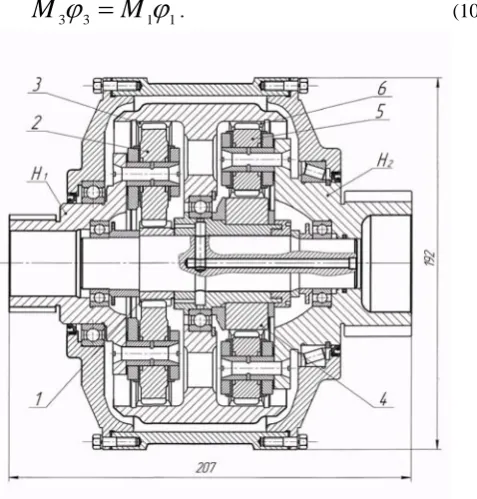
H2.On fig. 3 the assembly drawing of the simplest adaptive gear box is presented. The gear box is carried out for scheme of gear transfer which is presented on fig. 2.
IV. STATIC ANALYSIS OF GEAR ADAPTIVE TRANSFER
The set parameters are the external moments 2
1
,
HH
M
M
and input angular speed
H1. It is required to determine angular speeds
H2,
1,
3of linksH
2, 1, 3 and internal forces.Output angular speed we shall determine, using differential constraint (8), under the formula (11).
The interrelation of kinematic and geometrical parameters (geometrical constraint) in view of
3 6 1
4
,
is determined by formulas:) 1 ( 13 1 3
1
1 H
H H
u
, (12)
) 2 ( 46 2 3
2
1 H
H H
u
. (13)
Where
u
13(H1)
z
3/
z
1,u
46(H2)
z
6/
z
4- the transfer ratios expressed through numbers of teeth of wheels 3, 1 and 6, 4.Solving system of the equations (12), (13), we shall determine angular speeds
3,
1 of blocks of wheels 3-6 and 1-4) 2 ( 46 ) 1 ( 13
2 )
2 ( 46 1
) 1 ( 13 3
)
1
(
)
1
(
H H
H H
H H
u
u
u
u
, (14)1 1
3 ) 1 ( 13
1
(
H)
HH
u
. (15) Reactions in kinematic pairs it is determined on the setmoments of external forces, using conditions of a statics. Efficiency of gear adaptive transfer we shall determine as the ratio of useful power to all spent power
1 1 2
2 H
/
H HH
M
M
. (16) Efficiency of gear adaptive transfer corresponds to efficiency of the closed differential mechanism.Animation model of working transfer is presented on web-site http://www.madbass.narod.ru. This web-site allows seeing work of transfer at constant input power and variable torque. Keys "W" and "Q" create imitation of change of the output loading and provide change of a mode of motion.
V. FUNCTIONAL PROPERTIES OF AN ADAPTIVE GEAR TRANSFER
The adaptive gear transfer has following essentially new functional properties:
1. Smooth stepless automatic regulation of the transfer ratio without any control because of presence of force adaptation.
2. The transfer ratio has a range of smooth regulation from 1 to 6. Higher transfer ratio leads to excessive increase in angular speeds of intermediate links.
continuously the inverse dependence of output angle speed from external torque at constant input angle speed.
4. High efficiency because of absence of losses of power on transformation of the transfer ratio. The adaptive gear transfer provides the variable transfer ratio by means of gear mechanism with constant engagement of gear wheels.
5. High reliability in connection with use mechanism with constant engagement of gear wheels (without any switching) and a rigid design of mechanical type (without hydraulics).
6. Extreme simplicity of a design. The adaptive gear transfer contains only two rows of gear wheels in constant engagement without any additional devices.
VI. DEFINABILITY OF GEAR ADAPTIVE MECHANISM ON THE START-UP
Definability of gear adaptive mechanism takes place when start-up is going.
In the beginning of motion when the start-up takes place the output carrier is stopped and mechanism is in a status with one degree of freedom.
Let's define laws of transition of mechanism from a status with one degree of freedom in a status with two degrees of freedom.
Let's consider the creation of gear adaptive mechanism with two degrees of freedom on the basis of transformation of the closed gear differential mechanism with one degree of freedom by rotation of all mechanism with additional angular speed around of the central axis.
If to give to all mechanism in a status of equilibrium the rotation with some design additional speed the mechanism will get an additional degree of freedom. The system with two degrees of freedom at presence only one input link in the common case is not the mechanism [4]; however in the considered particular case definability of motion will be saved.
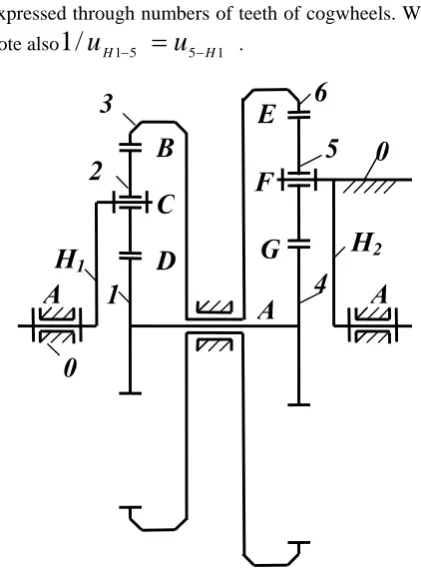
The initial closed differential mechanism (fig. 4) contains input carrier
H
1 , the satellite 2, the central wheels 1 and 3 and the closing mechanism. The closing mechanism contains a wheel 4 rigidly connected with a wheel 1, a wheel 6 rigidly connected with a wheel 3, and a wheel 5 with a motionless axis of rotation. The initial input torqueM
H10 is acting on input carrierH
1 which is rotated with initial angular speed
H10 . The output torque of resistanceM
50 is acting on the output link 5 which is rotated with initial angular speed
50 . The torque of resistanceM
50 can take place as the moment of inertia forces at the acceleration motion of a link 5 of initial mechanism till angular speed0 5
. In the hingeF
on a link 5 the reactionR
05 from a frame 0 on a link 5 is acting.Equilibrium of the initial mechanism is defined by the general equation of a statics: the sum of works (or capacities) all external forces is equal to zero:
0
50 50 1010
M
M
H H . (17) From the equation (17) it followsM
50/
M
H10
H10/
50
u
H15 . Here5 1 H
[image:5.595.311.522.71.356.2]u
- the mechanism ratio of the initial mechanism expressed through numbers of teeth of cogwheels. We shall note also1
/
u
H15
u
5H1 .Fig. 4 The closed differential mechanism which is transformed in a gear adaptive mechanism
The condition of equality to zero of the sum of external forces of the closed contour of the initial mechanism with links 2, 1- 4, 5, 6- 3 becomes
F
C
R
F
, (18) WhereF
C
M
H10/
r
H1 - motive force in a pointC
(herer
H1 - radius of carrierH
1 ),R
F
R
05 - reaction in a pointF
. Then the condition (18) will become1 10 05
M
H/
r
HR
.The initial closed differential mechanism will be transformed by inversion. The transformed mechanism with two degrees of freedom we shall receive as follows. We shall give to all initial mechanism the rotation around of the central axis with the additional angular speed
0 which was not leading to stop of any the central wheel. It can be made at preservation of equilibrium by replacement of the engine of the mechanism with other engine having new angular speed0 10
1
H
H
. If in the initial mechanism the reactionR
05from a frame 0 on a link 5 in a pointF
has final valueR
05
then the transformed mechanism with the increased input power will overcome resistance in a pointF
and will actuate a linkH
2.The mechanism will get an additional link in the form of carrier
H
2 (which earlier was a frameAF
) which will rotate with angular speed
0 . This mechanism will get theA
A
G
E
A
D
B
C
1
4
6
H
12
3
5
F
0
0
force of resistance
F
H2 in a pointF
. This force has a form of reaction from a frame 0 on a link 5 (F
H2
R
05).The condition of the beginning of motion of a link
H
2 and all transformed mechanism is defined as a condition (18) of equality to zero of external forces of the initial mechanismwith the changed parameters 1
1 2
2
05
M
H/
r
H,
F
CM
H/
r
HR
(herer
H2- radiuscarrier
H
2)1 1 2
2
/
H H/
HH
r
M
r
M
. (19) The torque which should be overcome at the beginning ofmotion
M
H2
M
H1r
H2/
r
H1. It is required to prove, that such additional angular speed0
of the initial mechanism takes place when the received transformed mechanism with two degrees of freedom and with one input is in equilibrium.Angular speeds of links of the transformed mechanism: 0 50 5 0 2 0 10
1
,
,
H
H
H
. The moments of forces on links of the transformed mechanism:
2 05 2 50 5
0 10
1 H
,
,
H HH
M
M
M
M
M
R
r
M
Where
M
0 - the additional torque on a linkH
1 , necessary for overcoming the torque of resistanceM
H2 on the output carrierH
2 . It is necessary to note, that the increase of angular speed of a link 5 and capacity spent by him will not demand to increase the input torque at a link1
H
as this link will receive the same increase in speed. The additional torqueM
0 on a linkH
1 is defined from a condition of equality of additional input and output powers in the transformed mechanism2 2 1
0 H
M
H HM
or
M
0(
H10
0)
M
H2
0.From here
M
0
M
H2
0/(
H10
0)
. Then the driving torque on input carrier)
/(
10 00 2 10
1
H
H
H
H
M
M
M
. (20)If the transformed mechanism with two degrees of freedom and with one input will be in a status of equilibrium its parameters will be connected by the general equation of statics
0
2 2 55 1
1 H
H H
H
M
M
M
. (21)Motion of the transformed mechanism with two degrees of freedom at presence only one input link
H
1 is considered uncertain [4].Let's prove that at some certain value of additional angular speed
0 the transformed mechanism with one input will be in a status of equilibrium. For the proof we shall substitute into the equation (21) the values of the torques and angular speeds of the transformed mechanism
)(
)
(
M
H10M
0
H10
00
)
(
50 0 2 050
M
M
H
.From here in view of
50
H10u
5H1 it is possible to define the additional angular speed
0 which is necessary for preservation of equilibrium in the transformed mechanism, through parameters of the initial mechanism and the set torque of resistanceM
H2 of the transformed mechanism10 0 10 50
2
1 5 50 0
10
0 H
H H
H H
M
M
M
M
u
M
M
M
. (22) Thus, it is proved, that there is such additional angular speed
0 of an input link at which the transformed mechanism with two degrees of freedom and with one input is under action of the set forces into a status of equilibrium, as was to be shown.The equation (22) defines a condition of qualitative transition of mechanical system from a status with one degree of freedom in a status with two degrees of freedom. At
2 HM
we shall receive
0
0
, that corresponds to system with one degree of freedom.VII. CONCLUSION
The gear mechanism with two degrees of freedom at presence only one input realizes effect of force adaptation which allows using it as a gear automatic adaptive variator with constant engagement of gear wheels. In work it is analyzed interrelation of kinematic and force parameters and formulas for performance static calculation of transfer are presented. Gear adaptive transfer possesses essentially new functional properties defining its high efficiency. The adaptive gear transfer possesses extreme simplicity of a design. Force adaptation allows creating the simplest adaptive drives of machines with the variable transfer ratio depending on variable technological loading.
REFERENCES
[1] Samuel J. Crockett. Shiftless, continuously-aligning transmission. Patent of USA 4,932,928, Cl. F16H 47/08, U.S. Cl. 475/51; 475/47.1990, 9 p.
[2] Harries John. Power transmission system comprising two sets of epicyclic gears. Patent of Great Britain GB2238090 (A). 1991, 11 p. [3] MarkeevA.P. Theoretical mechanics. Moscow. Science. 1990. 414 p. [4] Levitsky N.I. Theory of mechanisms and machines. Moscow. Science.
1979. 574 p.
[5] Ivanov K.S. The Question of the Synthesis of Mechanical Automatic Variable Speed Drives. Proceedings of the Ninth World Congress on the Theory of Machines and Mechanisms, Vol.1, Politechnico di Milano, Italy, August 29/Sept 2, 1995. - P. 580 - 584.
[6] Ivanov K.S. Discovery of the force Adaptation Effect. Proceedings of the 11th World Congress in Mechanism and Machine Science. V. 2. April 1 - 4, 2004, Tianjin, China. - P. 581 - 585.
[7] Ivanov K.S. Gear Automatic Adaptive Variator with Constant Engagement of Gears. Proceedings of the 12th World Congress in Mechanism and Machine Science. Besancon. France. 2007, Vol. 2. - P. 182 - 188.
[8] Ivanov K.S. Transfer with automatically adjustable speed. The preliminary patent of republic Kazakhstan N 3208 from 15.03.96 [9] Ivanov K.S. Automatic transmission. The preliminary patent of