Joint Entity and Event Coreference Resolution across Documents
Heeyoung Lee, Marta Recasens, Angel Chang, Mihai Surdeanu, Dan Jurafsky Stanford University, Stanford, CA 94305
{heeyoung,recasens,angelx,mihais,jurafsky}@stanford.edu
Abstract
We introduce a novel coreference resolution system that models entities and events jointly. Our iterative method cautiously constructs clusters of entity and event mentions using lin-ear regression to model cluster merge opera-tions. As clusters are built, information flows between entity and event clusters through fea-tures that model semantic role dependencies. Our system handles nominal and verbal events as well as entities, and our joint formulation allows information from event coreference to help entity coreference, and vice versa. In a cross-document domain with comparable doc-uments, joint coreference resolution performs significantly better (over 3 CoNLL F1 points) than two strong baselines that resolve entities and events separately.
1 Introduction
Most coreference resolution systems focus on enti-ties and tacitly assume a correspondence between entities and noun phrases (NPs). Focusing on NPs is a way to restrict the challenging problem of coref-erence resolution, but misses corefcoref-erence relations like the one betweenhanged andhis suicidein (1), and betweenplacedandputin (2).
1. (a) One of the key suspected Mafia bosses ar-rested yesterdayhas hanged himself.
(b) Police saidLo Prestihad hanged himself. (c) His suicide appeared to be related to clan feuds.
2. (a) The New Orleans SaintsplacedReggie Bush on the injured list on Wednesday.
(b) SaintsputBushon I.R.
As (1c) shows, NPs can also refer to events, and so corefer with phrases other than NPs (Webber, 1988). By being anchored in spatio-temporal dimen-sions, events represent the most frequent referent of verbal elements. In addition to time and location, events are characterized by their participants or ar-guments, which often correspond with discourse en-tities. This two-way feedback between events and their arguments (or entities) is the core of our ap-proach. Since arguments play a key role in describ-ing an event, knowdescrib-ing that two arguments corefer is useful for finding coreference relations between events, and knowing that two events corefer is use-ful for finding coreference relations between enti-ties. In (1), the coreference relation between One of the key suspected Mafia bosses arrested yesterday and Lo Presti can be found by knowing that their predicates (i.e., has hangedandhad hanged) core-fer. On the other hand, the coreference relations be-tween the arguments Saints and Bush in (2) helps to determine the coreference relation between their predicatesplacedandput.
In this paper, we take a holistic approach to coref-erence. We annotate a corpus with cross-document coreference relations for nominal and verbal men-tions. We focus on both intra and inter-document coreference because this scenario is at the same time more challenging and more relevant to real-world applications such as news aggregation. We use this corpus to train a model that jointly addresses refer-ences to both entities and events across documents. The contributions of this work are the following:
• We introduce a novel approach for entity and event coreference resolution. At the core of
our approach is an iterative algorithm that cau-tiously constructs clusters of entity and event mentions using linear regression to model clus-ter merge operations. Importantly, our model allows information to flow between clusters of both types through features that model context using semantic role dependencies.
• We annotate and release a new corpus with coreference relations between both entities and events across documents. The relations anno-tated are both intra and inter-document, which more accurately models real-world scenarios.
• We evaluate our cross-document coreference resolution system on this corpus and show that our joint approach significantly outperforms two strong baselines that resolve entities and events separately.
2 Related Work
Entity coreference resolution is a well studied prob-lem with many successful techniques for identify-ing mention clusters (Ponzetto and Strube, 2006; Haghighi and Klein, 2009; Stoyanov et al., 2009; Haghighi and Klein, 2010; Raghunathan et al., 2010; Rahman and Ng, 2011, inter alia). Most of these techniques focus on matching compatible noun pairs using various syntactic and semantic features, with efforts targeted toward improving features and clus-tering models.
Prior work showed that models that jointly resolve mentions across multiple entities result in better per-formance than simply resolving mentions in a pair-wise fashion (Denis and Baldridge, 2007; Poon and Domingos, 2008; Wick et al., 2008; Lee et al., 2011, inter alia). A natural extension is to perform coref-erence jointly across both entities and events. Yet there has been little attempt in this direction.
We know of only limited work that incorporates event-related information in entity coreference, typ-ically by incorporating the verbs in context as fea-tures. For instance, Haghighi and Klein (2010) in-clude the governor of the head of nominal mentions as features in their model. Rahman and Ng (2011) also used event-related information by looking at which semantic role the entity mentions can have and the verb pairs of their predicates. We confirm
that such features are useful but also show that the complementary features for verbal mentions lead to even better performance, especially when event and entity clusters are jointly modeled.
Compared to the extensive work on entity coref-erence, the related problem of event coreference re-mains relatively under-explored, with minimal work on how entity and event coreference can be con-sidered jointly on an open domain. Early work on event coreference for MUC (Humphreys et al., 1997; Bagga and Baldwin, 1999) focused on scenario-specific events. More recently, there have been approaches that looked at event coreference for wider domains. Chen and Ji (2009) proposed us-ing spectral graph clusterus-ing to cluster events. Be-jan and Harabagiu (2010) proposed a nonparamet-ric Bayesian model for open-domain event resolu-tion. However, most of this prior work focused only on event coreference, whereas we address both en-tities and events with a single model. Humphreys et al. (1997) considered entities as well as events, but due to the lack of a corpus annotated with event coreference, their approach was only evaluated im-plicitly in the MUC-6 template filling task. To our knowledge, the only previous work that considered entity and event coreference resolution jointly is He (2007), but limited to the medical domain and focused on just five semantic categories.
3 Architecture
Algorithm 1: Joint Coreference Resolution
input : set of documentsD
input : coreference modelΘ // clusters of mentions:
E={}
1
// clusters of documents:
C=clusterDocuments(D)
2
foreachdocument clustercinCdo 3
// all mentions in one doc cluster:
M=extractMentions(c)
4
// singleton mention clusters:
E0=buildSingletonClusters(M)
5
// high-precision deterministic sieves:
E0=applyHighPrecisionSieves(E0)
6
// iterative event/entity coreference:
while∃e1, e2∈ E0s.t.score(e1, e2,Θ)>0.5do 7
(e1, e2) = arg maxe1,e2∈E0score(e1, e2,Θ) 8
E0
=merge(e1, e2,E0) 9
// pronoun sieve:
E0
=applyPronounSieve(E0 )
10
// append to global output:
E=E+E0
11
output :E
3.1 Document Clustering
Our approach starts with several steps that reduce the search space for the actual coreference resolution task. The first is document clustering, which clusters the set of input documents (D) into a set of docu-ment clusters (C). In the subsequent steps we only cluster mentions that appear in the same document cluster. We found this to be very useful in practice because, in addition to reducing the search space, it provides a word sense disambiguation mechanism based on corpus-wide topics. For example, with-out document clustering, our algorithm may decide to cluster two mentions of the verb hit, but know-ing that one belongs to a cluster containknow-ing earth-quake reports and the other to a cluster with reports on criminal activities, this decision can be avoided.1 Any non-parametric clustering algorithm can be used in this step. In this paper, we used the rithm proposed by Surdeanu et al. (2005). This algo-rithm is an Expectation Maximization (EM) variant where the initial points (and the number of clusters) are selected from the clusters generated by a hierar-chical agglomerative clustering algorithm using
ge-1
Since different mentions of the verbsayin the same topic might refer to different events, they are only merged if they have coreferent arguments.
ometric heuristics. This algorithm performs well on our data. For example, in the training dataset, only two topics (handling different earthquake events) are incorrectly merged into the same cluster.
3.2 Mention Extraction
In this step (4 in Algorithm 1) we extract nominal, pronominal, and verbal mentions. We extract nom-inal and pronomnom-inal mentions using the mention identification component in the publicly download-able Stanford coreference resolution system (Raghu-nathan et al., 2010; Lee et al., 2011). We consider as verbal mentions all words whose part of speech starts with VB, with the exception of some auxil-iary/copulative verbs (have,beandseem). For each of the identified mentions we build a singleton clus-ter (step 5 in Algorithm 1).
Crucially, we do not make a formal distinction be-tween entity and event mentions. This distinction is not trivial to implement (e.g., is the nounearthquake an entity or an event mention?) and an imperfect classification would negatively affect the following coreference resolution. Instead, we simply classify mentions into verbal or nominal, and use this dis-tinction later during feature generation (Section 5). To compare event nouns (e.g., development) with verbal mentions, the “derivationally related form” relation in WordNet is used.
3.3 High-precision Entity Resolution Sieves
High-precision sieves Discourse processing sieve Exact string match sieve Relaxed string match sieve
Precise constructs sieve (e.g., appositives) Strict head match sieves
Proper head noun match sieve Relaxed head matching sieve
Table 1: Deterministic sieves in step 6 of Algorithm 1.
one sieve clusters together two entity mentions only when they have the same head word. Note that all these heuristics were designed for within-document coreference. They work well in our context be-cause we apply them in individual document clus-ters, where the one-sense-per-discourse principle still holds (Yarowsky, 1995).
Importantly, these sieves do not address verbal mentions. That is, all verbal mentions are still in sin-gleton clusters after this step. Furthermore, none of these sieves use features that facilitate the joint reso-lution of nominal and verbal mentions (e.g., features from semantic role frames). All these limitations are addressed next.
3.4 Iterative Entity/Event Resolution
In this stage (steps 7 – 9 in Algorithm 1), we con-struct entity and event clusters using a cautious or “baby steps” approach. We use a single linear re-gressor (Θ) to model cluster merge operations be-tween both verbal and nominal clusters. Intuitively, the linear regressor models the quality of the merge operation, i.e., a score larger than0.5indicates that more than half of the mention pairs introduced by this merge are correct. We discuss the training pro-cedure that yields this scoring function in Section 4. In each iteration, we perform the merge operation that has the highest score. Once two clusters are merged (step 9) we regenerate all the mention fea-tures to reflect the current clusters. We stop when no merging operation with an overall benefit is found.
This iterative procedure is the core of our joint coreference resolution approach. This algorithm transparently merges both entity and event men-tions and, importantly, allows information to flow between clusters of both types as merge operations take place. For example, assume that during iter-ationi we merge the twohanged verbs in the first
example in Section 1 (because they have the same lemma). Because of this merge, in iterationi+ 1the nominal mentionsLo PrestiandOne of the key sus-pected Mafia bosseshave the same semantic role for verbs assigned to the same cluster. This is a strong hint that these two nominal mentions belong to the same cluster. Indeed, the feature that models this structure received one of the highest weights in our linear regression model (see Section 7).
3.5 Pronoun Sieve
Our approach concludes with the pronominal coref-erence resolution sieve from the Stanford system. This sieve is necessary because our current reso-lution algorithm ignores mention ordering and dis-tance (i.e., in step 7 we compare all clusters regard-less of where their mentions appear in the text). As previous work has proved, the structure of the text is crucial for pronominal coreference (Hobbs, 1978). For this reason, we handle pronouns outside of the main algorithm block.
4 Training the Cluster Merging Model
Two observations drove our choice of model and training algorithm. First, modeling the merge op-eration as a classification task is not ideal, because only a few of the resulting clusters are entirely cor-rect or incorcor-rect. In practice, most of the clusters will contain some mention pairs that are correct and some that are not. Second, generating training data for the merging model is not trivial: a brute force approach that looks at all the possible combinations is exponential in the number of mentions. This is both impractical and unnecessary, as some of these combinations are unlikely to be seen in practice.
We address these observations with Algorithm 2. The algorithm uses gold coreference labels to train a linear regressor that models the quality of the clus-ters produced by merge operations. We define the quality scoreq of a new cluster as the percentage of new mention pairs (i.e., not present in either one of the clusters to be merged) that are correct:
q= linkscorrect
linkscorrect+linksincorrect (1)
wherelinks(in)correctis the number of newly
Algorithm 2: Training Procedure
input : set of documentsD
input : correct mention clustersG C=clusterDocuments(D)
1
// linear regression coreference model:
Θ =assignInitialWeights(C,G)
2
// repeat for T epochs:
fort = 1toTdo 3
// training data for linear regressor:
Γ ={}
4
foreachdocument clustercinCdo 5
M=extractMentions(c)
6
E=buildSingletonClusters(M)
7
E=applyHighPrecisionSieves(E)
8
// gather training examples
// as clusters are built:
while∃e1, e2∈ Es.t.sco(e1, e2,Θ)>0.5do 9
foralle01, e
0
2∈ Edo 10
q=qualityOfMerge(e01, e02,G) 11
Γ =append(e01, e
0
2, q,Γ) 12
(e1, e2) = arg maxe1,e2∈Esco(e1, e2,Θ) 13
E=merge(e1, e2,E) 14
// train using data from last epoch:
Θ0=trainLinearRegressor(Γ)
15
// interpolate with older model:
Θ =λΘ + (1−λ)Θ0
16
output :Θ
We address the potential explosion in training data size by considering only merge operations that are likely to be inspected by the algorithm as it runs. To achieve this, Algorithm 2 repeatedly runs the ac-tual clustering algorithm (as given by the current modelΘ) over the training dataset (steps 5 – 14).2 When the algorithm iteratively constructs its clus-ters (steps 9 – 14), we generate training data from all possible cluster pairs available during a particular iteration (steps 10 – 12). For each pair, we compute its score using Equation 1 (step 11) and add it to the training corpusΓ(step 12). Note that this avoids in-specting many of the possible cluster combinations: once a cluster is built (e.g., during the previous iter-ations or by the deterministic sieves in step 8), we do not generate training data from its members, but rather treat it as an atomic unit. On the other hand, our approach generates more training data than on-line learning, which trains using only the actual de-cisions taken during inference in each iteration (i.e.,
2We skip the pronoun sieve here because it does not affect
the decisions taken during the iterative resolution steps.
the pair(e1, e2)in step 13).
After each epoch we have a new training cor-pusΓ, which we use to train the new linear regres-sion modelΘ’ (step 15), which is then interpolated with the old one (step 16).
Our training procedure is similar in spirit to trans-formation based learning (TBL) (Brill, 1995). Sim-ilarly to TBL, our approach repeatedly applies the model over the training data and attempts to mini-mize the error rate of the current model. However, while TBL learns rules that directly minimize the current error rate, our approach achieves this indi-rectly, by incorporating the reduction in error rate in the score of the generated datums. This allows us to fit a linear regression to this task, which, as dis-cussed before, is a better model for this task.
Just like any hill-climbing algorithm, our ap-proach has the risk of converging to a local max-imum. To mitigate this risk, we do not initialize our model Θ with random weights, but rather use hints from the deterministic sieves. This procedure (listed in step 2) runs the high-precision sieves in-troduced in Section 3.3 and, just like the data gen-eration loop in Algorithm 2, creates training exam-ples from the clusters available after every merge operation. Since these deterministic models address only nominal clusters, at the end we generate train-ing data for events by inspecttrain-ing all the pairs of sin-gleton verbal clusters. Using this data, we train the initial linear regression model.
We trained our model using L2 regularized linear regression with a regularization coefficient of 1.0. We did not tune the regularization coefficient. We ran the training algorithm for 10 epochs, although we observed minimal changes after three epochs. We tuned the interpolation weight (λ) to a value of0.7using our development corpus.
5 Features
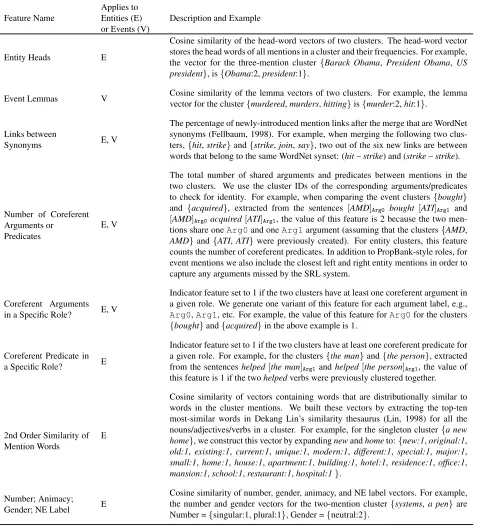
We list in Table 2 the features used by the lin-ear regression model. As the table indicates, our feature set relies heavily on semantic roles, which were extracted using the SwiRL semantic role la-beling (SRL) system (Surdeanu et al., 2007).3 Be-cause SwiRL addresses only verbal predicates, we extended it to handle nominal predicates. In this
Feature Name
Applies to Entities (E) or Events (V)
Description and Example
Entity Heads E
Cosine similarity of the head-word vectors of two clusters. The head-word vector stores the head words of all mentions in a cluster and their frequencies. For example, the vector for the three-mention cluster {Barack Obama, President Obama, US president}, is{Obama:2,president:1}.
Event Lemmas V Cosine similarity of the lemma vectors of two clusters. For example, the lemma vector for the cluster{murdered,murders,hitting}is{murder:2,hit:1}.
Links between
Synonyms E, V
The percentage of newly-introduced mention links after the merge that are WordNet synonyms (Fellbaum, 1998). For example, when merging the following two clus-ters,{hit,strike}and{strike,join,say}, two out of the six new links are between words that belong to the same WordNet synset: (hit–strike) and (strike–strike).
Number of Coreferent Arguments or
Predicates
E, V
The total number of shared arguments and predicates between mentions in the two clusters. We use the cluster IDs of the corresponding arguments/predicates to check for identity. For example, when comparing the event clusters{bought} and {acquired}, extracted from the sentences [AMD]Arg0 bought [ATI]Arg1 and
[AMD]Arg0acquired[ATI]Arg1, the value of this feature is 2 because the two
men-tions share oneArg0and oneArg1argument (assuming that the clusters{AMD,
AMD}and{ATI,ATI}were previously created). For entity clusters, this feature counts the number of coreferent predicates. In addition to PropBank-style roles, for event mentions we also include the closest left and right entity mentions in order to capture any arguments missed by the SRL system.
Coreferent Arguments in a Specific Role? E, V
Indicator feature set to 1 if the two clusters have at least one coreferent argument in a given role. We generate one variant of this feature for each argument label, e.g., Arg0,Arg1, etc. For example, the value of this feature forArg0for the clusters {bought}and{acquired}in the above example is 1.
Coreferent Predicate in a Specific Role? E
Indicator feature set to 1 if the two clusters have at least one coreferent predicate for a given role. For example, for the clusters{the man}and{the person}, extracted from the sentenceshelped[the man]Arg1andhelped[the person]Arg1, the value of
this feature is 1 if the twohelpedverbs were previously clustered together.
2nd Order Similarity of Mention Words
E
Cosine similarity of vectors containing words that are distributionally similar to words in the cluster mentions. We built these vectors by extracting the top-ten most-similar words in Dekang Lin’s similarity thesaurus (Lin, 1998) for all the nouns/adjectives/verbs in a cluster. For example, for the singleton cluster{a new home}, we construct this vector by expandingnewandhometo:{new:1,original:1,
old:1, existing:1, current:1, unique:1, modern:1, different:1, special:1, major:1,
small:1,home:1,house:1,apartment:1,building:1,hotel:1,residence:1,office:1,
mansion:1,school:1,restaurant:1,hospital:1}. Number; Animacy;
Gender; NE Label E
[image:6.612.74.559.54.582.2]Cosine similarity of number, gender, animacy, and NE label vectors. For example, the number and gender vectors for the two-mention cluster {systems,a pen}are Number ={singular:1, plural:1}, Gender ={neutral:2}.
Table 2: List of features used when comparing two clusters. If any of the two clusters contains a verbal mention we consider the merge an operation between event (V) clusters; otherwise it is a merge between entity (E) clusters. We append to all entity features the suffixProperorCommonbased on the type of the head word of the first mention in each of the two clusters. We use the suffixProperonly if both head words are proper nouns.
paper we used a single heuristic: the possessor of a nominal event’s predicate is marked as itsArg0,
e.g.,Loganis theArg0toruninLogan’s run.4
4
We extracted named entity labels using the named entity recognizer from the Stanford CoreNLP suite.
6 Evaluation
6.1 Corpus
The training and test data sets were derived from the EventCorefBank (ECB) corpus5 created by Be-jan and Harabagiu (2010) to study event coreference since standard corpora such as OntoNotes (Pradhan et al., 2007) contain a small number of annotated event clusters. The ECB corpus consists of 482 doc-uments from Google News clustered into 43 topics, where a topic is described as a seminal event. The reason for including comparable documents was to increase the number of cross-document coreference relations. Bejan and Harabagiu (2010) only anno-tated a selection of events.
For the purpose of our study, we extended the original corpus in two directions: (i) fully anno-tated sentences, and (ii) entity coreference relations. In addition, we removed relations other than coref-erence (e.g., subevent, purpose, related, etc.) that had been originally annotated. We revised and com-pleted the original annotation by annotating every entity and event in the sentences that were (partially) annotated. The annotation was performed by four experts, using the Callisto annotation tool.6 The annotation guidelines and the generated corpus are available here.7
Our annotation of the ECB corpus followed the OntoNotes (Pradhan et al., 2007) standard for coref-erence annotation, with a few extensions to handle events. For nouns, we annotated full NPs (with all modifiers), excluding appositive phrases and nomi-nal predicates. Only premodifiers that were proper nouns or possessive phrases were annotated. For events, we annotated the semantic head of the verb phrase. We extended the OntoNotes guidelines by also annotating singletons (but we do not score them; see below), and by including all events men-tions (not only those mentioned at least once with an NP). This required us to be specific with respect to:
5http://faculty.washington.edu/bejan/
data/ECB1.0.tar.gz
6http://callisto.mitre.org 7http://nlp.stanford.edu/pubs/
jcoref-corpus.zip
Training Dev Test Total
# Topics 12 3 28 43
# Documents 112 39 331 482
# Entities 459 46 563 1068
# Entity Mentions 1723 259 3465 5447
# Events 300 30 444 774
[image:7.612.313.549.55.140.2]# Event Mentions 751 140 1642 2533
Table 3: Corpus statistics.
hENTITY COREFID=“26”i A publicist h/ENTITYi hEVENT COREFID=“4”i says h/EVENTi hENTITY COREFID=“23”i
Tara Reid h/ENTITYi has hEVENT COREFID=“3”i checked
h/EVENTi hENTITY COREFID=“23”iherselfh/ENTITYi hEVENT COREFID=“3*”iintoh/EVENTi hENTITY COREFID=“28”irehab
h/ENTITYi.
Figure 1: Annotation example.
Light verbs Verbs such asgiveandmakefollowed by a noun (e.g.,make an offer) were not anno-tated, but the noun was.
Phrasal verbs We annotated the verb together with the preposition or adverb (e.g.,check in).
Idioms They were annotated with all their elements (e.g.,booze it up).
The first topic was annotated by all four anno-tators as burn-in. Afterwards, annotation disagree-ments were resolved between all annotators and the next three topics were annotated again by all four an-notators to measure agreement. Following Passon-neau (2004), we computed an inter-annotator agree-ment of α = 0.55 (Krippendorff, 2004) on these three topics, indicating moderate agreement among the annotators. Given the complexity of the task, we consider this to be a good score. For example, the average of the CoNLL F1 between any two annota-tors is 73.58, which is much higher than the system scores reported in the literature.
MUC B3 CEAF-φ4 BLANC
System R P F1 R P F1 R P F1 R P F1 CoNLL F1
Baseline 1 Wo/ SRL
Entity 47.4 72.3 57.2 44.1 82.7 57.5 42.5 21.9 28.9 60.1 78.3 64.8 47.9 Event 56.0 56.8 56.4 59.8 71.9 65.3 32.2 31.6 31.9 63.5 68.8 65.7 51.2 Both 49.9 75.4 60.0 44.9 83.9 58.5 46.2 23.3 31.0 60.9 81.2 66.1 49.8 Baseline 2
With SRL
Entity 52.7 73.0 61.2 48.6 80.8 60.7 41.8 24.1 30.6 63.4 78.4 68.2 50.8 Event 59.2 57.0 58.1 62.3 70.8 66.3 31.5 33.2 32.3 65.4 68.0 66.6 52.2 Both 54.5 76.4 63.7 48.7 82.6 61.3 46.3 25.5 32.9 63.9 81.1 69.2 52.6
This paper
Entity 60.7 70.6 65.2 55.5 74.9 63.7 39.3 29.5 33.7 66.9 79.6 71.5 54.2
Event 62.7 62.8 62.7 62.5 73.9 67.7 34.0 33.9 33.9 67.6 78.5 71.7 54.8
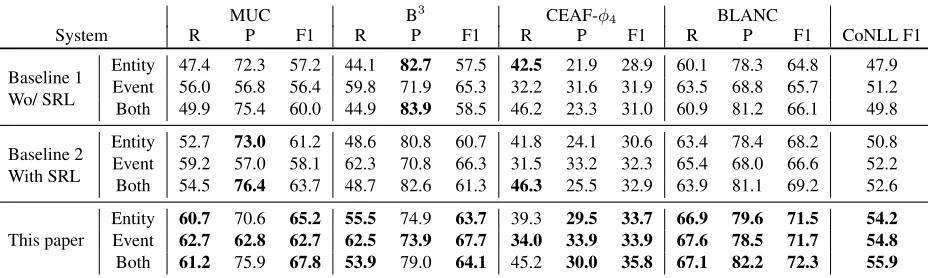
[image:8.612.74.538.55.194.2]Both 61.2 75.9 67.8 53.9 79.0 64.1 45.2 30.0 35.8 67.1 82.2 72.3 55.9 Table 4: Performance of the two baselines and our model. We report scores for entity clusters, event clusters and the complete task using five metrics.
6.2 Evaluation
We use five coreference evaluation metrics widely used in the literature:
MUC (Vilain et al., 1995) Link-based metric which measures how many predicted and gold clus-ters need to be merged to cover the gold and predicted clusters, respectively.
B3 (Bagga and Baldwin, 1998) Mention-based metric which measures the proportion of over-lap between predicted and gold clusters for a given mention.
CEAF (Luo, 2005) Entity-based metric that, unlike B3, enforces a one-to-one alignment between gold and predicted clusters. We employ the entity-based version of CEAF.
BLANC (Recasens and Hovy, 2011) Metric based on the Rand index (Rand, 1971) that consid-ers both coreference and non-coreference links to address the imbalance between singleton and coreferent mentions.
CoNLL F1 Average of MUC, B3, and CEAF-φ4. This was the official metric in the CoNLL-2011 shared task (Pradhan et al., 2011).
We followed the CoNLL-2011 evaluation methodol-ogy, that is, we removed all singleton clusters, and apposition/copular relations before scoring.
We evaluated the systems on three different set-tings: only on entity clusters, only on event clus-ters, and on the complete task, i.e., both entities and events. Note that the gold corpus separates clusters into entity and event clusters (see Table 3), but our
system does not make this distinction at runtime. In order to compute the entity-only and event-only scores in Table 4, we implemented the following procedure: (a) when scoring entity clusters, we re-moved all mentions that were found to be coreferent with at least one gold event mention and not coref-erent with any gold entity mentions; and (b) we per-formed the opposite action when scoring event clus-ters. This procedure is necessary because our men-tion identificamen-tion component is not perfect, i.e., it generates mentions that do not exist in the gold an-notation. Furthermore, this procedure is conserva-tive with respect to the clustering errors of our sys-tem, e.g., all spurious mentions that our system in-cludes in a cluster with a gold entity mention are considered for the entity score, regardless of their gold type (event or entity).
6.3 Results
Table 4 compares the performance of our system against two strong baselines that resolve entities and events separately. Baseline 1 uses a modified Stan-ford coreference resolution system after our doc-ument clustering and mention identification steps. Because the original Stanford system implements only entity coreference, we extended it with an extra sieve that implements lemma matching for events. This additional sieve merges two verbal clusters (i.e., clusters that contain at least one verbal men-tion) or a verbal and a nominal cluster when at least two lemmas of mention head words are the same be-tween clusters, e.g.,helpedandthe help.
contextual information using semantic roles. The first sieve merges two nominal clusters when two mentions in the respective clusters have the same head words and two mentions (possibly with dif-ferent heads) modify with the same role label two predicates that have the same lemma. For exam-ple, this sieve merges the clusters{Obama,the pres-ident} (seen in the text [Obama]Arg0 attended and
[the president]Arg1was elected) and{Obama}(seen in the text[Obama]Arg1 was elected), because they share a mention with the same head word (Obama) and two mentions modify with the same role (Arg1) predicates with the same lemma (elect). The sec-ond sieve implements the complementary action for event clusters. That is, it merges two verbal clusters when at least two mentions have the same lemma and at least two mentions have semantic arguments with the same role label and the same lemma.
7 Discussion
The first block in Table 4 indicates that lemma matching is a strong baseline for event resolution. Most of the event scores for Baseline 1 are actually higher than the corresponding entity scores, which were obtained using the highest ranked system at the CoNLL-2011 shared task (Lee et al., 2011). Adding contextual information using semantic roles (Base-line 2) helps both entities and events. The CoNLL F1 for Baseline 2 increases almost 3 points for enti-ties and 1 point for events. This demonstrates that local syntactico-semantic context is important for coreference resolution even in a cross-document set-ting and that the current state-of-the-art in SRL can model this context accurately.
The best scores (almost unanimously) are ob-tained by the model proposed in this paper, which scores 3.4 CoNLL F1 points higher than Baseline 2 for entities, and 2.6 points higher for events. For the complete task, our approach scores 3.3 CoNLL F1 points higher than Baseline 2, and 6.1 points higher than Baseline 1. This demonstrates that a holistic approach to coreference resolution improves the res-olution of both entities and events more than models that address aspects of the task separately. To fur-ther understand our experiments, we listed the top five entity/event features with the highest weights in our model in Table 5. The table indicates that six out of the ten features serve the purpose of passing
infor-Entity Feature Weight
Entity Heads – Proper 1.10
Coreferent Predicate forArgM-LOC– Common 0.45
Entity Heads – Common 0.36
Coreferent Predicate forArg0– Proper 0.29 Coreferent Predicate forArg2– Common 0.28
Event Feature Weight
Event Lemmas 0.45
Coreferent Argument forArg1 0.19
Links between Synonym 0.16
[image:9.612.314.540.58.212.2]Coreferent Argument forArg2 0.13 Number of Coreferent Arguments 0.07
Table 5: Top five features with the highest weights.
mation between entity and event clusters. For exam-ple, the “Coreferent Argument forArg1” feature is triggered when two event clusters haveArg1 argu-ments that already belong to the same entity cluster. This allows information from previous entity coref-erence operations to impact future merges of event clusters. This is the crux of our iterative approach to joint coreference resolution.
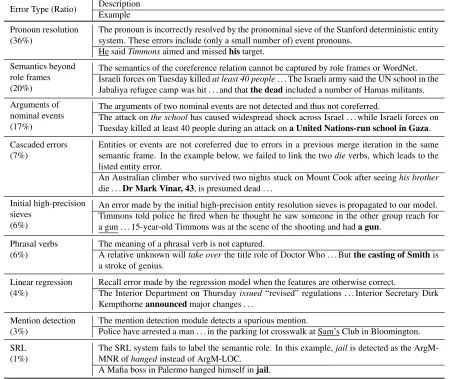
Finally, we performed an error analysis by man-ually evaluating 100 errors. We distinguished nine major types of errors. Their ratios together with a description and an example are given in Table 6.
This work demonstrates that an approach that jointly models entities and events is better for cross-document coreference resolution. However, our model can be improved. For example, document clustering and coreference resolution can be solved jointly, which we expect would improve both tasks. Furthermore, our iterative coreference resolution procedure (Algorithm 1) could be modified to ac-count for mention ordering and distance, which would allow us to include pronominal resolution in our joint model, rather than addressing it with a sep-arate deterministic sieve.
8 Conclusion
Error Type (Ratio) Description Example Pronoun resolution
(36%)
The pronoun is incorrectly resolved by the pronominal sieve of the Stanford deterministic entity system. These errors include (only a small number of) event pronouns.
He saidTimmonsaimed and missedhistarget. Semantics beyond
role frames (20%)
The semantics of the coreference relation cannot be captured by role frames or WordNet. Israeli forces on Tuesday killedat least 40 people. . . The Israeli army said the UN school in the Jabaliya refugee camp was hit . . . and thatthe deadincluded a number of Hamas militants. Arguments of
nominal events (17%)
The arguments of two nominal events are not detected and thus not coreferred.
The attack onthe schoolhas caused widespread shock across Israel . . . while Israeli forces on Tuesday killed at least 40 people during an attack ona United Nations-run school in Gaza. Cascaded errors
(7%)
Entities or events are not coreferred due to errors in a previous merge iteration in the same semantic frame. In the example below, we failed to link the twodieverbs, which leads to the listed entity error.
An Australian climber who survived two nights stuck on Mount Cook after seeinghis brother
die . . .Dr Mark Vinar, 43, is presumed dead . . . Initial high-precision
sieves (6%)
An error made by the initial high-precision entity resolution sieves is propagated to our model. Timmons told police he fired when he thought he saw someone in the other group reach for a gun . . . 15-year-old Timmons was at the scene of the shooting and hada gun.
Phrasal verbs (6%)
The meaning of a phrasal verb is not captured.
A relative unknown willtake overthe title role of Doctor Who . . . Butthe casting of Smithis a stroke of genius.
Linear regression (4%)
Recall error made by the regression model when the features are otherwise correct.
The Interior Department on Thursdayissued“revised” regulations . . . Interior Secretary Dirk Kempthorneannouncedmajor changes . . .
Mention detection (3%)
The mention detection module detects a spurious mention.
Police have arrested a man . . . in the parking lot crosswalk at Sam’s Club in Bloomington. SRL
(1%)
The SRL system fails to label the semantic role. In this example,jailis detected as the ArgM-MNR ofhangedinstead of ArgM-LOC.
[image:10.612.68.518.59.438.2]A Mafia boss in Palermo hanged himself injail.
Table 6: Error analysis. Mentions to be resolved are inbold face, correct antecedents are initalics, and our system’s predictions are underlined.
merging state to benefit from the previous merged entity and event mentions. This approach allows us to start with a set of high-precision coreference rela-tions and gradually add new ones to increase recall.
The experimental evaluation shows that our coref-erence algorithm gives markedly better F1 for both entities and events, outperforming two strong base-lines that handle entities and events separately, mea-sured by all the standard measures: MUC, B3, CEAF-φ4, BLANC and the official CoNLL-2011 metric. This is noteworthy since each measure has been shown to place primary emphasis in evaluating a different aspect of the coreference resolution task.
Our system is tailored for cross-document coref-erence resolution on a corpus that contains news ar-ticles that repeatedly report on a smaller number of topics. This makes it particularly suitable for
real-world applications such as multi-document summa-rization and cross-document information extraction. We also release our labeled corpus to facilitate ex-tensions and comparisons to our work.
Acknowledgements
References
Amit Bagga and Breck Baldwin. 1998. Algorithms for scoring coreference chains. In Proceedings of
the LREC 1998 Workshop on Linguistic Coreference,
pages 563–566.
Amit Bagga and Breck Baldwin. 1999. Cross-document event coreference: Annotations, experiments, and ob-servations. InProceedings of the ACL 1999 Workshop
on Coreference and Its Applications, pages 1–8.
Cosmin Bejan and Sanda Harabagiu. 2010. Unsuper-vised Event Coreference Resolution with Rich Lin-guistic Features. InProceedings of ACL 2010, pages 1412–1422.
Eric Brill. 1995. Transformation-based error-driven learning and natural language processing: a case study in part of speech tagging. Computational Linguistics, 21(4):543–565.
Zheng Chen and Heng Ji. 2009. Graph-based event coreference resolution. In Proceedings of the ACL-IJCNLP 2009 Workshop on Graph-based Methods for
Natural Language Processing, pages 54–57.
Pascal Denis and Jason Baldridge. 2007. Joint determi-nation of anaphoricity and coreference resolution us-ing integer programmus-ing. InProceedings of
NAACL-HLT 2007.
Christiane Fellbaum. 1998. WordNet: An Electronic
Lexical Database. MIT Press, Cambridge.
Aria Haghighi and Dan Klein. 2009. Simple coreference resolution with rich syntactic and semantic features. In
Proceedings of EMNLP 2009, pages 1152–1161.
Aria Haghighi and Dan Klein. 2010. Coreference resolu-tion in a modular, entity-centered model. In
Proceed-ings of HLT-NAACL 2010, pages 385–393.
Tian He. 2007. Coreference Resolution on Entities and
Events for Hospital Discharge Summaries. Thesis,
Massachusetts Institute of Technology.
Jerry R. Hobbs. 1978. Resolving pronoun references.
Lingua, 44(4):311–338.
Kevin Humphreys, Robert Gaizauskas, and Saliha Az-zam. 1997. Event coreference for information extrac-tion. InProceedings of the Workshop On Operational Factors In Practical Robust Anaphora Resolution For
Unrestricted Texts, pages 75–81.
Klaus Krippendorff. 2004. Content Analysis: An
In-troduction to its Methodology. Sage, Thousand Oaks,
CA, second edition.
Heeyoung Lee, Yves Peirsman, Angel Chang, Nathanael Chambers, Mihai Surdeanu, and Dan Jurafsky. 2011. Stanford’s multi-pass sieve coreference resolution sys-tem at the CoNLL-2011 shared task. InProceedings
of CoNLL 2011: Shared Task, pages 28–34.
Dekang Lin. 1998. Automatic retrieval and clustering of similar words. InProceedings of COLING-ACL 1998, pages 768–774.
Xiaoqiang Luo. 2005. On coreference resolution perfor-mance metrics. InProceedings of HLT-EMNLP 2005, pages 25–32.
A. Meyers, R. Reeves, C. Macleod, R. Szekely, V. Zielin-ska, B. Young, and R. Grishman. 2004. The Nom-Bank project: an interim report. InProceedings of the HLT-NAACL 2004 Workshop on Frontiers in Corpus
Annotation, pages 24–31.
Rebecca Passonneau. 2004. Computing reliability for coreference annotation. In Proceedings of LREC 2004, pages 1503–1506.
Simone Paolo Ponzetto and Michael Strube. 2006. Exploiting semantic role labeling, WordNet and Wikipedia for coreference resolution. InProceedings
of HLT-NAACL 2006, pages 192–199.
Hoifung Poon and Pedro Domingos. 2008. Joint unsu-pervised coreference resolution with Markov logic. In
Proceedings of EMNLP 2008, pages 650–659.
Sameer S. Pradhan, Lance Ramshaw, Ralph Weischedel, Jessica MacBride, and Linnea Micciulla. 2007. Un-restricted coreference: Identifying entities and events in OntoNotes. InProceedings of ICSC 2007, pages 446–453.
Sameer Pradhan, Lance Ramshaw, Mitchell Marcus, Martha Palmer, Ralph Weischedel, and Nianwen Xue. 2011. CoNLL-2011 shared task: Modeling unre-stricted coreference in OntoNotes. InProceedings of
CoNLL 2011: Shared Task, pages 1–27.
Karthik Raghunathan, Heeyoung Lee, Sudarshan Ran-garajan, Nathanael Chambers, Mihai Surdeanu, Dan Jurafsky, and Chris Manning. 2010. A multi-pass sieve for coreference resolution. In Proceedings of
EMNLP 2010, pages 492–501.
Altaf Rahman and Vincent Ng. 2011. Coreference resolution with world knowledge. InProceedings of
ACL 2011, pages 814–824.
William M. Rand. 1971. Objective criteria for the eval-uation of clustering methods.Journal of the American
Statistical Association, 66(336):846–850.
Marta Recasens and Eduard Hovy. 2011. BLANC: Im-plementing the Rand index for coreference evaluation.
Natural Language Engineering, 17(4):485–510.
Veselin Stoyanov, Nathan Gilbert, Claire Cardie, and Ellen Riloff. 2009. Conundrums in noun phrase coref-erence resolution: Making sense of the state-of-the-art.
InProceedings of ACL-IJCNLP 2009, pages 656–664.
Mihai Surdeanu, Llu´ıs M`arquez, Xavier Carreras, and Pere R. Comas. 2007. Combination strategies for se-mantic role labeling. Journal of Artificial Intelligence
Research, 29:105–151.
Marc Vilain, John Burger, John Aberdeen, Dennis Con-nolly, and Lynette Hirschman. 1995. A model-theoretic coreference scoring scheme. InProceedings
of MUC-6, pages 45–52.
Bonnie Lynn Webber. 1988. Discourse deixis: reference to discourse segments. InProceedings of ACL 1988, pages 113–122.
Michael L. Wick, Khashayar Rohanimanesh, Karl Schultz, and Andrew McCallum. 2008. A unified ap-proach for schema matching, coreference and canoni-calization. InProceedings of KDD 2008, pages 722– 730.
David Yarowsky. 1995. Unsupervised word sense dis-ambiguation rivaling supervised methods. In