SMT Helps Bitext Dependency Parsing
Wenliang Chen†‡, Jun’ichi Kazama‡, Min Zhang†, Yoshimasa Tsuruoka∗‡,
Yujie Zhang?‡, Yiou Wang‡, Kentaro Torisawa‡and Haizhou Li†
†Human Language Technology, Institute for Infocomm Research, Singapore
‡National Institute of Information and Communications Technology (NICT), Japan
∗School of Information Science, JAIST, Japan
?Beijing Jiaotong University, China
{wechen, mzhang, hli}@i2r.a-star.edu.sg
{kazama, torisawa, yujie, wangyiou}@nict.go.jp
Abstract
We propose a method to improve the accuracy of parsing bilingual texts (bitexts) with the help of statistical machine translation (SMT) systems. Previous bitext parsing methods use human-annotated bilingual treebanks that are hard to obtain. Instead, our approach uses an auto-generated bilingual treebank to produce bilingual constraints. However, because the auto-generated bilingual treebank contains er-rors, the bilingual constraints are noisy. To overcome this problem, we use large-scale unannotated data to verify the constraints and design a set of effective bilingual features for parsing models based on the verified results. The experimental results show that our new parsers significantly outperform state-of-the-art baselines. Moreover, our approach is still able to provide improvement when we use a larger monolingual treebank that results in a much stronger baseline. Especially notable is that our approach can be used in a purely monolingual setting with the help of SMT.
1 Introduction
Recently there have been several studies aiming to improve the performance of parsing bilingual texts (bitexts) (Smith and Smith, 2004; Burkett and Klein, 2008; Huang et al., 2009; Zhao et al., 2009; Chen et al., 2010). In bitext parsing, we can use the in-formation based on “bilingual constraints” (Burkett and Klein, 2008), which do not exist in monolingual sentences. More accurate bitext parsing results can be effectively used in the training of syntax-based machine translation systems (Liu and Huang, 2010). Most previous studies rely on bilingual treebanks to provide bilingual constraints for bitext parsing.
Burkett and Klein (2008) proposed joint models on bitexts to improve the performance on either or both sides. Their method uses bilingual treebanks that have human-annotated tree structures on both sides. Huang et al. (2009) presented a method to train a source-language parser by using the reordering in-formation on words between the sentences on two sides. It uses another type of bilingual treebanks that have tree structures on the source sentences and their human-translated sentences. Chen et al. (2010) also used bilingual treebanks and made use of tree structures on the target side. However, the bilingual treebanks are hard to obtain, partly because of the high cost of human translation. Thus, in their experi-ments, they applied their methods to a small data set, the manually translated portion of the Chinese Tree-bank (CTB) which contains only about 3,000 sen-tences. On the other hand, many large-scale mono-lingual treebanks exist, such as the Penn English Treebank (PTB) (Marcus et al., 1993) (about 40,000 sentences in Version 3) and the latest version of CTB (over 50,000 sentences in Version 7).
In this paper, we propose a bitext parsing ap-proach in which we produce the bilingual constraints on existing monolingual treebanks with the help of SMT systems. In other words, we aim to improve source-language parsing with the help of automatic translations.
In our approach, we first use an SMT system to translate the sentences of a source monolingual treebank into the target language. Then, the target sentences are parsed by a parser trained on a tar-get monolingual treebank. We then obtain a bilin-gual treebank that has human annotated trees on the source side and auto-generated trees on the target side. Although the sentences and parse trees on the
target side are not perfect, we expect that we can improve bitext parsing performance by using this newly auto-generated bilingual treebank. We build word alignment links automatically using a word alignment tool. Then we can produce a set of bilin-gual constraints between the two sides.
Because the translation, parsing, and word align-ment are done automatically, the constraints are not reliable. To overcome this problem, we verify the constraints by using large-scale unannotated mono-lingual sentences and bimono-lingual sentence pairs. Fi-nally, we design a set of bilingual features based on the verified results for parsing models.
Our approach uses existing resources including monolingual treebanks to train monolingual parsers on both sides, bilingual unannotated data to train SMT systems and to extract bilingual subtrees, and target monolingual unannotated data to extract monolingual subtrees. In summary, we make the fol-lowing contributions:
• We propose an approach that uses an auto-generated bilingual treebank rather than human-annotated bilingual treebanks used in previous studies (Burkett and Klein, 2008; Huang et al., 2009; Chen et al., 2010). The auto-generated bilingual treebank is built with the help of SMT systems.
• We verify the unreliable constraints by using the existing large-scale unannotated data and design a set of effective bilingual features over the verified results. Compared to Chen et al. (2010) that also used tree structures on the tar-get side, our approach defines the features on the auto-translated sentences and auto-parsed trees, while theirs generates the features by some rules on the human-translated sentences.
• Our parser significantly outperforms state-of-the-art baseline systems on the standard test data of CTB containing about 3,000 sentences. Moreover, our approach continues to achieve improvement when we build our system us-ing the latest version of CTB (over 50,000 sen-tences) that results in a much stronger baseline.
• We show the possibility that we can improve the performance even if the test set has no hu-man translation. This means that our proposed
approach can be used in a purely monolingual setting with the help of SMT. To our knowl-edge, this paper is the first one that demon-strates this widened applicability, unlike the previous studies that assumed that the parser is applied only on the bitexts made by humans. Throughout this paper, we use Chinese as the source language and English as the target language. The rest of this paper is organized as follows. tion 2 introduces the motivation of this work. Sec-tion 3 briefly introduces the parsing model used in the experiments. Section 4 describes a set of bilin-gual features based on the bilinbilin-gual constraints and Section 5 describes how to use large-scale unanno-tated data to verify the bilingual constraints and de-fine another set of bilingual features based on the verified results. Section 6 explains the experimental results. Finally, in Section 7 we draw conclusions.
2 Motivation
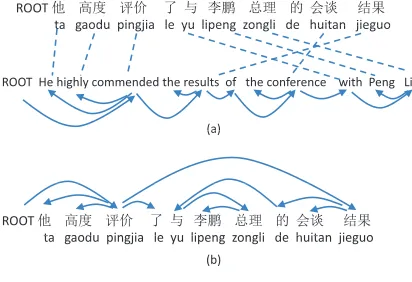
Here, bitext parsing is the task of parsing source sen-tences with the help of their corresponding transla-tions. Figure 1-(a) shows an example of the input of bitext parsing, where ROOT is an artificial root token inserted at the beginning and does not depend on any other token in the sentence, the dashed unrected links are word alignment links, and the di-rected links between words indicate that they have a dependency relation. Given such inputs, we build dependency trees for the source sentences. Figure 1-(b) shows the output of bitext parsing for the ex-ample in 1-(a).
ROOT!Ԇ 儈ᓖ 䇴ԧ Ҷ о ᵾ呿 ᙫ⨶ Ⲵ Պ䈸 㔃᷌
ta gaodu pingjia le yu lipeng zongli de huitan jieguo ta gaodu pingjia le!!yu lipeng zongli de!!!huitan jieguo
ROOT H hi hl d d h l f h f i h P Li ROOT!!He!highly!commended!the!results!!of!!!the!conference!!!!with!!Peng Li
(a) (a)
ROOT!Ԇ 儈ᓖ 䇴ԧ Ҷ о ᵾ呿 ᙫ⨶ Ⲵ Պ䈸 㔃᷌
ta gaodu pingjia le yu lipeng zongli de huitan jieguo ta gaodu pingjia le!!yu lipeng zongli de!!huitan jieguo
[image:2.612.326.532.503.644.2](b)
Figure 1: Input and output of our approach
target side. These differences are expected to help improve source-side parsing.
Suppose we have a Chinese sentence shown in Figure 2-(a). In this sentence, there is a nomi-nalization case (Li and Thompson, 1997) in which the particle “的(de)/nominalizer” is placed after the
verb compound “培育(peiyu)起来(qilai)/cultivate”
to modify “技 巧(jiqiao)/skill”. This
nominaliza-tion is a relative clause, but does not have a clue about its boundary. That is, it is very hard to deter-mine which word is the head of “技巧(jiqiao)/skill”.
The head may be “发挥(fahui)/demonstrate” or “培 育(peiyu)/cultivate”, as shown in Figure 2-(b) and
-(c), where (b) is correct.
Ԇ ᐼᵋ ޘփ 䘀ࣘઈ ݵ࠶ ਁᥕ ᒣᰦ ษ㛢 䎧ᶕ Ⲵ ࣋䟿 ઼ ᢰᐗ
ta xiwang quanti yundongyuan chongfeng fahui pingshi peiyu qilai de!!liliang he!jiqiao PN!!!!!!!VV!!!!!!!!!DT!!!!!!!!!!!!!!!NN!!!!!!!!!!!!!!!AD!!!!!!!!!!!!!!VV!!!!!!AD!!!!!!!VV!!!!VV DEC NN!!!!CC!!!NN
(a)
Ԇ ᐼᵋ ޘփ 䘀ࣘઈ ݵ࠶ ਁᥕ ᒣᰦ ษ㛢 䎧ᶕ Ⲵ ࣋䟿 ઼ ᢰᐗ
ta xiwang quanti yundongyuan chongfeng fahui pingshi peiyu qilai de!!liliang he!jiqiao (b)
Ԇ ᐼᵋ ޘփ 䘀ࣘઈ ݵ࠶ ਁᥕ ᒣᰦ ษ㛢 䎧ᶕ Ⲵ ࣋䟿 ઼ ᢰᐗ
ta xiwang quanti yundongyuan chongfeng fahui pingshi peiyu qilai de!!liliang he!jiqiao (c)
Figure 2: Example of an ambiguity on the Chinese side
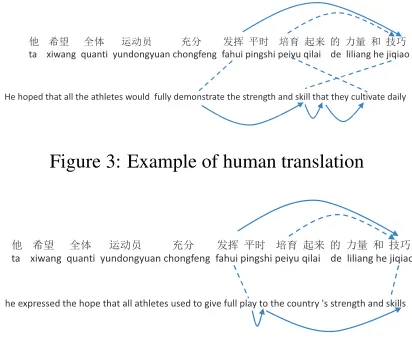
In its English translation (Figure 3), word “that” is a clue indicating the relative clause which shows the relation between “skill” and “cultivate”, as shown in Figure 3. The figure shows that the translation can provide useful bilingual constraints. From the de-pendency tree on the target side, we find that the word “skill” corresponding to “技 巧(jiqiao)/skill”
depends on the word “demonstrate” corresponding to “发挥(fahui)/demonstrate”, while the word
“cul-tivate” corresponding to “培育(peiyu)/cultivate” is a
grandchild of “skill”. This is a positive evidence for supporting “发挥(fahui)/demonstrate” as being the
head of “技巧(jiqiao)/skill”.
The above case uses the human translation on the target side. However, there are few human-annotated bilingual treebanks and the existing bilin-gual treebanks are usually small. In contrast, there are large-scale monolingual treebanks, e.g., the PTB and the latest version of CTB. So we want to use existing resources to generate a bilingual treebank with the help of SMT systems. We hope to improve source side parsing by using this newly built bilin-gual treebank.
Ԇ ᐼᵋ ޘփ 䘀ࣘઈ ݵ࠶ ਁᥕ ᒣᰦ ษ㛢 䎧ᶕ Ⲵ ࣋䟿 ઼ ᢰᐗ
Ԇ ᐼᵋ ޘփ 䘀ࣘઈ ݵ࠶ ਁᥕ ᒣᰦ ษ㛢 䎧ᶕ Ⲵ ࣋䟿 ઼ ᢰᐗ
ta xiwang quanti yundongyuan chongfeng fahui pingshi peiyu qilai de!!liliang he!jiqiao
[image:3.612.323.529.49.222.2]He!hoped!that!all!the!athletes!would!!fully!demonstrate!the!strength!and!skill!that!they!cultivate!daily
Figure 3: Example of human translation
Ԇ ᐼᵋ ޘփ 䘀ࣘઈ ݵ࠶ ਁᥕ ᒣᰦ ษ㛢 䎧ᶕ Ⲵ ࣋䟿 ઼ ᢰᐗ
Ԇ ᐼᵋ ޘփ 䘀ࣘઈ ݵ࠶ ਁᥕ ᒣᰦ ษ㛢 䎧ᶕ Ⲵ ࣋䟿 ઼ ᢰᐗ
ta xiwang quanti yundongyuan chongfeng fahui pingshi peiyu qilai de!!liliang he!jiqiao
[image:3.612.86.295.245.354.2]he!expressed!the!hope!that!all!athletes!used!to!give!full!play!to!the!country!'s!strength!and!skills!
Figure 4: Example of Moses translation
Figure 4 shows an example of a translation us-ing a Moses-based system, where the target sen-tence is parsed by a monolingual target parser. The translation contains some errors, but it does contain some correct parts that can be used for disambigua-tion. In the figure, the word “skills” corresponding to “技巧(jiqiao)/skill” is a grandchild of the word
“play” corresponding to “发挥(fahui)/demonstrate”.
This is a positive evidence for supporting “发 挥(fahui)/demonstrate” as being the head of “技 巧(jiqiao)/skill”.
From this example, although the sentences and parse trees on the target side are not perfect, we still can explore useful information to improve bitext parsing. In this paper, we focus on how to design a method to verify such unreliable bilingual con-straints.
3 Parsing model
In this paper, we implement our approach based on graph-based parsing models (McDonald and Pereira, 2006; Carreras, 2007). Note that our ap-proach can also be applied to transition-based pars-ing models (Nivre, 2003; Yamada and Matsumoto, 2003).
s(x, y) =X
g∈y
score(w, x, g) =X
g∈y
w·f(x, g) (1)
where x is an input sentence,y is a dependency tree forx, andgis a spanning subgraph ofy.f(x, g)
can be based on arbitrary features of the subgraph and the input sequence x and the feature weight vectorware the parameters to be learned by using MIRA (Crammer and Singer, 2003) during training. In our approach, we use two types of features for the parsing model. One is monolingual fea-tures based on the source sentences. The mono-lingual features include the first- and second- order features presented in McDonald and Pereira (2006) and the parent-child-grandchild features used in Car-reras (2007). The other one is bilingual features (de-scribed in Sections 4 and 5) that consider the bilin-gual constraints.
We call the parser with the monolingual features on the source side Parsers, and the parser with the
monolingual features on the target side Parsert.
4 Original bilingual features
In this paper, we generate two types of bilingual fea-tures, original and verified bilingual features. The original bilingual features (described in this section) are based on the bilingual constraints without being verified by large-scale unannotated data. And the verified bilingual features (described in Section 5) are based on the bilingual constraints verified by us-ing large-scale unannotated data.
4.1 Auto-generated bilingual treebank
Assuming that we have monolingual treebanks on the source side, an SMT system that can translate the source sentences into the target language, and a Parserttrained on the target monolingual treebank.
We first translate the sentences of the source monolingual treebank into the target language using the SMT system. Usually, SMT systems can output the word alignment links directly. If they can not, we perform word alignment using some publicly avail-able tools, such as Giza++ (Och and Ney, 2003) or Berkeley Aligner (Liang et al., 2006; DeNero and Klein, 2007). The translated sentences are parsed by the Parsert. Then, we have a newly auto-generated
bilingual treebank.
4.2 Bilingual constraint functions
In this paper, we focus on the first- and second-order graph models (McDonald and Pereira, 2006; Carreras, 2007). Thus we produce the constraints for bigram (a single edge) and trigram (adjacent edges) dependencies in the graph model. For the tri-gram dependencies, we consider the parent-sibling and parent-child-grandchild structures described in McDonald and Pereira (2006) and Carreras (2007). We leave the third-order models (Koo and Collins, 2010) for a future study.
Suppose that we have a (candidate) dependency relation rs that can be a bigram or trigram
de-pendency. We examine whether the corresponding words of the source words ofrshave a dependency
relationrt in the target trees. We also consider the
direction of the dependency relation. The corre-sponding word of the head should also be the head inrt. We define a binary function for this bilingual
constraint: Fbn(rsn: rtk), wherenandk refers to
the types of the dependencies (2 for bigram and 3 for trigram). For example, inrs2 : rt3,rs2 is a bigram
dependency on the source side andrt3 is a trigram
dependency on the target side.
4.2.1 Bigram constraint function:Fb2
For rs2, we consider two types of bilingual
con-straints. The first constraint function, denoted as Fb2(rs2 : rt2), checks if the corresponding words
also have a direct dependency relation rt2. Figure
5 shows an example, where the source word “全 体(quanti)” depends on “运 动 员(yundongyuan)”
and word “all” corresponding to “全体(quanti)”
de-pends on word “athletes” corresponding to “运 动 员(yundongyuan)”. In this case, Fb2(rs2 : rt2) = +. However, when the source words are “他(ta)”
and “希望(xiwang)”, this time their corresponding
words “He” and “hope” do not have a direct depen-dency relation. In this case,Fb2(rs2:rt2) =−.
The second constraint function, denoted as Fb2(rs2 : rt3), checks if the corresponding words
form a parent-child-grandchild relation that often occurs in translation (Koehn et al., 2003). Figure 6 shows an example. The source word “技巧(jiqiao)”
depends on “发挥(fahui)” while its corresponding
word “skills” indirectly depends on “play” which corresponds to “发挥(fahui)” via “to”. In this case,
Ԇ ᐼᵋ ޘփ 䘀ࣘઈ ݵ࠶ ਁᥕ ᒣᰦ ษ㛢 䎧ᶕ Ⲵ ࣋䟿 ઼ ᢰᐗ
Ԇ ᐼᵋ ޘփ 䘀ࣘઈ ݵ࠶ ਁᥕ ᒣᰦ ษ㛢 䎧ᶕ Ⲵ ࣋䟿 ઼ ᢰᐗ
ta xiwang quanti yundongyuan chongfeng fahui pingshi peiyu qilai de!!liliang he!jiqiao
he!expressed!the!hope!that!all!athletes!used!to!give!full!play!to!the!country!'s!strength!and!skills!
Figure 5: Example of bilingual constraints (2to2)
Ԇ ᐼᵋ ޘփ 䘀ࣘઈ ݵ࠶ ਁᥕ ᒣᰦ ษ㛢 䎧ᶕ Ⲵ ࣋䟿 ઼ ᢰᐗ
Ԇ ᐼᵋ ޘփ 䘀ࣘઈ ݵ࠶ ਁᥕ ᒣᰦ ษ㛢 䎧ᶕ Ⲵ ࣋䟿 ઼ ᢰᐗ
ta xiwang quanti yundongyuan chongfeng fahui pingshi peiyu qilai de!!liliang he!jiqiao
he!expressed!the!hope!that!all!athletes!used!to!give!full!play!to!the!country!'s!strength!and!skills!
Figure 6: Example of bilingual constraints (2to3)
4.2.2 Trigram constraint function:Fb3
For a second-order relation on the source side, we consider one type of constraint. We have three source words that form a second-order relation and all of them have the corresponding words. We define function Fb3(rs3 : rt3) for this constraint.
The function checks if the corresponding words form a trigram dependencies structure. An exam-ple is shown in Figure 7. The source words “力 量(liliang)”, “和(he)”, and “技 巧(jiqiao)” form a
parent-sibling structure, while their corresponding words “strength”, “and”, and “skills” also form a parent-sibling structure on the target side. In this case, functionFb3(rs3:rt3) = +.
Ԇ ᐼᵋ ޘփ 䘀ࣘઈ ݵ࠶ ਁᥕ ᒣᰦ ษ㛢 䎧ᶕ Ⲵ ࣋䟿 ઼ ᢰᐗ
Ԇ ᐼᵋ ޘփ 䘀ࣘઈ ݵ࠶ ਁᥕ ᒣᰦ ษ㛢 䎧ᶕ Ⲵ ࣋䟿 ઼ ᢰᐗ
ta xiwang quanti yundongyuan chongfeng fahui pingshi peiyu qilai de!!liliang he!jiqiao
he!expressed!the!hope!that!all!athletes!used!to!give!full!play!to!the!country!'s!strength!and!skills!
Figure 7: Example of bilingual constraints (3to3)
4.3 Bilingual reordering function: Fro
Huang et al. (2009) proposed features based on reordering between languages for a shift-reduce parser. They define the features based on word-alignment information to verify whether the corre-sponding words form a contiguous span to resolve shift-reduce conflicts. We also implement similar features in our system. For example, in Figure 1-(a) the source span is [会谈(huitan),结果(jieguo)],
which maps onto [results, conference]. Because no
word within this target span is aligned to a source word outside of the source span, this span is a con-tiguous span. In this case, functionFro= +,
other-wiseFro=−.
4.4 Original bilingual features
We define original bilingual features based on the bilingual constraint functions and the bilingual re-ordering function.
Table 1 lists the original features, where Dir refers to the directions1of the source-side
dependen-cies, Fb2 can be Fb2(rs2 : rt2) andFb2(rs2 : rt3), and Fb3 is Fb3(rs3 : rt3). Each line of the table defines a feature template that is a combination of functions.
First-order features Second-order features hFroi
hFb2, Diri hFb3, Diri hFb2, Dir, Froi hFb3, Dir, Froi
Table 1: Original bilingual features
We use an example to show how to generate the original bilingual features in practice. In Figure 4, we want to define the bilingual features for the bi-gram dependency (rs2) between “发挥(fahui)” and “技巧(jiqiao)”. The corresponding words form a
tri-gram relationrt3in the target dependency tree. The direction of the bigram dependency is right. Then we have feature “hFb2(rs2:rt3) = +, RIGHTi” for the second first-order feature template in Table 1.
5 Verified bilingual features
However, because the bilingual treebank is gener-ated automatically, using the bilingual constraints alone is not reliable. Therefore, in this section we verify the constraints by using large-scale unanno-tated data to overcome this problem. More specifi-cally,rtk of the constraint is verified by checking a
list of target monolingual subtrees and rsn: rtk is
verified by checking a list of bilingual subtrees. The subtrees are extracted from the large-scale unanno-tated data. The basic idea is as follows: if the de-pendency structures of a bilingual constraint can be found in the list of the target monolingual subtrees
1For the second order features,Diris the combination of
or bilingual subtrees, this constraint will probably be reliable.
We first parse the large-scale unannotated mono-lingual and bimono-lingual data. Subsequently, we ex-tract the monolingual and bilingual subtrees from the parsed data. We then verify the bilingual con-straints using the extracted subtrees. Finally, we generate the bilingual features based on the verified results for the parsing models.
5.1 Verified constraint functions
5.1.1 Monolingual target subtrees
Chen et al. (2009) proposed a simple method to extract subtrees from large-scale monolingual data and used them as features to improve monolingual parsing. Following their method, we parse large unannotated data with the Parsertand obtain the
sub-tree list (STt) on the target side. We extract two
types of subtrees: bigram (two words) subtree and trigram (three words) subtree.
H b ht b h b k
ROOT!!He!!!!!bought!!!!!a!!!!book
He!!!!!bought bought!!book!
a book b ht b k a!!!!!book
(a) (b)
[image:6.612.328.535.317.412.2]bought!!!a!!!!!book!
Figure 8: Example of monolingual subtree extraction
From the dependency tree in Figure 8-(a), we ob-tain the subtrees shown in Figure 8-(b) where the first three are bigram subtrees and the last one is a trigram subtree. After extraction, we obtain the subtree listSTt that includes two sets, one for
bi-gram subtrees, and the other one for tribi-gram sub-trees. We remove the subtrees occurring only once in the data. For each set, we assign labels to the extracted subtrees according to their frequencies by using the same method as that of Chen et al. (2009). If the frequency of a subtree is in the top 10% in the corresponding set, it is labeled HF. If the frequency is between the top 20% and 30%, it is labeled MF. We assign the label LF to the remaining subtrees. We useT ype(stt)to refer to the label of a subtree,
stt.
5.1.2 Verified target constraint function:
Fvt(rtk)
We use the extracted target subtrees to verify the rtkof the bilingual constraints. In fact,rtkis a
can-didate subtree. If the rtk is included in STt,
func-tion Fvt(rtk) = T ype(rtk), otherwise Fvt(rtk) =
ZERO. For example, in Figure 5 the bigram struc-ture of “all” and “athletes” can form a bigram sub-tree that is includedSTtand its label is HF. In this
case,Fvt(rt2) =HF.
5.1.3 Bilingual subtrees
We extract bilingual subtrees from a bilingual corpus, which is parsed by the Parsers and Parsert
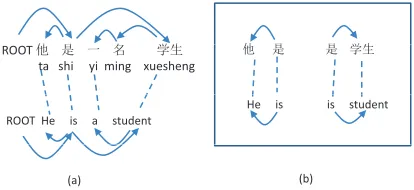
on both sides. We extract three types of bilingual subtrees: bigram-bigram (stbi22), bigram-trigram (stbi23), and trigram-trigram (stbi33) subtrees. For example,stbi22consists of a bigram subtree on the source side and a bigram subtree on the target side.
Ԇ ᱟ ᆖ⭏ Ԇ ᱟ ᱟ ᆖ⭏
ROOT!Ԇ ᱟ а ᆖ⭏ ta shi yi ming xuesheng
Ԇ ᱟ ᱟ ᆖ⭏
ROOT!!He!!!!!is!!!!!a!!!!!student
He!!!!!is is!!!!!student
(a) (b)
Figure 9: Example of bilingual subtree extraction
From the dependency tree in Figure 9-(a), we obtain the bilingual subtrees shown in Figure 9-(b). Figure 9-(b) shows the extracted bigram-bigram bilingual subtrees. After extraction, we obtain the bilingual subtreesSTbi. We remove the subtrees
oc-curring only once in the data.
5.1.4 Verified bilingual constraint function:
Fvb(rbink)
We use the extracted bilingual subtrees to verify the rsn : rtk (rbink in short) of the bilingual
con-straints. rsnandrtkform a candidate bilingual
sub-treestbink. If thestbinkis included inSTbi, function
Fvb(rbink) = +, otherwiseFvb(rbink) =−.
5.2 Verified bilingual features
[image:6.612.83.292.371.436.2]Table 2 lists the verified bilingual features used in our experiments, where each line defines a feature template that is a combination of functions.
We use an example to show how to generate the verified bilingual features in practice. In Figure 4, we want to define the verified features for the bi-gram dependency (rs2) between “发挥(fahui)” and
“技 巧(jiqiao)”. The corresponding words form a
trigram relation rt3. The direction of the bigram
dependency is right. Suppose we can find rt3 in
STt with label MF and can not find the candidate
bilingual subtree in STbi. Then we have feature
“hFb2(rs2 : rt3) = +, Fvt(rt3) = M F, RIGHTi”
for the third first-order feature template and feature “hFb2(rs2:rt3) = +, Fvb(rbi23) =−, RIGHTi” for
the fifth in Table 2.
First-order features Second-order features hFroi
hFb2, Fvt(rtk)i hFb3, Fvt(rtk)i
hFb2, Fvt(rtk), Diri hFb3, Fvt(rtk), Diri
hFb2, Fvb(rbink)i hFb3, Fvb(rbink)i
hFb2, Fvb(rbink), Diri hFb3, Fvb(rbink), Diri
[image:7.612.356.503.151.191.2]hFb2, Fro, Fvb(rbink)i
Table 2: Verified bilingual features
6 Experiments
We evaluated the proposed method on the translated portion of the Chinese Treebank V2 (referred to as CTB2tp) (Bies et al., 2007), articles 1-325 of CTB,
which have English translations with gold-standard parse trees. The tool “Penn2Malt”2was used to
con-vert the data into dependency structures. Following the studies of Burkett and Klein (2008), Huang et al. (2009) and Chen et al. (2010), we used the ex-act same data split: 1-270 for training, 301-325 for development, and 271-300 for testing. Note that we did not use human translation on the English side of this bilingual treebank to train our new parsers. For testing, we used two settings: a test with hu-man translation and another with auto-translation. To process unannotated data, we trained a first-order Parserson the training data.
To prove that the proposed method can work on larger monolingual treebanks, we also tested our
2http://w3.msi.vxu.se/˜nivre/research/Penn2Malt.html
methods on the CTB7 (LDC2010T07) that includes much more sentences than CTB2tp. We used
arti-cles 301-325 for development, 271-300 for testing, and the other articles for training. That is, we eval-uated the systems on the same test data as CTB2tp.
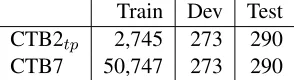
Table 3 shows the statistical information on the data sets.
Train Dev Test CTB2tp 2,745 273 290
CTB7 50,747 273 290
Table 3: Number of sentences of data sets used
We built Chinese-to-English SMT systems based on Moses3. Minimum error rate training (MERT)
with respect to BLEU score was used to tune the de-coder’s parameters. The translation model was cre-ated from the FBIS corpus (LDC2003E14). We used SRILM4to train a 5-gram language model. The
lan-guage model was trained on the target side of the FBIS corpus and the Xinhua news in English Gi-gaword corpus (LDC2009T13). The development and test sets were from NIST MT08 evaluation cam-paign5. We then used the SMT systems to translate
the training data of CTB2tpand CTB7.
To directly compare with the results of Huang et al. (2009) and Chen et al. (2010), we also used the same word alignment tool, Berkeley Aligner (Liang et al., 2006; DeNero and Klein, 2007), to perform word alignment for CTB2tp and CTB7.
We trained a Berkeley Aligner on the FBIS corpus (LDC2003E14). We removed notoriously bad links in{a, an, the}×{的(de),了(le)}following the work
of Huang et al. (2009).
To train an English parser, we used the PTB (Marcus et al., 1993) in our experiments and the tool “Penn2Malt” to convert the data. We split the data into a training set (sections 2-21), a develop-ment set (section 22), and a test set (section 23). We trained first-order and second-order Parsert on
the training data. The unlabeled attachment score (UAS) of the second-order Parsert was 91.92,
in-dicating state-of-the-art accuracy on the test data. We used the second-order Parsertto parse the
auto-translated/human-made target sentences in the CTB
3http://www.statmt.org/moses/
[image:7.612.77.300.273.372.2]data.
To extract English subtrees, we used the BLLIP corpus (Charniak et al., 2000) that contains about 43 million words of WSJ texts. We used the MX-POST tagger (Ratnaparkhi, 1996) trained on train-ing data to assign POS tags and used the first-order Parsert to process the sentences of the BLLIP
cor-pus. To extract bilingual subtrees, we used the FBIS corpus and an additional bilingual corpus contain-ing 800,000 sentence pairs from the traincontain-ing data of NIST MT08 evaluation campaign. On the Chinese side, we used the morphological analyzer described in (Kruengkrai et al., 2009) trained on the training data of CTBtp to perform word segmentation and
POS tagging and used the first-order Parsersto parse
all the sentences in the data. On the English side, we used the same procedure as we did for the BLLIP corpus. Word alignment was performed using the Berkeley Aligner.
We reported the parser quality by the UAS, i.e., the percentage of tokens (excluding all punctuation tokens) with correct HEADs.
6.1 Experimental settings
For baseline systems, we used the monolingual tures mentioned in Section 3. We called these fea-tures basic feafea-tures. To compare the results of (Bur-kett and Klein, 2008; Huang et al., 2009; Chen et al., 2010), we used the test data with human trans-lation in the following three experiments. The tar-get sentences were parsed by using the second-order Parsert. We used PAG to refer to our parsers trained
on the auto-generated bilingual treebank.
6.2 Training with CTB2tp
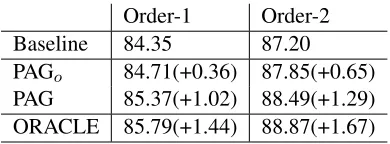
Order-1 Order-2 Baseline 84.35 87.20 PAGo 84.71(+0.36) 87.85(+0.65)
[image:8.612.321.528.446.611.2]PAG 85.37(+1.02) 88.49(+1.29) ORACLE 85.79(+1.44) 88.87(+1.67)
Table 4: Results of training with CTB2tp
First, we conducted the experiments on the stan-dard data set of CTB2tp, which was also used in
other studies (Burkett and Klein, 2008; Huang et al., 2009; Chen et al., 2010). The results are given in Table 4, where Baseline refers to the system with
the basic features, PAGo refers to that after adding
the original bilingual features of Table 1 to Baseline, PAG refers to that after adding the verified bilingual features of Table 2 to Baseline, and ORACLE6refers
to using human-translation for training data with adding the features of Table 1. We obtained an ab-solute improvement of 1.02 points for the first-order model and 1.29 points for the second-order model by adding the verified bilingual features. The improve-ments of the final systems (PAG) over the Baselines were significant in McNemar’s Test (p<0.001 for the first-order model and p<0.0001 for the second-order model). If we used the original bilingual fea-tures (PAGo), the system dropped 0.66 points for the
first-order and 0.64 points for the second-order com-pared with system PAG. This indicated that the ver-ified bilingual constraints did provide useful infor-mation for the parsing models.
We also found that PAG was about 0.3 points lower than ORACLE. The reason is mainly due to the imperfect translations, although we used the large-scale subtree lists to help verify the con-straints. We tried adding the features of Table 2 to the ORACLE system, but the results were worse. These facts indicated that our approach obtained the benefits from the verified constraints, while using the bilingual constraints alone was enough for OR-ACLE.
6.3 Training with CTB7
0.83 0.84 0.85 0.86 0.87 0.88 0.89 0.9 0.91 0.92
5 10 20 30 40 50
UAS
Amount of training data (K) Baseline1
[image:8.612.91.286.528.600.2]PAG1 Baseline2 PAG2
Figure 10: Results of using different sizes of training data
Here, we demonstrate that our approach is still able to provide improvement, even if we use larger
6Note that we also used the tool to perform the word
Baseline D10 D20 D50 D100 GTran BLEU n/a 14.71 15.84 16.92 17.95 n/a UAS 87.20 87.63 87.67 88.20 88.49 88.58
Table 5: Results of using different translations
training data that result in strong baseline systems. We incrementally increased the training sentences from the CTB7. Figure 10 shows the results of us-ing different sizes of CTB7 trainus-ing data, where the numbers of the x-axis refer to the sentence numbers of training data used, Baseline1 and Baseline2 re-fer to the first- and second-order baseline systems, and PAG1 and PAG2 refer to our first- and second-order systems. The figure indicated that our sys-tem always outperformed the baseline syssys-tems. For small data sizes, our system performed much better than the baselines. For example, when using 5,000 sentences, our second-order system provided a 1.26 points improvement over the second-order baseline. Finally, when we used all of the CTB7 training data, our system achieved 91.66 for the second-order model, while the baseline achieved 91.10.
6.4 With different settings of SMT systems
We investigated the effects of different settings of SMT systems. We randomly selected 10%, 20%, and 50% of FBIS to train the Moses systems and used them to translate CTB2tp. The results are in
Table 5, where D10, D20, D50, and D100 refer to the system with 10%, 20%, 50%, and 100% data re-spectively. For reference, we also used the Google-translate online system7, indicated as GTran in the
table, to translate the CTB2tp.
From the table, we found that our system outper-formed the Baseline even if we used only 10% of the FBIS corpus. The BLEU and UAS scores became higher, when we used more data of the FBIS corpus. And the gaps among the results of D50, D100, and GTran were small. This indicated that our approach was very robust to the noise produced by the SMT systems.
6.5 Testing with auto-translation
We also translated the test data into English using the Moses system and tested the parsers on the new
7http://translate.google.com/
test data. Table 6 shows the results. The results showed that PAG outperformed the baseline systems for both the first- and second-order models. This indicated that our approach can provide improve-ment in a purely monolingual setting with the help of SMT.
[image:9.612.333.523.219.262.2]Order-1 Order-2 Baseline 84.35 87.20 PAG 84.88(+0.53) 87.89(+0.69)
Table 6: Results of testing with auto-translation (training
with CTB2tp)
6.6 Comparison results
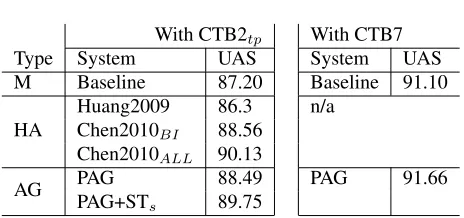
With CTB2tp With CTB7
Type System UAS System UAS
M Baseline 87.20 Baseline 91.10
HA Huang2009Chen2010BI 86.388.56 n/a
Chen2010ALL 90.13
AG PAGPAG+ST 88.49 PAG 91.66
s 89.75
Table 7: Comparison of our results with other pre-vious reported systems. Type M denotes training on monolingual treebank. Types HA and AG denote training on human-annotated and auto-generated bilingual tree-banks respectively.
We compared our results with the results reported previously for the same data. Table 7 lists the re-sults, where Huang2009 refers to the result of Huang et al. (2009), Chen2010BI refers to the result of
using bilingual features in Chen et al. (2010), and Chen2010ALL refers to the result of using all of
the features in Chen et al. (2010). The results showed that our new parser achieved better accuracy than Huang2009 and comparable to Chen2010BI.
To achieve higher performance, we also added the source subtree features (Chen et al., 2009) to our system: PAG+STs. The new result is close to
[image:9.612.315.547.334.443.2]Huang et al. (2009) and Chen et al. (2010), our approach used an auto-generated bilingual treebank while theirs used a human-annotated bilingual tree-bank. By using all of the training data of CTB7, we obtained a more powerful baseline that performed much better than the previous reported results. Our parser achieved 91.66, much higher accuracy than the others.
7 Conclusion
We have presented a simple yet effective approach to improve bitext parsing with the help of SMT sys-tems. Although we trained our parser on an auto-generated bilingual treebank, we achieved an accu-racy comparable to the systems trained on human-annotated bilingual treebanks on the standard test data. Moreover, our approach continued to pro-vide improvement over the baseline systems when we used a much larger monolingual treebank (over 50,000 sentences) where target human translations are not available and very hard to construct. We also demonstrated that the proposed approach can be ef-fective in a purely monolingual setting with the help of SMT.
Acknowledgments
This study was started when Wenliang Chen, Yu-jie Zhang, and Yoshimasa Tsuruoka were members of Language Infrastructure Group, National Insti-tute of Information and Communications Technol-ogy (NICT), Japan. We would also thank the anony-mous reviewers for their detailed comments, which have helped us to improve the quality of this work.
References
Ann Bies, Martha Palmer, Justin Mott, and Colin Warner. 2007. English Chinese Translation Treebank V 1.0,
LDC2007T02.Linguistic Data Consortium.
David Burkett and Dan Klein. 2008. Two languages are
better than one (for syntactic parsing). InProceedings
of EMNLP 2008, pages 877–886, Honolulu, Hawaii, October. Association for Computational Linguistics. Xavier Carreras. 2007. Experiments with a higher-order
projective dependency parser. In Proceedings of the
CoNLL Shared Task Session of EMNLP-CoNLL 2007, pages 957–961, Prague, Czech Republic, June. Asso-ciation for Computational Linguistics.
Eugene Charniak, Don Blaheta, Niyu Ge, Keith Hall, John Hale, and Mark Johnson. 2000. BLLIP
1987-89 WSJ Corpus Release 1, LDC2000T43. Linguistic
Data Consortium.
Wenliang Chen, Jun’ichi Kazama, Kiyotaka Uchimoto, and Kentaro Torisawa. 2009. Improving dependency
parsing with subtrees from auto-parsed data. In
Pro-ceedings of EMNLP 2009, pages 570–579, Singapore, August.
Wenliang Chen, Jun’ichi Kazama, and Kentaro Torisawa. 2010. Bitext dependency parsing with bilingual
sub-tree constraints. InProceedings of ACL 2010, pages
21–29, Uppsala, Sweden, July. Association for Com-putational Linguistics.
Koby Crammer and Yoram Singer. 2003.
Ultraconser-vative online algorithms for multiclass problems. J.
Mach. Learn. Res., 3:951–991.
John DeNero and Dan Klein. 2007. Tailoring word
alignments to syntactic machine translation. In
Pro-ceedings of ACL 2007, pages 17–24, Prague, Czech Republic, June. Association for Computational Lin-guistics.
Liang Huang, Wenbin Jiang, and Qun Liu. 2009.
Bilingually-constrained (monolingual) shift-reduce
parsing. InProceedings of EMNLP 2009, pages 1222–
1231, Singapore, August. Association for Computa-tional Linguistics.
Philipp Koehn, Franz J. Och, and Daniel Marcu. 2003.
Statistical phrase-based translation. InProceedings of
NAACL 2003, pages 48–54. Association for Computa-tional Linguistics.
Terry Koo and Michael Collins. 2010. Efficient
third-order dependency parsers. In Proceedings of ACL
2010, pages 1–11, Uppsala, Sweden, July. Association
for Computational Linguistics.
Canasai Kruengkrai, Kiyotaka Uchimoto, Jun’ichi Kazama, Yiou Wang, Kentaro Torisawa, and Hitoshi Isahara. 2009. An error-driven word-character hybrid model for joint Chinese word segmentation and POS
tagging. InProceedings of ACL-IJCNLP2009, pages
513–521, Suntec, Singapore, August. Association for Computational Linguistics.
Charles N. Li and Sandra A. Thompson. 1997.
Man-darin Chinese - A Functional Reference Grammar. University of California Press.
Percy Liang, Ben Taskar, and Dan Klein. 2006.
Align-ment by agreeAlign-ment. InProceedings of NAACL 2006,
pages 104–111, New York City, USA, June. Associa-tion for ComputaAssocia-tional Linguistics.
Yang Liu and Liang Huang. 2010. Tree-based and
forest-based translation. InTutorial Abstracts of ACL 2010,
Mitchell P. Marcus, Beatrice Santorini, and Mary Ann Marcinkiewicz. 1993. Building a large annotated
cor-pus of English: the Penn Treebank. Computational
Linguisticss, 19(2):313–330.
Ryan McDonald and Fernando Pereira. 2006. On-line learning of approximate dependency parsing
algo-rithms. InProceedings of EACL 2006, pages 81–88.
Joakim Nivre. 2003. An efficient algorithm for
projective dependency parsing. In Proceedings of
IWPT2003, pages 149–160.
Franz Josef Och and Hermann Ney. 2003. A system-atic comparison of various statistical alignment mod-els. Computational Linguistics, 29(1):19–51.
Adwait Ratnaparkhi. 1996. A maximum entropy model
for part-of-speech tagging. InProceedings of EMNLP
1996, pages 133–142.
David A. Smith and Noah A. Smith. 2004. Bilingual parsing with factored estimation: Using English to
parse Korean. InProceedings of EMNLP 2004, pages
49–56.
Hiroyasu Yamada and Yuji Matsumoto. 2003. Statistical dependency analysis with support vector machines. In
Proceedings of IWPT 2003, pages 195–206.
Hai Zhao, Yan Song, Chunyu Kit, and Guodong Zhou.
2009. Cross language dependency parsing
us-ing a bilus-ingual lexicon. In Proceedings of