Dependency language models for sentence completion
Joseph Gubbins Computer Laboratory University of Cambridge
Andreas Vlachos Computer Laboratory University of Cambridge
Abstract
Sentence completion is a challenging seman-tic modeling task in which models must choose the most appropriate word from a given set to complete a sentence. Although a variety of language models have been ap-plied to this task in previous work, none of the existing approaches incorporate syntactic in-formation. In this paper we propose to tackle this task using a pair of simple language mod-els in which the probability of a sentence is estimated as the probability of the lexicalisa-tion of a given syntactic dependency tree. We apply our approach to the Microsoft Research Sentence Completion Challenge and show that it improves on n-gram language models by 8.7 percentage points, achieving the highest accu-racy reported to date apart from neural lan-guage models that are more complex and ex-pensive to train.
1 Introduction
The verbal reasoning sections of standardised tests such as the Scholastic Aptitude Test (SAT) fea-ture problems where a partially complete sentence is given and the candidate must choose the word or phrase from a list of options which completes the sentence in a logically consistent way. Sen-tence completion is a challenging semantic mod-elling problem. Systematic approaches for solving such problems require models that can judge the global coherence of sentences. Such measures of global coherence may prove to be useful in various applications, including machine translation and nat-ural language generation (Zweig and Burges, 2012).
Most approaches to sentence completion employ language models which use a window of immedi-ate context around the missing word and choose the word that results in the completed sentence with the highest probability (Zweig and Burges, 2012; Mnih and Teh, 2012). However, such language models may fail to identify sentences that are locally co-herent but are improbable due to long-range syntac-tic/semantic dependencies. Consider, for example, completing the sentence
I saw a tiger which was really very ...
with either fierce or talkative. A language model relying on up to five words of immediate context would ignore the crucial dependency between the missing word and the nountiger.
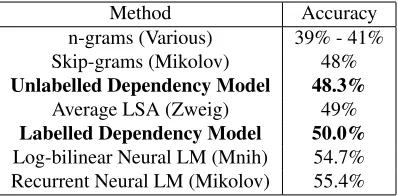
In this paper we tackle sentence completion us-ing language models based on dependency gram-mar. These models are similar to standard n-gram language models, but instead of using the linear or-dering of the words in the sentence, they generate words along paths in the dependency tree of the sen-tence. Unlike other approaches incorporating syntax into language models (e.g., Chelba et al., 1997), our models are relatively easy to train and estimate, and can exploit standard smoothing methods. We apply them to the Microsoft Research Sentence Comple-tion Challenge (Zweig and Burges, 2012) and show an improvement of 8.7 points in accuracy over n-gram models, giving the best results to date for any method apart from the more computationally de-manding neural language models.
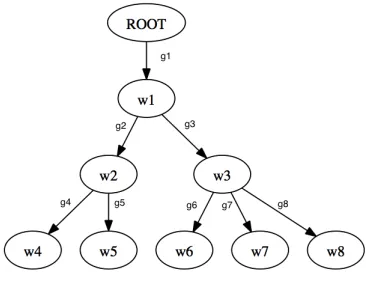
Figure 1: Dependency tree example
2 Unlabelled Dependency Language Models
In dependency grammar, each word in a sentence is associated with a node in a dependency tree (Figure 1). We define a dependency tree as a rooted, con-nected, acyclic directed graph together with a map-ping from the nodes of the tree to a set of gram-matical relation labels R. We define a lexicalised dependency tree as a dependency tree along with a mapping from the vertices of the tree to a vocabulary V.
We seek to model the probability distribution of the lexicalisation of a given dependency tree. We will use this as a language model; we neglect the fact that a given lexicalised dependency tree can correspond to more than one sentence due to vari-ations in word order. Let ST be a lexicalised de-pendency tree, whereT is the unlexicalised tree and letw1w2. . . wm be an ordering of the words corre-sponding to a breadth-first enumeration of the tree. In order for this representation to be unique, when we parse a sentence, we will use the unique breadth-first ordering where the children of any node appear in the same order as they did in the sentence. We definew0 to be a special symbol denoting the root of the tree. We denote the grammatical relation be-tweenwkand its parent bygk∈ R.
We apply the chain rule to the words in the tree in the order of this breadth-first enumeration:
P[ST|T] =
m
Y
i=1
P[wi|(wk)ik−=01, T] (1)
Given a word wi, we define the ancestor sequence
A(w) to be the subsequence of (wk)ik−=01 describ-ing the path from the root node to the parent of
w, where each element of the sequence is the par-ent of the next elempar-ent. For example in Figure 1,
A(w8) = (w0, w1, w3). We make the following two assumptions:
• that each wordwiis conditionally independent of the words outside of its ancestor sequence
(wk)ki−=01∩A(wi)c, given the ancestor sequence A(wi);
• that the words are independent of the labels
(gk)mk=1.
Using these assumptions, we can write the probabil-ity as:
P[ST|T] =
m
Y
i=1
P[wi|A(wi)] (2)
Given a training data corpus consisting of sen-tences parsed into dependency trees, the maximum likelihood estimator for the probabilityP[wi|A(wi)] is given by the proportion of cases where the ances-tor sequenceA(wi)was followed bywi. LetC(·)be the count of the number of observations of a pattern in the corpus. We have
ˆ
P[wi|A(wi)] =
C((A(wi), wi))
P
w∈VC((A(wi), w)) (3)
As is the case for n-gram language models, we can’t hope to observe all possible sequences of words no matter how big the corpus. To deal with this data sparsity issue, we take inspiration from n-gram mod-els and assume a Markov property of order(N−1):
P[w|A(w)] =P[w|A(N−1)(w)] (4)
where A(N−1)(w) denotes the sequence of up to
(N −1)closest ancestors ofw.
The maximum likelihood estimator for this prob-ability is:
ˆ
P[wi|A(N−1)(wi)] =
C((A(N−1)(wi), wi))
P
w∈VC((A(N−1)(wi), w))
is that each word in the tree can have several chil-dren, while in the n-gram models it can only be fol-lowed by one word. Thus the sum in the denomina-tor above does not simplify to the count of the ances-tor sequence in the way that it does for n-gram lan-guage models. However, we can calculate and store the denominators easily during training, so that we do not need to sum over the vocabulary each time we evaluate the estimator. We refer to this model as the
order N unlabelled dependency language model. As is the case for n-gram language models, even for low values of N, we will often encounter se-quences(A(N−1)(w), w) which were not observed in training. In order to avoid assigning zero prob-ability to the entire sentence, we need to use a smoothing method. We can use any of the smooth-ing methods used for n-gram language models. For simplicity, we use stupid backoff smoothing (Brants et al., 2007).
3 Labelled Dependency Language Models
We assumed above that the words are generated in-dependently from the grammatical relations. How-ever, we are likely to ignore valuable information in doing so. To illustrate this point, consider the fol-lowing pair of sentences:
You ate an apple
nsubj
dobj det
An apple ate you
det nsubj dobj
The dependency trees of the two sentences are very similar, with only the grammatical relations be-tween ate and its arguments differing. The unla-belled dependency language model will assign the same probability to both of the sentences as it ig-nores the labels of grammatical relations. In order to be able to distinguish between them, the nature of the grammatical relations between the words in the dependency tree needs to be incorporated in the language model. We relax the assumption that the words are independent of the labels of the parse tree, assuming instead the each word is conditionally in-dependent of the words and labels outside its ances-tor path given the words and labels in its ancesances-tor
path. We defineG(wi)to be the sequence of gram-matical relations between the successive elements of
(A(wi), wi). G(wi)is the sequence of grammatical relations found on the path from the root node to
wi. For example, in Figure 1,G(w8) = (g1, g3, g8). With our modified assumption we have:
P[ST|T] =
m
Y
i=1
P[wi|A(wi), G(wi)] (5)
Once again we apply a Markov assumption. Let G(N−1)(w) be the sequence of grammat-ical relations between successive elements of
(A(N−1)(w), w). With an(N −1)thorder Markov assumption, we have:
P[ST|T] =
m
Y
i=1
P[wi|A(N−1)(wi), G(N−1)(wi)]
The maximum likelihood estimator for the probabil-ity is once again given by the ratio of the counts of labelled paths. We refer to this model as theorder N labelled dependency language model.
4 Dataset and Implementation Details
I saw a tiger which was really very a.fierce
b. talkative
I saw a tiger which was really very fierce ROOT
P[“fierce”] = P[saw|ROOT]×P[I|ROOT, saw]×P[tiger|ROOT, saw]×P[a|saw, tiger]×P[fierce|saw, tiger] ×P[which|tiger,fierce]×P[was|tiger,fierce]×P[really|tiger,fierce]×P[very|tiger,fierce]
PARSE
[image:4.612.81.517.60.189.2]EVALUATE PROBABILITY
Figure 2: Procedure for evaluating sentence completion problems
N Unlab-SB Lab-SB Ngm-SB Ngm-KN
2 43.2% 43.0% 28.1% 27.8%
3 48.3% 49.8% 38.5% 38.4%
4 48.3% 50.0% 40.8% 41.1%
[image:4.612.328.527.240.338.2]5 47.4% 49.9% 41.3% 40.8%
Table 1: Summary of results for Sentence Completion
language models for 2 ≤ N ≤ 5. Words which occured fewer than 5 times were excluded from the vocabulary. In order to have a baseline to compare against, we also trained n-gram language models with Kneser-Ney smoothing and stupid backoff us-ing the Berkeley Language Modelus-ing Toolkit (Pauls and Klein, 2011).
To test a given language model, we calculated the scores it assigned to each candidate sentence and chose the completion with the highest score. For the dependency language models we parsed the sen-tence with each of the 5 possible completions and calculated the probability in each case. Figure 2 il-lustrates an example of this process for the order 3 unlabelled model.
5 Results
Table 1 summarises the results.Unlab-SBis the or-der N unlabelled dependency language model with Stupid Backoff, Lab-SB is the order N labelled dependency language model with Stupid Backoff,
Ngm-SBis the n-gram language model with Stupid Backoff and Ngm-KN is the interpolated Kneser-Ney smoothed n-gram language model.
Both of the dependency language models outper-fomed the n-gram language models by a substantial
Method Accuracy
n-grams (Various) 39% - 41% Skip-grams (Mikolov) 48%
Unlabelled Dependency Model 48.3%
Average LSA (Zweig) 49%
Labelled Dependency Model 50.0%
Log-bilinear Neural LM (Mnih) 54.7% Recurrent Neural LM (Mikolov) 55.4%
Table 2: Comparison against previous results
margin for all orders considered. The best result was achieved by the order 4 labelled dependency model which is 8.7 points in accuracy better than the best n-gram model. Furthermore, the labelled dependency models outperformed their unlabelled counterparts for every order except 2.
6 Related Work and Discussion
The best-known language model based on depen-dency parsing is that of Chelba et al. (1997). This model writes the probability in the familiar left-to-right chain rule decomposition in the linear order of the sentence, conditioning the probability of the next word on the linear trigram context, as well as some part of the dependency graph information re-lating to the words on its left. The language mod-els we propose are far simpler to train and compute. A somewhat similar model to our unlabelled depen-dency language model was proposed in Graham and van Genabith (2010). However they seem to have used different probability estimators which ignore the fact that each node in the dependency tree can have multiple children. Other research on syntac-tic language modelling has focused on using phrase structure grammars (Pauls and Klein, 2012; Char-niak, 2001; Roark, 2001; Hall and Johnson, 2003). The linear complexity of deterministic dependency parsing makes dependency language models such as ours more scalable than these approaches.
The most similar task to sentence completion is lexical substitution (McCarthy and Navigli, 2007). The main difference between them is that in the lat-ter the word to be substituted provides a very im-portant clue in choosing the right candidate, while in sentence completion this is not available. An-other related task is selectional preference modeling (S´eaghdha, 2010; Ritter et al., 2010), where the aim is to assess the plausibility of possible syntactic ar-guments for a given word.
The dependency language models described in this paper assign probabilities to full sentences. Lan-guage models which require full sentences can be used in automatic speech recognition (ASR) and ma-chine translation (MT). The approach is to use a con-ventional ASR or MT decoder to produce an N-best list of the most likely candidate sentences and then re-score these with the language model. This was done by Chelba et al. (1997) for ASR using a de-pendency language model and by Pauls and Klein (2011) for MT using a PSG-based syntactic lan-guage model.
7 Conclusion
We have proposed a pair of language models which are probabilistic models for the lexicalisation of a given dependency tree. These models are simple to train and evaluate and are scalable to large data sets. We applied them to the Microsoft Research Sentence Completion Challenge. They performed substantially better than n-gram language models, achieving the best result reported for any single method except for the more expensive and complex to train neural language models.
Acknowledgments
Andreas Vlachos is funded by the European Community’s Seventh Framework Programme (FP7/2007-2013) under grant agreement no. 270019 (SPACEBOOK project www.spacebook-project.eu). The authors would like to thank Dr. Stephen Clark for his helpful comments.
References
Thorsten Brants, Ashok C Popat, Peng Xu, Franz J Och, and Jeffrey Dean. 2007. Large Language Mod-els in Machine Translation. In Proceedings of the 2007 Joint Conference on Empirical Methods in Natu-ral Language Processing and Computational NatuNatu-ral Language Learning, pages 858–867. Association for Computational Linguistics.
Eugene Charniak. 2001. Immediate-head parsing for language models. InProceedings of the 39th Annual Meeting on Association for Computational Linguis-tics, pages 124–131. Association for Computational Linguistics.
Ciprian Chelba, David Engle, Frederick Jelinek, Vic-tor Jimenez, Sanjeev Khudanpur, Lidia Mangu, Harry Printz, Eric Ristad, Ronald Rosenfeld, Andreas Stol-cke, et al. 1997. Structure and performance of a dependency language model. In Proceedings of Eu-rospeech, volume 5, pages 2775–2778.
Yvette Graham and Josef van Genabith. 2010. Deep syn-tax language models and statistical machine transla-tion. InProceedings of the 4th Workshop on Syntax and Structure in Statistical Translation, pages 118– 126. Coling 2010 Organizing Committee, August.
Tomas Mikolov, Kai Chen, Greg Corrado, and Jeffrey Dean. 2013. Efficient estimation of word representa-tions in vector space. arXiv preprint arXiv:1301.3781. Andriy Mnih and Yee W Teh. 2012. A fast and sim-ple algorithm for training neural probabilistic language models. InProceedings of the 29th International Con-ference on Machine Learning, pages 1751–1758. Joakim Nivre and Mario Scholz. 2004. Deterministic
dependency parsing of English text. InProceedings of the 20th International Conference on Computational Linguistics, page 64. Association for Computational Linguistics.
Joakim Nivre, Johan Hall, and Jens Nilsson. 2006. Malt-parser: A data-driven parser-generator for dependency parsing. In Proceedings of LREC, volume 6, pages 2216–2219.
Adam Pauls and Dan Klein. 2011. Faster and Smaller N-Gram Language Models. In Proceedings of the 49th Annual Meeting of the Association for Compu-tational Linguistics: Human Language Technologies, pages 258–267. Association for Computational Lin-guistics.
Adam Pauls and Dan Klein. 2012. Large-scale syntac-tic language modeling with treelets. InProceedings of the 50th Annual Meeting of the Association for Com-putational Linguistics: Long Papers-Volume 1, pages 959–968. Association for Computational Linguistics. Alan Ritter, Oren Etzioni, et al. 2010. A latent
dirich-let allocation method for selectional preferences. In Proceedings of the 48th Annual Meeting of the Associ-ation for ComputAssoci-ational Linguistics, pages 424–434. Association for Computational Linguistics.
Brian Roark. 2001. Probabilistic top-down parsing and language modeling. Computational Linguistics, 27(2):249–276.
Diarmuid O S´eaghdha. 2010. Latent variable models of selectional preference. InProceedings of the 48th Annual Meeting of the Association for Computational Linguistics, pages 435–444. Association for Computa-tional Linguistics.
Geoffrey Zweig and Chris JC Burges. 2012. A challenge set for advancing language modeling. InProceedings of the NAACL-HLT 2012 Workshop: Will We Ever Re-ally Replace the N-gram Model? On the Future of Language Modeling for HLT, pages 29–36. Associa-tion for ComputaAssocia-tional Linguistics.