Recursive Autoencoders for ITG-based Translation
Peng Li, Yang Liu and Maosong Sun
State Key Laboratory of Intelligent Technology and Systems Tsinghua National Laboratory for Information Science and Technology
Department of Computer Science and Technology, Tsinghua University, Beijing 100084, China [email protected], {liuyang2011,sms}@tsinghua.edu.cn
Abstract
While inversion transduction grammar (ITG) is well suited for modeling ordering shifts between languages, how to make applying the two reordering rules (i.e., straight and inverted) dependent on actual blocks being merged remains a challenge. Unlike previous work that only uses boundary words, we pro-pose to use recursive autoencoders to make full use of the entire merging blocks alter-natively. The recursive autoencoders are ca-pable of generating vector space representa-tions for variable-sized phrases, which enable predicting orders to exploit syntactic and se-mantic information from a neural language modeling’s perspective. Experiments on the NIST 2008 dataset show that our system sig-nificantly improves over the MaxEnt classifier by 1.07 BLEU points.
1 Introduction
Phrase-based models (Koehn et al., 2003; Och and Ney, 2004) have been widely used in practical ma-chine translation (MT) systems due to their effec-tiveness, simplicity, and applicability. First, as se-quences of consecutive words, phrases are capable of memorizing local word selection and reorder-ing, making them an effective mechanism for trans-lating idioms or translations with word insertions or omissions. Moreover, n-gram language models can be seamlessly integrated into phrase-based de-coders since partial translations grow left to right in decoding. Finally, phrase-based systems can be applicable to most domains and languages,
espe-cially for resource-scarce languages without high-accuracy parsers.
However, as phrase-based decoding casts transla-tion as a string concatenatransla-tion problem and permits arbitrary permutations, it proves to be NP-complete (Knight, 1999). Therefore, phrase reordering mod-eling has attracted intensive attention in the past decade (e.g., Och et al., 2004; Tillman, 2004; Zens et al., 2004; Al-Onaizan and Papineni, 2006; Xiong et al., 2006; Koehn et al., 2007; Galley and Man-ning, 2008; Feng et al., 2010; Green et al., 2010; Bisazza and Federico, 2012; Cherry, 2013).
Among them, reordering models based on inver-sion transduction grammar (ITG) (Wu, 1997) are one of the important ongoing research directions. As a formalism for bilingual modeling of sentence pairs, ITG is particularly well suited to predicting ordering shifts between languages. As a result, a number of authors have incorporated ITG into left-to-right decoding to constrain the reordering space and reported significant improvements (e.g., Zens et al., 2004; Feng et al., 2010). Along another line, Xiong et al. (2006) propose a maximum entropy (MaxEnt) reordering model based on ITG. They use the CKY algorithm to recursively merge two blocks (i.e., a pair of source and target strings) into larger blocks, either in a straight or an inverted order. Un-like lexicalized reordering models (Tillman, 2004; Koehn et al., 2007; Galley and Manning, 2008) that are defined on individual bilingual phrases, the Max-Ent ITG reordering model is a two-category classi-fier (i.e., straight or inverted) for two arbitrary bilin-gual phrases of which the source phrases are adja-cent. This potentially alleviates the data sparseness
problem since there are usually a large number of reordering training examples available (Xiong et al., 2006). As a result, the MaxEnt ITG model and its extensions (Xiong et al., 2008; Xiong et al., 2010) have achieved competing performance as compared with state-of-the-art phrase-based systems.
Despite these successful efforts, the ITG reorder-ing classifiers still face a major challenge: how to extract features from training examples (i.e., a pair of bilingual strings). It is hard to decide which words are representative for predicting reordering, either manually or automatically, especially for long sen-tences. As a result, Xiong et al. (2006) only use boundary words (i.e., the first and the last words in a string) to predict the ordering. What if we look inside? Is it possible to avoid manual feature engi-neering and learn semantic representations from the data?
Fortunately, the rapid development of intersect-ing deep learnintersect-ing with natural language processintersect-ing (Bengio et al., 2003; Collobert and Weston, 2008; Collobert et al., 2011; Glorot et al., 2011; Bordes et al., 2011; Socher et al., 2011a; Socher et al., 2011b; Socher et al., 2011c; Socher et al., 2012; Bordes et al., 2012; Huang et al., 2012; Socher et al., 2013; Hermann and Blunsom, 2013) brings hope for alle-viating this problem. In these efforts, natural lan-guage words are represented as real-valued vectors, which can be naturally fed to neural networks as in-put. More importantly, it is possible to learn vec-tor space representations for multi-word phrases us-ingrecursive autoencoders(Socher et al., 2011c), which opens the door to leveraging semantic repre-sentations of phrases in reordering models from a neural language modeling point of view.
In this work, we propose an ITG reordering clas-sifier based on recursive autoencoders. The neu-ral network consists of four autoencoders (i.e., the first source phrase, the first target phrase, the sec-ond source phrase, and the secsec-ond target phrase) and a softmax layer. The recursive autoencoders, which are trained on reordering examples extracted from word-aligned bilingual corpus, are capable of producing vector space representations for arbi-trary multi-word strings in decoding. Therefore, our model takes the whole phrases rather than only boundary words into consideration when predict-ing phrase permutations. Experiments on the NIST
2008 dataset show that our system significantly im-proves over the MaxEnt classifier by 1.07 in terms of case-insensitive BLEU score.
2 Recursive Autoencoders for ITG-based Translation
2.1 Inversion Transduction Grammar
Inversion transduction grammar (ITG) (Wu, 1997) is a formalism for synchronous parsing of bilingual sentence pairs. Xiong et al. (2006) apply bracketing transduction grammar (BTG), which is a simplified version of ITG, to phrase-based translation using the following production rules:
X → [X1, X2] (1)
X → hX1, X2i (2)
X → f /e (3)
whereX is ablockthat consists of a pair of source and target strings,fis a source phrase, andeis a tar-get phrase. X1 andX2 are two neighboring blocks of which the two source phrases are adjacent. While rule (1) merges two target phrases in astraight or-der, rule (2) merges in an inverted order. Besides these tworeordering rules, rule (3) is alexical rule that translates a source phrasef into a target phrase e. This is exactly a bilingual phrase used in conven-tional phrase-based systems.
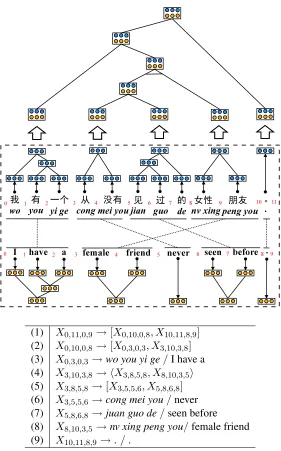
An ITG derivation, which consists of a sequence of production rules, explains how a sentence pair is generated simultaneously. Figure 1 shows an ITG derivation for a Chinese sentence and its English translation. We distinguish between two types of blocks:
1. atomic blocks: blocks generated by applying lexical rules,
2. composed blocks: blocks generated by apply-ing reorderapply-ing rules.
In Figure 1, the sentence pair is segmented into five atomic blocks:
X0,3,0,3 :wo you yi ge↔I have a X3,5,5,6 :cong mei you↔never X5,8,6,8 :jian guo de↔seen before
(1) X0,11,0,9→[X0,10,0,8, X10,11,8,9] (2) X0,10,0,8→[X0,3,0,3, X3,10,3,8] (3) X0,3,0,3→wo you yi ge/I have a (4) X3,10,3,8→ hX3,8,5,8, X8,10,3,5i
[image:3.612.163.444.117.568.2](5) X3,8,5,8→[X3,5,5,6, X5,8,6,8] (6) X3,5,5,6→cong mei you/never (7) X5,8,6,8→juan guo de/seen before (8) X8,10,3,5→nv xing peng you/female friend (9) X10,11,8,9 →./.
Figure 1: An ITG derivation for a Chinese sentence and its translation. We useXi,j,k,l=hf j i, e
l
kito represent a block.
whereX3,5,5,6 indicates that the block consists of a source phrase spanning from position 3 to position 5 (i.e.,“cong mei you”) and a target phrase spanning from position 5 to position 6 (i.e., “never”). More formally, a blockXi,j,k,l = hfij, elki is a pair of a source phrasefij = fi+1. . . fj and a target phrase elk = ek+1. . . el. Obviously, these atomic blocks
are generated by lexical rules.
Two blocks of which the source phrases are adja-cent can be merged into a larger one in two ways: concatenating the target phrases in a straight order using rule (1) or in an inverted order using rule (2). For example, atomic blocksX3,5,5,6andX5,8,6,8are merged into a composed blockX3,8,5,8in a straight order, which is further merged with an atomic block X8,10,3,5 into another composed block X3,10,3,8 in an inverted order. This process recursively proceeds until the entire sentence pair is generated.
The major challenge of applying ITG to machine translation is to decide when to merge two blocks in a straight order and when in an inverted order. Therefore, the ITG reordering model can be seen as a two-category classifierP(o|X1, X2), where o ∈ {straight, inverted}.
A naive way is to assign fixed probabilities to two reordering rules, which is referred to asflat model
by Xiong et al. (2006):
P(o|X1, X2) =
p o=straight
1−p o=inverted (4)
The drawback of the flat model is ignoring the actual blocks being merged. Intuitively, different blocks should have different preferences between the two orders.
To alleviate this problem, Xiong et al. (2006) pro-pose a maximum entropy (MaxEnt) classifier:
P(o|X1, X2) = exp(θ·h(o, X 1, X2))
P
o0exp(θ·h(o0, X1, X2)) (5)
[image:4.612.317.531.54.232.2]where h(·) is a vector of features defined on the blocks and the order,θis a vector of feature weights. While MaxEnt is a flexible and powerful frame-work for including arbitrary features, feature engi-neering becomes a major challenge for the MaxEnt classifier. Xiong et al. (2006) find that boundary words (i.e., the first and the last words in a string) are informative for predicting reordering. Actually,
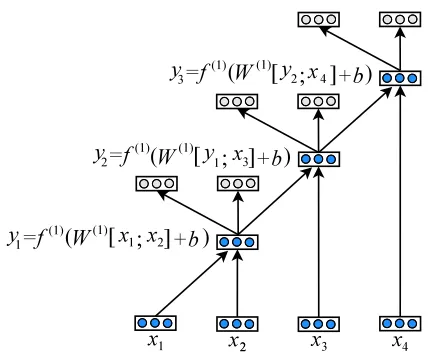
Figure 2: A recursive autoencoder for multi-word strings. The example is adapted from (Socher et al., 2011c). Blue and grey nodes are original and reconstructed ones, re-spectively.
it is hard to decide which internal words in a long composed blocks are representative and informa-tive. Therefore, they only use boundary words as the main features.
However, it seems not enough to just consider boundary words and ignore all internal words when making order predictions, especially for long sen-tences.1 Indeed, Xiong et al. (2008) find that the MaxEnt classifier with boundary words as features is prone to make wrong predictions for long com-posed blocks. As a result, they have to impose a hard constraint to always prefer merging long composed blocks in a monotonic way.
Therefore, it is important to consider more than boundary words to make more accurate reordering predictions. We need a new mechanism to achieve this goal.
2.2 Recursive Autoencoders
2.2.1 Vector Space Representations for Words
In neural networks, a natural language word is represented as a real-valued vector (Bengio et al., 2003; Collobert and Weston, 2008). For example, we can use[0.1 0.8 0.4]T to represent “female” and
1
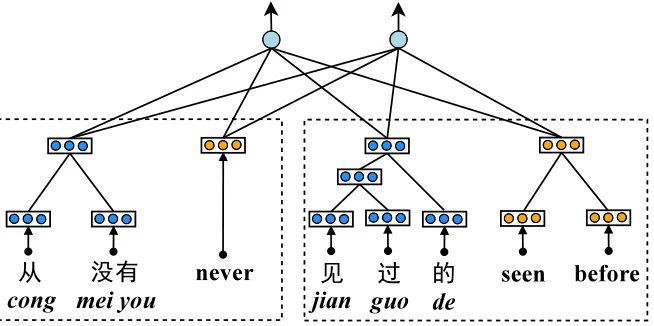
Figure 3: A neural ITG reordering model. The binary classifier makes decisions based on the vector space representa-tions of the source and target sides of merging blocks.
[0.7 0.1 0.5]T to represent “friend”. Such vector space representations enable natural language words to be fed to neural networks as input.
Formally, we denote each word as a vectorx ∈ Rn. These word vectors are then stacked into a word
embedding matrixL∈Rn×|V|, where|V|is the
vo-cabulary size. Given a sentence that is an ordered list ofmwords, each word has an associated vocabulary indexk into the word embedding matrixL that we use to retrieve the word’s vector space representa-tion. This look-up operation can be seen as a simple projection layer:
xi =Lbk∈Rn (6)
wherebkis a binary vector which is zero in all
posi-tions except for thekth index.
In Figure 1, we assumen= 3for simplicity and can retrieve vectors for Chinese and English words from two embedding matrices, respectively.
2.2.2 Vector Space Representations for Multi-Word Strings
To apply neural networks to ITG-based transla-tion, it is important to generate vector space repre-sentations for atomic and composed blocks.
For example, since the vector of “female” is [0.1 0.8 0.4]T and the vector of “friend” is [0.7 0.1 0.5]T, what is the vector of the phrase “fe-male friend”? If we denote “fe“fe-male friend” as p (i.e., parent), “female” as c1 (i.e., the first child), and “friend” asc2 (i.e., the second child), this can
be done by applying a functionf(1):
p=f(1)(W(1)[c1;c2] +b(1)) (7)
where [c1;c2] ∈ R2n×1 is the concatenation of c1 andc2,W(1) ∈Rn×2nis a parameter matrix,b(1)∈
Rn×1is a bias term, andf(1)is an element-wise
ac-tivation function such as tanh(·), which is used in our experiments.
Note that the resulting vector for the parent is also an n-dimensional vector, e.g, [0.6 0.9 0.2]T. The same neural network can be recursively applied to two strings until the vector of the entire sentence is generated. As ITG derivation builds a binary parse tree, the neural network can be naturally integrated into CKY parsing.
To assess how well the learned vectorprepresents its children, we can reconstruct the children in a reconstruction layer:
[c01;c02] =f(2)(W(2)p+b(2)) (8)
wherec01andc02are the reconstructed children,W(2) is a parameter matrix for reconstruction,b(2)is a bias term for reconstruction, andf(2)is an element-wise activation function, which is also set as tanh(·) in our experiments. Similarly, the same reconstruction neural network can be applied to each node in an ITG parse.
binary tree. The blue and grey nodes are the original and reconstructed nodes, respectively. The autoen-coder is re-used at each node of the tree. The bi-nary tree is composed of a set of triplets in the form of(p → c1 c2), where pis a parent vector and c1 andc2 are children vectors ofp. Each child can be either an input word vector or a multi-word vector. Therefore, the tree in Figure 2 can be represented as three triplets: (y1 → x1 x2), (y2 → y1 x3), and (y3→y2x4).
In Figure 1, we use recursive autoencoders to gen-erate vector space representations for Chinese and English phrases, which form the atomic blocks for further block merging.
2.2.3 A Neural ITG Reordering Model
Once the vectors for blocks are generated, it is straightforward to introduce a neural ITG reorder-ing model. As shown in Figure 3, the neural net-work consists of an input layer and a softmax layer. The input layer is composed of the vectors of the first source phrase, the first target phrase, the second source phrase, and the second target phrase. Note that all phrases in the same language use the the same recursive autoencoder. The softmax layer out-puts the probabilities of the two merging orders:
P(o|X1, X2) = exp(g(o, X 1, X2))
P
o0exp(g(o0, X1, X2)) (9)
g(o, X1, X2) =f(Woc(X1, X2) +bo) (10)
where o ∈ {straight, inverted}, Wo ∈ R1×4n
is a parameter matrix, bo ∈
R is a bias term, and
c(X1, X2)∈R4n×1is the concatenation of the
vec-tors of the four phrases.
3 Training
There are three sets of parameters in our recursive autoencoders:
1. θL: word embedding matrixLfor both source and target languages (Section 2.2.1);
2. θrec: recursive autoencoder parameter matrices
W(1), W(2) and bias terms b(1), b(2) for both source and target languages (Section 2.2.2);
3. θreo: neural ITG reordering model parameter
matrixWoand bias termbo(Section 2.2.3).
All these parameters are learned automatically from the training data. For clarity, we will useθto denote all these parameters in the rest of the paper.
For training word embedding matrix, there are two settings commonly used. In the first setting, the word embedding matrix is initialized randomly. This works well in a supervised scenario, in which a neural network updates the matrix in order to op-timize some task-specific objectives (Collobert et al., 2011; Socher et al., 2011c). In the second set-ting, the word embedding matrix is pre-trained us-ing an unsupervised neural language model (Bengio et al., 2003; Collobert and Weston, 2008) with huge amount of unlabeled data. In this work, we prefer to the first setting because the word embedding matri-ces can be trained to minimize errors with respect to reordering modeling.
There are two kinds of errors involved
1. reconstruction error: how well the learned vector space representations represent the cor-responding strings?
2. reordering error: how well the classifier pre-dicts the merging order?
As described in Section 2.2.2, the input vector c1 andc2 of a recursive autoencoder can be recon-structed using Eq. 8 asc01andc02. We use Euclidean distance between the input and the reconstructed vectors to measure thereconstruction error:
Erec([c1;c2];θ) = 1 2
[c1;c2]−[c01;c02]
2
. (11)
remains. Socher et al. (2011c) find that the greedy algorithm runs fast without significant loss in perfor-mance as compared with CKY-style algorithms.
Given a training example set S = {ti =
(oi, Xi1, Xi2)}, the average reconstruction error on the source side on the training set is defined as
Erec,s(S;θ) = 1 Ns
X
i
X
p∈Tθ R(ti,s)
Erec([p.c1, p.c2];θ)
(12) whereTRθ(ti, s) denotes all the intermediate nodes
on the source side in binary trees,Ns is the num-ber of these intermediate nodes, andp.ck is thekth child vector ofp. The average reconstruction error on the target side, denoted by Erec,t(S;θ), can be
computed in a similar way.
Therefore, the reconstruction error is defined as
Erec(S;θ) =Erec,s(S;θ) +Erec,t(S;θ). (13)
Given a training exampleti = (oi, Xi1, Xi2), we
assume the probability distributiondti for its label
is[1,0]whenoi = straight, and[0,1]whenoi = inverted. Then the cross-entropy error is
Ec(ti;θ) =−
X
o
dti(o) log Pθ(o|X
1, X2)
(14)
whereo ∈ {straight, inverted}. As a result, the reordering error is defined as
Ereo(S;θ) = 1
|S|
X
i
Ec(ti;θ). (15)
Therefore, the joint training objective function is
J =αErec(S;θ) + (1−α)Ereo(S;θ) +R(θ) (16)
whereα is a parameter used to balance the prefence between reconstruction error and reordering er-ror,R(θ)is the regularizer and defined as2
R(θ) = λL 2 kθLk
2 +λrec
2 kθreck 2
+λreo 2 kθreok
2 .
(17) As Socher et al. (2011c) stated, a naive way for lowering the reconstruction error is to make the magnitude of the hidden layer very small, which is
2
The bias termsb(1),b(2)andboare not regularized. We do not exclude them from the equation explicitly just for clarity.
not desirable. In order to prevent such behavior, we normalize all the output vectors of the hidden layers to have length 1 in the same way as (Socher et al., 2011c). Namely we setp = ||pp|| after computingp
as in Eq. 7, andc01 = c01
||c0
1||,
c02 = c02
||c0
2|| in Eq. 8.
Following Socher et al. (2011c), we use L-BFGS to estimate the parameters with respect to the joint training objective. Given a set of parameters, we construct binary trees for all the phrases using the greedy algorithm. The derivatives for these fixed binary trees can be computed via backpropagation through structures (Goller and Kuchler, 1996).
4 Experiments
4.1 Data Preparation
We evaluated our system on Chinese-English trans-lation. The training corpus contains 1.23M sen-tence pairs with 32.1M Chinese words and 35.4M English words. We used SRILM (Stolcke, 2002) to train a 4-gram language model on the Xinhua portion of the GIGAWORD corpus, which con-tains 398.6M words. We used the NIST 2006 MT Chinese-English dataset as the development set and NIST 2008 dataset as the test set. The evaluation metric is case-insensitive BLEU. Because of the ex-pensive computational cost for training our neural ITG reordering model, only the reordering exam-ples extracted from about 1/5 of the entire parallel training corpus were used to train our neural ITG re-ordering model.
For the neural ITG reordering model, we set the dimension of the word embedding vectors to 25 em-pirically, which is a trade-off between computational cost and expressive power. We use the early stop-ping principle to determine when to stop L-BFGS. The hyper-parameters α,λL, λrec andλreo are
System NIST 2006 (tune) NIST 2008
maxent 30.40 23.75
neural 31.61* 24.82*
Table 1: BLEU scores on the NIST 2006 and 2008 datasets. *: significantly better (p < 0.01). “maxent” denotes the baseline maximum entropy system and “neu-ral” denotes our recursive autoencoder system.
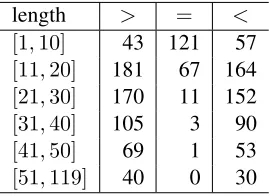
length > = < [1,10] 43 121 57 [11,20] 181 67 164 [21,30] 170 11 152 [31,40] 105 3 90 [41,50] 69 1 53 [51,119] 40 0 30
Table 2: Number of sentences that our system has a higher (>), equal (=) or lower (<) sentence-level BLEU-4 score on the NIST 2008 dataset.
to 0.3, andλL,λrec,λreo exponentially from10−8
to10−2. We use the following hyper-parameters in our experiments:α= 0.11764,λL = 7.59×10⁻⁵, λrec = 1.30×10⁻⁵andλreo= 3.80×10−4.3
The baseline system is a re-implementation of (Xiong et al., 2006). Our system is different from the baseline by replacing the MaxEnt reordering model with a neural model. Both the systems have the same pruning settings: the threshold pruning parameter is set to 0.5 and the histogram pruning parameter to 40. For minimum-error-rate training, both systems generate 200-best lists.
4.2 MT Evaluation
Table 1 shows the case-insensitive BLEU-4 scores of the baseline system and our system on the devel-opment and test sets. Our system outperforms the baseline system by 1.21 BLEU points on the de-velopment set and 1.07 on the test set. Both the differences are statistically significant atp = 0.01 level (Riezler and Maxwell, 2005).
Table 2 shows the number of sentences that our system has a higher (>), equal (=) or lower (<) BLEU score on the NIST 2008 dataset. We find that our system is superior to the baseline system for long
3
The choice ofαis very important for achieving high BLEU scores. We tried a number of intervals and found that the clas-sification accuracy is most stable in the interval [0.100,0.125].
5 10 15 20 25 30 35
1 90 95 100
88
Length
Accuracy (%)
[image:8.612.317.530.57.195.2]neural maxent
Figure 4: Comparison of reordering classification accu-racies between the MaxEnt and neural classifiers over varying phrase lengths. “Length” denotes the sum of the lengths of two source phrases in a reordering example. Our classifier (neural) outperforms the MaxEnt classi-fier (maxent) consistently, especially for predicting long-distance reordering.
# of examples NIST 2006 (tune) NIST 2008
100,000 30.88 23.78
200,000 30.75 23.89
400,000 30.80 24.35
800,000 31.01 24.45
6,004,441 31.61 24.82
Table 3: The effect of reordering training data size on BLEU scores. The BLEU scores rise with the increase of training data size. Due to the computational cost, we only used 1/5 of the entire bilingual corpus to train our neural reordering model.
sentences.
Figure 4 compares classification accuracies of the neural and MaxEnt classifiers. “Length” denotes the sum of the lengths of two source phrases in a re-ordering example. For each length, we randomly se-lect 200 unseen reordering examples to calculate the classification accuracy. Our classifier outperforms the baseline consistently, especially for long com-posed blocks.
[image:8.612.116.251.168.266.2]cluster 1 cluster 2 cluster 3 cluster 4 cluster 5 1.18 works for alternative duties these people who of the three
[image:9.612.80.530.59.143.2]accessibility verify on one-day conference the reasons why on the fundamental wheelchair tunnels from armed groups the story of how over the entire candies transparency in chinese language works the system which through its own cough opinion at eating habits the trend towards with the best
Table 4: Words and phrases that are close in the Euclidean space. The words and phrases in the same cluster have similar behaviors from a reordering point of view rather than relatedness, suggesting that the vector representations produced by the recursive autoencoders are helpful for capturing reordering regularities.
significantly. One possible reason is that there is limited room for improvement as our system makes fewer wrong predictions for long composed blocks. The above results suggest that our system does go beyond using boundary words and make a better use of the merging blocks by using vector space repre-sentations.
Table 3 shows the effect of training dataset size on BLEU scores. We find that BLEU scores on both the development and test sets rise with the increase of the training dataset size. As the training process is very time-consuming, only the reordering examples extracted from 1/5 of the entire parallel training cor-pus are used in our experiments to train our model. Obviously, with more efficient training algorithms, making full use of all the reordering examples ex-tracted from the entire corpus will result in better results. We leave this for future work.
4.3 Qualitative Analysis on Vector Representations
Table 4 shows a number of words and phrases that are close (measured by Euclidean distance) in the n-dimensional space. We randomly select about 370K target side phrases used in our experiments and cluster them into 983 clusters using k-means al-gorithm (MacQueen, 1967). The distance between two phrases are measured by the Euclidean distance between their vector representations. As shown in Table 4, cluster 1 mainly consists of nouns, clus-ter 2 mainly contains verb/noun+preposition struc-tures, cluster 3 contains compound phrases, cluster 4 consists of phrases which should be followed by a clause, and cluster 5 mainly contains the begin-ning parts of prepositional phrases that tend to be followed by a noun phrase or word. We find that the words and phrases in the same cluster have
sim-ilar behaviors from a reordering point of view rather than relatedness. This indicates that the vector rep-resentations produced by the recursive autoencoders are helpful for capturing reordering regularities.
5 Conclusion
We have presented an ITG reordering classifier based on recursive autoencoders. As recursive au-toencoders are capable of producing vector space representations for arbitrary multi-word strings in decoding, our neural ITG system achieves an ab-solute improvement of 1.07 BLEU points over the baseline on the NIST 2008 Chinese-English dataset. There are a number of interesting directions we would like to pursue in the near future. First, placing the MaxEnt classifier with a neural one defines the conditions for risk-free hypothesis re-combination. We find that the number of hypothe-ses that can be recombined reduces in our system. Therefore, we plan to use forest reranking (Huang, 2008) to alleviate this problem. Second, it is in-teresting to follow Socher et al. (2013) to combine linguistically-motivated labels with recursive neural networks. Another problem with our system is that the decoding speed is much slower than the baseline system because of the computational overhead intro-duced by RAEs. It is necessary to investigate more efficient decoding algorithms. Finally, it is possible to apply our method to other phrase-based and even syntax-based systems.
Acknowledgments
(2013)), by the Singapore National Research Foun-dation under its International Research Centre @ Singapore Funding Initiative and administered by the IDM Programme Office, and by a Research Fund No. 20123000007 from Tsinghua MOE-Microsoft Joint Laboratory. Many thanks go to Chunyang Liu and Chong Kuang for their great help for setting up the computing platform. We also thank Min-Yen Kan, Meng Zhang and Yu Zhao for their insightful discussions.
References
Yaser Al-Onaizan and Kishore Papineni. 2006. Distor-tion models for statistical machine translaDistor-tion. In Pro-ceedings of the 21st International Conference on Com-putational Linguistics and 44th Annual Meeting of the Association for Computational Linguistics, pages 529–536, Sydney, Australia, July.
Yoshua Bengio, R´ejean Ducharme, Pascal Vincent, and Christian Janvin. 2003. A neural probabilistic lan-guage model.Journal of Machine Learning Research, 3:1137–1155, March.
James Bergstra and Yoshua Bengio. 2012. Random search for hyper-parameter optimization. The Jour-nal of Machine Learning Research, 13(1):281–305, February.
Arianna Bisazza and Marcello Federico. 2012. Modi-fied distortion matrices for phrase-based statistical ma-chine translation. InProceedings of the 50th Annual Meeting of the Association for Computational Linguis-tics (Volume 1: Long Papers), pages 478–487, Jeju Is-land, Korea, July.
Antoine Bordes, Jason Weston, Ronan Collobert, and Yoshua Bengio. 2011. Learning structured embed-dings of knowledge bases. In Proceedings of the Twenty-Fifth AAAI Conference on Artificial Intelli-gence, pages 301–306.
Antoine Bordes, Xavier Glorot, Jason Weston, and Yoshua Bengio. 2012. Joint learning of words and meaning representations for open-text semantic pars-ing. InInternational Conference on Artificial Intelli-gence and Statistics, pages 127–135.
Colin Cherry. 2013. Improved reordering for phrase-based translation using sparse features. In Proceed-ings of the 2013 Conference of the North American Chapter of the Association for Computational Linguis-tics: Human Language Technologies, pages 22–31, Atlanta, Georgia, June.
Ronan Collobert and Jason Weston. 2008. A unified ar-chitecture for natural language processing: Deep neu-ral networks with multitask learning. In
Proceed-ings of the 25th International Conference on Machine Learning, pages 160–167.
R. Collobert, J. Weston, L. Bottou, M. Karlen, K. Kavukcuoglu, and P. Kuksa. 2011. Natural lan-guage processing (almost) from scratch. Journal of Machine Learning Research, 12:2493–2537.
Yang Feng, Haitao Mi, Yang Liu, and Qun Liu. 2010. An efficient shift-reduce decoding algorithm for phrased-based machine translation. InProceedings of the 23rd International Conference on Computational Linguis-tics: Posters, pages 285–293, Beijing, China, August. Michel Galley and Christopher D. Manning. 2008. A
simple and effective hierarchical phrase reordering model. In Proceedings of the 2008 Conference on Empirical Methods in Natural Language Processing, pages 848–856, Honolulu, Hawaii, October.
Xavier Glorot, Antoine Bordes, and Yoshua Bengio. 2011. Domain adaptation for large-scale sentiment classification: A deep learning approach. In Proceed-ings of the 28th International Conference on Machine Learning (ICML-11), pages 513–520.
Christoph Goller and Andreas Kuchler. 1996. Learning task-dependent distributed representations by back-propagation through structure. InProceedings of 1996 IEEE International Conference on Neural Networks (Volume:1), volume 1, pages 347–352.
Spence Green, Michel Galley, and Christopher D. Man-ning. 2010. Improved models of distortion cost for statistical machine translation. InProceedings of Hu-man Language Technologies: The 2010 Annual Con-ference of the North American Chapter of the Associ-ation for ComputAssoci-ational Linguistics, pages 867–875, Los Angeles, California, June.
Karl Moritz Hermann and Phil Blunsom. 2013. The role of syntax in vector space models of compositional se-mantics. InProceedings of the 51st Annual Meeting of the Association for Computational Linguistics (Vol-ume 1: Long Papers), pages 894–904, Sofia, Bulgaria, August.
Eric Huang, Richard Socher, Christopher Manning, and Andrew Ng. 2012. Improving word representations via global context and multiple word prototypes. In Proceedings of the 50th Annual Meeting of the Associ-ation for ComputAssoci-ational Linguistics (Volume 1: Long Papers), pages 873–882, Jeju Island, Korea, July. Liang Huang. 2008. Forest reranking: Discriminative
parsing with non-local features. InProceedings of the 46th Annual Meeting of the Association for Compu-tational Linguistics: Human Language Technologies, pages 586–594, Columbus, Ohio, June.
Philipp Koehn, Franz Josef Och, and Daniel Marcu. 2003. Statistical phrase-based translation. In Proceed-ings of the 2003 Conference of the North American Chapter of the Association for Computational Linguis-tics on Human Language Technology-Volume 1, pages 48–54.
Philipp Koehn, Hieu Hoang, Alexandra Birch, Chris Callison-Burch, Marcello Federico, Nicola Bertoldi, Brooke Cowan, Wade Shen, Christine Moran, Richard Zens, Chris Dyer, Ondrej Bojar, Alexandra Con-stantin, and Evan Herbst. 2007. Moses: Open source toolkit for statistical machine translation. In Proceed-ings of the 45th Annual Meeting of the Association for Computational Linguistics Companion Volume Pro-ceedings of the Demo and Poster Sessions, pages 177– 180, Prague, Czech Republic, June.
James MacQueen. 1967. Some methods for classifica-tion and analysis of multivariate observaclassifica-tions. In Pro-ceedings of the Fifth Berkeley Symposium on Mathe-matical Statistics and Probability, volume 1.
Franz Josef Och and Hermann Ney. 2004. The align-ment template approach to statistical machine transla-tion.Computational Linguistics, 30(4):417–449. Franz Josef Och, Daniel Gildea, Sanjeev Khudanpur,
Anoop Sarkar, Kenji Yamada, Alex Fraser, Shankar Kumar, Libin Shen, David Smith, Katherine Eng, Viren Jain, Zhen Jin, and Dragomir Radev. 2004. A smorgasbord of features for statistical machine trans-lation. InProceedings of the Human Language Tech-nology Conference of the North American Chapter of the Association for Computational Linguistics: HLT-NAACL 2004: Main Proceedings, pages 161–168, Boston, Massachusetts, USA, May.
Stefan Riezler and John T. Maxwell. 2005. On some pitfalls in automatic evaluation and significance test-ing for MT. InProceedings of the ACL Workshop on Intrinsic and Extrinsic Evaluation Measures for Ma-chine Translation and/or Summarization, pages 57– 64, Ann Arbor, Michigan, June.
Richard Socher, Eric H. Huang, Jeffrey Pennin, An-drew Y. Ng, and Christopher D. Manning. 2011a. Dy-namic pooling and unfolding recursive autoencoders for paraphrase detection. InProceedings of Advances in Neural Information Processing Systems 24, pages 801–809.
Richard Socher, Cliff C. Lin, Andrew Y. Ng, and Christo-pher D. Manning. 2011b. Parsing natural scenes and natural language with recursive neural networks. In Proceedings of the 26th International Conference on Machine Learning (ICML), pages 129–136.
Richard Socher, Jeffrey Pennington, Eric H. Huang, An-drew Y. Ng, and Christopher D. Manning. 2011c. Semi-supervised recursive autoencoders for predicting sentiment distributions. InProceedings of the 2011
Conference on Empirical Methods in Natural Lan-guage Processing, pages 151–161, Edinburgh, Scot-land, UK., July.
Richard Socher, Brody Huval, Christopher D. Manning, and Andrew Y. Ng. 2012. Semantic compositional-ity through recursive matrix-vector spaces. In Pro-ceedings of the 2012 Joint Conference on Empirical Methods in Natural Language Processing and Com-putational Natural Language Learning, pages 1201– 1211, Jeju Island, Korea, July.
Richard Socher, John Bauer, Christopher D. Manning, and Ng Andrew Y. 2013. Parsing with compositional vector grammars. InProceedings of the 51st Annual Meeting of the Association for Computational Linguis-tics (Volume 1: Long Papers), pages 455–465, Sofia, Bulgaria, August.
Andreas Stolcke. 2002. SRILM - an extensible lan-guage modeling toolkit. InProceedings of Interna-tional Conference on Spoken Language Processing, vol. 2, pages 901–904, September.
Christoph Tillman. 2004. A unigram orientation model for statistical machine translation. InProceedings of the Human Language Technology Conference of the North American Chapter of the Association for Com-putational Linguistics: HLT-NAACL 2004: Short Pa-pers, pages 101–104, Boston, Massachusetts, USA, May.
Dekai Wu. 1997. Stochastic inversion transduction grammars and bilingual parsing of parallel corpora. Computational Linguistics, 23(3):377–403.
Deyi Xiong, Qun Liu, and Shouxun Lin. 2006. Maxi-mum entropy based phrase reordering model for sta-tistical machine translation. InProceedings of the 21st International Conference on Computational Linguis-tics and 44th Annual Meeting of the Association for Computational Linguistics, pages 521–528, Sydney, Australia, July.
Deyi Xiong, Min Zhang, Aiti Aw, Haitao Mi, Qun Liu, and Shouxun Lin. 2008. Refinements in BTG-based statistical machine translation. InProceedings of the Third International Joint Conference on Natural Lan-guage Processing: Volume-I, pages 505–512.
Deyi Xiong, Min Zhang, Aiti Aw, and Haizhou Li. 2010. Linguistically annotated reordering: Evaluation and analysis. Computational Linguistics, 36(3):535–568, September.