2357
MathQA: Towards Interpretable Math Word Problem Solving
with Operation-Based Formalisms
Aida Amini1, Saadia Gabriel1, Shanchuan Lin1, Rik Koncel-Kedziorski1,
Yejin Choi1,2, and Hannaneh Hajishirzi1,2
1University of Washington 2Allen Institute for AI
{amini91, skgabrie, linsh, kedzior, yejin, hannaneh}@cs.washington.edu
Abstract
We introduce a large-scale dataset of math word problems and an interpretable neural math problem solver that learns to map prob-lems to operation programs. Due to an-notation challenges, current datasets in this domain have been either relatively small in scale or did not offer precise operational an-notations over diverse problem types. We introduce a new representation language to model precise operation programs correspond-ing to each math problem that aim to im-prove both the performance and the inter-pretability of the learned models. Using this representation language, our new dataset, MathQA, significantly enhances the AQuA dataset with fully-specified operational pro-grams. We additionally introduce a neu-ral sequence-to-program model enhanced with automatic problem categorization. Our exper-iments show improvements over competitive baselines in our MathQA as well as the AQuA datasets. The results are still significantly lower than human performance indicating that the dataset poses new challenges for future re-search. Our dataset is available at: https: //math-qa.github.io/math-QA/.
1 Introduction
Answering math word problems poses unique challenges for logical reasoning over implicit or explicit quantities expressed in text. Math word-problem solving requires extraction of salient in-formation from natural language narratives. Auto-matic solvers must transform the textual narratives into executable meaning representations, a process that requires both high precision and, in the case of story problems, significant world knowledge.
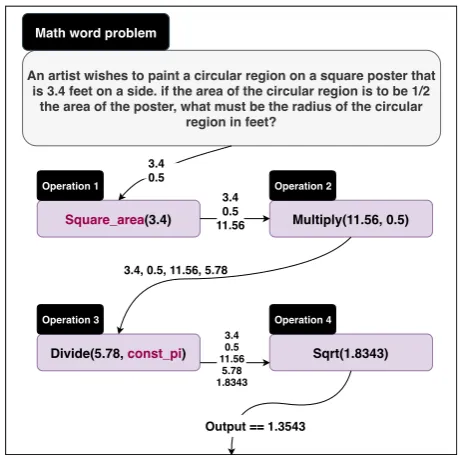
As shown by the geometry question in Figure1, math word problems are generally narratives de-scribing the progress of actions and relations over some entities and quantities. The operation
pro-An artist wishes to paint a circular region on a square poster that is 3.4 feet on a side. if the area of the circular region is to be 1/2
the area of the poster, what must be the radius of the circular region in feet?
Math word problem
Square_area(3.4)
Operation 1
Multiply(11.56, 0.5)
Operation 2
Divide(5.78, const_pi)
Operation 3
Sqrt(1.8343)
Operation 4
3.4 0.5
3.4 0.5 11.56
3.4, 0.5, 11.56, 5.78
Output == 1.3543
3.4 0.5 11.56
[image:1.595.305.536.220.449.2]5.78 1.8343
Figure 1: Example of a math word problem aligned with representation language by crowd-sourced anno-tation
gram underlying the problem in Figure 1 high-lights the complexity of the problem-solving task. Here, we need the ability to deduce implied con-stants (pi) and knowledge of domain-specific for-mulas (area of the square).
In this paper, we introduce a new operation-based representation language for solving math word problems. We use this representation lan-guage to construct MathQA1, a new large-scale, diverse dataset of 37k English multiple-choice math word problems covering multiple math do-main categories by modeling operation programs corresponding to word problems in the AQuA dataset (Ling et al., 2017). We introduce a neu-ral model for mapping problems to operation pro-grams with domain categorization.
1The dataset is available at: https://math-qa.
Most current datasets in this domain are small in scale (Kushman et al.,2014) or do not offer pre-cise operational annotations over diverse problem types (Ling et al., 2017). This is mainly due to the fact that annotating math word problems pre-cisely across diverse problem categories is chal-lenging even for humans, requiring background math knowledge for annotators. Our representa-tion language facilitates the annotarepresenta-tion task for crowd-sourcing and increases the interpretability of the proposed model.
Our sequence-to-program model with catego-rization trained on our MathQA dataset outper-forms previous state-of-the-art on the AQuA test set in spite of the smaller training size. These re-sults indicate the superiority of our representation language and the quality of the formal annotations in our dataset. Our model achieves competitive results on MathQA, but is still lower than human performance indicating that the dataset poses new challenges for future research. Our contributions are as follows:
• We introduce a large-scale dataset of math word problems that are densely annotated with oper-ation programs
• We introduce a new representation language to model operation programs corresponding to each math problem that aim to improve both the performance and the interpretability of the learned models.
• We introduce a neural architecture leveraging a sequence-to-program model with automatic problem categorization, achieving competitive results on our dataset as well as the AQuA dataset
2 Background and Related Work
Large-Scale Datasets Several large-scale math word problem datasets have been released in re-cent years. These include Dolphin18K (Huang et al., 2016), Math23K (Wang et al., 2017) and AQuA. We choose the 2017 AQUA-RAT dataset to demonstrate use of our representation language on an existing large-scale math word problem solving dataset. The AQuA provides over 100K GRE- and GMAT-level math word problems. The problems are multiple choice and come from a wide range of domains.
The scale and diversity of this dataset makes it particularly suited for use in training deep-learning models to solve word problems. However
there is a significant amount of unwanted noise in the dataset, including problems with incorrect solutions, problems that are unsolvable without brute-force enumeration of solutions, and ratio-nales that contain few or none of the steps re-quired to solve the corresponding problem. The motivation for our dataset comes from the fact we want to maintain the challenging nature of the problems included in the AQuA dataset, while re-moving noise that hinders the ability of neuralized models to learn the types of signal neccessary for problem-solving by logical reasoning.
Additional Datasets Several smaller datasets have been compiled in recent years. Most of these works have focused on algebra word problems, in-cluding MaWPS (Koncel-Kedziorski et al.,2016), Alg514 (Kushman et al., 2014), and DRAW-1K (Upadhyay and Chang, 2017). Many of these datasets have sought to align underlying equations or systems of equations with word problem text. While recent works like (Liang et al.,2018; Locas-cio et al.,2016) have explored representing math word problems with logical formalisms and reg-ular expressions, our work is the first to provide well-defined formalisms for representing interme-diate problem-solving steps that are shown to be generalizable beyond algebra problems.
Solving with Handcrafted FeaturesDue to spar-sity of suitable data, early work on math word problem solving used pattern-matching to map word problems to mathematical expressions (Bo-brow, 1964; Charniak, 1968, 1969), as well as non-neural statistical modeling and semantic pars-ing approaches (Liguda and Pfeiffer,2012).
Some effort has been made on parsing the prob-lems to extract salient entities (Hosseini et al., 2017). This approach views entities as contain-ers, which can be composed into an equation tree representation. The equation tree representation is changed over time by operations implied by the problem text.
them based on the problem.
Neural Word Problem SolversFollowing the in-creasing availability of large-scale datasets like AQuA, several recent works have explored deep neural approaches to math word problem solv-ing (Wang et al., 2017). Our representation lan-guage is motivated by exploration of using inter-mediate formalisms in the training of deep neural problem-solving networks, as is done in the work of (Huang et al., 2018b) to solve problems with sequence to sequence models. While this work fo-cused on single-variable arithmetic problems, our work introduces a formal language of operations for covering more complex multivariate problems and systems of equations.
Interpretability of Solvers While the statisti-cal models with handcrafted features introduced by prior work are arguably “interpretable” due to the relative sparsity of features as well as the clear alignments between inputs and outputs, new neuralized approaches present new challenges to model interpretability of math word problem solvers (Huang et al., 2018a). While this area is relatively unexplored, a prior approach to increas-ing robustness and interpretability of math word problem-solving models looks at using an adver-sarial dataset to determine if models are learn-ing logical reasonlearn-ing or exploitlearn-ing dataset biases through pattern-matching (Liang et al.,2018).
3 Representing Math Word Problems
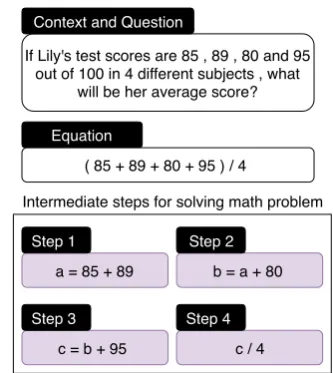
A math word problem consists of a narrative that grounds mathematical formalisms in real-world concepts. Solving these problems is a challenge for both humans and automatic methods like neu-ral network-based solvers, since it requires logical reasoning about implied actions and relations be-tween entities. For example, in Figure 2, opera-tions like addition and division are not explicitly mentioned in the word problem text, but they are implied by the question. As we examine the con-text of a math word problem, we have to select arguments for operations based on which values are unimportant for solving the problem and which are salient. In Figure2, the numeric value “100” appears in the context but does not appear in the underlying equation.
By selecting implied operations and arguments, we can generate a program of intermediate steps for solving a math word problem. Each step
in-Equation
If Lily's test scores are 85 , 89 , 80 and 95 out of 100 in 4 different subjects , what
will be her average score?
( 85 + 89 + 80 + 95 ) / 4
Context and Question
a = 85 + 89
Step 1
b = a + 80
Step 2
c = b + 95 c / 4
Step 3 Step 4
[image:3.595.330.497.59.246.2]Intermediate steps for solving math problem
Figure 2: Example of a math word problem with its un-derlying equation and intermediate steps for problem-solving
volves a mathematical operation and its related ar-guments. In Figure 2, there are three addition op-erations and one division. As illustrated in the fig-ure, operations can be dependant to the previous ones by the values they use as arguments. Every math word problem can be solved by sequentially executing these programs of dependent operations and arguments.
We define formalisms for expressing these se-quential operation programs with a domain-aware representation language. An operation program in our representation language is a sequence with
noperations. The general form is shown below. Each operationoitakes in a list of argumentsaof
lengthi:
o1(a1)o2(a2)...on(an) (1)
Given this general definition, the problem in Fig-ure2has the following representation2:
add1(85,89)add2(174,80)
add3(254,95)divide4(349,4)
(2)
Our representation language consists of 58 op-erations and is designed considering the following objectives.
• Correctness → Operation programs should result in the correct solution when all oper-ations are executed.
• Domain-awareness → Operation problems should make use of both math knowledge and
2Here the arguments174,254and349are the outputs of
domain knowledge associated with subfields like geometry and probability to determine which operations and arguments to use.
• Human interpretability → Each operation and argument used to obtain the correct so-lution should relate to part of the input word problem context or a previous step in the op-eration program.
Learning logical forms has led to success in other areas of semantic parsing (Cheng et al., 2017; Zelle and Mooney,1996;Zettlemoyer and Collins, 2007, 2005) and is a natural representation for math word problem-solving steps. By augment-ing our dataset with these formalisms, we are able to cover most types of math word problems3. In contrast to other representations like simultane-ous equations, our formalisms ensure that every problem-solving step is aligned to a previous one. There are three advantages to this approach. First, we use this representation language to provide hu-man annotators with clear steps for how a partic-ular problem should be solved with math and do-main knowledge. Second, our formalisms provide neural models with a continuous path to execute operations for problems with systems of equa-tions, instead of forcing models to align equations before problem solving. This reduces the possi-bility of intermediate errors being propagated and leading to a incorrect solution. Finally, by hav-ing neural models generate a solution path in our representation language before computing the fi-nal solution, we are able to reconstruct the logi-cal hops inferred by the model output, increasing model interpretability.
4 Dataset
Our dataset (called MathQA) consists of 37,200 math word problems, corresponding lists of multiple-choice options and aligned operation pro-grams. We use problems in the AQuA dataset and carefully annotate those problems with formal op-eration programs.
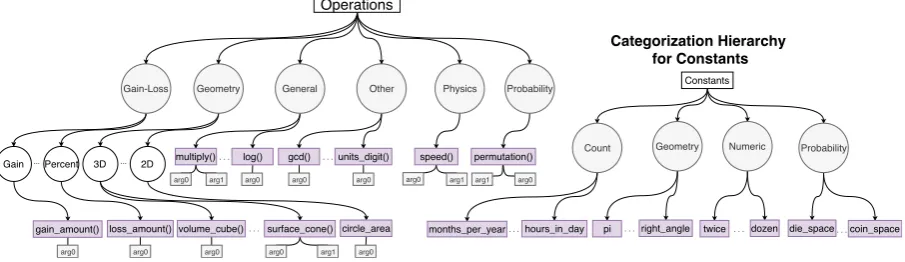
Math problems are first categorized into math domains using term frequencies (more details in Section 5.2). These domains are used to prune the search space of possible operations to align with the word problem text. Figure 3 shows
3We omit high-order polynomials and problems where the
solutions are entirely nonnumeric.
Category #Prob. Avg #words #Vocab Avg #ops
Geometry 3,316 34.3 1,839 4.8
Physics 9,830 37.3 3,340 5.0
Probability 663 38.9 937 5.0
Gain-Loss 4,377 34.3 1,533 5.7
General 17,796 38.6 6,912 5.1
Other 1,277 31.3 1,425 4.7
[image:4.595.308.525.62.151.2]All 37,259 37.9 6,664 5.3
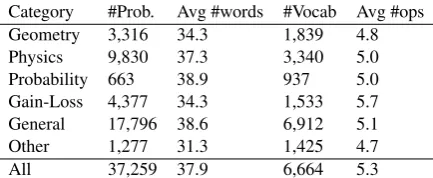
Table 1: Statistics for our dataset; the total number of operations in the dataset is 58.
the category-based hierarchies for operation for-malisms.
We use crowdsourcing to carefully align prob-lems with operation programs (Section4.1). Ta-ble1shows overall statistics of the dataset.4
4.1 Annotation using Crowd Workers
Annotating GRE level math problems can be a challenging and time consuming task for humans. We design a dynamic annotation platform to an-notate math word problems with formal opera-tion programs. Our annotaopera-tion platform has the following properties: (a) it provides basic math knowledge to annotators, (b) it is dynamic by it-eratively calculating intermediate results after an operation submission, and (c) it employs quality control strategies.
Dynamic Annotation Platform The annotators are provided with a problem description, a list of operations related to the problem category, and a list of valid arguments. They iteratively select op-erations and arguments until the problem is solved. • Operation Selection The annotators are in-structed to sequentially select an operation from the list of operations in the problem category. Annotators are provided with math knowledge by hovering over every operation and getting the related hint that consists of arguments, for-mula and a short explanation of the operation.
• Argument Selection After selecting the oper-ation the list of valid arguments are presented
4
We also experimented with an automatic dynamic pro-gramming approach to annotation that generates operation programs for problems using numbers in the AQuA
ratio-nales. Due to the noise in the rationales, only61%of those
Geometry Physics
Gain-Loss General Other Probability
Gain Percent
gain_amount() ...
loss_amount() 3D ... 2D
volume_cube() surface_cone() circle_area multiply() log() gcd() units_digit() speed()
Operations
Constants
Count Geometry Numeric Probability
months_per_year hours_in_day pi right_angle twice dozen die_space coin_space
arg0 arg0 arg0 arg0 arg1 arg0
arg0 arg1 arg0 arg1 arg0 arg0 arg0
permutation() . . . .
arg1 arg0
. . . .
[image:5.595.74.527.65.196.2]Categorization Hierarchy for Constants
Figure 3: Category-based Hierarchies for Operation Formalisms
to the annotators to choose from. Valid argu-ments consist of numbers in the problem, con-stants in the problem category, and the previous calculations. The annotators are restricted to se-lect only from these valid arguments to prevent having noisy and dangling numbers. After sub-mission of an operation and the corresponding arguments, the result of the operation is auto-matically calculated and will be added as a new valid argument to the argument list.
• Program Submission To prevent annotators from submitting arbitrary programs, we en-force restrictions to the final submission. Our platform only accepts programs which include some numbers from the problem, and whose fi-nal calculation is very close to the correct nu-meric solution.
High Quality Crowd Workers We
dynami-cally evaluate and employ high-quality annotators through a collection of quality-control questions. We take advantage of the annotation platform in Figure Eight.5 The annotators are randomly eval-uated through a pre-defined set of test questions, and they have to maintain an accuracy threshold to be able to continue their annotations. If an an-notator’s accuracy drops below a threshold, their previous annotations are labeled as untrusted and will be added to the pool of annotations again.
Alignment Validation To further evaluate the quality of the annotated programs, we leverage a validation strategy to check whether the problems and annotated programs are aligned or not. Ac-cording to this strategy, at least 2 out of 3 valida-tors should rank the operation program as valid for it to be selected. The validation accuracy is
94.64%across categories.
5https://www.figure-eight.com
5 Models
We develop encoder-decoder neural models to map word problems to a set of feasible operation programs. We match the result of the executed op-eration program against the list of multiple-choice options given for a particular problem. The match-ing solution is the final model output.
We frame the problem of aligning an operation program with a math word problem as a neural machine translation (NMT) task, where the word problemxand gold operation program y form a parallel text pair. The vocabulary of y includes all possible operations and arguments in our rep-resentation language.
5.1 Sequence-to-Program
For our initial sequence-to-program model, we follow the attention-based NMT paradigm of (Bahdanau et al., 2015; Cho et al., 2014). We encode the source word problem text x =
(x1, x2, ..., xM) using a bidirectional RNN
en-coder θenc. The decoderθdec predicts a distribu-tion over the vocabulary and input tokens to gener-ate each operation or argument in the target opera-tion program. For our sequence-to-program model vocabulary, we use informed generation, in which the program tokens are generated separately from the vocabulary of operationsOor argumentsA.
The encoded text is represented by a se-quence of d-dimensional hidden states henc = (henc
1 , henc2 , .., hencM ), whereMis the length of the
input text. A context vector ai is computed by
taking the weighted sum of the attention model weightsαt,ifor each timestept∈(1,2, ..., T)and
each encoder hidden statehenci :
ai =PMi=1αt,ihenci .
Multiply 50 ... <eos>
[image:6.595.83.517.63.272.2]Multiply 167
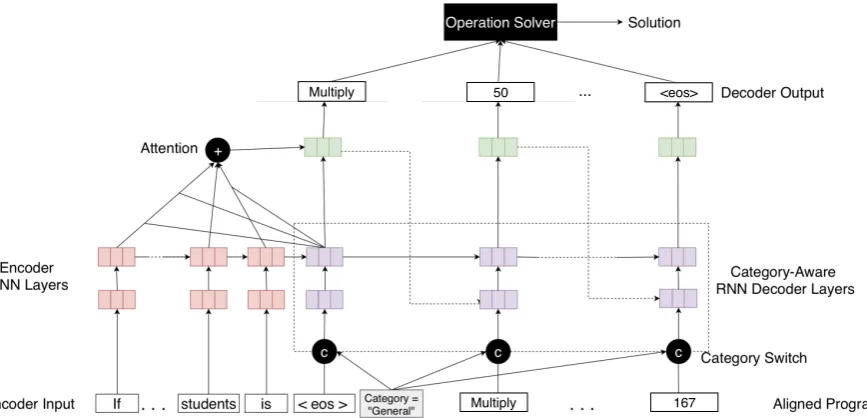
Figure 4: Architecture of sequence-to-program model with categorization. Shown with example problem “If the average marks of three batches of 62 , 60 and 45 students respectively is 50 , 55 , 60 , then the average marks of all the students is.”
statehdeci using a LSTM recurrent layer:
hdeci =LST M(hdeci−1, yi−1, ai) (3)
At each timestep, we make a prediction for an operator opi or argument argik, where k
corre-sponds to the index of the argument in operator
i’s argument list. This prediction is conditioned on the previous tokens (y1, ..., yi−1) and the
in-putxto decode an entire operation programy =
(y1, y2, ..., yN)of lengthN:
P(y|x) =
N Y
i=1
P(yi|y<i,x) (4)
P(yi|y<i,x) =g(f(hdeci , yi, ai)) (5)
Here f is a 1-layer feed-forward neural network and g is the softmax function. During train-ing time, we minimize the negative log-likelihood (NLL) using the following objective:
L(θenc, θdec) =−logP(y|x;θenc, θdec) (6)
At test time, we only observe the input text when predicting operation programs:
ˆ
y=argmaxyP(y|x) (7)
5.2 Categorized Sequence-to-Program Model
We extend our base sequence-to-program model to integrate knowledge of math word problem do-main categories. We modify the RNN decoder lay-ers that compute the decoder hidden state to be
category-aware. Here, the category labelcis de-terministically computed by the category extractor (explained below). It functions as a hard decision switch that determines which set of parameters to use for the hidden state computation:
hdeci =LST Mc(hdeci−1, yi−1, ai) (8)
The updated objective function from equation (7) is shown below:
L(θenc, θdecc ) =−logP(y|x;θenc, θcdec) (9)
The full model architecture is shown in Figure4.
Domain-Specific Category Extraction We first construct a lexicon of n-grams relating to a specific domain. The lexicon is a list consisting of domain-specific categories and associated n-grams. For each domain category c in the lexicon, we se-lect associated n-gramsncthat occur frequently in
word problems belonging to domain category c, but rarely appear in other domain categories. We compute n-gram frequency fpc as the number of
n-grams associated with a categorycappearing in the text of a word problem p. We obtain a list of potential categories forp by choosing all cat-egories for whichfpc > 0, and then assign a
cat-egory label topbased on which category has the highest n-gram frequency.
5.3 Solving Operation Programs
sequentially along with its predicted set of argu-ments to obtain a possible solution. For each word problemp and options o, we generate a beam of the top ndecoded operation programs. We exe-cute each decoded programgto find the solution from the list of optionsoof the problem. We first choose options that are within a threshold of the executed value ofg. We selectgas the predicted solution by checking the number of selected op-tions and the minimum distance between the exe-cuted value of gand a possible option forp. For the problems in AQuA that do not belong in any category of MathQA, we randomly choose an op-tion.
6 Experimental Setup
6.1 Datasets
Our dataset consists of 37k problems which are randomly split in (80/12/8)% training/dev/test problems. Our dataset significantly enhances the AQuA dataset by fully annotating a portion of solvableproblems in the AQuA dataset into for-mal operation programs.
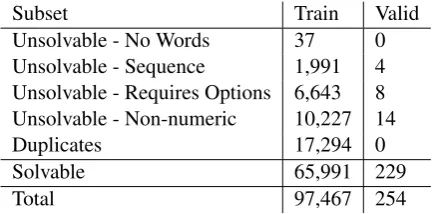
We carefully study the AQuA dataset. Many of the problems are near-duplicates with slight changes to the math word problem stories or nu-merical values since they are expanded from a set of 30,000 seed problems through crowdsourcing (Ling et al., 2017). These changes are not al-ways reflected in the rationales, leading to incor-rect solutions. There are also some problems that are not solvable given current math word prob-lem solving frameworks because they require a level of reasoning not yet modeled by neural net-works. Sequence problems, for example, require understanding of patterns that are difficult to intuit without domain knowledge like sequence formu-las, and can only be solved automatically through brute-force or guessing. Table 2 shows a full breakdown of the AQuA dataset by solvability.6
6.2 Annotation Details
We follow the annotation strategy described in Section4to formally annotate problems with op-eration programs. 7
6There is overlap between unsolvable subsets. For
exam-ple, a sequence problem may also be a duplicate of another problem in the AQuA dataset.
7We tried two other strategies of showing extra
informa-tion (rainforma-tionales or end soluinforma-tions) to annotators to facilitate solving problems. However, our manual validation showed
Subset Train Valid
Unsolvable - No Words 37 0
Unsolvable - Sequence 1,991 4
Unsolvable - Requires Options 6,643 8
Unsolvable - Non-numeric 10,227 14
Duplicates 17,294 0
Solvable 65,991 229
[image:7.595.307.524.62.169.2]Total 97,467 254
Table 2: Full original AQuA solvability statistics.
Annotator Agreements and Evaluations Our expert evaluation of the annotation procedure for a collection of 500 problems shows that 92% of the annotations are valid. Additionally, it has87%
agreement between the expert validation and the crowd sourcing validation task.
Annotation Expansion The AQuA dataset con-sists of a group of problems which share simi-lar characteristics. These problems can be solved with similar operation programs. We find closely similar problems, replace numeric values with generic numbers, and expand annotations to cover more problems from the AQuA dataset. For simi-larity, we use Levenshtein distance with a thresh-old of 4 words in edit distance.
6.3 Model and Training Details
We use the official python implementation of OpenNMT (Klein et al.). We choose a LSTM-based encoder-decoder architecture. We use Adam optimizer (Kingma and Ba,2015), and the learning rate for training is0.001. The hidden size for the encoder and decoder is set to d = 100. Both the encoder and decoder have2layers. The word embedding vectors are randomly initialized. At inference time, we implemented a beam search with beam size of 200 for AQuA and 100 for MathQA.
The program vocabulary consists of the opera-tions O in our representation language and valid argumentsA. For valid arguments, we do not use their actual values since the space is very large. In-stead, we keep a list of numbers according to their source. Constants are predefined numbers that are available to all problems. Problem numbers are added to the list according to their order in the problem text. Calculated numbers in the
square_area(n0) divide(#0,n1) divide(#1,const_pi) sqrt(#2)
an artist wishes to paint a circular region on a square poster that is 3.4 feet on a side . if the area of the region is to be 1 / 2 the area of the poster , what must be the radius of the circular
region in feet ?
Operation Sequence Word Problem
[image:8.595.99.504.63.175.2]3.4 .5
Figure 5: Example of an operation program generated by our Seq2prog model with categorization
Model MathQA AQuA
Random 20.0 20.0
AQuA Model - 36.4 Seq2prog 51.9 33.0 Seq2prog + cat 54.2 37.9
Table 3: Experimental results for accuracy on our MathQA and AQuA test sets
diate steps are added to the list according to the operation order.
7 Experimental Results
7.1 Results
Table 3 compares the performance of our sequence-to-program models trained on MathQA with baselines on MathQA and AQuA test sets. The base model is referred to as “Seq2prog,” while our model with categorization is “Seq2prog + cat.” For accuracy, the performance was measured in terms of how well the model would perform on an actual math test.
We observe improvement for our “Seq2prog + cat” model despite the fact that our training data is proportionally smaller than the AQuA dataset, and our model is much simpler than the state-of-the-art model on this dataset. This indicates the ef-fectiveness of our formal representation language to incorporate domain knowledge as well as the quality of the annotations in our dataset.
7.2 Analysis
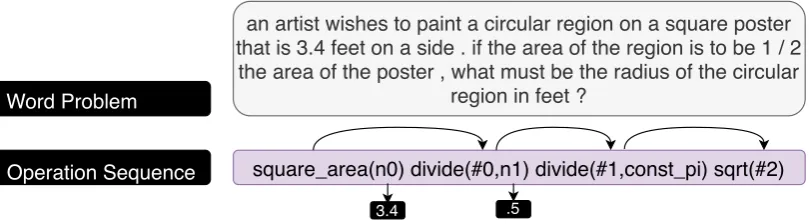
Qualitative Analysis Table5and Figure5show some examples of problems solved by our method. We analyzed 50 problems that are solved wrongly by our system on the MathQA dataset. Table 4 summarizes four major categories of errors.
The most common type of errors are problems that need complicated or long chain of mathemat-ical reasoning. For example, the first problem in Table 4 requires reasoning that goes beyond one sentence. Other errors are due to limitations in our
representation language. For example, the second problem in Table4 requires thefactorization op-eration which is not defined in our representation language. Future work can investigate more do-mains of mathematics such as logic, number fac-tors, etc. Some errors are due to the slightly noisy nature of our categorization strategy. For example, the third problem in Table4is mistakenly catego-rized as belonging to physics domain due to the presence of wordsm, cm, literin the problem text, while the correct category for the problem is ge-ometry. The final category of errors are due to problems that do not have enough textual context or erroneous problems (e.g., fourth problem in Ta-ble4).
Impact of Categorization Table3indicates that our category-aware model outperforms the base model on both AQuA and MathQA datasets. The gain is relatively small because the current model only uses categorization decisions as hard con-straints at decoding time. Moreover, the prob-lem categorization might be noisy due to our use of only one mathematical interpretation for each domain-specific n-gram. For example, the pres-ence of the words “square” or “cube” in the text of a math word problem indicate that the word prob-lem is related to the geometry domain, but these unigrams can also refer to an exponential opera-tion (n2orn3).
To measure the effectiveness of our categoriza-tion strategy, we used human annotacategoriza-tion over 100 problems. The agreement between human anno-tators is84%and their agreement with our model is74.5%. As a future extension of this work, we would like to also consider the context in which domain-specific n-grams appear.
[image:8.595.97.267.204.272.2]prob-Error type Problem
Hard problems (45%) Jane and Ashley take 8 days and 40 days respectively to complete a project when they
work on it alone. They thought if they worked on the project together, they would take fewer days to complete it. During the period that they were working together, Jane took an eight day leave from work. This led to Jane’ s working for four extra days on her own to complete the project. How long did it take to finish the project? Limitation in representation
lan-guage (25%)
How many different positive integers are factors of 25?
Categorization errors (12.5%) A cistern of capacity 8000 litres measures externally 3.3 m by 2.6 m by 1.3 m and its
walls are 5 cm thick. The thickness of the bottom is: Incorrect or insufficient problem
text) (17.5%)
[image:9.595.70.521.60.203.2]45 x ? = 25%of 900
Table 4: Examples of mistakes made by our system. The reason of the errors are underlined.
Problem :A rectangular field is to be fenced on three sides leaving a side of 20 feet uncovered. if the area of the field is 10 sq. feet, how many feet of fencing will be required?
Operations :divide(10,20), multiply(#0, const_2), add(20, 1)
Problem : How long does a train 110m long running at the speed of 72 km/hr takes to cross a bridge 132m length?
Operations : add(110, 132), multiply(72, const_0.2778), divide(#0, #1),
floor(#2)
Table 5: Problems solved correctly by Seq2prog+cat model.
lems that are currently unsolvable or have multi-ple interpretations leading to multimulti-ple correct solu-tions. While problems that can only be solved by brute-force instead of logical reasoning and non-narrative problems that do not fit the definition of a math word problem (in Table2these appear as “no word”) are removed from consideration, there are other problems that are beyond the scope of current models but could pose an interesting chal-lenge for future work. One example is the domain of sequence problems. Unlike past word problem-solving models, our models incorporate domain-specific math knowledge, which is potentially ex-tensible to common sequence and series formulas.
8 Conclusion
In this work, we introduced a representation lan-guage and annotation system for large-scale math word problem-solving datasets that addresses un-wanted noise in these datasets and lack of for-mal operation-based representations. We demon-strated the effectiveness of our representation lan-guage by transforming solvable AQuA word prob-lems into operation formalisms. Experimental
re-sults show that both our base and category-aware sequence-to-program models outperform base-lines and previous results on the AQuA dataset when trained on data aligned with our representa-tion language. Our representarepresenta-tion language pro-vides an extra layer of supervision that can be used to reduce the influence of statistical bias in datasets like AQuA. Additionally, generated op-eration programs like the examples in figure 5 demonstrate the effectiveness of these operation formalisms for representing math word problems in a human interpretable form.
The gap between the performance of our mod-els and human performance indicates that our MathQA still maintains the challenging nature of AQuA problems. In future work, we plan to ex-tend our representation language and models to cover currently unsolvable problems, including se-quence and high-order polynomial problems.
Acknowledgements This research was sup-ported by ONR (N00014-18-1-2826), NSF (IIS 1616112), Allen Distinguished Investigator Award, and gifts from Google, Allen Institute for AI, Amazon, and Bloomberg. We thank Marti A. Hearst, Katie Stasaski, and the anonymous reviewers for their helpful comments.
References
D. Bahdanau, K. Cho, and Y. Bengio. 2015. Machine translation by jointly learning to align and translate. InICLR.
Yefim Bakman. 2007. Robust understanding of word problems with extraneous information. In arXiv preprint math/0701393.
Diane J Briars and Jill H Larkin. 1984. An integrated model of skill in solving elementary word problems. InCognition and instruction 1(3), pages 245–296.
Eugene Charniak. 1968. Calculus word problems. Ph.D. thesis, Massachusetts Institute of Technology.
Eugene Charniak. 1969. Computer solution of calcu-lus word problems. InProceedings of the 1st inter-national joint conference on Artificial intelligence, pages 303–316. Morgan Kaufmann Publishers Inc.
Jianpeng Cheng, Siva Reddy, Vijay Saraswat, and Mirella Lapata. 2017. Learning structured natural language representations for semantic parsing. In Proceedings of the 55th Annual Meeting of the As-sociation for Computational Linguistics (Volume 1: Long Papers), pages 44–55. Association for Compu-tational Linguistics.
Kyunghyun Cho, Bart van Merri¨enboer, Dzmitry Bah-danau, and Yoshua Bengio. 2014. On the properties of neural machine translation: Encoderdecoder ap-proaches. InProceedings of SSST-8, Eighth Work-shop on Syntax, Semantics and Structure in Statisti-cal Translation, pages 103–111.
Denise Dellarosa. 1986. A computer simulation of childrens arithmetic word-problem solving. In Be-havior Research Methods, Instruments, Computers 18(2), pages 147–154.
Mohammad Javad Hosseini, Hannaneh Hajishirzi, Oren Etzioni, and Nate Kushman. 2017. Learning to solve arithmetic word problems with verb catego-rization. InProceedings of the 2014 Conference on Empirical Methods in Natural Language Processing (EMNLP).
Danqing Huang, Jing Liu, Chin-Yew Lin, and Jian Yin. 2018a. Neural math word problem solver with rein-forcement learning. InProceedings of the 27th In-ternational Conference on Computational Linguis-tics, pages 213–223.
Danqing Huang, Shuming Shi, Chin-Yew Lin, Jian Yin, and Wei-Ying Ma. 2016. How well do comput-ers solve math word problems? large-scale dataset construction and evaluation. In Proceedings of the 54th Annual Meeting of the Association for Compu-tational Linguistics (ACL).
Danqing Huang, Jin-Ge Yao, Chin-Yew Lin, Qingyu Zhou, and Jian Yin. 2018b. Using intermediate rep-resentations to solve math word problems. In Pro-ceedings of the 56th Annual Meeting of the Associa-tion for ComputaAssocia-tional Linguistics.
Diederik P. Kingma and Jimmy Ba. 2015. Adam: A method for stochastic optimization. Inthe 3rd Inter-national Conference for Learning Representations (ICLR).
G. Klein, Y. Kim, Y. Deng, J. Senellart, and A. M. Rush. Opennmt: Open-source toolkit for neural ma-chine translation. ArXiv e-prints.
Rik Koncel-Kedziorski, Subhro Roy, Aida Amini, Nate Kushman, and Hannaneh Hajishirzi. 2016. Mawps: A math word problem repository. InNAACL.
Nate Kushman, Yoav Artzi, Luke Zettlemoyer, and Regina Barzilay. 2014. Learning to automatically solve algebra word problems. InProceedings of the 52nd Annual Meeting of the Association for Compu-tational Linguistics (ACL).
Chao-Chun Liang, Yu-Shiang Wong, Yi-Chung Lin, and Keh-Yih Su. 2018. A meaning-based statistical english math word problem solver. InProceedings of NAACL-HLT 2018.
Christian Liguda and Thies Pfeiffer. 2012. Modeling math word problems with augmented semantic net-works. InInternational Conference on Application of Natural Language to Information Systems, pages 247–252. Springer.
Wang Ling, Dani Yogatama, Chris Dyer, and Phil Blun-som. 2017. Program induction by rationale genera-tion: Learning to solve and explain algebraic word problems. InProceedings of ACL.
Nicholas Locascio, Karthik Narasimhan, Eduardo DeLeon, Nate Kushman, and Regina Barzilay. 2016. Neural generation of regular expressions from nat-ural language with minimal domain knowledge. In Proceedings of the 2016 Conference on Em-pirical Methods in Natural Language Processing (EMNLP), pages 247–252. Association for Compu-tational Linguistics.
Subhro Roy and Dan Roth. 2018. Mapping to declar-ative knowledge for word problem solving. In Pro-ceedings of NAACL-HLT 2018.
Shyam Upadhyay and Ming-Wei Chang. 2017. An-notating derivations: A new evaluation strategy and dataset for algebra word problems. InProceedings of the 15th Conference of the European Chapter of the Association for Computational Linguistics.
Yan Wang, Xiaojiang Liu, and Shuming Shi. 2017. Deep neural solver for math word problems. In Pro-ceedings of the 2017 Conference on Empirical Meth-ods in Natural Language Processing (EMNLP).
John M. Zelle and Raymond J. Mooney. 1996. Learn-ing to parse database queries usLearn-ing inductive logic programming. In AAAI/IAAI, pages 1050–1055. AAAI Press/MIT Press.
Luke Zettlemoyer and Michael Collins. 2005. Learn-ing to map sentences to logical form: Structured classification with probabilistic categorial gram-mars. InUAI 05, Proceedings of the 21st Confer-ence in Uncertainty in Artificial IntelligConfer-ence, pages 658–666.