Proceedings of NAACL-HLT 2019, pages 3302–3312 3302
Structural Supervision Improves Learning of Non-Local Grammatical
Dependencies
Ethan Wilcox1,Peng Qian2,Richard Futrell3,Miguel Ballesteros4, andRoger Levy2
1Department of Linguistics, Harvard University,[email protected]
2Department of Brain and Cognitive Sciences, MIT,{pqian,rplevy}@mit.edu
3Department of Language Science, UC Irvine,[email protected]
4IBM Research, MIT-IBM Watson AI Lab[email protected]
Abstract
State-of-the-art LSTM language models trained on large corpora learn sequential contingencies in impressive detail and have been shown to acquire a number of non-local grammatical dependencies with some success. Here we investigate whether supervision with hierarchical structure enhances learning of a range of grammatical dependencies, a ques-tion that has previously been addressed only for subject-verb agreement. Using controlled experimental methods from psycholinguistics, we compare the performance of word-based LSTM models versus two models that rep-resent hierarchical structure and deploy it in left-to-right processing: Recurrent Neural Network Grammars (RNNGs) (Dyer et al.,
2016) and a incrementalized version of the Parsing-as-Language-Modeling configuration
fromCharniak et al.(2016). Models are tested
on a diverse range of configurations for two classes of non-local grammatical dependen-cies in English—Negative Polarity licensing and Filler–Gap Dependencies. Using the same training data across models, we find that structurally-supervised models outperform the LSTM, with the RNNG demonstrating best results on both types of grammatical dependencies and even learning many of the Island Constraints on the filler–gap depen-dency. Structural supervision thus provides data efficiency advantages over purely string-based training of neural language models in acquiring human-like generalizations about non-local grammatical dependencies.
1 Introduction
Long Short-Term Memory Recurrent Neural Net-works (LSTMs) (Hochreiter and Schmidhuber,
1997) have achieved state of the art language mod-eling performance (Jozefowicz et al., 2016) and have been shown to indirectly learn a number of non-local grammatical dependencies, such as
subject-verb number agreement and filler-gap li-censing (Linzen et al.,2016;Wilcox et al.,2018), although they fail to learn others, such as Nega-tive Polarity Item and anaphoric pronoun licensing (Marvin and Linzen, 2018; Futrell et al., 2018). LSTMs, however, require large amounts of train-ing data and remain relatively uninterpretable. One model that attempts to address both these is-sues is the Recurrent Neural Network Grammar (Dyer et al., 2016). RNNGs are generative mod-els, which represent hierarchical syntactic struc-ture and use neural control to deploy it in left-to-right processing. They can achieve state-of-the-art broad-coverage scores on language modeling and phrase structure parsing tasks, learn Noun Phrase headedness (Kuncoro et al., 2016), and outper-form linear models at learning subject-verb num-ber agreement (Kuncoro et al.,2018).
In this work, we comparatively evaluate LSTMs, RNNGs and a third model trained using syntactic supervision—similar to the Parsing-as-Language-Modeling configuration fromCharniak et al.(2016)—by conducting side-by-side tests on two novel English grammatical dependencies, de-ploying methodology from psycholinguistics. In this paradigm, the language models are fed with hand-crafted sentences, designed to draw out be-havior that belies whether they have learned the underlying syntactic dependency. For example,
such asnotornone—and a Negative Polarity Item such as any or ever. The filler–gap dependency is the dependency between a filler—such aswho
orwhat—and a gap, which is an empty syntactic position. Both dependencies have been shown to be learnable by LSTMs trained on large amounts of data (Wilcox et al., 2018;Marvin and Linzen,
2018). Here, we investigate whether, after control-ling for size of the training data, explicit hierarchi-cal representation results in learning advantages.
2 Methodology
2.1 Neural Language Models
Recurrent Neural Network LMs model a sen-tence in a purely sequential basis, without ex-plicitly representing the latent syntactic structure. We use the LSTM architecture in Hochreiter and Schmidhuber (1997), deploying a 2-layer LSTM language model with hidden layer size 256, input embedding size 256, and dropout rate 0.3. We re-fer to this model as the “LSTM” model in the fol-lowing sections.
Recurrent Neural Network Grammars (Dyer et al.,2016) predict joint probability of a sentence as well as its syntactic parse. RNNGs contain three sub-components, all of which are LSTMS: the neural stack, which keeps track of the cur-rent parse, the output buffer, which keeps track of previously-seen terminals and thehistory of ac-tions. At each timestep the model can take three different actions: NT, which introduces a
non-terminal symbol—such as a VP or NP—onto the stack;SHIFT, which places a terminal symbol onto the top of the stack, or REDUCE. REDUCEpops terminal symbols (words) off the stack until a non-terminal phrasal boundary is encountered; it then combines the terminals into a single representation via a bidirectional-LSTM and pushes the newly-reduced constituent back onto the stack. By reduc-ing potentially unbounded constituents within the neural stack, the RNNG is able to create structural adjacency between co-dependent words that may be linearly distal. Following Dyer et al. (2016), we use 2-layer LSTMs with 256 hidden layer size for the stack-LSTM, action LSTM, and terminal LSTM, and dropout rate 0.3.
ActionLSTM: It is the combination of the neural stack and theREDUCE function that may give the
RNNG an advantage over purely sequential mod-els (such as LSTMS) or modmod-els that deploy syn-tactic supervision without explicit notions of
com-positionality. In order to assess the gains from explicitly modeling compositionality, we com-pare the previous two models against an incre-mentalized version of the Parsing-as-Language-Modeling configuration presented in Charniak et al. (2016). In this model, we strip an RNNG of itsneural stack andoutput buffer, and train it to jointly predict the action sequence of a parse tree as well as the upcoming word. The action space of the model contains a set of non-terminal nodes (NT), terminal generations (GEN), as well as a (REDUCE) action, which functions only as a generic phrasal boundary marker. The model was trained using embedding size 256, dropout 0.3, and was able to achieve a parsing F1 score of 92.81 on the PTB, which is only marginally better than the performance of the original architecture on the same test set, as reported inKuncoro et al.(2016). We will refer to this model as the “ActionLSTM” model in the following sections.
All three models are trained on the training-set portion of the English Penn Treebank stan-dardly used in the parsing literature (PTB; sec-tions 2-21), which consists of about 950,000 to-kensof English language news-wire text (Marcus et al.,1993). The RNNG and Action models get supervision from syntactic annotation–crucially, only constituent boundaries and major syntactic categories, with functional tags and empty cat-egories stripped away—whereas the LSTM lan-guage model only uses the sequences of termi-nal words. We train the models until performance converges on the held-out PTB development-set data.
2.2 Psycholinguistic Assessment Paradigm
2.2.1 Surprisal
The surprisal, or negative log-conditional prob-ability, S(xi) of a sentence’s ith word xi, tells us
how stronglyxi is expected in context and is also
known to correlate with human processing diffi-culty (Smith and Levy, 2013; Hale, 2001; Levy,
2008). For sentences out of context, surprisal is:
S(xi) =−logp(xi|x1. . .xi−1)
should set up an expectation for the licensee thus reducing its surprisal compared to minimal pairs in which the licensor is absent. We derive the word surprisal from the LSTM language model by directly computing the negative log value of the predicted conditional probability p(xi|x1. . .xi−1) from the softmax layer.
Following the method in Hale et al. (2018) for estimating word surprisals from RNNG, we use word-synchronous beam search (Stern et al.,
2017) to find a set of most likely incremental parses and sum their forward probabilities to ap-proximateP(x1, . . .xi)andP(x1, . . .xi−1)for com-puting the surprisal. We set the action beam size to 100 and word beam size to 10. We ensured that the correct incremental RNNG parses were present on the beam immediately before and throughout the material over which surprisal was calculated through manual spot inspection; the correct parse was almost always at the top of the beam.
2.2.2 Wh-Licensing Interaction
Unlike NPI, licensing, the filler—gap dependency is the covariance between a piece of extant mate-rial, a filler, and a piece ofabsentmaterial, a gap. Here, we employ the methodology from Wilcox et al.(2018), which introduces theWh-Licensing Interaction. To compute the wh-licensing inter-action for a sentence, Wilcox et al. (2018) con-struct four variants, given in (1), that exhibit the four possible combinations of fillers and gaps for a specific syntactic position. The underscores are for presentational purposes only and were not in-cluded in experimental materials.
(1)a. I know that the lion devoured the gazelle at sunrise. [-FILLER-GAP]
b. *I know what the lion devoured the gazelle at sunrise. [+FILLER-GAP]
c. *I know that the lion devoured at sunrise. [-FILLER
+GAP]
d. I know what the lion devoured at sunrise. [+FILLER+GAP]
If a filler sets up an expectation for a gap, then filled syntactic positions should be more surpris-ing in the context of a filler than in a minimally-different, non-filler variants. We measure this ex-pectation by calculating the difference of surprisal between(1-b)and(1-a). Similarly, if gaps require fillers to be licensed, transitions from transitive verbs to adjunct clauses that skip an obligatory ar-gument should be less surprising in the context of a filler than in minimally-different, non-filler vari-ants. We measure this expectation by computing the difference in surprisal between(1-c)and(1-d).
Because the filler–gap dependency is a two-way interaction, the wh-licensing interaction consists of the difference of these two differences, which is given in(2).
(2)(S(1-b)−S(1-a))−(S(1-c)−S(1-d))
For basic filler—gap dependencies, we expect the presence of a filler to set up a global expectation for a gap, thus we measure the summed licens-ing interaction across the entire embedded clause, which we expect to be significantly above zero if the model is learning the dependency. Our exper-imental materials include only vocabulary items within the PTB, avoiding the need for Out of Vo-cabulary handling. We determine statistical sig-nificance using a mixed-effects linear regression model, using sum-coded conditions (Baayen et al.,
2008). For within-model comparison we use sur-prisal as the dependent variable and experimental conditions as predictors; for between-model com-parison, we use wh-licensing interaction as the de-pendent variable with model type and experimen-tal conditions as predictors. All figures depict by-item means, with error bars representing 95% con-fidence intervals, computed by subtracting out the within-item means from each condition as advo-cated byMasson and Loftus(2003). The strength of a wh-licensing interaction can be interpreted as either its mean size in bits, or as its mean size normalized by its standard deviation across items. The latter is Cohen’sd, rooted in signal-detection theory (?); because all our experiments involve similar number of items, it is roughly proportional to the size of wh-interaction relative to the size of the associated confidence interval.1
3 Negative Polarity Item Licensing
In English, Negative Polarity Items (NPIs), such asany, ever must be in the SCOPE of a negative
LICENSOR such as no, none, or not (?Ladusaw,
1979). Crucially, the scope of a licensor is char-acterized structurally, not in purely linear terms; for present purposes, a sufficient approximation is that an NPI is in the proper scope of a licensor if it is c-commanded by it. Thus whileeverin(3-b)
and(3-d)is grammatical because it is licensed by
noin the main-clause subject,everis ungrammat-ical in(3-c)despite the linearly precedingno,
be-1All of our experiments were pre-registered online
at http://aspredicted.org/blind.php?x={xd9cw9,
cause inside a subject-modifying relative clause is not a valid position for an NPI licensor; we call this aDISTRACTORposition.
(3)a. *The senator that supported the measure has ever found any support from her constituents.
b. Nosenator that supported the measure has ever found any support from her constituents.
c. *The senator that supported no measure has ever found any support from her constituents.
d. Nosenator that supported no measure has ever found any support from her constituents.
Learning of NPI licensing conditions by LSTM language models trained on large corpora has pre-viously been investigated by Marvin and Linzen
(2018) and Futrell et al. (2018). Futrell et al.
found that the language models of bothGulordava et al. (2018) and Jozefowicz et al. (2016) (here-after called ‘Large Data LSTMs’) learned a con-tingency between licensors and NPIs: the NPIs in examples like(3) were lower-surprisal when lin-early preceded by negative licensors. However, both papers reported that these models failed to constrain the contingency along the correct struc-tural lines: negative NPI surprisal was decreased at least as much by a preceding negative distractor as by a negative licensor.
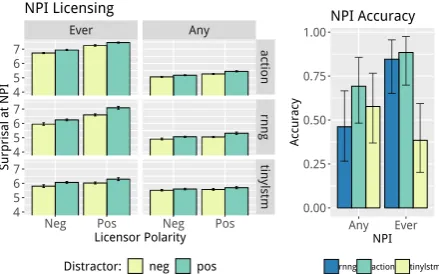
Syntactic supervision might plausibly facilitate learning of NPI licensing conditions. We tested this following the method ofFutrell et al.(2018), constructing 27 items on the design of in(3), with two variants: one includedeverand omittingany, and one includinganyand omittingever. Figure1, left panel, shows the results. For the RNNG and the ActionLSTM, negative licensors and distrac-tors alike reduced surprisal of both NPIs (p<0.05 for the RNNG, p<0.001 for the ActionLSTM). For the LSTM, negative licensors and distractors alike reduced surprisal of ever (both p<0.01), but not any. This may seem surprising asanyis considerably more frequent thanever(123 vs. 727 instances in the training data), butany’s non-NPI uses (e.g.,I will eat anything fried) may compli-cate its learning.
From Figure1it is also apparent that the RNNG and ActionLSTM show signs of stronger NPI li-censing effects from negation in the licensor po-sition than in the distractor popo-sition, at least for
[image:4.595.312.532.64.201.2]ever. To quantify this, we follow Marvin and Linzen(2018) in computing item-mean classifica-tion accuracies, with classificaclassifica-tion being consid-ered correct if the NPI is assigned higher prob-ability in context for (3-b) than for (3-c). Re-sults are shown in Figure 1, right panel. No
Figure 1: NPI Licensing at left: Y-axis shows sur-prisal at the NPI, x-axis indicates polarity of the c-commanding licensor, and color indicates distractor polarity. Licensing accuracy at right: Y-axis shows classification accuracy, x-axis indicates the NPI tested, and color indicates the model. Error bars represent 95% binomial confidence intervals.
model is significantly above chance for any, but for ever the syntactically supervised models form much better: The RNNG reaches 85% per-formance, and the ActionLSTM 88%, both sig-nificantly above chance (p<0.001 by binomial test for each), and are not significantly different from each other, but both better than the LSTM (p<0.01 for the RNNG/LSTM;p<0.001 for the ActionLSTM/LSTM by Fisher’s exact test). To our knowledge this is the first demonstration of a language model learning the licensing conditions for an NPI without direct supervision.
Overall, we find that syntactic supervision facil-itates the contingency of NPIs on a negative licen-sor in context, but is not sufficient for clean gen-eralization of the structural conditions on NPI li-censing with the training dataset used here.
4 Filler–Gap Dependencies
The dependency between aFILLER, which is a wh-word such aswho orwhat, and a GAP, which is
S
VP
SBAR
S
VP
SBAR
S
VP
VP
t2
t1
make to WHADVP-2
how know NP
we WHNP-1
what make NP
[image:5.595.75.289.64.189.2]We
Figure 2: Example of filler–gap dependency represen-tation in the Penn Treebank. Non-local dependency annotation indicated in bold, red font is stripped from the training data, so that the RNNG must learn about the filler-gap dependency purely through neural gener-alization.
Location of Gap All Fillers ‘Who’ ‘What’ All Positions 13907 1888 660 Subject Position 6632 1510 236
Object Position 2080 12 332
Indirect Object Position 57 0 6
Table 1: Filler—Gap Dependency Statistics for the Penn Treebank training data (used for both models).
4.1 Flexibility of Gap Position
The filler–gap dependency is flexible: a filler can license a gap in any of a number of syntactic posi-tions, including the argument positions of subject, object, and indirect object, as illustrated in(4), as well as in other positions (e.g. the adjunct position forhowin Figure2).
(4)a. I know who introduced the accountant to the guests after lunch.
b. I know who the CEO introduced to the guests after lunch.
c. I know who the CEO introduced the accountant to after lunch.
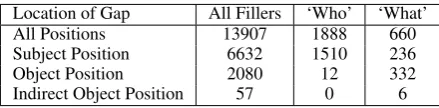
These gap positions differ in frequency, however (Table1): the majority (63.1%) are in some argu-ment structure position, of which the vast major-ity (75.6%) are subject position (mostly subject-extracted relative clauses), 23.7% are object posi-tion, and 0.7% are indirect object position.
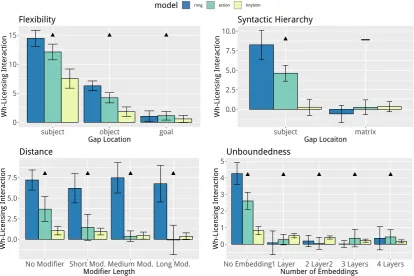
Using the wh-interaction measure described in Section 2.2, Wilcox et al. (2018) showed that large-data LSTMs learn filler–gap dependencies for all three argument positions, with the size of the wh-interaction generally largest for subject gaps and smallest for indirect-object gaps. Ta-ble1suggests that this gradation may reflect fre-quency of learning signal, with the dependency be-ing learned more robustly the more frequent the extraction type. We applied the same method,
adaptingWilcox et al.’s items to the smaller train-ing dataset. The results can be seen in the upper-left panel of Figure3.
All three models learn the filler-gap dependency for subject and object positions, and there is sug-gestive but inconclusive evidence for learning in the rare indirect object position. We see stronger dependency learning for more frequent gap types, as was found for large data LSTMs, and the super-vised models show a much stronger wh-licensing effect than the LSTM.
4.2 Syntactic Hierarchy
As with NPIs, the filler–gap dependency is subject to a number of hierarchical, structural constraints. The most basic of these constraints is that the filler must be “above” the gap in the appropriate struc-tural sense (to a first approximation, the filler must
c-command the gap, though see e.g.? for qualifi-cations). Hencewhoin(5-a)is a legitimate extrac-tion from the relative clause, but(5-b)is ungram-matical as the gap is in the matrix clause, above the filler.
(5)a. The policeman who the criminal shot with his gun shocked the jury during the trial.
b. *The policeman who the criminal shot the politician with his gun shocked during the trial.
A model that properly generalizes this constraint on the filler–gap dependency should not show a wh-interaction for cases like (5-b): an undis-charged who filler should not make the matrix-clause gap particularly more expected. As far as we are aware, no prior work has investigated this property of the filler–gap dependency in lan-guage models; we do so here. Because the con-text in (5) does not allow for an immediate that
clause initiation for the –FILLER condition as in
(1), we instantiate this condition by contrasting the +FILLER,+GAPcondition of (5-b)with the vari-ants in (6), where the who filler is immediately discharged as the RC verb’s extracted subject: (6)a. *The policeman who knows that the criminal shot
the politician with his gun shocked during the trial. -FILLER,+GAP
b. *The policeman who the criminal shot the politi-cian with his gun shocked the jury during the trial. +FILLER,–GAP
c. The policeman who knows that the criminal shot the politician with his gun shocked the jury during the trial. -FILLER,–GAP
We created 22 items following the templates of
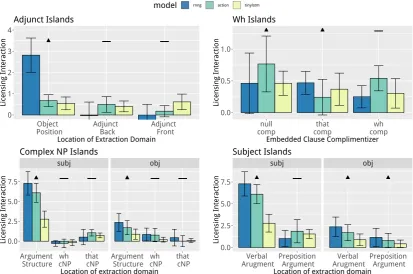
[image:5.595.72.292.279.333.2]Figure 3: Model results for the basic properties of filler–gap licensing. “N” indicates grammatical conditions in which models should display strong wh-licensing interaction, “–” indicates ungrammatical conditions in which models should display reduced wh-licensing interaction. The RNNG model significantly outperforms the LSTM model in 8/13 grammatical cases; the ActionLSTM model outperforms the LSTM model in 5/13 cases; and the RNNG outperforms the ActionLSTM model in 6/13 cases where strong licensing is expected.
wh-licensing interaction effect for a gap inside the subject-modifying relative clause—with the RNNG demonstrating more licensing interaction than the ActionLSTM—and neither model inap-propriately generalizes this licensing effect to a matrix-clause gap. The LSTM shows no wh-licensing effects in either position, suggesting that syntactic supervision facilitates appropriately generalized filler-gap dependencies for subject-modifying relative clauses.2
4.3 Robustness to Intervening Material
For a model that learns human-like syntactic gen-eralizations and maintains accurate phrase-like representations throughout a string, filler–gap de-pendencies should be robust to linearly inter-vening material that does not change the tree-structural relationship between the filler and the gap. Wilcox et al. (2018) found that the large-data RNNs described earlier exhibit a robust wh-interaction of this type, by introducing an optional
2Results for the Larger Data LSTM models for the
Hier-archy and Unboundedness experiments presented here can be found in the appendix.
postnominal modifier between filler and gap to sentence templates like(7), with no modification
(7-a), short (3–5 word) modifiers (7-b), medium (6–8 word) modifiers(7-c), and long (8–12 word) modifiers(7-d).
(7)a. I know what your friend gave to Alex last weekend.
b. I know what your friend in the hat gave to Alex last weekend.
c. I know what your friend who you ate lunch with yes-terday gave to Alex last weekend.
d. I know what your friend who recently took you on a walking tour of the city gave to Alex last weekend.
ActionLSTM shows strong interactions in theNo Modifier condition (d =1.02), but weak interac-tion once any modifying material is introduced (d<0.4 in all other conditions). This result is sig-nificant, as it indicates that RNNG is able to lever-age the structural locality afforded by the neural stack to maintain robust gap expectancy.
4.4 Unboundedness
For humans, filler–gap dependencies are not only robust to linearly intervening material that does not change their tree-structural relationship, they can be STRUCTURALLY NON-LOCAL as well,
propagating through intervening syntactic struc-tures (subject to constraints examined in Sec-tion5). For example, a filler can be extracted from multiply-nested complement clauses as in(8-b): (8)a. I know who your aunt insulted at the party.
b. I know who the chauffeur said [Sthe hostess believed
[Sthe butler reported [Sher friend thinks your aunt
insulted at the party.]]]
Humans show sensitivity to a single layer of sen-tential embedding when processing filler—gap de-pendencies in an offline ‘complexity rating’ task (Phillips et al., 2005). This may due to the rela-tive frequency of single versus doubly-embedded filler—gap dependencies. In our training data there were 13,907 examples of filler—gap depen-dencies, however only 758 examples that spanned two layers of sentential embedding and 19 that spanned three layers. There were no instances of filler—gap dependencies spanning over more than three sentential embeddings, as in(8-b).
The unboundedness of filler–gap dependencies has not previously been tested for contemporary language models. To do this, we constructed 22 test items like (8), varying embedding depth within-item between zero, one, two, three, and four levels, and measured the resulting licens-ing interactions. The results are in Figure 3, bottom-right panel. No model’s filler–gap de-pendency is perfectly robust to clausal embed-ding. The LSTM’s wh-licensing interaction starts out small and diminishes with embedding depth. The RNNG and ActionLSTM show strong wh-licensing interaction in the unembedded condition but no significant wh-licensing interaction after even a single layer of embedding. Since these experimental materials are new, we also tested the large-data LSTMs on them, which exhibited much larger and more robust filler–dependency ef-fects (Appendix B). Hence the syntactic
supervi-θ
ν
ζ
X
δ γ β
filler
α
[image:7.595.342.489.70.148.2]×
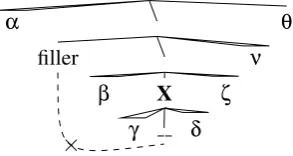
Figure 4: Anatomy of an island constraint. If nodeXis an island, then a filler outsideXcannot associate with a gap insideX. For our analyses, successful learning of an island constraint implies that we shouldnotsee a wh-licensing interaction at the first part of the material δimmediately following the potential gap site.
sion explored here is not sufficient to guarantee that learned filler–gap dependencies can be struc-turally unbounded.
5 Island Constraints
A crucial exception to the flexibility and unbound-edness of filler–gap dependencies is that ISLAND
CONSTRAINTSprevent association of a filler and a gap through certain types of syntactic nodes, il-lustrated in Figure 4 (Ross, 1967). Contempo-rary theories variously attribute island effects to grammatical rules, incremental processing consid-erations, or discourse-structural factors (Ambridge and Goldberg, 2008; Hofmeister and Sag, 2010;
Sprouse and Hornstein, 2013). In our setting, a language model is sensitive to an island con-straint if it fails to show a wh-licensing interac-tion between a filler and a gap that cross an is-land. Wilcox et al. (2018) found evidence that large-data LSTMs are sensitive to some island constraints (although seeChowdhury and Zampar-elli(2018) for a contrasting view), but not to oth-ers. Here we investigate whether LSTMs would learn these from smaller training datasets, and if an RNNG’s syntactic supervision provides a learning advantage for island constraints. In this section we measure the wh-licensing interaction in the material immediately following the potential gap site, which is guaranteed to implicate the model’s (lack of) expectation for a gap inside the island, rather than throughout the entire embedded clause, which also implicates filler-driven expectations af-ter the end of the island.
5.1 Adjunct Islands
Adjunct clauses block the filler–gap dependency.
large-data LSTMs are sensitive to adjunct islands, as ev-idenced by attenuated and often fully eliminated wh-licensing interactions for materials like(9-b)–
(9-c)relative to(9-a)below. (In this and the sub-sequent subsections, the post-gap material used for wh-interaction computation is inbold.)
(9) a. The director discovered what the robbers stole last
night. [OBJECT]
b. *The director discovered what the security guard slept while the robbers stole last night. [ADJ-BACK] c. *The director discovered what, while the robbers stole
last night, the security guard slept. [ADJ-FRONT]
We adapted these materials; results are in Fig-ure5, upper-left panel. The RNNG shows a strong licensing interaction in the baseline main-clause object extraction position, but no licensing inter-action for a gap in an adjunct either at the back or front of the main clause. Because RNNGs failed our test for unboundedness of filler–gap depen-dency, however (Section4.4), this result is incon-clusive as to whether anything corresponding to an island constraint is learned. The LSTM and the ActionLSTM show no sign of filler–gap depen-dency attenuation from adjunct islands, in contrast to previous findings using the LSTM architecture on much larger training datasets.
5.2 Wh Islands
Embedded sentences introduced bywh-words are also islands; hence,(10-c)is anomalous but(10-a)
and(10-b)are not.
(10)a. I know what the guide said the lion devoured
yes-terday. [NULLCOMP]
b. I know what the guide said that the lion devoured
yesterday. [THATCOMP]
c. *I know what the guide said whether the lion devoured
yesterday. [WH- COMP]
Wilcox et al. (2018) found that the large-data LSTMs learned this island constraint: the wh-licensing interaction was eliminated or severely at-tenuated for the WH-COMPlementizer variant but not for the other variants. Results for our three models are in Figure5, top-right panel. These ma-terials paint a slightly more optimistic picture than the results of Section 4.4 for the RNNG’s abil-ity to propagate a gap expectation from a filler down one level of clausal embedding. However, no models show an appreciable attenuation in the WH- COMP condition that would suggest an is-land constraint-like generalization.
5.3 Complex Noun-Phrase Islands
Extractions from within clauses dominated by a lexical head noun are unacceptable; this is the
Complex Noun Phrase Constraint. For example,
(11-b)and(11-c) are unacceptable object extrac-tions compared with(11-a); the same acceptability pattern holds for subject extractions.
(11)a. I know what the collector bought last week. [ARGUMENTextraction]
b. *I know what the collector bought the painting which depicted last week. [WH- COMPLEXNP] c. *I know what the collector bought the painting that
depicted last week. [THAT- COMPLEXNP]
Wilcox et al.(2018) found that large-data LSTM behavior reflected this island constraint, with at-tenuated wh-licensing interactions for complex NPs like(11-b)–(11-c)and for analogous complex NPs involving subject extractions. Our results for adaptations of their materials are shown in Fig-ure5, bottom-left panel. All three models show at-tenuated wh-licensing interactions inside complex NPs in subject position, with the licensing interac-tion in the grammaticalARGUMENT STRUCTURE
position greatest for the RNNG and ActionLSTM. This may be taken as an indication of Complex NP Constraint-like learning, but is inconclusive due to the models’ general failure to propagate gap ex-pectations into embedded clauses (Section4.4).
5.4 Subject Islands
Prepositional phrases attaching to subjects are is-lands: this is the Subject Constraint, and ac-counts for the unacceptability of(12-d)compared to(12-c)(Huang,1998).
(12)a. I know what the collector bought yesterday. [OBJ
VERBAL-ARG]
b. I know what the collector bought a painting of
yes-terday. [OBJPREP-ARG]
c. I know what soldfor a high price at auction. [SUBJ
VERBAL-ARG]
d. *I know what a painting of soldfor a high price at auction. [SUBJPREP-ARG]
wh-Figure 5: Model results for Syntactic Islands. “N” indicates grammatical conditions in which models should display strong wh-licensing interaction, “–” indicates ungrammatical conditions in which models should display reduced wh-licensing interaction.
licensing interaction for subject-modifying PPs, which should be islands, and no wh-licensing in-teraction for object-modifying PPs.
6 Conclusion
In this paper we have argued that structural su-pervision provides advantages over purely string-based training of neural language models in ac-quiring more human-like generalizations about non-local grammatical dependencies. We have also demonstrated how the neural compositional-ity of the RNNG architecture can provide even further advantages, especially at maintaining ex-pectations into structurally-local but linearly dis-tant material. We compared RNNG, ActionL-STM and LActionL-STM models using recently developed controlled experimental materials, and developed additional experimental materials to further test several characteristics of grammatical dependency learning for neural language models (Sections4.2,
4.4). We found advantages for syntactic super-vision in learning conditions forNegative Polar-ity Item licensingand a majority of tests involv-ingfiller–gap dependencies, showing particularly strong wh-licensing effects in tree-structurally-local contexts. On basic filler—gap dependency
properties the RNNG significantly outperformed the LSTM in 8/13 and the ActionLSTM outper-formed the LSTM on 5/13 cases where strong licensing interaction was expected. While the RNNG, and to some extent the ActionLSTM, ex-hibited more humanlike behavior than the LSTM for a number of Island Constraints, the tests were inconclusive due to the models’ failure to propagate gap expectation into embedded clauses: island-like behavior may merely be sensitivity to general syntactic complexity, not the highly-specific syntactic arrangements that constitute the family of island constructions. Thus, major-category supervision does not provide enough in-formation for the neural component to learn fully robust and human-like filler—gap dependencies from 1-million words alone. However, for some dependencies tested (i.e. NPIs) structural supervi-sion on 1 million words provides better outcomes than even large-data LSTMs. Scaling the gains de-rived from structural supervision is a challenge for data-scarce NLP and is the basis for future work.
Acknowledgments
[image:9.595.92.506.65.339.2]References
Ben Ambridge and Adele E Goldberg. 2008. The is-land status of clausal complements: Evidence in fa-vor of an information structure explanation. Cogni-tive Linguistics, 19(3):357–389.
R Harald Baayen, Douglas J Davidson, and Douglas M Bates. 2008. Mixed-effects modeling with crossed random effects for subjects and items. Journal of memory and language, 59(4):390–412.
Eugene Charniak et al. 2016. Parsing as language mod-eling. In Proceedings of the 2016 Conference on Empirical Methods in Natural Language Process-ing, pages 2331–2336.
Shammur Absar Chowdhury and Roberto Zamparelli. 2018. Rnn simulations of grammaticality judgments on long-distance dependencies. In Proceedings of the 27th International Conference on Computational Linguistics, pages 133–144.
Chris Dyer, Adhiguna Kuncoro, Miguel Ballesteros, and Noah A. Smith. 2016. Recurrent neural network grammars. InProc. of NAACL.
Richard Futrell, Ethan Wilcox, Takashi Morita, and Roger Levy. 2018. Rnns as psycholinguistic sub-jects: Syntactic state and grammatical dependency. arXiv preprint arXiv:1809.01329.
Kristina Gulordava, Piotr Bojanowski, Edouard Grave, Tal Linzen, and Marco Baroni. 2018. Color-less green recurrent networks dream hierarchically. arXiv preprint arXiv:1803.11138.
John Hale. 2001. A probabilistic earley parser as a psy-cholinguistic model. In Proceedings of the second meeting of the North American Chapter of the Asso-ciation for Computational Linguistics on Language technologies, pages 1–8. Association for Computa-tional Linguistics.
John Hale, Chris Dyer, Adhiguna Kuncoro, and Jonathan R Brennan. 2018. Finding syntax in hu-man encephalography with beam search. arXiv preprint arXiv:1806.04127.
Sepp Hochreiter and J¨urgen Schmidhuber. 1997. Long short-term memory. Neural computation, 9(8):1735–1780.
Philip Hofmeister and Ivan A Sag. 2010. Cognitive constraints and island effects. Language, 86(2):366.
C-T James Huang. 1998. Logical relations in Chinese and the theory of grammar. Taylor & Francis.
Rafal Jozefowicz, Oriol Vinyals, Mike Schuster, Noam Shazeer, and Yonghui Wu. 2016. Exploring the lim-its of language modeling. arXiv, 1602.02410.
Adhiguna Kuncoro, Miguel Ballesteros, Lingpeng Kong, Chris Dyer, Graham Neubig, and Noah A Smith. 2016. What do recurrent neural network grammars learn about syntax? arXiv preprint arXiv:1611.05774.
Adhiguna Kuncoro, Chris Dyer, John Hale, Dani Yo-gatama, Stephen Clark, and Phil Blunsom. 2018. Lstms can learn syntax-sensitive dependencies well, but modeling structure makes them better. In Pro-ceedings of the 56th Annual Meeting of the Associa-tion for ComputaAssocia-tional Linguistics (Volume 1: Long Papers), volume 1, pages 1426–1436.
William Ladusaw. 1979. Polarity Sensitivity as In-herent Scope Relations. Ph.D. thesis, University of Texas at Austin.
Roger Levy. 2008. Expectation-based syntactic com-prehension. Cognition, 106(3):1126–1177.
Tal Linzen, Emmanuel Dupoux, and Yoav Goldberg. 2016. Assessing the ability of lstms to learn syntax-sensitive dependencies. Transactions of the Associ-ation for ComputAssoci-ational Linguistics, 4:521–535.
Mitchell P Marcus, Mary Ann Marcinkiewicz, and Beatrice Santorini. 1993. Building a large annotated corpus of english: The penn treebank. Computa-tional linguistics, 19(2):313–330.
Rebecca Marvin and Tal Linzen. 2018. Targeted syn-tactic evaluation of language models.arXiv preprint arXiv:1808.09031.
Michael EJ Masson and Geoffrey R Loftus. 2003. Us-ing confidence intervals for graphically based data interpretation. Canadian Journal of Experimen-tal Psychology/Revue canadienne de psychologie exp´erimentale, 57(3):203.
Colin Phillips, Nina Kazanina, and Shani H Abada. 2005. Erp effects of the processing of syntactic long-distance dependencies. Cognitive Brain Re-search, 22(3):407–428.
John Robert Ross. 1967. Constraints on variables in syntax.
Nathaniel J Smith and Roger Levy. 2013. The effect of word predictability on reading time is logarithmic. Cognition, 128(3):302–319.
Jon Sprouse and Norbert Hornstein. 2013. Experimen-tal syntax and island effects. Cambridge University Press.
Mitchell Stern, Daniel Fried, and Dan Klein. 2017. Effective inference for generative neural parsing. arXiv preprint arXiv:1707.08976.
Ethan Wilcox, Roger Levy, Takashi Morita, and Richard Futrell. 2018. What do rnn language mod-els learn about filler-gap dependencies? arXiv preprint arXiv:1809.00042.
Appendix
(the ‘google’ model) and the highest-performing model presented in the supplementary materials of
Gulordava et al.(2018) (the ‘Gulordava’ model). Both models where shown in (Wilcox et al.,2018) to represent filler—gap dependencies and some is-land constraints.
A Syntactic Hierarchy
We tested the two large LSTM models using our stimuli from the syntactic hierarchy experiment and measured the wh-licensing interaction across the entire embedded clause. The results of this ex-periment can be seen in Figure 6. Both models show significant licensing interaction in the gram-maticalSubject condition (p<0.001), and a sig-nificant reduction in licensing interaction between the Subject and Matrixconditions (p<0.001 in both models). Additionally, there is a significant licensing interaction in the Matrix condition for the Google model, but not so for the Gulordava model.
B Unboundedness
We tested the two large LSTM models from
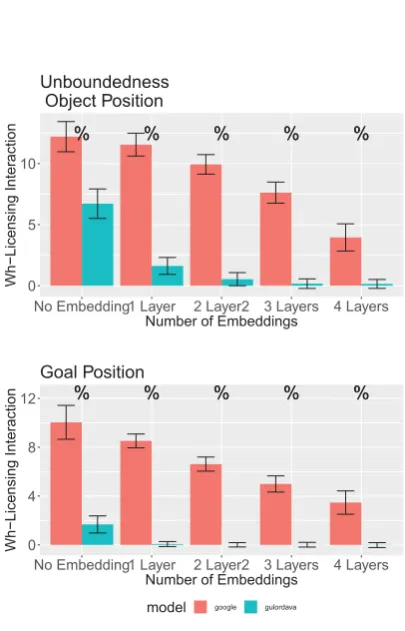
Wilcox et al. (2018) following the stimuli from our unboundedness experiment, with two variants, one that included gaps inObjectposition and one that included gaps in indirect object orGoal posi-tion. The results can be seen in Figure7. For the Google model inObjectposition, we find a signif-icant reduction of wh-licensing interaction across more than three layers of embedding (p<0.001). For the Gulordava model, we find a significant re-duction in wh-licensing interaction after only one layer of embedding (p<0.001). In theGoal posi-tion: For the Google model, we find a significant reduction in licensing interaction after two layers of embedding (p<0.05 for 2 layers, p<0.001 for 3-4 layers). For the Gulordava model, we find no significant licensing interaction after one layer of embedding. These results indicate the larger LSTMs are able to thread gap expectation through embedded clauses.
% X
% X
0 5 10 15
subject matrix Gap Locaiton
Wh−Licensing Inter
action
[image:11.595.309.510.114.236.2]model google gulordava Syntactic Heirarchy
Figure 6: Syntactic Hierarchy. %s indicate conditions where we would expect a strong wh-licensing interac-tion, Xs where we expect low wh-licensing interaction.
% % % % %
% % % % %
0 5 10
No Embedding1 Layer 2 Layer2 3 Layers 4 Layers
Number of Embeddings
Wh−Licensing Inter
action
Unboundedness Object Position
% % % % %
% % % % %
0 4 8 12
No Embedding1 Layer 2 Layer2 3 Layers 4 Layers Number of Embeddings
Wh−Licensing Inter
action
model google gulordava Goal Position
[image:11.595.307.510.366.682.2]