3404
Multi-task Learning for Japanese Predicate Argument Structure Analysis
Hikaru Omori
Tokyo Metropolitan University [email protected]
Mamoru Komachi Tokyo Metropolitan University
Abstract
An event-noun is a noun that has an argu-ment structure similar to a predicate. Re-cent works, including those considered state-of-the-art, ignore event-nouns or build a single model for solving both Japanese predicate ar-gument structure analysis (PASA) and event-noun argument structure analysis (ENASA). However, because there are interactions be-tween predicates and event-nouns, it is not suf-ficient to target only predicates. To address this problem, we present a multi-task learn-ing method for PASA and ENASA. Our multi-task models improved the performance of both tasks compared to a single-task model by shar-ing knowledge from each task. Moreover, in PASA, our models achieved state-of-the-art re-sults in overall F1 scores on the NAIST Text Corpus. In addition, this is the first work to employ neural networks in ENASA.
1 Introduction
[image:1.595.318.515.213.377.2]Japanese predicate argument structure analysis (PASA) examines semantic structures between the predicate and its arguments in a text. The identifi-cation of the argument structure such as “who did what to whom?” is useful for natural language pro-cessing that requires deep analysis of complicated sentences such as machine translation and recog-nizing textual entailment. PASA is a task targeted at predicates such as verbs and adjectives. How-ever, there are also many nouns that have event-related arguments in a sentence. We call these nouns that refer to eventsevent-nouns, for exam-ple, a verbal noun (sahennouns) such ashoukoku “report” or a deverbal noun (nominalized forms of verbs) such assukui“rescue.”
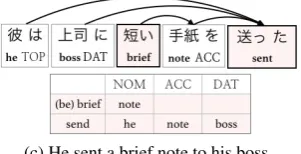
Figure 1 shows examples of PASA and event-noun argument structure analysis (ENASA). In the NAIST Text Corpus (Iida et al., 2007), both predicates and event-nouns have one of three core
(a) He reports the result to his boss.
(b) His progress report was too short; hence, he got scolded by his boss.
[image:1.595.342.493.410.487.2](c) He sent a brief note to his boss.
Figure 1: Examples of PASA and ENASA. The edges denote dependency paths.
case roles,nominative(NOM),accusative(ACC), anddative (DAT) as an argument. According to Iida et al. (2007), predicates have almost no ar-gument in the same bunsetsu1 phrase. However, in the case of event-nouns, approximately half of the accusative and dative arguments appear in the same bunsetsu phrase. Accordingly, although PASA and ENASA are semantically highly re-lated, they are syntactically different tasks. How-ever, most previous studies focused on predi-cates only; hence, there are few studies that focus
1Functional chunk in Japanese. It consists of one or more
on event-nouns (Komachi et al., 2007; Taira et al., 2008). To identify the semantic units of a sentence and to correctly understand syntactic relations, it is not sufficient to target only PASA.
Thus, we propose a multi-task learning model that effectively leverages ENASA and improves PASA. Our proposed model is based on an end-to-end multilayer bi-directional recurrent neural net-work (RNN) used in recent net-works, and the model has networks that distinguish task-independent in-formation and task-specific inin-formation.
In summary, the main contributions of this work are the following:
1. This is the first attempt to design a multi-task learning framework for PASA and ENASA, and we show that our models improve the performance of both tasks.
2. Although our model is a simple model that does not consider the interactions between multiple predicates, it achieves a state-of-the-art result on the NAIST Text Corpus (NTC) in PASA by combining syntactic information as one of the features.
3. For ENASA, this is the first work to em-ploy neural networks to effectively incorpo-rate PASA.
2 Related Work
2.1 Japanese PASA and ENASA Approaches
Many machine learning-based methods have been studied in Japanese PASA. Traditional models take pointwise approaches that construct inde-pendent models for each core case role (NOM, ACC, DAT). Taira et al. (2008) proposed a super-vised model that learns features of each case us-ing decision lists and support vector machines. Imamura et al. (2009) proposed a model that com-bines a maximum entropy model with a language model trained from large-scale newspaper articles. Hayashibe et al. (2011) designed three models ex-ploiting argument position and type and deter-mined the maximum likelihood output using pair-wise comparison.
However, the joint approach that optimizes the scores of all predicate-argument pairs in a sen-tence simultaneously showed better results than the pointwise approach. Yoshikawa et al. (2011) proposed a model that considers dependency be-tween multiple predicate-argument relations us-ing Markov logic networks. Ouchi et al. (2015)
jointly optimized the combinations among multi-ple predicates and arguments in a sentence using a bipartite graph.
Except for (Taira et al., 2008), these stud-ies focused on the analysis of predicates while there are few studies that focus on event-nouns. Komachi et al. (2007) decomposed ENASA into two tasks: event-hood determination and argu-ment identification; they proposed a supervised method using lexico-syntactic patterns. Event-hood determination is the most important char-acteristic that semantically differentiates ENASA from PASA. It is a task to determine whether a noun refers to an event (e.g.,houkokucan refer to either “to report” or the outcome of reporting ac-tion, “a report”). Since the previous ENASA mod-els adopted the pointwise approach with a single model, they did not explore the effective features in each task. In contrast, our models simultane-ously optimize three core case roles. Moreover, the proposed models allow us to distinguish be-tween task-shared and task-specific features using multi-task learning.
2.2 PASA using neural networks
Some neural models have achieved higher perfor-mance than traditional machine learning models in Japanese PASA. Shibata et al. (2016) replaced Ouchi et al. (2015)’s scoring function with feed forward neural networks. Matsubayashi and Inui (2017) represented a dependency path between a predicate and its argument with path embeddings and showed that even the local model without mul-tiple predicates can outperform a global model.
2.3 Semantic Role Labeling
Semantic role labeling (SRL) is a similar task to Japanese PASA. Recently, several end-to-end models using neural networks showed high per-formance in English SRL (Zhou and Xu, 2015; He et al., 2017; Tan et al., 2018). Strubell et al. (2018) proposed a multi-task learning model that jointly learned dependency parsing, part-of-speech tagging, predicate detection, and SRL based on multi-head self-attention. Ouchi et al. (2018) proposed a span-based SRL model using bi-directional LSTMs and achieved state-of-the-art results. The authors scored all possible spans for each label and selected correct spans satisfy-ing constraints when decodsatisfy-ing. In terms of the event-noun research, Gerber and Chai (2010) used pointwise mutual information (PMI) as a feature for 10 event-nouns with high frequency and iden-tified semantic roles using a logistic regression model.
There were several LSTM models that also achieved high accuracy gains in Chinese SRL (Wang et al., 2015; Roth and Lapata, 2016; Sha et al., 2016; Marcheggiani et al., 2017; Qian et al., 2017). For event-nouns, Li et al. (2009) showed that combining effective features in verbal SRL with nominal SRL can improve results. Although the authors did not demonstrate that verbal SRL also improves performance in combination with nominal SRL, we show that our model improves performance in both PASA and ENASA.
3 Japanese PASA and ENASA
3.1 Task Description
Japanese predicate (event-noun) argument struc-ture analysis is a task to extract arguments for certain predicates (event-nouns) and assign three case labels, NOM, ACC and DAT (Iida et al., 2007). Arguments are divided into four categories (Taira et al., 2008) according to the positions with their predicates (event-nouns).
Dep Arguments depend on their predicate (event-noun), or a predicate (event-noun) depends on its arguments.
Zero Arguments and their predicate (event-noun) are in the same sentence, but the arguments are omitted by zero anaphora. Therefore, they have no direct dependency.
Inter-zero Zero anaphoric arguments and their predicate (event-noun) are not in the same sentence.
Bunsetsu Arguments and their event-noun are in the same bunsetsu.
A sentence w = w1, w2,· · ·, wT and a
predi-cate (event-noun) p = p1, p2,· · ·, pq are given
as input. Iida et al. (2006), Imamura et al. (2009), and Sasano and Kurohashi (2011) also analyze Inter-zero, which is a difficult task because the whole document must be searched. Follow-ing existFollow-ing research (Ouchi et al., 2015, 2017; Matsubayashi and Inui, 2017, 2018; Taira et al., 2008), we only focus on three categories where ar-guments and their predicate (event-noun) are in the same sentence. In addition, we exclude the Bun-setsu category from the PASA evaluation follow-ing Ouchi et al. (2017) and Matsubayashi and Inui (2018).
3.2 End-to-end Single Model
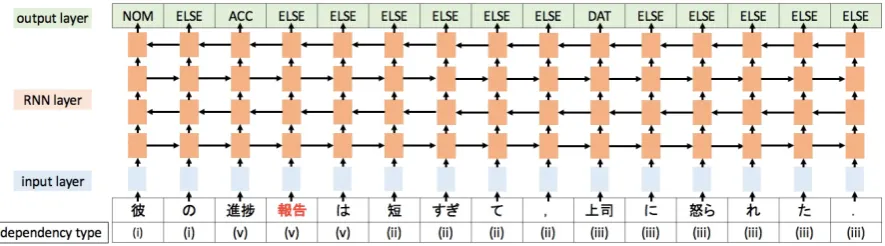
Our single model is based on an end-to-end ap-proach (Zhou and Xu, 2015; Ouchi et al., 2017; Matsubayashi and Inui, 2018). Additionally, we add new features. Figure 2 shows the network ar-chitecture of our base model.
3.2.1 Input Layer
Each word wt ∈ [w1,· · ·, wT]is converted to a
feature representationxt∈[x1,· · ·,xT]at the
in-put layer. We use six types of features. The feature representationxtis defined as follows:
xt = xast ⊕x posi t ⊕x
dep t ⊕x
type
t ⊕xtaskp (1)
where (⊕) indicates concatenation of vectors.
Argument Structure Predicate (event-noun)
wp and argument candidateswt are converted to
the vectors xast ∈ R2dw by the word embedding
matrix.
Position This is a feature that represents the po-sitional relation betweenwp andwt. The feature
is calculated by subtracting the word index of ar-gument candidates from the word index of pred-icates (event-nouns). We use two types of units to represent relative position: word unitpwordt and bunsetsu unitpbunsetsut , which are converted to the word positional vectorpword
t ∈ Rdp and the
bun-setsu positional vector pbunsetsut ∈ Rdp,
embed-Figure 2: End-to-end single model.
ding matrices. We concatenate these two vectors and obtain the positional vectorsxposit ∈R2dp.
Dependency This is a feature that represents the dependency relation between wp andwt. We set
five types of dependency relations:
i). Argument candidates depend on the predicate (event-noun).
ii). The predicate (event-noun) depends on the argument candidates.
iii). No dependency relations between the predi-cate (event-noun) and argument candidates.
iv). The predicate and candidate arguments are in the same bunsetsu.
v). The event-noun and candidate arguments are in the same bunsetsu.
The dependency relationdtis converted to the
de-pendency vectorxdept ∈ Rdd by the dependency
relation embedding matrix. The dependency type in Figure 2 shows how to make dependency fea-tures in Figure 1b as an example. We define the dependency type from the syntactic information annotated in the NTC.
In previous work, dependency features are used differently from our study. Imamura et al. (2009) used a binary feature that represents whether or not there is a dependency relation between the predicate and its arguments. We employ more fine-grained relation types to adapt to event-nouns. Matsubayashi and Inui (2017) represented the in-teractions between a predicate and its arguments using path embedding. In contrast, we define different types for a predicate and event-noun to distinguish event-nouns from predicates and learn embeddings to find the associated latent structures.
Event-hood Type This is a binary feature to flag all predicates (event-nouns) in a sentence inspired by Matsubayashi and Inui (2018). The purpose of this feature is to prevent predicates from becoming arguments and to help some event-nouns become arguments. The event-hood type vectorxtypet ∈
R2of a candidate indicates [0,1] if the candidate is
a predicate, [1,0] if the candidate is an event-noun, and [0,0] otherwise. The predicate and event-noun are annotated in the NTC.
Task Label This is a binary feature vector xtaskp ∈R1that indicates 1 if the task is predicate argument structure analysis; otherwise, 0.
3.2.2 RNN Layer
We use the gated recurrent unit (GRU) (Cho et al., 2014) for RNN. The RNN layers are made up of L layers of stacked bi-directional GRU. Ad-ditionally, we apply the residual connections (He et al., 2016) following Ouchi et al. (2017); Matsubayashi and Inui (2018). At each time step
t, the hidden statehl
t∈Rdh in thel∈[1,· · · , L]
-th layer is calculated as follows:
hlt =
{
gl(hlt−1,hlt−1) (l= odd)
gl(hlt−1,hlt+1) (l= even) (2)
wheregl(·) denotes the l-th layer GRU function. In addition,h0t =xt.
3.2.3 Output Layer
In the output layer, we input each hidden statehLt. Then, we obtain the output vector ot using the
softmax function:
ot = softmax(WohLt +bo) (3)
whereWo ∈ R4×dh is the parameter matrix, and
bo ∈R4is the bias term. The output vector
[image:4.595.79.522.63.186.2](a) Single (b) Multi-input (c) Multi-RNN
[image:5.595.98.513.61.312.2](d) Multi-output (e) Multi-ALL
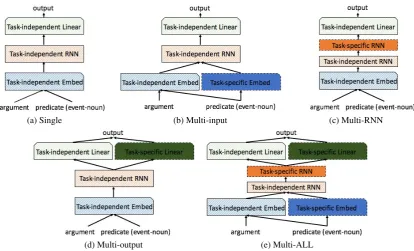
Figure 3: Proposed models: (a) Single, (b) Multi-input, (c) Multi-RNN, (d) Multi-output, (e) Multi-ALL.
over four labels, [NOM, ACC, DAT, ELSE]. ELSE denotes that the candidate argument does not have a case label. In testing, the maximum probability label is selected as the output label. We train the model using the cross-entropy loss function.
4 Multi-task Model
Multi-task learning has been successfully applied to various natural language processing tasks (Collobert et al., 2011; Søgaard and Goldberg, 2016; Luong et al., 2016; Hashimoto et al., 2017; Liu et al., 2017; Stoyanov et al., 2018; Marasovic and Frank, 2018; Strubell et al., 2018). One of the advantages of multi-task learning is that it learns better representation, which is robust against task-dependent noise by increasing training data. In this paper, we introduce multi-task learning to PASA and ENASA for the first time. We propose three methods to extend the end-to-end single model to the multi-task learning model in the input layer, RNN layer, and output layer. Figure 3 shows the proposed models. Our final model combines all three methods (Figure 3e).
4.1 Multi Input Layer
Even if the surface form is the same, the con-texts are different for predicates and event-nouns. For example, the event-noun houkoku“report” in Figure 1b has an argument in the same bunsetsu
unlike predicates. Moreover, the event-noun also has a nominative argument role for the predicate mijikai “short”. Therefore, given this, we pre-pare a task-specific word embedding matrix that addresses the task-specific distribution of words. The predicate is converted to PASA-specific vec-torsxpt ∈Rd′wby the PASA-specific predicate
em-bedding matrix. Similarly, the event-noun is con-verted to ENASA-specific vectors xnt ∈ Rd′w by
the ENASA-specific event-noun embedding ma-trix. These matrices are randomly initialized and can be learned during training.
The feature vectorxtis defined as follows:
xt =
{
xt⊕xpt (PASA)
xt⊕xnt (ENASA)
(4)
4.2 Multi RNN Layer
hidden statemlt′ ∈ Rd′h in thel′ ∈ [1,· · ·, L′]-th
layer is calculated as follows:
mlt′ =
{
gl′(ml′−1 t ,ml
′
t−1) (l′ = odd) gl′(mlt′−1,mlt+1′ ) (l′ = even)(5)
gl′(·) =
{
gpl′(·) (PASA)
gnl′(·) (ENASA) (6)
wheregl′(·),gpl′(·), andgln′(·)denote thel′-th layer GRU functions. In addition,m0t =hLt.
4.3 Multi Output Layer
The position of arguments is different with respect to predicates and event-nouns. For example, pred-icates seldom have arguments in the same bun-setsu. In contrast, event-nouns often have argu-ments in the same bunsetsu, compound nouns, for example. Therefore, it is intuitive and natural to divide the output layer into task-independent and task-specific layers. The task-specific output vec-tors are calculated as follows:
opt = Wpoht+bpo (7)
ont = Wnoht+bno (8)
gt = σ(Wght+bg) (9)
whereWop,Won,Wg ∈ R4×dh are the parameter
matrices, andbpo,bno,bg ∈R4 are the bias terms.
ht is the hidden state of the last layer. We
com-bine task-specific output vectorsopt,ont with task-independent output vectorotby the gategt.
ct =
{
gt⊙ot+ (1−gt)⊙opt (PASA)
gt⊙ot+ (1−gt)⊙ont (ENASA)
(10)
ot = softmax(ct) (11)
where (⊙) denotes the element-wise product. The output vector ot represents the probability of
[NOM, ACC, DAT, ELSE].
5 Experiments
5.1 Dataset and Setting
We use NTC 1.5 for our experiments. We divide the dataset into training, development, and test sets in the same way as Taira et al. (2008). We use morphological and syntactic information, such as the word boundaries, the bunsetsu boundaries and the dependency relations provided in the NTC.
For the development and test sets, if there are two or more arguments annotated with the same
the dimension of word embeddingsdw 300
the dimension of position embeddingsdp 16
the dimension of dependency embeddingsdd 16
the dimension of hidden statesdh 300
the number of GRU layersL 4
the dimension of task-specific word embeddingsd′w 16 the dimension of task-specific hidden statesd′h 300 the number of task-specific GRU layersL′ 2
dropout rate 0.4
batch size 8
[image:6.595.311.528.60.187.2]gradient clipping 4
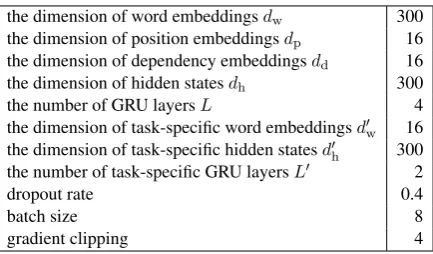
Table 1: Hyperparameters.
case label in a sentence, we set an argument that only has a dependency relation with a predicate as a correct answer and assign the ELSE label to other arguments. If there is no dependency rela-tion, we set an argument with the shortest distance
|wp −wt|as a correct answer. If the distance is
equal, an argument on the left side of a predicate is considered a correct answer.
In NTC 1.5, if there is a predicate phrase, such as “verbal noun + suru,” suru is annotated as a predicate word. We consider the verbal noun as the predicate word at the preprocessing step to match the surface of a predicate with that of an event-noun. Take the predicatehoukoku-suru“to report” and an event-nounhoukoku“report” as an example. Although wp before preprocessing are
suruandhoukoku,wpare unified tohoukokuafter
preprocessing.
5.2 Hyperparameters
We use pre-trained embeddings2for the initial ues of the word embedding matrix. The initial val-ues of the other embedding matrices are sampled according to a uniform distribution of [-0.25,0.25]. We convert words appearing more than once in the training set into word vectors and the remaining words into the unknown word vector. We adopt AdaDelta (ϵ= 10−6,ρ = 0.95) as the optimiza-tion method. We set the number of epochs to 20 and evaluate the model with the highest F1 scores on the development set. Table 1 shows the hyper-parameters.
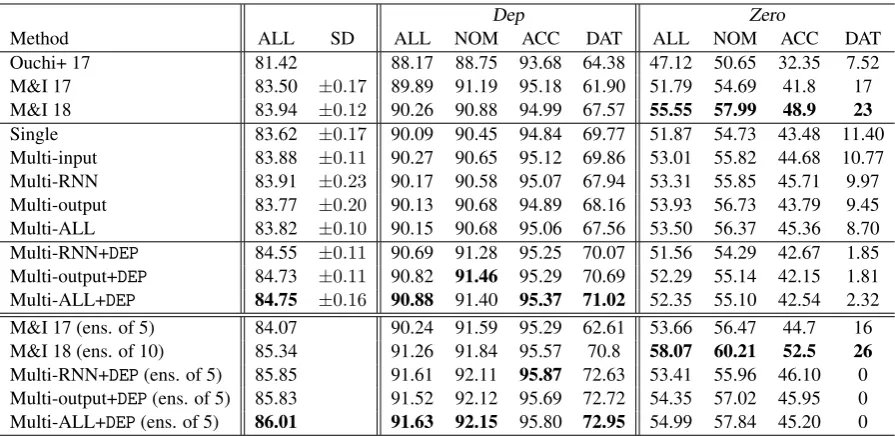
5.3 Results
We evaluate each model with the NTC 1.5 test. The experimental results for the argument struc-ture analysis of predicates and event-nouns are shown in Tables 2 and 3.
Dep Zero
Method ALL SD ALL NOM ACC DAT ALL NOM ACC DAT
Ouchi+ 17 81.42 88.17 88.75 93.68 64.38 47.12 50.65 32.35 7.52 M&I 17 83.50 ±0.17 89.89 91.19 95.18 61.90 51.79 54.69 41.8 17 M&I 18 83.94 ±0.12 90.26 90.88 94.99 67.57 55.55 57.99 48.9 23
Single 83.62 ±0.17 90.09 90.45 94.84 69.77 51.87 54.73 43.48 11.40 Multi-input 83.88 ±0.11 90.27 90.65 95.12 69.86 53.01 55.82 44.68 10.77 Multi-RNN 83.91 ±0.23 90.17 90.58 95.07 67.94 53.31 55.85 45.71 9.97 Multi-output 83.77 ±0.20 90.13 90.68 94.89 68.16 53.93 56.73 43.79 9.45 Multi-ALL 83.82 ±0.10 90.15 90.68 95.06 67.56 53.50 56.37 45.36 8.70 Multi-RNN+DEP 84.55 ±0.11 90.69 91.28 95.25 70.07 51.56 54.29 42.67 1.85 Multi-output+DEP 84.73 ±0.11 90.82 91.46 95.29 70.69 52.29 55.14 42.15 1.81 Multi-ALL+DEP 84.75 ±0.16 90.88 91.40 95.37 71.02 52.35 55.10 42.54 2.32 M&I 17 (ens. of 5) 84.07 90.24 91.59 95.29 62.61 53.66 56.47 44.7 16 M&I 18 (ens. of 10) 85.34 91.26 91.84 95.57 70.8 58.07 60.21 52.5 26
[image:7.595.75.523.61.279.2]Multi-RNN+DEP(ens. of 5) 85.85 91.61 92.11 95.87 72.63 53.41 55.96 46.10 0 Multi-output+DEP(ens. of 5) 85.83 91.52 92.12 95.69 72.72 54.35 57.02 45.95 0 Multi-ALL+DEP(ens. of 5) 86.01 91.63 92.15 95.80 72.95 54.99 57.84 45.20 0
Table 2: F1 scores on the PASA test set. Single is a base model without multi-task learning.
Dep Zero Bunsetsu
Method ALL SD ALL NOM ACC DAT ALL NOM ACC DAT ALL NOM ACC DAT Taira+ 08 on NTC 1.4 68.01 62.46 56.05 36.19 20.46 6.62 78.93 77.96 58.13 Single 66.21 ±0.15 74.64 76.06 74.54 51.28 46.05 49.67 33.36 13.63 78.24 76.67 81.75 48.55 Multi-input 67.89 ±0.42 75.62 76.63 75.78 57.17 49.07 52.81 36.95 19.39 79.35 77.31 83.31 51.03 Multi-RNN 67.96 ±0.44 75.86 76.90 76.33 54.46 48.67 52.18 38.47 18.89 79.08 77.24 82.89 50.93 Multi-output 67.96 ±0.17 76.25 77.18 76.90 54.97 48.74 52.48 36.09 19.64 79.02 77.00 83.04 50.60 Multi-ALL 68.00 ±0.41 75.90 77.16 76.05 53.00 49.66 53.37 37.64 14.46 79.05 77.32 82.61 51.83 Multi-ALL+DEP 67.68 ±0.39 75.95 77.18 76.11 55.26 47.57 51.21 35.14 15.65 79.06 77.44 82.66 51.10 Multi-ALL (ens. of 5) 71.14 78.63 79.66 78.83 58.29 52.49 56.41 39.02 16.42 81.90 80.25 85.21 56.29 Multi-ALL+DEP(ens. of 5) 69.90 77.86 78.89 78.16 58.46 49.36 53.10 36.36 17.23 81.16 79.74 84.57 52.99
Table 3: F1 scores on the ENASA test set.
Predicate Argument Structure Analysis The first set of rows in Table 2 shows the results of previous models. Ouchi+ 17 is the model from the Multi-Seq model in (Ouchi et al., 2017). M&I 17 is the model in (Matsubayashi and Inui, 2017). M&I 18 is the model from the MP-POOL-SELFATT model in (Matsubayashi and Inui, 2018).
The second set of rows in Table 2 shows the re-sults of the proposed models. These models do not use the dependency feature. Compared with the single model, all multi-task learning models improved the overall F1 scores. Among them, Multi-RNN improved the overall F1 score from the single model by 0.29 points. In previous work, Ouchi et al. (2017); Matsubayashi and Inui (2018) see improvements of 0.27 and 0.55 F1 points in their baseline models by considering multi-ple predicate-argument interactions. Therefore, we show that multi-task learning with ENASA achieved comparable effects as these studies in PASA.
The third set of rows shows the results of pro-posed models using all features including the de-pendency feature. Multi-ALL+DEP achieved the best F1 score among all the models including pre-vious state-of-the-art models. In particular, the de-pendency feature was effective for Dep arguments. On the other hand, the performance for Zero ar-guments was poor. This result suggests that the dependency feature causes the model to optimize mainly for Dep arguments since Dep arguments are more numerous than Zero arguments.
[image:7.595.77.525.309.425.2]in-(a) predicate:結成“organize,” NOM:会長“president,” ACC:会派“faction.”
(b) predicate:左右“determine,” NOM:カギ“key,” ACC:行方“whereabouts.”
(c) event-noun:打開“break,” NOM:カギ“key,” ACC:事態“situation.”
(d) predicate:回避“avoid,” NOM:トップ“top,” ACC:責任“responsibility.”
(e) predicate:押す“push,” ACC:丸“circle,” DAT:左下“lower left.”
(f) predicate:果たす“play,” NOM: E, ACC:役割“role,” DAT:発病“pathogenesis.”
Figure 4: Examples of analysis errors on the PASA test set
formation in the end-to-end model is a subject for future work.
Event-noun Argument Structure Analysis
The first set of rows in Table 3 shows the results of a previous model in event-noun argument structure analysis. Taira+ 08 is the model from (Taira et al., 2008). Since its scores are from NTC 1.4, the model cannot be directly compared to our models. Compared with the single model, all multi-task models improved the overall F1 scores. However, Multi-ALL+DEPcompared unfavorably with Multi-ALL even though it was the best PASA architecture. Therefore, this implies that the dependency type feature between the predicate and its argument is not effective in ENASA.
5.4 Analysis
In Figure 4, we compare the PASA results from test sets for each model. In Examples (a), (b) and (d), the single model failed to predict cor-rect arguments but the Multi-RNN model corcor-rectly predicted arguments. In Example (a), the sin-gle model incorrectly predicted that arguments do not exist in this sentence. Comparing the train-ing set of each task, although the number of event-nouns is approximately one-third of the number of predicates, the number of kessei 結成 “organize (event-nouns)” is approximately twice the num-ber ofkessei結成“organize (predicates).” Accord-ingly, we showed that the Multi-RNN model ef-fectively leverages the information of event-nouns using multi-task learning.
predicted that the NOM argument does not ex-ist, but the multi-RNN predicted the correct argu-ments. Comparing the training set, there issayuu 左右 “determine (predicate)” but not sayuu 左 右 “determine (event-noun).” However, there are some kagi カギ “key (arguments of predicates)” in the PASA training set, and there is onekagiカ ギ“key (argument of event-noun)” in the ENASA training set (Example (c)). Moreover, in Exam-ple (c),dakai打開“break (event-noun)” depends on kagi カギ “key” like sayuu 左右 “determine (predicate)” in Example (b); however, no pred-icate depends on kagi カギ “key” in the train-ing set. Accordtrain-ingly, the Multi-RNN model also leverages the arguments of event-nouns and the positional relations between event-nouns and their arguments.
Example (d) is an interesting case in which a predicate kaihi 回避 “avoid” and its argument sekinin 責任 “responsibility” are located in the same bunsetsu. Although this argument type (Bunsetsu) is excluded from the evaluation target in PASA, it is common as a compound noun in ENASA. Therefore, the single model wrongly pre-dicted that the ACC argument does not exist, but multi-RNN was able to predict the answer using the specific knowledge of event-nouns.
In contrast, in Example (e), the single model correctly predicted the answer, but the multi-RNN model failed to predict the correct arguments. Multi-RNN incorrectly predicted that the DAT ar-gument does not exist in this sentence. However, niに, a postpositional particle located after an ar-gument, often indicates a dative case. Neverthe-less, multi-RNN often predicted a wrong DAT ar-gument by ignoring ni に. Therefore, for DAT analysis, the information of event-nouns adversely affects PASA.
In Example (f), the Multi-ALL+DEP model correctly predicted the answer, but the Multi-ALL model failed. Specifically, Multi-Multi-ALL+DEP correctly predicted that the ACC argument is yakuwari 役割 “role,” which is dependent on hatasu 果たす “play.” However, the Multi-ALL incorrectly predicted that the ACC argument is kaimei 解明 “solution.” Similarly, Multi-ALL without syntactic information made many mis-takes, including attributive modification, such as Figure 1c. Table 4 shows the results of the two PASA models for attributive modification in-stances. Multi-ALL+DEP considerably
outper-ALL NOM ACC DAT
[image:9.595.309.520.61.94.2]Multi-ALL 80.31 83.37 72.16 19.48 Multi-ALL+DEP 81.83 84.67 74.41 28.31
Table 4: F1 scores on the PASA test set with respect to attributive modifications.
formed Multi-ALL for all cases using dependency features. Therefore, these results suggest that the dependency type feature is effective for PASA with respect to attributive modifications.
6 Conclusion
We design a multi-task learning model for predi-cate and event-noun argument structure analysis. The experiment results show that the multi-task models outperform the single-task model on the NAIST Test Corpus for both tasks. Moreover, our model achieves a state-of-the-art result for PASA. In addition, this is the first work to employ neural networks for ENASA. In future work, we plan to consider multiple predicates and event-nouns.
References
Kyunghyun Cho, Bart van Merrienboer, Caglar Gul-cehre, Dzmitry Bahdanau, Fethi Bougares, Holger Schwenk, and Yoshua Bengio. 2014. Learning phrase representations using RNN encoder–decoder for statistical machine translation. InProceedings of EMNLP, pages 1724–1734.
Ronan Collobert, Jason Weston, L´eon Bottou, Michael Karlen, Koray Kavukcuoglu, and Pavel Kuksa. 2011. Natural language processing (almost) from scratch. J. Mach. Learn. Res., 12:2493–2537.
Matthew Gerber and Joyce Chai. 2010. Beyond Nom-Bank: A study of implicit arguments for nominal predicates. In Proceedings of ACL, pages 1583– 1592.
Kazuma Hashimoto, caiming xiong, Yoshimasa Tsu-ruoka, and Richard Socher. 2017. A joint many-task model: Growing a neural network for multiple NLP tasks. InProceedings of EMNLP, pages 1923–1933.
Yuta Hayashibe, Mamoru Komachi, and Yuji Mat-sumoto. 2011. Japanese predicate argument struc-ture analysis exploiting argument position and type. InProceedings of IJCNLP, pages 201–209.
Kaiming He, Xiangyu Zhang, Shaoqing Ren, and Jian Sun. 2016. Deep residual learning for image recog-nition. InProceedings of CVPR, pages 770–778.
Ryu Iida, Kentaro Inui, and Yuji Matsumoto. 2006. Ex-ploiting syntactic patterns as clues in zero-anaphora resolution. InProceedings of COLING/ACL, pages 625–632.
Ryu Iida, Mamoru Komachi, Kentaro Inui, and Yuji Matsumoto. 2007. Annotating a Japanese text cor-pus with predicate-argument and coreference rela-tions. In Proceedings of the Linguistic Annotation Workshop, pages 132–139.
Kenji Imamura, Kuniko Saito, and Tomoko Izumi. 2009. Discriminative approach to predicate-argument structure analysis with zero-anaphora res-olution. InProceedings of ACL-IJCNLP, pages 85– 88.
Mamoru Komachi, Ryu Iida, Kentaro Inui, and Yuji Matsumoto. 2007. Learning based argument struc-ture analysis of event-nouns in Japanese. In Pro-ceedings of PACLING, pages 120–128.
Junhui Li, Guodong Zhou, Hai Zhao, Qiaoming Zhu, and Peide Qian. 2009. Improving nominal SRL in Chinese language with verbal SRL information and automatic predicate recognition. InProceedings of EMNLP, pages 1280–1288.
Pengfei Liu, Xipeng Qiu, and Xuanjing Huang. 2017. Adversarial multi-task learning for text classifica-tion. InProceedings of ACL, pages 1–10.
Minh-Thang Luong, Quoc V. Le, Ilya Sutskever, Oriol Vinyals, and Lukasz Kaiser. 2016. Multi-task se-quence to sese-quence learning. In Proceedings of ICLR.
Ana Marasovic and Anette Frank. 2018. SRL4ORL: Improving opinion role labeling using multi-task learning with semantic role labeling. InProceedings of NAACL, pages 583–594.
Diego Marcheggiani, Anton Frolov, and Ivan Titov. 2017. A simple and accurate syntax-agnostic neural model for dependency-based semantic role labeling. InProceedings of CoNLL, pages 411–420.
Yuichiroh Matsubayashi and Kentaro Inui. 2017. Re-visiting the design issues of local models for Japanese predicate-argument structure analysis. In
Proceedings of IJCNLP, pages 128–133.
Yuichiroh Matsubayashi and Kentaro Inui. 2018. Distance-free modeling of multi-predicate interac-tions in end-to-end Japanese predicate argument structure analysis. In Proceedings of COLING, pages 94–106.
Hiroki Ouchi, Hiroyuki Shindo, Kevin Duh, and Yuji Matsumoto. 2015. Joint case argument identifica-tion for Japanese predicate argument structure anal-ysis. In Proceedings of ACL-IJCNLP, pages 961– 970.
Hiroki Ouchi, Hiroyuki Shindo, and Yuji Matsumoto. 2017. Neural modeling of multi-predicate interac-tions for Japanese predicate argument structure anal-ysis. InProceedings of ACL, pages 1591–1600.
Hiroki Ouchi, Hiroyuki Shindo, and Yuji Matsumoto. 2018. A span selection model for semantic role labeling. InProceedings of EMNLP, pages 1630– 1642.
Feng Qian, Lei Sha, Baobao Chang, LuChen Liu, and Ming Zhang. 2017. Syntax aware LSTM model for semantic role labeling. InProceedings of the 2nd Workshop on Structured Prediction for Natural Lan-guage Processing, pages 27–32.
Michael Roth and Mirella Lapata. 2016. Neural se-mantic role labeling with dependency path embed-dings. InProceedings of ACL, pages 1192–1202.
Ryohei Sasano and Sadao Kurohashi. 2011. A dis-criminative approach to Japanese zero anaphora res-olution with large-scale lexicalized case frames. In
Proceedings of IJCNLP, pages 758–766.
Lei Sha, Sujian Li, Baobao Chang, Zhifang Sui, and Tingsong Jiang. 2016. Capturing argument relation-ship for Chinese semantic role labeling. In Proceed-ings of EMNLP, pages 2011–2016.
Tomohide Shibata, Daisuke Kawahara, and Sadao Kurohashi. 2016. Neural network-based model for Japanese predicate argument structure analysis. In
Proceedings of ACL, pages 1235–1244.
Anders Søgaard and Yoav Goldberg. 2016. Deep multi-task learning with low level tasks supervised at lower layers. InProceedings of ACL, pages 231– 235.
Veselin Stoyanov, Heng Ji, Ying Lin, and Shengqi Yang. 2018. A multi-lingual multi-task architecture for low-resource sequence labeling. InProceedings of ACL, pages 799–809.
Emma Strubell, Patrick Verga, Daniel Andor, David Weiss, and Andrew McCallum. 2018. Linguistically-informed self-attention for semantic role labeling. In Proceedings of EMNLP, pages 5027–5038.
Hirotoshi Taira, Sanae Fujita, and Masaaki Nagata. 2008. A Japanese predicate argument structure anal-ysis using decision lists. InProceedings of EMNLP, pages 523–532.
Zhixing Tan, Mingxuan Wang, Jun Xie, Yidong Chen, and Xiaodong Shi. 2018. Deep semantic role la-beling with self-attention. InProceedings of AAAI, pages 4929–4936.
Katsumasa Yoshikawa, Masayuki Asahara, and Yuji Matsumoto. 2011. Jointly extracting Japanese predicate-argument relation with Markov logic. In
Proceedings of IJCNLP, pages 1125–1133.