Proceedings of the Third Conference on Machine Translation (WMT), Volume 2: Shared Task Papers, pages 541–545
EVALD Reference-Less Discourse Evaluation for WMT18
Ondˇrej Bojar Jiˇr´ı M´ırovsk´y Kateˇrina Rysov´a Magdal´ena Rysov´a Charles University, Faculty of Mathematics and Physics
Institute of Formal and Applied Linguistics
Malostransk´e n´amˇest´ı 25, 118 00 Prague, Czech Republic
<surname>@ufal.mff.cuni.cz
Abstract
We present the results of automatic evalua-tion of discourse in machine translaevalua-tion (MT) outputs using the EVALD tool. EVALD was originally designed and trained to assess the quality ofhumanwriting, for native speakers and foreign-language learners. MT has seen a tremendous leap in translation quality at the level of sentences and it is thus interesting to see if the human-level evaluation is becoming relevant.
1 Introduction
The output quality of machine translation has sub-stantially improved in the last few years thanks to the neural models (NMT). In some setups, NMT systems may even surpass the quality of human reference translations if evaluated at the level of individual sentences. The natural next step is (1) to start evaluating MT using larger pieces of texts, e.g. whole documents, and (2) to evaluate using methods suitable for the text quality produced by humans.
Our contribution to the WMT18 test suites re-sponds to both of these goals. We experiment with the application of automatic, reference-less evaluation of text quality which was originally de-signed to evaluate texts written by humans. In this exploratory study, we do not have the human re-sources for a contrastive manual evaluation of the texts. We thus limit the comparison to overall MT system quality as provided by WMT.
In Section2, we briefly describe the tool we use, EVALD. Section3describes the texts and MT sys-tem used. Section 4 provides and discusses the empirical results and we conclude in Section5.
2 Evaluating Discourse
EVALD (Evaluator of Discourse)1 was used for
the automatic evaluation of the translated texts. There are two main versions of EVALD: EVALD for native speakers of Czech (“L1”) and EVALD for non-native speakers (“L2”). The versions share the same features but differ in training texts.
EVALD L1 was trained on 1118 essays written by native speakers, while EVALD L2 was trained on 945 essays written by learners of Czech as a foreign language. Both systems use the same 180 features that can be divided into two types: (i) shallow features that use information from lower layers of language description, namely spelling, vocabulary, morphology and syntax, and (ii) deep text features directly related to surface coherence and reaching also beyond the sentence bound-aries, namely coreference, discourse connectives diversity, discourse connectives quantity, and sen-tence information structure. Details about the sys-tems can be found inNov´ak et al.(2018),Rysov´a et al.(2018),Nov´ak et al.(2017), orRysov´a et al.
(2017).
We expect EVALD L2 to work better because it was designed and trained for evaluation of texts that are usually not fully coherent. The same as-pect is exas-pected by the automatically translated texts – they can be sometimes disrupted from the linguistic point of view.
EVALD L1 and L2 also differ in the class labels assigned. We normalize both of them to assign scores from 1 (worst) to 5 or 6 (best; L1 uses 5 classes, L2 uses 6 classes).
3 Data
Since the domain of WMT18 Shared Translation Task is news, we needed to find a different input
1https://lindat.mff.cuni.cz/services/
evald-foreign/
ENG NRE PSY SOC EDU HIS IOE PHI POL CLS ECO LIN NUR BIO CEE MEC PHY Creative Writing 3/1 1/- 1/-
1/-Critique 4/- 2/2 -/2 2/- -/1 1/1 2/-
3/-Essay 4/1 -/1 -/2 2/- 1/1 -/2 -/1 3/- 1/- 1/-
1/-Proposal 1/- 1/- -/2 3/- 1/1 2/- 2/1 1/2 -/1
Report -/2 -/2 -/6 2/3 -/3 -/2 -/3 -/1 1/- 2/- -/1 -/1
Research Paper 2/- 4/- 1/- -/1 -/2 -/2
Table 1: Texts in our test suite by genre and domain. The numbers indicate texts written by a native/non-native English speaker.
texts which matches more closely to domain that EVALD is trained for.
3.1 Evaluated Texts
We selected Michigan Corpus of Upper-Level Stu-dent Papers (MICUSP),2 an open-source
collec-tion of original English texts developed at the University of Michigan (English Language Insti-tute). MICUSP contains about 830 papers (2.6 million words). The texts come from four aca-demic areas: Humanities and Arts, Social Sci-ences, Biological and Health SciSci-ences, Physical Sciences. At the same time, various text genres are present (argumentative essay, creative writing, critique/evaluation, proposal report, research pa-per, response paper). Authors of the papers are fi-nal year undergraduate and graduate students who reached an A grade. The corpus contains texts written by the native as well as non-native speak-ers of English. The overview of the MICUSP texts selected for evaluation is presented in Table 1.
The genre that should fit EVALD best is cre-ative writing. We thus specifically extracted all 7 texts labelled as creative writing. To further extend our test suite, we selected texts of suitable length across the genres and domains, as summarized in Table1. In total, there are 56 texts written by na-tive speakers and 51 texts written by non-nana-tive speakers.
We segmented the texts into individual sen-tences and manually edited them to correct any errors in segmentation, to remove auxiliary seg-ments like “[Figure]” and to abbreviate them oc-casionally by removing e.g. inline tables.
3.2 MT Systems Used
The final texts were included in inputs of MT sys-tems participating in the WMT18 News Transla-tion Task. In addiTransla-tion to the “primary” systems CUNI Transformer, UEDIN and the online sys-tems, we also added three baseline (contrastive)
2http://micusp.elicorpora.info/
systems: CUNI Chimera, CUNI Chimera noDep-fix and CUNI Moses.
CUNI Moses is a phrase-based MT system (Koehn et al., 2007) trained on very large data and domain-adapted for the news text. CUNI Chimera (Bojar et al.,2013) is a hybrid MT system combining the outputs of transfer-based TectoMT (ˇZabokrtsk´y et al.,2008) and recently also neural MT outputs from Nematus (Sennrich et al.,2017) and Neural Monkey (Helcl et al.,2018). The back-bone of Chimera is nevertheless phrase-based, so Chimera suffers from the standard problems of flu-ency. Depfix (Rosa et al., 2012) is a rule-based grammar correction system that served very well as the last step of Chimera prior to NMT. For a contrast, we also provide the outputs of Chimera without this rule-based component.
CUNI Transformer (Popel and Bojar,2018) is a highly optimized NMT system based on the non-recurrent architecture of Transformer (Vaswani et al.,2017). Based on the preliminary evaluation, CUNI Transformer is expected to perform compa-rably or better than humans when evaluating indi-vidual sentences in isolation.
UEDIN is a 4-way ensemble of deep RNN sys-tem, running left-to-right and reranked with 4 deep right-to-left systems. It uses subword units (BPE) and back-translation. The other systems are com-mercial ones and their description is not available. The manual evaluation of WMT18 is still in progress, so what we can provide now are only au-tomatic scores as reported inmatrix.statmt. org, see Table 2. None of the WMT18 evalua-tions will be strictly comparable to ours due to the difference in the domain and the set of sentences. Nevertheless, it is still the best indication of MT output quality we can get.
4 Evaluation
System BLEU BLEU-cased TER BEER 2.0 CharactTER
CUNI Transformer 26.6 26.0 0.638 0.567 0.532
UEDIN 24.0 23.4 0.666 0.554 0.550
CUNI Chimera noDepFix 21.0 19.8 0.703 0.528 0.600
CUNI Chimera 20.8 19.2 0.704 0.522 0.605
[image:3.595.134.466.63.125.2]CUNI Moses 17.5 16.4 0.739 0.509 0.632
Table 2: Automatic results of WMT18 English-Czech systems as listed athttp://matrix.statmt.org/
matrix/systems_list/1883.
EVALD version L1 L2
CUNI Transformer 5.00±0.00 5.02±0.91 CUNI Chimera noDepFix 5.00±0.00 4.92±0.88
UEDIN 5.00±0.00 4.77±0.89
[image:3.595.77.285.176.280.2]online-B 5.00±0.00 4.76±0.87 CUNI Moses 4.97±0.29 4.69±0.83 online-A 5.00±0.00 4.60±0.81 CUNI Chimera 5.00±0.00 4.58±0.80 online-G 4.97±0.29 4.58±0.81 Source 1.00±0.00 1.00±0.00
Table 3: Overall EVALD scores for individual MT sys-tems. L1: EVALD for native speakers with 5 being the best mark, L2: EVALD for non-natives with 6 being the best possible mark.
EVALD L2 Score # Docs # Creative Writing 6.00±0.00 7 56
Report 4.72±0.84 29 289
Essay 4.67±0.89 21 153
Critique 4.65±0.90 20 136
Research Paper 4.59±0.70 12 90
Proposal 4.52±0.66 18 132
Table 4: Results for individual genres.
EVALD, trained for Czech, should very much dis-like the original English text.
The overall EVALD score across the 107 texts produced by each MT system is listed in Table3. Clearly, the L1 version of EVALD aimed at na-tive speakers is non-discerning. All systems get almost the same score. It is actually the best possi-ble score, but this tells us primarily that the system trained for L1 is not suitable for our setting. Only the source gets the worst possible score.
The L2 version is more interesting. As ex-pected, English Source receives the worst rating, 1.0 with no variance at all. MT systems score around 4 or 5. While this is a clear overestimation of the text quality (6 would be the best score and e.g. phrase-based MT Moses gets 4.69), it reveals some differences between the systems.
We thus explore only EVALD L2 in the follow-ing.
Table 4 lists EVALD L2 scores for individual genres across MT systems; Source was not con-sidered. The columns “#” and “# Docs” specify
EVALD L2 Score # # Docs
HIS 5.48±0.89 27 3
ENG 5.23±0.97 83 13
NRE 5.11±0.63 35 4
IOE 5.03±0.79 65 7
PSY 4.83±0.97 88 11
SOC 4.79±0.91 160 17
BIO 4.74±0.60 38 4
CEE 4.62±0.61 32 4
ECO 4.56±0.73 16 2
EDU 4.55±0.86 78 12
POL 4.48±0.80 63 9
LIN 4.44±0.73 59 7
NUR 4.37±0.49 43 5
MEC 4.36±0.50 11 1
PHY 4.36±0.50 11 1
CLS 4.27±0.46 15 3
[image:3.595.326.501.178.366.2]PHI 4.00±0.00 32 4
Table 5: Results for individual domains.
EVALD L2 Score # # Docs Native Speaker 4.86±0.93 298 56 Non-Native Speaker 4.68±0.82 558 51
Table 6: Results depending on whether the author of the English original was an English native speaker.
the size of the sample in terms of individual scor-ings and distinct documents, respectively.
We see that all 56 translations of the 7 doc-uments of Creative Writing seemed excellent. Again, EVALD is non-discerning in this setting. Other genres exhibit some divergence in scores. Since all the genres differ from the news texts that the MT systems are geared towards, it is not easy to explain the stability of the score in Cre-ative Writing. Possibly, EVALD is checking many shallow discourse features (e.g. the presence of a certain variety of conjunctions) and our texts in Creative Writing superficially include the required diversity, and this diversity is preserved by all MT systems.
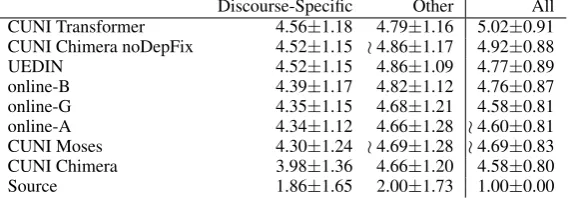
Discourse-Specific Other All CUNI Transformer 4.56±1.18 4.79±1.16 5.02±0.91 CUNI Chimera noDepFix 4.52±1.15 o4.86±1.17 4.92±0.88
UEDIN 4.52±1.15 4.86±1.09 4.77±0.89
online-B 4.39±1.17 4.82±1.12 4.76±0.87 online-G 4.35±1.15 4.68±1.21 4.58±0.81 online-A 4.34±1.12 4.66±1.28 o4.60±0.81 CUNI Moses 4.30±1.24 o4.69±1.28 o4.69±0.83 CUNI Chimera 3.98±1.36 4.66±1.20 4.58±0.80
[image:4.595.158.444.64.163.2]Source 1.86±1.65 2.00±1.73 1.00±0.00
Table 7: Comparison of EVALD L2 scores using discourse-specific (deep) features, other (shallow) features, and all features. Vertical tildes mark differences in rank in comparison with the rank given by the discourse-specific features.
Avg. var. of scores across nativeness 0.88 across MT systems 0.85
across genre 0.67
across domain 0.67
Table 8: Variance in EVALD L2 scores across various aspects of our test suite.
of ranks, as humanities do (HIStory or the men-tioned PHIlosophy).
Table 6 documents the effect of the mother tongue of the author of the original English text before the translation.
Table 7 compares EVALD L2 scores in three experimental settings: using only the deep text features (marked discourse-specific in the table), shallow features (marked other) and all features.3
Vertical tildes mark differences in rank in compar-ison with the rank given by the deep text features. Agreement in five first ranks using the deep fea-tures and all feafea-tures indicates that the full version of EVALD (i.e. using all features) really evaluates the translation systems based on the quality of the text coherence, rather than on the basis of shallow features.
Table 8 summarizes the variance of EVALD scores according to individual aspects captured in the previously mentioned tables. The highest vari-ance of the scores appeared in the aspect of native-ness of the text author.
The second most diverse results are across MT systems. The evaluation proposed here thus seems as a promising research direction, although a care-ful analysis of EVALD features and their adapta-tion will be needed to obtain more discerning eval-uation. Finally, the genre and domain of the orig-inal text also play a role but this is always to be expected.
3See Section2for the list of features.
5 Conclusion
We presented the results of automatic evaluation of Czech text quality applied to the output of gen-erally good MT systems translating from English into Czech.
The results indicate that EVALD, as now trained for human-authored texts, is ineffective in its sion for native speakers. However, EVALD ver-sion for non-natives has a rather promising poten-tial for evaluating automatic translations because it allows distinguishing individual MT systems.
The most diversity of scores can be attributed to the nativeness of the author of the original text. We conclude that the examined MT systems in general preserve sufficient traits of source text quality for this.
EVALD-style of evaluation seems promising because the second most differentiating aspect is the MT system used. Further exploration of EVALD features as well as a direct comparison with manual assessment of translation quality are, however, necessary to make EVALD a useful MT evaluation method.
Acknowledgments
This work has been supported by the grants 18-24210S, GA17-06123S and GA17-03461S of the Czech Science Foundation, SVV 260 453, and us-ing language resources and tools distributed by the LINDAT/CLARIN project of the Ministry of Education, Youth and Sports of the Czech Re-public (projects LM2015071 and OP VVV VI CZ.02.1.01/0.0/0.0/16 013/0001781).
References
Statistical Machine Translation, pages 92–98, Sofia, Bulgaria. Association for Computational Linguis-tics.
Jindˇrich Helcl, Jindˇrich Libovick´y, Tom Kocmi, Tom´aˇs Musil, Ondˇrej C´ıfka, Duˇsan Variˇs, and Ondˇrej Bo-jar. 2018. Neural monkey: The current state and beyond. In The 13th Conference of The Associa-tion for Machine TranslaAssocia-tion in the Americas, Vol. 1: MT Researchers’ Track, pages 168–176, Strouds-burg, PA, USA. The Association for Machine Trans-lation in the Americas, The Association for Machine Translation in the Americas.
Philipp Koehn, Hieu Hoang, Alexandra Birch, Chris Callison-Burch, Marcello Federico, Nicola Bertoldi, Brooke Cowan, Wade Shen, Christine Moran, Richard Zens, Chris Dyer, Ondˇrej Bojar, Alexandra Constantin, and Evan Herbst. 2007. Moses: Open Source Toolkit for Statistical Machine Translation. InACL 2007, Proceedings of the 45th Annual Meet-ing of the Association for Computational LMeet-inguistics Companion Volume Proceedings of the Demo and Poster Sessions, pages 177–180, Prague, Czech Re-public. Association for Computational Linguistics.
Michal Nov´ak, Jiˇr´ı M´ırovsk´y, Kateˇrina Rysov´a, and Magdal´ena Rysov´a. 2018. Topic-focus articulation: A third pillar of automatic evaluation of text coher-ence. conference paper. In Proceedings of MICAI 2018. Springer LNAI – Lecture Notes in Artificial Intelligence, in press.
Michal Nov´ak, Kateˇrina Rysov´a, Magdal´ena Rysov´a, and Jiˇr´ı M´ırovsk´y. 2017. Incorporating corefer-ence to automatic evaluation of cohercorefer-ence in es-says. InStatistical Language and Speech Process-ing, number 10583 in Lecture Notes in Computer Science, pages 58–69, Cham, Switzerland. Claude Chappe Informatics Institute at University of Le Mans, Springer International Publishing.
Martin Popel and Ondej Bojar. 2018. Training Tips for the Transformer Model. The Prague Bulletin of Mathematical Linguistics, 110(1):43–70.
Rudolf Rosa, David Mareˇcek, and Ondej Duˇsek. 2012. DEPFIX: A System for Automatic Correction of Czech MT Outputs. InProceedings of the Seventh Workshop on Statistical Machine Translation, pages 362–368, Montr´eal, Canada. Association for Com-putational Linguistics.
Kateˇrina Rysov´a, Magdal´ena Rysov´a, Jiˇr´ı M´ırovsk´y, and Michal Nov´ak. 2017. Introducing EVALD soft-ware applications for automatic evaluation of dis-course in czech. InProceedings of the International Conference Recent Advances in Natural Language Processing, pages 634–641, ˇSumen, Bulgaria. Bul-garian Academy of Sciences, INCOMA Ltd.
Magdal´ena Rysov´a, Kateˇrina Rysov´a, Jiˇr´ı M´ırovsk´y, and Michal Nov´ak. 2018. Practicing students writ-ing skills through elearnwrit-ing: Automated evalua-tion of text coherence in czech. InEDULEARN18
Proceedings, pages 1963–1970, Valencia, Spain. IATED Academy, IATED Academy.
Rico Sennrich, Alexandra Birch, Anna Currey, Ulrich Germann, Barry Haddow, Kenneth Heafield, An-tonio Valerio Miceli Barone, and Philip Williams. 2017. The university of edinburgh’s neural mt sys-tems for wmt17. InProceedings of the Second Con-ference on Machine Translation, Volume 2: Shared Task Papers, pages 389–399, Copenhagen, Den-mark. Association for Computational Linguistics.
Ashish Vaswani, Noam Shazeer, Niki Parmar, Jakob Uszkoreit, Llion Jones, Aidan N Gomez, Ł ukasz Kaiser, and Illia Polosukhin. 2017. Attention is all you need. In I. Guyon, U. V. Luxburg, S. Bengio, H. Wallach, R. Fergus, S. Vishwanathan, and R. Gar-nett, editors, Advances in Neural Information Pro-cessing Systems 30, pages 6000–6010. Curran As-sociates, Inc.