Proceedings of the Third Conference on Machine Translation (WMT), Volume 2: Shared Task Papers, pages 788–793
Contextual Encoding for Translation Quality Estimation
Junjie Hu, Wei-Cheng Chang, Yuexin Wu, Graham Neubig Language Technologies Institute, Carnegie Mellon University
{junjieh, wchang2, yuexinw, gneubig}@cs.cmu.edu
Abstract
The task of word-level quality estimation (QE) consists of taking a source sentence and machine-generated translation, and predicting which words in the output are correct and which are wrong. In this paper, propose a method to effectively encode the local and global contextual information for each target word using a three-part neural network ap-proach. The first part uses an embedding layer to represent words and their part-of-speech tags in both languages. The second part lever-ages a one-dimensional convolution layer to integrate local context information for each target word. The third part applies a stack of feed-forward and recurrent neural networks to further encode the global context in the sen-tence before making the predictions. This model was submitted as the CMU entry to the WMT2018 shared task on QE, and achieves strong results, ranking first in three of the six tracks.1
1 Introduction
Quality estimation (QE) refers to the task of mea-suring the quality of machine translation (MT) system outputs without reference to the gold trans-lations (Blatz et al.,2004;Specia et al.,2013). QE research has grown increasingly popular due to the improved quality of MT systems, and poten-tial for reductions in post-editing time and the cor-responding savings in labor costs (Specia, 2011;
Turchi et al.,2014). QE can be performed on mul-tiple granularities, including at word level, sen-tence level, or document level. In this paper, we focus on quality estimation at word level, which is framed as the task of performing binary clas-sification of translated tokens, assigning “OK” or “BAD” labels.
1Our software is available athttps://github.com/
junjiehu/CEQE.
Early work on this problem mainly focused on hand-crafted features with simple regres-sion/classification models (Ueffing and Ney,2007;
Bic¸ici, 2013). Recent papers have demonstrated that utilizing recurrent neural networks (RNN) can result in large gains in QE performance (Martins et al., 2017). However, these approaches encode the context of the target word by merely concate-nating its left and right context words, giving them limited ability to control the interaction between the local context and the target word.
In this paper, we propose a neural architecture, Context Encoding Quality Estimation (CEQE), for better encoding of context in word-level QE. Specifically, we leverage the power of both (1) convolution modules that automatically learn lo-cal patterns of surrounding words, and (2) hand-crafted features that allow the model to make more robust predictions in the face of a paucity of la-beled data. Moreover, we further utilize stacked recurrent neural networks to capture the long-term dependencies and global context information from the whole sentence.
We tested our model on the official bench-mark of the WMT18 word-level QE task. On this task, it achieved highly competitive results, with the best performance over other competitors on English-Czech, English-Latvian (NMT) and English-Latvian (SMT) word-level QE task, and ranking second place on English-German (NMT) and German-English word-level QE task.
2 Model
The QE module receives as input a tuplehs, t,Ai, where s = s1, . . . , sM is the source sentence,
t=t1, . . . , tN is the translated sentence, andA ⊆
{(m, n)|1 ≤ m ≤ M,1 ≤ n ≤ N}is a set of word alignments. It predicts as output a sequence
ˆ
y=y1, . . . , yN, with eachyi ∈ {BAD,OK}. The
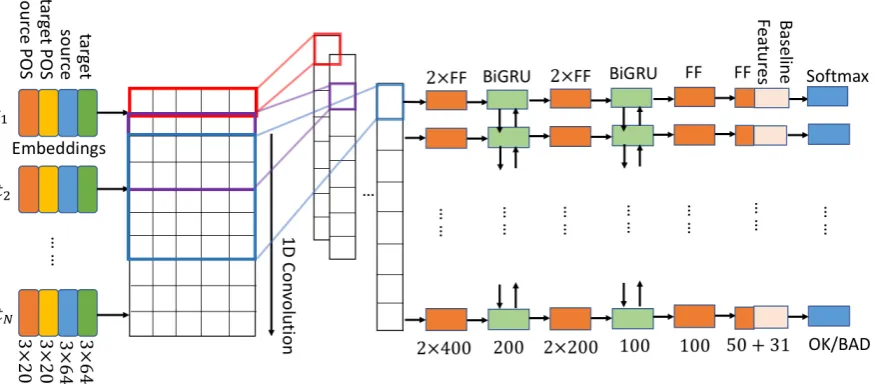
overall architecture is shown in Figure1
CEQE consists of three major components: (1) embedding layers for words and part-of-speech (POS) tags in both languages, (2) convolution en-coding of the local context for each target word, and (3) encoding the global context by the recur-rent neural network.
2.1 Embedding Layer
Inspired by (Martins et al., 2017), the first em-bedding layer is a vector representing each tar-get wordtjobtained by concatenating the
embed-ding of that word with those of the aligned words sA(:,tj)in the source. If a target word is aligned to multiple source words, we average the embedding of all the source words, and concatenate the target word embedding with its average source embed-ding. The immediate left and right contexts for source and target words are also concatenated, en-riching the local context information of the em-bedding of target word tj. Thus, the embedding
of target word tj, denoted as xj, is a 6d
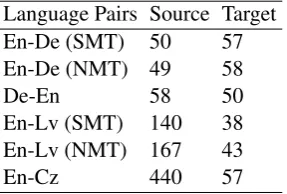
dimen-sional vector, wheredis the dimension of the word embeddings. The source and target words use the same embedding parameters, and thus identical words in both languages, such as digits and proper nouns, have the same embedding vectors. This al-lows the model to easily identify identical words in both languages. Similarly, the POS tags in both languages share the same embedding parameters. Table1shows the statistics of the set of POS tags over all language pairs.
Language Pairs Source Target
En-De (SMT) 50 57
En-De (NMT) 49 58
De-En 58 50
En-Lv (SMT) 140 38 En-Lv (NMT) 167 43
[image:2.595.111.255.512.609.2]En-Cz 440 57
Table 1: Statistics of POS tags over all language pairs
2.2 One-dimensional Convolution Layer The main difference between the our work and the neural model of Martins et al.(2017) is the one-dimensional convolution layer. Convolutions pro-vide a powerful way to extract local context fea-tures, analogous to implicitly learningn-gram fea-tures. We now describe this integral part of our model.
After embedding each word in the target sen-tence{t1, . . . , tj, . . . , tN}, we obtain a matrix of
embeddings for the target sequence,
x1:N =x1⊕x2. . .⊕xN,
where ⊕is the column-wise concatenation oper-ator. We then apply one-dimensional convolution (Kim, 2014; Liu et al., 2017) on x1:N along the
target sequence to extract the local context of each target word. Specifically, a one-dimensional con-volution involves a filter w ∈ Rhk, which is
ap-plied to a window ofhwords in target sequence to produce new features.
ci=f(w·xi:i+h−1+b),
whereb ∈ Ris a bias term and f is some func-tions. This filter is applied to each possible win-dow of words in the embedding of target sen-tence {x1:h,x2:h+1, . . . ,xN−h+1:N} to produce
features
c= [c1, c2, . . . , cN−h+1].
By the padding proportionally to the filter sizeh at the beginning and the end of target sentence, we can obtain new featurescpad ∈ RN of target
sequence with output size equals to input sentence lengthN. To capture various granularities of local context, we consider filters with multiple window sizesH = {1,3,5,7}, and multiple filters nf = 64are learned for each window size.
The output of the one-dimensional convolution layer, C ∈ RN×|H|·nf, is then concatenated with the embedding of POS tags of the target words, as well as its aligned source words, to provide a more direct signal to the following recurrent layers. 2.3 RNN-based Encoding
After we obtain the representation of the source-target word pair by the convolution layer, we fol-low a similar architecture as (Martins et al.,2017) to refine the representation of the word pairs using feed-forward and recurrent networks.
1. Two feed-forward layers of size 400 with rec-tified linear units (ReLU; Nair and Hinton
(2010));
2. One bi-directional gated recurrent unit (Bi-GRU; Cho et al. (2014)) layer with hidden size 200, where the forward and backward hidden states are concatenated and further normalized by layer normalization (Ba et al.,
Figure 1: The architecture of our model, with the convolutional encoder on the left, and stacked RNN on the right.
Category Description
Binary target word is a stopword Binary target word is a punctuation mark Binary target word is a proper noun Binary target word is a digit
Float backoff behavior of ngramwi−2wi−1wi (wiis the target word)
[image:3.595.81.519.70.262.2]Float backoff behavior of ngramwi−1wiwi+1 Float backoff behavior of ngramwiwi+1wi+2 One-hot highest order of ngram that includestarget word and its left context One-hot highest order of ngram that includestarget word and its right context One-hot highest order of ngram that includessource word and its left context One-hot highest order of ngram that includessource word and its right context
Table 2: Baseline Features
3. Two feed-forward layers of hidden size 200 with rectified linear units;
4. One BiGRU layer with hidden size 100 us-ing the same configuration of the previous Bi-GRU layer;
5. Two feed-forward layers of size 100 and 50 respectively with ReLU activation.
We concatenate the 31 baseline features extracted by the Marmot2 toolkit with the last 50 feed-forward hidden features. The baseline features are listed in Table2. We then apply a softmax layer on the combined features to predict the binary labels.
2https://github.com/qe-team/marmot
3 Training
We minimize the binary cross-entropy loss be-tween the predicted outputs and the targets. We train our neural model with mini-batch size8
us-ing Adam (Kingma and Ba, 2015) with learning rate0.001and decay the learning rate by
multiply-ing0.75if the F1-Multi score on the validation set
decreases during the validation. Gradient norms are clipped within5to prevent gradient explosion
for feed-forward networks or recurrent neural net-works. Since the training corpus is rather small, we use dropout (Srivastava et al.,2014) with prob-ability0.3to prevent overfitting.
4 Experiment
We evaluate our CEQE model on the WMT2018 Quality Estimation Shared Task3 for word-level German, German-English, English-Czech, and English-Latvian QE. Words in all lan-guages are lowercased. The evaluation metric is the multiplication of F1-scores for the “OK” and “BAD” classes against the true labels. F1-score is the harmonic mean of precision and recall. In Ta-ble3, our model achieves the best performance on three out of six test sets in the WMT 2018 word-level QE shared task.
4.1 Ablation Analysis
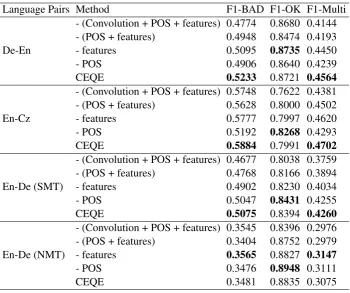
In Table 4, we show the ablation study of the features used in our model on English-German, German-English, and English-Czech. For each
Language Pairs F1-BAD F1-OK F1-Multi Rank En-De (SMT) 0.5075 0.8394 0.4260 3 En-De (NMT) 0.3565 0.8827 0.3147 2
De-En 0.4906 0.8640 0.4239 2
En-Lv (SMT) 0.4211 0.8592 0.3618 1 En-Lv (NMT) 0.5192 0.8268 0.4293 1
[image:4.595.311.525.60.222.2]En-Cz 0.5882 0.8061 0.4741 1
Table 3: Best performance of our model on six datasets in the WMT2018 word-level QE shared task on the leader board (updated on July 27th 2018)
language pair, we show the performance of CEQE without adding the corresponding components specified in the second column respectively. The last row shows the performance of the complete CEQE with all the components. As the base-line features released in the WMT2018 QE Shared Task for English-Latvian are incomplete, we train our CEQE model without using such features. We can glean several observations from this data:
1. Because the number of “OK” tags is much larger than the number of “BAD” tags, the model is easily biased towards predicting the “OK” tag for each target word. The F1-OK scores are higher than the F1-BAD scores across all the language pairs.
2. For German-English, English Czech, and English-German (SMT), adding the baseline features can significantly improve the F1-BAD scores.
3. For English-Czech, English-German (SMT), and English-German (NMT), removing POS tags makes the model more biased towards predicting “OK” tags, which leads to higher F1-OK scores and lower F1-BAD scores.
4. Adding the convolution layer helps to boost the performance of F1-Multi, especially on English-Czech and English-Germen (SMT) tasks. Comparing the F1-OK scores of the model with and without the convolution layer, we find that adding the convolution layer help to boost the F1-OK scores when translating from English to other languages, i.e., English-Czech, English-German (SMT and NMT). We conjecture that the convo-lution layer can capture the local informa-tion more effectively from the aligned source words in English.
1000 2000 3000 4000
Iteration 0
0.3 0.4 0.5 0.6 0.7
F1
-Mul
ti
[image:4.595.74.301.62.159.2]Train-0.7 Train-0.3 Train-0.1 Valid-0.7 Valid-0.3 Valid-0.1
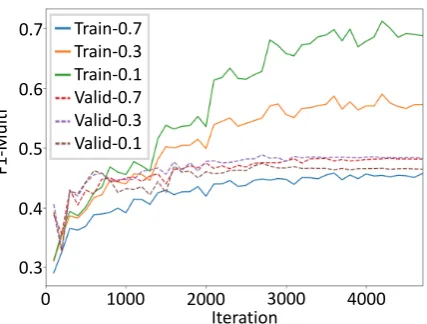
Figure 2: Effect of the dropout rate during training.
5 Case Study
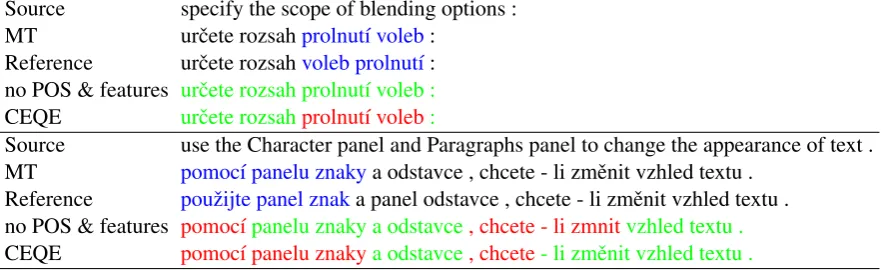
Table5shows two examples of quality prediction on the validation data of WMT2018 QE task for English-Czech. In the first example, the model without POS tags and baseline features is biased towards predicting “OK” tags, while the model with full features can detect the reordering error. In the second example, the target word “panelu” is a variant of the reference word “panel”. The target word “znaky” is the plural noun of the reference “znak”. Thus, their POS tags have some subtle differences. Note the target word “zmnit” and its aligned source word “change” are both verbs. We can observe that POS tags can help the model cap-ture such syntactic variants.
5.1 Sensitivity Analysis
During training, we find that the model can easily overfit the training data, which yields poor perfor-mance on the test and validation sets. To make the model more stable on the unseen data, we ap-ply dropout to the word embeddings, POS embed-dings, vectors after the convolutional layers and the stacked recurrent layers. In Figure2, we exam-ine the accuracies dropout rates in [0.1,0.3,0.7].
We find that adding dropout alleviates overfitting issues on the training set. If we reduce the dropout rate to 0.1, which means randomly setting some
values to zero with probability0.1, the training
F1-Multi increases rapidly and the validation F1-multi score is the lowest among all the settings. Prelim-inary results proved best for a dropout rate of0.3,
Language Pairs Method F1-BAD F1-OK F1-Multi
De-En
- (Convolution + POS + features) 0.4774 0.8680 0.4144 - (POS + features) 0.4948 0.8474 0.4193
- features 0.5095 0.8735 0.4450
- POS 0.4906 0.8640 0.4239
CEQE 0.5233 0.8721 0.4564
En-Cz
- (Convolution + POS + features) 0.5748 0.7622 0.4381 - (POS + features) 0.5628 0.8000 0.4502
- features 0.5777 0.7997 0.4620
- POS 0.5192 0.8268 0.4293
CEQE 0.5884 0.7991 0.4702
En-De (SMT)
- (Convolution + POS + features) 0.4677 0.8038 0.3759 - (POS + features) 0.4768 0.8166 0.3894
- features 0.4902 0.8230 0.4034
- POS 0.5047 0.8431 0.4255
CEQE 0.5075 0.8394 0.4260
En-De (NMT)
- (Convolution + POS + features) 0.3545 0.8396 0.2976 - (POS + features) 0.3404 0.8752 0.2979
- features 0.3565 0.8827 0.3147
- POS 0.3476 0.8948 0.3111
[image:5.595.124.475.60.353.2]CEQE 0.3481 0.8835 0.3075
Table 4: Ablation study on the WMT18 Test Set
6 Conclusion
In this paper, we propose a deep neural architec-ture for word-level QE. Our framework leverages a one-dimensional convolution on the concatenated word embeddings of target and its aligned source words to extract salient local feature maps. In additions, bidirectional RNNs are applied to cap-ture temporal dependencies for better sequence prediction. We conduct thorough experiments on four language pairs in the WMT2018 shared task. The proposed framework achieves highly compet-itive results, outperforms all other participants on English-Czech and English-Latvian word-level, and is second place on English-German, and German-English language pairs.
Acknowledgements
The authors thank Andre Martins for his advice regarding the word-level QE task.
This work is sponsored by Defense Advanced Research Projects Agency Information Innovation Office (I2O). Program: Low Resource Languages for Emergent Incidents (LORELEI). Issued by DARPA/I2O under Contract No. HR0011-15-C0114. The views and conclusions contained in this document are those of the authors and should not be interpreted as representing the official
poli-cies, either expressed or implied, of the U.S. Gov-ernment. The U.S. Government is authorized to reproduce and distribute reprints for Government purposes notwithstanding any copyright notation here on.
References
Lei Jimmy Ba, Ryan Kiros, and Geoffrey E. Hinton. 2016. Layer normalization. CoRR, abs/1607.06450. Ergun Bic¸ici. 2013. Referential translation machines for quality estimation. InProceedings of the eighth workshop on statistical machine translation, pages 343–351.
John Blatz, Erin Fitzgerald, George Foster, Simona Gandrabur, Cyril Goutte, Alex Kulesza, Alberto Sanchis, and Nicola Ueffing. 2004. Confidence es-timation for machine translation. In Proceedings of the 20th international conference on Computa-tional Linguistics, page 315. Association for Com-putational Linguistics.
Source specify the scope of blending options : MT urˇcete rozsahprolnut´ı voleb:
Reference urˇcete rozsahvoleb prolnut´ı: no POS & features urˇcete rozsah prolnut´ı voleb : CEQE urˇcete rozsahprolnut´ı voleb:
Source use the Character panel and Paragraphs panel to change the appearance of text .
MT pomoc´ı panelu znakya odstavce , chcete - li zmˇenit vzhled textu .
[image:6.595.79.521.65.200.2]Reference pouˇzijte panel znaka panel odstavce , chcete - li zmˇenit vzhled textu . no POS & features pomoc´ıpanelu znaky a odstavce, chcete - li zmnitvzhled textu . CEQE pomoc´ı panelu znakya odstavce, chcete- li zmˇenit vzhled textu .
Table 5: Examples on WMT2018 validation data. The source and translated sentences, the reference sentences, the predictions of the CEQE without and with POS tags and baseline features are shown. Words predicted as OK are shown ingreen, those predicted as BAD are shown inred, the difference between the translated and reference sentences are shown inblue.
Yoon Kim. 2014. Convolutional neural networks for sentence classification. InProceedings of the 2014 Conference on Empirical Methods in Natural Lan-guage Processing, EMNLP 2014, October 25-29, 2014, Doha, Qatar, A meeting of SIGDAT, a Special Interest Group of the ACL, pages 1746–1751.
Diederik P Kingma and Jimmy Ba. 2015. Adam: A method for stochastic optimization. InICLR.
Jingzhou Liu, Wei-Cheng Chang, Yuexin Wu, and Yiming Yang. 2017. Deep learning for extreme multi-label text classification. InProceedings of the 40th International ACM SIGIR Conference on Re-search and Development in Information Retrieval, pages 115–124. ACM.
Andr´e Martins, Marcin Junczys-Dowmunt, Fabio Ke-pler, Ram´on Astudillo, Chris Hokamp, and Roman Grundkiewicz. 2017. Pushing the limits of transla-tion quality estimatransla-tion. Transactions of the Associ-ation for ComputAssoci-ational Linguistics, 5:205–218.
Vinod Nair and Geoffrey E Hinton. 2010. Rectified linear units improve restricted boltzmann machines. InProceedings of the 27th international conference on machine learning (ICML-10), pages 807–814.
Lucia Specia. 2011. Exploiting objective annotations for measuring translation post-editing effort. In Pro-ceedings of the 15th Conference of the European As-sociation for Machine Translation, pages 73–80.
Lucia Specia, Kashif Shah, Jose GC Souza, and Trevor Cohn. 2013. Quest-a translation quality estimation framework. InProceedings of the 51st Annual Meet-ing of the Association for Computational LMeet-inguis- Linguis-tics: System Demonstrations, pages 79–84.
Nitish Srivastava, Geoffrey Hinton, Alex Krizhevsky, Ilya Sutskever, and Ruslan Salakhutdinov. 2014. Dropout: a simple way to prevent neural networks from overfitting. The Journal of Machine Learning Research, 15(1):1929–1958.
Marco Turchi, Antonios Anastasopoulos, Jos´e GC de Souza, and Matteo Negri. 2014. Adaptive qual-ity estimation for machine translation. In Proceed-ings of the 52nd Annual Meeting of the Association for Computational Linguistics (Volume 1: Long Pa-pers), volume 1, pages 710–720.
Nicola Ueffing and Hermann Ney. 2007. Word-level confidence estimation for machine translation.