Morphological Analysis without Expert Annotation
Garrett Nicolai and Grzegorz Kondrak
Department of Computing Science University of Alberta, Edmonton, Canada
{nicolai,gkondrak}@ualberta.ca
Abstract
The task of morphological analysis is to produce a complete list of lemma+tag analyses for a given word-form. We pro-pose a discriminative string transduction approach which exploits plain inflection tables and raw text corpora, thus obviat-ing the need for expert annotation. Ex-periments on four languages demonstrate that our system has much higher cover-age than a hand-engineered FST analyzer, and is more accurate than a state-of-the-art morphological tagger.
1 Introduction
The task of morphological analysis is to anno-tate a given word-form with its lemma and mor-phological tag. Since word-forms are often am-biguous, the goal is to produce a complete list of correct analyses, which may involve not only multiple inflections, but also distinct lemmas and parts of speech (c.f. Table 1). Hand-built lexi-cons, such as CELEX (Baayen et al., 1995), con-tain this kind of information, but they exist only for a small number of languages, are expensive to create, and have limited coverage. Finite-state an-alyzers, such as Morphisto (Zielinski and Simon, 2009) and Omorfi (Pirinen, 2015), provide an al-ternative to lexicons, but their construction also requires expert knowledge and substantial engi-neering effort. Furthermore, they are often more general than lexicons, although they may require a lemmatic lexicon to ensure high precision.
Morphological tagging is a distinct but related task, which aims at determining a single correct analysis of a word-form within the context of a sentence. Machine learning taggers, such as Mor-fette (Chrupała et al., 2008) and Marmot (M¨uller et al., 2013), are capable of achieving high tagging
accuracy, but they need to be trained on morpho-logically annotated corpora, which are unavailable for most languages. Often, morphological tag-ging can be performed as a downstream applica-tion of morphological analysis: tools such as Mar-mot and the Zurich Dependency Parser (Sennrich et al., 2009) have the functionality to incorporate the output of a morphological analyzer to perform morphological tagging.
In this paper, we propose a novel discrimina-tive string transduction approach to morphologi-cal analysis, which is designed to be trained on plain inflection tables, thus obviating the need for expert rule engineering or morphologically anno-tated corpora. Inflection tables are available for many languages on web sites such as Wiktionary, thanks to crowd-sourcing efforts of moderately-skilled native speakers.1 In addition, our system
is capable of leveraging raw unannotated corpora to refine its analyses by re-ranking. The accu-racy of the system on German approaches that of a hand-engineered FST analyzer, while having much higher coverage. The experimental results on English, Dutch, German, and Spanish demon-strate that it also more accurate than the analysis module of a state-of-the-art morphological tagger.
2 Methods
Our approach to morphological analysis is based on string transduction between a word-form (e.g. l¨ufte) and an analysis composed of a lemma and a tag (e.g. l¨uften+1SIE), where the tag corresponds to the predicted inflection slot. Our system con-sists of four modules: alignment, transduction, re-ranking, and thresholding.
1The Unimorph Project (unimorph.org) provides inflec-tion tables for more than 350 languages.
Lemma POS Inflection Tag
luft Noun Nom. Pl. NP
luft Noun Acc. Pl. AP
luft Noun Gen. Pl. GP
[image:2.595.317.515.60.147.2]l¨uften Verb 1stSg. Ind. Pres. 1SIE l¨uften Verb 1stSg. Subj. Pres. 1SKE l¨uften Verb 3rdSg. Subj. Pres. 3SKE l¨uften Verb Sg. Imperative RS
Table 1: An example of morphological analy-sis: multiple correct interpretations of the German word-forml¨ufte.
2.1 Alignment
For the training of the string transduction models, we need aligned source-target pairs. Monotonic alignments are inferred with a modified version of the M2M (many-to-many) aligner of Jiampo-jamarn et al. (2007), which maximizes the joint likelihood of the aligned source and target sub-string pairs using the Expectation-Maximization algorithm. A transduction from a word-form which happens to be shorter than its lemma (e.g. l¨ufte/l¨uften) could be achieved by including an in-sertion operation (e.g. → n). However, in or-der to avoid a prohibitively expensive transduc-tion model, we model insertransduc-tion as a many-to-many alignment, which bounds the transduction opera-tion to its context.
We modify the M2M aligner by allowing the alignment to learn the likelihood of a generalized identity alignment (i.e., i → i). Although inflec-tion modifies some characters in a word, the ma-jority of characters remain unchanged. This mod-ification influences M2M towards small, single-character alignments.
The alignment of tags (e.g. 1SIE) merits special consideration. The tag is treated as a single indi-visible unit, which is typically aligned to a sub-string in the word-form that involves the corre-sponding affix.2 We allow the maximum length
of the alignment substring to be longer for the tag alignment than for the individual characters in the lemma. After aligning the training data we record all substring alignments that involve affixes and tags. At test time, the source-target alignment is implied by the substring transduction sequence. 2Although our method can handle multiple tags, one tag is sufficient to represent the word-forms of the languages that we consider in this paper. The only exception is the circumfix of the German past participle.
s c h r e i b et
s c h r e i b en+2PKA X
s c h r e i b en+2PKE X
s c h r e i b en+3SIA ×
s c h r e i b en+3PIE ×
s c h r e i b en+2PIA X
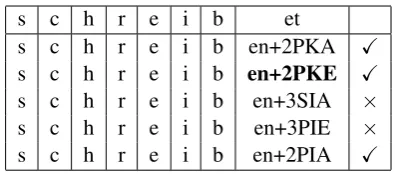
Table 2: Example alignments of hypothetical anal-yses of the German word-form schreibet. The check marks indicate which of the analyses satisfy the affix-match constraint.
We say that a lemma+tag analysis generated from a word-form satisfies theaffix-match constraintif and only if the resulting affix-tag pair occurs in the alignment of the training data. Table 2 shows the alignments of five possible analyses to the corre-sponding word-formschreibet, of which three sat-isfy the affix-match constraint. Only analysis #2 (in bold) is correct.
2.2 Transduction
We train transduction models for transforming the word-forms into analyses on the aligned source-target pairs using a modified version of DI -RECTL+ (Jiampojamarn et al., 2010). DIRECTL+
is a feature-rich, discriminative character trans-ducer, which searches for a model-optimal se-quence of character transformation rules for its input. The core of the engine is a dynamic pro-gramming algorithm capable of transducing many consecutive characters in a single operation, also known as a semi-Markov model. Using a struc-tured version of the MIRA algorithm (McDonald et al., 2005), training attempts to assign weights to each feature so that its linear model separates the gold-standard derivation from all others in its search space.
DIRECTL+ uses a number of feature templates
[image:2.595.74.291.61.173.2]Source Target
schreiben + 2PKA schriebet ×
schreiben + 2PKE schreibet X
schreiben + 3SIA schrieb ×
schrieben + 2PKE schriebet ×
[image:3.595.333.500.60.200.2]schreiben + 2PIA schriebt ×
Table 3: Example source-target pairs of the inflec-tor model. The check marks indicate which of the analyses of the German word-formschreibet sat-isfy the mirror constraint.
Following Toutanova and Cherry (2009), we modify the out-of-the-box version of DIRECTL+
by augmenting it with an abstract copy feature that indicates when a rule simply copies its source characters into the target, e.g. b → b. The copy feature has the effect of biasing the transducer towards preserving the source characters during transduction.
In addition to training an analyzer model that transforms a word-form into an analysis, we also train an inflectormodel that converts an analysis back into a word-form. This opposite transforma-tion corresponds to the task of morphological in-flection (Cotterell et al., 2016). By deriving two complementary models from the same training set, we attempt to mimic the functionality of a genuine finite-state transducer. We say that a lemma+tag analysis generated by the analyzer model satis-fies themirror constraintif and only if the inflec-tor model correctly reconstructs the original word-form from the analysis by returning it as its top-1 prediction. Table 3 shows five possible analyses of the word-formschreibet, of which only one sat-isfies the mirror constraint. Only analysis #2 (in bold) is correct.
2.3 Re-ranking
In order to produce multiple morphological anal-yses, we take advantage of the capability of DI -RECTL+ to outputn-best lists of candidate target
strings. To promote the most likely lemma+tag combinations, we re-rank then-best lists using the Liblinear SVM tool (Fan et al., 2008), converting the classification task into the ranking task with the method of Joachims (2002).
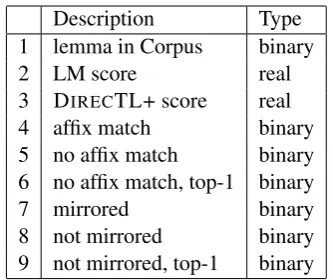
The re-ranker employs several features, which are enumerated in Table 4. The first three features consider the form of the predicted lemma. Fea-ture 1 indicates whether the lemma occurs at least
Description Type 1 lemma in Corpus binary
2 LM score real
3 DIRECTL+ score real
4 affix match binary 5 no affix match binary 6 no affix match, top-1 binary
7 mirrored binary
[image:3.595.95.269.61.147.2]8 not mirrored binary 9 not mirrored, top-1 binary
Table 4: Features of the re-ranker.
once in a text corpus. Feature 2 is set to the nor-malized likelihood score of the lemma computed with a 4-gram character language model that is de-rived from the corpus. Feature 3 is the normalized confidence score assigned by DIRECTL+.
Features 4-6 refer to theaffix-match constraint defined in Section 2.1, in order to promote anal-yses that involve correct tags. Features 4 and 5 are complementary and indicate whether the align-ment between the affix of the given word-form and the tag of the predicted analysis was generated at least once in the training data. Feature 6 accounts for unusual affix-tag pairs that are unattested in the training data: it fires if the affix-match constraint in not satisfied but the analysis is deemed the most likely by DIRECTL+.
Features 7-9 refer to the mirror constraint de-fined in Section 2.2, in order to promote analy-ses that the inflector model correctly transduces back into the initial word-form. These three fea-tures follow the same pattern as the affix-match features.
2.4 Thresholding
con-ditional: it only allows a relatively high-scoring analysis if its lemma occurs in one of the anal-yses that clear the first threshold. For example, the fourth analysis in Table 3,schrieben+ 2PKE, needs to clear both thresholds, because its lemma differs from the top-1 analysis,schreiben+ 2PKA. Both thresholds are tuned on a development set.
3 Experiments
In this section, we evaluate our morphological an-alyzer on English, German, Dutch, and Spanish, and compare our results to two other systems. 3.1 Data
We extract complete inflection tables for English, German, and Dutch from the CELEX lexical database (Baayen et al., 1995). The number of in-flectional categories across verbs, nouns, and ad-jectives is 16, 50, and 24, respectively, in the three languages. However, in order to test whether an analyzer can handle arbitrary word-forms, the data is not separated according to distinct POS sets. For consistency, we ignore German noun capitaliza-tion.
The Spanish data is from Wiktionary inflection tables, as provided by Durrett and DeNero (2013). and includes 57 inflectional categories of Spanish verbs. We convert accented characters to their un-accented counterparts followed by a special sym-bol (e.g.cant´o→canto’), with no loss of infor-mation.
The data is split into 80/10/10 train/dev/test sets; for Spanish, we use the same splits as Dur-rett and DeNero (2013). We eliminate duplicate identical word-forms from the test data, and hold out 20%of the development data to train the re-ranker. The training instances are randomly shuf-fled to eliminate potential biases.
For re-ranking, we extract word-form lists from the first one million lines of the November 2, 2015 Wikipedia dump for the given language, and de-rive our language models using the CMU Statisti-cal Language Modeling Toolkit.3
3.2 Comparison to Morphisto
We first compare our German results against Mor-phisto (Zielinski and Simon, 2009), an FST ana-lyzer. Beyond morphological analysis, Morphisto also performs some derivational analysis, convert-ing compound segments back into lemmas. For a
3http://www.speech.cs.cmu.edu
fair comparison, we exclude compounds from the test set. In addition, because the lexicon of Mor-phisto has a limited coverage, we report micro-averaged results in this section.
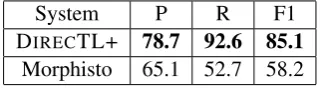
Table 5 shows that overall our system per-forms much better on the test sets than the hand-engineered Morphisto, which fails to analyze 43% of the word-forms in the test set. If we disregard the word-forms that Morphisto cannot handle, its F-score is actually higher: 89.5%vs. 84.0%.
3.3 Comparison to Marmot
Marmot (M¨uller et al., 2013) is a state-of-the-art, publicly available morphological tagger4,
aug-mented with a lemmatizing module (M¨uller et al., 2015), which can also take advantage of unanno-tated corpora. In order to make a fair comparison, we train Marmot on the same data as our system, with default parameters. Because Marmot is a morphological tagger, rather than an analyzer, we provide the training and test word-forms as single-word sentences. In addition, we have modified the source code to output a list of n-best analy-ses instead of a single best analysis. No additional re-ranking of the results is performed, as Marmot already contains its own module for leveraging a corpus, which is activated in these experiments. Separate thresholds for each language are tuned on the development sets. (c.f. Section 2.4).
Table 6 presents the results. We evaluate the systems using macro-averaged precision, recall, and F-score. Our system is consistently more ac-curate, improving the F-score on each of the four languages. Both systems make few mistakes on Spanish verbs.
The English results stand out, with Marmot achieving a higher recall at the cost of precision. English contains more syncretic forms than the other three languages: 3 different analyses per word-form on average in the test set, compared to 1.9, 1.3, and 1.1 for German, Dutch, and Spanish, respectively. Marmot’s edit-tree method of candi-date selection favors fewer lemmas, which allows the lemmatization module to run efficiently. On the other hand, DIRECTL+ has no bias towards
lemmas or tags. This may be the reason of the substantial difference between the two systems on Dutch, where nearly a quarter of all syncretic test word-forms involve multiple lemmas.
English German Dutch Spanish
P R F1 P R F1 P R F1 P R F1
DIRECTL+ 93.5 88.9 91.2 87.3 88.7 88.0 87.3 90.3 88.8 99.3 99.5 99.4
[image:5.595.82.521.62.120.2]Marmot 87.5 94.3 90.8 85.3 88.5 86.9 81.3 84.7 82.9 99.2 98.9 99.1
Table 6: Macro-averaged results on four languages.
System P R F1
DIRECTL+ 78.7 92.6 85.1
Morphisto 65.1 52.7 58.2
Table 5: Micro-averaged results on German.
by Spanishlacremos. Both systems correctly iden-tify it as a plural subjunctive form of the verb lacrar. However, Marmot also outputs an al-ternative analysis that involves a bizarre lemma lacr. Our system is able to exclude this word-form thanks to a low score from the character lan-guage model, which is taken into consideration by the re-ranker.
4 Conclusion
We have presented a transduction-based morpho-logical analyzer that can be trained on plain inflec-tion tables. Our system is highly accurate, and has a much higher coverage than a carefully-crafted FST analyzer. By eliminating the necessity of expert-annotated data, our approach may lead to the creation of analyzers for a wide variety of lan-guages.
Acknowledgments
The authors thank Ryan Cotterell for his com-ments regarding the Marmot source code. This re-search was supported by the Natural Sciences and Engineering Research Council of Canada, and the Alberta Innovates Technology Futures.
References
Harald R. Baayen, Richard Piepenbrock, and Leon Gu-likers. 1995. The CELEX Lexical Database. Re-lease 2 (CD-ROM). Linguistic Data Consortium, University of Pennsylvania, Philadelphia, Pennsyl-vania.
Grzegorz Chrupała, Georgiana Dinu, and Josef Van Genabith. 2008. Learning morphology with Morfette. InLREC.
Ryan Cotterell, Christo Kirov, John Sylak-Glassman, David Yarowsky, Jason Eisner, and Mans Hulden.
2016. The SIGMORPHON 2016 shared task: mor-phological reinflection.ACL 2016, page 10.
Greg Durrett and John DeNero. 2013. Supervised learning of complete morphological paradigms. In
HLT-NAACL, pages 1185–1195.
Rong-En Fan, Kai-Wei Chang, Cho-Jui Hsieh, Xiang-Rui Wang, and Chih-Jen Lin. 2008. LIBLINEAR: A library for large linear classification. The Journal of Machine Learning Research, 9:1871–1874.
Sittichai Jiampojamarn, Grzegorz Kondrak, and Tarek Sherif. 2007. Applying many-to-many alignments and hidden Markov models to letter-to-phoneme conversion. InNAACL-HLT, pages 372–379.
Sittichai Jiampojamarn, Colin Cherry, and Grzegorz Kondrak. 2010. Integrating joint n-gram features into a discriminative training network. In NAACL-HLT.
Thorsten Joachims. 2002. Optimizing search en-gines using clickthrough data. InProceedings of the eighth ACM SIGKDD international conference on Knowledge discovery and data mining, pages 133– 142. ACM.
Ryan McDonald, Koby Crammer, and Fernando Pereira. 2005. Online large-margin training of de-pendency parsers. InACL.
Thomas M¨uller, Helmut Schmid, and Hinrich Sch¨utze. 2013. Efficient higher-order CRFs for morphologi-cal tagging. InEMNLP, pages 322–332.
Thomas M¨uller, Ryan Cotterell, and Alexander Fraser. 2015. Joint lemmatization and morphological tag-ging with LEMMING. InEMNLP.
Tommi A. Pirinen. 2015. Omorfi - free and open source morphological lexical database for Finnish. In Proceedings of the 20th Nordic Con-ference of Computational Linguistics, NODALIDA 2015, May 11-13, 2015, Vilnius, Lithuania, number 109 in NEALT Proceedings Series, pages 313–315. Link¨oping University Electronic Press, Link¨opings universitet.
[image:5.595.101.262.164.208.2]Kristina Toutanova and Colin Cherry. 2009. A global model for joint lemmatization and part-of-speech prediction. InACL, pages 486–494.