Abstract— Softwares are products which are designed and developed to work on the operating systems. But nowadays, some softwares are compatible only with the latest version of the Os and it fails to run in the older ones. This is because the older versions of the operating system are not able to understand the architecture of the software. So we conducted a survey on this problem. Nearly 300 IT professionals attended the questionnaires and the factors were identified. So from the Matrix model of calculating the software usability, the factors mentioned by the IT professionals are included and then calculated. As a result of these calculations, new factors are included in the existing matrix model and the resulting matrix is our proposed model. In this paper we discuss about the formation of the model, result of the model and how this architectural model is advantageous over the existing model. The results derived as graphs were obtained by using a graphical simulator specially designed for this research work.
Index Terms— Usability, MATRIX MODEL, Software metrics.
I. INTRODUCTION
The software usability has been considered as a quality set that explores the extent to which the software product can be used by specified users to achieve specified goals with effectiveness, efficiency and satisfaction in a specified context of use as per ISO 9241-11. It may also be said as a set of attributes that bear on the effort for use and on the individual assessment of such use by a stated or implied set of users. The software usability engineering is to be performed to determine the user ability in a using environment within the usage time. The output of such an engineering exercise is to identify and inform the user about the accessibility of the product for maximum correct usage within minimal time.
Murugappan Alagappan is with KCG College of Technology, Chennai – 600097, India (corresponding author to provide mobile:+91 9444586197; e-mail: [email protected] ).
Ferdin Joe J is with KCG College of Technology, Chennai – 600097, India (corresponding author to provide mobile:+91 9442421576; e-mail:
[email protected] ; URL: http://www.ferdin.co.nr ).
Shamika M is with KCG College of Technology, Chennai – 600097, India (corresponding author to provide mobile:+91 9884714928; e-mail:
Manideep Vutukuri is with KCG College of Technology, Chennai – 600097, India (corresponding author to provide mobile:+91 9884221082; e-mail:
Mridul.M is with KCG College of Technology, Chennai – 600097, India (corresponding author to provide mobile:+91 9840431062; e-mail: [email protected]).
The software usability is considered as a combined form of understandability, learnability, operability and finally the attractiveness of the product to the final user or user group [Pressman, 1999]. As per Metrics for Usability Standards In Computing (MUSIC) technology, the physical architecture which may be a corporate building or a single room with all computing resources play an important role in determining the usability of the product but also the nature of computing resources [Tandler,2001]. Context aware computing like user identity based services and location aware appliances like GPS based services are to be considered in determining the software usability [Carroll, 2002]. The ubiquitous computing advocates that the Human- Computer-Interface (HCI) brings the information in the style like ‘wwiwwa’ (we want information where we are) instead of ‘wysiwyg’ (what you say is what you get). New developments in the fields of multimedia, hypertext and virtual reality technology face major challenges in designing HCI which in turn affect the usability of these products. Roomware which necessitates a different approach in determining the usability in a device oriented conceptual cooperative computing environment. Use performance measurement is carried out using a number of sub measures and these are: task effectiveness, efficiency, productive period and relative user efficiency [Chang, 2006]. Therefore software usability measures and the design for usability are centered on the users, necessitating a user centered design (UCD) model that can be arrived by analyzing the important user entities and their corresponding attributes mapped to the design attributes. But the UCD model may include the information interface on which a user is utilizing the power of a software product and the context of usage for timely behavior of the product. Hence an enhanced software usability model is proposed by considering all the modern computing devices and their environment styles with attractiveness and of advising type.
II. SOFTWARE USABILITY ENGINEERING
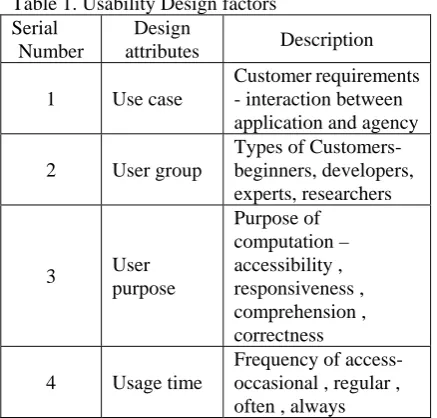
The software usability engineering may be considered as a discipline of analyzing the non functional characteristics of the software product influenced by the user group within the usage period keeping the operating environment and the functional requirements of the application unchanged. Such engineering leads to determine the responsiveness and the accessibility factors of the product. The conventional design model considers the user application focusing its requirements and user ability to handle the software product up to satisfaction in usage time. The various user-centered design factors are listed in Table 1. To arrive at a usability design model, the design factors are to be weighted and
Metric Based Architecture to Enhance Software
Usability
suitably mapped into a set of enhanced usability design factors shown in Table 2.
Table 1. Usability Design factors Serial
Number
Design
attributes Description
1 Use case
Customer requirements - interaction between application and agency
2 User group
Types of Customers- beginners, developers, experts, researchers
3 User
purpose
Purpose of computation – accessibility , responsiveness , comprehension , correctness
4 Usage time
Frequency of access- occasional , regular , often , always
The mapping from conventional UCD model to enhanced UCD model is based on the environment in which the software product is put into use. The design is focusing on the environment in which the software product is used which is not clearly defined in the earlier works and suitably incorporated in the enhanced usability design model.
III. ENHANCED USABILITY
This objective of this work is to propose an enhanced design model in which not only the impact of context of use and nature of ubiquitous computing but also the nature of co-operative devices and the physical architecture of place are considered. The multi users belonging to different geographical areas involving in applications that share the information in an asynchronous manner through flexible user interfaces may also be considered. A graphical tool has been developed in Visual Basic to determine the minimum and maximum values of the enhanced goal metrics for different usability matrices. The user group and usage time are mapped in to the design model into user interface device attributes respectively. The software usability design can be enhanced by incorporating the above said factors in a MAtrix Model (MAM) of software usability
Table 2. Enhanced Usability Design factors Serial
Number
Design
attributes Description
1 User Interface
Visual requirements - cognitive , control , presentation and interaction between application
2 User context
Truly ubiquitous - time , behavior , position and identity
3 User space
Dimension of abstraction physical architecture, social and mental 4 User
device
Nature of computing device – interactive , adaptive and predictive
Engineering aspects to achieve the user goal which comprises of user satisfaction, safety and the product’s effectiveness, productivity. The mathematical approach leads to give an overall picture of the relatedness of user and product. The software product usability matrix may be constructed by considering the core factors of the product and user as [U] which is a 1 x 4 matrix and the other matrix representing the non functional quality factors of the product in various dimensions as [Q] which is a 4 x 5 matrix. The multiplied effect of the two matrices helps the user to achieve the socio-business goals with ease and satisfaction. The resultant [G] is found to be a 1 x 5 matrix whose elements are reflecting the end user goal in handling any software product. The Goal matrix thus obtained can be used to find the end user goal in handling any software product. This in turn gives the final software product usability matrix. Thus user satisfaction, safety and the product’s effectiveness, productivity is obtained.
IV. END-USER COMPUTING SATISFACTION AND SAFETY
The software product is highly reliable and maintainable if the faults are detected at an early stage and corrected so as to complete the given application within the stipulated time. If the product gives error free output for the specified user, the satisfaction of that end user is going to be high. The maintenance activities either in the form of corrective or enhancement type accounts for the enhanced usability of the product at approximately zero risk. At the same time, the working environment will bring safety and satisfaction to the end user in the case of multiple user application areas like E-Commerce and Distributed Banking applications. The usability factors are to be centered in the case of enterprise application development since the repetitiveness of the same type of work in a lonely room even with high end computing resources will bring fatigue and mental tiredness easily.
V. EASINESS AND EFFECTIVENESS
VI. ENHANCED PRODUCTIVITY
The software productivity is totaling depending on the efficient methods in using the product within the available time. The text application software or the graphics application software efficiency is responsible for its productivity measure. The usability factor is in turn depends on the techniques used in utilizing the available hardware and software resources efficiently. The usage time and various resources that are to be shared in some of the application areas are also responsible for enhancement of the existing usability model thereby the overall productivity is improved by that software product.
[image:3.595.308.548.73.437.2]
Figure 2 Application- Product- Goal Model
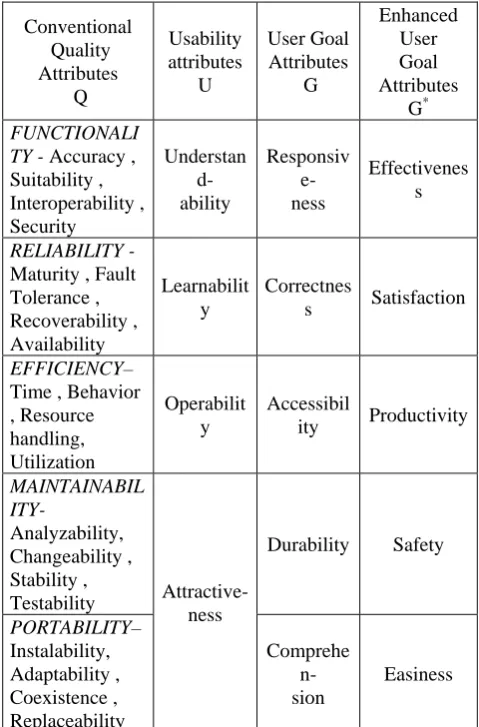
The usability matrix [U] consists of understandability, learnability, operability and attractiveness of the product. The non functional quality matrix [Q] consists of five columns representing functionality, reliability, efficiency, maintainability and portability factors. The row elements of matrix [U] when interacted with the individual column elements of matrix [Q] yields the resultant matrix [G] with satisfaction, effectiveness, productivity, safety and easiness elements of the product when the end user handles the product in specified environment. The user Application – Product – Goal Matrix model in determining the software usability is shown in Figure 2.The above usability model may be represented mathematically as follows.
Mathematically,
[U ] X [ Q ] = [ G ] ………… (1)
The enhanced usability model turns out to be a resultant matrix of the modified matrix [ U ] into [ U] * where the elements of original [ U ] has been transformed as per the use information model, use architectural space, use behavioral context and user interactive device. The enhanced user
Interaction – Context - Device Matrix model of software usability can be given by the equation,
[ U ] * X [ Q ] = [ G ]* ………… (2)
where the enhanced usability design attributes are considered in the matrix [ U ] *
Table 3. Enhanced Usability attributes and other Quality Factors
Conventional Quality Attributes
Q
Usability attributes
U
User Goal Attributes
G
Enhanced User Goal Attributes
G* FUNCTIONALI
TY - Accuracy , Suitability , Interoperability , Security
Understan d- ability
Responsiv e- ness
Effectivenes s
RELIABILITY -Maturity , Fault Tolerance , Recoverability , Availability
Learnabilit y
Correctnes
s Satisfaction
EFFICIENCY– Time , Behavior , Resource handling, Utilization
Operabilit y
Accessibil
ity Productivity
MAINTAINABIL
ITY-Analyzability, Changeability , Stability , Testability
Durability Safety
PORTABILITY– Instalability, Adaptability , Coexistence , Replaceability
Attractive-ness
Comprehe n- sion
Easiness
The proposed software usability metrics are useful in the emerging technologies as well as in new application areas demanding new approaches like multi user applications supporting cooperative software development. Such enhanced usability metrics are listed below:
1. Usability @ Functionality which indicates the extent at which the software product is effective for the user towards his accurate, secured functionality on multiple computing platforms in suitable applications. This is due to thorough understanding of the product in achieving the goal of computation.
2. Usability @ Reliability which indicates the extent at which the software can give end user satisfaction in a reliable , fault tolerant and recoverable manner with perfect maturity. This is possible only if the software is learnable irrespective of the user group.
3. Usability @ Efficiency which brings the productivity of the software within the operational time through an expected behavior style utilizing the minimal resources. This can be very well enhanced if the operability of the same is relatively high.
[image:3.595.50.279.208.386.2]safety aspects in completion of the work may be determined. In turn, this approach necessitates the analyzability and testability of the product when there are essential major or minor changes have to carry over for a stable functionality.
5. Usability @ Portability which speaks the extent at which the end user feels easy in handling and navigating through the software with or without the ’ help’ documents and finds the adaptable nature of the product in replacing from one system to other system and installing with other coexisting software including dual operating systems, plug-ins and open source software products.
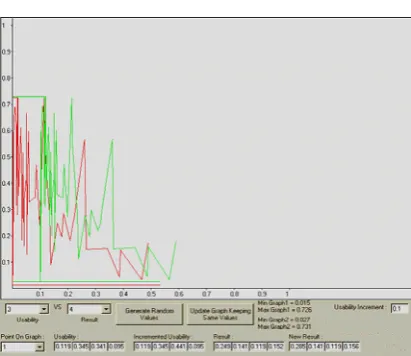
A Usability calculator has been developed in Visual Basic which will be helpful in calculating the end user usability values after each incremental value that is selected from a survey conducted among different groups of end users. The enhanced usability design attributes and the user goal attributes are shown in Figures 3 and 4. A single unit of software usability measurement can be found out as the product of all the elements of the goal matrix as for a fixed period of use time by a specified user group.
Enhanced Usability = Effectiveness x Satisfaction x Productivity x Safety x Easiness
Annexure includes the type and the nature of questions asked to a group of professional developers, students and end users of different commercial software products and their satisfaction has been scaled to a maximum weightage of 0.1 improvements in each case.
As a sample case,
U * Q = G ---(1) where U,Q,G are,
U = [ understandability learnability operability attractiveness ] *
accuracy maturity time-bound Q = suitability fault-tolerance behaviour
inter-operability recordability resource security availability utilisation
analisability adaptability changability installability
stability co-existance
testability replaceability
G = [ effectiveness productivity safety satisfaction confidence ] By giving random values to all the attributes,
U = [0.2 0.2 0.4 0.2]
0.2 0.2 0.4 0.6 0.3 Q = 0.4 0.6 0.1 0.1 0.2 0.2 0.1 0.4 0.1 0.2 0.2 0.1 0.1 0.2 0.3
As per equation (1), that is G = U*Q
G = 0.2400 0.2200 0.2800 0.2200 0.2400 The single metric for usability is the products of all the elements in G matrix, that is 0.00078
By incrementing understandability value by 0.1 ,
U* * Q = G* ---(2)
U* = [0.3 0.2 0.4 0.2]
Q = 0.2 0.2 0.4 0.6 0.3 0.4 0.6 0.1 0.1 0.2 0.2 0.1 0.4 0.1 0.2 0.2 0.1 0.1 0.2 0.3
As per equation (2), that is G* = U* * Q G* = 0.2600 0.2400 0.3200 0.2800 0.2700
[image:4.595.315.528.358.524.2]The enhanced goal attributes are given in G matrix. The single enhanced usability metric is the product of all the elements in G matrix, that is 0.001509. As per the survey results the usability is enhanced if the understandability of the software due to the factors depending on devices and physical architecture. The Relationship between enhanced usability factors and the modified goal factors are shown in Figure 3 to 6.
Figure 3 Understandability versus End user Satisfaction
[image:4.595.319.525.570.748.2]Figure 5 Operability versus Satisfaction
Figure 6 Attractiveness versus Confidence
VII. CONCLUSION
The usability evaluation has been carried over and a new matrix model of enhanced end user usability attributes has been achieved. The usability attributes are given sample increments from the survey conducted and the relationship between the final goals attributes and enhanced usability attributes are shown in various graphs. A graphical simulator has been developed to find the various usability attributes of the end user. The single unit of software usability is also proposed incorporating all the factors regarding the environment, devices of computation and the information interface as per the context of usage of the product.
R
EFERENCES[1] Roger S.Pressman, Software Engineering – A Practitioner’s Approach, Software Engineering Series, McGraw –Hill International Edition,1997.
[2] Peter Tandler,”Software Infrastructure for Ubiquitous Computing Environments supporting synchronous collaboration with multiple single-and multi-user device”, Proceedings of UBICOMP 2001: Lecture Notes in Computer Science, Heidelberg: Springer.
[3] John.M.Carroll,“Human-Computer Interaction in the New Millennium”, Boston: Addison-Wesley, 2002 [4] E.Chang, T.S. Dillon, and D.Cook, “Measurement of
usability of software using a fuzzy system approach “,in Invited Key Note Paper Proc. 8th Int Conf. Software Engineering and Knowledge Engineering, Lake Tahoe, NV, 1996, pp.69-76.