Event Coreference Resolution by Iteratively Unfolding Inter-dependencies
among Events
Prafulla Kumar Choubey and Ruihong Huang Department of Computer Science and Engineering
Texas A&M University
(prafulla.choubey, huangrh)@tamu.edu
Abstract
We introduce a novel iterative approach for event coreference resolution that grad-ually builds event clusters by exploiting inter-dependencies among event mentions within the same chain as well as across event chains. Among event mentions in the same chain, we distinguish within- and cross-document event coreference links by using two distinct pairwise classifiers, trained separately to capture differences in feature distributions of within- and cross-document event clusters. Our event coref-erence approach alternates between WD and CD clustering and combines argu-ments from both event clusters after ev-ery merge, continuing till no more merge can be made. And then it performs fur-ther merging between event chains that are both closely related to a set of other chains of events. Experiments on the ECB+ corpus show that our model outper-forms state-of-the-art methods in joint task of WD and CD event coreference resolu-tion.
1 Introduction
Event coreference resolution is the task of iden-tifying event mentions and clustering them such that each cluster represents a unique real world event. The capability of resolving links among co-referring event identities is vital for information aggregation and many NLP applications, includ-ing topic detection and trackinclud-ing, information ex-traction, question answering and text summariza-tion (Humphreys et al., 1997; Allan et al., 1998;
Daniel et al., 2003; Narayanan and Harabagiu,
2004;Mayfield et al., 2009;Zhang et al., 2015). Yet, studies on event coreference are few
com-pared to the well-studied entity coreference reso-lution.
Event mentions that refer to the same event can occur both within a document (WD) and across multiple documents (CD). One common practice (Lee et al., 2012) to approach CD coreference task is to resolve event coreference in a mega-document created by concatenating topic-relevant documents, which essentially does not distinguish WD and CD event links.
However, intuitively, recognizing CD corefer-ent evcorefer-ent pairs requires stricter evidence com-pared to WD event linking because it is riskier to link two event mentions from two distinct docu-ments rather than the same document. In a per-fect scenario where all WD event mentions are properly clustered and their participants and argu-ments are combined within a cluster, CD cluster-ing can be performed with ease as sufficient ev-idences are collected through initial WD cluster-ing. Therefore, another very common practice for event coreference is to first group event mentions within a document and then group WD clusters across documents (Yang et al.,2015).
Nonetheless, WD coreference chains are equally hard to resolve. Event mentions in the same document can look very dissimilar (”killed/ VB” and ”murder/ NN”), have event arguments (i.e., participants and spatio-temporal information of an event (Bejan and Harabagiu,2010)) partially or entirely omitted, or appear in distinct contexts compared to their antecedent event mentions, par-tially to avoid repetitions. Under this irresolute state, approaching WD and CD individually is in-competent.
While CD coreference resolution is overall dif-ficult, we observe that some CD coreferent event mentions, especially the ones that appear at the beginning of documents, share sufficient contexts and are relatively easier to resolve. At the same
time, many of them bear sufficient differences that can bring in new information and further lead to more WD merges and consequently more CD merges.
Guided by these observations, we present an event coreference approach that exploits inter-dependencies among event mentions within an event chain both within a document and across documents, by sequentially applying WD and CD merges in an alternating manner until no more merge can be made. We combine argument fea-tures of event mentions after each CD (WD) merge in order to resolve more difficult WD (CD) merges in the following iterations. Furthermore, our model uses two distinct pairwise classifiers that are separately trained with features intrinsic to each type. Specifically, the WD classifier uses fea-tures based on event mentions and their arguments while the CD classifier relies on features charac-terizing surrounding contexts of event mentions as well.
We further exploit second-order inter-dependencies across event clusters in order to resolve additional WD and CD coreferent event pairs. Intuitively, if two event mentions are related to the same set of events, it is likely that the two event mentions refer to the same real world event, even when their word forms and local contexts are distinct. Specifically, we merge event clusters if their event mentions are tightly associated (i.e., having the same dependency relations) or loosely associated (i.e., co-occurring in the same sentential context) with enough (i.e., passing a threshold) other events that are known coreferent. Experimental results on the benchmark event coreference dataset, ECB+ (Cybulska and Vossen,
2014b,a), show that our model extensively ex-ploits inter-dependencies between events and out-performs the state-of-the-art methods for both WD and CD event coreference resolution.
2 Related Work
Different approaches, focusing on either of WD or CD coreference chains, have been proposed for event coreference resolution. Works specific to WD event coreference includes pairwise classi-fiers (Ahn, 2006;Chen et al.,2009) graph based clustering method (Chen and Ji, 2009), informa-tion propagainforma-tion (Liu et al., 2014), and markov logic networksLu et al. (2016). As to only CD event coreference, Cybulska and Vossen (2015a)
created pairwise classifiers using features indicat-ing granularities of event slots and in another work (2015b), grouped events based on compatibilities of event contexts.
Like this work, several studies have consid-ered both WD and CD event coreference resolu-tion task together. However to simplify the prob-lem, they (Lee et al.,2012;Bejan and Harabagiu,
2010,2014) created a meta-document by concate-nating topic-relevant documents and treated both as an identical task. Most recently, Yang et al.
(2015) applied a two-level clustering model that first groups event mentions within a document and then groups WD clusters across documents in a joint inference process. Our approach advances these works and emphasizes on different natures of WD and CD clusters along with the benefits of distinguishing WD merges from CD merges and exploiting their mutual dependencies.
Iterative models, in general, have been applied to both entity coreference resolution (Singh et al.,
2009;Clark and Manning, 2015, 2016;Wiseman et al.,2016) and prior event coreference resolution (Lee et al., 2012) works, which gradually build clusters and enable later merges to benefit from earlier ones. Especially, Lee et al. (2012) used an iterative model to jointly build entity and event clusters and showed the advantages of information flow between entity and event clusters through se-mantic role features. Our model, by alternating be-tween WD and CD merges, allows the multi-level flow of first order interdependencies. Moreover, additional cross cluster merges based on 2nd order interdependencies effectively exploits the seman-tic relations among events, in contrast to only se-mantic roles (between events and arguments) used in previous work.
3 System Overview and A Worked Example
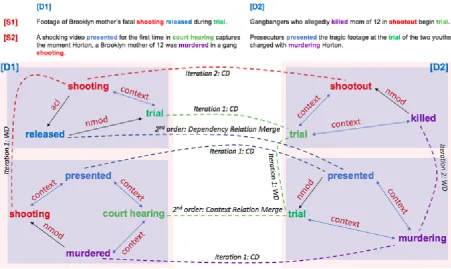
Figure 1: An example of Event Coreference using the iterative two stage model. All event mentions are boldfaced; solid arrow line between event mentions show second order relations between them; dashed lines link coreferent event mentions and are tagged with the type of merge.
within a cluster after each merge operation. In the second stage, it explores second order relations across event clusters w.r.t context event mentions in order to carefully generate candidate event clus-ters and perform further merging.
The example in Figure 1 illustrates the two stages of our proposed approach. It shows two iterations of WD and CD merges. In iteration 1, relatively easy coreferent event mentions were linked, including the two shooting and two trial event mentions in doc1 and doc2 as well as the
event mentionspresented,trialandmurderacross the two documents. Argument propagation was conducted after each merge and murder’s argu-ment ”mother of 12” in doc1 is combined with
the murderevent in doc2 after iteration 1. Then in iteration 2, more merges were made by rec-ognizing additional coreferent event mentions in-cluding event mentions in one document (e.g., murdering and killed in doc2) and event
men-tions across the two documents (e.g., shooting in
doc1 andshootout in doc2). Next, two additional merges were made by leveraging second-order inter-dependencies. Specifically, both the event mentions releasedindoc1 andpresentedin doc2
are in the same dependency relation (“nmod”)
with a mention of thetrialevent cluster, therefore, a new merge was made between clusters contain-ing the two mentions. Followcontain-ing this, the event mentionscourt hearing indoc1 andtrial indoc2
were identified to have multiple coreferent events in their sentential contexts, therefore, the clusters containing these two event mentions were merged as well.
4 Detailed System Description:
Exploiting Interdependencies between Events
4.1 Document Clustering
Our approach starts with a pre-processing step that clusters input documents (D) into a set of docu-ment clusters (C). This is meant to reduce search space and mitigate errors (Lee et al., 2012). In our experiments, we used the Affinity Propaga-tion algorithm (Buitinck et al.,2013) ontf−idf
dataset (Cybulska and Vossen,2014b,a). This is consistent with the prior study (Lee et al., 2012) on the related ECB dataset (Bejan and Harabagiu,
2010)1, which shows that document clustering in
the ECB dataset is trivial.
Algorithm 1:
input: set of DocumentsD
Within-Document Classifier:ΘWD Cross-Document Classifier:ΘCD
// clusters of event mentions
1 EM={}
// clusters of Documents 2 C= ClusterDocument(D)
3 for eachdocument clustercinCdo 4 EM0={Singleton Clusters}
// Iterative WD and CD Merging 6 whileiteratedo
7 iterate=False
8 for each two clusters E1, E2 ∈ EM0
s.t. ∃e1 ∈ E1, e2 ∈ E2, (e1, e2) ∈ a Doc, and
score(ΘWD, e1, e2)>0.60do 9 Merge(E1, E2,EM0) 10 iterate=True
11 if notiteratebreak 12 iterate=False
13 for each two clusters E1, E2 ∈ EM0 s.t. ∃e1 ∈ E1, e2 ∈ E2, (e1, e2) ∈/ a Doc, and
score(ΘCD, e1, e2)>0.90do 14 Merge(E1, E2,EM0)
15 iterate=True
// Exploiting Second-Order
Inter-dependencies Across Event Chains
16 while ∃ two clusters E1, E2 ∈ EM0 s.t. GovernorModifierRelated(E1, E2,ΘCD)do
17 EM0= Merge(E1, E2,EM0)
18 while ∃ two clusters E1, E2 ∈ EM0 s.t. ContextSimilarity(E1, E2,ΘCD)do
19 EM0= Merge(E1, E2,EM0)
20 EM=EM+EM0
21 output:EM
4.2 Iterative WD and CD Merging
We iteratively conduct WD merges and CD merges until no more merge can be done. We train pairwise classifiers for identifying event clusters to merge. Specifically for WD merges as indi-cated in lines 8-10 in Algorithm 1, we iteratively go through pairs of clusters that contain a pair
1The ECB+ dataset is an extended version of the ECB dataset. Both datasets have documents for the same 43 topics.
of within-document event mentions, one mention from each cluster. If the similarity score between the two event mentions is above a tuned threshold of0.62, we merge the two clusters. Similarly, for
CD merges described in lines 13-15 of Algorithm 1, we iteratively go through pairs of clusters that contain a pair of cross-document event mentions and merge the two clusters if the similarity score between the two event mentions is above another tuned threshold of 0.9 3. Following each cluster
pair merge, arguments are combined for the two merged clusters.
4.3 Merging by Exploiting Second-Order Inter-dependencies Across Event Chains
Intuitively, two event mentions that share events in their contexts are likely to be coreferent. Simi-larly, if their context events are coreferent, the two events are likely to be coreferent as well.
First, if two event mentions are in the same dependency relation with two other event mentions that are known coreferent, then the first two event mentions are likely to de-scribe the same real world event as well. In steps 16-17 of Algorithm 1, we perform event cluster merges by collecting evidence pertain-ing to dependency relations. The subrou-tineGovernorModifierRelated(E1, E2,ΘCD) checks whether two event mentions e1 and e2, from clustersE1 and E2 respectively, have a
re-lated evente3 from another clusterE3, such that E3 ∈ {/ E1, E2} and pairs (e1, e3),(e2, e3) are linked with the same dependency relation. Note that observing shared event mentions in the con-texts will increase the likelihood that the two event mentions are coreferent, but we can not suffi-ciently infer the coreference relation yet, we still need to look at features describing the event men-tions. Therefore, if the condition was satisfied, the subroutine eventually makes merges based on the CD confidence score assigned to the event pair (e1, e2)but using a lower threshold of0.8.
In addition, seeing coreferent event mentions in the sentential contexts of two events will increase the likelihood that the two events are coreferent as well. Then as shown in steps 18-19, we
fur-2all tunings are performed on Validation dataset (topics 23-25)
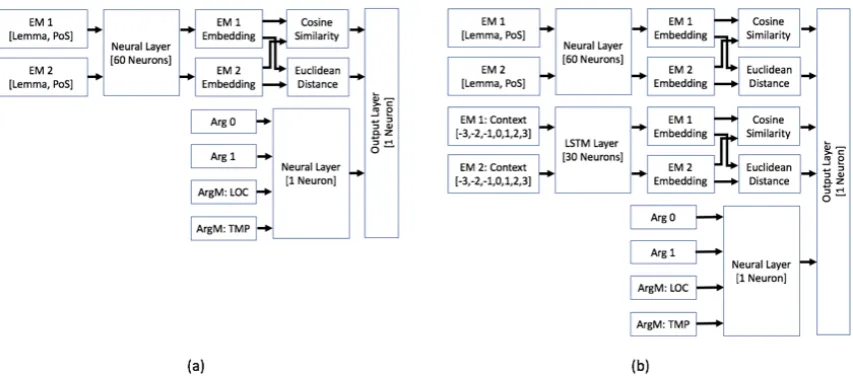
Figure 2: Pairwise Classifiers for resolving (a) Within-Document Coreference Links (b) Cross-Document Coreference Links.EM: event mentions;Arg0, Arg1, ArgM:LOC, ArgM:TMP: semantic roles.
ther use context events co-occurring in the same sentence as another parameter to perform addi-tional clustering. SubroutineContextSimilarity
(E1, E2,ΘCD) generates a context vector (CV) for each event cluster and check whether cosine sim-ilarity between context vectors of two clustersE1
andE2(cos(CV~1, ~CV2)) is above0.7. Specifically, we definecontext clustersfor an event mention as the different event clusters that have event men-tions co-occurring in the same sentence. Then the context vector of an event cluster has an entry for each of its context clusters, with the value to be the number of sentences where event mentions from the two clusters co-occur. This subroutine also makes merges based on the CD confidence score using the same lower threshold of0.8.
5 Distinguishing WD and CD Merging We implement two distinct pairwise classifiers to effectively utilize the distributional variations in WD and CD clusters. The first classifier (WD) is used for calculating a similarity between two event mentions within a document and recogniz-ing coreferent event mention pairs. The second classifier (CD) is used for calculating a similar-ity between two event mentions across two doc-uments and then identifying coreferent event men-tion pairs across documents. Both classifiers were implemented as neural nets (Chollet,2015). The architectures of the two classifiers are shown in Figure2.
WD Classifier: the neural network based WD classifier essentially inherits the features that have
been shown effective in previous event corefer-ence studies (Ahn,2006;Chen et al., 2009), in-cluding both features for event words and fea-tures for their arguments. Specifically, the classi-fier includes a common neural layer shared by two event mentions to embed event lemma and parts-of-speech features. Then the classifier calculates cosine similarity and euclidean distance between two event embeddings, one per event mention. In addition, the classifier includes a neural layer com-ponent to embed event arguments that are over-lapped between the two event mentions. Its out-put layer takes the calculated cosine similarity and euclidean distance between event mention embed-dings as well as the embedding of the overlapped event arguments as input, and output a confidence score to indicate the similarity of the two event mentions.
embed-dings and event word embedembed-dings, as well as the embedding of the overlapped event arguments as input, and further calculate a confidence score indicating the similarity of two event mentions across documents.
5.1 Characteristics of WD and CD Event Linking
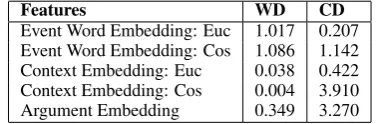
In order to further understand characteristics of within- and cross-document event linking, we trained two classifiers having the same CD clas-sifier architecture (Figure 2(b)) but with differ-ent sets of evdiffer-ent pairs, within-documdiffer-ent or cross-document event pairs, then analyzed the impacts of features on each type of event linking by com-paring the neural net learned weights for each fea-ture. Table 1 shows the comparisons of feature weights.
Features WD CD
[image:6.595.86.275.316.378.2]Event Word Embedding: Euc 1.017 0.207 Event Word Embedding: Cos 1.086 1.142 Context Embedding: Euc 0.038 0.422 Context Embedding: Cos 0.004 3.910 Argument Embedding 0.349 3.270
Table 1: Comparisons of Feature Weights Learned Using In-doc or Cross-doc Coreferent Event Pairs, Euc: Euclidean Distance, Cos: Co-sine Similarity
We can see that within-document event linking mainly relies on the euclidean distance and co-sine similarity scores calculated using event word features, with a reasonable amount of weight as-signed to overlapped arguments’ embedding as well. However, only very small weights were as-signed to the similarity and distance scores calcu-lated using context embeddings. In contrast, in the classifier trained with cross-doc coreferent event mention pairs, the highest weight was assigned to the cosine similarity score calculated using con-text embeddings of two event mentions. Addi-tionally, both the cosine similarity score calculated using event word embeddings and the overlapped argument features were assigned high weights as well. The comparisons clearly demonstrate the significantly different nature of WD and CD event coreference.
5.2 Neural Net Classifiers and Training
In both WD and CD classifiers, we use neural net-work layer with 60 neurons for embedding event word features and another layer with 1 neuron
for embedding argument features. Additionally, in CD classifier, we use an LSTM layer with 30 neurons to embed context features. Dropout of 0.25 was applied to both the event word neural net layer and the context layer. We used sig-moid activation function for the dense layers and tanh activation for the LSTM layer. We used 300-dimensional word embeddings and one hot 374
di-mensional pos tag embeddings in all our experi-ments. Therefore, input to word embedding layer is a 337-dimensional vector and to LSTM layer is 300*7 dimensional vectors.
We train both classifiers using the ECB+ cor-pus (Cybulska and Vossen,2014b,a). We train the WD classifier using all pairs of WD event men-tions that are in an annotated event chain as pos-itive instances and using all pairs of WD event mentions that are not in an annotated event chain as negative instances. However, there are signif-icantly more CD coreferent event mention pairs annotated in the ECB+ corpus, therefore, we ran-domly sampled 70% of all the CD coreferent event mention pairs as positive instances and randomly sampled from non-coreferent CD event mention pairs as negative instances. Specifically, number of negative instances are kept 5 times of positive instances.
Note that the pairwise classifiers will be used throughout the iterative merging stage. However, after each merge, argument propagation is con-ducted to enrich features for each event mention in the merged cluster and the number of arguments of an event mention will grow after several merges. In order to account for the growing number of ar-guments in iterative merging, we augment argu-ments for each event mention in training instances with arguments derived from other event mentions in the same pair. The augmenting was performed randomly for only 50% of event mentions.
6 Evaluation
We perform all the experiments on the ECB+ corpus (Cybulska and Vossen, 2014b,a), which is an extension to the earlier EventCorefBank (ECB) (Bejan and Harabagiu, 2010) dataset. We have adopted the settings used in Yang et al.
(2015). We divide the dataset into training set (topics 1-20), validation set (topics 21-23) and test
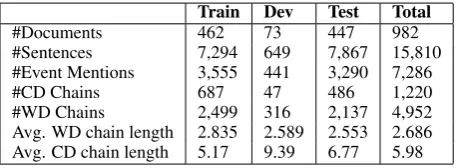
set (topics 24-43). Table2shows the distribution of the corpus.
Train Dev Test Total
#Documents 462 73 447 982
#Sentences 7,294 649 7,867 15,810 #Event Mentions 3,555 441 3,290 7,286
#CD Chains 687 47 486 1,220
[image:7.595.72.302.102.186.2]#WD Chains 2,499 316 2,137 4,952 Avg. WD chain length 2.835 2.589 2.553 2.686 Avg. CD chain length 5.17 9.39 6.77 5.98
Table 2: ECB+ Corpus Statistics.
We used event mentions identified by CRF based event extractor used in Yang et al.
(2015) and extracted event arguments by apply-ing state-of-the-art semantic role labelapply-ing system (SwiRL (Surdeanu et al., 2007)). In addition, we used the Stanford parser (Chen and Manning,
2014) for generating dependency relations, parts-of-speech tags and lemmas. We use pre-trained Glove vectors (Pennington et al.,2014)5for word
representation and one-hot vectors for parts-of-speech tags.
We evaluate our model using four commonly adopted event coreference evaluation metrics, namely, MUC (Vilain et al., 1995), B3 (Bagga
and Baldwin, 1998), CEAFe (Luo, 2005) and
CoNLL F1(Pradhan et al., 2014). We used the publicly available official implementation of re-vised coreference scorer (v8.01).6
6.1 Baseline Systems
We compare our iterative event coreference reso-lution model with five baseline systems.
LEMMA: The Lemma match baseline links event mentions within- or cross- documents which have the same lemmatized head word. It is often considered a strong baseline for this task.
HDDCRP (Yang et al.,2015): The second base-line is the supervised Hierarchical Distance De-pendent Bayesian Model, the most recent event coreference system evaluated on the same ECB+ dataset. This model uses distances between event mentions, generated using a feature-rich learnable distance function, as Bayesian priors for single pass non-parametric clustering.
HDP-LEX7: A reimplementation of the
unsu-pervised hierarchical bayesian model by Bejan 5Trained on 840 billion tokens of Common Crawl data, http://nlp.stanford.edu/projects/glove/
6https://github.com/conll/reference-coreference-scorers 7The results were taken from the paperYang et al.(2015).
and Harabagiu(2010,2014).
Agglomerative7: A Reimplementation of
two-step agglomerative clustering model, WD cluster-ing followed by CD clustercluster-ing (Chen et al.,2009). We have trained our systems using the same ECB+ dataset and the same set of event mentions as these prior systems.
6.2 Our Systems
We evaluate several variation systems of our pro-posed model.
Common Classifier (WD or CD): the system implementing only the first stage of iterative WD & CD merging. In addition, the same neural net classifier with the architecture as shown in Figure 2(a) (the WD classifier) or in Figure 2(b) (the CD classifier) was applied for both WD and CD merg-ing. The neural net classifiers were trained using all coreferent event mention pairs including both within-document and cross-document ones.
WD and CD Classifiers: distinguishes WD from CD merges by using two distinct classifiers (Fig-ure 2(a), 2(b)) in the first stage of the algorithm.
+ 2nd Order Relations: after iterative WD and CD merges within each individual chain as sug-gested by pairwise classifiers (the first stage), fur-ther merges (the second stage) were conducted leveraging second order event inter-dependencies across event chains.
6.3 Results
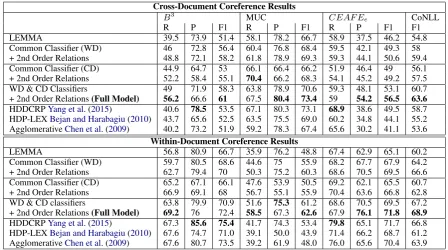
Table 3 shows the comparison results for both within-document and cross-document event coref-erence resolution. In the first stage of iterative merging, using two distinct WD and CD classifiers for corresponding WD and CD merges yields clear improvements for both WD and CD event coref-erence resolution tasks, compared with using one common classifier for both types of merges. In addition, the second stage of iterative merging fur-ther improves both WD and CD event coreference resolution performance stably by leveraging sec-ond order event inter-dependencies. The improve-ments are consistent when measured using various coreference resolution evaluation metrics.
Cross-Document Coreference Results
B3 MUC CEAF E
e CoNLL
R P F1 R P F1 R P F1 F1
LEMMA 39.5 73.9 51.4 58.1 78.2 66.7 58.9 37.5 46.2 54.8
Common Classifier (WD) 46 72.8 56.4 60.4 76.8 68.4 59.5 42.1 49.3 58 + 2nd Order Relations 48.8 72.1 58.2 61.8 78.9 69.3 59.3 44.1 50.6 59.4 Common Classifier (CD) 44.9 64.7 53 66.1 66.4 66.2 51.9 46.4 49 56.1 + 2nd Order Relations 52.2 58.4 55.1 70.4 66.2 68.3 54.1 45.2 49.2 57.5 WD & CD Classifiers 49 71.9 58.3 63.8 78.9 70.6 59.3 48.1 53.1 60.7 + 2nd Order Relations(Full Model) 56.2 66.6 61 67.5 80.4 73.4 59 54.2 56.5 63.6 HDDCRPYang et al.(2015) 40.6 78.5 53.5 67.1 80.3 73.1 68.9 38.6 49.5 58.7 HDP-LEXBejan and Harabagiu(2010) 43.7 65.6 52.5 63.5 75.5 69.0 60.2 34.8 44.1 55.2 AgglomerativeChen et al.(2009) 40.2 73.2 51.9 59.2 78.3 67.4 65.6 30.2 41.1 53.6
Within-Document Coreference Results
LEMMA 56.8 80.9 66.7 35.9 76.2 48.8 67.4 62.9 65.1 60.2
[image:8.595.74.523.61.311.2]Common Classifier (WD) 59.7 80.5 68.6 44.6 75 55.9 68.2 67.7 67.9 64.2 + 2nd Order Relations 62.7 79.4 70 50.3 75.2 60.3 68.6 70.5 69.5 66.6 Common Classifier (CD) 65.2 67.1 66.1 47.6 53.9 50.5 69.2 62.1 65.5 60.7 + 2nd Order Relations 66.9 69.1 68 56.7 55.1 55.9 70.4 63.6 66.8 62.8 WD & CD classifiers 63.8 79.9 70.9 51.6 75.3 61.2 68.6 70.5 69.5 67.2 + 2nd Order Relations(Full Model) 69.2 76 72.4 58.5 67.3 62.6 67.9 76.1 71.8 68.9 HDDCRPYang et al.(2015) 67.3 85.6 75.4 41.7 74.3 53.4 79.8 65.1 71.7 66.8 HDP-LEXBejan and Harabagiu(2010) 67.6 74.7 71.0 39.1 50.0 43.9 71.4 66.2 68.7 61.2 AgglomerativeChen et al.(2009) 67.6 80.7 73.5 39.2 61.9 48.0 76.0 65.6 70.4 63.9
Table 3: Within- and cross-document event coreference result on ECB+ Corpus.
7 Discussion and Analysis
Cross-Document Coreference Results
Fmeasure B3 MUC CEAF Ee CoNLL
1 Iteration 56 69.3 50.3 58.5 2 Iterations 57.9 69.9 52.4 60.1 3 Iterations 58.3 70.6 53.1 60.7
Within-Document Coreference Results 1 Iteration 69.7 55.8 68.8 64.8 2 Iterations 70.2 60.3 69.4 66.6 3 Iterations 70.9 61.2 69.5 67.2
Table 4: Per-iteration Performance Analysis for the First Stage of Iterative WD & CD Merging.
Stage I: The first stage of our algorithm, itera-tive WD and CD merging, went for three iterations (See Table4). Our analysis of merges in each iter-ation shows that most of the merges in the initial it-eration are between event mentions with the same lemma or shared arguments. In the second and third iterations, more merges were between event mentions with synonymous lemmas or shared ar-guments that have been accumulated in previous iterations. Example merges between synonymous event mentions include(nominate, nominations), (die, death),(murder, killing),(hit, strike),(attack, bomb)etc.
Stage II: It is even more intriguing to discuss the clusters that were merged in stage 2 of merg-ing, that leverages second order event interdepen-dencies across event chains. We found that
al-most all of the 81 merges happening in the second stage are between event mentions that are quite dissimilar including (take over, replace), (unveil, announce), (win, victory, comeback), (downtime, problem, outage), (cut, damage), (spark, trigger) etc. Most interestingly, two event pairs which are antonymous to each other,(win, beat)and(defeat, victory), were also correctly merged.
Errors: while our iterative algorithm has gradu-ally resolved coreference relations between event mentions that are synonyms or distant by sur-face forms, many coreference links were over-looked and many unrelated events were wrongly predicted as coreferential. We analyzed our sys-tem’s final predictions in order to identify the most common sources of errors.
[image:8.595.78.285.383.484.2]men-tions, including event words and event arguments, in resolving the coreference relation. For these event mentions having few arguments identified, the iterative algorithm may get stuck from the be-ginning.
While it is a grand challenge to further re-solve coreferential relations between event men-tions that do not have sufficient local features, these missed coreference links easily break a long and influential event chain into several sub-chains, which makes event coreference resolution results less useful for many potential applications, such as text summarization.
Wrongly Predicted Coreference Links: The majority of this type of errors are between non-coreferent event mentions that have the same lemma. This is especially common among report-ing event mentions and light verb mentions. For instance, we found that 24 non-coreferent event clusters corresponding to reporting events, e.g., said, told and reported, and 13 non-coreferent clusters corresponding to light verbs, e.g., take, giveandget, were incorrectly merged by the sys-tem.
8 Conclusions and Future Work
We presented a novel approach for event coref-erence resolution that extensively exploits event inter-dependencies between event mentions in the same chain and event mentions across chains. The approach iteratively conducts WD and CD merges followed by further merges leveraging sec-ond order event inter-dependencies across chains. We further distinguish WD and CD merges using two distinct classifiers that capture differences of within- and cross-document event clusters in fea-ture distributions. Our system was shown effec-tive in both WD and CD event coreference and has outperformed the previous best event coreference system in both tasks.
Note that our approach is flexible to incorpo-rate different stincorpo-rategies for conducting WD and CD merges. In the future, we plan to continue to investigate the distinct characteristics of WD and CD coreferent event mentions in order to fur-ther improve event coreference performance. Es-pecially, we are interested in including additional discourse-level features for improving WD coref-erence merge performance, such as, features indi-cating the distance between two event mentions in a document.
Acknowledgments
We want to thank our anonymous reviewers for providing insightful review comments.
References
David Ahn. 2006. The stages of event extraction. In
Proceedings of the Workshop on Annotating and Reasoning about Time and Events, pages 1–8. As-sociation for Computational Linguistics.
James Allan, Jaime G Carbonell, George Doddington, Jonathan Yamron, and Yiming Yang. 1998. Topic detection and tracking pilot study final report. Amit Bagga and Breck Baldwin. 1998. Algorithms
for scoring coreference chains. In The first
in-ternational conference on language resources and evaluation workshop on linguistics coreference, vol-ume 1, pages 563–566.
Cosmin Adrian Bejan and Sanda Harabagiu. 2010. Un-supervised event coreference resolution with rich linguistic features. InProceedings of the 48th An-nual Meeting of the Association for Computational Linguistics, pages 1412–1422. Association for Com-putational Linguistics.
Cosmin Adrian Bejan and Sanda Harabagiu. 2014.
Un-supervised event coreference resolution.
Computa-tional Linguistics, 40(2):311–347.
Lars Buitinck, Gilles Louppe, Mathieu Blondel, Fabian Pedregosa, Andreas Mueller, Olivier Grisel, Vlad Niculae, Peter Prettenhofer, Alexandre Gramfort, Jaques Grobler, Robert Layton, Jake VanderPlas, Arnaud Joly, Brian Holt, and Ga¨el Varoquaux. 2013. API design for machine learning software:
experi-ences from the scikit-learn project. InECML PKDD
Workshop: Languages for Data Mining and Ma-chine Learning, pages 108–122.
Danqi Chen and Christopher D Manning. 2014. A fast and accurate dependency parser using neural
net-works. InEMNLP, pages 740–750.
Zheng Chen and Heng Ji. 2009. Graph-based event
coreference resolution. InProceedings of the 2009
Workshop on Graph-based Methods for Natural Language Processing, pages 54–57. Association for Computational Linguistics.
Zheng Chen, Heng Ji, and Robert Haralick. 2009. A pairwise event coreference model, feature impact and evaluation for event coreference resolution. In
Proceedings of the workshop on events in emerging text types, pages 17–22. Association for Computa-tional Linguistics.
Franc¸ois Chollet. 2015. Keras. https://github.
com/fchollet/keras.
Kevin Clark and Christopher D Manning. 2016. Im-proving coreference resolution by learning entity-level distributed representations.
Agata Cybulska and Piek Vossen. 2014a. Guidelines for ecb+ annotation of events and their coreference. Technical report, Technical report, Technical Report NWR-2014-1, VU University Amsterdam.
Agata Cybulska and Piek Vossen. 2014b. Using a sledgehammer to crack a nut? lexical diversity and event coreference resolution. InLREC, pages 4545– 4552.
Agata Cybulska and Piek Vossen. 2015a. Translat-ing granularity of event slots into features for event
coreference resolution. In Proceedings of the 3rd
Workshop on EVENTS at the NAACL-HLT, pages 1– 10.
Agata Cybulska and Piek Vossen. 2015b. bag of events approach to event coreference resolution. supervised classification of event templates. IJCLA, page 11.
Naomi Daniel, Dragomir Radev, and Timothy Allison. 2003. Sub-event based multi-document
summariza-tion. InProceedings of the HLT-NAACL 03 on Text
summarization workshop-Volume 5, pages 9–16. As-sociation for Computational Linguistics.
Sepp Hochreiter and J¨urgen Schmidhuber. 1997.
Long short-term memory. Neural computation,
9(8):1735–1780.
Kevin Humphreys, Robert Gaizauskas, and Saliha Az-zam. 1997. Event coreference for information
ex-traction. InProceedings of a Workshop on
Opera-tional Factors in Practical, Robust Anaphora Reso-lution for Unrestricted Texts, pages 75–81. Associa-tion for ComputaAssocia-tional Linguistics.
Heeyoung Lee, Marta Recasens, Angel Chang, Mihai Surdeanu, and Dan Jurafsky. 2012. Joint entity and event coreference resolution across documents. In
Proceedings of the 2012 Joint Conference on Empir-ical Methods in Natural Language Processing and Computational Natural Language Learning, pages 489–500. Association for Computational Linguis-tics.
Zhengzhong Liu, Jun Araki, Eduard H Hovy, and
Teruko Mitamura. 2014. Supervised
within-document event coreference using information
prop-agation. InLREC, pages 4539–4544.
Jing Lu, Deepak Venugopal, Vibhav Gogate, and Vin-cent Ng. 2016. Joint inference for event coreference resolution.
Xiaoqiang Luo. 2005. On coreference resolution
per-formance metrics. In Proceedings of the
confer-ence on Human Language Technology and Empiri-cal Methods in Natural Language Processing, pages 25–32. Association for Computational Linguistics.
James Mayfield, David Alexander, Bonnie J Dorr, Ja-son Eisner, Tamer Elsayed, Tim Finin, Clayton Fink, Marjorie Freedman, Nikesh Garera, Paul McNamee, et al. 2009. Cross-document coreference resolu-tion: A key technology for learning by reading. In
AAAI Spring Symposium: Learning by Reading and Learning to Read, volume 9, pages 65–70.
Srini Narayanan and Sanda Harabagiu. 2004. Ques-tion answering based on semantic structures. In
Proceedings of the 20th international conference on Computational Linguistics, page 693. Association for Computational Linguistics.
Jeffrey Pennington, Richard Socher, and Christopher D Manning. 2014. Glove: Global vectors for word
representation. InEMNLP, volume 14, pages 1532–
1543.
Sameer Pradhan, Xiaoqiang Luo, Marta Recasens, Ed-uard Hovy, Vincent Ng, and Michael Strube. 2014.
Scoring coreference partitions of predicted men-tions: A reference implementation. In Proceed-ings of the 52nd Annual Meeting of the Association for Computational Linguistics (Volume 2: Short Pa-pers), pages 30–35, Baltimore, Maryland. Associa-tion for ComputaAssocia-tional Linguistics.
Sameer Singh, Karl Schultz, and Andrew McCallum. 2009. Bi-directional joint inference for entity reso-lution and segmentation using imperatively-defined
factor graphs. Machine Learning and Knowledge
Discovery in Databases, pages 414–429.
Mihai Surdeanu, Llu´ıs M`arquez, Xavier Carreras, and Pere R Comas. 2007. Combination strategies for semantic role labeling. Journal of Artificial Intel-ligence Research, 29:105–151.
K. Toutanova, D. Klein, C. Manning, and Y. Singer. 2003. Feature-Rich Part-of-Speech Tagging with
a Cyclic Dependency Network. InProceedings of
HLT-NAACL 2003.
Marc Vilain, John Burger, John Aberdeen, Dennis Con-nolly, and Lynette Hirschman. 1995. A
model-theoretic coreference scoring scheme. In
Proceed-ings of the 6th conference on Message
understand-ing, pages 45–52. Association for Computational
Linguistics.
Sam Wiseman, Alexander M Rush, and Stuart M Shieber. 2016. Learning global features for
coref-erence resolution. InProceedings of NAACL-HLT,
pages 994–1004.
Bishan Yang, Claire Cardie, and Peter Frazier. 2015. A hierarchical distance-dependent bayesian model for
event coreference resolution. Transactions of the
Association for Computational Linguistics, 3:517– 528.
Tongtao Zhang, Hongzhi Li, Heng Ji, and Shih-Fu Chang. 2015. Cross-document event corefer-ence resolution based on cross-media features. In