Learning How to Conjugate the Romanian Verb. Rules for Regular and
Partially Irregular Verbs
Liviu P. Dinu
Faculty of Mathematics and Computer Science University of Bucharest [email protected]
Vlad Niculae
Faculty of Mathematics and Computer Science University of Bucharest
Octavia-Maria S,ulea
Faculty of Foreign Languages and Literatures
Faculty of Mathematics and Computer Science University of Bucharest [email protected]
Abstract
In this paper we extend our work described in (Dinu et al., 2011) by adding more con-jugational rules to the labelling system in-troduced there, in an attempt to capture the entire dataset of Romanian verbs ex-tracted from (Barbu, 2007), and we em-ploy machine learning techniques to predict a verb’s correct label (which says what con-jugational pattern it follows) when only the infinitive form is given.
1 Introduction
Using only a restricted group of verbs, in (Dinu et al., 2011) we validated the hypothesis that pat-terns can be identified in the conjugation of the Romanian (partially irregular) verb and that these patterns can be learnt automatically so that, given the infinitive of a verb, its correct conjugation for the indicative present tense can be produced. In this paper, we extend our investigation to the whole dataset described in (Barbu, 2008) and at-tempt to capture, beside the general ending pat-terns during conjugation, as much of the phono-logical alternations occuring in the stem of verbs (apophony) from the dataset as we can.
Traditionally, Romanian has received a Latin-inspired classification of verbs into 4 (or some-times 5) conjugational classes based on the ending of their infinitival form alone (Costanzo, 2011). However, this infinitive-based classification has proved itself inadequate due to its inability to ac-count for the behavior of partially irregular verbs (whose stems have a smaller number of allo-morphs than the completely irregular) during their conjugation.
There have been, thus, numerous attempts throughout the history of Romanian Linguistics
to give other conjugational classifications based on the way the verb actually conjugates. Lom-bard (1955), looking at a corpus of 667 verbs, combined the traditional 4 classes with the way in which the biggest two subgroups conjugate (one using the suffix ”ez”, the other ”esc”) and ar-rived at 6 classes. Ciompec (Ciompec et. al., 1985 in Costanzo, 2011) proposed 10 conjuga-tional classes, while Felix (1964) proposed 12, both of them looking at the inflection of the verbs and number of allomorphs of the stem. Romalo (1968, p. 5-203) produced a list of 38 verb types, which she eventually reduced to 10.
For the purpose of machine translation, Moisil (1960) proposed 5 regrouped classes of verbs, with numerous subgroups, and introduced the method of letters with variable values, while Pa-pastergiou et al. (2007) have recently developed a classification from a (second) language acquisi-tion point of view, dividing the 1st and 4th tradi-tional classes into 3 and respectively 5 subclasses, each with a different conjugational pattern, and offering rules for alternations in the stem.
Of the more extensive classifications, Barbu (2007) distinguished 41 conjugational classes for all tenses and 30 for the indicative present alone, covering a whole corpus of more that 7000 con-temporary Romanian verbs, a corpus which was also used in the present paper. However, her classes were developed on the basis of the suf-fixes each verb receives during conjugation, and the classification system did not take into account the alternations occuring in the stem of irregular and partially irregular verbs. The system of rules presented below took into account both the end-ings pattern and the type of stem alternation for each verb.
pre-dict the labels.
2 Approach
The problem which we are aiming to solve is to determine how to conjugate a verb, given its in-finitive form. The traditional inin-finitive-based clas-sification taught in school does not take one all the way to solving this problem. Many conjugational patterns exist within each of these four classes.
2.1 Labeling the dataset
Following our own observations, the alternations identified in (Papastergiou et al., 2007) and the classes of suffix patterns given in (Barbu, 2007), we developed a number of conjugational rules which were narrowed down to the 30 most pro-ductive in relation to the dataset. Each of these 30 rules (or patterns) contains 6 regular expres-sions through which the rule models how a (dif-ferent) type of Romanian verb conjugates in the indicative present. They each consist of 6 reg-ular expressions because there are three persons (first, second, and third) times two numbers (sin-gular and plural).
Rule 10, for example, models, as stated in the list that follows, how verbs of the type ”a cˆanta” (to sing) conjugate in the indicative present, by having the first regular expression model the first person singular form ”(eu) cˆant” (in regular expression format: ˆ(.+)$), the sec-ond, model the second person singular form ”(tu) cˆant¸i” (ˆ(.+)t¸i$), the third, model the third per-son singular form ”(ei) cˆant˘a” (ˆ(.+)˘a$), and so forth. Thus, rule 10 catches the alternation t→t¸ for the 2nd person singular, while modelling a particular type of verb class with a particular set of suffixes. Note that the dot accepts any letter in the Romanian alphabet and that, for each of the six forms, the value of the capturing groups (those between brackets) remains constant, in this casecˆan. These groups correspond to all parts of the stem that remain unchanged and ensure that, given the infinitive and the regular expressions, one can work backwards and produce the correct conjugation.
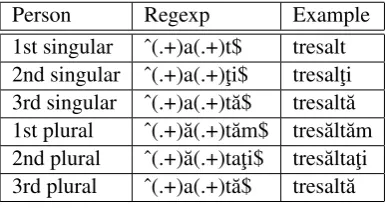
For a clearer understanding of one such rule, Table 1 shows an example of how the verb ”a tres˘alta” is modeled by rule 14.
Below, we list all the rules used, with the stem alternations they capture and an example of a verb
Person Regexp Example
[image:2.595.317.510.62.168.2]1st singular ˆ(.+)a(.+)t$ tresalt 2nd singular ˆ(.+)a(.+)t¸i$ tresalt¸i 3rd singular ˆ(.+)a(.+)t˘a$ tresalt˘a 1st plural ˆ(.+)˘a(.+)t˘am$ tres˘alt˘am 2nd plural ˆ(.+)˘a(.+)tat¸i$ tres˘altat¸i 3rd plural ˆ(.+)a(.+)t˘a$ tresalt˘a
Table 1: Rule 14 modelling ”a tres˘alta”
that they model. Note that, when we say (no) al-ternation, we mean (no) alternation in the stem. So the difference between rules 1, 20, 22, and the sort lies in the suffix that is added to the stem for each verb form. They may share some suf-fixes, but not all and/or not for the same person and number.
1. no alternation; ”a spera” (to hope);
2. alternation: ˘a→e for the 2nd person singular; ”a num˘ara” (to count);
3. no alternation; ”a intra” (to enter), stem ends in ”tr”, ”pl”, ”bl” or ”fl” which determines the addition of ”u” at the end of the 1st per-son singular form;
4. alternation: it lacks t→t¸ for the 2nd person singular, which otherwise normally occurs; ”a mis¸ca” (to move), stem ends in ”s¸ca”;
5. no alternation; ”a t˘aia” (to cut), ends in ”ia” and has a vowel before;
6. no alternation; ”a speria” (to scare), ends in ”ia” and has a consonant before;
7. no alternation; ”a dansa” (to dance), conju-gated with the suffix ”ez”;
8. no alternation; ”a copia” (to copy), conju-gated with a modified ”ez” due to the stem ending in ”ia”;
9. altenation c→ch(e) or g→gh(e); ”a parca” (to park), conjugated with ”ez”, ending in ”ca” or ”ga”;
10. alternation: t→t¸ for the 2nd person singular; ”a cˆanta” (to sing);
12. alternation: a→ea for the 3rd person singular and plural, t→t¸ for the 2nd person singular; ”a des¸tepta” (to awake/arouse);
13. alternation: e→ea for the 3rd person singular and plural, t→t¸ for the 2nd person singular; ”a des¸erta” (to empty);
14. alternation: ˘a→a for all the forms except the 1st and 2nd person plural; ”a tres˘alta” (to start, to take fright);
15. alternation: ˘a→a in the 3rd person singular and plural, ˘a→e in the 2nd person singular; ”a desf˘ata” (to delight);
16. alternation: ˘a→a for all the forms except for the 1st and 2nd person plural; ”a p˘area” (to seem);
17. alternation: d→z for the 2nd person singu-lar due to palatalization, along with ˘a→e; ”a vedea” (to see), stem ends in ”d”;
18. alternation: ˘a→a for all forms except the 1st and 2nd person plural, d→z for the 2nd per-son singular due to palatalization; ”a c˘adea” (to fall);
19. no alternation; ”a veghea” (to watch over), conjugates with another type of ”ez” ending pattern;
20. no alternations; ”a merge” (to walk), receives the typical ending pattern for the third conju-gational class;
21. alternation: t→t¸ for the 2nd person singular; ”a promite” (to promise);
22. no alternation; ”a scrie” (to write);
23. alternations: s¸t→sc for the 1st person singu-lar and 3rd person plural; ”a nas¸te” (to give birth), ends in ”s¸te”;
24. alternation: ”n” is deleted from the stem in the 2nd person singular; ”a pune” (to put), ends in ”ne”;
25. alternation: d→z in the 2nd person singular due to palatalization; ”a crede” (to believe), stem ends in ”d”;
26. no alternation; ”a sui” (to climb), ends in ”ui”, ”˘ai”, or ”ˆai”;
27. no alternation; ”a citi” (to read), conjugates with the suffix ”esc” ;
28. this type preserves the ”i” from the infinitive; ”a locui” (to reside), ends in ”˘ai”, ”oi”, or ui” and conjugates with ”esc”;
29. alternation: o→oa in the 3rd person singular and plural; end in ”ˆı”, ”a omorˆı” (to kill);
30. no alternation; ”a hot˘arˆı” (to decide), ends in ”ˆı” and conjugates with ”˘asc”, a variant of ”esc”
2.2 Classifiers and features
Each infinitive in the dataset received a label cor-responding to the first rule that correctly produces a conjugation for it. This was implemented in order to reduce the ambiguity of the data, which was due to some verbs having alternate conjuga-tion patterns. The unlabeled verbs were thrown out, while the labeled ones were used to train and evaluate a classifier.
The context sensitive nature of the alternations leads to the idea that n-gram character windows are useful. In the preprocessing step, the list of in-finitives is transformed to a sparse matrix whose lines correspond to samples, and whose features are the occurence or the frequency of a specific n-gram. This feature extraction step has three free parameters: the maximum n-gram length, the op-tional binarization of the features (taking only bi-nary occurences instead of counts), and the op-tional appending of a terminator character. The terminator character allows the classifier to iden-tify and assign a different weight to the n-grams that overlap with the suffix of the string.
For example, consider the English infinitiveto walk. We will assume the following illustrative values for the parameters: n-gram size of 3 and appending the terminator character. Firstly, a ter-minator is appended to the end, yielding the string
walk$. Subsequently, the string is broken into 1, 2 and 3-grams: w,a,l,k,$,wa,al,lk,k$,wal,alk,
lk$. Next, this list is turned into a vector using a standard process. We have first built a dictionary of all the n-grams from the whole dataset. These, in order, encode the features. The verb(to) walk
rule no. verbs
1 547
2 8
3 18
4 5
5 8
6 16
7 3330
8 273
9 89
10 4
11 5
12 4
13 106
14 13
15 5
rule no. verbs
16 13
17 6
18 4
19 14
20 124
21 25
22 15
23 7
24 41
25 51
26 185
27 1554
28 486
29 5
[image:4.595.100.266.63.280.2]30 27
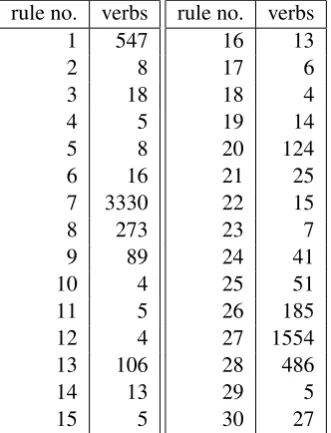
Table 2: Number of verbs captured by each of our rules
features because all of the n-grams of this short verb occur only once. But for a verb such as(to)
tantalize, the feature corresponding to the 2-gram
tawould get a value of 2 in a count reprezentation, but only a value of 1 in a binary one.
The system was put together using the scikit-learn machine scikit-learning library for Python (Pe-dregosa et al., 2011), which provides a fast, scal-able implementation of linear support vector ma-chines based onliblinear(Fan et al., 2008), along with n-gram extraction and grid search function-ality.
3 Results
Tabel 2 shows how well the rules fitted the dataset. Out of 7,295 verbs in the dataset, 349 were uncap-tured by our rules. As expected, the rule capturing the most verbs (3,330) is the one modelling those from the 1st conjugational class (whose infinitives end in ”a”) which conjugate with the ”ez” suffix and are regular, namely rule 7, created for verbs like ”a dansa”. The second largest class, also as expected, is the one belonging to verbs from the 4th conjugational group (whose infinitives end in ”i”), which are regular, meaning no alternation in the stem, and conjugate with the ”esc” suffix. This class is modeled by rule number 27.
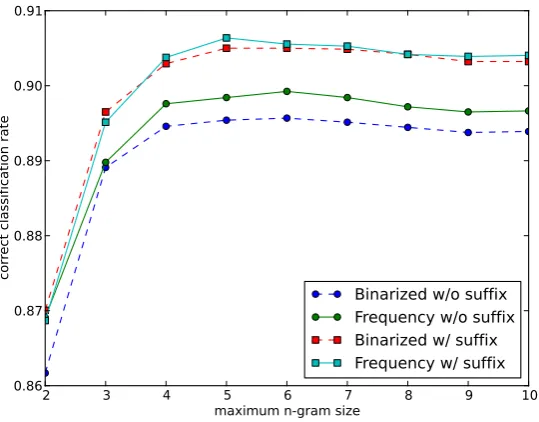
The support vector classifier was evaluated using a 10-fold cross-validation. The multi-class problem is treated using the one-versus-all scheme. The parameters chosen by grid search are a maximum n-gram length of 5, with appended
terminator and with non-binarized (count) fea-tures. The estimated correct classification rate is 90.64%, with a weighted averaged precision of 80.90%, recall of 90.64% andF1score of 89.89%. Appending the artificial terminator character ’$’ consistently improves accuracy by around 0.7%. Because each word was represented as a bag of character n-grams instead of a continuous string, and because, by its nature, a SVM yields sparse solutions, combined with the evaluation using cross-validation, we can safely say that the model does not overfit and indeed learns useful decision boundaries.
4 Conclusions and Future Works
Our results show that the labelling system based on the verb conjugation model we developed can be learned with reasonable accuracy. In the future, we plan to develop a multiple tiered labelling sys-tem that will allow for general alternations, such as the ones occuring as a result of palatalization, to be defined only once for all verbs that have them, taking cues from the idea of letters with multiple values. This, we feel, will highly im-prove the acuracy of the classifier.
5 Acknowledgements
The authors would like to thank the anonymous reviewers for their helpful comments. All authors contributed equally to this work. The research of Liviu P. Dinu was supported by the CNCS, IDEI - PCE project 311/2011, ”The Structure and In-terpretation of the Romanian Nominal Phrase in Discourse Representation Theory: the Determin-ers.”
References
Ana-Maria Barbu. Conjugarea verbelor romˆa-nes¸ti. Dict¸ionar: 7500 de verbe romˆanes¸ti
gru-pate pe clase de conjugare. Bucharest: Coresi,
2007. 4th edition, revised. (In Romanian.) (263 pp.).
Ana-Maria Barbu. Romanian lexical databases: Inflected and syllabic forms dictionaries. In
Sixth International Language Resources and
Evaluation (LREC’08), 2008.
Angelo Roth Costanzo. Romance Conjugational
Classes: Learning from the Peripheries. PhD
Figure 1: 10-fold cross validation scores for various combination of parameters. Only the values corresponding to the bestCregularization parameters are shown.
Liviu P. Dinu, Emil Ionescu, Vlad Niculae, and Octavia-Maria S¸ulea. Can alternations be learned? a machine learning approach to verb alternations. In Recent Advances in Natural
Language Processing 2011, September 2011.
Rong-En Fan, Kai-Wei Chang, Cho-Jui Hsieh, Xiang-Rui Wang, and Chih-Jen Lin. Liblinear: A library for large linear classification.Journal
of Machine Learning Research, 9:1871–1874,
June 2008. ISSN 1532-4435.
Jiˇri Felix.Classification des verbes roumains, vol-ume VII. Philosophica Pragensia, 1964.
Alf Lombard. Le verbe roumain. Etude
mor-phologique, volume 1. Lund, C. W. K. Gleerup,
1955.
Grigore C. Moisil. Probleme puse de traduc-erea automat˘a. conjugarea verbelor ˆın limba romˆan˘a. Studii si cercet˘ari lingvistice, XI(1): 7–29, 1960.
I. Papastergiou, N. Papastergiou, and L. Man-deki. Verbul romˆanesc - reguli pentru ˆınlesnirea ˆınsus¸irii indicativului prezent. In Romanian National Symposium ”Directions in
Roma-nian Philological Research”, 7th Edition, May
2007.
F. Pedregosa, G. Varoquaux, A. Gramfort, V. Michel, B. Thirion, O. Grisel, M. Blon-del, P. Prettenhofer, R. Weiss, V. Dubourg,
J. Vanderplas, A. Passos, D. Cournapeau, M. Brucher, M. Perrot, and E. Duchesnay. Scikit-learn: Machine learning in Python.
Jour-nal of Machine Learning Research, 12:2825–
2830, Oct 2011.
Valeria Gut¸u Romalo. Morfologie Structural˘a a
limbii romˆane. Editura Academiei Republicii