Coordination Structure Analysis using Dual Decomposition
Atsushi Hanamoto1 Takuya Matsuzaki1
1. Department of Computer Science, University of Tokyo, Japan 2. Web Search & Mining Group, Microsoft Research Asia, China
{hanamoto, matuzaki}@is.s.u-tokyo.ac.jp [email protected]
Jun’ichi Tsujii2
Abstract
Coordination disambiguation remains a dif-ficult sub-problem in parsing despite the frequency and importance of coordination structures. We propose a method for disam-biguating coordination structures. In this method, dual decomposition is used as a framework to take advantage of both HPSG parsing and coordinate structure analysis with alignment-based local features. We evaluate the performance of the proposed method on the Genia corpus and the Wall Street Journal portion of the Penn Tree-bank. Results show it increases the per-centage of sentences in which coordination structures are detected correctly, compared with each of the two algorithms alone.
1 Introduction
Coordination structures often give syntactic ambi-guity in natural language. Although a wrong anal-ysis of a coordination structure often leads to a totally garbled parsing result, coordination disam-biguation remains a difficult sub-problem in pars-ing, even for state-of-the-art parsers.
One approach to solve this problem is a gram-matical approach. This approach, however, of-ten fails in noun and adjective coordinations be-cause there are many possible structures in these coordinations that are grammatically correct. For
example, a noun sequence of the form “n0 n1
and n2 n3” has as many as five possible
struc-tures (Resnik, 1999). Therefore, a grammatical approach is not sufficient to disambiguate coor-dination structures. In fact, the Stanford parser (Klein and Manning, 2003) and Enju (Miyao and
Tsujii, 2004) fail to disambiguate a sentenceI am
a freshman advertising and marketing major. Ta-ble 1 shows the output from them and the correct coordination structure.
The coordination structure above is obvious to humans because there is a symmetry of conjuncts
(-ing) in the sentence. Coordination structures
of-ten have such structural and semantic symmetry of conjuncts. One approach is to capture local symmetry of conjuncts. However, this approach fails in VP and sentential coordinations, which can easily be detected by a grammatical approach. This is because conjuncts in these coordinations do not necessarily have local symmetry.
It is therefore natural to think that consider-ing both the syntax and local symmetry of con-juncts would lead to a more accurate analysis. However, it is difficult to consider both of them in a dynamic programming algorithm, which has been often used for each of them, because it ex-plodes the computational and implementational complexity. Thus, previous studies on coordina-tion disambiguacoordina-tion often dealt only with a re-stricted form of coordination (e.g. noun phrases) or used a heuristic approach for simplicity.
In this paper, we present a statistical analysis model for coordination disambiguation that uses the dual decomposition as a framework. We con-sider both of the syntax, and structural and se-mantic symmetry of conjuncts so that it outper-forms existing methods that consider only either of them. Moreover, it is still simple and requires
onlyO(n4)time per iteration, wherenis the
num-ber of words in a sentence. This is equal to that of coordination structure analysis with alignment-based local features. The overall system still has a quite simple structure because we need just slight modifications of existing models in this approach,
Stanford parser/Enju
I am a ( freshman advertising ) and ( marketing major )
Correct coordination structure
[image:2.595.327.519.561.636.2]I am a freshman ( ( advertising and mar-keting ) major )
Table 1: Output from the Stanford parser, Enju and the correct coordination structure
so we can easily add other modules or features for future.
The structure of this paper is as follows. First, we describe three basic methods required in the technique we propose: 1) coordination structure analysis with alignment-based local features, 2) HPSG parsing, and 3) dual decomposition. Fi-nally, we show experimental results that demon-strate the effectiveness of our approach. We com-pare three methods: coordination structure anal-ysis with alignment-based local features, HPSG parsing, and the dual-decomposition-based ap-proach that combines both.
2 Related Work
Many previous studies for coordination disam-biguation have focused on a particular type of NP coordination (Hogan, 2007). Resnik (1999) dis-ambiguated coordination structures by using se-mantic similarity of the conjuncts in a taxonomy.
He dealt with two kinds of patterns, [n0 n1 and
n2n3] and [n1andn2n3], whereniare all nouns.
He detected coordination structures based on sim-ilarity of form, meaning and conceptual
associa-tion betweenn1 andn2 and between n1 andn3.
Nakov and Hearst (2005) used the Web as a train-ing set and applied it to a task that is similar to Resnik’s.
In terms of integrating coordination disam-biguation with an existing parsing model, our ap-proach resembles the apap-proach by Hogan (2007). She detected noun phrase coordinations by find-ing symmetry in conjunct structure and the depen-dency between the lexical heads of the conjuncts.
They are used to rerank then-best outputs of the
Bikel parser (2004), whereas two models interact with each other in our method.
Shimbo and Hara (2007) proposed an
alignment-based method for detecting and dis-ambiguating non-nested coordination structures.
They disambiguated coordination structures
based on the edit distance between two conjuncts. Hara et al. (2009) extended the method, dealing with nested coordinations as well. We used their method as one of the two sub-models.
3 Background
3.1 Coordination structure analysis with
alignment-based local features
Coordination structure analysis with alignment-based local features (Hara et al., 2009) is a hy-brid approach to coordination disambiguation that combines a simple grammar to ensure consistent global structure of coordinations in a sentence, and features based on sequence alignment to cap-ture local symmetry of conjuncts. In this section, we describe the method briefly.
A sentence is denoted byx=x1...xk, wherexi
is thei-th word ofx. Acoordination boundaries
setis denoted byy=y1...yk, where
yi=
(bl, el, br, er) (if xiis a coordinating
conjunction having left
conjunctxbl...xeland
right conjunctxbr...xer)
null (otherwise)
In other words, yi has a non-null value
only when it is a coordinating conjunction.
For example, a sentence I bought books and
stationary has a coordination boundaries set
(null, null, null,(3,3,5,5), null).
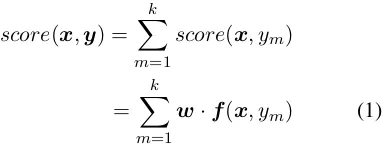
The score of a coordination boundaries set is defined as the sum of score of all coordinating conjunctions in the sentence.
score(x,y) =
k ∑
m=1
score(x, ym)
=
k ∑
m=1
w·f(x, ym) (1)
wheref(x, ym)is a real-valued feature vector of
the coordination conjunctxm. We used almost the
same feature set as Hara et al. (2009): namely, the surface word, part-of-speech, suffix and prefix of the words, and their combinations. We used the
averaged perceptron to tune the weight vectorw.
COORD Coordination.
CJT Conjunct.
N Non-coordination.
CC Coordinating conjunction like “and”.
W Any word.
Table 2: Non-terminals
Rules for coordinations:
COORDi,m→CJTi,jCCj+1,k−1CJTk,m
Rules for conjuncts:
CJTi,j →(COORD|N)i,j
Rules for non-coordinations:
Ni,k →COORDi,jNj+1,k
Ni,j→Wi,i(COORD|N)i+1,j
Ni,i→Wi,i
Rules for pre-terminals:
CCi,i→(and|or|but|,|;|+|+/−)i
CCi,i+1 →(,|; )i(and|or|but)i+1
CCi,i+2 →(as)i(well)i+1(as)i+2
Wi,i → ∗i
Table 3: Production rules
is only defined on the coordination structures that are licensed by the grammar. We only slightly ex-tended their grammar for convering more variety of coordinating conjunctions.
Table 2 and Table 3 show the non-terminals and production rules used in the model. The only ob-jective of the grammar is to ensure the consistency of two or more coordinations in a sentence, which means for any two coordinations they must be ei-ther non-overlapping or nested coordinations. We use a bottom-up chart parsing algorithm to out-put the coordination boundaries with the highest score. Note that these production rules don’t need to be isomorphic to those of HPSG parsing and actually they aren’t. This is because the two meth-ods interact only through dual decomposition and the search spaces defined by the methods are con-sidered separately.
This method requires O(n4) time, where nis
the number of words. This is because there are
O(n2) possible coordination structures in a
sen-tence, and the method requiresO(n2)time to get
a feature vector of each coordination structure.
3.2 HPSG parsing
HPSG (Pollard and Sag, 1994) is one of the linguistic theories based on lexicalized grammar
sign
PHONlist of string
SYNSEM synsem LOCAL local CAT category HEAD head MODLsynsem MODRsynsem SUBJlist of synsem COMPSlist of synsem SEMsemantics
NONLOC
nonlocal RELlist of local SLASHlist of local
Figure 1: HPSG sign
2 SUBJ < >
COMPS < >
2 HEADSUBJ < > COMPS < > 1 HEAD
SUBJ < > COMPS < >
1
HEAD SUBJ COMPS < | >
1
COMPS < > HEAD
SUBJ COMPS
1
2
3 4 3
4 2
Figure 2: Subject-Head Schema (left) and Head-Complement Schema (right)
and unbounded dependencies. SEMfeature rep-resents the semantics of a constituent, and in this study it expresses a predicate-argument structure. Figure 2 presents the Subject-Head Schema and the Head-Complement Schema1 defined in
(Pollard and Sag, 1994). In order to express gen-eral constraints, schemata only provide sharing of feature values, and no instantiated values.
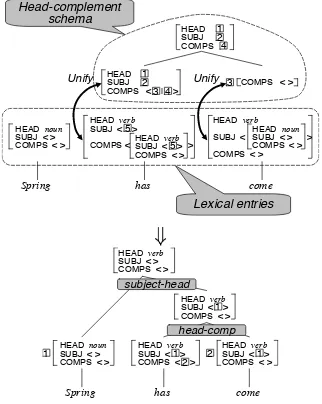
Figure 3 has an example of HPSG parsing of the sentence “Spring has come.” First, each of the lexical entries for “has” and “come” are unified with a daughter feature structure of the Head-Complement Schema. Unification provides the phrasal sign of the mother. The sign of the larger constituent is obtained by repeatedly apply-ing schemata to lexical/phrasal signs. Finally, the phrasal sign of the entire sentence is output on the top of the derivation tree.
3 Acquiring HPSG from the Penn Treebank
As discussed in Section 1, our grammar devel-opment requires each sentence to be annotated with i) a history of rule applications, and ii) ad-ditional annotations to make the grammar rules bepseudo-injective. In HPSG, a history of rule applications is represented by a tree annotated with schema names. Additional annotations are 1The value ofcategoryhas been presented for simplicity, while the other portions of the sign have been omitted.
Spring
HEAD noun
SUBJ < > COMPS < >
HEAD verb
SUBJ < > COMPS < >
5
has
HEAD verb
SUBJ < > COMPS < >
come
HEAD verb
SUBJ < > COMPS < >5
HEAD noun
SUBJ < > COMPS < > HEAD
SUBJ COMPS < | >
1
COMPS < > HEAD
SUBJ COMPS
1
2
3 4 3
4 2 Unify Unify Head-complement schema Lexical entries Spring
HEAD noun
SUBJ < >
COMPS < > 2 HEAD verb
SUBJ < > COMPS < >1
has
HEAD verb
SUBJ < > COMPS < >1
come
2 HEAD verb
SUBJ < > COMPS < >1 HEAD verb
SUBJ < > COMPS < >
1
subject-head
head-comp
Figure 3: HPSG parsing
required because HPSG schemata are not injec-tive, i.e., daughters’ signs cannot be uniquely de-termined given the mother. The following annota-tions are at least required. First, theHEADfeature of each non-head daughter must be specified since this is not percolated to the mother sign. Second,
SLASH/RELfeatures are required as described in our previous study (Miyao et al., 2003a). Finally, theSUBJfeature of the complement daughter in the Head-Complement Schema must be specified since this schema may subcategorize an unsatu-rated constituent, i.e., a constituent with a non-emptySUBJ feature. When the corpus is anno-tated with at least these features, the lexical en-tries required to explain the sentence are uniquely determined. In this study, we define partially-specified derivation treesas tree structures anno-tated with schema names and HPSG signs includ-ing the specifications of the above features.
We describe the process of grammar develop-ment in terms of the four phases: specification, externalization, extraction,andverification.
3.1 Specification
General grammatical constraints are defined in this phase, and in HPSG, they are represented through the design of the sign and schemata. Fig-ure 1 shows the definition for the typed featFig-ure structure of a sign used in this study. Some more features are defined for each syntactic category al-Figure 1: subject-head schema (left) and
head-complement schema (right); taken from Miyao et al. (2004).
formalism. In a lexicalized grammar, quite a
small numbers of schemata are used to explain general grammatical constraints, compared with
other theories. On the other hand, rich
word-specific characteristics are embedded in lexical
entries. Both of schemata and lexical entries
are represented by typed feature structures, and
constraints in parsing are checked byunification
among them. Figure 1 shows examples of HPSG schema.
Figure 2 shows an HPSG parse tree of the
sen-tence “Spring has come.” First, the lexical
en-tries of “has” and “come” are joined by
head-complement schema. Unification gives the HPSG sign of mother. After applying schemata to HPSG signs repeatedly, the HPSG sign of the whole sen-tence is output.
We use Enju for an English HPSG parser (Miyao et al., 2004). Figure 3 shows how a co-ordination structure is built in the Enju grammar. First, a coordinating conjunction and the right
conjunct are joined bycoord right schema.
Af-terwards, the parent and the left conjunct are
joined bycoord left schema.
The Enju parser is equipped with a disam-biguation model trained by the maximum entropy method (Miyao and Tsujii, 2008). Since we do not need the probability of each parse tree, we treat the model just as a linear model that defines the score of a parse tree as the sum of feature weights. The features of the model are defined on local subtrees of a parse tree.
The Enju parser takesO(n3)time since it uses
the CKY algorithm, and each cell in the CKY parse table has at most a constant number of edges because we use beam search algorithm. Thus, we can regard the parser as a decoder for a weighted CFG.
3.3 Dual decomposition
de-sign
PHONlist of string
SYNSEM synsem LOCAL local CAT category HEAD head MODLsynsem MODRsynsem SUBJlist of synsem COMPSlist of synsem SEMsemantics
NONLOC
[image:4.595.311.469.70.206.2]nonlocal RELlist of local SLASHlist of local
Figure 1: HPSG sign
2
SUBJ < > COMPS < >
2 HEADSUBJ < > COMPS < >
1
HEAD SUBJ < > COMPS < >
1
HEAD SUBJ COMPS < | >
1
COMPS < > HEAD
SUBJ COMPS
1
2 3 4 3
[image:4.595.101.262.82.284.2]4 2
Figure 2: Subject-Head Schema (left) and Head-Complement Schema (right)
and unbounded dependencies. SEMfeature rep-resents the semantics of a constituent, and in this study it expresses a predicate-argument structure. Figure 2 presents the Subject-Head Schema and the Head-Complement Schema1 defined in (Pollard and Sag, 1994). In order to express gen-eral constraints, schemata only provide sharing of feature values, and no instantiated values.
Figure 3 has an example of HPSG parsing of the sentence “Spring has come.” First, each of the lexical entries for “has” and “come” are unified with a daughter feature structure of the Head-Complement Schema. Unification provides the phrasal sign of the mother. The sign of the larger constituent is obtained by repeatedly apply-ing schemata to lexical/phrasal signs. Finally, the phrasal sign of the entire sentence is output on the top of the derivation tree.
3 Acquiring HPSG from the Penn Treebank
As discussed in Section 1, our grammar devel-opment requires each sentence to be annotated with i) a history of rule applications, and ii) ad-ditional annotations to make the grammar rules bepseudo-injective. In HPSG, a history of rule applications is represented by a tree annotated with schema names. Additional annotations are
1The value ofcategoryhas been presented for simplicity,
while the other portions of the sign have been omitted.
Spring HEAD noun SUBJ < > COMPS < >
HEAD verb SUBJ < > COMPS < >
5
has
HEAD verb
SUBJ < >
COMPS < >
come HEAD verb
SUBJ < > COMPS < >5
HEAD noun SUBJ < > COMPS < > HEAD
SUBJ COMPS < | >
1
COMPS < > HEAD
SUBJ COMPS
1
2
3 4 3
4 2 Unify Unify Head-complement schema Lexical entries Spring HEAD noun
SUBJ < >
COMPS < > 2
HEAD verb
SUBJ < > COMPS < >1
has
HEAD verb
SUBJ < > COMPS < >1
come
2
HEAD verb
SUBJ < > COMPS < >1 HEAD verb
SUBJ < > COMPS < >
1
subject-head
head-comp
Figure 3: HPSG parsing
required because HPSG schemata are not injec-tive, i.e., daughters’ signs cannot be uniquely de-termined given the mother. The following annota-tions are at least required. First, theHEADfeature of each non-head daughter must be specified since this is not percolated to the mother sign. Second,
SLASH/RELfeatures are required as described in our previous study (Miyao et al., 2003a). Finally, theSUBJfeature of the complement daughter in the Head-Complement Schema must be specified since this schema may subcategorize an unsatu-rated constituent, i.e., a constituent with a non-emptySUBJ feature. When the corpus is anno-tated with at least these features, the lexical en-tries required to explain the sentence are uniquely determined. In this study, we define partially-specified derivation treesas tree structures anno-tated with schema names and HPSG signs includ-ing the specifications of the above features.
We describe the process of grammar develop-ment in terms of the four phases: specification, externalization, extraction,andverification.
3.1 Specification
General grammatical constraints are defined in this phase, and in HPSG, they are represented through the design of the sign and schemata. Fig-ure 1 shows the definition for the typed featFig-ure structure of a sign used in this study. Some more features are defined for each syntactic category
al-Figure 2: HPSG parsing; taken from Miyao et al. (2004).
Coordina(on
Le3,Conjunct Coordina(onPar(al,
Coordina(ng,
Conjunc(on ConjunctRight,
← coord_right_schema ← coord_left_schema
Figure 3: Construction of coordination in Enju
composed into efficiently solvable sub-problems. It is becoming popular in the NLP community and has been shown to work effectively on sev-eral NLP tasks (Rush et al., 2010).
We consider an optimization problem
arg max
x (f(x) +g(x)) (2)
which is difficult to solve (e.g. NP-hard), while
arg maxxf(x)andarg maxxg(x)are effectively
solvable. In dual decomposition, we solve
min
u maxx,y (f(x) +g(y) +u(x−y))
instead of the original problem.
To find the minimum value, we can use a sub-gradient method (Rush et al., 2010). The subgra-dient method is given in Table 4. As the algorithm
u(1) ←0
fork= 1toK do
x(k)←arg maxx(f(x) +u(k)x)
y(k)←arg maxy(g(y)−u(k)y)
ifx=ythen
return u(k)
end if
u(k+1)←uk−ak(x(k)−y(k))
end for
return u(K)
Table 4: The subgradient method
shows, you can use existing algorithms and don’t need to have an exact algorithm for the optimiza-tion problem, which are features of dual decom-position.
Ifx(k) =y(k)occurs during the algorithm, then
we simply takex(k)as the primal solution, which
is the exact answer. If not, we simply takex(K),
the answer of coordination structure analysis with alignment-based features, as an approximate an-swer to the primal solution. The anan-swer does not always solve the original problem Eq (2), but pre-vious works (e.g., (Rush et al., 2010)) has shown that it is effective in practice. We use it in this paper.
4 Proposed method
In this section, we describe how we apply dual decomposition to the two models.
4.1 Notation
We define some notations here. First we describe weighted CFG parsing, which is used for both coordination structure analysis with alignment-based features and HPSG parsing. We follows the formulation by Rush et al., (2010). We assume a context-free grammar in Chomsky normal form,
with a set of non-terminals N. All rules of the
grammar are either the formA→BCorA→w
whereA, B, C ∈N andw∈V. For rules of the
formA→wwe refer toAas the pre-terminal for
w.
Given a sentence with nwords, w1w2...wn, a
parse tree is a set of rule productions of the form
⟨A → BC, i, k, j⟩ where A, B, C ∈ N, and
1 ≤ i ≤ k ≤ j ≤ n. Each rule production
rep-resents the use of CFG ruleA→BCwhere
[image:4.595.79.285.339.483.2]spans word wi...wk, and non-terminal C spans
word wk+1...wj if k < j, and the use of CFG
ruleA→wiifi=k=j.
We now define the index setfor the
coordina-tion structure analysis as
Icsa ={⟨A→BC, i, k, j⟩:A, B, C∈N,
1≤i≤k≤j ≤n}
Each parse tree is a vectory ={yr :r ∈ Icsa},
withyr = 1if ruleris in the parse tree, andyr=
0otherwise. Therefore, each parse tree is
repre-sented as a vector in{0,1}m, wherem =|Icsa|.
We useY to denote the set of all valid parse-tree
vectors. The setYis a subset of{0,1}m.
In addition, we assume a vectorθcsa ={θcsar :
r ∈ Icsa}that specifies a score for each rule
pro-duction. Each θrcsa can take any real value. The
optimal parse tree is y∗ = arg maxy∈Yy·θcsa
wherey·θcsa =∑
ryr·θcsar is the inner product
betweenyandθcsa.
We use similar notation for HPSG parsing. We
define Ihpsg, Z and θhpsg as the index set for
HPSG parsing, the set of all valid parse-tree vec-tors and the weight vector for HPSG parsing re-spectively.
We extend the index sets for both the coor-dination structure analysis with alignment-based features and HPSG parsing to make a constraint
between the two sub-problems. For the
coor-dination structure analysis with alignment-based features we define the extended index set to be
I′csa =Icsa∪Iuniwhere
Iuni ={(a, b, c) :a, b, c∈ {1...n}}
Here each triple (a, b, c) represents that word
wc is recognized as the last word of the right
conjunct and the scope of the left conjunct or
the coordinating conjunction is wa...wb1. Thus
each parse-tree vectorywill have additional
com-ponents ya,b,c. Note that this representation is
over-complete, since a parse tree is enough to determine unique coordination structures for a
sentence: more explicitly, the value of ya,b,c is
1
This definition is derived from the structure of a co-ordination in Enju (Figure 3). The triples show where the coordinating conjunction and right conjunct are in
coord right schema, and the left conjunct and partial coor-dination are incoord left schema. Thus they alone enable not only the coordination structure analysis with alignment-based features but Enju to uniquely determine the structure of a coordination.
1 if rule COORDa,c → CJTa,bCC , CJT ,c or
COORD,c →CJT , CCa,bCJT ,c is in the parse
tree; otherwise it is 0.
We apply the same extension to the HPSG in-dex set, also giving an over-complete
representa-tion. We defineza,b,canalogously toya,b,c.
4.2 Proposed method
We now describe the dual decomposition ap-proach for coordination disambiguation. First, we
define the setQas follows:
Q={(y, z) :y∈ Y, z∈ Z, ya,b,c=za,b,c
for all (a, b, c)∈ Iuni}
Therefore, Q is the set of all (y, z) pairs that
agree on their coordination structures. The coor-dination structure analysis with alignment-based features and HPSG parsing problem is then to solve
max
(y,z)∈Q(y·θ
csa+γz·θhpsg) (3)
whereγ > 0is a parameter dictating the relative
weight of the two models and is chosen to opti-mize performance on the development test set.
This problem is equivalent to
max
z∈Z(g(z)·θ
csa+γz·θhpsg) (4)
where g : Z → Y is a function that maps a
HPSG treezto its set of coordination structures
z=g(y).
We solve this optimization problem by using dual decomposition. Figure 4 shows the result-ing algorithm. The algorithm tries to optimize the combined objective by separately solving the sub-problems again and again. After each
itera-tion, the algorithm updates the weightsu(a, b, c).
These updates modify the objective functions for the two sub-problems, encouraging them to agree
on the same coordination structures. If y(k) =
z(k) occurs during the iterations, then the
algo-rithm simply returnsy(k) as the exact answer. If
not, the algorithm returns the answer of coordina-tion analysis with alignment features as a heuristic answer.
It is needed to modify original sub-problems for calculating (1) and (2) in Table 4. We modified
the sub-problems to regard the score ofu(a, b, c)
as a bonus/penalty of the coordination. The mod-ified coordination structure analysis with
u(1)(a, b, c)←0for all(a, b, c)∈I uni fork= 1toKdo
y(k)←arg maxy∈Y(y·θcsa−!(a,b,c)∈Iuniu(k)(a, b, c)ya,b,c)... (1)
z(k)←arg maxz∈Z(z·θhpsg +!(a,b,c)∈Iuniu(k)(a, b, c)za,b,c)... (2)
ify(k)(a, b, c) =z(k)(a, b, c)for all(a, b, c)∈I
uni then
return y(k) end if
for all(a, b, c)∈Iuni do
u(k+1)(a, b, c)←u(k)(a, b, c)−ak(y(k)(a, b, c)−z(k)(a, b, c))
[image:6.595.349.473.290.389.2]end for end for return y(K)
Figure 4: Proposed algorithm
w · f(x,(i, j, l, m)) to the score of the
sub-tree, when the rule production COORDi,m →
CJTi,jCCj+1,l−1CJTl,mis applied.
The modified Enju addsu(k)(i, j, l) when
co-ord left schema is applied, where word wc is recognized as a coordinating conjunction and left side of its scope is wa...wb, or
co-ord right schema is applied, where word wc is recognized as a coordinating conjunction and right side of its scope iswa...wb.
5 Experiments
5.1 Test/Training data
We trained the alignment-based coordination analysis model on both the Genia corpus (?) and the Wall Street Journal portion of the Penn Treebank (?), and evaluated the performance of our method on (i) the Genia corpus and (ii) the Wall Street Journal portion of the Penn Treebank. More precisely, we used HPSG treebank con-verted from the Penn Treebank and Genia, and further extracted the training/test data for coor-dination structure analysis with alignment-based features using the annotation in the Treebank. Ta-ble??shows the corpus used in the experiments.
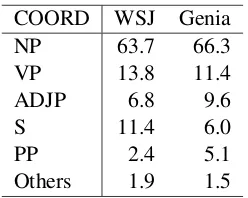
The Wall Street Journal portion of the Penn Treebank has 2317 sentences from WSJ articles, and there are 1356COODtags in the sentences, while the Genia corpus has 1754 sentences from MEDLINE abstracts, and there are 1848COOD
tags in the sentences. COOD tags are further subcategorized into phrase types such as NP-COOD or VP-COOD. Table ?? shows the per-centage of each phrase type in all COOD tags. It indicates the Wall Street Journal portion of the
COORD WSJ Genia
NP 63.7 66.3
VP 13.8 11.4
ADJP 6.8 9.6
S 11.4 6.0
PP 2.4 5.1
Others 1.9 1.5
Table 6: The percentage of each conjunct type (%) of each test set
Penn Treebank has moreVP-COODtags and S-COOD tags, while the Genia corpus has more
NP-COODtags andADJP-COODtags.
5.2 Implementation of sub-problems
We used Enju (?) for the implementation of HPSG parsing, which has a wide-coverage prob-abilistic HPSG grammar and an efficient parsing algorithm, while we re-implemented Hara et al., (2009)’s algorithm with slight modifications.
5.2.1 Step size
We used the following step size in our algo-rithm (Figure??). First, we initializeda0, which
is chosen to optimize performance on the devel-opment set. Then we defined ak = a0 ·2−ηk , whereηk is the number of times thatL(u(k!)) >
L(u(k!−1))fork# ≤k.
5.3 Evaluation metric
We evaluated the performance of the tested meth-ods by the accuracy of coordination-level brack-eting (?); i.e., we count each of the coordination scopes as one output of the system, and the system
Figure 4: Proposed algorithm
1, m), as well as adding w·f(x,(i, j, l, m))to
the score of the subtree, when the rule produc-tion COORDi,m → CJTi,jCCj+1,l−1CJTl,m is
applied.
The modified Enju adds u(k)(a, b, c) when
coord right schema is applied, where word
wa...wb is recognized as a coordinating
conjunc-tion and the last word of the right conjunct is wc, orcoord left schemais applied, where word
wa...wbis recognized as the left conjunct and the
last word of the right conjunct iswc.
5 Experiments
5.1 Test/Training data
We trained the alignment-based coordination analysis model on both the Genia corpus (Kim et al., 2003) and the Wall Street Journal portion of the Penn Treebank (Marcus et al., 1993), and evaluated the performance of our method on (i) the Genia corpus and (ii) the Wall Street Jour-nal portion of the Penn Treebank. More precisely, we used HPSG treebank converted from the Penn Treebank and Genia, and further extracted the training/test data for coordination structure analy-sis with alignment-based features using the anno-tation in the Treebank. Table 5 shows the corpus used in the experiments.
The Wall Street Journal portion of the Penn Treebank in the test set has 2317 sentences from WSJ articles, and there are 1356 coordinations in the sentences, while the Genia corpus in the test set has 1764 sentences from MEDLINE ab-stracts, and there are 1848 coordinations in the sentences. Coordinations are further
subcatego-COORD WSJ Genia
NP 63.7 66.3
VP 13.8 11.4
ADJP 6.8 9.6
S 11.4 6.0
PP 2.4 5.1
Others 1.9 1.5
Table 6: The percentage of each conjunct type (%) of each test set
rized into phrase types such as a NP coordination or PP coordination. Table 6 shows the percentage of each phrase type in all coordianitons. It indi-cates the Wall Street Journal portion of the Penn Treebank has more VP coordinations and S co-ordianitons, while the Genia corpus has more NP coordianitons and ADJP coordiations.
5.2 Implementation of sub-problems
We used Enju (Miyao and Tsujii, 2004) for the implementation of HPSG parsing, which has a wide-coverage probabilistic HPSG grammar and an efficient parsing algorithm, while we re-implemented Hara et al., (2009)’s algorithm with slight modifications.
5.2.1 Step size
We used the following step size in our
algo-rithm (Figure 4). First, we initializeda0, which
is chosen to optimize performance on the
devel-opment set. Then we definedak = a0 ·2−ηk ,
whereηkis the number of times that L(u(k
′)
) >
Task (i) Task (ii)
Training WSJ (sec. 2–21) + Genia (No. 1–1600) WSJ (sec. 2–21)
Development Genia (No. 1601–1800) WSJ (sec. 22)
[image:7.595.124.467.71.129.2]Test Genia (No. 1801–1999) WSJ (sec. 23)
Table 5: The corpus used in the experiments
Proposed Enju CSA
Precision 72.4 66.3 65.3
Recall 67.8 65.5 60.5
[image:7.595.96.267.172.228.2]F1 70.0 65.9 62.8
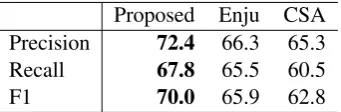
Table 7: Results of Task (i) on the test set. The preci-sion, recall, and F1 (%) for the proposed method, Enju, and Coordination structure analysis with alignment-based features (CSA)
5.3 Evaluation metric
We evaluated the performance of the tested meth-ods by the accuracy of coordination-level bracket-ing (Shimbo and Hara, 2007); i.e., we count each of the coordination scopes as one output of the system, and the system output is regarded as cor-rect if both of the beginning of the first output conjunct and the end of the last conjunct match annotations in the Treebank (Hara et al., 2009).
5.4 Experimental results of Task (i)
We ran the dual decomposition algorithm with a
limit of K = 50 iterations. We found the two
sub-problems return the same answer during the algorithm in over 95% of sentences.
We compare the accuracy of the dual decompo-sition approach to two baselines: Enju and coor-dination structure analysis with alignment-based features. Table 7 shows all three results. The dual decomposition method gives a statistically signif-icant gain in precision and recall over the two
methods2.
Table 8 shows the recall of coordinations of each type. It indicates our re-implementation of CSA and Hara et al. (2009) have a roughly simi-lar performance, although their experimental set-tings are different. It also shows the proposed method took advantage of Enju and CSA in NP coordination, while it is likely just to take the an-swer of Enju in VP and sentential coordinations. This means we might well use dual
decomposi-2p <0.01
(by chi-square test)
60%$ 65%$ 70%$ 75%$ 80%$ 85%$ 90%$ 95%$ 100%$
1$ 3$ 5$ 7$ 9$ 11$13$15$17$19$21$23$25$27$29$31$33$35$37$39$41$43$45$47$49$
accuracy certificates
Figure 5: Performance of the approach as a function of
Kof Task (i) on the development set. accuracy (%): the percentage of sentences that are correctly parsed. certificates (%): the percentage of sentences for which a certificate of optimality is obtained.
tion only on NP coordinations to have a better re-sult.
Figure 5 shows performance of the approach as
a function of K, the maximum number of
iter-ations of dual decomposition. The graphs show
that values ofK much less than 50 produce
al-most identical performance to K = 50 (with
K = 50, the accuracy of the method is 73.4%,
with K = 20 it is 72.6%, and with K = 1 it
is 69.3%). This means you can use smallerK in
practical use for speed.
5.5 Experimental results of Task (ii)
We also ran the dual decomposition algorithm
with a limit of K = 50 iterations on Task (ii).
Table 9 and 10 show the results of task (ii). They show the proposed method outperformed the two
methods statistically in precision and recall3.
Figure 6 shows performance of the approach as
a function of K, the maximum number of
iter-ations of dual decomposition. The convergence speed for WSJ was faster than that for Genia. This is because a sentence of WSJ often have a simpler coordination structure, compared with that of Ge-nia.
3p <0.01
[image:7.595.307.512.174.298.2]COORD # Proposed Enju CSA # Hara et al. (2009)
Overall 1848 67.7 63.3 61.9 3598 61.5
NP 1213 67.5 61.4 64.1 2317 64.2
VP 208 79.8 78.8 66.3 456 54.2
ADJP 193 58.5 59.1 54.4 312 80.4
S 111 51.4 52.3 34.2 188 22.9
PP 110 64.5 59.1 57.3 167 59.9
[image:8.595.125.467.71.181.2]Others 13 78.3 73.9 65.2 140 49.3
Table 8: The number of coordinations of each type (#), and the recall (%) for the proposed method, Enju, coordination structure analysis with alignment-based features (CSA) , and Hara et al. (2009) of Task (i) on the development set. Note that Hara et al. (2009) uses a different test set and different annotation rules, although its test data is also taken from the Genia corpus. Thus we cannot compare them directly.
Proposed Enju CSA
Precision 76.3 70.7 66.0
Recall 70.6 69.0 60.1
[image:8.595.93.269.263.319.2]F1 73.3 69.9 62.9
Table 9: Results of Task (ii) on the test set. The preci-sion, recall, and F1 (%) for the proposed method, Enju, and Coordination structure analysis with alignment-based features (CSA)
COORD # Proposed Enju CSA
Overall 1017 71.6 68.1 60.7
NP 573 76.1 71.0 67.7
VP 187 62.0 62.6 47.6
ADJP 73 82.2 75.3 79.5
S 141 64.5 62.4 42.6
PP 19 52.6 47.4 47.4
Others 24 62.5 70.8 54.2
Table 10: The number of coordinations of each type (#), and the recall (%) for the proposed method, Enju, and coordination structure analysis with alignment-based features (CSA) of Task (ii) on the development set.
6 Conclusion and Future Work
In this paper, we presented an efficient method for detecting and disambiguating coordinate struc-tures. Our basic idea was to consider both gram-mar and symmetries of conjuncts by using dual decomposition. Experiments on the Genia corpus and the Wall Street Journal portion of the Penn Treebank showed that we could obtain statisti-cally significant improvement in accuracy when using dual decomposition.
We would need a further study in the follow-ing points of view: First, we should evaluate our
60%$ 65%$ 70%$ 75%$ 80%$ 85%$ 90%$ 95%$ 100%$
[image:8.595.306.514.264.389.2]1$ 3$ 5$ 7$ 9$ 11$13$15$17$19$21$23$25$27$29$31$33$35$37$39$41$43$45$47$49$ accuracy certificates
Figure 6: Performance of the approach as a function of
Kof Task (ii) on the development set. accuracy (%): the percentage of sentences that are correctly parsed. certificates (%): the percentage of sentences for which a certificate of optimality is provided.
method with corpus in different domains. Be-cause characteristics of coordination structures differs from corpus to corpus, experiments on other corpus would lead to a different result. Sec-ond, we would want to add some features to coor-dination structure analysis with alignment-based local features such as ontology. Finally, we can add other methods (e.g. dependency parsing) as sub-problems to our method by using the exten-sion of dual decomposition, which can deal with more than two sub-problems.
Acknowledgments
[image:8.595.78.283.390.503.2]References
Kazuo Hara, Masashi Shimbo, Hideharu Okuma, and Yuji Matsumoto. 2009. Coordinate structure analy-sis with global structural constraints and alignment-based local features. InProceedings of the 47th An-nual Meeting of the ACL and the 4th IJCNLP of the AFNLP, pages 967–975, Aug.
Deirdre Hogan. 2007. Coordinate noun phrase dis-ambiguation in a generative parsing model. In Pro-ceedings of the 45th Annual Meeting of the Asso-ciation of Computational Linguistics (ACL 2007), pages 680–687.
Jun-Dong Kim, Tomoko Ohta, and Jun’ich Tsujii. 2003. Genia corpus - a semantically annotated cor-pus for bio-textmining. Bioinformatics, 19. Dan Klein and Christopher D. Manning. 2003. Fast
exact inference with a factored model for natural language parsing. Advances in Neural Information Processing Systems, 15:3–10.
Mitchell P. Marcus, Beatrice Santorini, and Mary Ann Marcinkiewicz. 1993. Building a large annotated corpus of english: The penn treebank. Computa-tional Linguistics, 19:313–330.
Yusuke Miyao and Jun’ich Tsujii. 2004. Deep lin-guistic analysis for the accurate identification of predicate-argument relations. In Proceeding of COLING 2004, pages 1392–1397.
Yusuke Miyao and Jun’ich Tsujii. 2008. Feature forest models for probabilistic hpsg parsing. MIT Press, 1(34):35–80.
Yusuke Miyao, Takashi Ninomiya, and Jun’ichi Tsu-jii. 2004. Corpus-oriented grammar development for acquiring a head-driven phrase structure gram-mar from the penn treebank. In Proceedings of the First International Joint Conference on Natural Language Processing (IJCNLP 2004).
Preslav Nakov and Marti Hearst. 2005. Using the web as an implicit training set: Application to structural ambiguity resolution. InProceedings of the Human Language Technology Conference and Conference on Empirical Methods in Natural Language (HLT-EMNLP 2005), pages 835–842.
Carl Pollard and Ivan A. Sag. 1994. Head-driven phrase structure grammar. University of Chicago Press.
Philip Resnik. 1999. Semantic similarity in a takon-omy. Journal of Artificial Intelligence Research, 11:95–130.
Alexander M. Rush, David Sontag, Michael Collins, and Tommi Jaakkola. 2010. On dual decomposi-tion and linear programming relaxadecomposi-tions for natu-ral language processing. InProceeding of the con-ference on Empirical Methods in Natural Language Processing.
Masashi Shimbo and Kazuo Hara. 2007. A discrimi-native learning model for coordinate conjunctions.