Abstract—In this paper, we present a Knowledge Based Genetic Algorithm (KBGA) for the scheduling of Flexible manufacturing system. The proposed algorithm integrates the knowledge base for generating the initial population, selecting the individuals for reproduction and reproducing new individuals. From the literature, it has been seen that simple genetic-algorithm-based heuristics for this problem lead to and large number of generations. This paper extends the simple genetic algorithm and proposes a new methodology to handle a complex variety of variables in a typical FMS problem. To achieve this aim, three new genetic operators—knowledge based: initialization, selection, crossover, and mutation are introduced. The methodology developed here helps to improve the performance of classical GA by obtaining the results in fewer generations.
Index Terms— Genetic Algorithm, Knowledge Based Genetic Algorithm, Knowledge Management, Scheduling.
I. INTRODUCTION
Highlight Since the beginning of the last decade when the competitive environment went through a major transformation due to globalization, manufacturers have intensified their search for such systems that will give them a sustainable competitive advantage. It has been realized that flexibility has the crucial ability to handle such type of challenges posed on manufacturers. Some researchers like [1], [2] have presented the framework of the flexibility in manufacturing system. Thus, the flexible manufacturing system is a system which can cope up with such rapidly changing scenario. The prominent literature has the several definitions of the flexible manufacturing system which is given by the many a researchers like [3], [4], [5], [6] etc. Reference [7] has defined the flexibility as the ability to deal with change by judiciously providing and exploiting controllable options dynamically. Reference [8] also shows the knowledge sharing focus with flexibility.
Manuscript received December 30, 2008.
Prof. S. Wadhwa is the principal at IGIT, Delhi. He is professor at Indian Institute of Technology, Delhi, Hauz Khas New Delhi- 110016, India. (corresponding author to provide phone: 303-555-5555; fax: 303-555-5555; e-mail: [email protected]).
A. Prakash, is a research scholar at Indian Institute of Technology, Delhi, Hauz Khas, New Delhi-110016, India. (phone: 0091-11-26596317; fax: 0091-11-26582053; e-mail: [email protected]).
Prof. S.G. Deshmukh is now Director of ABVIIITM, Gwalior. He is professor at Indian Institute of Technology, Delhi, Hauz Khas, New Delhi-110016, India. (e-mail: [email protected]).
Scheduling of operations is one of the most critical issues in the planning and managing of manufacturing processes. To find the best schedule can be very easy or very difficult, depending on the shop environment, the process constraints and the performance indicator [9]. One of the most difficult problems in this area the Job-shop Scheduling Problem (JSP) is the most complicated problem, where a set of jobs must be processed on a set of machines. In scheduling, each job is formed by a sequence of consecutive operations, each operation requires exactly one machine, and machines are continuously available and can process one operation at a time without interruption. Thus, it can be said that it is a very difficult decision making problem which concerns to the given performance indicator to be optimized. JSP is a well-known NP-hard problem [10]. The Scheduling problem in flexible manufacturing system is more difficult due to the allocation of operations on any among a set of available machines. The intricacy of this system suggests the adoption of heuristic methods producing reasonably good schedules in a reasonable time, instead of looking for an exact solution. In recent years, the adoption of meta-heuristics like GA has led to better results than classical dispatching or greedy heuristic algorithms but all of these some limitations and drawbacks. To overcome this dilemma, the researchers are motivated to develop the classical heuristics with some new philosophy. Keeping this in the mind, a Knowledge Based Genetic Algorithm (KBGA) has been proposed in the present paper. It incorporates the delicacy of knowledge based systems along with classical GA.
The remainder of the paper has been arranged in the following manner: the back ground of GA and knowledge management has been presented in section 2 and 3. The proposed algorithm has been delineated in section 4. In section 5, the paper has been concluded.
II. BACKGROUND OF GA
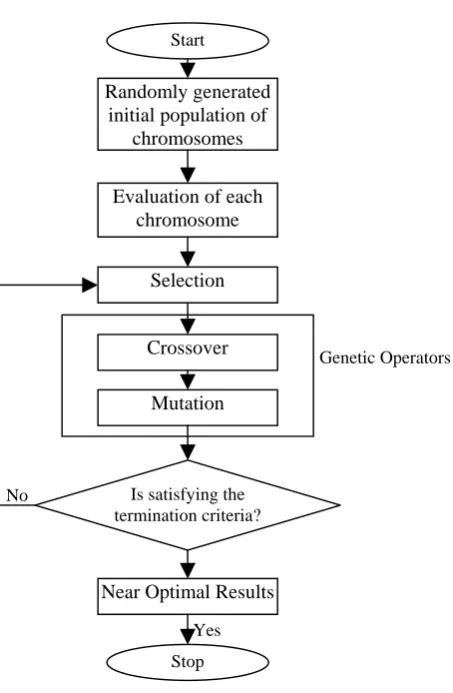
A Genetic Algorithm is an `intelligent’ probabilistic search algorithm that simulates the process of evolution by taking a population of solutions and applying genetic operators in each reproduction. Each solution in the population is evaluated according to some fitness measure. Fitter solutions in the population are used for reproduction. New `off spring’ solutions are generated and unfit solutions in the population are replaced. The cycle of evaluation-selection-reproduction is continued until a satisfactory solution is found ([11] and [12]). Reference [13] first described a GA, which is commonly called the Classical Genetic Algorithm (CGA). The working of the CGA can best be understood by the following steps, which is shown in figure 1.your manuscript
A Knowledge Based GA Approach for FMS
Scheduling
electronically for review.
Step 1. Generate the initial population. Determine the size of the population and the maximum number of the generation.
Step 2. Calculate the fitness value of each member of the initial population.
Step 3. Calculate the selection probability of each member of the initial population using the ratio of fitness value of that initial population to the summation of the fitness values of the individual solutions.
Step 4. Select a pair of members (parents) that can be used for reproduction using selection probability.
Step 5. Apply the genetic operators such as crossover, mutation, and inversion to the parents. Replace the parents with the new o€ spring to form a new population. Check the size of the new population. If it is equal to the initial population size, then go to step 6, otherwise go to step 4.
Step 6. If the current generation is equal to the maximum number of the generation then stop, else move to step 2.
After searching a large amount of the literature in the area of GA application, it has been found that there are a plethora of articles addressing the scheduling problems of FMSs. This research intends to demonstrate the advantage of Knowledge management in GA applications in the area of the scheduling problem of a random FMS that is known for its computational complexity (even for moderate size FMS).
III. BACKGROUND OF KM
As Francis Bacon said, “Knowledge is power”. To learn new things, maintain valuable heritage, create core competences, and initiate new situations, the power of knowledge is a very important resource for both individual and organizations now and in the future. According to [14], Knowledge has been defined as ‘‘justified true belief’’ that increases an organization’s capacity for effective action. It has two dimensions: explicit and tacit knowledge. Reference [15] defines knowledge as a fluid mix of framed experience, values, contextual information, and expert insight that provides a framework for evaluating and incorporating new experiences and information. They suggest that it originates and is applied only in the mind of knower and holders of tacit knowledge in organizations. It is embodied in documents, repositories, organizational routines, processes, practices and norms. To respond to competitive challenges, otherwise-independent firms have become more closely coupled than in the past, often working in parallel to complete assignments spanning traditional boundaries and functional areas. Knowledge Management (KM) provides processes to capture a part of tactic knowledge through informal methods and pointers and fairly high percentage of explicit knowledge, reducing the loss of organizational knowledge ([16]).
“KM is the formalization of and access to experience, knowledge and expertise that create new capabilities, enable superior performance, encourage innovation and enhance customer value” ([17]). According to [18], Knowledge Management is the ability to create and retain greater value from core business competencies. Reference [17] realizes that knowledge management is the systematic, explicit, and deliberate building, renewal, and application of knowledge to maximize an enterprise’s knowledge-related effectiveness and returns from its knowledge assets knowledge management is the formalization of and access to experience, knowledge, and expertise that create new capabilities, enable superior performance, encourage innovation, and enhance customer value. Whereas, [19] feels that knowledge management addresses business problems particular to business-whether it’s creating and delivering innovative products or services or managing and enhancing relationship with existing and new customers, partners, and suppliers, or administrating and improving work practices and processes. Reference [20] examines that knowledge has a connotation of ‘potential for action ’and is different from information in terms of its more immediate link with performance. It is linked to the values and experience of the user, and therefore takes many forms. One may have knowledge of certain facts. A KM strategy can help tear down traditional cross functional boundaries.
KM entails helping people share and put knowledge into action by creating access, context, infrastructure, and simultaneously reducing learning cycles ([21] and [22])
The creation of today’s knowledge base requires blending of knowledge from diverse disciplinary and personal skills Randomly generated
initial population of chromosomes
Selection Evaluation of each
chromosome
Crossover Mutation
Is satisfying the termination criteria?
Near Optimal Results
Start
Stop No
Yes
[image:2.595.48.275.82.429.2]Genetic Operators
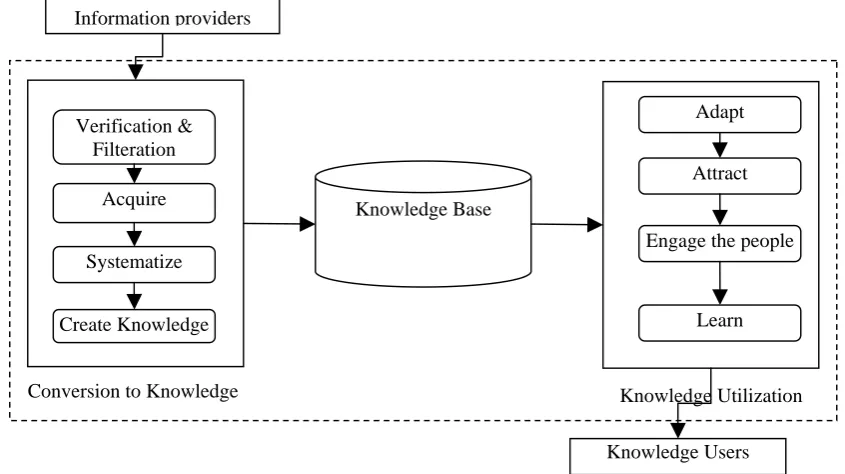
based on perspectives where creative cooperation is critical for innovation. An integrated framework of KM has been shown in the figure 2. It shows the conversion of information to knowledge and integration of knowledge base with knowledge utilization. To convert the information to knowledge, the process follows the various activities as verification, acquiring the filtered information, classification and creation of the knowledge from this information. All the
acquired knowledge is stored in the knowledge base. After accumulation, the knowledge has been distributed to the knowledge users by following the steps like adaptation, attraction, engaging the people and teaches them how to use this knowledge. The knowledge synergy based thinking showed in figure 1 can significantly benefit the KM guided manufacturing endeavors.
IV. KNOWLEDGE BASED GENETIC ALGORITHM (KBGA) Although GA is a global search technique, its practical usefulness depends on the initialization of the problem, crossover and mutation techniques and selection scheme for the next generation. Therefore, a number of techniques have been developed for handling all the above constraints. To improve the performance of GA, there is a lot of research especially in the FMS scheduling problem. Very few researches have addressed the constraints of algorithm itself instead of constraints of the problem or the environment.
In the present paper, we have introduced a concept of improving the performance of GA by exercising the knowledge based system, which will develop a faster algorithm for better performance of the system. It will employ on the basis of tacit and explicit knowledge both. For a search stratagem, it is very essential that it should also handle the inherent characteristics and complexities of the environment. By employing the knowledge of the environment like FMS and the complexities i.e. flexibilities, we can get the better result within lesser time than classical genetic algorithm (CGA). As it works with the knowledge base, it is identified as Knowledge Based Genetic Algorithm (KBGA). The proposed algorithm works not only for improving the performance measures of the system like traditional genetic algorithm but the performance of the algorithm. To enhance this idea, the knowledge based initialization, knowledge based crossover and knowledge based mutation, knowledge based selection have also been
incorporating in the algorithm. The procedure of the algorithm has been described in the next section.
A. Procedure of KBGA for Scheduling Problem
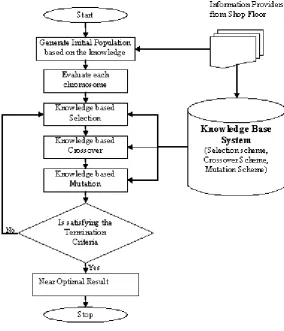
As stated in the previous section, it is clear that the strong point of KBGA over SGA is the knowledge based generation of the initial population instead of random generation. It is followed by the knowledge based selection (KBS), Knowledge based crossover (KBC), and Knowledge based mutation (KBM) to provide the wider search space within lesser time. The full procedure of KBGA has been shown in the figure 3. All the steps of the proposed algorithm (KBGA) are as follows:
1) Knowledge Based Initialization (KBI): In the first step of the algorithm, an initial population set of the solutions has been generated on the basis of the knowledge based system. In this step, firstly the information related to the system environment like (manufacturing system, types of flexibilities etc.), machines (type of machine, machine performance, setup time etc.), part (part types, no. of parts to be scheduled etc.), operation (no. of operations, type of operation, operation time etc.) has been collected. After this, the appropriate traditional scheduling rules have been selected on the basis of knowledge base. Hence, it can be said that the seed of initial population will work better than randomly generated population.
[image:3.595.61.484.159.396.2]2) Evaluation: In this step, each sequence has been calculated according to the evaluation criteria, which is a problem specific function. In the real world state of affairs, several objectives work at the same time. Thus, the proposed Fig. 2. An integrated framework of knowledge management
Information providers
Verification & Filteration
Acquire
Systematize
Create Knowledge
Knowledge Base
Adapt
Attract
Engage the people
Learn
Knowledge Users
algorithm provides the facility to specify several objectives. The user can specify the relative weighted average for each objective. In the proposed algorithm (KBGA), the knowledge based system is highly efficient for sustaining the solution feasibility.
3) Knowledge Based Selection (KBS): After the evaluation of all the sequences, a subset of the initial population is selected on random basis. It works on the basis of Neo Darwinism which can sub-divide the procedure of selection of three categories: a) Directional selection, b) Steady selection and c) Unruly selection. In the knowledge base system, all types of selection schemes with their characteristics and their performance in different systems have been placed. Thus, the selection is also effected by the knowledge base system to improve the performance of the algorithm.
4) Knowledge Based Crossover (KBC): Following the KBS, the surviving chromosomes are selected to form the new off springs to explore the wider search space. Initially, a sub-set of survived chromosomes has been randomly selected according to the crossover probability. The characteristics of each crossover scheme and their performance for different types of system environments and problems have been kept in the knowledge base and it will be
updated as increasing the knowledge. The knowledge based crossover gives the inherent characteristics to the off springs from parents.
5) Knowledge Based Mutation (KBM): Following the above step, the next genetic operator, named as mutation, empowers the algorithm to explore the search space. It modifies single chromosome by altering the genes or bits instead of recombining the two chromosomes. In the proposed algorithm, a knowledge base has been created to store the knowledge about the performance of various mutation operators. Hence, it is cleared now that knowledge (explicit or implicit) can help to determine the value of genetic parameter.
[image:4.595.158.443.346.678.2]6) Termination Criteria: After mutation, the selected populations, equal to the size of initial population, have to be entered to the next generation out of the extended population of the chromosomes. The whole process will be repeated until satisfy the termination criteria. The termination criteria can be characterized by the number of generations or the predefined level of the output.
V. CONCLUSIONS AND FUTURE SCOPE
The present paper provides a new insight to the practitioner to solve the different combinatorial problems e.g. scheduling in the flexible manufacturing context. The proposed algorithm, KBGA, improves the performance of traditional GA through introducing the knowledge base system which includes both explicit and implicit knowledge. It mainly emphasizes on the initialization, selection and genetic operators. The effectiveness of the productivity of classical GA based on knowledge rather than information is intended towards creating worthy knowledge and giving sufficient privileges to the same. It can be hopefully said that the proposed algorithm can be expanded to the various combinatorial problems in the real FMS world. This research can also be exploited to other multi objective problems with more flexible attributes. The proposed algorithm can also be developed with some filtering scheme for better results. In the new economy brought about by globalization, the fast changing nature of the technology warrants consideration for the formation of knowledge integration with such meta-heuristics. A knowledge-based view of the algorithm is necessary to understand the requirement of the real world flexible attributes and vis-à-vis the algorithm capability.
REFERENCES
[1] S. Wadhwa and J. Browne, “Modeling FMS with Petri Nets”, International Journal of flexible Manufacturing Systems, vol. 1, pp. 255-280, 1989.
[2] A. K Sethi, and S. P. Sethi, “Flexibility in Manufacturing: A Survey.” The International Journal of Flexible Manufacturing Systems, vol. 2, pp. 289-328, 1990.
[3] B. Carlsson , “Flexibility and the Theory of the Firm,” International Journal of Industrial Organization, vol.7, pp. 179–203, 1989. [4] D. Upton, “The Management of Manufacturing Flexibility”, California
Management Review, vol. 36(2), pp. 72-89, 1994.
[5] S. Wadhwa, and A. Aggarwal, “Synergism of Flexibility, Integration and Automation in Computer Integrated Manufacturing (CIM) Systems”, Studies in Informatics and Control, 2000.
[6] S. Wadhwa., K. S. Rao, F. T. S. Chan, “Flexibility-Enabled Lead-Time Reduction in Flexible System”, International Journal of Production Research, vol. 43(15), pp. 3131-3163, 2005.
[7] S. Wadhwa., and K. S. Rao, “Flexibility: An Emerging Meta-Competence for Managing High Technology”, International Journal of Technology Management, vol. 19(7/8), 2000.
[8] S. Wadhwa and A. Saxena, “Supply Chain Flexibility and Knowledge Management: A Decision Knowledge Sharing Focus,” Studies in Informatics and Control, vol. 15(1), 2006.
[9] M. Pinedo, Scheduling: theory, algorithms and systems, Englewood cliffs, NJ, Prentice-Hall, 2002.
[10] M. R. Garey, D.S. Johnson, and R. Sethi, “The complexity of flowshop and jobshop scheduling”, Mathematics of Operations Research, vol. 1, pp. 117–29, 1976.
[11] D.E. Goldberg, B. Korb, K. Deb, Messy genetic algorithm: Motivation analysis and first results, Complex System. Complex System publications, 1989.
[12] Z. Michaelwicz, Genetic algorithm + data structure = evaluation programs, Springer Verlag, New York, 1992.
[13] H.H. Holland, Adaptation in Natural and Artificial Systems, University of Michigan Press, Detroit MI, 1975.
[14] Nonaka, "A Dynamic Theory of Organizational Knowledge Creation" Organization Science, vol. (5) 1, pp. 14-37. 1994.
[15] T. Davenport, and L. Prusak, Working Knowledge: How Organizations Manage What They Know, Harvard Business School Press, Boston, MA. 1998.
[16] Nonaka, and H. Takeuchi, The Knowledge-Creating Company: How Japanese Companies Create the Dynamics of Innovation, Oxford University Press, New York, NY, 1995.
[17] T. Beckman, "A methodology for knowledge management", in Harmza, M.H. (Eds),” in Proc. of the IASTED International Conference on Artificial Intelligence and Soft Computing, 1997, p.29-32.
[18] A. Tiwana, The knowledge Management toolkit, Prantice hall, 2000. [19] A. Tiwana, and R. Balasubramaniam, “A design knowledge
management system to support collaborative information product evolution,” Decision Support Systems, vol. 31, pp. 241–262, 2001. [20] M. Nietok, “From R&D management to knowledge management An
overview of studies of innovation management”, Technological Forecasting & Social Change, vol. 70, pp. 135–161, 2003.
[21] T. H. Davenport, D. W. Delong, and M. C. Beers, “Successful knowledge management projects,” Sloan Management Review, vol. 39(2), pp.43– 57, 1998.