Unsupervised Grammar Induction by Distribution and Attachment
David J. Brooks
School of Computer Science University of Birmingham Birmingham, B15 2TT, UK [email protected]
Abstract
Distributional approaches to grammar in-duction are typically inefficient, enumer-ating large numbers of candidate con-stituents. In this paper, we describe a simplified model of distributional analy-sis which uses heuristics to reduce the number of candidate constituents under consideration. We apply this model to a large corpus of over 400000 words of written English, and evaluate the results using EVALB. We show that the perfor-mance of this approach is limited, provid-ing a detailed analysis of learned structure and a comparison with actual constituent-context distributions. This motivates a more structured approach, using a process of attachment to form constituents from their distributional components. Our find-ings suggest that distributional methods do not generalize enough to learn syntax effectively from raw text, but that attach-ment methods are more successful.
1 Introduction
Distributional approaches to grammar induction ex-ploit the principle of substitutability: constituents of the same type may be exchanged with one another without affecting the syntax of the surrounding con-text. Reversing this notion, if we can identify “sur-rounding context” by observation, we can hypothe-size that word sequences occurring in that context
will be constituents of the same type. Thus, distri-butional methods can be used to segment text into constituents and classify the results. This work fo-cuses on distributional learning from raw text.
Various models of distributional analysis have been used to induce syntactic structure, but most use probabilistic metrics to decide between candi-date constituents. We show that the efficiency of these systems can be improved by exploiting some properties of probable constituents, but also that this reliance on probability is problematic for learning from text. As a consequence, we propose an exten-sion to strict distributional learning that incorporates more information about constituent boundaries.
The remainder of this paper describes our expe-riences with a heuristic system for grammar induc-tion. We begin with a discussion of previous dis-tributional approaches to grammar induction in Sec-tion 2 and describe their implicaSec-tions in SecSec-tion 3. We then introduce a heuristic distributional system in Section 4, which we analyze empirically against a treebank. Poor system performance leads us to ex-amine actual constituent-context distributions (Sec-tion 5), the implica(Sec-tions of which motivate a more structured extension to our learning system, which we describe and analyze in Section 6.
2 Previous approaches
Distributional methods analyze text by alignment, aiming to find equivalence classes covering substi-tutable units. We align common portions of texts termed contexts, leaving distinct contiguous word-sequences, termed expressions. An expression and its context form an alignment pattern, which is
fined as:
Clef t|Expression|Cright (AP1)
From this alignment pattern, we can extract context-free grammar rules:
N T →Expression1∨...∨Expressionn (1)
While the definition of expression is straightfor-ward, the definition of context is problematic. We would like as much context as possible, but word-sequence contexts become less probable as their length increases, making learning harder. Therefore, simple models of context are preferred, although the precise definition varies between systems.
Distributional approaches to grammar induction fall into two categories, depending on their treat-ment of nested structure. The first category cov-ers Expectation-Maximization (EM) systems. These systems propose constituents based on analysis of text, then select a non-contradictory combination of constituents for each sentence that maximizes a given metric, usually parsing probability. EM has the advantage that constituent probabilities are only compared when constituents compete, which re-moves the inherent bias towards shorter constituents, which tend to have higher probability. However, EM methods are more susceptible to data sparsity issues associated with raw text, because there is no gener-alization during constituent proposal.
Examples of EM learning systems are Context Distribution Clustering (CDC) (Clark, 2001) and Constituent-Context Model (CCM) (Klein, 2005, Chapter 5), which avoid the aforementioned data-sparsity issues by using a part-of-speech (POS) tagged corpus, rather than raw text. Alignment Based Learning (ABL) (van Zaanen, 2000) is the only EM system applied directly to raw text. ABL uses minimal String-Edit Distance between sen-tences to propose constituents, from which the most probable combination is chosen. However, ABL is relatively inefficient and has only been applied to small corpora.
The second category is that of incremental learn-ing systems. An incremental system analyzes a cor-pus in a bottom-up fashion: each time a new con-stituent type is found, it is inserted into the corpus
to provide data for later learning. This has the ad-vantage of easing the data-sparsity issues described above because infrequent sequences are clustered into more frequent non-terminal symbols. However, in incremental systems, constituents are compared directly, which can lead to a bias towards shorter constituents.
The EMILE system (Adriaans, 1999) learns
shal-low languages in an incremental manner, and has
been applied to natural language under the assump-tion that such languages are shallow. Shallowness is the property whereby, for any constituent type in a language, there exist well-supported minimal units of that type. EMILE aligns complete sentences only, attempting to isolate minimal units, which are then used to process longer sequences. This method is efficient because alignment is non-recursive. How-ever, as a consequence, EMILE offers only a limited treatment of nested and recursive structures.
A more comprehensive approach to learning nested structure is found in the ADIOS sys-tem (Solan et al., 2003). ADIOS enumerates all pat-terns of a given length, under the condition that each sequence must have non-empty contexts and expres-sions. These patterns are ranked using an informa-tion gain metric, and the best pattern at each iterainforma-tion is rewritten into the graph, before pattern scanning begins again. ADIOS learns context-sensitive equiv-alence classes, but does not induce grammars, and has not been formally evaluated against treebanks.
Grammar induction systems are evaluated using standard metrics for parser evaluation, and in par-ticular, the EVALB algorithm1. The above sys-tems have been evaluated with respect to the ATIS treebank. Compared with supervised parsers, these systems perform relatively poorly, with the strictly unsupervised EMILE and ABL systems recovering 16.8% and 35.6% of constituent structure respec-tively. The partially-supervised systems of CDC and CCM perform better, with the latter retrieving 47.6% of the constituent structure in ATIS. However, the strictly unsupervised systems of ABL, EMILE and ADIOS have not been evaluated on larger corpora, in part due to efficiency constraints.
1
3 Issues for distributional learning
There are many issues with distributional learning, especially when learning from raw text. First, previ-ous systems hypothesize and select constituents ac-cording to the probability of their contexts: ABL, EMILE and CCM use the probability of proposed equivalence classes, or the equivalent context prob-ability; ADIOS uses an information gain metric, again favouring probable contexts. However, when learning from raw text, this preference for hypothe-ses with more probable contexts means that open-class words will seldom be considered as contexts. In POS-based learners, it is possible to align open-class POS contexts. These contexts are demonstra-bly important despite low word probabilities, which suggests that selecting contexts on the basis of prob-ability will be limited in success.
The second problem relates to word-senses. Alignment proceeds by matching orthographic types, but these types can have numerous associated syntactic senses. For example, ‘to’ plays two distinct roles: infinitive marker or preposition. If we align using the orthographic type, we will often misalign words, as seen in the following alignment:
I gave it to the man in the grey jacket John agreed to see me in 20 minutes Here, we are (mis)aligning a prepositional ‘to’, with an infinitive marker. The result would be a correctly identified noun-phrase, ‘the man’, and an incorrect structure, contradicting both the verb-group ‘to see’ and the noun-phrase ‘me’. This problem does not affect POS-based learning systems, as POS tags are unambiguously assigned.
Finally, grammar induction systems are typically inefficient, which prohibits training over large cor-pora. Distributional analysis is an expensive proce-dure, and must be performed for large numbers of word sequences. Previous approaches have tended to enumerate all alignment patterns, of which the best are selected using probabilistic metrics. How-ever, given the preference for probable alignments, there is considerable wasted computation here, and it is on this issue that we shall focus.
4 A heuristic approach to alignment
Rather than enumerating all word sequences in a corpus, we propose a heuristic for guiding
distribu-tional systems towards more favourable alignment patterns, in a system called Directed Alignment. In this system, we define context as the ordered pair of left- and right-context for a given constituent,
hClef t−Crighti, whereClef tandCrightare
single-units. The atomic units of this system are words, but learned constituents may also act as context-units.
The probability of a pattern depends primarily on its contexts, since they are common to all matching sequences. We can reduce the task of finding proba-ble alignments to simply finding probaproba-ble context-pairs. However, we can reduce this further: for a context-pair to be probable, its components must also be probable. Therefore, rather than enumerat-ing all patterns in the corpus, we direct the alignment procedure towards patterns where Clef t and Cright
are probable.
The first stage of direction creates an index for the corpus, compiling a list of unit types, where units are initially words. From this list of types, the most probable 1% are selected as context-units. These context-units are the only types allowed to fill the rolesClef tandCrightin alignment patterns.
Alignments are created directly from the context-unit index. For each context-context-unit token cu in the index, we locate cu in the corpus and create an alignment pattern, such that cu is the left context (Clef t). Next, we scan the sequence of words
fol-lowingcu, extending the alignment pattern until an-other context-unit cu′ is found, or a fixed length threshold is exceeded. Ifcu′is found, it fills the role of right context (Cright), and the completed
align-ment pattern is cached; otherwise, the pattern is dis-regarded.
Direction permits two forms of valid expressions in the contexthcu−cu′i:
1. nc1. . . ncn, where eachnciis a non-context
2. c1. . . cn, where eachciis a context-unit
As an example, consider the following sequence, with context units underlined:
put the whole egg , all the seasonings and vegeta-bles into the bowl and process for 10 seconds until smoothly pured .
This would be broken into non-recursive expres-sions2:
(put) the (whole egg) , all the (seasonings) and (veg-etables) into the (bowl) and (process) for (10 sec-onds) until (smoothly pureed) .
These expressions will be replaced by non-terminal unit representing the class of expressions, such that each class contains all units across the corpus that occur in the same context:
NT0 the NT1 , all the NT2 and NT3 into the NT2 and NT4 for NT5 until NT6 .
Following this generalization nested structures can be discovered using the same process.
This approach has some interesting parallels with chunking techniques, most notably that of function-word phrase identification (Smith and Witten, 1993). This similarity is enforced by disallowing nested structures. Unlike chunking systems, however, this work will also attempt to recover nested structures by means of incremental learning.
4.1 Selecting alignment patterns
The direction process extracts a set of candidate alignments, and from this set we select the best alignment to rewrite as an equivalence class. Previ-ous approaches offer a number of metrics for rank-ing constituents, based around constituent or context probability (ABL and CCM), Mutual Information (CDC), and information gain (ADIOS). We have im-plemented several of these metrics, but our expe-riences suggest that context probability is the most successful.
The probability of an alignment is effectively the sum of all path probabilities through the alignment:
P(Clef t, Cright) = ΣP(pathlef t,right) (2)
where eachpathlef t,rightis a unique word sequence
starting withlef tand ending withright, under the
2
For clarity, we have shown all alignments for the given sen-tence simultaneously. However, the learning process is incre-mental, so each alignment would be proposed during a distinct learning iteration.
constraints on expressions described above. There is an important practical issue here: probability sums such as that in Equation 2 do not decrease when ex-pressions are replaced with equivalence classes. To alleviate this problem, we rewrite the units when up-dating the distribution, but discard paths that match the current alignment. This prevents looping while allowing the rewritten paths to contribute to nested structures.
4.2 Generalizing expression classes
The model outlined above is capable of learning strictly context-sensitive constituents. While this does allow for nested constituents, it is problematic for generalization. Consider the following equiva-lence classes, which are proposed relatively early in Directed Alignment:
the NT1 of the NT2 in
Here, the non-terminals have been assigned on the basis of context-pairs: NT1 is defined byhthe−ofi
and NT2 is defined byhthe−ini. These types are distinct, although intuitively they account for simple noun-phrases. If we then propose an alignment pat-tern with NT1 asClef t, it must be followed by ‘of’,
which removes any possibility of generalizing ‘of’ and ‘in’.
We alleviate this problem by generalizing equiv-alence classes, using a simple clustering algorithm. For each new alignment, we compare the set of ex-pressions with all existing expression classes, rank-ing the comparisons by the degree of overlap with the current alignment. If this degree of overlap ex-ceeds a fixed threshold, the type of the existing class is assumed; otherwise, a new class is created.
4.3 Experiments, results and analysis
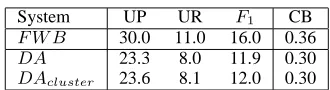
System UP UR F1 CB F W B 30.0 11.0 16.0 0.36
DA 23.3 8.0 11.9 0.30
[image:5.612.102.267.54.99.2]DAcluster 23.6 8.1 12.0 0.30
Table 1: EVALB results after 500 iterations of Di-rected Alignment applied to ICE-GB, showing both context-sensitive (DA) and clustered (DAcluster)
alignment. The columns represent Unlabeled Preci-sion, Unlabeled Recall, Unlabeled F-Score and the proportion of sentence with crossing brackets re-spectively.
of our algorithm, which chunks text into expres-sions between function words, which we refer to as Function-Word Bracketing (FWB).
Table 1 summarizes the EVALB scores for two 500-iteration runs of Directed Alignment over ICE-GB:DAis the standard context-sensitive version of the algorithm;DAclusteris the version with context
clustering. F W B precision is relatively low, with only 30% of proposed structures appearing in the treebank. Recall is even lower, with only 11% of structure retrieved. This is unsurprising, as no nested constructions are considered.
In comparison, both versions of Directed Align-ment perform significantly worse, with DAcluster
being only fractionally better than standardDA. Ex-periments over more learning iterations suggest that the performance of DA converges onF W B, with few nested constituents discovered. Both variants of the system produce very poor performance, with very little nested structure recovered. While these results seem discouraging, it is worth investigating system performance further.
Table 2, summarizes the success of the algorithm at discovering different types of constituent. Note that these results are unlabeled, so we are examining the proportion of each type of constituent in ICE-GB that has been identified. Here, Directed Align-ment exhibits the most success at identifying non-clauses, of which the primary source of success is short sentence fragments. Around 10% of noun-phrases (NP), verb-noun-phrases (VP) and subordinate-phrases (SUBP) were recovered, this limited suc-cess reflects the nature of the constituents: all three have relatively simple constructions, whereby a sin-gle word represents the constituent. In contrast,
con-Recall (%) Category Frequency FWB DA DAcluster
NP 117776 11.81 10.83 10.79
CL 28641 0.50 1.21 1.14
VP 50280 20.88 9.58 9.89
PP 42134 0.10 0.67 0.73
SUBP 7474 1.10 11.05 11.15
[image:5.612.321.535.55.140.2]NONCL 1919 4.27 22.98 22.98
Table 2: Constituent retrieval results for Function-Word Bracketing (FWB) and Directed Alignment (DAandDAcluster), categorized by gold-type
(a) DA, top 5 noun-matches of 271
Learned Recall Precision
NT0 4.61 84.53
NT5 1.58 93.44
NT7 1.36 87.14
NT4 1.09 75.10
NT10 0.82 84.54
(b) DAcluster, top 5
noun-matches of 135
Learned Recall Precision
NT0 6.93 87.09
NT4 6.48 89.91
NT8 2.62 40.48
NT11 0.86 68.60
NT10 0.58 16.95
Table 3: The top five expression classes to match N (noun) in ICE-GB, ranked by recall.
stituent types that comprise multiple units, such as prepositional-phrases (PP), are seldom recovered.
4.3.1 Class generalization
During learning in DAcluster, we induce
gener-alized classes using the expression clustering algo-rithm. This generalization can be evaluated, com-paring induced classes with those in the treebank us-ing precision and recall. Table 2(a) shows the top five proposed classes matching the type noun (N) in ICE-GB during 500 iterations of context-sensitive Directed Alignment. There are 271 types matching noun, and as can be seen, the top five account for a very small proportion of all nouns, some 9.46% (recall).
[image:5.612.366.491.203.377.2](a) Noun Phrases (frequency=123870)
LEFT START END RIGHT SYMB REC SYMB REC SYMB REC SYMB REC PREP 0.36 ART 0.29 N 0.53 PUNC 0.36 V 0.19 PRON 0.29 PRON 0.19 V 0.18 #STA# 0.12 N 0.2 N 2 0.11 AUX 0.13 CONJ 0.11 N 1 0.06 PUNC 0.06 CONJ 0.09 PUNC 0.09 ADJ 0.06 NUM 0.04 PREP 0.07
(b) Verb Phrases (frequency=50693)
Left Start End Right SYMB REC SYMB REC SYMB REC SYMB REC PRON 0.32 V 0.68 V 0.98 PREP 0.20 N 0.26 AUX 0.29 PUNC 0.01 ART 0.16 PTCL 0.11 AUX 1 0.02 AUX 0.00 PRON 0.14 PUNC 0.06 V 1 0.00 V 2 0.00 ADV 0.13 CONJ 0.05 ADV 0.00 ADV 0.00 ADJ 0.09
(c) Prepositional Phrases (frequency=45777)
[image:6.612.77.295.57.268.2]Left Start End Right SYMB REC SYMB REC SYMB REC SYMB REC N 0.46 PREP 0.96 N 0.63 PUNC 0.56 V 0.23 PREP 1 0.02 N 2 0.12 CONJ 0.09 ADV 0.05 ADV 0.01 PUNC 0.08 PREP 0.09 PUNC 0.05 NUM 0.00 PRON 0.05 V 0.07 ADJ 0.04 ADV 1 0.00 NUM 0.03 AUX 0.05
Table 4: The five most frequent left/start/end/right POS contexts for NP, VP and PP constituents.
of nouns in ICE-GB. The algorithm seems to be achieving some worthwhile generalization, which is reflected in a slight increase in EVALB scores forDAcluster. However, this increase is not a
sig-nificant one, suggesting that this generalization is not sufficient to support distributional learning. We might expect this: attempting to cluster based on the low-frequency and polysemous words in expres-sions seems likely to produce unreliable clusters.
5 A closer look at distributional contexts
The results discussed so far seem discouraging for the approach. However, there are good reasons why these results are so poor, and why we can expect little improvement in the current formulation. We can show some of these reasons by examining ac-tual constituent-context distributions.
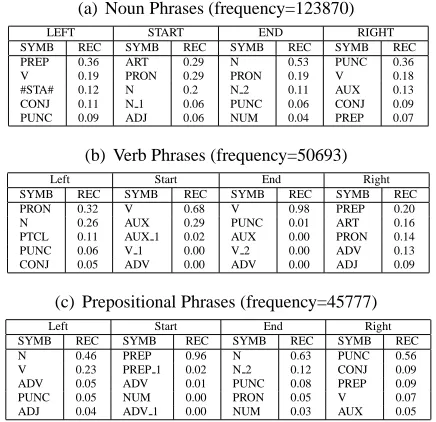
Table 4 shows an analysis of the constituent types NP, VP and PP in ICE-GB, against the five most frequent POS tags3 occurring as left-context, constituent-start, constituent-end, and right-context. We distinguish the following POS categories as be-ing primarily functional, as they account for the ma-jority of context-units considered by Directed Align-ment: prepositions (PREP), articles (ART),
aux-3
The same trends can be shown for words, but a POS analy-sis is preferred for clarity and brevity.
iliaries (AUX), sentence-starts (#STA#), pronouns (PRON), conjunctions (CONJ), particles (PTCL) and punctuation (PUNC).
From Table 4, we can see that noun-phrases and verb-phrases are relatively well-suited to our ap-proach. First, both types have strong functional left- and right-contexts: 58% of NP left-contexts and 50% of NP right-contexts are members of our func-tional POS; similarly, 43% of VP left-contexts and 49% of VP right-contexts are functional. This means that a probability-based model of context, such as ours, will find relatively strong support for these types. Second, both NP and VP have minimal unit types: nouns and pronouns for NP; verbs for VP. As a consequence, these types tend to carry more proba-bility mass, since shorter sequences tend to be more frequent. We should expect our system to perform reasonably on NP and VP as a result.
In contrast, prepositional-phrases are much less amenable to distributional analysis. First, PP tend to be longer, since they contain NP, and this has obvious repercussions for alignment probabilities. More damagingly, PP contexts are dominated by open-class words - the top 74% of PP left-contexts are nouns, verbs and adverbs. Therefore, a purely probabilistic distributional approach cannot account for prepositional-phrases, since learning data is too sparse. Previous approaches have relied upon open-class generalization to reduce this problem, but these methods suffer from the same problems of data spar-sity, and as such are not reliable enough to resolve the issue.
6 Attachment
ig-nored.
One method for achieving such an internal rela-tionship might be to attach contexts to the expres-sions with which they co-occur, and we propose us-ing such a method here. However, this requires that we have some criterion for deciding when and how expressions should be attached to their contexts. We use a measure based on STOP arguments (Collins, 1999), which allows us to condition the decision to insert a constituent boundary on the evidence we see for doing so. For raw text, the only boundaries that are explicitly marked are at the start and end of sen-tences, and it is this information we use to decide when to attach contexts to expressions4. In other words, if a context is likely to start a sentence, we assume it is also likely to start a constituent at other positions within a sentence.
In order to calculate the likelihood of a particu-lar context wordwoccurring at the start or end of a sentence, we simply use the bigram probabilities be-tweenwand the special symbols START and END, which denote the start and end of a sentence respec-tively. From these probabilities, we calculate Mutual Information M I(ST ART, w) and M I(w, EN D). We prefer MI because it describes the strength of the relation between w and these special symbols without bias towards more probable words. From these MI values, we calculate a Directional
Prefer-ence (DP) for the context word:
dp(w) =M I(w, EN D)−M I(ST ART, w) (3)
This yields a number representing whether w is more likely to start or end a sentence. This num-ber will be zero if we are equally likely to seewat the start or end of a sentence, negative ifwis more likely to start a sentence, and positive ifwis is more likely to end a sentence.
Using DP, we can decide how to attach an expres-sion to its contexts. For a given alignment, we con-sider the possibility of attaching the expression to neither context, the left-context, or the right-context, by comparing the DP for the left- and right-contexts. If the left-context shows a strong tendency to start sentences, and the right-context does not show a
4
For this method to work, we assume that our corpus is seg-mented into sentences. This is not the case for speech, but for learning from text it seems a reasonable assumption.
System UP UR F1 CB
[image:7.612.354.495.143.216.2]DAST OP 33.6 14.1 19.8 0.42
Table 5: EVALB results after 500 iterations of Di-rected Alignment with STOP attachment applied to ICE-GB (DAST OP).
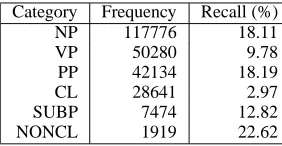
Category Frequency Recall (%)
NP 117776 18.11
VP 50280 9.78
PP 42134 18.19
CL 28641 2.97
SUBP 7474 12.82
NONCL 1919 22.62
Table 6: Constituent retrieval results for DAST OP,
categorized by gold-type
strong tendency to end sentences (i.e. there is an overall DP is negative), we attach the expression to its left-context; if the reverse situation is true, we at-tach the expression to its right context. Should the difference between these DP fall below a threshold, neither context is preferred, and the expression re-mains unattached.
Let us consider a specific example of attachment. The first alignment considered by the system (when applied to ICE-GB) is:
the NT1 of
Here, we need to compare the likelihood of seeing a constituent start with ‘the’ with with the likelihood of seeing a constituent end with ‘of’. Intuitively, ‘the’ occurs frequently at the start of a sentence, and never at the end. Consequently, it has a high neg-ative DP. Meanwhile ‘of’ has a small negneg-ative DP. In combination, there is a high negative DP, so we attach the expression to the left-context, ‘the’.
6.1 Experimental Analysis
We applied Directed Alignment with attachment based on STOP arguments (DAST OP) to ICE-GB
as before, running for 500 iterations. These results are shown in Table 5. The results are encouraging. Unlabeled precision increased by almost 50%, from 23.6% forDAclusterto 33.6%. Likewise, system
re-call increased dramatire-cally, from 8.1% to 14.1%, up some 75%. Crossing-brackets increased slightly, but remained relatively low at 0.42.
for the major non-terminal types, as before. The improvement in EVALB scores is attributable to a marked increase in success at identifying prepositional-phrases, with a lesser increase in noun-phrase identification.
6.2 Discussion
The attachment procedure described above is more successful at discovering nested constituents than distributional methods. There are good reasons why this should be the case. First, attachment compresses the corpus, removing the bias towards shorter se-quences. Indeed, the algorithm seems capable of retrieving complex constituents of up to ten words in length during the first 500 iterations.
Second, the STOP-conditioning criterion, while somewhat ad hoc in relation to distributional meth-ods, allows us to assess where constituent bound-aries are likely to occur. As such, this can be seen as a rudimentary method for establishing argument relations, such as those observed in (Klein, 2005, Chapter 6).
Despite these improvements, the attachment pro-cess also makes some systematic mistakes. Some of these may be attributed to discrepancies between the syntactic theory used to annotate the treebank and the attachment process. For example, verbs are rou-tinely attached to their subjects before objects, con-tradicting the more traditional interpretation present in treebanks. Some of the remaining mistakes can be attributed to the misalignment, due to the ortho-graphic match problem described in Section 3.
7 Future Work
The major problem when applying distributional methods to raw text is that of orthographic match-ing, which causes misalignments between alterna-tive senses of a particular word-form. To reduce this problem, context-units must be classified in some way to disambiguate these different senses. Such classification could be used as a precursor to align-ment in the system we have described.
In addition, to better evaluate the quality of at-tachment, dependency representations and treebanks could be used, which do not have an explicit order on attachment. This would give a more accurate evalu-ation where subject-verb attachment is concerned.
8 Conclusions
We have presented an incremental grammar induc-tion system that uses heuristics to improve the effi-ciency of distributional learning. However, in tests over a large corpus, we have shown that it is capable of learning only a small subset of constituent struc-ture. We have analyzed actual constituent-context distributions to explain these limitations. This anal-ysis provides the motivation for a more structured learning method, which incorporates knowledge of verifiable constituent boundaries - the starts and ends of sentences. This improved system performs significantly better, with a 75% increase in recall over distributional methods, and a significant im-provement at retrieving structures that are problem-atic for distributional methods alone.
References
Pieter Adriaans. 1999. Learning shallow context-free languages under simple distributions. Technical Re-port PP-1999-13, Institute for Logic, Language, and Computation, Amsterdam.
Alexander Clark. 2001. Unsupervised induction of stochastic context free grammars with distributional clustering. In Proceedings of the Fifth
Confer-ence on Natural Language Learning, pages 105–112,
Toulouse, France, July.
Michael Collins. 1999. Head-Driven Statistical Models
for Natural Language Parsing. Ph.D. thesis,
Univer-sity of Pennsylvania.
Dan Klein. 2005. The Unsupervised Learning of
Natu-ral Language Structure. Ph.D. thesis, Department of
Computer Science, Stanford University, March.
Tony C. Smith and Ian H. Witten. 1993. Language in-ference from function words. Working Paper Series 1170-487X-1993/3, Department of Computer Science, University of Waikato, Hamilton, New Zealand, Au-gust.
Zach Solan, David Horn, Eytan Ruppin, and Shimon Edelman. 2003. Unsupervised efficient learning and representation of language structures. In R. Alterman and D. Kirsch, editors, Proceedings of the 25th
Con-ference of the Cognitive Science Society, Hillsdale, NJ.
Erlbaum.
Menno van Zaanen. 2000. Learning structure using Alignment Based Learning. In Proceedings of the
Third Annual Doctoral Research Colloquium (CLUK),