An Analogical Learner for Morphological Analysis
Nicolas Stroppa & Franc¸ois Yvon GET/ENST & LTCI, UMR 5141 46 rue Barrault, 75013 Paris, France
{stroppa,yvon}@enst.fr
Abstract
Analogical learning is based on a two-step inference process: (i) computation of a structural mapping between a new and a memorized situation; (ii) transfer of knowledge from the known to the un-known situation. This approach requires the ability to search for and exploit such mappings, hence the need to properly de-fine analogical relationships, and to effi-ciently implement their computation.
In this paper, we propose a unified defini-tion for the nodefini-tion of (formal) analogical proportion, which applies to a wide range of algebraic structures. We show that this definition is suitable for learning in do-mains involving large databases of struc-tured data, as is especially the case in Nat-ural Language Processing (NLP). We then present experimental results obtained on two morphological analysis tasks which demonstrate the flexibility and accuracy of this approach.
1 Introduction
Analogical learning (Gentner et al., 2001) is based on a two-step inductive process. The first step con-sists in the construction of a structural mapping be-tween a new instance of a problem and solved in-stances of the same problem. Once this mapping is established, solutions for the new instance can be
induced, based on one or several analogs. The im-plementation of this kind of inference process re-quires techniques for searching for, and reasoning with, structural mappings, hence the need to prop-erly define the notion of analogical relationships and to efficiently implement their computation.
In Natural Language Processing (NLP), the typ-ical dimensionality of databases, which are made up of hundreds of thousands of instances, makes the search for complex structural mappings a very challenging task. It is however possible to take ad-vantage of the specific nature of linguistic data to work around this problem. Formal (surface) analog-ical relationships between linguistic representations are often a good sign of deeper analogies: a surface similarity between the word stringswriteandwriter
denotes a deeper (semantic) similarity between the related concepts. Surface similarities can of course be misleading. In order to minimize such confu-sions, one can take advantage of other specificities of linguistic data: (i) their systemic organization in (pseudo)-paradigms, and (ii) their high level of re-dundancy. In a large lexicon, we can indeed expect to find many instances of pairs likewrite-writer: for instanceread-reader,review-reviewer...
Complementing surface analogies with statistical information thus has the potential to make the search problem tractable, while still providing with many good analogs. Various attempts have been made to use surface analogies in various contexts: automatic word pronunciation (Yvon, 1999), morphological analysis (Lepage, 1999a; Pirrelli and Yvon, 1999) and syntactical analysis (Lepage, 1999b). These ex-periments have mainly focused on linear
tations of linguistic data, taking the form of finite sequences of symbols, using a restrictive and some-timesad-hocdefinition of the notion of an analogy.
The first contribution of this paper is to propose a general definition of formal analogical proportions for algebraic structures commonly used in NLP: attribute-value vectors, words on finite alphabets and labeled trees. The second contribution is to show how these formal definitions can be used within an instance-based learning framework to learn morpho-logical regularities.
This paper is organized as follows. In Section 2, our interpretation of analogical learning is intro-duced and related to other models of analogical learning and reasoning. Section 3 presents a general algebraic framework for defining analogical propor-tions as well as its instantiation to the case of words and labeled trees. This section also discusses the algorithmic complexity of the inference procedure. Section 4 reports the results of experiments aimed at demonstrating the flexibility of this model and at assessing its generalization performance. We con-clude by discussing current limitations of this model and by suggesting possible extensions.
2 Principles of analogical learning
2.1 Analogical reasoning
The ability to identify analogical relationships be-tween what looks like unrelated situations, and to use these relationships to solve complex problems, lies at the core of human cognition (Gentner et al., 2001). A number of models of this ability have been proposed, based on symbolic (e.g. (Falken-heimer and Gentner, 1986; Thagard et al., 1990; Hofstadter and the Fluid Analogies Research group, 1995)) or subsymbolic (e.g. (Plate, 2000; Holyoak and Hummel, 2001)) approaches. The main focus of these models is the dynamic process of analogy making, which involves the identification of a struc-tural mappings between a memorized and a new sit-uation. Structural mapping relates situations which, while being apparently very different, share a set of common high-level relationships. The building of a structural mapping between two situations utilizes several subparts of their descriptions and the rela-tionships between them.
Analogy-making seems to play a central role in
our reasoning ability; it is also invoked to explain some human skills which do not involve any sort of conscious reasoning. This is the case for many tasks related to the perception and production of language: lexical access, morphological parsing, word pronun-ciation, etc. In this context, analogical models have been proposed as a viable alternative to rule-based models, and many implementation of these low-level analogical processes have been proposed such as decision trees, neural networks or instance-based learning methods (see e.g. (Skousen, 1989; Daele-mans et al., 1999)). These models share an accepta-tion of analogy which mainly relies on surface simi-larities between instances.
Our learner tries to bridge the gap between these approaches and attempts to remain faithful to the idea of structural analogies, which prevails in the AI literature, while also exploiting the intuitions of large-scale, instance-based learning models.
2.2 Analogical learning
We consider the following supervised learning task: a learner is given a set S of training instances {X1, . . . , Xn}independently drawn from some
un-known distribution. Each instance Xi is a vector
containing m features: hXi1, . . . , Ximi. Given S,
the task is to predict the missing features of partially informed new instances. Put in more standard terms, the set of known (resp. unknown) features for a new valueX forms the input space (resp. output space): the projections of X onto the input (resp. output) space will be denotedI(X)(resp.O(X)). This set-ting is more general than the simpler classification task, in which only one feature (the class label) is unknown, and covers many other interesting tasks.
The inference procedure can be sketched as fol-lows: training examples are simply stored for fu-ture use; no generalization (abstraction) of the data is performed, which is characteristic of lazy learning (Aha, 1997). Given a new instanceX, we identify formal analogical proportions involvingXin the in-put space; known objects involved in these propor-tions are then used to infer the missing features.
we contend that it is possible to construct analogical proportions between (possibly partially informed) objects inS. LetI(X)be a partially described ob-ject not seen during training. The analogical infer-ence process is formalized as:
1. Construct the setT(X)⊂ S3 defined as:
T(X) ={(A, B, C)∈ S3|
I(A) :I(B) ::I(C) :I(X)}
2. For each (A, B, C) ∈ T(X), compute hy-pothesesO\(X)by solving the equation:
\
O(X) =O(A) :O(B) ::O(C) :?
This inference procedure shows lots of similari-ties with the k-nearest neighbors classifier (k-NN) which, given a new instance, (i) searches the training set for close neighbors, (ii) compute the unknown class label according to the neighbors’ labels. Our model, however, does not use any metric between objects: we only rely on the definition of analogical proportions, which reveal systemic, rather than su-perficial, similarities. Moreover, inputs and outputs are regarded in a symmetrical way: outputs are not restricted to a set of labels, and can also be structured objects such as sequences. The implementation of the model still has to address two specific issues.
• When exploringS3, an exhaustive search
eval-uates |S|3 triples, which can prove to be
in-tractable. Moreover, objects in S may be unequally relevant, and we might expect the search procedure to treat them accordingly.
• Whenever several competing hypotheses are proposed for O\(X), a ranking must be
per-formed. In our current implementation, hy-potheses are ranked based on frequency counts.
These issues are well-known problems fork-NN classifiers. The second one does not appear to be critical and is usually solved based on a majority rule. In contrast, a considerable amount of effort has been devoted to reduce and optimize the search pro-cess, via editing and condensing methods, as stud-ied e.g. in (Dasarathy, 1990; Wilson and Martinez, 2000). Proposals for solving this problem are dis-cussed in Section 3.4.
3 An algebraic framework for analogical proportions
Our inductive model requires the availability of a de-vice for computing analogical proportions on feature vectors. We consider that an analogical proportion holds between four feature vectors when the propor-tion holds for all components. In this secpropor-tion, we propose a unified algebraic framework for defining analogical proportions between individual features. After giving the general definition, we present its in-stantiation for two types of features: words over a finite alphabet and sets of labelled trees.
3.1 Analogical proportions
Our starting point will be analogical proportions in a set U, which we define as follows: ∀x, y, z, t ∈ U, x:y::z:tif and only if eitherx=yandz =t orx =zandy = t. In the sequel, we assume that U is additionally provided with an associative inter-nal composition law⊕, which makes(U,⊕)a group. The generalization of proportions to semi-groups involves two key ideas: the decomposition of objects into smaller parts, subject to alternation con-straints. To formalize the idea of decomposition, we define the factorization of an elementuinU as:
Definition 1 (Factorization)
A factorization ofu ∈ U is a sequence u1. . . un,
with ∀i, ui ∈ U, such that: u1 ⊕ . . . ⊕un = u.
Each termuiis a factor ofu.
The alternation constraint expresses the fact that analogically related objects should be made of alter-nating factors: forx:y::z:tto hold, each factor inxshould be found alternatively inyand inz. This yields a first definition of analogical proportions:
Definition 2 (Analogical proportion)
(x, y, z, t) ∈ U form an analogical proportion, de-noted byx:y::z:tif and only if there exists some factorizationsx1⊕. . .⊕xd=x,y1⊕. . .⊕yd=y,
z1 ⊕ . . . ⊕zd = z, t1⊕ . . . ⊕td = tsuch that
∀i,(yi, zi) ∈ {(xi, ti),(ti, xi)}. The smallestdfor
which such factorizations exist is termed the degree of the analogical proportion.
3.2 Words over Finite Alphabets
3.2.1 Analogical Proportions between Words
LetΣbe a finite alphabet. Σ? denotes the set of finite sequences of elements ofΣ, called words over Σ. Σ?, provided with the concatenation operation . is a free monoid whose identity element is the empty wordε. Forw∈Σ?,w(i)denotes theithsymbol in
w. In this context, definition (2) can be re-stated as:
Definition 3 (Analogical proportion in (Σ?,.))
(x, y, z, t) ∈Σ? form an analogical proportion, de-noted byx:y::z:tif and only if there exists some integer d and some factorizations x1. . . xd = x,
y1. . . yd = y,z1. . . zd =z,t1. . . td =tsuch that
∀i,(yi, zi)∈ {(xi, ti),(ti, xi)}.
An example of analogy between words is:
viewing :reviewer::searching:researcher
withx1 = , x2 = view, x3 = ing andt1 = re,
t2 = search, t3 = er. This definition generalizes
the proposal of (Lepage, 1998). It does not ensure the existence of a solution to an analogical equation, nor its uniqueness when it exists. (Lepage, 1998) gives a set of necessary conditions for a solution to exist. These conditions also apply here. In particu-lar, iftis a solution ofx:y::z:?, thentcontains, in the same relative order, all the symbols inyandz that are not inx. As a consequence, all solutions of an equation have the same length.
3.2.2 A Finite-state Solver
Definition (3) yields an efficient procedure for solving analogical equations, based on finite-state transducers. The main steps of the procedure are sketched here. A full description can be found in (Yvon, 2003). To start with, let us introduce the no-tions of complementary set and shuffle product.
Complementary set If v is a subword of w, the complementary set ofv with respect tow, denoted byw\vis the set of subwords ofwobtained by re-moving fromw, in a left-to-right fashion, the sym-bols inv. For example,eeais a complementary sub-word ofxmplr with respect toexemplar. Whenvis not a subword ofw,w\vis empty. This notion can be generalized to any regular language.
The complementary set ofv with respect towis a regular set: it is the output language of the finite-state transducerTw(see Figure 1) for the inputv.
0 1 k
w(1) :ε ε:w(1)
w(k) :ε ε:w(k)
Figure 1: The transducer Tw computing
comple-mentary sets wrtw.
Shuffle The shuffleu•v of two wordsu andvis introduced e.g. in (Sakarovitch, 2003) as follows:
u•v={u1v1u2v2. . . unvn, st.ui, vi∈Σ?,
u1. . . un=u, v1. . . vn=v}
The shuffle of two wordsuandvcontains all the wordswwhich can be composed using all the sym-bols in u and v, subject to the condition that if a precedes b in u (or in v), then it precedes b in w. Taking, for instance, u = abc and v = def, the words abcdef, abdef c, adbecf are in u • v; this is not the case with abef cd. This operation gen-eralizes straightforwardly to languages. The shuf-fle of two regular languages is regular (Sakarovitch, 2003); the automatonA, computingK•L, is derived from the automataAK = (Σ, QK, q0K, FK, δK)and
AL = (Σ, QL, qL0, FL, δL)recognizing respectively
K and Las the product automata A = (Σ, QK ×
QL,(qK0, qL0), FK ×FL, δ), where δ is defined as:
δ((qK, qL), a) = (rK, rL) if and only if either
δK(qK, a) = rK andqL = rL orδL(qL, a) = rL
andqK =rK.
The notions of complementary set and shuffle are related through the following property, which is a direct consequence of the definitions.
w∈u•v⇔u∈w\v
Solving analogical equations The notions of shuffle and complementary sets yield another characterization of analogical proportion between words, based on the following proposition:
Proposition 1.
∀x, y, z, t∈Σ?, x:y::z:t⇔x•t∩y•z6=∅
Proposition 2.
tis a solution ofx:y::z:?⇔t∈(y•z)\x
The set of solutions of an analogical equation x:y::z:?is a regular set, which can be computed with a finite-state transducer. It can also be shown that this analogical solver generalizes the approach based on edit distance proposed in (Lepage, 1998).
3.3 Trees
Labelled trees are very common structures in NLP tasks: they can represent syntactic structures, or terms in a logical representation of a sentence. To express the definition of analogical proportion be-tween trees, we introduce the notion of substitution.
Definition 4 (Substitution)
A (single) substitution is a pair(variable← tree). The application of the substitution(v←t0)to a tree tconsists in replacing each leaf oftlabelled byvby the tree t0. The result of this operation is denoted: t(v←t0). For each variablev, we define the binary operator/v ast /v t0 =t(v←t0).
Definition 2 can then be extended as:
Definition 5 (Analogical proportion (trees))
(x, y, z, t) ∈ U form an analogical propor-tion, denoted by x:y::z:t iff there exists some variables (v1, . . . , vn−1) and some factorizations
x1/v1 . . . /vn−1 xn=x, y1 /v1 . . . /vn−1 yn = y, z1/v1. . . /vn−1zn=z,t1/v1. . . /vn−1tn=tsuch that∀i,(yi, zi)∈ {(xi, ti),(ti, xi)}.
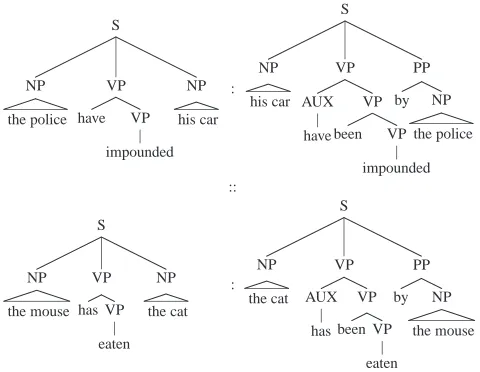
An example of such a proportion is illustrated on Figure 2 with syntactic parse trees.
This definition yields an effective algorithm computing analogical proportions between trees (Stroppa and Yvon, 2005). We consider here a sim-pler heuristic approach, consisting in (i) linearizing labelled trees into parenthesized sequences of sym-bols and (ii) using the analogical solver for words introduced above. This approach yields a faster, al-beit approximative algorithm, which makes analogi-cal inference tractable even for large tree databases.
3.4 Algorithmic issues
We have seen how to compute analogical relation-ships for features whose values are words and trees.
S
NP
the police VP
have VP
impounded NP
his car :
S
NP
his car VP
AUX
have VP
been VP
impounded PP
by NP
the police
::
S
NP
the mouse VP
has VP
eaten NP
the cat :
S
NP
the cat VP
AUX
has VP
been VP
eaten PP
by NP
[image:5.612.316.556.59.245.2]the mouse
Figure 2: Analogical proportion between trees.
If we use, for trees, the solver based on tree lin-earizations, the resolution of an equation amounts, in both cases, to solving analogies on words.
The learning algorithm introduced in Section 2.2 is a two-step procedure: a search step and a trans-fer step. The latter step only involves the resolu-tion of (a restricted number of) analogical equaresolu-tions. When x, y and z are known, solving x:y::z:? amounts to computing the output language of the transducer representing (y • z)\x: the automaton for this language has a number of states bounded by |x| × |y| × |z|. Given the typical length of words in our experiments, and given that the worst-case ex-ponential bound for determinizing this automaton is hardly met, the solving procedure is quite efficient.
The problem faced during the search procedure is more challenging: given x, we need to retrieve all possible triples (y, z, t) in a finite set L such that x:y::z:t. An exhaustive search requires the computation of the intersection of the finite-state automaton representing the output language of (L•L)\xwith the automaton forL. Given the size ofLin our experiments (several hundreds of thou-sands of words), a complete search is intractable and we resort to the following heuristic approach.
Lis first split intoKbins{L1, ..., LK}, with|Li|
small with respect to|L|. We then randomly select kbins and compute, for each binLi, the output
lan-guage of(Li•Li)\x, which is then intersected with
two words from the same bin. It has to be noted that the bins are not randomly constructed: training ex-amples are grouped into inflectional or derivational families. To further speed up the search, we also im-pose an upper bound on the degree of proportions. All triples retrieved during thesek partial searches are then merged and considered for the transfer step. The computation of analogical relationships has been implemented in a generic analogical solver; this solver is based on Vaucanson, an automata ma-nipulation library using high performance generic programming (Lombardy et al., 2003).
4 Experiments
4.1 Methodology
The main purpose of these experiments is to demon-strate the flexibility of the analogical learner. We considered two different supervised learning tasks, both aimed at performing the lexical analysis of iso-lated word forms. Each of these tasks represents a possible instantiation of the learning procedure in-troduced in Section 2.2.
The first experiment consists in computing one or several vector(s) of morphosyntactic features to be associated with a form. Each vector comprises the lemma, the part-of-speech, and, based on the part-of-speech, additional features such as number, gender, case, tense, mood, etc. An (English) put/output pair for this tasks thus looks like: in-put=replying; output={reply;V-pp--}, where the placeholder ’-’ denotes irrelevant features. Lexi-cal analysis is useful for many applications: a POS tagger, for instance, needs to “guess” the possi-ble part(s)-of-speech of unknown words (Mikheev, 1997). For this task, we use the definition of analog-ical proportions for “flat” feature vectors (see sec-tion 3.1) and for word strings (secsec-tion 3.2). The training data is a list of fully informed lexical en-tries; the test data is a list of isolated word forms not represented in the lexicon. Bins are constructed based on inflectional families.
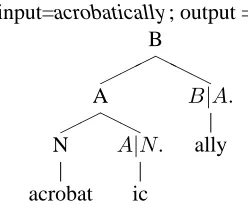
The second experiment consists in computing a morphological parse of unknown lemmas: for each input lemma, the output of the system is one or sev-eral parse trees representing a possible hierarchical decomposition of the input into (morphologically categorized) morphemes (see Figure 3). This kind
of analysis makes it possible to reconstruct the series of morphological operations deriving a lemma, to compute its root, its part-of-speech, and to identify morpheme boundaries. This information is required, for instance, to compute the pronunciation of an un-known word; or to infer the compositional meaning of a complex (derived or compound) lemma. Bins gather entries sharing a common root.
input=acrobatically; output = B
H H H
A
HH
N
acrobat
A|N.
ic
B|A.
[image:6.612.343.467.176.280.2]ally
Figure 3: Input/output pair for task 2. Bound mor-phemes have a compositional type: B|A.denotes a suffix that turns adjectives into adverbs.
These experiments use the English, German, and Dutch morphological tables of the CELEX database (Burnage, 1990). For task 1, these tables contain respectively 89 000, 342 000 and 324 000 different word forms, and the number of features to predict is respectively 6, 12, and 10. For task 2, which was only conducted with English lemma, the total num-ber of different entries is 48 407.
For each experiment, we perform 10 runs, using 1 000 randomly selected entries for testing1. Gen-eralization performance is measured as follows: the system’s output is compared with the reference val-ues (due to lexical ambiguity, a form may be asso-ciated in the database with several feature vectors or parse trees). Per instance precision is computed as the relative number of correct hypotheses, i.e. hypotheses which exactly match the reference: for task 1, all features have to be correct; for task 2, the parse tree has to be identical to the reference tree. Per instance recall is the relative number of refer-ence values that were actually hypothesized. Preci-sion and recall are averaged over the test set; num-bers reported below are averaged over the 10 runs.
Various parameters affect the performance:k, the number of randomly selected bins considered during the search step (see Section 3.4) and d, the upper
1
bound of the degree of extracted proportions.
4.2 Experimental results
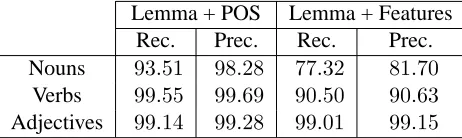
Experimental results for task 1 are given in Tables 1, 2 and 3. For each main category, two recall and pre-cision scores are computed: one for the sole lemma and POS attributes (left column); and one for the lemma and all the morpho-syntactic features (on the right). In these experiments, parameters are set as follows:k= 150andd= 3. Askgrows, both recall and precision increase (up to a limit);k = 150 ap-pears to be a reasonable trade-off between efficiency and accuracy. A further increase ofddoes not sig-nificantly improve accuracy: takingd= 3ord= 4 yields very comparable results.
Lemma + POS Lemma + Features
Rec. Prec. Rec. Prec.
[image:7.612.72.306.272.453.2]Nouns 76.66 94.64 75.26 95.37 Verbs 94.83 97.14 94.79 97.37 Adjectives 26.68 72.24 27.89 87.67
Table 1: Results on task 1 for English
Lemma + POS Lemma + Features
Rec. Prec. Rec. Prec.
[image:7.612.73.304.486.555.2]Nouns 71.39 92.17 54.59 74.75 Verbs 96.75 97.85 93.26 94.36 Adjectives 91.59 96.09 90.02 95.33
Table 2: Results on task 1 for Dutch
Lemma + POS Lemma + Features
Rec. Prec. Rec. Prec.
Nouns 93.51 98.28 77.32 81.70 Verbs 99.55 99.69 90.50 90.63 Adjectives 99.14 99.28 99.01 99.15
Table 3: Results on task 1 for German
As a general comment, one can note that high generalization performance is achieved for lan-guages and categories involving rich inflectional paradigms: this is exemplified by the performance on all German categories. English adjectives, at the other end of this spectrum, are very difficult to analyze. A simple and effective workaround for this problem consists in increasing the size the sub-lexicons (Liin Section 3.4) so as to incorporate in a
given bin all the members of the same derivational (rather than inflectional) family. For Dutch, these results are comparable with the results reported in (van den Bosch and Daelemans, 1999), who report an accuracy of about 92% on the task of predicting the main syntactic category.
Rec. Prec.
Morphologically Complex 46.71 70.92
Others 17.00 46.86
Table 4: Results on task 2 for English
The second task is more challenging since the ex-act parse tree of a lemma must be computed. For morphologically complex lemmas (involving affixa-tion or compounding), it is nevertheless possible to obtain acceptable results (see Table 4, showing that some derivational phenomena have been captured. Further analysis is required to assess more precisely the potential of this method.
From a theoretical perspective, it is important to realize that our model does not commit us to a morpheme-based approach of morphological pro-cesses. This is obvious in task 1; and even if task 2 aims at predicting a morphematic parse of in-put lemmas, this goal is achieved without segment-ing the input lemma into smaller units. For in-stance, our learner parses the lemmaenigmatically
as:[[[.N enigma][.A|N ical]]B|A. ly], that is with-out trying to decide to which morph the orthographic
t should belong. In this model, input and output spaces are treated symmetrically and correspond to distinct levels of representation.
5 Discussion and future work
In this paper, we have presented a generic analog-ical inference procedure, which applies to a wide range of actual learning tasks, and we have detailed its instantiation for common feature types. Prelimi-nary experiments have been conducted on two mor-phological analysis tasks and have shown promising generalization performance.
lin-guistic entities; they can thus be used to devise flex-ible and effective learners for NLP tasks.
This work is currently being developed in various directions: first, we are gathering additional experi-mental results on several NLP tasks, to get a deeper understanding of the generalization capabilities of our analogical learner. One interesting issue, not addressed in this paper, is the integration of vari-ous forms of linguistic knowledge in the definition of analogical proportions, or in the specification of the search procedure. We are also considering al-ternative heuristic search procedures, which could improve or complement the approaches presented in this paper. A possible extension would be to define and take advantage of non-uniform distributions of training instances, which could be used both during the searching and ranking steps. We finally believe that this approach might also prove useful in other application domains involving structured data and are willing to experiment with other kinds of data.
References
David W. Aha. 1997. Editorial. Artificial Intelligence
Review, 11(1-5):7–10. Special Issue on Lazy
Learn-ing.
Gavin Burnage. 1990. CELEX: a guide for users. Tech-nical report, University of Nijmegen, Center for Lexi-cal Information, Nijmegen.
Walter Daelemans, Antal Van Den Bosch, and Jakub Za-vrel. 1999. Forgetting exceptions is harmful in lan-guage learning. Machine Learning, 34(1–3):11–41.
B.V. Dasarathy, editor. 1990. Nearest neighbor (NN)
Norms: NN Pattern Classification Techniques. IEEE
Computer Society Press, Los Alamitos, CA.
Brian Falkenheimer and Dedre Gentner. 1986. The
structure-mapping engine. In Proceedings of the
meet-ing of the American Association for Artificial Intelli-gence (AAAI), pages 272–277.
Dedre Gentner, Keith J. Holyoak, and Boicho N. Konikov, editors. 2001. The Analogical Mind. The MIT Press, Cambridge, MA.
Douglas Hofstadter and the Fluid Analogies Research group, editors. 1995. Fluid Concepts and Creative
Analogies. Basic Books.
Keith J. Holyoak and John E. Hummel. 2001. Under-standing analogy within a biological symbol system. In Dedre Gentner, Keith J. Holyoak, and Boicho N.
Konikov, editors, The analogical mind, pages 161– 195. The MIT Press, Cambridge, MA.
Yves Lepage. 1998. Solving analogies on words: An algorithm. In Proceedings of COLING-ACL ’98, vol-ume 2, pages 728–735, Montr´eal, Canada.
Yves Lepage. 1999a. Analogy+tables=conjugation.
In G. Friedl and H.G. Mayr, editors, Proceedings of
NLDB ’99, pages 197–201, Klagenfurt, Germany.
Yves Lepage. 1999b. Open set experiments with direct analysis by analogy. In Proceedings of NLPRS ’99, volume 2, pages 363–368, Beijing, China.
Sylvain Lombardy, Rapha¨el Poss, Yann R´egis-Gianas, and Jacques Sakarovitch. 2003. Introducing Vaucan-son. In Proceedings of CIAA 2003, pages 96–107.
Andrei Mikheev. 1997. Automatic rule induction for unknown word guessing. Computational Linguistics, 23(3):405–423.
Vito Pirrelli and Franc¸ois Yvon. 1999. Analogy in the lexicon: a probe into analogy-based machine learning of language. In Proceedings of the 6th International
Symposium on Human Communication, Santiago de
Cuba, Cuba.
Tony A. Plate. 2000. Analogy retrieval and processing
with distributed vector representations. Expert
sys-tems, 17(1):29–40.
Jacques Sakarovitch. 2003. El´ements de th´eorie des
au-tomates. Vuibert, Paris.
Royal Skousen. 1989. Analogical Modeling of
Lan-guage. Kluwer, Dordrecht.
Nicolas Stroppa and Franc¸ois Yvon. 2005. Formal
models of analogical relationships. Technical report, ENST, Paris, France.
Paul Thagard, Keith J. Holoyak, Greg Nelson, and David Gochfeld. 1990. Analog retrieval by constraint satis-faction. Artificial Intelligence, 46(3):259–310.
Antal van den Bosch and Walter Daelemans. 1999.
Memory-based morphological processing. In
Pro-ceedings of ACL, pages 285–292, Maryland.
D. Randall Wilson and Tony R. Martinez. 2000. Reduc-tion techniques for instance-based learning algorithms.
Machine Learning, 38(3):257–286.
Franc¸ois Yvon. 1999. Pronouncing unknown words us-ing multi-dimensional analogies. In Proc. Eurospeech, volume 1, pages 199–202, Budapest, Hungary.
Franc¸ois Yvon. 2003. Finite-state machines solving