Topological Parsing
Gerald Penn
Department of Computer Science
University of Toronto
[email protected]
Mohammad Haji-Abdolhosseini
Department of Linguistics
University of Toronto
[email protected]
Abstract
We present a new grammar formalism for parsing with freer word-order lan-guages, motivated by recent linguistic research in German and the Slavic lan-guages. Unlike CFGs, these grammars contain two primitive notions of con-stituency that are used to preserve the semantic or interpretational aspects of phrase structure, while at the same time providing a more efficient backbone for parsing based on word-order and conti-guity constraints. A simple parsing al-gorithm is presented, and compilation of grammars into Constraint Handling Rules is also discussed.
1 Motivation
There is a growing awareness among computa-tional linguists that, in order for the funccomputa-tional- functional-ity of current real-world natural language applica-tions to progress to the next level, access to the-matic roles and gramthe-matical function assignment, i.e., "who did what to whom," will be just as im-portant as a probabilistic model's ability to predict the next word in a string. In striving to represent useful meaning relations, we, and the annotated corpora we use, have dutifully followed the com-mon assumption in linguistics that the assignment of relations are artifacts of configurational ones — primitive relationships between nodes in phrase-structure trees licensed by a grammar.
In the case of parsing with English, there have been some remarkable successes in the last five years, most notably that of Collins (1999) and sev-eral successive improvements, who use knowl-edge about headedness and subcategorisation, tra-ditional n-grams and some information about un-bounded dependencies to dramatically improve on our ability to predict the most likely phrase-structure tree given a string of words — with the tacit assumption that this tree has something to do with interpretation. While there have also been more modest successes with purely dependency-based grammars in the realm of freer word-order (FWO) languages, these often map dependency trees to phrase structure trees, and even agreeing on what the best phrase-structure tree should be in these languages is not easy. Predicting the tree from data, moreover, seems utterly intractable, given the number of movement operations and empty projections that would be involved in the standard approach.
of contiguity do not agree. The constraints from these levels of linguistic structure interact, and phrases — of some variety — are the basic units for defining this interaction. For computational purposes, these constraints are interesting because they can be used to restrict search and, in the con-text of statistical parsing, to militate against less likely interpretations.
2 Kinds of Constituency
There has, in fact, been a considerable under-current of linguistics research, beginning as early as Curry (1961), that challenges the Chomskyan assumption that one flavour of constituency ex-ists on which constraints from all of these lev-els of linguistic structure can happily agree. Curry (1961) distinguished what he called tec-togrammatical structure, on which semantic inter-pretation takes place, from a pheno grammatical structure, which deals with word order, morphol-ogy and (dis)contiguities. Much of this work, in-cluding Curry's, has not been very formal. The purpose of this paper is to present one possible formalisation of it, and in a manner particularly consistent with how Curry's work has developed within HPSG (Kathol, 2000).
The one exception to this informality, Lexical-Functional Grammar (Kaplan and Bresnan, 1982), is worth noting, since it is also widely used by computational linguists. LFG, to its credit, had the foresight to distinguish two different kinds of structure very early on. One of them, func-tional or f-structure, is represented using a feature structure that directly indicates thematic role and grammatical function assignment, among other things, without any appeal to a primitive "f-constituent." While a more conservative represen-tation (a phrase structure tree) will be used here for tectogrammatical structure, it would be entirely consistent with the spirit of the present work to use feature structures or even dependency trees in the context of this level of phrase structure. In LFG, the other, constituent or c-structure, which corresponds roughly to phenogrammatical struc-ture, uses a phrase structure tree labelled with very tectogrammatical-looking categories: nouns, PPs, on occasion NPs, etc. Where these are not realised as contiguous substrings, c-structure trees are
gen-erally just flatter and wider-branching, in order to match the daughters of these di scontiguous con-stituents directly, contiguously, and in the accept-able orders.
What is missing here is a primitive in the for-malism for talking about contiguous substrings that may not have a semantic, tectogrammatical significance, and a primitive for talking about non-tectogrammatical regions over which word order constraints are expressed. Examples of the former are quite evident in the Slavic languages, such as with second-position clitics. As their name sug-gests, these clitics occur after something in first position. That something can be a normal tec-togrammatical constituent, like an NP, or it can be a prosodic word, such as a preposition and first adjective of an NP (Browne, 1974), or, in certain circumstances, it can be a sequence of discourse-linked NPs (Penn, 1997). Of the latter, proba-bly the best-known example is the German Mit-telfeld. Within this field, pronouns generally pre-cede prosodically heavier NPs (and with a partic-ular order prescribed among multiple pronouns), and temporal adjuncts generally precede locatival adjuncts. It is false to claim that these ordering constraints holds only within a VP or over an en-tire clause. The Mittelfeld is, in fact, defined in linear terms, as the substring bounded on the left by either a complementizer or a finite verb, and on the right by a periphrastic verbal complex.
other, an interpretive tectogrammatical tree struc-ture with potentially crossing links. Along with these come constraints that associate substructures from the two representations, in a very similar spirit to LFG structural correspondence functions. The idea of using topological fields as a guide for general parsing appears to have originated with Oliva (1992); more recent work primarily folds in parochial facts from German, includ-ing Duchier (2001), which presents German topo-logical parsing as a constraint satisfaction prob-lem. The present approach actually received its inspiration initially from Slavic language word-order data, but can be applied equally well to German. Synchronous tree-adjoining grammars (Shieber and Schabes, 1990) bear some resem-blance to the parallel derivations used here, al-though the same constituents are used there in both.
3 Formalism
We can state three characterizing assumptions that restrict the expressive power of this formalism:
• Topological Linearity: all word-order
con-straints can be witnessed by a topology de-fined on some linear region.
• Topological Locality: discontiguities may
exist due to scrambling, but they are not unbounded.1 Hence all discontiguities can
be characterized in some local region of bounded topological size.
• Qualified Isomorphy: While linear and
lo-cal regions are not always the same as tra-ditional (tectogrammatical) constituents, they themselves are the same. Furthermore, prin-ciples governing linear order and discontigu-ity are stated relative to the smallest common region that witnesses the substrings being or-dered or dislocated.
Topological Linearity agrees with the assumption made in traditional ID/LP grammars that linear
1While we do not deny the existence of unbounded depen-dencies, we believe they deserve a much different treatment. Our current approach has been to handle them within the tec-togrammatical categories themselves, such as in the SLASH feature of an HPSG feature structure. These will not be dis-cussed further here.
precedence constraints apply within some region, although with ID/LP, that region is a tectogram-matically defined subtree. Linearity can be en-forced by assigning substrings to different topo-logical fields. Compared to relative statements of linear order, e.g., NP < VP, topological fields al-low one to make more absolute statements about linear position that are crucial for thinking about FWO syntax in a more modular fashion. Qualified Isomorphy refines an assumption made in earlier work on topological fields that every word sim-ply bears a unique topological field. Topological structure is nested because the tectogrammatical structures it constrains are. Using phenogrammat-ical trees of nested regions allows us to order the words of an embedded clause, for example, with-out contradicting their placement relative to the words of a matrix clause because which field a word bears is relative to the region being consid-ered.
We begin with the basic primitives from which grammars are constructed:
Definition 1 A topological signature is a
quintu-ple, (L, Field, Region, E, Phon), such that:
• is a constraint language for describing tee-togrammatical categories, with a countable set of variables,
• Field is a set of topological fields, such as the German Mittelfeld,
• Region is a set of regions, such as clauses, relative to which topological fields are de-fined,
• E is a lexicon, and
• Phon : E* is a function that maps el-ements in an interpretation, I, of
L
to phono-logical strings.G
could be as simple as variables and constants representing atomic categories like NP, or ade-scription logic for feature structures, for example. It can be a language with disjunction, although there is obviously a computational cost to be paid for this.
Definition 2 A set of topological fields, Field,
• f E Desc (Field) (unique field),
• {f} E Desc(Field) (optional field),
• f* E Desc (Field) (0 or more fields),
• f+ E Desc(Field) (1 or more fields).
We can now define our phenogrammatical structures. These are the extended CFG rules that divide regions topologically into fields:
Definition 3 Given a topological signature, a
P
>
phenogrammatical rule is of the form r d1... 04,, where r E Region, the di Desc(Field), and n > 0.
When we look at the parse tree that corresponds to a derivation with a set of pheno-rules over some string, we see that every field and region can ac-count for some contiguous substring that its sub-tree dominates. This is called the yield of that field or region. We can extend this notion of yield to tectogrammatical categories, although the substrings that correspond to these may not be contiguous. We could, following Johnson (1985), think of yields as bit vectors defined over a fixed length corresponding to the length of the input, for example.
Structural constraints constrain pheno-yields in terms of tecto-yields and vice versa. We look at them in terms of whether one covers another, i.e., substring inclusion.
Definition 4 Given a topological signature, the
structural constraints, C, over that signature are, for every 0 E L, f E Field, and r E Region:
• covering: 0 covers f, covers r,
f covered_by 0, r covered_by 0,
• matching: 0 matches f, 0 matches r,
f matched_by 0, r matched_by 0,
• linkage: rkf,f ,ri,
• compaction: (0).
Structural constraints are interpreted with univer-sal quantification on their left-hand sides and exis-tential quantification on their right hand sides, so
REL f is not equivalent to its dual f REL _by 0. Covering constraints specify that the phonological
yield of every/some tectogrammatical category de-noted by 0 consumes, or includes, the phonolog-ical yield of some/every field or region f T., al-though the yield of 0 may also extend into other phenogrammatical constituents. A special case of covering is matching, e.g., 0 matches f. This is when the phonological yield of every/some tec-togrammatical category denoted by 0 is exactly the same as the phonological yield of some/every field or region f/r. As shorthand, we also allow < I r for 0 covers f flr covered_by 0. Similarly, matching constraints with universal quantification on both sides are written as
0
f Ir.
Linkage constraints are essentially the converse of phenogrammatical structural rules: they license the links in a phenogrammatical tree with field mothers and region daughters. Linkage rules are always unary-branching. A field contains at most one region, with the alternative being one lexical item, i.e., a pre-terminal field.
Compaction constraints indicate that a tec-togrammatical constituent has a phonological yield with no discontiguities. To these, we can also add universally quantified implication con-straints, 0 0, which are the usual ones from constraint-based grammar — any tectogrammati-cal constituent in the denotation of 0 is also in the denotation of '0.
We are now in a position to introduce the tec-togrammatical rules, which tell us how to build tectogrammatical structures. These are subject to the universally quantified constraints above, but can also specify constraints on a particular daugh-ter:
Definition 5 Given a topological signature and
n E N, the indexed structural constraints, C„, over that signature are, for every 1 < i,j < n,
0 < k < n, f E Field, and r E Region:
• covering: i covers f, i covers r,
• matching: i matches f/r, f/r matched_by
• precedence: i < j,
• immediate precedence: i < < j,
• compaction: (k).
tectogrammatical rule is of the form 00 T
>
01 ... 0
n;
p, where the 0,E
,C, n > 1, and pE
The indices in indexed constraints refer to the mother or daughter constituents in a tectogram-matical rule. In the absence of any indexed con-straints, a tecto-rule makes no assumptions about the linear relationships among its daughters. Rel-ative precedence and immediate precedence can be used to describe traditional phrase structure, where it exists, which can also be provided as an idiom: cbo > 01 ... On. Note that, as with
traditional ID/LP, compaction can be specified in the absence of precedence, which serves to spec-ify contiguity separately from linear order; un-like ID/LP, precedence can be specified in the ab-sence of contiguity (Goetz and Penn, 1997; Suhre, 1999). Manandhar (1995) has a similar approach to linear precedence.
4 Parsing
Just as with CFGs, there are a number of different control strategies that could be imagined for pars-ing with this topological formalism. The one pre-sented here incorporates elements that are reminis-cent of naive bottom-up, top-down and left-corner parsing. Information about headedness or statisti-cally estimated parameters would be incorporated into a more sophisticated large-scale parser. For simplicity, the exposition here assumes that for every field or region, f I r, there is at most one structural constraint of each variety that univer-sally quantifies over f/r.
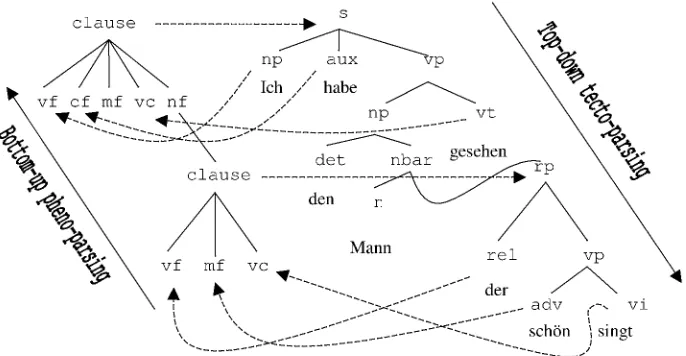
The flow of the parsing algorithm is shown schematically running on a German example in Figure 1. Parsing begins after consulting a lex-icon to find the tecto-categories associated with each word of input. These categories are then mapped by structural constraints to topological fields or regions (leftward arrows). From there, structure is built bottom-up using pheno-rules, much as in a bottom-up CFG parser. In Ger-man, it is often assumed that clauses have the fol-lowing topology defined on them:
clause vf, cf,mf*, {vc}, Infl.
where m f marks the Mittelfeld mentioned above. It is listed as mf* because the Mittelfeld can
con-tain a sequence of regions. At fields or regions f ir where there are structural constraints universally quantified on f Ir, we then predict some tecto-category (rightward arrows). In the figure above, for example, it is assumed that there is a constraint in German that:
clause matched_by (s V rp V cp).
which encodes our knowledge about the contigu-ity and position of these three categories' yields. Parsing proceeds in tectogrammar top-down in a manner restricted so that only what is topologi-cally accessible to f /r can be matched, as ex-plained below. During top-down parsing, deriva-tions are checked against structural constraints universally quantified on descriptions that are consistent with the current category. Further bottom-up pheno-parsing can in principle be inter-leaved with top-down tecto-prediction in any man-ner.
4.1 Edges
Specifically, in a chart-parser implementation, we require four kinds of edges:
• pheno-edges: by parsing right-to-left and
in-terpreting pheno-rules left-to-right, we need only passive (inactive) edges for bottom-up pheno-parsing. These record the field/region recognised and the interval spanned by the edge.
• active tecto-edges: these are the edges predicted
during pheno-parsing. They record the category
predicted, the field/region that predicted them,
called the sponsor, and two bit vectors: one de-noting the substring that can be used (can-BV), and one denoting the substring that can optionally be used (opt-BV). Their difference is what must be consumed by the category being sought. They also carry a set of keys for topological accessibil-ity (explained below).
• passive tecto-edges: They record the category found, the sponsor that predicted them, a bit
vec-tor denoting the substring used (used-BV), and a set of keys that they confer.
• frozen tecto-edges: These are essentially active
det clause
clause
np aux
habe
np vt C.k.„
'
---nb a r gesehen °,34tfA
-dp,
den
vf mf vc rel vp
der Z\ adv vi
--- schirin 1 singt
[image:6.595.98.441.86.264.2]--Mann vf of mf vc nf
Figure 1: Flow of control in the topological parsing algorithm.
4.2 Rule Operation
There are four main combinations we must then implement once the input has been scanned:
• pheno-completion: given pheno rule r d1 d and pheno-edges for d1 dr,, add a
pheno-edge for r with the union of their intervals (likewise for linking)
• tecto-prediction: given an active tecto-edge with category consistent with 00, and tecto-rule
00 >
predict 01 with the same spon-sor, can-BV, and keys, but with an opt-BV equal to its cB V — everything is optional because an-other daughter may consume the rest.• tecto-completion: given an active tecto-edge with category consistent with 00, tecto-rule
T
00 > On;
p, passive tecto-edges consis-tent with 01. 03. Then:- non-final if j < n — 1, predict an active tecto-edge for 03+1, with can-BV and opt-BV equal to the can-opt-BV of 00 less the used-BVs of the passive edges, the keys of the pas-sive edge for 0j, and the same sponsor.
penultimate: If j = n — 1, then predict the same for 0n, but set its opt-BV to the opt-BV of 00 less the used-B Vs of the passive edges — this is the last daughter and must consume the remainder of what is required.
- ultimate: If j = n, then check that what the union of the used-BVs does not cover in the can-BV of 00 is in opt-BV, and create a pas-sive tecto-edge for 0, with the unions of the
keys and used-B Vs of the passive daughters. If the active edge was an initial prediction from pheno-structure, add the sponsor to the set of keys too. This can be interpreted as an exchange in which some higher active edge will be given access to this sponsor's yield in exchange for using this passive edge.
If a passive edge is lexical (produced by the in-put scan), we must ensure that its bit is topologi-cally accessible to the sponsor of the active edge. If a tecto-rule has indexed constraints, then these constraints must be checked in addition (with bit-vector arithmetic, mainly).
• tecto-unfreezing: given an active tecto-edge and a frozen tecto-edge with consistent categories and accessible sponsors, if the req-By of the frozen edge is contained in the can-BV of the ac-tive edge, then create a new acac-tive tecto-edge, with the same sponsor and can-BV, with an opt-BV less the req-BV, and a set of keys augmented by the sponsor of the frozen edge. This can be interpreted as an exchange in which the active edge promises to consume req-B V, and in turn receives a key to access some topological field/region.
4.3 Structural Constraint Operation
The first three of these are a variation on context-free parsing, in which bit-vectors are main-tained instead of intervals. Active tecto-edges are initially predicted from pheno-structure by
can-us
/
NPI
7/....,kuxp..., /PP
Pro VP Aux
Ich sa te er I NP/ V hatI mit NP
NP VP
/N
Pro V CP
npr\ TVI
I I
1\11 gesehen
N I
Mann dem Teleskop
[image:7.595.353.529.274.407.2]den
Figure 3: The well-formed tecto-tree for Figure 2.
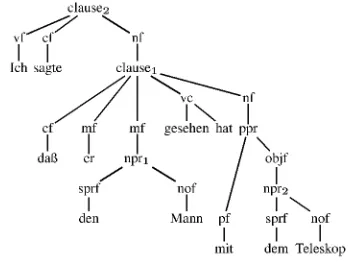
clause2
vi ci N'N'nf
Ich sagte clausei
vc nf
daf3 npri
sprf nof
mf gesehen hat ppr INI n
objf
pr2
Pf sprf nof
den Mann
mit dem Teleskop
BV of that interval without necessarily finishing pheno-parsing. Once we have built the
0,
we will refuse admission to this f Ir to higher active edges unless they agree to use0.
In this way, we can en-sure that every f Ir contains a 0 in the final tecto-structure for the input.Frozen edges are added to the chart by f Ir covered_by 0 constraints. We know that f Ir should be consumed by a 0 in tectogrammar, but 0 may be larger. Frozen edges refuse admission to
f/r
to every active edge except those trying to build a 0.Constraints of the form 0 matches f Ir restrict the can-BVs of active edges for 0 to the maximal topologically accessible
f
/rs they cover, and en-force the requirement that the passive edges of0
match some f Ir interval. Constraints of the form 0 covers f Ir enforce their interpretation on pas-sive 0 edges, and eliminate active edges in which can-BV covers no f Ir.
Clearly, the idioms introduced above can be compiled specially to exploit the combination of constraints they provide. Input is accepted as grammatical if it is possible to build both a span-ning pheno-edge of a distinguished region and a spanning tecto-edge of a distinguished category.
4.4 Topological Accessibility
Not all subconstituents in tectogrammar are com-patible with each other just because their cate-gories combine in a tecto-rule. The reason for this is that multiple pheno-structures are being built si-multaneously in the chart. These pheno-structures can have different fields and thus, unlike CFGs, different structural constraints. As a result, we need some means of ensuring that passive edges from one pheno-tree are not being used by ac-tive edges predicted by another pheno-tree with incompatible structural constraints.
In order for a lexical passive edge to be incor-porated into a tecto-structure, there must be an ac-cessible path in the corresponding pheno-structure from the sponsor of the active edge at the root of the tecto-structure down to the lexical item. Every daughter field/region is accessible to its mother in a pheno-structure, but transitive closure of this re-lation is blocked by fields/regions that appear on the left-hand-sides of structural constraints, i.e.,
the fields/regions that predict tecto-edges. The sponsor of an active edge only has access through a blocking field/region if it possesses the key is-sued by that field/region. This key is given to the predicting edge only if it agrees to use up all the daughters under the blocking node.
[image:7.595.344.542.503.680.2]Topological inaccessibility makes parsing of scrambling-related constructions more efficient. In a typical grammar, active tecto-edges are ei-ther prevented outright from using large portions of inaccessible input, or required to use an exist-ing passive edge as the only means of access. Fig-ure 2 shows a well-formed pheno-tree for German
Figure 2: A well-formed pheno-tree for German.
with not only clauses but NP regions and PP re-gions that define those categories' internal struc-tures. Figure 3 shows its corresponding
NP edge for npri. The other embedded NP is in-side a blocking ppr, and the subject NP is not in the yield of the clausej that sponsored this VP. Notice that the internals of clausej are inaccessible to the
VP dominating sagte apart from the CP it offers because of a matched_by constraint. The result is that clauses are parsed largely independently.
5 Future Work
We are currently implementing a compiler based on this formalism in SICStus Prolog. The input to the compiler is a topological grammar and the output is a Prolog parser for that grammar. While there are no corpora sufficiently annotated for this model, the topologically annotated Verbmobil II corpus of German comes the closest. Based on a grammar with 74 phenogrammatical rules and 72 tectogrammatical rules extracted from 87 reanno-tated sentences of this corpus, our parser takes an average of 8.26 seconds per sentence to parse a larger set of 125 sentences from the same corpus on a Celeron 600 MHz computer running Win-dows XP. Much of the VM-II corpus consists of relatively simple utterances, and there were no re-cursive tectogrammatical rules, a significant ob-stacle for any purely top-down parser. The next step in implementation is to integrate bottom-up or mixed control into tectogrammatical parsing to more closely constrain the number of active edges predicted. A great deal more static analysis of parsing rule interaction and morphological anal-ysis must also be performed for tractable parsing.
The space of parsing algorithms that this for-malism supports needs to be mapped out to match syntactic properties of grammars with optimal al-gorithms for them. A significant amount of ex-perimentation also needs to be done on provid-ing the right higher-level constructs to grammar-writers that will reduce the complexity that comes with using this more flexible formalism. This may also lead to simplifications that could even-tually be parametrised and statistically estimated to produce efficient large-scale language models for FWO languages that can capture more seman-tic information.
References
W. Browne. 1974. On the problem of enclitic placement in Serbo-Croatian. In R. D. Brecht and C. V. Chvany, editors, Slavic Transformational
Syn-tax, volume 10 of Michigan Slavic Materials. Dept.
of Slavic Languages and Literatures, University of Michigan.
. Collins. 1999. Head-Driven Statistical Models for
Natural Language Parsing. Ph.D. thesis, University
of Pennsylvania.
H. Curry. 1961. Some logical aspects of grammati-cal structure. In Jacobson, editor, Structure of
Lan-guage and its Mathematical Aspects: Proceedings of the Twelfth Symposium in Applied Mathematics,
pages 56-68. American Mathematical Society.
D. Duchier. 2001. Lexicalized syntax and topology for non-projective dependency grammar. In G.-J. Krui-jff, editor, Proceedings of the Joint Formal
Gram-mar Conference /Seventh Meeting on the Mathemat-ics of Language.
T. Goetz and G. Penn. 1997. A proposed linear spec-ification language. Arbeitspapier des SFB 340 134, Ebarhard-Karls-Unviersitat Tubingen.
. Johnson. 1985. Parsing discontinuous constituents. In Proceedings of the 23rd Annual Meeting of the
Association for Computational Linguistics.
R. Kaplan and J. Bresnan. 1982. Lexical-functional grammar: A formal system for grammatical repre-sentation. In J. Bresnan, editor, The Mental
Repre-sentation of Grammatical Relations. MIT Press.
A. Kathol. 2000. Linear Syntax. Oxford Univ. Press.
S. Manandhar. 1995. Deterministic consistency check-ing of LP constraints. In Proceedcheck-ings of the 7th
Conference of the EACL, pages 165-172.
K. Oliva. 1992. The proper treatment of word or-der in HPSG. In Proceedings of the 14th
Inter-national Conference on Computational Linguistics,
volume 1, pages 184-190.
G. Penn. 1997. On the plausibility of purely structural multiple wh-fronting. In Proceedings of the
Sec-ond European Conference on Formal Description of Slavic Languages.
S. Shieber and Y. Schabes. 1990. Synchronous tree ad-joining grammars. In Proceedings of the 13th
Inter-national Conference on Computational Linguistics,
volume 3, pages 1-6.