Power Aware Encoding for the Instruction
Address Buses Using Program Constructs
Prakash Krishnamoorthy
∗and Meghanad D. Wagh
∗Abstract— This paper examines the address traces produced by various program constructs. By using the correlation induced by the program constructs within these traces, we develop a scalable bus en-coding algorithm to significantly reduce the switching activity on the instruction address bus. Simulation results for Spec2000 benchmarks show that for mod-est coding complexity, the proposed scheme reduces switching activity on the instruction address bus by as much as 88% and the overall bus power by as much as 71%.
Keywords: Low power, Switching activity, Address bus, Embedded systems.
1
Introduction
With the growing demand for mobile and embedded sys-tems, power consumption has become an important de-sign criteria. For many such systems built around pro-cessor cores or custom ASICs, off chip bus power [1] rep-resents a dominant portion of the total system power. This work focuses on systems that use Harvard archi-tecture employing independent data and instruction ad-dress buses. Examples of such systems range from simple embedded processor based systems to systems based on cores implemented on Programmable Gate arrays where bus activity is a significant source of power dissipation [2].
The problem of reducing power in on-chip address and data bases in deep submicron technologies has been ap-proached on various fronts [3]. For such buses, crosstalk and leakage are major contributors towards total bus power as opposed to capacitance of the off-chip buses. In the former, attention has been given to reduction of crosstalk [4, 5] and leakage power consumption that arise due to the large number of buffers that are used to man-age signal slew rates and intrinsic delays. Based on our experience working with off-chip buses, crosstalk is not the main factor as ample time and effort is spent in rout-ing these bus traces on multilayer boards. Further, the components on the board exhibit little or no leakage. In these cases, interconnect bus capacitance is the major contributor to bus power and methods to reduce bus
tran-∗Department of Electrical and Computer Engineering, Lehigh
University, Bethlehem, PA 18015. Tel: (610)758-4142, Email: [email protected], [email protected]
sition activity are extremely important. We do precisely that in our work where we show that a method based on program constructs delivers the best possible reduction in switching activity on the instruction address buses. We also demonstrate the power reduction by simulating and comparing our method with three best methods us-ing spec2000 integer benchmarks run on the simple-scalar tool set [6]. For work on power reduction methods on data buses, the interested reader can refer elsewhere [1, 7].
Off-chip buses with their large capacitive loads consume a substantial amount of power for every transition. In an instruction address bus, when addresses change sequen-tially from 0 to 2n
, one can expect as many as 2n
−1 transitions on the bus. This number could be even larger (on an average, n2n−1
) if the 2n
address transitions are random. Naturally, reduction of switching activity asso-ciated with buses has attracted a lot of attention. Bus switching may be reduced by encoding the bus data. Such encoding typically takes into account the predictability of the data. Unfortunately, in a general computing en-vironment where bus data is not deterministic, one can only exploit the statistical properties of the samples be-ing transferred on the bus, and in particular, the tempo-ral correlation of successive samples. The statistics that have been employed to date include properties of the in-dividual samples (such as their weights), their temporal correlation and their variance (or localization). This pa-per shows that by exploiting the statistics resulting from common program constructs, one can further reduce the address bus switching activity significantly.
Bus encoding techniques can be grouped in three broad categories. The first category of encoding algorithms such as theBus Invert Method[8],Frequent Value codes[9] and
Self organizing lists[10] are designed to use statistics of individual samples. The Bus Invert Method and its vari-ants judiciously complement the bus data based on its weight to guarantee an upper bound on the amount of switching activity. Frequent Value codes and Self orga-nizing lists memorize addresses that appear on the ad-dress bus repeatedly and map them to code words with lower switching activity.
based on the principle that in the sequential code execu-tion, instruction addresses increase by a constant stride. Since the uniformly increasing addresses can be easily re-generated at the receiver, bus contents may be frozen to completely eliminate bus switching. T0 codes require an additional bus line to indicate whether the addresses are in stride increments or random jumps. It is also pos-sible to modify the T0 code such that the requirement of additional bus line is eliminated [13]. Encodings that use several combinations of bus-invertandT0 encodings have also been developed [14]. The concept of correlation between consecutive samples can be extended to correla-tion between nearby samples. TheOffset XOR SM and
Offset XOR SMC codes minimize switching activity for addresses spaced by small offsets [13]. This may work well for data organized in small structures. While all these techniques work very well for sequential code, they deliver inferior performance when they encounter (large) loops, jumps and subroutine calls where there is a repet-itive address pattern.
The third category of bus encoding techniques such as the
Work Zone Encoding(WZE) [15] and theDynamic Sector Encoding(DSE) [16] attempt to remedy the poor perfor-mance of previous bus encoding methods in the presence of multiple sequences of correlated addresses. These tech-niques partition program address traces into segments and assume that addresses within a segment are highly correlated. TheDynamic Sector Encodinguses two regis-ters that track up to two sequences of correlated addresses at a time. This technique produces no switching for con-secutive addresses that increase by a stride, but cannot cope with more than two address sequences. For every monitored zone in the WZE method, a zone register holds some address from that zone. The encoding algorithm transmits on the bus a zone identifier and the distance of the current address from the address in the relevant zone register. The Work zone encoding technique deliv-ers superior performance in terms of switching activity reduction when encountering multiple address sequences, but the encoder and decoder themselves consume signifi-cant amount of power. So, between sector and work zone encoding, the effective method seems to be dependent on the ratio of the capacitance of internal nets to the exter-nal bus lines.
In this work, we present a bus encoding method whose encoder/decoder power consumption and switching ac-tivity reduction is far superior to that ofWZEandDSE
methods. The bus encoding algorithm presented here ex-amines instruction address traces issued by the processor in response to program constructs such as sequential exe-cution, loops, while statements, if-then-else blocks, jumps and subroutine calls. Each of these constructs produces address sequences that can be characterized as groups of addresses that change by a fixed stride. The starting ad-dress of each group depends on a specific branch adad-dress
in the program. By saving these start addresses, the re-ceiver can guess the current address on the bus from the group to which it belongs. Since minimal information about the address needs to be transferred, a power effi-cient bus transfer occurs.
The rest of the paper is organized as follows. Section II illustrates correlation between program constructs and the address trace. This section also presents the proposed
Program Construct Based Encoding (PCBE) algorithm that uses this correlation. Simulation results comparing the performance of the PCBE algorithm with other bus encoding algorithms is presented in Section III. Section IV presents our conclusions.
2
New Bus Encoding Algorithm
There is a close relationship between program constructs and the switching activity on the Instruction address bus. This relationship provides significant insight to develop-ing an efficient bus encoddevelop-ing algorithm.
Program instructions can be broadly classified as se-quential and branching. Sese-quential constructs constitute about 70% of any typical program [17]. Non-branching portion of a code produces an instruction address trace in which consecutive addresses increase by a constant (known) stride. Branch control constructs such as if-then-else blocks, while statements, interrupts, jumps (in-cluding conditional jumps), loops and subroutine calls cause the instruction address to change abruptly to a value that has no relation to the prior address.
Most prior bus encoding algorithms considered each oc-currence of a branch target address as a random un-known address. However, many branch target addresses repeat often in a program execution. Examples of these include branching addresses generated by program con-structs such as the interrupt calls and loops. If an ex-ternal event (such as a key being pressed) occurs, the program always calls the same interrupt address. Simi-larly, during all the iterations of a loop, the same branch address representing the beginning of the loop appears in the address trace.
It is well known that most program codes are temporally stable, i.e., they use the same segments of code and sub-routines multiple times before changing the context and thereby, the suit of modules and subroutines being used. This implies that for an extended period of time, the same branch addresses representing the starting addresses of subroutines appear in the address trace. This same ob-servation also applies to branch target addresses gener-ated by conditional and non-conditional jumps, loops and while statements.
bus encoding technique called the Program Construct Based Encoding (PCBE)algorithm. Letn represent the number of address bits. PCBE algorithm uses one addi-tional line, i.e. a bus that isn+ 1 bit wide. Encoders and decoders realizing PCBE algorithms use k ≤ n Branch Target Registers Bi, 0≤ i < k. These k registers hold
k branch target addresses. In addition, another register, R, holds the stride incremented previous address.
Program Construct Based Encoding (PCBE) utilizes the fact that program constructs produce instruction address traces in the form of sequences of addresses. The ad-dresses in each sequence are separated by constant stride and their starting addresses are random but are likely to occur multiple times within any given time span. The encoder (and the decoder) save these starting addresses in registers Bi and and the stride incremented value of
the previous transmitted value in a registerR. For every address that needs to be transmitted, encoder first de-termines if it is available in one of these registers. If the program instruction does not call for branching, the new address matches the one inR. In that event, the encoded bus contents are frozen to avoid switching transitions. If a match is found withBi, only thei-th bit of the encoded
address bus is complemented. Thus the power dissipation is restricted to one bus line.
If the new address is neither inR, nor inBi, 0≤i < k,
then the encoded bus must carry this whole address. In addition, the extra bus line that was added is comple-mented1. Note that the extra bus line is not interpreted
as the miss signal; rather, its logical value switches ev-ery time there is miss. This helps limit transitions on this line only to the times when new addresses are trans-mitted. The new address (without the extra bit) is also recorded in one of the Bi registers. We use the round
robin algorithm to allocate a Bi register. This is
sim-ple and still takes advantage of the temporal stability of the branching addresses. In other words, the round-robin procedure allows our algorithm to store the branch ad-dresses of the innermost constructs of a program, which have a very high likelihood of being executed frequently. The PCBE encoder algorithm is shown in Fig. 1. The cor-responding PCBE decoder algorithm is shown in Fig. 2. For proper operation, theBiregisters in the encoder and
the decoder are initialized to match for eachiand theR registers are set equal to each other as well. (They all may be initialized to 0 on power-up.) In addition, a one bit storageprev miss is set to 0 in both the encoder and the decoder. Once synchronized this way, the decoderR andBiregisters mirror the contents of the corresponding
registers in the encoder for ever. The algorithms ensures that the intended addresses are reproduced correctly.
Our algorithm produces a switching activity of one bit for a branch address which has already been stored in
1In Fig. 1,n+ 1 bit bus is used, whose 0-th bit is used to carry
thismissinformation and bits 1 throughncarry the new address.
Encoder(input: addr) if (addr==R)
index=prev index; addrsent=prev addr;
R=R+stride; else
for (i= 0;i < targets;i+ + ) if (Bi==addr)
index=i;
addr sent= (prev addr XOR2index
); R=Bindex+stride;
miss= 0; else
miss= 1; if(miss= 1)
index=round robin(); Bindex=addr;
R=addr+stride; addr sent=addr; addr sent= (addr sent)∗2
+(miss XOR prev miss); prev addr=addr sent;
prev index=index; if (miss= 1)
prev miss=miss XOR prev miss; return addr sent;
Figure 1: Proposed encoder algorithm
Decoder(input: addr sent)
miss= (prev miss)XOR(addr sent%2); if (miss= 0)
if (addr sent/2 ==prev addr) index=prev index;
addr received=R; R=R+stride; else
index=log2((addr sent/2) XOR prev addr); addr received=Bindex;
R=Bindex+stride;
else if (miss= 1)
index=round robin(); addr received=addr sent/2; Bindex=addr sent/2;
R= (addr sent/2) +stride;
prev miss=miss XOR prev miss; prev addr=addr sent/2;
prev index=index; return addr received;
one of the Bi registers, zero transitions when addresses
match the contents of the R register and an average of (n/2) + 1 transitions on a miss.
Since the PCBE algorithm is specifically designed to work with program constructs, it is worthwhile to evaluate its performance for the common branching constructs.
• Sequential: There is no switching activity on the bus when processing sequential addresses.
• If-then-else construct: Bus activity occurs only if branches are taken. Each branching, whether to go to the else code or to skirt around it, implies an average of (n/2 + 1) bit changes. Since one of the branch must be taken, the construct causes (n/2+1) bit transitions on its first occurrence. Note that if the sameif-then-else code is encountered again within a relatively short period of time, then it is quite likely that the required branch address is in one of theBi
registers and the branching activity in that case will only be 1 bit.
• For loop:For this construct, the branching back to the starting of the loop for the first iteration requires PCBE to send the new branching address causing an average of (n/2 + 1) transitions on the encoded bus. The remaining iterations use the branch ad-dress saved to an Bi register and require only 1 bit
change on the encoded bus to indicate that branch-ing address. Thus, if a t iteration loop is encoun-tered, then the total expected bit changes on the PCBE bus would only be (n/2 +t). If the same loop is encountered again with the branching address still in one of the Bi registers, then the construct will
cause only (t−1) transitions on the encoded bus.
• While loop: For this construct, the first iteration implies branching to the start of the while loop, a new address, with an average of (n/2 + 1) bus tran-sitions. However, for the remaining iterations, this address would be in one of theBiregisters and would
imply only a single bit change to transmit it on the encoded bus. After all the iterations of the while loop are completed, control branches to the instruc-tions following the while block. This causes, on an average, another (n/2 + 1) transitions on the bus. Thus the cost of awhileconstruct doingt iterations is (n+t+ 1) bits transitions on its first occurrence. Note however that on subsequent occurrences, the branching addresses would likely be in theBi
regis-ters dropping the total cost of the construct to only (t+ 1).
• Call-and-Return: Clearly, every time acallis ex-ecuted, a new subroutine start address needs to be transmitted over the bus. When areturnis executed, the program address changes abruptly again and the
new address has to transmitted as well. Thus the
call-and-returnconstruct causes (n+ 2) bit changes on the encoded address bus. If the subroutine is en-countered again, the branch addresses may still be in the Bi registers implying only 2 bit changes on
the address bus for the entire construct.
3
Performance Comparison
To evaluate the efficiency of the bus encoding scheme of Section II, we used address traces generated by the spec2000 benchmark programs using a Simple-Scaler/ ALPHA ver. 3.0 tool set [6]. We compared ourProgram Construct Based Encoding(PCBE) algorithm with three best algorithms, namely theWork Zone Encoding(WZE) and theDynamic Sector Encoding(DSE) algorithms and
T0-C encoding methods.
We synthesized the bus encoding and decoding logic for PCBE, WZE, DSE and T0-C using Synopsys synthesis tools and then mapped to a 1.2 Volt, 0.13µ CMOS li-brary. The I/O Voltage was assumed to be 2.5 Volts. Parasitic information (net and cell) was then backan-noted into Primepower (Synopsys gate level power anal-ysis tool) and a gate level simulator. Address traces from spec2000 benchmarks were fed into the gate level simu-lation tool to obtain accurate switching activity informa-tion of internal nets using the real delays derived through backannotation. Finally, Synopsis tool Primepowerwas invoked to obtain power dissipation for the various bus encoding schemes. The power dissipation numbers re-ported in this paper include power dissipation in the en-coder, the decoder and the bus. For these simulations, we have used a bus access frequency of 50Mhz and a bus capacitance of 10pf per line.
The total power dissipation (including the power used by the encoders and decoders) of various address bus en-coding schemes for five Spec2000 benchmark programs is given in Table 1. The power required without any en-coding and the percent saving due to each scheme is also indicated in this table. One can clearly see that the pro-posed Program Construct Based Encoding (PCBE) has substantially higher power savings as compared to other methods for every benchmark program tested.
Table 1: Power dissipation (mW) and savings (%) for various bus encoding schemes when WZE uses 2 zones and PCBE uses 2 registers.
Benchmark No encoding Sector Encoding Work Zone Encoding T0-C Encoding PCBE
Program Power Power savings Power savings Power Savings Power Savings
VORTEX 3.55 1.59 55.22% 2.35 33.88% 1.46 58.85% 1.03 70.97%
GCC 3.59 1.93 46.26% 2.70 24.78% 1.76 50.91% 1.33 62.91%
GZIP 3.38 1.36 59.66% 2.23 33.93% 1.44 57.42% 1.01 70.16%
[image:5.595.47.553.278.398.2]PARSER 3.41 1.60 53.16% 2.41 29.39% 1.51 55.75% 1.08 68.37% TWOLF 3.39 1.60 52.72% 2.34 31.10% 1.48 56.23% 1.05 68.93%
Table 2: Power dissipation (mW) and power savings (%) for WZE and PCBE for larger number of zones/registers. The power dissipation without any encoding for each benchmark is given in Table 1.
Coding Work Zone PCBE Work Zone PCBE Work Zone PCBE
4 zones 4 regs 8 zones 8 regs 16 zones 16 regs
Benchmark mW sav. mW sav, mW sav. mW sav. mW sav. mW sav.
VORTEX 2.87 19.15% 1.08 69.53% 3.63 -2.11% 1.34 62.29% 5.36 -50.99% 1.53 56.79% GCC 3.13 12.82% 1.27 64.48% 3.88 -8.10% 1.45 59.58% 5.65 -57.42% 1.63 54.49% GZIP 2.69 20.49% 1.06 68.59% 3.50 -3.45% 1.21 64.24% 4.94 -45.96% 1.49 56.03% PARSER 2.76 19.15% 1.03 69.73% 3.50 -2.56% 1.10 67.76% 5.29 -54.98% 1.22 64.19% TWOLF 2.77 18.33% 0.99 70.84% 3.54 -4.31% 1.18 65.14% 5.33 -57.15% 1.43 57.86%
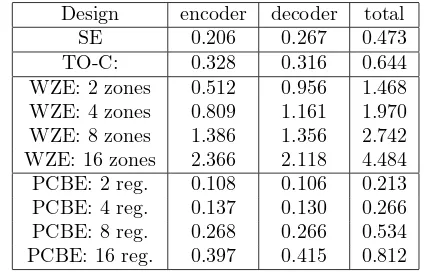
the non-encoded bus shown in the table suggests that the reduction in switching power due to larger number of zones/registers may not always be able to offset the in-crease in power due to larger encoders and decoders. Ta-ble 3 shows the power requirement of different encoder/ decoder circuits.
Table 3: A comparison of the Encoder/decoder power (mW) for various encoding schemes.
Design encoder decoder total SE 0.206 0.267 0.473 TO-C: 0.328 0.316 0.644 WZE: 2 zones 0.512 0.956 1.468 WZE: 4 zones 0.809 1.161 1.970 WZE: 8 zones 1.386 1.356 2.742 WZE: 16 zones 2.366 2.118 4.484 PCBE: 2 reg. 0.108 0.106 0.213 PCBE: 4 reg. 0.137 0.130 0.266 PCBE: 8 reg. 0.268 0.266 0.534 PCBE: 16 reg. 0.397 0.415 0.812
From the simulation results, one can infer that for the as-sumed bus capacitance of 10pf, the PCBE-2 and PCBE-4 provide the best possible power savings. These methods save as much as 70% of total bus power with as much as
88% reduction in bus switching activity. Larger config-urations of the PCBE methods (PCBE-8 and PCBE-16) become effective in cases where the off-chip bus capaci-tance is greater than 10pf.
Our algorithm uses only one additional bus line as com-pared to WZE which needs 1 +⌈log2z⌉ additional bus lines where z equals number of zones used. Moreover, the hardware complexity of the our encoding algorithm is much less as compared to WZE for a given number of registers used to track addresses. Both PCBE and
WZEmethods are scalable, i.e., the power savings can be traded with hardware complexity. One can use PCBE-8 and PCBE-16 with larger values of on chip bus ca-pacitances when the excess power consumed by the en-coder/decoder is offest by switching power reduction in the bus.
It is significant to note that the presence of arithmetic circuitry (adder) in the encoded address path, in itself introduces enormous number of transitions in the DSE,
[image:5.595.62.274.542.679.2]Finally, for the technology used in these studies, the encoder and decoder hardware complexity for the four schemes, namely T0-C, DSE, WZE (2 registers) and PCBE is (2 registers) was 2110, 2701, 2713 and 1554 gates respectively. At the same time, the delays for the four schemes were 3.34, 18.92, 19.02, 4.13 nsecs. respec-tively.
4
Conclusions
In this paper, we present a novel approach for power re-duction in off-chip instruction address buses. The pri-mary difference between our approach and those of oth-ers is that our algorithm does not classify branching ad-dresses as random new adad-dresses; rather, it associates them with program constructs. Its ability to distinguish between addresses generated by regular strides from those generated by branching constructs allows our algorithm to reduce the switching activity on the address bus by a significant amount. It is a scalable algorithm and its complexity can be chosen to take advantage of varying bus capacitances.
References
[1] D. C. Suresh, B. Agrawal, W. Najjar, and J. Yang, “Low power electronics and design,” inProc. of the 2005 Int. Symp. on SLPED, pp. 319–322, Aug. 8–10 2005.
[2] Y. Aghaghiri, , and M. Pedram, “Beam: Bus en-coding based on instruction-set-aware memories,” in Proc. of Asia South Pacific Design Automation Conference, (Kitakyushu, Japan), ACM/IEEE, Jan 2003.
[3] H. Kaul, D. Sylveter, M. A. Anders, and R. K. Krish-namurthy, “Design and analysis of spacial encoding circuits for peak power reduction in on-chip buses,”
IEEE Trans. Very Large Scale Integration Systems, vol. 13, pp. 1225–1238, Nov. 2005.
[4] C.-G. Lyuh and T. Kim, “Low power bus encod-ing with crosstalk delay elimination [SoC],” in15th Annual IEEE Int. ASIC/SOC Conf., pp. 389–393, Sept. 25–28 2002.
[5] P. Subrahmanya, R. Manimegalai, V. Kamakoti, and M. Mutyam, “A bus encoding technique for power and cross-talk minimization,” in Proc. of the 17th Int. Conf. on VLSI Design, pp. 443–448, 2004.
[6] T. Austin, E. Larson, and D. Ernest, “SimpleScaler: An infrastructure for computer system modeling,”
IEEE Computer, vol. 35, pp. 59–67, Feb 2002.
[7] D. C. Suresh, B. Agrawal, W. Najjar, and J. Yang, “VALUE: variable length value encoder for off-chip data buses,” in IProc. of the 2005 Int. Conf. on Computer Design, pp. 631–633, Oct. 2–5 2005.
[8] M. R. Stan and W. P. Burleson, “Bus-invert coding for low-power i/o,” IEEE Trans. on VSLI, vol. 3, pp. 49–58, Mar 1995.
[9] J. Yang and R. Gupta, “Fv encoding for low-power data i/o,” inProc. of Symp. on Low Power Electron-ics and Design, (Huntington Beach, CA), pp. 84–87, ACM, Aug 2001.
[10] M. Mamidipaka, D. Hirschberg, and N. Dutt, “Low power address encoding using self-orgnaizing lists,” inInternational Symp. on Low Power Design, (Huntington Beach, CA), pp. 188–193, ACM, Aug 2001.
[11] L. Benini, G. D. Micheli, E. Macii, D. Sciuto, and C. Silvano, “Asymtotic zero-transition ac-tivity encoding for address buses in low power microprocessor-based systems,” in IEEE 7th Great Lakes Symp. on VLSI, (Urbana, IL), pp. 77–82, IEEE, Mar 1997.
[12] W. Fornaciari, M. Polentarutti, D. Sciuto, and C. Silvano, “Power optimization of system level ad-dress buses based on software profiling,” inCODES, pp. 29–33, 2000.
[13] Y. Aghaghiri, F. Fallah, and M. Pedram, “Irredun-dant address bus encoding for low power,” inProc. of Symp. on Low Power Electronics and Design, (Hunt-ington Beach, CA), pp. 182–187, ACM, Aug 2001.
[14] L. Benini, G. D. Michelli, E. Macii, D. Sciuto, and C. Silvano, “Address bus encoding techniques for system level power optimization,” in Design Au-tomation and Test in Europe, pp. 861–866, 1998.
[15] E. Musoll, T. Lang, and J. Cortadella, “Working-zone encoding for reducing the energy in micropro-cessor address buses,” IEEE Trans. on VLSI Sys-tems, vol. 6, pp. 568–572, Dec 1998.
[16] Y. Aghaghiri, F. Fallah, and M. Pedram, “Reducing transitions on memory buses using sector based en-coding technique,” inProc. of Symp. on Low Power Electronics and Design, (Monterey, CA), pp. 190– 195, ACM, Aug 2002.