Subgrammars, Rule Classes and Control in the
Rosetta Translation System *
Lisette Appelo
Carel Fellinger
Jan Landsbergen
Philips Research Laboratories
P.O. Box 80 000, 5600 JA Eindhoven, The Netherlands
A b s t r a c t
The paper discusses a recent extension of the linguistic framework of the Rosetta system. The original frame- work is elegant and has proved its value in practice, but it also has a number of deficiencies, of which the most salient is the impossibility to assign an explicit structure to the grammars. This may cause problems, especially in a situation where large grammars have to be written by a group of people. The newly devel- oped framework enables us to divide a grammar into subgrammars in a linguistically motivated way and to control explicitly the application of rules in a subgram- mar. On the other hand it enables us to divide the set of grammar rules into rule classes in such a way that we get hold of the more difficult translation rela- tions. The use of both these divisions naturally leads to a highly modular structure of the system, which helps in controlling its complexity. We will show that these divisions also give insight into a class of difficult translation problems in which there is a mismatch of categories.
1
T h e R o s e t t a F r a m e w o r k
In this section we will give an outline of the approach to machine translation pursued in the Rosetta project, which takes place at Philips Research Laboratories. The linguistic framework of Rosetta can be character- ized by a number of principles. These are 'working principles', intended to be helpful for systematic re- search on translation and for the actual construction of translation systems.The principles are discussed here to the extent in which they are relevant to this paper.
~ r h i s paper is the merger of two complementary papers on the Rosetta translation system that were submitted to the European ACL Conference 1987, i.e. 'Subgrammars and Rule Classes in the Rosetta Translation System' by Appelo and Fellinger and 'Controlled M-Grammars in the Rosetta System' by Landsbergen.
This research was partially sponsered by Nehem (Neder- landse Herst ruct ureringsmaatschappij).
P r i n c i p l e o f E x p l i c i t G r a m m a r s : There is an explicit grammar for both the source and the target language.
In most translation systems the target language is defined indirectly by means of contrastive transfer rules that specify the differences with the source language. We think it important to have an in- dependent criterion for correctness of the target text.
C o m p o s i t i o n a l i t ¥ P r i n c i p l e . " The meaning of an expression is a function of the meaning of its parts and the way in which they are syntactically combined.
This principle was adopted from Montague Gram- mar (cf. Thomason, 1974). Obviously, this prin- ciple will lead to an organlsation of the syntax that is strongly i~nfiuenced by semantic considera- tions. But as it is an important criterion of a cor- rect translation that it is meaning-preserving, this seems to be a useful guideline in machine transla- tion.
The compositional grammars of Rosetta, called M-grammars, consist of three components: a syn- tactic, a semantic and a morphological compo- nent.
The s y n t a c t i c c o m p o n e n t defines surface trees of sentences. The surface trees used in Rosetta, called S-trees, are ordered trees of which the nodes are labelled with syntactic categories and attribute-value pairs that bear other morpho- syntactic information. The branches are labelled with syntactic relations. S-trees are used as inter- mediate representations as well.
The syntactic component defines the set of correct S-trees by specifying:
1. a set of b a s i c e x p r e s s i o n s .
tree starting from basic expressions by applying syntactic rules recursively, in a 'bottom-up' way, can be represented in a syntactic derivation tree with the basic expressions at the terminals and the n a m e s of the applied rules at the non- terminals. W i t h each node of the derivation tree an intermediate resulting S-tree can be associated, i.e. the S-tree that is the result of the application of the rule of that node on the resulting S-trees of its daughters (see figure I).
the donkey is eating apples
-the donkey
the donkey eat apples
donkey R,
eat zl z2
R4
R aR2
z t eat apples
apples
apple
Figure I: syntactic derivation tree, the derived S-trees are paraphrased by strings
T h e leaves of a complete surface tree correspond to the words of the sentence, but they have the form of categories and attribute-value pairs. T h e
morphological component
relates these leaves to actual symbol strings. In this paper w e will ignore this morphological component and the S- trees will be 'paraphrased' by strings most of the time to enhance the readability of these trees.T h e M - g r a m m a r s have a s e m a n t i c c o m p o n e n t that specifies
1. the meaning of the basic expressions (basic
meanings).
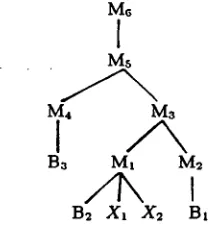
2. the meaning of the rules ( r u l e m e a n i n g s ) . In Montague Grammar these meanings are ex- pressed in intensional logic. In the Rosetta system the meanings of rules and basic expressions are not elaborated on in a logical language, but they are represented by means of unique names. The consequence is that a meaning of a sentence can be represented as a so-called s e m a n t i c deriva- tion tree: a tree with the s a m e geometry as the
syntactic derivation tree but labelled with names of rule meanings and basic meanings instead of syntactic rules and basic expressions. In figure 2 an example of a semantic derivation tree is given, corresponding to the syntactic derivation tree of figure 1.
As basic expressions may have various meanings, there is in general a set of semantic derivation trees corresponding to a syntactic derivation tree. There is in general a set of syntactic derivation trees corresponding to each semantic derivation tree, because a basic meaning may correspond to various basic expressions and a meaning rule may correspond to various syntactic rules.
M6
I
M sM+ Ma
B~
Mt
M2
/ %
i
B2 X~ X2
Bt
Figure 2: semantic derivation tree corresponding to the
syntacticderivatlon tree of figure 1
O n e
Grammar Principle:
The analysis and generation components for one language are based on the same grammar.In other terms, we require the compositional grammar defined above to be 'reversible'. The analysis component maps sentences onto deriva- tion trees, the generation component maps deriva- tion trees onto sentences.
Because of this principle M-grammars have
to
obey certain conditions. The most important con- dition is that for each generative syntactic rule there must be a reverse analytical rule. For a more extensive discussion of these conditions we refer to Landsbergen (1984). Thanks to these con- ditions analysis algorithms can be defined which yield for any input sentence the set of syntactic derivation trees of that sentence (see section 6 for the formal definitions).In addition to theoretical motives, there are eco- nomic motives for adopting the O n e G r a m m a r Principle. If w e plan to m a k e translation systems that translate both from and into a particular lan- guage, it is efficient if these systems can be based on one grammar.
[image:2.612.85.278.202.416.2] [image:2.612.341.448.248.361.2]• I s o m o r p h y P r i n c i p l e : Two sentences are trans- lations of each other if their meanings are derived from the same basic meRnings in the same way, i.e. if they have the same semantic derivation tree. So this principle says that the information that has to be conveyed during translation is not only the meaning, but also the way in which the mean- ing is derived.
This implies that we have to attune the grammars of the system in the following way:
1. each basic expression in one grammar corre- sponds to at least one basic expression in the other grammar with the same meaning (i.e. corresponding to the same basic meaning). 2. each syntactic rule of one grammar corre-
sponds to at least one rule in the other grammar with the same meaning (i.e. cor- responding to the same rule meaning). So, two sentences are translations of each other if they have corresponding, i s o m o r p h i c syntac- tic derivation trees, i.e. trees with the same ge- ometry and corresponding basic expressions and corresponding rules at the leaves and at the nodes respectively (see figure 3).
Following this principle there are corresponding sets of rules, related to the same meaning rule, and corresponding sets of basic expressions, re- lated to the same basic meaning. W e call the grammars isomorphic if these corresponding sets of rules obey certain applicability conditions.
T h e Isomorphy Principle is the most characteris- tic principle of the Rosetta system, as it expresses our compositional theory of translation.
In this approach complex structural transfer rules are avoided, as rules and basic expressions of the source language are related locally to rules and basic expressions of the target language, although, of course, the individual grammars m a y be com- plicated because of the attuning.
• Principle of Interllnguality: There is an intermediate language into which analysis com- ponents of various languages translate and from which the generation components of these lan- guages are able to translate. If we combine this principle with the Isomorphy Principle, the main consequence is that the semantic derivation trees constitute the intermediate language and that the attuning of the grammars is done for possibly more than two grammars.
It should be stressed that the isomorphy and not the interlinguality is the primary characteristic of the Rosetta framework.
For a more extensive discussion of these principles and more interesting examples we refer to Appelo and Landsbergen (1986). Leermakers and Rous (1986) give
an introduction to the Rosetta method along different lines.
The global design of the Rosetta system, which fol- lows from these principles is sketched in figure 4. For each M - g r a m m a r the following system components are defined:
• an analytical and a generative morphological com- ponent, A - M O R P H and G - M O R P H . They ac- count for the relation between strings and lexical S-trees (i.e. S-trees corresponding to words).
• an analytical and a generative syntactic com- ponent, M - P A R S E R and M - G E N E R A T O R . They account for the relation between surface trees and syntactic derivation trees. These sys- tem components follow directly from the syntac- tic component of an M-grammar. Their formal definition is given in subsection 6.1.
• an analytical and a generative semantic compo- nent, A - T R A N S F E R and G - T R A N S F E R . They account for the relation between syntactic and semantic derivation trees.
M - P A R S E R is preceded by a component called S - P A R S E R (for surface parser) which maps a sequence of lexical S-trees (which is the output of A - M O R P H ) onto a set of surface trees of which the lexical S-trees are the leaves. This set should contain the correct sur- face trees, but may contain also incorrect ones. The generative counterpart, L E A V E S , is trivial; it maps the surface tree onto the sequence of its leaves.
2
P r o b l e m s w i t h t h e R o s e t t a
f r a m e w o r k
The framework outlined above has been worked out in a way that is simple and mathematically elegant, as the formal definitions in subsection 6.1 will illustrate. This formalism has also proved its value in practice: the implemented systems R o s e t t a l and Rosetta2 have been written in this framework. In the sequel we will refer to it as the Rosetta2 framework. However, it also has a number of deficiencies, which may cause problems, especially in a situation where large grammars have to be written by a group of people. Three kinds of problems can be distinguished.
1. L a c k o f s t r u c t u r e in M - g r a m m a a r s
E N G L I S H < = = > D U T C H
the donkey
donkey
R6 / " ~ - - - _ _ _ _ ~ _
I
the donkey is eating apples
Rs
the donkey eat apples
R4 R3 ~ ~ R~
Ri R2 ~ ezel
apples
eat z, z2 apple
R'~
I
de ezel eet appels
R I
/ ~
de ezel appel8 eten
~
zt
appels eten
R'~
R~
/ / ~ I
appas
eet zt z~ appel
F i g u r e 3: isomorphic syntactic derivation trees for the sentence The
donkey is eating apples
and its translation in DutchDe ezel
set appel8
Source language Target language
sentence sentences
A-MORPH
J,
?
sequences of sequences of
lexical S-trees lexical S-trees
$
't
S-PARSER
| L AVES
,,,]
surface trees
4,
M - P A R S E R
surface trees
syntactic syntactic
derivation derivation
trees J, trees
A - T R A N S F E R I G - T R A N S F E R
) semantic derivation trees J, I
F i g u r e 4: Global design of the Rosetta system
2.
This holds in particular if the grammars are devel- oped by a group of people. It is necessary to have an explicit division of tasks and to coordinate the work of the individuals in a flexible way so that the system will be easy to modify, maintain and extend.
In computer science it is common practice to di- vide a large task into subtasks with well-defined interfaces. This is known as the m o d u l a r a p - p r o a c h . This approach has gained recognition in the field of natural language processing too (cf. Isabelle and Macklovitch, 1986 and Vauquols and Boitet, 1985). The question is how such a mod- ular approach can be applied in a compositional grammar, in an insightful and linguistically moti- vated way.
Lack o f c o n t r o l o n r u l e
applications
[image:4.612.86.508.77.273.2] [image:4.612.57.288.345.668.2]disadvantages is that it leads to a proliferation of rather unnatural categories.
It is hard to find an elegant and transparent way of specifying rule order in a compositional gram- mar; the situation is more complicated than in transformational systems llke R O B R A (Vauquois and Boitet, 1985), because rules may have more than one argument.
In addition to linear ordering one may want to add other means of controlling the application of rules, e.g. one may want to make a distinction between obligatory, optional and recursive rules. In M-grammars all rules are optional and poten- tially recursive. It is not clear how to add obliga- tory rules to such a free production system; in fact it is hard to understand what that would mean. There is also a problem with the reversibility of obligatory rules: a rule that is obligatory dur- ing generation is not necessarily obligatory during analysis.
3. L a c k o f s t r u c t u r e In t h e t r a n s l a t i o n r e l a t i o n As we have explained in section 1, the translation relation between languages is defined by attuning the grammars to each other. In this way complex structural transfer (as discussed in Nagao and Tsujii, 1986) can be avoided, but in some cases the dependency between the grammars may com- plicate individual grammars. C a t e g o r y m i s - m a t c h is one of these translation problems, e.g. the
graag//iilce
case, where a Dutch adverb corre- sponds to an English verb. In cases like this there is a mismatch of syntactic categories coupled with different behaviour with respect to, e.g., tense: a verb has tense, whereas an adverb has not. In Landsbergen (1984) a solution of thegraag//like
problem by means of isomorphic grammars w ~ discussed, for small example grammars. For larger grammars a more systematic and struc- tured treatment of these translation problems is needed, but this is not supported by the Rosetta2 formalism.Another problem is caused by the fact that in the isomorphic grammar framework each syntac- tic rule of one grammar must correspond to at least one rule of another grammar. For rules that contribute to the meaning this is exactly what we want, because what h ~ to be conveyed during translation is not only the meaning, but also the way in which the meaning is derived. However, there is a problem with rules that are only rele- vant to the form of the sentence and that carry no translation-relevant information, especially if they are language-specific. A purely syntactic transfor- mation as Verb-Second in an SOV language like Dutch does not correspond in a natural way to a syntax rule of English. In Rosetta2 this prob- lem could be solved in one of the following two ways: by adding a corresponding rule to the En-
glish syntax that did nothing more than change the syntactic category or by merging the Dutch transformation rule with a meaningful rule. These solutions are not very elegant and complicate the grammars unnecessarily. It would be better if the correspondence between rules as required by the Isomorphy Principle must hold for meaning- ful rules only. The translation relation would then be defined in terms of a reduced derivation tree, which is labelled with meaningful rules. T h e gen- eration component ( M - G E N E R A T O R ) will oper- ate on such a reduced tree and will have to decide what syntactic transformations are applicable at what point of the derivation. This requires some way of controlling the applicability of the trans- formation rules.
In the next sections we will describe the modular ap- proach chosen for the development of Rosetta3, which m a y help to solve the above-mentioned problems. W e will discuss a syntax oriented dlvlslon into subgram- mars in section 3 and a translation oriented division into rule classes in section 4. In section S we will argue that a combination of the two divisions is needed. In section 6 the newly introduced notions will get a formal treatment. It will turn out that the way in which sub- grammars are defined enables us to define the control of rule applications in a transparent way.
The proposed modifications are completely in accor- dance with the basic principles mentioned in section 1.
3
S u b g r a m m a r s ,
a S y n t a x
Oriented Division
F r o m the computer language Modula2 (cf. Wlrth, 1985) we learned the essentials of the modular ap- proach:
I. divide the total into smaller parts (modules) with a well-defined task,
2. define explicitly what is used from other parts (Import) and what m a y be used by other parts ( e x p o r t ) ,
3. separate the definition from the implementation. The explicit definition of import and export and the strict separation of implementation and definition makes it possible to prove the correctness of a module in terms of its imports, without having to look at the implementation of the imported modules. This tack- les the above-mentioned complexity problem and the coordination problem caused by the lack of structure in the M - g r a m m a r s nicely. In our view, applying the modular approach to grammars comes d o w n to the fol- lowing requirements:
2. defining explicitly what is visible to other sub- grammars (export) and what is used from other subgrammars (Import),
3. ensuring that the actual implementation (i.e. the rules) is of local significance only.
Dividing grammars into subgrammars with a linguistic task has been done before, e.g. in the GETA-systems (cf. Vauquois and Boitet, 1985). However, to our knowledge, they do not meet requirement 2 and 3
The actual subdivision chosen for the development of Rosetta3 was inspired by the notion projection from the X.-theory of Transformational Generative Gram- m a r (cf. e.g. Chomsky, 1970): every major category X is said to have a maximal projection X '~z, e.g. N O U N has the maximal projection NP. Such projections pro- vide a syntactic division of the constituents of language and appear to be a useful choice for modular units in a natural language system.
Applying this idea to the compositional grammars of Rosetta implies that basic expressions have a ma- jor category X and that there are syntactic rules that will ultimately compose S-trees of category X "~'=. For each maximal projection a subgrammar can n o w be de- fined that expresses h o w X ' ~ can be derived from X and other imported categories. W e will call a possible derivation process of the projection from X to X maz a projection p a t h (see figure 5. The most important major categories (and their projections) in use in the Rosetta systems are: N O U N (NP), V E R B (VP), A D J (ADJP), A D V ( A D V P ) and P R E P (PP).
R . . . . X " ~ z
/
R S I 41R
/
[image:6.612.355.495.75.157.2] [image:6.612.93.222.446.571.2]X
Figure 5: A projection path from X to X 'naz X-theory also states that all projections have a sim- ilar syntactic structure (i.e. phrase marker), which is represented in the schema of figure 6, but this aspect is less relevant for the Rosetta grammars. For us, it is of more interest whether they are the result of similar derivations. W e will come back to this point in section 5.
A sentence is usually seen as a subject-predicate re- lation, i.e. a combination of an N P and a VP. But other
(
speci/Z~..
" ~
( complement ) X ( complement )
Figure 6: The projection of X to X 'naz
X P (i.e. X maz) categories than VP, together with an NP, can express a subject-predlcate relationship as well (cf. Stowell, 1981). Such subject-predlcate relations are called small clauses. For example, the N P him and the A D J P
funny
inI think [him funny],
or the two N P ' shim
anda fool
inI consider [him a foo 4
form a small clause. In Rosetta such tenseless clauses are called X P - P R O P in which X stands for the X of the predicate. For example, in[him funny]
we have A D J P P R O F (with X = A D J ) and in[him a foo4
we have N P P R O P (with X = N O U N ) . A tensed X P P R O P is called a C L A U S E in Rosetta. For example, in the sentencesI think that
he is sleeping
andI think that he is funny
we have the CLAUSEs[that he is sleeping]
and[that he is funny]
respectively.
This means that, starting from a basic expression of category X, in principle three S-trees with a different top category X '°P can be derived: XP, X P P R O P and CLAUSE. Figure 7 shows some of the resulting deriva- tion trees and S-trees of the examples given above.
Defining subgrammars in accordance with these 'projection paths' provides a natural way of expressing the application order of the rules within a subgrammar: the order is defined with respect to the projection path only. A side effect of this explicit ordering of rule ap- plication is that it enables us to use a more efficient parse algorithm ( M - P A R S E R ) .
A subgrammar can n o w be characterized as follows:
1. export S-tree of category X t"p (XP, X P P R O P or C L A U S E )
2. import:
• S-tree with a special category, the X-
category, also called the h e a d category.
• S-trees with categories that are exported by
other subgrammars and that can be taken as an argument by rules with more than one argument.
R2
NP
A
he
C L A U S E he is sleeping
Rl C L A U S E
xl VP
/,,,
sleep xL V E R BA
sleep
R4
NP
A
him
A D J P P R O P him funny
R 3 - - A D J P P R O P
x2 A D J P
/ ' , .
funny
x2 A D J
funny
N P P R O P
him a fool
R6,
A
N P Rs
him
x3 N O U N ~ o l
N P P R O P
x~ N P
/ N
a fool
F i g u r e 7: The derivation trees with the resulting S-trees of the projection of VERB to CLAUSE, ADJ to ADJPPROP and NOUN to NPPROP
4. c o n t r o l e x p r e s s i o n : a definition of the possible application sequences of the rules, ordered with respect to their head arguments.
Neither the rules nor the intermediate results are known to other subgrammars. They can be considered local to the subgrammar. So 1 and 2 define the relation with other subgrammars, whereas 3 and 4 are only of local significance, thus meeting our requirements for the modular approach.
An example of a subgrammar is the N P - s u b g r a m m a r with a N O U N as head and exporting an NP. O t h e r categories that are imported by this subgrammar are DETP, A D J P P R O P , etc. the set of rules contains modification rules and determiner rules, the control expression indicates that the modification rules can be applied recursively and that they precede the deter- miner rules.
Obviously, there will n o w be subgrammars that con- tain the same rules, e.g. the subgrammars for N O U N to N P and P R O N O U N to NP. For efficiency reasons, it is allowed to merge such subgrammars by defining a set of heads as import and a set of top categories as export.
For an elaboration of the notion control expression and a formalisation of subgrammars we refer to section 6.
The advantages of this division into subgrammars are 1) that the structure of the grammar has become more transparent, 2) that we now have units with well- defined interfaces which enables us to divide the work over several people, 3) that we can work at and test smaller parts of a grammar.
4
R u l e C l a s s e s , a T r a n s l a t i o n
O r i e n t e d D i v i s i o n
In the Rosetta framework as sketched in section 1, the translation relation is defined at the level of rules and basic expressions. If there is a rule or basic expression in one grammar, there must be at least one rule or basic expression in the other grammar with the same meaning (the Isomorphy Principle). It is hard to get hold of the translation relation as a whole in terms of these primitives alone. What we need is some structure of a higher order.
[image:7.612.88.241.116.614.2]This point was already mentioned in section 2. Such rules are now no longer considered to be part of the translation relation that is expressed by the isomorphy relation between the grammars. Therefore, they can be added freely to a gram- mar. In this way a better distinction can be made between purely syntactic (and hence language- specific) knowledge and t r a n s l a t i o n r e l e v a n t knowledge. The translation relation now can be freed from improper elements, which is highly de- sirable.
In section 2 it was noticed that the introduction of transformation rules requires some way of control- ling their applicability. The control expressions introduced in section 3 and formalised in section 6 provide for this.
2. The set of rules of the grammars are divided into groups called r u l e classes, each of which handles some linguistic phenomenon. These rule classes are subdivided into transformation classes and meaningful rule classes. A meaningful rule class handles a linguistic phenomenon of which the se- mantics should be preserved during translation. Such
translation relevant
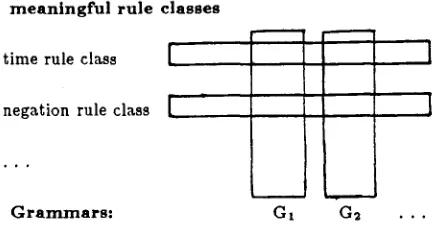
linguistic phenomena are, e.g., valency/semantic relations, scope, time, negation and voice. The translation relation can be further structured by these meaningful rule classes. Only rules of different languages that be- long to the same meaningful rule class may corre- spond to each other or, to put it in other words, rules that do not belong to the same meaningful rule class can never be translations of each other (see figure 8). Within a meaningful rule c l ~ s there can, of course, be some 'semantic differentia- tion', which should be retained under translation. For example, in the time rule class more than one time reference can be distinguished, each with a distinct meaning, tThere can also be 'corresponding' transformation classes in the grammars for different languages - e.g. agreement rules -, but they do not play a role in the translation relation.
5
C o m b i n i n g
S u b g r a m m a r s
and R u l e Classes
Having introduced some order into the syntactic rules of the grammar and into the translation relation, we see that these divisions of rules are along 'vertical' and 'horizontal' lines respectively (see figure 9). The pro- jections of basic categories in one grammar, leading to the division of the grammar into subgrammars, are 1For each distinct time reference meaning a separate rule can be defined, but it is also possible to introduce abstract basic expressions ranging over the possible time references and have one rule that has such an abstract basic expression as argument.
m e a n i n g f u l r u l e c l a s s e s
time rule class [~
i
negation rule class
G r a m m a r s : G t G 2
Figure 8: meaningful rule classes bring order in the trans-
lation relation between the grammars of the languages in- volved
along vertical lines. T h e relations between the gram- mars, leading to the division of all the rules of the g r a m m a r s into (meaningful) rule classes, are along hor- izontal lines.
These two ways of dividing g r a m m a r s have several consequences.
O n the one hand, s u b g r a m m a r s help to structure the grammar in a more modular way; they also give some insight into the translation relation, but only in the more 'trivial' cases, where the corresponding basic expressions have the same syntactic category, subgram- mar G,l of grammar G corresponds solely to subgram- mar Gt of grammar G . In category mismatch cases the corresponding basic expressions fall into different subgrammars (e.g. the
graag/like
case of section 2).On the other hand meaningful rule classes group to- gether semantically related rules, which gives insight in what has to be preserved during translation, but they are not the.right unit to make a modular struc- ture. This makes it hard to define an adequate inter- face (import/export) between rule classes, because e.g. the rule that negates a sentence is determined more by the rules that form a sentence than by the other nega- tion rules (e.g. in an adjective phrase) with which it forms the negation rule class.
However, both s u b g r a m m a r s and rule classes allow for a division of the labour over people. That this is the case with s u b g r a m m a r s is trivial, as s u b g r a m m a r s form a modular structure. T h e reason that rule classes are also useful units to divide the work is that knowledge of a specific linguistic topic is needed for every rule class, knowledge that can typically be handled by one person.
In order to have the benefits of both w e combined s u b g r a m m a r s and rule classes in the following way:
I. the rules of s u b g r a m m a r s are divided into rule subclasses, which are subsets of rule classes
[image:8.612.315.531.86.206.2]m e a n i n g f u l r u l e c l a s s e s time rule class [
rule class i"
negation !
I
N P
~#/~/~
C L A U S E
• m
V P i N P V P C L A U S E
S u b g r a n t m a r s o f g r a m m a r G 1 S u b g r a m m a r s o f g r a m m a r G:
F i g u r e O: horizontal and vertical division within grammars. The shaded part denotes the subclass of the negation rules for the CLAUSE subgrammar of G t.
The combination results in a modular structure of each g r a m m a r and helps to reduce the complexity of the translation relation. It also helps to solve the class of category mismatch problems elegantly.
Isomorphic s u b g r a m m a r s
As was already mentioned in section 3, X-theory states that the projections of all major categories have a similar structure. The division of the grammars into subgrammars was based on the notion major category
and the sorts of projections that we recognize (XP, X P P R O P and C L A U S E ) . The fact that in X-theory the phrase markers of the resulting constituents are similar, suggests that it is possible to assign similar derivations to them in a compositional grammar. This similarity is also suggested by the fact that most rule classes handle phenomena that play a role in every subgrammar. For example, in all subgrammars rules for valency/semantic relations and negation are found. They may differ, of course, in their transformations.
The fact that we consider the Dutch N P s de ezel die appels set and de appels etende ezel to be paraphrases which are both translations of the English NP the don- key that is eating apples 2 suggests that a tensed relative clause should be composed similar to a tenseless 'ad- jectival' relative clause, or in other terms: that their derivation trees should be i s o m o r p h i c with respect to their meaningful rules. The same can be said for the adjectival phrase smart and the relative clause that
is smart in the [smart] girl and the girl [that is smart/
respectively.
To m a k e it possible that such phr~es and clauses are translations of each other, the subgrammars involved are attuned as far as possible, resulting in 'isomorphic' subgrammars within one grammar.
W e will discuss two cases:
2the eatin¢ apples donkey is ungrammatical.
1. Same head category, but different top category 2. Different head category
Same head category, b u t different t o p cate-
gory
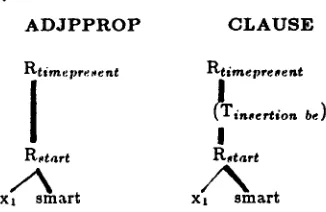
In the example of the smart girl / the girl that is 8mart the subgrammars for the projection of A D J to A D J P P R O P and A D J to C L A U S E are involved. They differ in that a transformation exists for the insertion of the auxiliary verb be in the clause case. For isomor- phy reasons, in both cases a rule for time reference is needed: in the clause case it spells out the tense for the verb be; in the adjectival case it seems to be super- fluous, but with model-theoretical semantics in mind it can be argued to be needed, if we assume a model with a time component (see figure 10).
A D J P P R O P C L A U S E
Rtimepre~ent Rtimepresent
!
R~tart R~tart
xl*~smext xt//~smart
F i g u r e 10: Derivation trees resulting from the subgram- mars ADJ to ADJPROP and ADJ to CLAUSE
[image:9.612.74.538.70.203.2] [image:9.612.332.495.481.587.2]C L A U S E N P . ~ b . , , ~ ,
V E R B P P R O P V E R B P P R O P
C L A U S E
~ub.t,z
l RNPi[ R...~.~.,lllt,
hij I| R ,
[ [
R.,o..
X2 toeqallig [ k xl komen
A D V P P R O P V E R B P P R O P
He happened to come
Hi] klnam toevallig
F i g u r e l h Syntactic derivation trees with the relevant subgrammars
D i f f e r e n t h e a d c a t e g o r y
If the approach of attuning subgrammars as far as possible is extended to subgrammars with different head categories, then it can help to solve the problems with the above-mentioned class of category mismatch
c a s e s .
For example, in
he happened to come
the raising verbhappen
occurs and inhi] kwam toevallig
the sentential adverbtoevallig.
As these two sentences are considered translations of each other, the subgrammars for VERB and ADV should be attuned to each other. This seems to be impossible because it is quite natural that the complement ofhappen,
i.e[he come]
is inserted into the clause ofhappen,
whereastoevallig
(the basic expression that corresponds tohappen)
is inserted into the clause corresponding to the complement clause ofhappen,
i.e[hi] komen].
Semantically, in both cases, the clause is the ar- gument of
happen
andtoevallig,
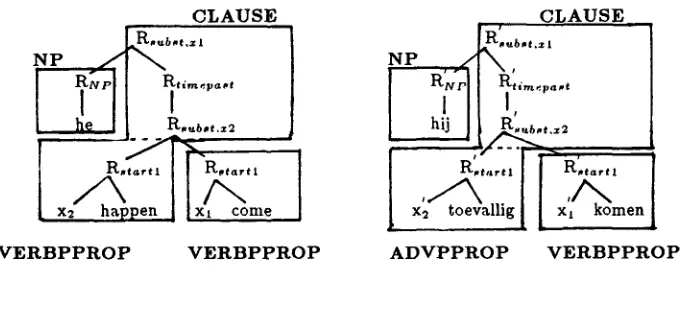
but from a syntactic viewpoint adverbs are inserted into their arguments. We can solve this problem by allowing in these cases a 'switch of subgrammar'. This is possible if the sub- grammars are split into two parts in such a way that the place of this subdivision coincides with the 'switch point'. There is another argument for making this sub- division: the first part of the control expression of the subgrammars for X to X P P R O P and X to CLAUSE is the same. The succeeding part is in the CLAUSE case very similar for all X.Figure 11 sketches how the examples
He happened
to come
andHi] kwam toevallig
now can be derived isomorphically.We noticed that this kind of mismatch of syntac- tic category appears most frequently with modal verbs and adverbs, auxiliaries and semi-auxiliaries, at least in the languages Rosetta deals with (Dutch, English and Spanish). In translation systems dealing with Japanese and English these phenomena occur more frequently.
(cf. Nagao and Tsujii, 1986).
Partial i s o m o r p h y o f s u b g r a m m a r s
Isomorphy between grammars of different languages must be defined in terms of isomorphy between the subgrammars of these languages. It should be noted that it is not always possible to m a k e a subgrammar of one language completely isomorphic to one subgram- m a r of the other language. However, it is possible to make subgrammars partially isomorphic and sets of subgrammars completely isomorphic, both within one language and between different languages. For exam- ple, within one language the subgrammars for A D J to C L A U S E and A D J to A D J P P R O P need not be com- pletely isomorphic, neither do the ones for A D V to C L A U S E and V E R B to C L A U S E . But together the subgrammars for A D J to C L A U S E and A D J to A D - J P P R O P for Dutch can be completely isomorphic to the corresponding subgrammars for English.
6
F o r m a l a s p e c t s
In this section we will discuss the main consequences for the Rosetta formalism of the ideas put forward in sections 3, 4 and 5. These consequences relate in particular to the definition of M - P A R S E R and M - G E N E R A T O R . W e will first give - in section 6.1 - the original definitions for the free, i.e. 'uncontrolled' M - grammars of Rosetta2. In 6.2 we will give the revised definitions for controlled M-grammars, currently used for the development of Rosetta3.
6 . 1 F r e e M - g r a m m a r s
[image:10.612.93.436.75.230.2]An S - t r e e is - a node N,
- or an expression of the form N[rl/tl,..., r . / t . ] (n>0)
where N is a node, the ri's are syntactic relations and the t;'s are S-trees.
(we will often use this kind of recursive definition: the second - recursive - part of the definition indi- cates t h a t S-trees m a y have arbitrary, b u t finite, depth; the first part shows how the recursion terminates: the leaves of the trees are always (terminal) nodes)
A node N is defined as a syntactic category followed by a tuple of a t t r i b u t e - v a l u e pairs (ai:vi).
N = O { a l : v , . . . ak:vk} (k>O)
For each syntactic category the corresponding .-it- tributes are defined, for each attribute the set of pos- sible values is defined. So, given a set of syntactic relations and a set of syntactic categories with the cor- responding attributes and values, the set of possible S-trees is defined. This set is called T: the domain of S-trees.
So the general form of an S-tree t is
t = C { a t : v , , . . . , ak:vk} [ r t / t t , . . . , r , / t . ] C is called the syntactic category of t.
1 .
2.
3 .
ad 1.
ad 2.
T h e syntactic component of an M - g r a m m a r defines
- the domain T by enumerating the syntactic re-
lations, the categories and the corresponding at- tributes and values.
- the set T M of well-formed S-trees, a subset of T.
T M consists of the surface trees of sentences that are well-formed according to the grammar.
T M is defined by specifying:
a set B of basic S-trees,
a set of syntactic rules, called M-rules,
a special category: S E N T E N C E .
T h e set of basic S-trees is a subset of T (the basic lexicon). A basic S-tree b has a unique name, to be denoted as b_.
A n M-rule R; defines a compositional function F: from tuples of S-trees to finite sets of S-trees. So application of R; to a tuple tt,...,t, yields a set F~(tt,...,t,). T h e set is empty if the rule is not applicable.
Each M-rule is reversible, i.e. it also defines an analytical function Fi, the reverse of Fi.
t • F , ( t t . . . t . ) ¢==~ (tt . . . t , ) • F'i(t )
S-trees are constructed by applying M-rules recur- sively, starting from basic expressions, T h e set T M is the set of S-trees that can be derived in this w a y and that have the category S E N T E N C E .
The derivation process can be displayed in a syntac- tic derivation tree.
A d e r i v a t i o n t r e e is
- the n a m e b of a basic expression, - or an expression of the form R~ < d t . . . d , > , ( n > 0 ) ,
where R; is a rule n a m e a n d d r , . . . , d , are derivation trees.
On the basis of the syntactic c o m p o n e n t of an M - g r a m m a r the functions M - G E N E R A T O R a n d M- P A R S E R can be defined. M - G E N E R A T O R is applled to a derivation tree and yields a set of S-trees; M- P A R S E R is applied to an S-tree a n d yields a set of derivation trees.
M - G E N E R A T O R ( d ) = ~,.f
{ t I 3 b • B : d = b a n d t = b } U { t ] 3 t l , . . . , t . , dl . . . d . , R i :
d = R , < d l , . . . , d . > a n d t~ • M - G E N E R A T O R ( d l ) a n d t . • M - G E N E R A T O R ( d . ) a n d t • F,'(tl . . . t , ) }
(In this definition d, d~, d . are derivation trees, t,
t t , t . are S-trees, B is the set of basic S-trees, b is a basic S-tree, b is the n a m e of a basic expression, F : is the compositional function defined by rule R~)
M - P A R S E R ( t ) =d..f
{ d [ 3 b • B : t = b a n d d = b } U { d [ 9 t l , . . . . t . , d l . . . . ,dn, R; :
s
( t i . . . . , t . ) • F i ( t ) ,
dt • M - P A R S E R ( t l ) a n d
• . .
d , • M-PARSER(t,~) a n d
d = R ; < d t . . . . , d . > }
(F'; is the analytical function defined by rule R ; )
Given the reversibility of the M-rules, it is easy to prove that
Note that M - P A R S E R and M - G E N E R A T O R can both be used to define the set T M of well-formed S- trees. T ~ can be defined as the set of S-trees (of cat- egory S E N T E N C E ) that can be derived by applying M - G E N E R A T O R to all possible derivation trees. Ta4 can also be defined as the set of S-trees (of category S E N T E N C E ) for which M - P A R S E R yields at least one derivation tree. Because these definitions are equiva- lent, the O n e G r a m m a r Principle is obeyed.
A n M - g r a m m a r has to obey the m e a s u r e c o n d i -
t i o n :
First, a measure on S-trees, i.e. a function from S- trees to positive integers, must be defined.
T h e condition says: if t is the result of applying a compositional rule to S-trees tl,...,tn then t is bigger according to this measure than each of the arguments tt,...,tn. So application of an analytical rule yields smaller S-trees, which guarantees that the recursion in M - P A R S E R is finite.
T h e algorithms for the components M - P A R S E R and M - G E N E R A T O R follow directly from the set-theoretic definitions.
6 . 2
C o n t r o l l e d M - g r a m m a r s
T h e syntactic c o m p o n e n t of a c o n t r o l l e d M - g r a m m a r defines the d o m a i n T of S-trees in the same way as for free M - g r a m m a r s .
T h e set TM of well-formed S-trees is defined by spec- ifying:
1. a set B of basic S-trees, 2. a set of s u b g r a m m a r s ,
3. a special category: S E N T E N C E .
A s u b g r a m m a r Gi consists of:
• a set E X P O R T C A T S i of syntactic categories (the categories of S-trees t h a t can be exported).
• a set H E A D C A T S : of syntactic categories (the
categories of S-trees t h a t are allowed as the head), • a set I M P O R T C A T S : of syntactic categories (the Categories of o t h e r S-trees t h a t may be i m p o r t e d ) , • a set of M-rules, subdivided into a set M F - R U L E S : of meaningful rules and a set T R - R U L E S : of t r a n s f o r m a t i o n rules. For each mean- ingful M-rule one of the arguments has to be defined as the ' h e a d ' argument (transformations have only one argument). For notational conve- nience we will assume here t h a t the head is always the first a r g u m e n t .
• a control expression ce:, which indicates what se- quences of rule applications are possible, from im- p o r t e d head to e x p o r t e d result. ( T h e ordering of the rules concerns the head arguments)
T h e control expression indicates w h a t the rule subclasses are, h o w they are ordered, w h a t rules they consist of, and whether they are recursive, optional or obligatory. A control expression ce has the following
form:
c e = A o • A t ... An,
where each A~ is a rule subclass, either a meaningful rule class or a transformation class.
A rule class A~ m a y be
- obligatory: written as ( R t [ ... ] R t ), where the R,- are either meaningful rules or transformations.
- recursive: written as { RI [ ... [ R k }, - optional: written as [ R t [... [ R ~ ].
A n example:
(R,). [R2 I R s l . (R41Rs }. ( R 6 ] R , )
This control expression defines all sequences beginning
with Ri, then R2 or R3 or neither, then an arbitrarily
long sequence (possibly empty) of R4 or R~, then either
RG or RT.
A c t u a l l y a control expression is a restricted kind of regular expression over the a l p h a b e t of rule names. (It is not restricted in i t s c o n s t r u c t i o n s b u t in the pos- sible combinations of these constructions.) E a c h reg- ular expression denotes a set of instances: sequences of rule names. Each such rule sequence is a possible p r o j e c t i o n p a t h in the s u b g r a m m a r (of. section 3). Note t h a t the rules in a sequence need not be applica- ble, this depends on the applicability conditions of t h e rules themselves.
It is required t h a t each instance of the regular ex- pression contains at least one meaningful rule.
T h e definition of a derivation tree has to be adjusted as follows.
A d e r i v a t i o n t r e e is:
- the name b_ of a basic expression, - or an expression of the form
(G.R;)<d~ .... ,d.>
(n>0),
where Gi is (the n a m e of) a s u b g r a m m a r , R i is (the n a m e of) a meaningful M-rule, and dl,...,d,~ are derivation trees.
T h e r e are two differences with the old definition. The first is t h a t the n o n - t e r m i n a l nodes contain t h e s u b g r a m m a r name, next to the rule name. T h e sec- ond is t h a t the derivation tree is no longer a c o m p l e t e trace of rule applications, because the transformations d.re not indicated explicitly.
In the revised definition of M - G E N E R A T O R and M- P A R S E R we will use a kind of i n c o m p l e t e derivation tree, defined as follows.
- or an expression of the form ( G ; , R / ) < D I , . . . , D , >,
where G# is the name of a subgrammar, R i is the name of a meaningful M-rule, DI is an open derivation tree, D 2 , . . . , D , are derivation trees.
So an open derivation tree is like an ordinary deriva- tion tree, but with an empty derivation tree as leftmost leaf.
Where this is useful we will refer to an ordinary derivation tree as a c l o s e d derivation tree.
Be given open derivation trees Dl and D~.
We define DL[D2] as the open derivation tree that results if D2 is substituted for DE in Dr.
If D2 is a closed derivation tree, the result of the substitution DI[D2] is a closed derivation tree.
We will now present the revised definitions of M- PARSER and M - G E N E R A T O R , for controlled M- grammars. The definitions are not only valid for the restricted control expressions, but in fact for any regu- lar expression. Here the set-theoretical definitions are given, the algorithms can be derived from them di- rectly. The set TM of well-formed S-trees can be de- fined in terms of these functions, in the same way as in subsection 6.1.
R e v i s e d definition of M - P A R S E R
First we will give an informal description of M- PARSER, in an 'operational' way.
M-PARSER operates on an S-tree t. If t is a ba- sic expression b, M-PARSER(t) yields the derivation tree b_. For a non-basic t M-PARSER(t) tries to apply subgrammar parsers, by calling SG-PARSER(Gi,t) for all subgrammars G; with the appropriate export cat- egories (note that for the analytical functions the ex- -port categories indicate what can be 'imported'). SG- P A R S E R ( G i , t) tries to apply the rules of control ex- pression cei to t (i.e. the ~nalytical versions of the rules, starting at the right of the control expression).
A successful application of SG-PARSER yields a pair (D, u), where D is an open derivation tree and u is the resulting 'head' S-tree.
To u M-PARSER is applied again. If successful, M- PARSER(u) yields a derivation tree d. Then D{d] is a derivation tree of t.
S G - P A R S E R is defined by means of a function CE- P A R S E R . C E - P A R S E R has 4 arguments (G;, ce, D, t), where G, is a subgrammar name, ce is a control expression, D is the open derivation tree resulting from previous applications of C E - P A R S E R , t is the S-tree that is yet to be parsed.
W h e n CF_,-PARSER is called for the first time, D is the empty derivation tree and ce is the control expres- sion ce; of G;.
CF_,-PARSER(G;, ce, D, t) tries to apply the (an- alytical versions of the) rules of control expression ce
to t, in right-to-left order. Successful application of a rule yields a tnple of S-trees t l , . . . , t , . To tl the ' n e x t ' rule of the control expression is applied. To t 2 , . . . , t n the full M-PARSER is applied. During the recurslve application of CF_,-PARSER D grows while ce shrinks. Application of a meaningful rule Rj leads to substi- tution of a new node (G#,Rj) in D. Application of a syntactic transformation does not change the deriva- tion tree.
The result of applying CE-PARSER successfully to (Gi, ce~, D, t) is a triple (D2, u, A). All rules of one instance of ce; have been applied then. D2 has the form D{DI], where Dl is the open derivation tree with the meaningful rules of this instance of cel at its projection path and u is the remaining S-tree to be parsed yet (the 'head'). A is a boolean, which tells whether a rule (or transformation) has been applied. This is needed to avoid vacuous recursion of CF_,-PARSER in case of control expressions of the form { ce }, where ce has empty instances, e.g. if ce has itself the form c e l • The boolean A would not be needed if the definitions would be tuned to the restricted form of control expressions as a sequence of rule classes.
The definitions:
M - P A R S E R ( t ) =d..I
{d 13 b E B : d = b a n d t = b } u { d
13
G,, dr, D2, u:syncat(t) E E X P O R T C A T S ; and (D2, u) E SG-PARSER(G;,t) and d~ E M - P A R S E R ( u )
and d = D2[d~] }
(In this definition d, dl are closed derivation trees, D2 is an open derivation tree, t, u are S-trees, syncat(t) is the syntactic category of t, b is a basic expression, b is the name of a basic expresslon, Gi is a subgrammar)
SG-PARSER(G~,t) =d..!
{ (D, u)
I
(D, u, true) e C E - P A R S E R ( G ; , ce;, DE, t)}
(ce; is the control expression of ce;)
CF_,-PARSER(G;, ce, D, t) =~..1
{ (D2, u, A) I q ceh ce2, DI, t l :
ce = cel.ce2 and "ce2 is not a concatenation s and (DI, t l , A~) E CE-PARSER(GI, ce2, D, t) and (D2, u, A~) E CE,-PARSER(G,, ce,, D, ,t,) and A = Al o r A 2 }
U { (D2, u, A) [ 3 ce,, ce2:
U CF_.-PARSER(G,, cet, D, t))
}
U
{
(D~,
u,
A) I 3
cet:ce = [ce, l and
((D~ = D and u = t and A = false) or
(D2, u, true) • CF_,-PARSER(GI, ce,, D, t) and A = true) }
U { (D~, u, A) I B c e , :
ce = {ce,} and
((D~ = D and u = t and A = false) or
( 3 D,,
it, At:(Dr, tt, true) • C E - P A R S E R ( G i , ce,, D, t) and (D2, u, A,) • C E - P A R S E R ( G I , ce, D,, tt) and A = true ) ) }
U { (D2, u, true) I 3 k, n, Rk, d2 .... ,d.: ce = Rk and
Rk • M F - R U L E S i and
D2 = D[(G;, R k ) < D ~ , d2 .... ,d.>] and
(u, ta ... t,) • F'k(t ) and d~ 6 M - P A R S E R ( t 2 ) and
d. • M - P A R S E R ( t . ) }
U { (D2, u, true) I 3 k, at: Rk 6 T R - R U L E S ; and D2 = D and ce = R k and u • F't,(t) }
(ce, ce,, ce2 are control (sub)expressions, D, D,, D2 are open derivation trees, d2,...,d, are closed deriva- tion trees, D e is the empty derivation tree, t, t,, t2, t., u are S-trees, Rk is an M-rule, F'k is the analytical function defined by rule Rk, A, At, A2 are booleans)
A n additional advantage of controlled M-grammars is that the measure condition (cf. 6.1) can be reformu- lated in a way that is much easier to obey that in the original framework.
The measure condition is reformulated as follows: 1. For the grammar as a whole a measure must be defined in such a way that application of a subgrammar in generation yields exported S-trees which are bigger than the imported S-trees. Consequently application of a subgrammar during analysis yields smaller S-trees. This measure is similar to the measure for rules we had in the free M - g r a m m a r formalism, but it is easier to define a measure for complete subgrammars than for rules. Possible measures are: the total number of nodes or the depth of an S-tree.
2. For each subexpression of the form { e } in a con- trol expression a measure on S-trees must be defined, such t h a t application of e during analysis yields o u t p u t S-trees that are smaller t h a n the argument S-trees ac- cording to this measure. This measure can be defined separately for each expression ( e }.
R e v i s e d d e f i n i t i o n o f M - G E N E R A T O R
As the definitions relating to M - G E N E R A T O R are completely symmetric to the definitions relating to M- P A R S E R , we will present t h e m w i t h o u t further com- ments.
M - G E N E R A T O R ( d ) =d~/ { t l B b 6 B : d = b a n d t = b } U { t I 3 G;, d,, D~, u:
d = D2[dt] and
u • M - G E N E R A T O R ( d r ) and syncat(u) • H E A D C A T S ; and t • SG-GEN(G;, D2, u) }
( d, dt are closed derivation trees, D2 is an open derivation tree, t, u are S-trees, b is a basic expression, b is the n a m e of a basic expression, G# is a s u b g r a m - mar, syncat(u) is the syntactic category of u)
SG-GEN(G;, D, u) =a..!
{t I (t, De, true) • C E - G E N ( G , , ce,, D, u)}
(cei is the control expression of Gi, D ~ is the empty derivation tree)
C E - G E N ( G ; , ce, D2, u) =d-.!
{ (t, D, A) ] q eel, ce2, D,, ti:
ce = ce,.ce2 and "cel is not a concatenation" and (t,, D,, A,) • CF_,-GEN(GI, ce,, D2, u) and (t, D, A2) • C E - G E N ( G ; , ce2, D r , t l ) and A = A l or A2 }
U { (t, D, A) I 3 ce,, ce2:
ce = cel]ce2 and "cet is not a dlsjunction" and ( t, D, A) • ( C E - G E N ( G ; , ce,, D2, u)
U CF_,-GEN(G,, ce,, D , , u)) } U { (t, D, A) I 3 ce,:
ce =
[cell
and((D~ = D and t = u a n d A = f a l s e ) or ((t, D, true) e C E - G E N ( G ; , ce,, Ds, u) and
A = true)) }
U { ( t , D , A ) J q c e t : ce = {cel} and
((D2 = D and t = u a n d A = false) or ( 3 D*, tl, At:
( t , , Dr, true) E CF_,-GEN(G,, cel, Ds, u) and (t, D, A,) 6 C E - G E N ( G ; , ce, Dl, tt) and A = true) ) }
Rk • M F - R U L E S ; and
D 2 = D[(G,, R k ) < D ~ , d2 .... ,d.>] and t • Ft(u,t2,...,t,) and
t2 • M - G E N E R A T O R ( d 2 ) and
t, • M - G E N E R A T O R ( d , ) )
U { (t, D, true) [ q k, Rk: Rk • T R - R U L E S ~ D = D2 and
ce = Rt and t • Fk(u) }
(ce, cet, ce2 are control expressions, D, Dr, D2 are open derivation trees, d2,...,d, are closed derivation trees, D ~ is the empty derivation tree, t, it, t2, t,, u are S-trees, R~ an M-rule, Ft is the compositional function defined by rule Rk, A, At, A2 are booleans)
R e m a r k s
In case of a recursive transformation class there is the possibility of infinite recurslon during application of CE-GEN. This must be prevented by defining a mea- sure on S-trees in such a way that each application of a transformation of the class yields a smaller S-tree according to this measure.
T h e definition of M - G E N E R A T O R is symmetric to the definition of M - P A R S E R • (There is one appar- ent exception: the condition on E X P O R T C A T S in • M - P A R S E R and the condition on H E A D C A T S in M - G E N E R A T O R . However, these conditions are redun- dant from a formal point of view, because they must follow from the applicability conditions of the rules in the control expression•) Thanks to this symmetry it is simple to prove that M - G E N E R A T O R and M - P A R S E R are each other's reverse. O n e of the virtues of this way of controlling rule applications is that the O n e G r a m m a r Principle can still be obeyed.
7 Conclusion
In section 2 we enumerated three types of problems with the free M - g r a m m a r formalism used for the de- velopment of the Rosettal and Rosetta2 systems.
T h e first problem was the lack of structure in free M - grammars. This was solved in section 3 by introducing a modular approach, where M - g r a m m a r s are divided into subgrammars in a way that was inspired by the programming language Modula-2 on the one hand and by the notion projection from X-theory on the other hand.
T h e second problem was that there is no way of explicitly controlling the application of rules in free M - grammars and that it is not obvious h o w this kind of control could be introduced in a compositional gram- mar, where rules m a y have more than one argument. T h e insight that was important to the solution of this
problem was that application of a s u b g r a m m a r comes d o w n to following a projection path, from the imported head to the exported projection. This implies that defining control in a subgrammar comes d o w n to spec- ifying a set of possible sequences of rule applications, which can be done by means of a control expression, a regular expression over rule names. A n important advantage of this way of controlling rule applications is that the O n e G r a m m a r Principle is still obeyed: the
same g r a m m a r (i.e. the same subgrammars: the same rules, the same control expressions, etc.) can be used for the compositional and the analytical definition of a language. This is proved by the formal definitions in subsection 6.2.
The third problem concerned the consequences of defining the translation relation by means of isomor- phic grammars. T h e introduction of an explicit dis- tinction between meaningful rules and syntactic trans- formations in section 4 avoids unnecessary complica- tions of the grammars without affecting the Principle of Isomorphy. Because the applicability of syntactic transformations is restrained by the control expres- sions, they do not cause problems with effectivity or efficiency. The introduction of rule classes gave more insight into complex translation relations. In section 5 it was shown that category mismatch problems can be handled more systematically by a combination of subgrammars and rule classes.
Acknowledgements
The authors would like to thank all the m e m b e r s of the Rosetta team for their constructive criticism. In par- ticular we want to mention the invaluable contributions of Jan Odijk with respect to linguistic matters.
References
Appelo, L. and J. Landsbergen (1986), The
Machine
Translation Project Rosetta,
Philips Research M.S.13.801, Proceedings First International Conference on State of the Art in Machine Translation, Saarbriicken,
pp. 34-51.
Chomsky, N. (1970), R e m a r ~ on Nominalisation, in R.A. Jacobs and P.S. Rosenbaum (eds), Readings in English Transformational Grammar, Georgetown Univer- sity Press, Washington D C , pp. 184-9.21.
Isabelle, P. and E. Macklovitch (1086),
Tran.sfer
and
M T Modularity,
Proceedings Coling 1986, Bonn, pp.115-117.
Machine Translation the state of the art, Edinburg Uni- versity
Press.
Leermakers, R. and J. Rous
(1986),
The Translation Method of Rosetta, Computers and Translation, Voh 1, Number 3, pp. 169-183.Nagao, M. and J. Tsujii (1986), The Transfer Phase of the MU Machine Translation System Proceedings Coling 1986, Bonn, pp. 97-103.
Stowell, T. (1981), Origins of Phrase Structure, P h . D .
dissertation,
MIT.Thomason, B. (1974),
Formal Philosophy. Selected Pa-
pers o| Richard Montague, Yale University Press, New
HRven.
Vauquois, B. and C. Boitet (1985),
Automated Transla- tion at Grenoble University,Computational Linguistics,
Vol. 11, Number 1, pp. 28-36.