Statistical Machine Translation with a Factorized Grammar
Libin Shen and Bing Zhang and Spyros Matsoukas and Jinxi XuandRalph Weischedel
Raytheon BBN Technologies Cambridge, MA 02138, USA
{lshen,bzhang,smatsouk,jxu,weisched}@bbn.com
Abstract
In modern machine translation practice, a sta-tistical phrasal or hierarchical translation sys-tem usually relies on a huge set of trans-lation rules extracted from bi-lingual train-ing data. This approach not only results in space and efficiency issues, but also suffers from the sparse data problem. In this paper, we propose to use factorized grammars, an idea widely accepted in the field of linguis-tic grammar construction, to generalize trans-lation rules, so as to solve these two prob-lems. We designed a method to take advantage of the XTAG English Grammar to facilitate the extraction of factorized rules. We experi-mented on various setups of low-resource lan-guage translation, and showed consistent sig-nificant improvement in BLEU over state-of-the-art string-to-dependency baseline systems with 200K words of bi-lingual training data.
1 Introduction
A statistical phrasal (Koehn et al., 2003; Och and Ney, 2004) or hierarchical (Chiang, 2005; Marcu et al., 2006) machine translation system usually re-lies on a very large set of translation rules extracted from bi-lingual training data with heuristic methods on word alignment results. According to our own experience, we obtain about 200GB of rules from training data of about 50M words on each side. This immediately becomes an engineering challenge on space and search efficiency.
A common practice to circumvent this problem is to filter the rules based on development sets in the step of rule extraction or before the decoding phrase, instead of building a real distributed system. How-ever, this strategy only works for research systems,
for which the segments for translation are always fixed.
However, do we really need such a large rule set to represent information from the training data of much smaller size? Linguists in the grammar con-struction field already showed us a perfect solution to a similar problem. The answer is to use a fac-torized grammar. Linguists decompose lexicalized linguistic structures into two parts, (unlexicalized) templates and lexical items. Templates are further organized into families. Each family is associated with a set of lexical items which can be used to lex-icalize all the templates in this family. For example, the XTAG English Grammar (XTAG-Group, 2001), a hand-crafted grammar based on the Tree Adjoin-ing Grammar (TAG) (Joshi and Schabes, 1997) for-malism, is a grammar of this kind, which employs factorization with LTAG e-tree templates and lexical items.
Factorized grammars not only relieve the burden on space and search, but also alleviate the sparse data problem, especially for low-resource language translation with few training data. With a factored model, we do not need to observe exact “template – lexical item” occurrences in training. New rules can be generated from template families and lexical items either offline or on the fly, explicitly or im-plicitly. In fact, the factorization approach has been successfully applied on the morphological level in previous study on MT (Koehn and Hoang, 2007). In this work, we will go further to investigate factoriza-tion of rule structures by exploiting the rich XTAG English Grammar.
We evaluate the effect of using factorized trans-lation grammars on various setups of low-resource language translation, since low-resource MT suffers greatly on poor generalization capability of
lation rules. With the help of high-level linguis-tic knowledge for generalization, factorized gram-mars provide consistent significant improvement in BLEU (Papineni et al., 2001) over string-to-dependency baseline systems with 200K words of bi-lingual training data.
This work also closes the gap between compact hand-crafted translation rules and large-scale unor-ganized automatic rules. This may lead to a more ef-fective and efficient statistical translation model that could better leverage generic linguistic knowledge in MT.
In the rest of this paper, we will first provide a short description of our baseline system in Section 2. Then, we will introduce factorized translation gram-mars in Section 3. We will illustrate the use of the XTAG English Grammar to facilitate the extraction of factorized rules in Section 4. Implementation de-tails are provided in Section 5. Experimental results are reported in Section 6.
2 A Baseline String-to-Tree Model
As the baseline of our new algorithm, we use a string-to-dependency system as described in (Shen et al., 2008). There are several reasons why we take this model as our baseline. First, it uses syntactic tree structures on the target side, which makes it easy to exploit linguistic information. Second, depen-dency structures are relatively easier to implement, as compared to phrase structure grammars. Third, a string-to-dependency system provides state-of-the-art performance on translation accuracy, so that im-provement over such a system will be more convinc-ing.
Here, we provide a brief description of the base-line string-to-dependency system, for the sake of completeness. Readers can refer to (Shen et al., 2008; Shen et al., 2009) for related information.
In the baseline string-to-dependency model, each translation rule is composed of two parts, source and target. The source sides is a string rewriting rule, and the target side is a tree rewriting rule. Both sides can contain non-terminals, and source and tar-get non-terminals are one-to-one aligned. Thus, in the decoding phase, non-terminal replacement for both sides are synchronized.
Decoding is solved with a generic chart parsing
algorithm. The source side of a translation rule is used to detect when this rule can be applied. The tar-get side of the rule provides a hypothesis tree struc-ture for the matched span. Mono-lingual parsing can be viewed as a special case of this generic algorithm, for which the source string is a projection of the tar-get tree structure.
Figure 1 shows three examples of string-to-dependency translation rules. For the sake of con-venience, we use English for both source and target. Upper-cased words represent source, while lower-cased words represent target. X is used for non-terminals for both sides, and non-terminal alignment is represented with subscripts.
In Figure 1, the top boxes mean the source side, and the bottom boxes mean the target side. As for the third rule,FUN Qstands for a function word in the source language that represents a question.
3 Translation with a Factorized Grammar
We continue with the example rules in Figure 1. Suppose, we have “... HATE ... FUN Q” in a given test segment. There is no rule having both HATE
andFUN Q on its source side. Therefore, we have to translate these two source words separately. For example, we may use the second rule in Figure 1. Thus,HATE will be translated intohates, which is wrong.
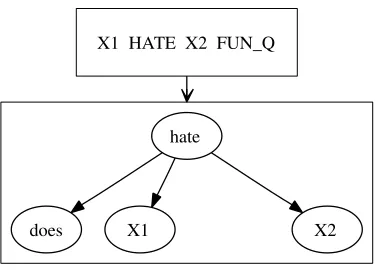
Intuitively, we would like to have translation rule that tell us how to translate X1 HATE X2 FUN Q
as in Figure 2. It is not available directly from the training data. However, if we obtain the three rules in Figure 1, we are able to predict this missing rule. Furthermore, if we know like and hate are in the same syntactic/semantic class in the source or target language, we will be very confident on the validity of this hypothesis rule.
Now, we propose a factorized grammar to solve this generalization problem. In addition, translation rules represented with the new formalism will be more compact.
3.1 Factorized Rules
X1 LIKE X2
likes
X1 X2
X1 HATE X2
hates
X1 X2
X1 LIKE X2 FUN_Q
like
[image:3.612.120.498.55.190.2]does X1 X2
Figure 1: Three examples of string-to-dependency translation rules.
X1 V X2
VBZ
X1 X2
X1 V X2
VBZ
X1 X2
X1 V X2 FUN_Q
VB
[image:3.612.113.499.232.368.2]does X1 X2
Figure 3: Templates for rules in Figure 1.
X1 HATE X2 FUN_Q
hate
does X1 X2
Figure 2: An example of a missing rule.
work on two languages at the same time.
For each rule, we first detect a pair of aligned head words. Then, we extract the stems of this word pair as lexical items, and replace them with their POS tags in the rule. Thus, the original rule becomes an unlexicalized rule template.
As for the three example rules in Figure 1, we will
extract lexical items (LIKE, like), (HATE, hate) and (LIKE, like) respectively. We obtain the same lexical items from the first and the third rules.
The resultant templates are shown in Figure 3. Here, V represents a verb on the source side, VB stands for a verb in the base form, andVBZmeans a verb in the third person singular present form as in the Penn Treebank representation (Marcus et al., 1994).
In the XTAG English Grammar, tree templates for transitive verbs are grouped into a family. All transi-tive verbs are associated with this family. Here, we assume that the rule templates representing struc-tural variations of the same word class can also be organized into a templatefamily. For example, as shown in Figure 4, templates and lexical items are associated with families. It should be noted that a template or a lexical item can be associated with more than one family.
[image:3.612.92.281.418.553.2]X1 V X2
VBZ
X1 X2
Family Transitive_3 X1 V X2 FUN_Q
VB
does X1 X2
X1 V FUN_Past
VBD
X1
Family Intransitive_2
[image:4.612.114.504.55.280.2]( LIKE, like ) ( HATE, hate ) ( OPEN, open ) ( HAPPEN, happen )
Figure 4: Templates and lexical items are associated with families.
rule in Figure 2, we can now generate it by replac-ing the POS tags in the second template of Figure 4 with lexical items (HATE, hate) with their correct inflections. Both the template and the lexical items here are associated with the family Transitive 3..
3.2 Statistical Models
Another level of indirection also leads to a desirable back-off model. We decompose a ruleRinto to two parts, its templatePRand its lexical itemsLR.
As-suming they are independent, then we can compute
P r(R)as
P r(R) =P r(PR)P r(LR), or
P r(R) =P
FP r(PR|F)P r(LR|F)P r(F),(1)
if they are conditionally independent for each fam-ilyF. In this way, we can have a good estimate for rules that do not appear in the training data. The second generative model will also be useful for un-supervised learning of families and related probabil-ities.
In this paper, we approximate families by using target (English) side linguistic knowledge as what we will explain in Section 4, so this changes the def-inition of the task. In short, we will be given a list of families. We will also be given an association table
B(L, F) for lexical items L and families F, such
that B(L, F) = true if and only L is associated withF, but we do not know the distributions.
LetS be the source side of a rule or a rule tem-plate,T the target side of a rule of a rule template. We define P rb, the back-off conditional model of
templates, as follows.
P rb(PS|PT, L) =
P
F:B(L,F)#(PS, PT, F)
P
F:B(L,F)#(PT, F)
, (2)
where#stands for the count of events.
LetP andLbe the template and lexical items of
Rrespectively. LetP rtbe the MLE model obtained
from the training data. The smoothed probability is then defined as follows.
P r(RS|RT) = (1−α)P rt(RS|RT)
+αP rb(PS|PT, L), (3)
whereαis a parameter. We fix it to0.1in later ex-periments. Conditional probability P r(RT|RS) is
defined in a similar way.
3.3 Discussion
learn families. Therefore, to use unsupervised learn-ing with a model like (1) somehow reduces a hard translation problem to another one of the same diffi-culty, when the training data is small.
However, in many cases, we do have extra infor-mation that we can take advantage of. For example, if the target language has rich resources, although the source language is a low-density one, we can ex-ploit the linguistic knowledge on the target side, and carry it over to bi-lingual structures of the translation model. The setup of X-to-English translation tasks is just like this. This will be the topic of the next section. We leave unsupervised learning of factor-ized translation grammars for future research.
4 Using A Mono-Lingual Grammar
In this section, we will focus on X-to-English trans-lation, and explain how to use English resources to build a factorized translation grammar. Although we use English as an example, this approach can be ap-plied to any language pairs that have certain linguis-tic resources on one side.
As shown in Figure 4, intuitively, the families are intersection of the word families of the two lan-guages involved, which means that they are refine-ment of the English word families. For example, a sub-set of the English transitive families may be translated in the same way, so they share the same set of templates. This is why we named the two fam-ilies Transitive 3 and Intransitive 2 in Figure 4.
Therefore, we approximate bi-lingual families with English families first. In future, we can use them as the initial values for unsupervised learning. In order to learn English families, we need to take away the source side information in Figure 4, and we end up with a template–family–word graph as shown in Figure 5. We can learn this model on large mono-lingual data if necessary.
What is very interesting is that there already exists a hand-crafted solution for this model. This is the XTAG English Grammar (XTAG-Group, 2001).
The XTAG English Grammar is a large-scale En-glish grammar based on the TAG formalism ex-tended with lexicalization and unification-based fea-ture strucfea-tures. It consists of morphological, syn-tactic, and tree databases. The syntactic database contains the information that we have represented
in Figure 5 and many other useful linguistic annota-tions, e.g. features.
The XTAG English grammar contains 1,004 tem-plates, organized in 53 families, and 221 individual templates. About 30,000 lexical items are associ-ated with these families and individual templates1. In addition, it also has the richest English morpho-logical lexicon with 317,000 inflected items derived from 90,000 stems. We use this resource to predict POS tags and inflections of lexical items.
In our applications, we select all the verb fami-lies plus one each for nouns, adjectives and adverbs. We use the families of the English word as the fam-ilies of bi-lingual lexical items. Therefore, we have a list of about 20 families and an association table as described in Section 3.2. Of course, one can use other linguistic resources if similar family informa-tion is provided, e.g. VerbNet (Kipper et al., 2006) or WordNet (Fellbaum, 1998).
5 Implementation
Nowadays, machine translation systems become more and more complicated. It takes time to write a decoder from scratch and hook it with various modules, so it is not the best solution for research purpose. A common practice is to reduce a new translation model to an old one, so that we can use an existing system, and see the effect of the new model quickly. For example, the tree-based model proposed in (Carreras and Collins, 2009) used a phrasal decoder for sub-clause translation, and re-cently, DeNeefe and Knight (2009) reduced a TAG-based translation model to a CFG-TAG-based model by applying all possible adjunction operations offline and stored the results as rules, which were then used by an existing syntax-based decoder.
Here, we use a similar method. Instead of build-ing a new decoder that uses factorized grammars, we reduce factorized rules to baseline string-to-dependency rules by performing combination of templates and lexical items in an offline mode. This is similar to the rule generation method in (DeNeefe and Knight, 2009). The procedure is as follows.
In the rule extraction phase, we first extract all the string-to-dependency rules with the baseline system.
1
VBZ
X1 X2
Family Transitive VB
does X1 X2
VBD
X1
Family Intransitive
[image:6.612.115.498.56.236.2]like hate open happen
Figure 5: Templates, families, and words in the XTAG English Grammar.
For each extracted rule, we try to split it into various “template–lexical item” pairs by choosing different aligned words for delexicalization, which turns rules in Figure 1 into lexical items and templates in Fig-ure 3. Events of templates and lexical items are counted according to the family of the target En-glish word. If an EnEn-glish word is associated with more than one family, the count is distributed uni-formly among these families. In this way, we collect sufficient statistics for the back-off model in (2).
For each family, we keep the top 200 most fre-quent templates. Then, we apply them to all the lexical items in this families, and save the gener-ated rules. We merge the new rules with the original one. The conditional probabilities for the rules in the combined set is smoothed according to (2) and (3).
Obviously, using only the 200 most frequent tem-plates for each family is just a rough approxima-tion. An exact implementation of a new decoder for factorized grammars can make better use of all the templates. However, the experiments will show that even an approximation like this can already provide significant improvement on small training data sets, i.e. with no more than 2M words.
Since we implement template application in an of-fline mode, we can use exactly the same decoding and optimization algorithms as the baseline. The de-coder is a generic chart parsing algorithm that gen-erates target dependency trees from source string in-put. The optimizer is an L-BFGS algorithm that maximizes expected BLEU scores on n-best
hy-potheses (Devlin, 2009).
6 Experiments on Low-Resource Setups
We tested the performance of using factorized gram-mars on low-resource MT setups. As what we noted above, the sparse data problem is a major issue when there is not enough training data. This is one of the cases that a factorized grammar would help.
We did not tested on real low-resource languages. Instead, we mimic the low-resource setup with two of the most frequently used language pairs, Arabic-to-English and Chinese-Arabic-to-English, on newswire and web genres. Experiments on these setups will be reported in Section 6.1. Working on a language which actually has more resources allows us to study the effect of training data size. This will be reported in Section 6.2. In Section 6.3, we will show exam-ples of templates learned from the Arabic-to-English training data.
6.1 Languages and Genres
The Arabic-to-English training data contains about 200K (target) words randomly selected from an LDC corpus, LDC2006G05 A2E set, plus an Arabic-English dictionary with about 89K items. We build our development sets from GALE P4 sets. There are one tune set and two test sets for the MT systems 2. TEST-1 has about 5000 segments and TEST-2 has about 3000 segments.
2
MODEL TUNE TEST-1 TEST-2
BLEU %BL MET BLEU %BL MET BLEU %BL MET
Arabic-to-English newswire
baseline 21.07 12.41 43.77 19.96 11.42 42.79 21.09 11.03 43.74 factorized 21.70 13.17 44.85 20.52 11.70 43.83 21.36 11.77 44.72
Arabic-to-English web
baseline 10.26 5.02 32.78 9.40 4.87 31.26 14.11 7.34 35.93 factorized 10.67 5.34 33.83 9.74 5.20 32.52 14.66 7.69 37.11
Chinese-to-English newswire
baseline 13.17 8.04 44.70 19.62 9.32 48.60 14.53 6.82 45.34 factorized 13.91 8.09 45.03 20.48 9.70 48.61 15.16 7.37 45.31
Chinese-to-English web
[image:7.612.105.508.52.250.2]baseline 11.52 5.96 42.18 11.44 6.07 41.90 9.83 4.66 39.71 factorized 11.98 6.31 42.84 11.72 5.88 42.55 10.25 5.34 40.34
Table 1: Experimental results on Arabic-to-English / Chinese-to-English newswire and web data. %BLstands for BLEU scores for documents whose BLEU scores are in the bottom 75% to 90% range of all documents.METstands for METEOR scores.
The Chinese-to-English training data contains about 200K (target) words randomly selected from LDC2006G05 C2E set, plus a Chinese-English dic-tionary (LDC2002L27) with about 68K items. The development data setup is similar to that of Arabic-to-English experiments.
Chinese-to-English translation is from a morphol-ogy poor language to a morpholmorphol-ogy rich language, while Arabic-to-English translation is in the oppo-site direction. It will be interesting to see if factor-ized grammars help on both cases. Furthermore, we also test on two genres, newswire and web, for both languages.
Table 1 lists the experimental results of all the four conditions. The tuning metric is expected BLEU. We are also interested in the BLEU scores for doc-uments whose BLEU scores are in the bottom 75% to 90% range of all documents. We mark it as %BL in the table. This metric represents how a system performances on difficult documents. It is important to certain percentile evaluations. We also measure METEOR (Banerjee and Lavie, 2005) scores for all systems.
The system using factorized grammars shows BLEU improvement in all conditions. We measure the significance of BLEU improvement with paired bootstrap resampling as described by (Koehn, 2004). All the BLEU improvements are over 95% confi-dence level. The new system also improves %BL
and METEOR in most of the cases.
6.2 Training Data Size
The experiments to be presented in this section are designed to measure the effect of training data size. We select Arabic web for this set of experi-ments. Since the original Arabic-to-English train-ing data LDC2006G05 is a small one, we switch to LDC2006E25, which has about 3.5M target words in total. We randomly select 125K, 250K, 500K, 1M and 2M sub-sets from the whole data set. A larger one always includes a smaller one. We still tune on expected BLEU, and test on BLEU, %BL and ME-TEOR.
MODEL SIZE TUNE TEST-1 TEST-2
BLEU %BL MET BLEU %BL MET BLEU %BL MET
Arabic-to-English web baseline
125K 8.54 2.96 28.87 7.41 2.82 26.95 11.29 5.06 31.37 factorized 8.99 3.44 30.40 7.92 3.57 28.63 12.04 6.06 32.87 baseline
250K 10.18 4.70 32.21 8.94 4.35 30.31 13.71 6.93 35.14 factorized 10.57 4.96 33.22 9.34 4.78 31.51 14.02 7.28 36.25 baseline
500K 12.18 5.84 35.59 10.82 5.77 33.62 16.48 8.30 38.73 factorized 12.40 6.01 36.15 11.14 5.96 34.38 16.76 8.53 39.27 baseline
1M 13.95 7.17 38.49 12.48 7.12 36.56 18.86 10.00 42.18 factorized 14.14 7.41 38.99 12.66 7.34 37.14 19.11 10.29 42.56 baseline
2M 15.74 8.38 41.15 14.18 8.17 39.26 20.96 11.95 45.18 factorized 15.92 8.81 41.51 14.34 8.25 39.68 21.42 12.05 45.51 baseline
[image:8.612.86.528.51.263.2]3.5M 16.95 9.76 43.03 15.47 9.08 41.28 22.83 13.24 47.05 factorized 17.07 9.99 43.18 15.49 8.77 41.41 22.72 13.10 47.23
Table 2: Experimental results on Arabic web. %BLstands for BLEU scores for documents whose BLEU scores are in the bottom 75% to 90% range of all documents.METstands for METEOR scores.
-0.4 -0.2 0 0.2 0.4 0.6 0.8 1
100000 1e+06
BLEU improvement
data size in logscale TEST-1
Figure 6: BLEU Improvement with 95% confidence range by using factorized grammars on TEST-1.
6.3 Example Templates
Figure 8 lists seven Arabic-to-English templates randomly selected from the transitive verb family. TMPL 151 is an interesting one. It helps to alleviate the pronoun dropping problem in Arabic. However, we notice that most of the templates in the 200 lists are rather simple. More sophisticated solutions are needed to go deep into the list to find out better tem-plates in future.
It will be interesting to find an automatic or semi-automatic way to discover source counterparts of target treelets in the XTAG English Grammar.
-0.4 -0.2 0 0.2 0.4 0.6 0.8 1
100000 1e+06
BLEU improvement
data size in logscale TEST-2
Figure 7: BLEU Improvement with 95% confidence range by using factorized grammars on TEST-2.
Generic rules like this will be very close to hand-craft translate rules that people have accumulated for rule-based MT systems.
7 Conclusions and Future Work
[image:8.612.319.532.321.482.2] [image:8.612.77.293.322.482.2]V
VB TMPL_1
X1 V
VBD
X1
TMPL_121 TMPL_31
V X1
for
VBG
X1
TMPL_151 TMPL_61
V X1
VBN
by
X1
TMPL_181 TMPL_91
X1 V
VBD
X1
the
V X1
VBD
he X1
X1 V X2
VBZ
[image:9.612.151.460.47.423.2]X1 X2
Figure 8: Randomly selected Arabic-to-English templates from the transitive verb family.
We took low-resource language translation, espe-cially X-to-English translation tasks, for case study. We designed a method to exploit family informa-tion in the XTAG English Grammar to facilitate the extraction of factorized rules. We tested the new model on low-resource translation, and the use of factorized models showed significant improvement in BLEU on systems with 200K words of bi-lingual training data of various language pairs and genres.
The factorized translation grammar proposed here shows an interesting way of using richer syntactic resources, with high potential for future research.
In future, we will explore various learning meth-ods for better estimation of families, templates and lexical items. The target linguistic knowledge that we used in this paper will provide a nice starting point for unsupervised learning algorithms.
We will also try to further exploit the factorized representation with discriminative learning. Fea-tures defined on templates and families will have good generalization capability.
Acknowledgments
This work was supported by DARPA/IPTO Contract HR0011-06-C-0022 under the GALE program3. We thank Aravind Joshi, Scott Miller, Richard Schwartz and anonymous reviewers for valuable comments.
3
References
Satanjeev Banerjee and Alon Lavie. 2005. Meteor: An automatic metric for mt evaluation with improved cor-relation with human judgments. InProceedings of the 43th Annual Meeting of the Association for Computa-tional Linguistics (ACL), pages 101–104, Ann Arbor, MI.
Xavier Carreras and Michael Collins. 2009. Non-projective parsing for statistical machine translation. In Proceedings of the 2009 Conference of Empirical Methods in Natural Language Processing, pages 200– 209, Singapore.
David Chiang. 2005. A hierarchical phrase-based model for statistical machine translation. In Proceedings of the 43th Annual Meeting of the Association for Com-putational Linguistics (ACL), pages 263–270, Ann Ar-bor, MI.
Steve DeNeefe and Kevin Knight. 2009. Synchronous tree adjoining machine translation. InProceedings of the 2009 Conference of Empirical Methods in Natural Language Processing, pages 727–736, Singapore. Jacob Devlin. 2009. Lexical features for statistical
ma-chine translation. Master’s thesis, Univ. of Maryland. Christiane Fellbaum, editor. 1998. WordNet: an
elec-tronic lexical database. The MIT Press.
Aravind K. Joshi and Yves Schabes. 1997. Tree-adjoining grammars. In G. Rozenberg and A. Salo-maa, editors, Handbook of Formal Languages, vol-ume 3, pages 69–124. Springer-Verlag.
Karin Kipper, Anna Korhonen, Neville Ryant, and Martha Palmer. 2006. Extensive classifications of en-glish verbs. InProceedings of the 12th EURALEX In-ternational Congress.
P. Koehn and H. Hoang. 2007. Factored translation mod-els. InProceedings of the 2007 Conference of Empiri-cal Methods in Natural Language Processing. Philipp Koehn, Franz J. Och, and Daniel Marcu. 2003.
Statistical phrase based translation. In Proceedings of the 2003 Human Language Technology Conference of the North American Chapter of the Association for Computational Linguistics, pages 48–54, Edmonton, Canada.
Philipp Koehn. 2004. Statistical significance tests for machine translation evaluation. In Proceedings of the 2004 Conference of Empirical Methods in Natu-ral Language Processing, pages 388–395, Barcelona, Spain.
Daniel Marcu, Wei Wang, Abdessamad Echihabi, and Kevin Knight. 2006. SPMT: Statistical machine translation with syntactified target language phrases. In Proceedings of the 2006 Conference of Empirical Methods in Natural Language Processing, pages 44– 52, Sydney, Australia.
M. P. Marcus, B. Santorini, and M. A. Marcinkiewicz. 1994. Building a large annotated corpus of En-glish: The Penn Treebank. Computational Linguistics, 19(2):313–330.
Franz J. Och and Hermann Ney. 2004. The alignment template approach to statistical machine translation.
Computational Linguistics, 30(4).
Kishore Papineni, Salim Roukos, and Todd Ward. 2001. Bleu: a method for automatic evaluation of machine translation. IBM Research Report, RC22176.
Libin Shen, Jinxi Xu, and Ralph Weischedel. 2008. A new string-to-dependency machine translation algo-rithm with a target dependency language model. In
Proceedings of the 46th Annual Meeting of the Associ-ation for ComputAssoci-ational Linguistics (ACL).
Libin Shen, Jinxi Xu, Bing Zhang, Spyros Matsoukas, and Ralph Weischedel. 2009. Effective Use of Lin-guistic and Contextual Information for Statistical Ma-chine Translation. InProceedings of the 2009 Confer-ence of Empirical Methods in Natural Language Pro-cessing, pages 72–80, Singapore.