Cross Language Text Classification by Model Translation and
Semi-Supervised Learning
Lei Shi Yahoo! Global R&D
Beijing, China [email protected]
Rada Mihalcea University of North Texas
Denton, TX, U.S.A. [email protected]
Mingjun Tian Yahoo! Global R&D
Beijing, China [email protected]
Abstract
In this paper, we introduce a method that au-tomatically builds text classifiers in a new lan-guage by training on already labeled data in another language. Our method transfers the classification knowledge across languages by translating the model features and by using an Expectation Maximization (EM) algorithm that naturally takes into account the ambigu-ity associated with the translation of a word. We further exploit the readily available un-labeled data in the target language via semi-supervised learning, and adapt the translated model to better fit the data distribution of the target language.
1 Introduction
Given the accelerated growth of the number of mul-tilingual documents on the Web and elsewhere, the need for effective multilingual and cross-lingual text processing techniques is becoming increasingly im-portant. There is a growing number of methods that use data available in one language to build text pro-cessing tools for another language, for diverse tasks such as word sense disambiguation (Ng et al., 2003), syntactic parsing (Hwa et al., 2005), information re-trieval (Monz and Dorr, 2005), subjectivity analysis (Mihalcea et al., 2007), and others.
In this paper, we address the task ofcross-lingual text classification(CLTC), which builds text classi-fiers for multiple languages by using training data in one language, thereby avoiding the costly and time-consuming process of labeling training data for each individual language. The main idea underlying our approach to CLTC is that although content can be expressed in different forms in different languages,
there is a significant amount of knowledge that is shared for similar topics that can be effectively used to port topic classifiers across languages.
Previous methods for CLTC relied mainly on ma-chine translation, by translating the training data into the language of the test data or vice versa, so that both training and test data belong to the same lan-guage. Monolingual text classification algorithms can then be applied on these translated data. Al-though intuitive, these methods suffer from two ma-jor drawbacks.
First, most off-the-shelf machine translation sys-tems typically generate only their best translation for a given text. Since machine translation is known to be a notoriously hard problem, applying mono-lingual text classification algorithms directly on the erroneous translation of training or test data may severely deteriorate the classification accuracy.
Second, similar to domain adaptation in statisti-cal machine learning, due to the discrepancy of data distribution between the training domain and test do-main, data distribution across languages may vary because of the difference of culture, people’s inter-ests, linguistic expression in different language re-gions. So even if the translation of training or test data is perfectly correct, the cross language classi-fier may not perform as well as the monolingual one trained and tested on the data from the same lan-guage.
In this paper, we propose a new approach to CLTC, which trains a classification model in the source language and ports the model to the target language, with the translation knowledge learned us-ing the EM algorithm. Unlike previous methods based on machine translation (Fortuna and Shawe-Taylor, 2005), our method takes into account
ferent possible translations for model features. The translated model serves as an initial classifier for a semi-supervised process, by which the model is fur-ther adjusted to fit the distribution of the target lan-guage. Our method does not require any labeled data in the target language, nor a machine transla-tion system. Instead, the only requirement is a rea-sonable amount of unlabeled data in the target lan-guage, which is often easy to obtain.
In the following sections, we first review related work. In section 3, we introduce our method that translates the classification model with the trans-lation knowledge learned using the EM algorithm. Section 4 describes model adaptation by training the translated model with unlabeled documents in the target language. Experiments and evaluations are presented in section 5 and finally we conclude the paper in section 6.
2 Related Work
Text classification has rightfully received a lot of at-tention from both the academic and industry com-munities, being one of the areas in natural language processing that has a very large number of practi-cal applications. Text classification techniques have been applied to many diverse problems, ranging from topic classification (Joachims, 1997), to genre detection (Argamon et al., 1998), opinion identifica-tion (Pang and Lee, 2004), spam detecidentifica-tion (Sahami et al., 1998), gender and age classification (Schler et al., 2006).
Text classification is typically formulated as a learning task, where a classifier learns how to distin-guish between categories in a given set, using fea-tures automatically extracted from a collection of documents. In addition to the learning methodol-ogy itself, the accuracy of the text classifier also de-pends to a large extent upon the amount of training data available at hand. For instance, distinguish-ing between two categories for which thousands of manually annotated examples are already available is expected to perform better than trying to separate categories that have only a handful of labeled docu-ments.
Some of the most successful approaches to date for text classification involve the use of machine learning methods, which assume that enough
an-notated data is available such that a classification model can be automatically learned. These include algorithms such as Naive Bayes (Joachims, 1997; McCallum and Nigam, 1998), Rocchio classifiers (Joachims, 1997; Moschitti, 2003), Maximum En-tropy (Nigam et al., 1999) or Support Vector Ma-chines (Vapnik, 1995; Joachims, 1998). If only a small amount of annotated data is available, the alternative is to use semi-supervised bootstrapping methods such as co-training or self-training, which can also integrate raw unlabeled data into the learn-ing model (Blum and Mitchell, 1998; Nigam and Ghani, 2000).
Despite the attention that monolingual text clas-sification has received from the research commu-nity, there is only very little work that was done on cross-lingual text classification. The work that is most closely related to ours is (Gliozzo and Strap-parava, 2006), where a multilingual domain kernel is learned from comparable corpora, and subsequently used for the cross-lingual classification of texts. In experiments run on Italian and English, Gliozzo and Strapparava showed that the multilingual domain kernel exceeds by a large margin a bag-of-words ap-proach. Moreover, they demonstrated that the use of a bilingual dictionary can drastically improve the performance of the models learned from corpora.
(Fortuna and Shawe-Taylor, 2005; Olsson et al., 2005) studied the use of machine translation tools for the purpose of cross language text classification and mining. These approaches typically translate the training data or test data into the same language, followed by the application of a monolingual classi-fier. The performance of such classifiers very much depends on the quality of the machine translation tools. Unfortunately, the development of statistical machine translation systems (Brown et al., 1993) is hindered by the lack of availability of parallel cor-pora and the quality of their output is often erro-neous. Several methods were proposed (Shi et al., 2006; Nie et al., 1999) to automatically acquire a large quantity of parallel sentences from the web, but such web data is however predominantly con-fined to a limited number of domains and language pairs.
different domains in the same language, the under-lying principle is similar to CLTC in the sense that different domains or languages may share a signif-icant amount of knowledge in similar classification tasks. (Blum and Mitchell, 1998) employed semi-supervised learning for training text classifiers. This method bootstraps text classifiers with only unla-beled data or a small amount of launla-beled training data, which is close to our setting that tries to leverage la-beled data and unlala-beled data in different languages to build text classifiers.
Finally, also closely related is the work carried out in the field of sentiment and subjectivity analysis for cross-lingual classification of opinions. For in-stance, (Mihalcea et al., 2007) use an English corpus annotated for subjectivity along with parallel text to build a subjectivity classifier for Romanian. Sim-ilarly, (Banea et al., 2008) propose a method based on machine translation to generate parallel texts, fol-lowed by a cross-lingual projection of subjectivity labels, which are used to train subjectivity annota-tion tools for Romanian and Spanish. A related, yet more sophisticated technique is proposed in (Wan, 2009), where a co-training approach is used to lever-age resources from both a source and a target lan-guage. The technique is tested on the automatic sen-timent classification of product reviews in Chinese, and showed to successfully make use of both cross-language and within-cross-language knowledge.
3 Cross Language Model Translation
To make the classifier applicable to documents in a foreign language, we introduce a method where model features that are learned from the training data are translated from the source language into the target language. Using this translation process, a feature associated with a word in the source lan-guage is transferred to a word in the target lanlan-guage so that the feature is triggered when the word occurs in the target language test document.
In a typical translation process, the features would be translated by making use of a bilingual dictio-nary. However, this translation method has a major drawback, due to the ambiguity usually associated with the entries in a bilingual dictionary: a word in one language can have multiple translations in an-other language, with possibly disparate meanings.
If an incorrect translation is selected, it can distort the classification accuracy, by introducing erroneous features into the learning model. Therefore, our goal is to minimize the distortion during the model trans-lation process, in order to maximize the classifica-tion accuracy in the target language.
In this paper, we introduce a method that em-ploys the EM algorithm to automatically learn fea-ture translation probabilities from labeled text in the source language and unlabeled text in the target lan-guage. Using the feature translation probabilities, we can derive a classification model for the target language from a mixture model with feature transla-tions.
3.1 Learning Feature Translation Probabilities with EM Algorithm
Given a documentdfrom the document collectionD in the target language, the probability of generating the documentP(d) is the mixture of generating d with different classesc∈C:
P(d) =∑
c
P(d|c)P(c)
In our cross-lingual setting, we view the generation ofd given a class c as a two step process. In the first step, a pseudo-documentd′ is generated in the source language, followed by a second step, where d′ is translated into the observed documentdin the target language. In this generative model,d′is a la-tent variable that cannot be directly observed. Since dcould have multiple translations d′ in the source language, the probability of generatingd can then be reformulated as a mixture of probabilities as in the following equation.
P(d) =∑
c
P(c)∑
d′
P(d|d′, c)P(d′|c)
According to the bag-of-words assumption, the document translation probability P(d|d′, c) is the product of the word translation probabilities P(wi|w′i, c), wherew′i ind′ is the source language word thatwiis translated from.P(d′|c)is the prod-uct ofP(wi′|c). The formula is rewritten as:
P(d) =∑
c
P(c)∑
d′ l
∏
i=1
wherewi is the ith word of the documentdwith l words. The prior probability P(c) and the proba-bility of the source language wordw′ given classc are estimated using the labeled training data in the source language, so we use them as known parame-ters.P(wi|w′i, c)is the probability of translating the word w′i in the source language to the wordwi in the target language given classc, and these are the parameters we want to learn from the corpus in the target language.
Using the Maximum Likelihood Estimation (MLE) framework, we learn the model parametersθ – the translation probabilityP(wi|w′i, c) – by max-imizing the log likelihood of a collection of docu-ments in the target language:
b
θ = argmaxθ m
∑
j=1
log(P(dj, θ))
= argmaxθ m
∑
j=1
log(∑
c
P(c)∑
d′
lj ∏
i=1
P(wi|wi′, c)P(wi|′ c))
wheremis the number of documents in the corpus in the target language andlj is the number of words in the documentdj.
In order to estimate the optimal values of the pa-rameters, we use the EM algorithm (Dempster et al., 1977). At each iteration of EM we determine those values by maximizing the expectation using the pa-rameters from the previous iteration and this itera-tive process stops when the change in the parameters is smaller than a given threshold. We can repeat the following two steps for the purpose above.
• E-step
P(w′c|w) ← P(cw
′w)
P(w)
= P(w|w
′c)P(w′c)
∑
c
∑
w′P(w|w′c)P(w′c) (1)
• M-step
P(w|w′c)← f(w)P(w
′c|w)
∑
w∈Kf(w)P(w′c|w) (2)
Algorithm 1EM algorithm for learning translation probabilities
Dl←labeled data in the source language Du ←unlabeled data in the target language L←bilingual lexicon
1: InitializeP0(w|w′c) = n1w′, where(w, w′)∈L,
otherwiseP0(w|w′c) = 0;
2: Compute P(w′c) with Dl according to equa-tion 3
3: repeat
4: Calculate Pt(w′c|w) with Du based on Pt−1(w|w′c)according to equation 1
5: Calculate Pt(w|w′c) based on Pt−1(w′c|w)
according to equation 2
6: until change of P(w|w′c) is smaller than the threshold
7: return P(w|w′c)
Heref(w)is the occurrence frequency of the word win the corpus. K is the set of translation candi-dates in the target language for the source language wordw′according to the bilingual lexicon. P(w’c) is the probability of occurrence of the source language wordw′ under the classc. It can be estimated from the labeled source language training data available as follows and it is regarded as a known parameter of the model.
P(w′c) = f(w
′c)
∑
w′∈V f(w′c)
(3)
whereV is the vocabulary of the source language. Algorithm 1 illustrates the EM learning process, wherenw′ denotes the number of translation candi-dates forw′according to the bilingual lexicon.
P(wi|w′i, c)by leveraging available labeled training data in the source language. For example, the prob-ability of translating “bush” as “树丛” (small trees) is higher than translating as “布什” (U.S. president) when the category of the text is “botany.”
3.2 Model Translation
In order to classify documents in the target language, a straightforward approach to transferring the classi-fication model learned from the labeled source lan-guage training data is to translate each feature from the bag-of-words model according to the bilingual lexicon. However, because of the translation ambi-guity of each word, a model in the source language could be potentially translated into many different models in the target language. Thus, we think of the probability of the class of a target language doc-ument as the mixture of the probabilities by each translated model from the source language model, weighed by their translation probabilities.
P(c|d, mt) ≈∑m′ tP(m
′
t|ms, c)P(c|d, m′t)
wheremtis the target language classification model and m′t is a candidate model translated from the model ms trained on the labeled training data in the source language. This is a very generic rep-resentation for model translation and the model m could be any type of text classification. Specifically in this paper, we take the Maximum Entropy (ME) model(Berger et al., 1996) as an example for the model translation across languages, since the ME model is one of the most widely used text classifica-tion models. The maximum entropy classifier takes the form
P(c|d) = 1
Z(d) ∏
w∈V
eλwf(w,c)
where:V is the vocabulary of the language;f(w, c) is the feature function associated with the word w and classcand its value is set to1whenwoccurs in dand the class iscor otherwise0. λwis the feature weight forf(wi, c)indicating the importance of the feature in the model. During model translation, the feature weight forf(wi, c)is transferred tof(wi′, c) in the target language model, wherew′i is the trans-lation ofwi.Z(d)is the normalization factor which
is invariant tocand hence we can omit it for classi-fication since our objective is to find the bestc. Ac-cording to the formulation of the Maximum Entropy model, the document can be classified as follows.
bc = argmaxc∈C
∑
m′t
P(m′t|ms, c) v
∏
i=1
eλwisf(w i t,c)
The model translation probabilityP(m′t|ms, c)can be modeled as the product of the translation proba-bilities of each of its individual bag-of-words fea-tures P(m′t|ms, c) ≈ ∏li=1P(wt|iwis, c) and the classification model can be further written as
b
c = argmaxc∈C
∑
m′t v
∏
i=1
P(wt|iwis, c)eλwisf(w i t,c)
where feature translation probabilities P(wit|wsi, c) are estimated with the EM algorithm described in the previous section. Note that if the average number of translations for a wordwisnandvis the num-ber of words in the vocabulary there arenvpossible models m′t translated from ms. However, we can do the following mathematical transformation on the equation which leads to a polynomial time complex-ity algorithm. The idea is that instead of enumerat-ing the exponential number of different translations of the entire model, we will instead handle one fea-ture at a time.
∑
m′t v
∏
i=1
P(wit|wis, c)eλwisf(w i t,c) =
n1
∑
j=1
P(wt1j|w1s, c)eλ1f(w1tj,c) ∑
m2t,v v
∏
i=2
P(wit|wis, c)eλif(wti,c)
Here w1 is the first word in the vocabulary of the
source language andw1j is a translation ofw1in the
target language withndenoting the number its trans-lations according to the bilingual lexicon. ∑m2,v
t are all the target language models translated from the model consisting of the rest of the wordsw2 ...
follows. ∑
m′t v
∏
i=1
P(wit|wis, c)eλwisf(w i t,c)
=
v
∏
i=1
ni ∑
j=1
P(wijt |wis, c)eλwisf(w ij t ,c)
Based on the above transformation, the class bc for the target language document d is then calculated with the following equation.
bc=argmaxc∈C v
∏
i=1
ni ∑
j=1
P(wijt |wsi, c)eλwisf(w ij t ,c)
The time complexity of computing the above equa-tion isn×v.
4 Model Adaptation with Semi-Supervised Learning
In addition to translation ambiguity, another chal-lenge in building a classifier using training data in a foreign language is the discrepancy of data distri-bution in different languages. Direct application of a classifier translated from a foreign model may not fit well the distribution of the current language. For ex-ample, a text about “sports” in (American) English may talk about “American football,” “baseball,” and “basketball,” whereas Chinese tend to discuss about “soccer” or “table tennis.”
To alleviate this problem, we employ semi-supervised learning in order to adapt the model to the target language. Specifically, we first start by us-ing the translated classifier from English as an initial classifier to label a set of Chinese documents. The initial classifier is able to correctly classify a num-ber of unlabeled Chinese documents with the knowl-edge transferred from English training data. For instance, words like “game(比赛),” “score(比分),” “athlete(运动员),” learned from English can still ef-fectively classify Chinese documents. We then pick a set of labeled Chinese documents with high con-fidence to train a new Chinese classifier. The new classifier can then learn new knowledge from these Chinese documents. E.g. it can discover that words like “soccer(足球)” or “badminton(羽毛球)” occur frequently in the Chinese “sports” documents, while words that are frequently occurring in English doc-uments such as “superbowl(超级碗)” and “NHL(全
Algorithm 2 Semi-supervised learning for cross-lingual text classification
Ls ← labeled data in the source language Ut ← unlabeled data in the target lan-guage
1: Cs=train(Ls)
2: Ct=translate(Cs)
3: repeat
4: Label(U, Ct)
5: L←select(conf idence(U, Ct))
6: Ct←train(L)
7: untilstopping criterion is met
8: return Ct
美冰球联盟)” do not occur as often. Re-training the classifier with the Chinese documents can adjust the feature weights for these words so that the model fits better the data distribution of Chinese documents, and thus it improves the classification accuracy. The new classifier then re-labels the Chinese documents and the process is repeated for several iterations. Al-gorithm 2 illustrates this semi-supervised learning process.
The confidence score associated with the docu-ments is calculated based on the probabilities of the class. For a binary classifier the confidence of clas-sifying the documentdis calculated as:
conf idence(d) =log(P(c|d)
P(c|d))
An unlabeled document is selected as training data for a new classifier when its confidence score is above a threshold.
5 Experiments and Evaluation
To evaluate the effectiveness of our method, we carry out several experiments. First, we compare the performance of our method on five different cate-gories, from five different domains, in order to see its generality and applicability on different domains. We also run experiments with two different language pairs - English-Chinese and English-French - to see if the distance between language families influences the effectiveness of our method.
approach that translates the training (test) data from the source language to the target language, as well as with a classifier trained on monolingual training data in the target language.
Finally, we evaluate the performance of each of the two steps of our proposed method. First, we evaluate the model translated with the parameters learned with EM, and then the model after the semi-supervised learning for data distribution adaptation with different parameters, including the number of iterations and different amounts of unlabeled data.
5.1 Data Set
Since a standard evaluation benchmark for cross-lingual text classification is not available, we built our own data set from Yahoo! RSS news feeds. The news feed contains news articles from October 1st 2009 to December 31st 2009. We collected a total of 615731 news articles, categorized by their edi-tors into topics such as “sports” or “business”. We selected five categories for our experiments, namely “sports”, “health”, “business”, “entertainment”, “ed-ucation”. The Yahoo! RSS news feed includes news in many languages, including English, Chi-nese, French, Spanish, and others.
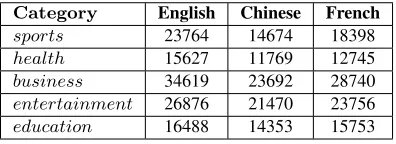
We experimented on two language pairs, English-Chinese and English-French, selected for their diver-sity: English and Chinese are disparate languages with very little common vocabulary and syntax, whereas English and French are regarded as more similar. We expect to evaluate the impact of the distance of languages on the effectiveness of our method. In both cases, English is regarded as the source language, where training data are available, and Chinese and French are the target languages for which we want to build text classifiers. Note that regardless of the language, the documents are assigned with one of the five category labels men-tioned above. Table 1 shows the distribution of doc-uments across categories and across languages.
Category English Chinese French
[image:7.612.87.285.611.683.2]sports 23764 14674 18398 health 15627 11769 12745 business 34619 23692 28740 entertainment 26876 21470 23756 education 16488 14353 15753
Table 1: number of documents in each class
Before building the classification model, several preprocessing steps are applied an all the docu-ments. First, the HTML tags are removed, and ad-vertisements and navigational information are also eliminated. For the Chinese corpus, all the Chinese characters with BIG5 encoding are converted into GB2312 and the Chinese texts are segmented into words. For the translation, we use the LDC bilin-gual dictionary1 for Chinese English and “stardict” 2for Spanish English.
5.2 Model Translation
To transfer a model learned in one language to an-other, we can translate all the bag-of-word features according to a bilingual lexicon. Due to the trans-lation ambiguity of each feature word, we com-pare three different ways of model translation. One method is to equally assign probabilities to all the translations for a given source language word, and to translate a word we randomly pick a translation from all of its translation candidates. We denote this as “EQUAL” and it is our baseline method. Another way is to calculate the translation probability based on the frequencies of the translation words in the tar-get language itself. For instance, the English word “bush” can be translated into “布什” , “树丛” or “套
管” . We can obtain the following unigram counts of these translation words in our Yahoo! RSS news corpus.
count translation sense
582 布什 Goerge W. Bush
43 树丛 small trees
2 套管 canula
We can estimate thatP(布什|bush) = 582/(582 +
43 + 2) = 92.8%and so forth. This method often
al-lows us to estimate reasonable translation probabili-ties and we use “UNIGRAM” to denote this method. And finally the third model translation approach is to use the translation probability learned with the EM algorithm proposed in this paper. The initial parameters of the EM algorithm are set to the prob-abilities calculated with the “UNIGRAM” method and we use 4000 unlabeled documents in Chinese
1
http://www.ldc.upenn.edu/Catalog/CatalogEntry.jsp? catalogId=LDC2002L27
2
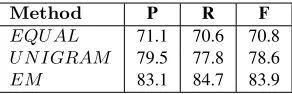
to learn translation probabilities with EM. We first train an English classification model for the topic of “sport” and then translate the model into Chinese us-ing translation probabilities estimated by the above three different methods. The three translated models are applied to Chinese test data and we measure the precision, recall and F-score as shown in Table 2.
Method P R F
[image:8.612.113.259.162.209.2]EQU AL 71.1 70.6 70.8 U N IGRAM 79.5 77.8 78.6 EM 83.1 84.7 83.9
Table 2: Comparison of different methods for model translation
From this table we can see that the baseline method has lowest classification accuracy due to the fact that it is unable to handle translation ambiguity since picking any one of the translation word is equally likely. “UNIGRAM” shows significant improve-ment over “EQUAL” as the occurrence count of the translation words in the target language can help disambiguate the translations. However occurrence count in a monolingual corpus may not always be the true translation probability. For instance, the English word “work” can be translated into “工
作(labor)” and “工厂(factory)” in Chinese. How-ever, in our Chinese monolingual news corpus, the count for “工厂(factory)” is more than that of “工
作(labor)” even though “工作(labor)” should be a more likely translation for “work”. The “EM” algo-rithm has the best performance as it is able to learn translation probabilities by looking at documents in both source language and target language instead of just a single language corpus.
5.3 Cross Language Text Classification
To evaluate the effectiveness of our method on cross language text classification, we implement several methods for comparison. In each experiment, we run a separate classification for each class, using a one-versus-all binary classification.
ML (Monolingual). We build a monolingual text classifier by training and testing the text classi-fication system on documents in the same language. This method plays the role of an upper-bound, since the best classification results are expected when
monolingual training data is available.
MT (Machine Translation). We use the Sys-tran 5.0 machine Sys-translation system to Sys-translate the documents from one language into the other in two directions. The first direction translates the training data from the source language into the target language, and then trains a model in the target language. This direction is denoted as MTS. The second direction trains a classifier in the source language and translates the test data into the source language. This direction is denoted as MTT. In our experiments, Systran generates the single best translation of the text as most off-the-shelf machine translation tools do.
EM (Model Translation with EM). This is the first step of our proposed method. We used 4,000 unlabeled documents to learn translation proba-bilities with the EM algorithm and the translation probabilities are leveraged to translate the model. The rest of the unlabeled documents are used for other experimental purpose.
SEMI (Adapted Model after Semi-Supervised Learning). This is our proposed method, after both model translation and semi-supervised learning. In the semi-supervised learning, we use 6,000 unlabeled target language documents with three training iterations.
In each experiment, the data consists of 4,000 la-beled documents and 1,000 test documents (e.g., in the cross-lingual experiments, we use 4,000 English annotated documents and 1,000 Chinese or French test documents). For a given language, the same test data is used across all experiments.
an-English→Chinese
Category ML MTS MTT EM SEMI
P R F P R F P R F P R F P R F
sports 96.1 94.3 95.2 80.6 81.7 81.2 81.7 83.8 82.7 83.1 84.7 83.9 92.1 91.8 91.9 health 95.1 93.1 94.1 80.8 81.5 81.2 81.6 83.5 82.6 84.5 85.8 85.2 90.2 91.7 90.9 business 91.6 93.1 92.4 81.3 81.9 81.6 80.7 81.0 80.9 81.6 82.0 81.8 87.3 89.3 88.3 entertainment 88.1 88.3 88.2 76.1 78.8 77.5 75.3 78.9 77.1 76.8 79.7 78.2 83.2 83.8 83.5 education 79.1 82.2 80.6 70.2 72.5 71.8 71.1 72.0 71.6 71.2 73.7 72.5 76.2 79.8 78.0
English→French
[image:9.612.95.518.54.212.2]sports 95.8 95.0 95.4 82.8 83.6 83.2 82.1 83.0 82.5 85.3 87.1 86.2 92.5 92.1 92.3 health 94.2 94.5 94.3 82.6 83.9 83.2 81.8 83.0 82.4 86.2 87.2 86.6 92.0 92.2 92.1 business 90.1 92.2 91.1 81.4 82.1 81.7 81.3 81.8 81.8 84.4 84.3 84.4 88.3 89.2 88.8 entertainment 87.4 87.2 87.3 76.6 79.1 77.8 76.0 78.8 77.4 78.9 81.0 80.0 84.3 85.5 84.9 education 78.8 81.8 80.3 72.1 74.8 73.5 72.3 72.7 72.5 73.8 76.2 75.0 76.3 80.1 78.2
Table 3: Comparison of different methods and different language pairs
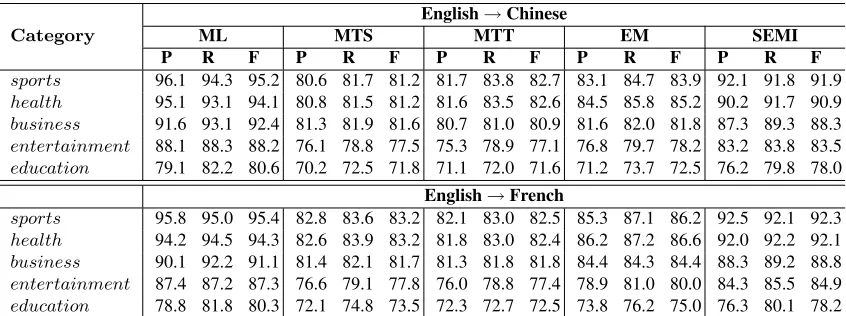
other does not adapt to the distribution of the sec-ond language, even if the documents belong to the same domain. Comparing the twoMTalternatives, we can see that translating the training data (MTS) has better performance than translating the test data (MTT). The reason is that when the model is trained on the translated training data, the model parame-ters are learned over an entire collection of translated documents, which is less sensitive to translation er-rors than translating a test document on which the classification is performed individually.
Our EM method for translating model features outperforms the machine translation approach, since it does not only rely on the best translation by the machine translation system, but instead takes into account all possible translations with knowledge learned specifically from the target language. Ad-ditionally, the SEMI (semi-supervised) learning is shown to further improve the classification accuracy. The semi-supervised learning is able to not only help adapt the translated model to fit the words distribu-tion in the target language, but it also compensates the distortion or information loss during the model translation process as it can down-weigh the incor-rectly translated features.
The improvement in performance for both the
EM and the SEMI methods is consistent across the five different domains, which indicates that the methods are robust and they are insensitive to the domain of the data.
The performance of the two language pairs English-Chinese and English-French shows a dif-ference as initially hypothesized. In both the EM
and the SEMI models, the classification accuracy of English-French exceeds that of English-Chinese, which is probably explained by the fact that there is less translation ambiguity in similar languages, and they have more similar distributions. Note that the monolingual models in French and Chinese perform comparably, which means the difficulty of the test data is similar between the two target languages.
5.4 Model Adaptation with Semi-Supervised Learning
Finally, to gain further insights into our proposed adaptation method, we run several experiments with different parameters for the semi-supervised learn-ing stage. As these experiments are very time con-suming, we run them only on Chinese.
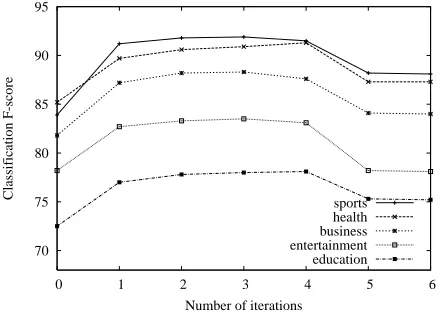
For each of the five categories, we train a classi-fication model using the 4,000 training documents in English and then translate the model into Chinese with the translation parameters learned withEMon 20,000 unlabeled Chinese documents. Then we fur-ther train the translated model on a set of unlabeled Chinese documents using a different number of it-erations and a different amount of unlabeled docu-ments. Figures 1 and 2 show the results of these evaluations.
70 75 80 85 90 95
0 1000 2000 3000 4000 5000 6000
Classification F-score
Size of unlabeled data
[image:10.612.76.297.59.217.2]sports health business entertainment education
Figure 1: Change in classification F-score for an increas-ing amount of unlabeled data in the target language
70 75 80 85 90 95
0 1 2 3 4 5 6
Classification F-score
Number of iterations sports health business entertainment education
Figure 2: Change in classification F-score for a different number of iterations
achieved after 3-4 iterations.
6 Conclusions
In this paper, we proposed a novel method for cross-lingual text classification. Our method ports a clas-sification model trained in a source language to a tar-get language, with the translation knowledge being learned using the EM algorithm. The model is fur-ther tuned to fit the distribution in the target language via semi-supervised learning. Experiments on ferent datasets covering different languages and dif-ferent domains show significant improvement over previous methods that rely on machine translation. Moreover, the cross-lingual classification accuracy obtained with our method was found to be close to the one achieved using monolingual text
classifica-tion.
Acknowledgments
The work of the second author has been partially supported by National Science Foundation awards #0917170 and #0747340. Any opinions, findings, and conclusions or recommendations expressed in this material are those of the authors and do not necessarily reflect the views of the National Science Foundation.
References
S. Argamon, M. Koppel, and G. Avneri. 1998. Style-based text categorization: What newspaper am i read-ing? InAAAI-98 Workshop on Learning for Text Cat-egorization, Madison.
C. Banea, R. Mihalcea, J. Wiebe, and S. Hassan. 2008. Multilingual subjectivity analysis using machine trans-lation. InProceedings of the Conference on Empirical Methods in Natural Language Processing (EMNLP 2008), Honolulu, Hawaii.
A. Berger, S. Della Pietra, and V. Della Pietra. 1996. A maximum entropy approach to natural language pro-cessing.Computational Linguistics, 22(1):39–71. A. Blum and T. Mitchell. 1998. Combining labeled and
unlabeled data with co-training. InCOLT: Proceed-ings of the Workshop on Computational Learning The-ory, Morgan Kaufmann Publishers, June.
P. Brown, S. della Pietra, V. della Pietra, and R. Mercer. 1993. The mathematics of statistical machine trans-lation: parameter estimation. Computational Linguis-tics, 19(2).
W. Dai, G. Xue, Q. Yang, and Y. Yu. 2007. Transfer-ring naive bayes classifiers for text classification. InIn Proceedings of the 22nd AAAI Conference on Artificial Intell igence, pages 540–545.
A.P. Dempster, N.M. Laird, and D.B. Rubin. 1977. Max-imum likelihood from incomplete data via the em al-gorithm. Journal of the Royal Statistical Society. Se-ries B (Methodological), 39(1).
B. Fortuna and J. Shawe-Taylor. 2005. The use of machine translation tools for cross-lingual text min-ing. In Learning With Multiple Views, Workshop at the 22nd International Conference on Machine Learn-ing (ICML).
[image:10.612.75.295.271.427.2]R. Hwa, P. Resnik, and A. Weinberg. 2005. Bootstrap-ping parsers via syntactic projection across parallel texts. Natural Language Engineering. Special issue on Parallel Texts, editors R. Mihalcea and M. Simard. T. Joachims. 1997. A probabilistic analysis of the
Roc-chio algorithm with TFIDF for text categorization. In
Proceedings of ICML-97, 14th International Confer-ence on Machine Learning, Nashville, US.
T. Joachims. 1998. Text categorization with Support Vector Machines: learning with mny relevant features. In Proceedings of the European Conference on Ma-chine Learning, pages 137–142.
P. Koehn and K. Knight. 2000. Estimating word transla-tion probabilities from unrelated monolingua l corpora using the em algorithm. In National Conference on Artificial Intelligence (AAAI 2000) Lang kilde, pages 711–715.
A. McCallum and K. Nigam. 1998. A comparison of event models for Naive Bayes text classification. In
Proceedings of AAAI-98 Workshop on Learning for Text Categorization.
R. Mihalcea, C. Banea, and J. Wiebe. 2007. Learning multilingual subjective language via cross-lingual pro-jections. InProceedings of the Association for Com-putational Linguistics, Prague, Czech Republic. C. Monz and B.J. Dorr. 2005. Iterative translation
dis-ambiguation for cross-language information retrieval. InProceedings of the 28th Annual International ACM SIGIR Conference on Research and Development in Information Retrieval, Salvador, Brazil.
A. Moschitti. 2003. A study on optimal paramter tun-ing for Rocchio text classifier. InProceedings of the European Conference on Information Retrieval, Italy. H.T. Ng, B. Wang, and Y.S. Chan. 2003. Exploiting
par-allel texts for word sense disambiguation: An empiri-cal study. InProceedings of the 41st Annual Meeting of the Association for Computational Linguistics (ACL 2003), Sapporo, Japan, July.
J.-Y. Nie, M. Simard, P. Isabelle, and R. Durand. 1999. Cross-language information retrieval based on parallel texts and automatic mining of parallel texts from the Web. InProceedings of the 22nd annual international ACM SIGIR conference on Research and development in information retrieval.
K. Nigam and R. Ghani. 2000. Analyzing the effec-tiveness and applicability of co-training. In Proceed-ings of the Conference on Information and Knowledge Management (CIKM 2000), McLean, VA, November. K. Nigam, J. Lafferty, and A. McCallum. 1999. Using
maximum entropy for text classification. InIJCAI-99 Workshop on Machine Learning for Information Fil-tering.
J.S. Olsson, D. W. Oard, and J. Hajic. 2005. Cross-language text classification. InProceedings of the 28th
Annual international ACM SIGIR Conference on Re-search and Development in information Retrieval. B. Pang and L. Lee. 2004. A sentimental education:
Sentiment analysis using subjectivity summarization based on minimum cuts. InProceedings of the 42nd Meeting of the Association for Computational Linguis-tics, Barcelona, Spain, July.
M. Sahami, S. Dumais, D. Heckerman, and E. Horvitz. 1998. A Bayesian approach to filtering junk e-mail. In AAAI-98 Workshop on Learning for Text Catego-rization, Madison.
J. Schler, M. Koppel, S. Argamon, and J. Pennebaker. 2006. Effects of age and gender on blogging. In Pro-ceedings of 2006 AAAI Spring Symposium on Com-putational Approaches for Analyzing Weblogs, pages 199–204, Stanford.
L. Shi, C. Niu, M. Zhou, and J. Gao. 2006. A dom tree alignment model for mining parallel data from the web. InProceedings of the Annual Meeting of the As-sociation for Computational Lingusitics (ACL 2006), Sydney, Australia.
V. Vapnik. 1995.The Nature of Statistical Learning The-ory. Springer, New York.