A Mixture Model with Sharing for Lexical Semantics
Joseph Reisinger
Department of Computer Science University of Texas at Austin 1616 Guadalupe, Suite 2.408
Austin, TX, 78701 [email protected]
Raymond Mooney Department of Computer Science
University of Texas at Austin 1616 Guadalupe, Suite 2.408
Austin, TX, 78701 [email protected]
Abstract
We introduce tiered clustering, a mixture model capable of accounting for varying de-grees of shared (context-independent) fea-ture strucfea-ture, and demonstrate its applicabil-ity to inferring distributed representations of word meaning. Common tasks in lexical se-mantics such as word relatedness or selec-tional preference can benefit from modeling such structure: Polysemous word usage is of-ten governed by some common background metaphoric usage (e.g. the senses ofline or run), and likewise modeling the selectional preference of verbs relies on identifying com-monalities shared by their typical arguments. Tiered clustering can also be viewed as a form of soft feature selection, where features that do not contribute meaningfully to the clustering can be excluded. We demonstrate the applica-bility of tiered clustering, highlighting partic-ular cases where modeling shared structure is beneficial and where it can be detrimental.
1 Introduction
Word meaning can be represented as high-dimensional vectors inhabiting a common space whose dimensions capture semantic or syntactic properties of interest (e.g. Erk and Pado, 2008;
Lowe, 2001). Suchvector-spacerepresentations of
meaning induce measures of word similarity that can be tuned to correlate well with judgements made
by humans. Previous work has focused on
de-signing feature representations and semantic spaces that capture salient properties of word meaning (e.g. Curran, 2004; Gabrilovich and Markovitch, 2007; Landauer and Dumais, 1997), often leveraging the distributional hypothesis, i.e. that similar words
ap-pear in similar contexts (Miller and Charles, 1991; Pereira et al., 1993).
Since vector-space representations are con-structed at the lexical level, they conflate multiple word meanings into the same vector, e.g. collaps-ing occurrences ofbankinstitutionandbankriver.
Meth-ods such asClustering by Committee(Pantel, 2003)
and multi-prototype representations (Reisinger and Mooney, 2010) address this issue by perform-ing word-sense disambiguation across word occur-rences, and then building meaning vectors from
the disambiguated words. Such approaches can
readily capture the structure of homonymous words with several unrelated meanings (e.g.batandclub), but are not suitable for representing the common metaphor structure found in highly polysemous words such aslineorrun.
In this paper, we introduce tiered clustering, a
novel probabilistic model of the shared structure
often neglected in clustering problems. Tiered
clustering performs soft feature selection,
allocat-ing features between a Dirichlet Process cluster-ing model and a background model consistcluster-ing of
a single component. The background model
ac-counts for features commonly shared by all occur-rences (i.e. context-independent feature variation), while the clustering model accounts for variation in word usage (i.e. context-dependent variation, or
word senses; Table 1).
Using the tiered clustering model, we derive a multi-prototype representation capable of capturing varying degrees of sharing between word senses, and demonstrate its effectiveness in lexical seman-tic tasks where such sharing is desirable. In parseman-tic- partic-ular we show that tiered clustering outperforms the multi-prototype approach for (1) selectional prefer-ence (Resnik, 1997; Pantel et al., 2007), i.e.
ing the typical filler of an argument slot of a verb, and (2) word-relatedness in the presence of highly polysemous words. The former case exhibits a high degree of explicit structure, especially for more se-lectionally restrictive verbs (e.g. the set of things that can beeatenor canshoot).
The remainder of the paper is organized as fol-lows: Section 2 gives relevant background on the methods compared, Section 3 outlines the multi-prototype model based on the Dirichlet Process mix-ture model, Section 4 derives the tiered cluster-ing model, Section 5 discusses similarity metrics, Section 6 details the experimental setup and in-cludes a micro-analysis of feature selection, Section 7 presents results applying tiered clustering to word relatedness and selectional preference, Section 8 dis-cusses future work, and Section 9 concludes.
2 Background
Models of the attributional similarity of concepts,
i.e. the degree to which concepts overlap based on their attributes (Turney, 2006), are commonly imple-mented using vector-spaces derived from (1) word collocations (Sch¨utze, 1998), directly leveraging the distributional hypothesis (Miller and Charles, 1991), (2) syntactic relations (Pad´o and Lapata, 2007), (3) structured corpora (e.g. Gabrilovich and Markovitch (2007)) or (4) latent semantic spaces (Finkelstein et al., 2001; Landauer and Dumais, 1997). Such models can be evaluated based on their correlation with human-reported lexical similarity judgements using e.g. the WordSim-353 collection (Finkelstein et al., 2001). Distributional methods exhibit a high degree of scalability (Gorman and Curran, 2006) and have been applied broadly in information retrieval (Manning et al., 2008), large-scale taxonomy induc-tion (Snow et al., 2006), and knowledge acquisiinduc-tion (Van Durme and Pas¸ca, 2008).
Reisinger and Mooney (2010) introduced a
multi-prototype approach to vector-space lexical seman-tics where individual words are represented as col-lections of “prototype” vectors. This representation is capable of accounting for homonymy and poly-semy, as well as other forms of variation in word usage, like similar context-dependent methods (Erk
and Pado, 2008). The set of vectors for a word
is determined by unsupervised word sense
discov-ery(Sch¨utze, 1998), which clusters the contexts in
which a word appears. Average prototype vectors
LIFE
all, about, life, would, death my, you, real, your, about spent, years, rest, lived, last
sentenced, imprisonment, sentence, prison insurance, peer, Baron, member, company Guru, Rabbi, Baba, la, teachings
RADIO
station, radio, stations, television amateur, frequency, waves, system show, host, personality, American song, single, released, airplay
operator, contact, communications, message
WIZARD
evil, powerful, magic, wizard Merlin, King, Arthur, Arthurian fairy, wicked, scene, tale
Harry, Potter, Voldemort, Dumbledore STOCK
stock, all, other, company, new market, crash, markets, price, prices housing, breeding, fish, water, horses car, racing, cars, NASCAR, race, engine card, cards, player, pile, game, paper rolling, locomotives, line, new, railway
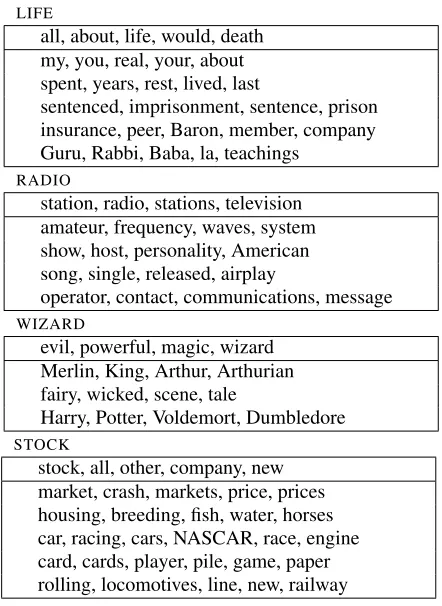
Table 1: Example tiered clustering representation of words with varying degrees of polysemy. Each boxed set shows the most common background (shared) fea-tures, and each prototype captures one thematic usage of the word. For example, wizard is broken up into a background cluster describing features common to all us-ages of the word (e.g.,magicandevil) and several genre-specific usages (e.g.Merlin,fairy talesandHarry Potter).
are then computed separately for each cluster, pro-ducing a distributed representation for each word.
Distributional methods have also proven to be a
powerful approach to modeling selectional
prefer-ence(Pad´o et al., 2007; Pantel et al., 2007), rivaling methods based on existing semantic resources such as WordNet (Clark and Weir, 2002; Resnik, 1997) and FrameNet (Pad´o, 2007) and performing nearly as well as supervised methods (Herdaˇgdelen and Ba-roni, 2009). Selectional preference has been shown to be useful for, e.g., resolving ambiguous attach-ments (Hindle and Rooth, 1991), word sense disam-biguation (McCarthy and Carroll, 2003) and seman-tic role labeling (Gildea and Jurafsky, 2002).
3 Multi-Prototype Models
[image:2.612.316.537.54.357.2]vector-space lexical semantics (Pantel, 2003; Pantel et al., 2007; Reisinger and Mooney, 2010). In this section we briefly introduce a version of the multi-prototype model based on the Dirichlet Process Mix-ture Model (DPMM), capable of inferring automat-ically the number of prototypes necessary for each word (Rasmussen, 2000). Similarity between two DPMM word-representations is then computed as a function of their cluster centroids (§5), instead of the centroid of all the word’s occurrences.
Multiple prototypes for each word w are
gener-ated by clustering feature vectorsvpcqderived from
each occurrence c P Cpwq in a large textual
cor-pus and collecting the resulting cluster centroids πkpwq, k P r1, Kws. This approach is commonly
employed in unsupervised word sense discovery; however, we do not assume that clusters correspond to word senses. Rather, we only rely on clusters to capture meaningful variation in word usage.
Instead of assuming all words can be repre-sented by the same number of clusters, we allocate representational flexibility dynamically using the DPMM. The DPMM is an infinite capacity model capable of assigning data to a variable, but finite
number of clusters Kw, with probability of
assign-ment to clusterkproportional to the number of data
points previously assigned tok. A single parameter
ηcontrols the degree of smoothing, producing more
uniform clusterings as η Ñ 8. Using this model,
the number of clusters no longer needs to be fixed a priori, allowing the model to allocate expressivity dynamically to concepts with richer structure. Such a model naturally allows the word representation to allocate additional capacity for highly polysemous words, with the number of clusters growing loga-rithmically with the number of occurrences. The DPMM has been used for rational models of con-cept organization (Sanborn et al., 2006), but to our knowledge has not yet been applied directly to lexi-cal semantics.
4 Tiered Clustering
Tiered clustering allocates features between two submodels: a (context-dependent) DPMM and a
sin-gle (context-independent) background component.
This model is similar structurally to the feature se-lective clustering model proposed by Law et al. (2002). However, instead of allocating entire feature
dimensionsbetween model and background
compo-θ
z
α
D w
w
β
!
∞
background
!
c
η
η
β
clusters [image:3.612.328.527.58.132.2]d
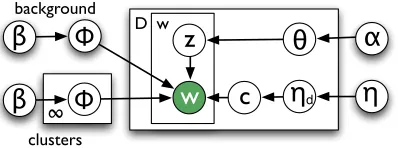
Figure 1: Plate diagram for the tiered clustering model with cluster indicators drawn from the Chinese Restau-rant Process.
nents, assignment is done at the level of individual feature occurrences, much like topic assignment in Latent Dirichlet Allocation (LDA; Griffiths et al.,
2007). At a high level, the tiered model can be
viewed as a combination of a multi-prototype model and a single-prototype back-off model. However, by leveraging both representations in a joint frame-work, uninformative features can be removed from the clustering, resulting in more semantically tight clusters.
Concretely, each word occurrencewdfirst selects
a clusterφdfrom the DPMM; then each featurewi,d
is generated from either the background modelφback
or the selected cluster φd, determined by the tier
indicatorzi,d. The full generative model for tiered
clustering is given by
θd|α Betapαq dPD,
φd|β, G0 DPpβ, G0q dPD,
φback|βback Dirichletpβbackq
zi,d|θd Bernoullipθdq iP |wd|,
wi,d|φd, zi,d $ ' ' & ' ' %
Multpφbackq
pzi,d1q Multpφdq
potherwiseq
iP |wd|,
where α controls the per-data tier distribution
smoothing andβcontrols the uniformity of the DP
cluster allocation. The DP is parameterized by a
base measure G0, controlling the per-cluster term
distribution smoothing; which use a Dirichlet with
hyperparameterη, as is common (Figure 1).
Since the background topic is shared across all
oc-currences, it can account for features with
context-independentvariance, such as stop words and other high-frequency noise, as well as the central tendency of the collection (Table 1). Furthermore, it is
possi-ble to put an asymmetric prior onη, yielding more
fine-grained control over the assumeduniformityof
Although exact posterior inference is intractable in this model, we derive an efficientcollapsed Gibbs samplervia analogy to LDA (Appendix 1).
5 Measuring Semantic Similarity
Due to its richer representational structure, comput-ing similarity in the multi-prototype model is less straightforward than in the single prototype case. Reisinger and Mooney (2010) found that simply av-eraging all similarity scores over all pairs of proto-types (sampled from the cluster distributions) per-forms reasonably well and is robust to noise. Given
two wordswandw1, thisAvgSimmetric is
AvgSimpw, w1q def 1 KwKw1
K¸w
j1
K¸w1
k1
dpπkpwq, πjpw1qq
KwandKw1are the number of clusters forwandw1
respectively, and dp,q is a standard distributional similarity measure (e.g. cosine distance). As cluster sizes become more uniform, AvgSim tends towards the single prototype similarity,1hence the effective-ness of AvgSim stems from boosting the influence of small clusters.
Tiered clustering representations offer more pos-sibilities for computing semantic similarity than multi-prototype, as the background prototype can be treated separately from the other prototypes. We make use of a simple sum of the distance between the two background components, and the AvgSim of the two sets of clustering components.
6 Experimental Setup
6.1 Corpus
Word occurrence statistics are collected from a snap-shot of English Wikipedia taken on Sept. 29th, 2009. Wikitext markup is removed, as are articles with fewer than 100 words, leaving 2.8M articles with a total of 2.05B words. Wikipedia was chosen due to its semantic breadth.
6.2 Evaluation Methodology
We evaluate the tiered clustering model on two prob-lems from lexical semantics: word relatedness and
selectional preference. For the word relatedness
1This can be problematic for certain clustering methods
that specify uniform priors over cluster sizes; however the DPMM naturally exhibits a linear decay in cluster sizes with theEr# clusters of sizeMs η{M.
Rating distribution
WS-353 0.0
0.5 1.0
Evocation Pado
Sense count distribution
WS-353 0
3 10 80
Evocation Pado Figure 2: (top) The distribution of ratings (scaled [0,1]) on WS-353, WN-Evocation and Pad´o datasets. (bottom) The distribution of sense counts for each data set (log-domain), collected from WordNet 3.0.
evaluation, we compared the predicted similarity of word pairs from each model to two collections of hu-man similarity judgements: WordSim-353 (Finkel-stein et al., 2001) and the Princeton Evocation rela-tions (WN-Evocation, Ma et al., 2009).
WS-353 contains between 13 and 16 human sim-ilarity judgements for each of 353 word pairs, rated on a 1–10 integer scale. WN-Evocation is signif-icantly larger than WS-353, containing over 100k similarity comparisons collected from trained hu-man raters. Comparisons are assigned to only 3-5 human raters on average and contain a signifi-cantly higher fraction of zero- and low-similarity items than WS-353 (Figure 2), reflecting more ac-curately real-world lexical semantics settings. In our experiments we discard all comparisons with fewer than 5 ratings and then sample 10% of the remain-ing pairs uniformly at random, resultremain-ing in a test set with 1317 comparisons.
For selectional preference, we employ the Pad´o
dataset, which contains 211 verb-noun pairs with human similarity judgements for how plausible the noun is for each argument of the verb (2 arguments per verb, corresponding roughly to subject and ob-ject). Results are averaged across 20 raters; typical inter-rater agreement isρ0.7(Pad´o et al., 2007).
In all cases correlation with human judgements is computed using Spearman’s nonparametric rank
[image:4.612.331.532.53.242.2](Agirre et al., 2009).
6.3 Feature Representation
In the following analyses we confine ourselves to representing word occurrences using unordered
un-igrams collected from a window of sizeT10
cen-tered around the occurrence, represented usingtf-idf
weighting. Feature vectors are pruned to a fixed lengthf, discarding all but the highest-weight fea-tures (f is selected via empirical validation, as de-scribed in the next section). Finally, semantic simi-larity between word pairs is computed using cosine distance (`2-normalized dot-product).2
6.4 Feature Pruning
Feature pruning is one of the most significant factors in obtaining high correlation with human similarity judgements using vector-space models, and has been suggested as one way to improve sense disambigua-tion for polysemous verbs (Xue et al., 2006). In this section, we calibrate the single prototype and multi-prototype methods on WS-353, reaching the limit of human and oracle performance and demonstrat-ing robust performance gains even with semanti-cally impoverished features. In particular we obtain
ρ0.75correlation on WS-353 usingonly unigram
collocations and ρ0.77 using a fixed-K
multi-prototype representation (Figure 3; Reisinger and Mooney, 2010). This result rivals average human performance, obtaining correlation near that of the supervised oracle approach of Agirre et al. (2009).
The optimal pruning cutoff depends on the fea-ture weighting and number of prototypes as well as the feature representation. t-testandχ2features are most robust to feature noise and perform well even with no pruning;tf-idf yields the best results but is most sensitive to the pruning parameter (Figure 3). As the number of features increases, more pruning is required to combat feature noise.
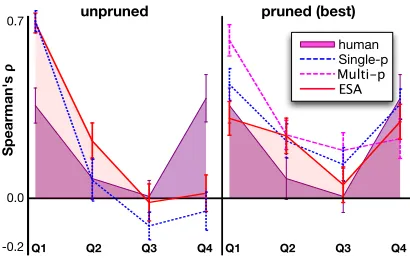
Figure 4 breaks down the similarity pairs into four quantiles for each data set and then shows corre-lation separately for each quantile. In general the more polarized data quantiles (1 and 4) have higher correlation, indicating that fine-grained distinctions
2(Parameter robustness) We observe lower correlations on
average forT25and T5and therefore observeT10to be near-optimal. Substituting weighted Jaccard similarity for cosine does not significantly affect the results in this paper.
0 0.4 0.8
0 0.4 0.8
Spearman's
ρ
0.7
0.0
-0.2
unpruned pruned (best)
Q1 Q2 Q3 Q4 Q1 Q2 Q3 Q4
[image:5.612.320.525.56.185.2]human Single-p Multi-p ESA
Figure 4: Correlation results on WS-353 broken down over quantiles in the human ratings. Quantile ranges are shown in Figure 2. In general ratings for highly sim-ilar (dissimsim-ilar) pairs are more predictable (quantiles 1 and 4) than middle similarity pairs (quantiles 2, 3). ESA shows results for a more semantically rich feature set de-rived using Explicit Semantic Analysis (Gabrilovich and Markovitch, 2007).
in semantic distance are easier for those sets.3 Fea-ture pruning improves correlations in quantiles 2–4 while reducing correlation in quantile 1 (lowest sim-ilarity). This result is to be expected as more fea-tures are necessary to make fine-grained distinctions between dissimilar pairs.
7 Results
We evaluate four models: (1) the standard single-prototype approach, (2) the DPMM multi-single-prototype
approach outlined in §3, (3) a simple
combina-tion of the multi-prototype and single-prototype
ap-proaches (MP+SP)4and (4) the tiered clustering
ap-proach (§4). Each data set is divided into 5
quan-tiles based on per-pair average sense counts,5
col-lected from WordNet 3.0 (Fellbaum, 1998);
ex-amples of pairs in the high-polysemy quantile are
shown in Table 2. Unless otherwise specified,
both DPMM multi-prototype and tiered clustering
3The fact that the per-quantile correlation is significantly
lower than the full correlation e.g. in the human case indicates that fine-grained ordering (within quantile) is more difficult than coarse-grained (between quantile).
4
(MP+SP) Tiered clustering’s ability to model both shared and idiosyncratic structure can be easily approximated by us-ing the sus-ingle prototype model as the shared component and multi-prototype model as the clustering. However, unlike in the tiered model, all features are assigned tobothcomponents. We demonstrate that this simplification actually hurts performance.
5Despite many skewed pairs (e.g. line has 36 senses while
0 0.4 0.8
0 0.4 0.8
0 0.4 0.8
0 0.4 0.8
K=1 K=10 K=50 tf-idf cosine, K=1,10,50
Spearman's
ρ
0.0 0.8
# of features
all 10k 5k 2k 1k 500 200 100 20 10
# of features
all 10k 5k 2k 1k 500 200 100 20 10
# of features
all 10k 5k 2k 1k 500 200 100 20 10
# of features
all 10k 5k 2k 1k 500 200 100 20 10 tf-idf
ttest χ2
tf
K=50 K=10 K=1 tf-idf
ttest χ2
tf tf-idf
ttest χ2
tf
[image:6.612.78.539.53.197.2]// // // //
Figure 3: Effects of feature pruning and representation on WS-353 correlation broken down across multi-prototype representation size. In generaltf-idffeatures are the most sensitive to pruning level, yielding the highest correlation for moderate levels of pruning and significantly lower correlation than other representations without pruning. The optimal amount of pruning varies with the number of prototypes used, with fewer features being optimal for more clusters. Bars show 95% confidence intervals.
WordSim-353
stock-live, start-match, line-insurance, game-round, street-place, company-stock
Evocation
break-fire, clear-pass, take-call, break-tin, charge-charge, run-heat, social-play
Pad´o
drop, return, hit-stock, raise-bank, see-face, raise-firm, raise-question
Table 2: Examples of highly polysemous pairs from each data set using sense counts from WordNet.
use symmetric Dirichlet hyperparameters, β0.1,
η0.1, and tiered clustering usesα10for the back-ground/clustering allocation smoother.
7.1 WordSim-353
Correlation results for WS-353 are shown in Table 3. In general the approaches incorporating multiple
prototypes outperform single prototype (ρ 0.768
vs.ρ0.734). The tiered clustering model does not significantly outperform either the multi-prototype or MP+SP models on the full set, but yields signifi-cantly higher correlation on the high-polysemy set.
The tiered model generates more clusters than DPMM multi-prototype (27.2 vs. 14.8), despite us-ing the same hyperparameter settus-ings: Since words commonly shared across clusters have been allo-cated to the background component, the cluster components have less overlap and hence the model naturally allocates more clusters.
Examples of the tiered clusterings for several
Method ρ100 ErCs background
Single prototype 73.40.5 1.0 -high polysemy 76.00.9 1.0
-Multi-prototype 76.80.4 14.8 -high polysemy 79.31.3 12.5
-MP+SP 75.40.5 14.8 -high polysemy 80.11.0 12.5
-Tiered 76.90.5 27.2 43.0% high polysemy 83.11.0 24.2 43.0%
Table 3: Spearman’s correlation on the WS-353 data set. Allrefers to the full set of pairs,high polysemyrefers to the top 20% of pairs, ranked by sense count.ErCsis the
average number of clusters employed by each method and background is the average percentage of features allo-cated by the tiered model to the background cluster. 95% confidence intervals are computed via bootstrapping.
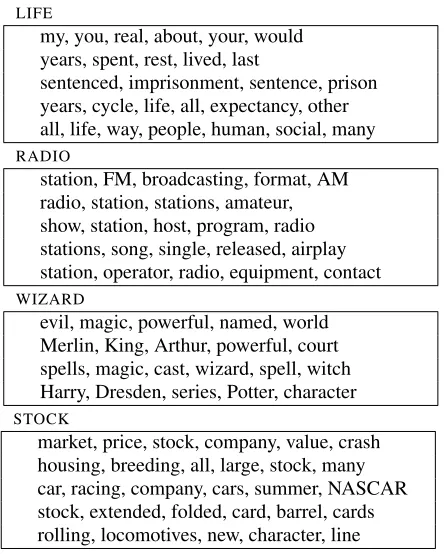
words from WS-353 are shown in Table 1 and corre-sponding clusters from the multi-prototype approach are shown in Table 4. In general the background component does indeed capture commonalities be-tween all the sense clusters (e.g. all wizards use magic) and hence the tiered clusters are more
se-mantically pure. This effect is most visible in
the-matically polysemouswords, e.g.radioandwizard.
7.2 Evocation
sim-LIFE
my, you, real, about, your, would years, spent, rest, lived, last
sentenced, imprisonment, sentence, prison years, cycle, life, all, expectancy, other all, life, way, people, human, social, many
RADIO
station, FM, broadcasting, format, AM radio, station, stations, amateur, show, station, host, program, radio stations, song, single, released, airplay station, operator, radio, equipment, contact WIZARD
evil, magic, powerful, named, world Merlin, King, Arthur, powerful, court spells, magic, cast, wizard, spell, witch Harry, Dresden, series, Potter, character
STOCK
[image:7.612.75.298.54.331.2]market, price, stock, company, value, crash housing, breeding, all, large, stock, many car, racing, company, cars, summer, NASCAR stock, extended, folded, card, barrel, cards rolling, locomotives, new, character, line
Table 4: Example DPMM multi-prototype representation of words with varying degrees of polysemy. Compared to the tiered clustering results in Table 1 the multi-prototype clusters are significantly less pure forthematically poly-semouswords such asradioandwizard.
ilarity is a sparse relation (Figure 2 top). Further-more, it contains proportionally more highly polyse-mous words relative to WS-353 (Figure 2 bottom).
On WN-Evocation, the single prototype and multi-prototype do not differ significantly in terms of correlation (ρ0.198andρ0.201respectively; Table 5), while SP+MP yields significantly lower correlation (ρ0.176), and the tiered model yields significantly higher correlation (ρ0.224). Restrict-ing to the top 20% of pairs with highest human similarity judgements yields similar outcomes, with single prototype, multi-prototype and SP+MP sta-tistically indistinguishable (ρ0.239, ρ0.227and ρ0.235), and tiered clustering yielding signifi-cantly higher correlation (ρ0.277). Likewise tiered clustering achieves the most significant gains on the high polysemy subset.
7.3 Selectional Preference
Tiered clustering is a natural model for verb selec-tional preference, especially for more selecselec-tionally restrictive verbs: the set of words that appear in a particular argument slot naturally have some kind of
Method ρ100 ErCs background
Single prototype 19.80.6 1.0 -high similarity 23.91.1 1.0 -high polysemy 11.51.2 1.0
-Multi-prototype 20.10.5 14.8 -high similarity 22.71.2 14.1 -high polysemy 13.01.3 13.2
-MP+SP 17.60.5 14.8 -high similarity 23.51.2 14.1 -high polysemy 11.41.0 13.2
[image:7.612.314.540.55.235.2]-Tiered 22.40.6 29.7 46.6% high similarity 27.71.3 29.9 47.2% high polysemy 15.41.1 27.4 46.6%
Table 5: Spearman’s correlation on the Evocation data set. Thehigh similaritysubset contains the top 20% of pairs sorted by average rater score.
Method ρ100 ErCs background
Single prototype 25.80.8 1.0 -high polysemy 17.31.7 1.0
-Multi-prototype 20.21.0 18.5 -high polysemy 14.12.4 17.4
-MP+SP 19.71.0 18.5 -high polysemy 10.52.5 17.4
-Tiered 29.41.0 37.9 41.7% high polysemy 28.52.4 37.4 43.2%
Table 6: Spearman’s correlation on the Pad´o data set.
commonality (i.e. they can beeatenor canpromise). The background component of the tiered clustering model can capture such general argument structure. We model each verb argument slot in the Pad´o set with a separate tiered clustering model, separating terms co-occurring with the target verb according to which slot they fill.
On the Pad´o set, the performance of the DPMM multi-prototype approach breaks down and it yields significantly lower correlation with human norms than the single prototype (ρ0.202 vs. ρ0.258; Table 6), due to its inability to capture the shared structure among verb arguments. Furthermore com-bining with the single prototype does not
signif-icantly change its performance (ρ0.197).
[image:7.612.314.540.288.423.2]8 Discussion and Future Work
We have demonstrated a novel model for dis-tributional lexical semantics capable of capturing both shared (context-independent) and idiosyncratic (context-dependent) structure in a set of word occur-rences. The benefits of this tiered model were most pronounced on a selectional preference task, where there is significant shared structure imposed by con-ditioning on the verb. Although our results on the Pad´o are not state of the art,6 we believe this to be due to the impoverished vector-space design; tiered clustering can be applied to more expressive vec-tor spaces, such as those incorporating dependency parse and FrameNet features.
One potential explanation for the superior perfor-mance of the tiered model vs. the DPMM multi-prototype model is simply that it allocates more clusters to represent each word (Reisinger and
Mooney, 2010). However, we find that
decreas-ing the hyperparameter β (decreasing vocabulary
smoothing and hence increasing the effective num-ber of clusters) beyondβ 0.1actually hurts multi-prototype performance. The additional clusters do not provide more semantic content due to significant background similarity.
Finally, the DPMM multi-prototype and tiered clustering models allocate clusters based on the
vari-ance of the underlying data set. We observe a
neg-ativecorrelation (ρ0.33) between the number of clusters allocated by the DPMM and the number of word senses found in WordNet. This result is most likely due to our use of unigram context window features, which induce clustering based on thematic rather than syntactic differences. Investigating this issue is future work.
(Future Work) The word similarity experiments
can be expanded by breaking pairs down further into highly homonymous and highly polysemous pairs, using e.g. WordNet to determine how closely related the senses are. With this data it would be interest-ing to validate the hypothesis that the percentage of features allocated to the background cluster is corre-lated with the degree of homonymy.
The basic tiered clustering can be extended with additional background tiers, allocating more expres-sivity to model background feature variation. This class of models covers the spectrum between a pure
6E.g., Pad´o et al. (2007) reportρ0.515on the same data.
topic model (all background tiers) and a pure clus-tering model and may be reasonable when there is believed to be more background structure (e.g. when jointly modeling all verb arguments). Furthermore, it is straightforward to extend the model to a two-tier, two-clustering structure capable of additionally
accounting for commonalitiesbetweenarguments.
Applying more principled feature selection ap-proaches to vector-space lexical semantics may yield more significant performance gains. Towards this end we are currently evaluating two classes of approaches for setting pruning parameters per-word
instead of globally: (1) subspace clustering, i.e.
unsupervised feature selection (e.g., Parsons et al., 2004) and (2) multiple clustering, i.e. finding fea-ture partitions that lead to disparate clusterings (e.g., Shafto et al., 2006).
9 Conclusions
This paper introduced a simple probabilistic model of tiered clustering inspired by feature selective clustering that leverages feature exchangeability to allocate data features between a clustering model and shared component. The ability to model back-ground variation, or shared structure, is shown to be beneficial for modeling words with high polysemy, yielding increased correlation with human similarity judgements modeling word relatedness and selec-tional preference. Furthermore, the tiered clustering model is shown to significantly outperform related models, yielding qualitatively more precise clusters.
Acknowledgments
Thanks to Yinon Bentor and Bryan Silverthorn for many illuminating discussions. This work was sup-ported by an NSF Graduate Research Fellowship to the first author, and a Google Research Award.
A Collapsed Gibbs Sampler
In order to sample efficiently from this model, we leverage the Chinese Restaurant Process represen-tation of the DP (cf., Aldous, 1985), introducing a
per-word-occurrence cluster indicatorcd. Word
oc-currence features are then drawn from a combination of a single cluster component indicated bycdand the
background topic.
By exploiting conjugacy, the latent variablesθ,φ
collapsed Gibbs sampler. The likelihood of word
occurrencedis given by
Ppw¹d|z, cd,φq
i
Ppwi,d|φcdq
δpzd,i0qPpw
i,d|φnoiseqδpzd,i1q.
Hence, this model can be viewed as a two-topic variant of LDA with the addition of a
per-word-occurrence (i.e. document) cluster indicator.7 The
update rule for the latent tier indicator z is similar to the update rule for 2-topic LDA, with the back-ground component as the first topic and the second topic being determined by the per-word-occurrence cluster indicatorc.
We can efficiently approximateppz|wqvia Gibbs sampling, which requires the complete conditional posteriors for allzi,d. These are
Ppzi,d t|zpi,dq,w, α, βq
nptwi,dq β
°
wpnp wq t βq
nptdq α
°
jpnp dq j αq
.
wherezpi,dqis shorthand for the setztzi,du,nptwq
is the number of occurrences of wordwin topictnot countingwi,d andnp
dq
t is the number of features in
occurrencedassigned to topict, not countingwi,d.
Likewise sampling the cluster indicators condi-tioned on the data ppcd|w,cd, α, ηq decomposes
into the DP posterior over cluster assignments and the cluster-conditional Multinomial-Dirichlet word-occurrence likelihood ppcd|w,cd, α, ηq
ppcd|cd, ηqppwd|wd,c,z, αqgiven by
Ppcdkold|cd, α, ηq9
mpk dq
mp dq η
looooooomooooooon
ppcd|cd,ηq
Cpα ÝÑnkpdq ÝÑnpdqqq
Cpα ÝÑnpk dqq
loooooooooooooomoooooooooooooon
ppwd|wd,c,z,αq
Ppcdknew|cd, α, ηq9
η
mp dq η
Cpα ÝÑnpdqq Cpαq
where mpk dq is the number of occurrences
as-signed to k not including d, ÝÑnpkdq is the vector of
counts of words from occurrence wd assigned to
7Effectively, the tiered clustering model is a special case of
thenestedChinese Restaurant Process with the tree depth fixed to two (Blei et al., 2003).
cluster k (i.e. words with zi,d 0) and Cpq is
the normalizing constant for the DirichletCpaq
Γp°mj1ajq1
±m
j1Γpajq operating over vectors
of countsa.
References
Eneko Agirre, Enrique Alfonseca, Keith Hall, Jana Kravalova, Marius Pas¸ca, and Aitor Soroa. 2009. A study on similarity and relatedness using
distri-butional and Wordnet-based approaches. InProc.
of NAACL-HLT-09, pages 19–27.
David J. Aldous. 1985. Exchangeability and related topics. In Ecole d’´et´e de probabilit´es de Saint-´ Flour, XIII—1983, volume 1117, pages 1–198. Springer, Berlin.
David Blei, Thomas Griffiths, Michael Jordan, and
Joshua Tenenbaum. 2003. Hierarchical topic
models and the nested Chinese restaurant process. InProc. NIPS-2003.
Stephen Clark and David Weir. 2002. Class-based probability estimation using a semantic hierarchy.
Computational Linguistics, 28(2):187–206.
James Richard Curran. 2004. From Distributional
to Semantic Similarity. Ph.D. thesis, University of Edinburgh. College of Science.
Katrin Erk and Sebastian Pado. 2008. A structured vector space model for word meaning in context. InProceedings of EMNLP 2008.
Christiane Fellbaum, editor. 1998. WordNet: An
Electronic Lexical Database and Some of its Ap-plications. MIT Press.
Lev Finkelstein, Evgeniy Gabrilovich, Yossi Matias, Ehud Rivlin, Zach Solan, Gadi Wolfman, and Ey-tan Ruppin. 2001. Placing search in context: the
concept revisited. InProc. of WWW 2001.
Evgeniy Gabrilovich and Shaul Markovitch.
2007. Computing semantic relatedness using
Wikipedia-based explicit semantic analysis. In
Proc. of IJCAI-07, pages 1606–1611.
Daniel Gildea and Daniel Jurafsky. 2002. Automatic
labeling of semantic roles. Computational
Lin-guistics, 28(3):245–288.
Thomas L. Griffiths, Mark Steyvers, and Joshua B. Tenenbaum. 2007. Topics in semantic
representa-tion. Psychological Review, 114:2007.
Amac¸ Herdaˇgdelen and Marco Baroni. 2009. Bag-pack: A general framework to represent semantic
relations. InProc. of GEMS 2009.
Donald Hindle and Mats Rooth. 1991. Structural
ambiguity and lexical relations. In Proc. of ACL
1991.
Thomas Landauer and Susan Dumais. 1997. A solu-tion to Plato’s problem: The latent semantic anal-ysis theory of acquisition, induction and
repre-sentation of knowledge. Psychological Review,
104(2):211–240.
Martin H. C. Law, Anil K. Jain, and M´ario A. T. Figueiredo. 2002. Feature selection in mixture-based clustering. InProc. of NIPS 2002.
Will Lowe. 2001. Towards a theory of semantic
space. InProceedings of the 23rd Annual Meeting
of the Cognitive Science Society, pages 576–581.
Xiaojuan Ma, Jordan Boyd-Graber, Sonya S.
Nikolova, and Perry Cook. 2009. Speaking
through pictures: Images vs. icons. InACM
Con-ference on Computers and Accessibility.
Christopher D. Manning, Prabhakar Raghavan, and
Hinrich Sch¨utze. 2008. Introduction to
Informa-tion Retrieval. Cambridge University Press.
Diana McCarthy and John Carroll. 2003. Disam-biguating nouns, verbs, and adjectives using
auto-matically acquired selectional preferences.
Com-putational Linguistics, 29(4):639–654.
George A. Miller and Walter G. Charles. 1991.
Con-textual correlates of semantic similarity.
Lan-guage and Cognitive Processes, 6(1):1–28.
Sebastian Pad´o and Mirella Lapata. 2007.
Dependency-based construction of semantic
space models. Computational Linguistics,
33(2):161–199.
Sebastian Pad´o, Ulrike Pad´o, and Katrin Erk. 2007. Flexible, corpus-based modelling of human
plau-sibility judgements. InProc. of EMNLP 2007.
Ulrike Pad´o. 2007.The Integration of Syntax and Se-mantic Plausibility in a Wide-Coverage Model of Sentence Processing. Ph.D. thesis, Saarland Uni-versity, Saarbr¨ucken.
Patrick Pantel, Rahul Bhagat, Timothy Chklovski, and Eduard Hovy. 2007. ISP: Learning
inferen-tial selectional preferences. InIn Proceedings of
NAACL 2007.
Patrick Andre Pantel. 2003. Clustering by
commit-tee. Ph.D. thesis, Edmonton, Alta., Canada.
Lance Parsons, Ehtesham Haque, and Huan Liu. 2004. Subspace clustering for high dimensional
data: A review. SIGKDD Explor. Newsl., 6(1).
Fernando Pereira, Naftali Tishby, and Lillian Lee. 1993. Distributional clustering of English words. InProc. of ACL 1993.
Carl E. Rasmussen. 2000. The infinite Gaussian
mixture model. In Advances in Neural
Informa-tion Processing Systems. MIT Press.
Joseph Reisinger and Raymond Mooney. 2010. Multi-prototype vector-space models of word
meaning. InProc. of NAACL 2010.
Philip Resnik. 1997. Selectional preference and
sense disambiguation. In Proceedings of ACL
SIGLEX Workshop on Tagging Text with Lexical Semantics, pages 52–57. ACL.
Adam N. Sanborn, Thomas L. Griffiths, and Daniel J. Navarro. 2006. A more rational model
of categorization. InProceedings of the 28th
An-nual Conference of the Cognitive Science Society.
Hinrich Sch¨utze. 1998. Automatic word sense
discrimination. Computational Linguistics,
24(1):97–123.
Patrick Shafto, Charles Kemp, Vikash Mansinghka, Matthew Gordon, and Joshua B. Tenenbaum.
2006. Learning cross-cutting systems of
cate-gories. InProc. CogSci 2006.
Rion Snow, Daniel Jurafsky, and Andrew Ng. 2006. Semantic taxonomy induction from heterogenous
evidence. InProc. of ACL 2006.
Peter D. Turney. 2006. Similarity of semantic
rela-tions.Computational Linguistics, 32(3):379–416.
Benjamin Van Durme and Marius Pas¸ca. 2008.
Finding cars, goddesses and enzymes:
Parametrizable acquisition of labeled instances
for open-domain information extraction. InProc.
of AAAI 2008.
Nianwen Xue, Jinying Chen, and Martha Palmer. 2006. Aligning features with sense distinction
![Figure 2: (topThe distribution of sense counts for each data set (log-) The distribution of ratings (scaled [0,1])on WS-353, WN-Evocation and Pad´o datasets](https://thumb-us.123doks.com/thumbv2/123dok_us/1373083.670808/4.612.331.532.53.242/figure-topthe-distribution-counts-distribution-ratings-evocation-datasets.webp)