1142
Knowledge-Augmented Language Model and Its Application to
Unsupervised Named-Entity Recognition
Angli Liu Facebook AI
Jingfei Du Facebook AI
Veselin Stoyanov Facebook AI
Abstract
Traditional language models are unable to ef-ficiently model entity names observed in text. All but the most popular named entities appear infrequently in text providing insufficient text. Recent efforts have recognized that con-text can be generalized between entity names that share the same type (e.g.,personor loca-tion) and have equipped language models with access to an external knowledge base (KB). Our Knowledge-Augmented Language Model (KALM) continues this line of work by aug-menting a traditional model with a KB. Un-like previous methods, however, we train with an end-to-end predictive objective optimizing the perplexity of text. We do not require any additional information such as named en-tity tags. In addition to improving language modeling performance, KALM learns to rec-ognize named entities in an entirely unsuper-vised way by using entity type information la-tent in the model. On a Named Entity Recog-nition (NER) task, KALM achieves perfor-mance comparable with state-of-the-art super-vised models. Our work demonstrates that named entities (and possibly other types of world knowledge) can be modeled success-fully using predictive learning and training on large corpora of text without any additional in-formation.
1 Introduction
Language modeling is a form of unsupervised learning that allows language properties to be learned from large amounts of unlabeled text. As components, language models are useful for many Natural Language Processing (NLP) tasks such as generation (Parvez et al.,2018) and machine trans-lation (Bahdanau et al., 2014). Additionally, the form of predictive learning that language model-ing uses is useful to acquire text representations that can be used successfully to improve a number
of downstream NLP tasks (Peters et al.,2018;
De-vlin et al.,2018). In fact, models pre-trained with
a predictive objective have provided a new state-of-the-art by a large margin.
Current language models are unable to encode and decode factual knowledge such as the infor-mation about entities and their relations. Names of entities are an open class. While classes of named entities (e.g.,personorlocation) occur fre-quently, each individual name (e.g, Atherton or
Zhouzhuang) may be observed infrequently even in a very large corpus of text. As a result, language models learn to represent accurately only the most popular named entities. In the presence of external knowledge about named entities, language models should be able to learn to generalize across entity classes. For example, knowing thatAliceis a name used to refer to a person should give ample infor-mation about the context in which the word may occur (e.g.,Bob visited Alice).
KALM works by providing a language model with the option to generate words from a set of entities from a database. An individual word can either come from a general word dictionary as in traditional language model or be generated as a name of an entity from a database. Entities in the database are partitioned by type. The decision of whether the word is a general term or a named en-tity from a given type is controlled by a gating mechanism conditioned on the context observed so far. Thus, KALM learns to predict whether the context observed is indicative of a named entity of a given type and what tokens are likely to be enti-ties of a given type.
The gating mechanism at the core of KALM is similar to attention in Neural Machine Trans-lation (Bahdanau et al.,2014). As in translation, the gating mechanism allows the LM to represent additional latent information that is useful for the end task of modeling language. The gating mech-anism (in our case entity type prediction) is la-tent and learned in an end-to-end manner to max-imize the probability of observed text. Experi-ments with named entity recognition show that the latent mechanism learns the information that we expect while LM experiments show that it is ben-eficial for the overall language modeling task.
This paper makes the following contributions:
• Our model, KALM, achieves a new state-of-the art for Language Modeling on several benchmarks as measured by perplexity.
• We learn a named entity recognizer without any explicit supervision by using only plain text. Our unsupervised named entity recog-nizer achieves a performance on par with the state-of-the supervised methods.
• We demonstrate that predictive learning com-bined with a gating mechanism can be uti-lized efficiently for generative training of deep learning systems beyond representation pre-training.
2 Related Work
Our work draws inspiration from Ahn et al.
(2016), who propose to predict whether the word to generate has an underlying fact or not. Their model can generate knowledge-related words by copying from the description of the predicted fact. While theoretically interesting, their model
func-tions only in a very constrained setting as it re-quires extra information: a shortlist of candidate entities that are mentioned in the text.
Several efforts successfully extend LMs with entities from a knowledge base and their types, but require that entity models are trained sepa-rately from supervised entity labels. Parvez et al.
(2018) and Xin et al.(2018) explicitly model the type of the next word in addition to the word itself. In particular,Parvez et al.(2018) use two LSTM-based language models, an entity type model and an entity composite (entity type) model. Xin
et al. (2018) use a similarly purposed entity
typ-ing module and a LM-enhancement module. In-stead of entity type generation, Gu et al. (2018) propose to explicitly decompose word genera-tion into sememe (a semantic language unit of meaning) generation and sense generation, but re-quires sememe labels.Yang et al. (2016) propose a pointer-network LM that can point to a 1-D or 2-D database record during inference. At each time step, the model decides whether to point to the database or the general vocabulary.
Unsupervised predictive learning has been proven effective in improving text understanding. ELMo (Peters et al., 2018) and BERT (Devlin
et al.,2018) used different unsupervised objectives
to pre-train text models which have advanced the state-of-the-art for many NLP tasks. Similar to these approaches KALM is trained end-to-end us-ing a predictive objective on large corpus of text.
Most unsupervised NER models are rule-based
(Collins and Singer, 1999; Etzioni et al., 2005;
Nadeau et al., 2006) and require feature
engi-neering or parallel corpora (Munro and Manning,
2012).Yang and Mitchell(2017) incorporate a KB
to the CRF-biLSTM model (Lample et al.,2016) by embedding triples from a KB obtained using
TransE(Bordes et al.,2013). Peters et al.(2017) add pre-trained language model embeddings as knowledge to the input of a CRF-biLSTM model, while still requiring labels in training.
To the best of our knowledge, KALM is the first unsupervised neural NER approach. As we dis-cuss in Section5.4, KALM achieves results com-parable to supervised CRF-biLSTM models.
3 Knowledge-Augmented Language Model
prob-abilities of words from a vocabulary Vg, but it
can also generate words that are names of entities of a specific type. Each entity type has a sepa-rate vocabulary{V1, ..., VK}collected from a KB.
KALM learns to predict from context whether to expect an entity from a given type and generalizes over entity types.
3.1 RNN language model
At its core, a language model predicts a distribu-tion for a word yt+1 given previously observed
wordsct := [y1, ..., yt−1, yt]. Models are trained
by maximizing the likelihood of the observed next word. In an LSTM LM, the probability of a word,
P(yt+1|ct), is modeled from the hidden state of an
LSTM (Hochreiter and Schmidhuber,1997):
P(yt+1 =i|ct) =
exp(Wpi,:·ht)
|Vg|
P
w=1
exp(Wpw,:·ht)
(1)
ht,γt=lstm(ht−1,γt−1,yt) (2)
wherelstmrefers to the LSTM step function and
hi, γi and yi are the hidden, memory and input
vectors, respectively.Wpis a projection layer that converts LSTM hidden states into logits that have the size of the vocabulary|Vg|.
3.2 Knowledge-Augmented Language Model
KALM builds upon the LSTM LM by adding type-specific entity vocabulariesV1, V2, ..., VK in
addition to the general vocabularyVg. Type
vocab-ularies are extracted from the entities of specific type in a KB. For a given word, KALM computes a probability that the word represents an entity of that type by using a type-specific projection matrix
{Wp,j|j = 0, ..., K}. The model also computes the probability that the next word represents dif-ferent entity types given the context observed so far. The overall probability of a word is given by the weighted sum of the type probabilities and the probability of the word under the give type.
More precisely, letτibe a latent variable
denot-ing the type of wordi. We decompose the proba-bility in Equation1using the typeτt+1:
P(yt+1|ct) = K
X
j=0
P(yt+1, τt+1=j|ct)
=
K
X
j=0
P(yt+1|τt+1=j, ct)
·P(τt+1=j|ct) (3)
WhereP(yt+1|τt+1, ct)is a distribution of
en-tity words of type τt+1. As in a general LM,
it is computed by projecting the hidden state of the LSTM and normalizing through softmax (eq.
4). The type-specific projection matrix Wp,j is learned during training.
We maintain a type embedding matrixWeand use it in a similar manner to compute the probabil-ity that the next word has a given typeP(τt+1|ct)
(eq. 5). The only difference is that we use an ex-tra projection matrix,Whto projecthtinto lower
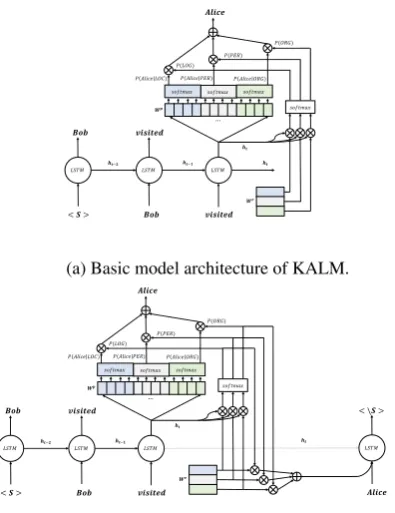
dimensions. Figure1a illustrates visually the ar-chitecture of KALM.
P(yt+1=i|τt+1 =j, ct) =
exp(Wp,ji,: ·ht)
|Vj|
P
w=1
exp(Wp,jw,:·ht)
(4)
P(τt+1 =j|ct) =
exp(Wej,:·(Wh·ht)) K
P
k=0
exp(Wek,:·(Wh·ht))
(5)
3.3 Type representation as input
In the base KALM model the input for word yt
consists of its embedding vectoryt. We enhance the base model by adding as inputs the embedding of the type of the previous word. As type informa-tion is latent, we represent it as the weighted sum of the type embeddings weighted by the predicted probabilities:
νt+1= K
X
j=0
P(τt+1=j|ct)·Wej,: (6)
˜
yt+1 = [yt+1;νt+1] (7)
P(τt+1=j|ct)is computed using Equation5and
!"#$
%&'&"() *+,-./0
!" !" 1234
*+,-./0 56&7(
1234
89: 1234
< < > !"#> 89: %&'&"()
*+,-./0 *+,-./0 ?(ABC) ?(?EB) ?(1AC)
? FGHIJ 1AK) ? FGHIJ ?EB) ? FGHIJ ABC)
…
L( LM
(a) Basic model architecture of KALM.
!"#$
%&'&"()
*+,-./0
!"
!" 1234
*+,-./0
56&7(
56&7(
1234 1234
89:
1234
< < >
!"#>
89: %&'&"()
*+,-./0 *+,-./0
?(ABC)
?(?EB) ?(1AC)
< \< >
? GHIJK 1AL) ? GHIJK ?EB) ? GHIJK ABC)
…
M(
MN
[image:4.595.77.275.61.318.2](b) Adding type representation as input to KALM.
Figure 1: KALM’s architectures
Adding type information as input serves two purposes: in the forward direction, it allows KALM to model context more precisely based on predicted entity types. During back propagation, it allows us to learn latent types more accurately based on subsequent context. The model enhanced with type input is illustrated in Figure1b.
4 Unsupervised NER
The type distribution that KALM learns is latent, but we can output it at test time and use it to pre-dict whether a given word refers to an entity or a general word. We computeP(τt+1|ct)using eq.5
and use the most likely entity type as the named entity tag for the corresponding wordyt+1.
This straightforward approach, however, pre-dicts the type based solely on the left context of the tag being predicted. In the following two subsec-tions, we discuss extensions to KALM that allow it to utilize the right context and the word being predicted itself.
4.1 Bidirectional LM
While we cannot use a bidirectional LSTM for generation, we can use one for NER, since the en-tire sentence is known.
For each word, KALM generates the hidden vectorshl,t andhr,t representing context coming
from left and right directions, as shown in Equa-tions8and9.
hl,t,γl,t =lstml(hl,t−1,γl,t−1,[yl,t;νl,t]) (8)
hr,t,γr,t =lstmr(hr,t+1,γr,t+1,[yr,t;νr,t])
(9)
We concatenate the hidden vectors from the two directions to form an overall context vectorht, and
generate the final type distribution using Equation
5.
Training the bidirectional model requires that we initialize the hidden and cell states from both ends of a sentence. Suppose the length of a sen-tence isn. The the cross entropy loss is computed for only then−2symbols in the middle. Similarly, we compute only the types of then−2 symbols in the middle during inference.
4.2 Current word information
Even bidirectional context is insufficient to predict the word type by itself. Consider the following example:Our computer models indicate Edouard is going to 1 The missing word can be either a location (e.g.,London), or a general word (e.g.,
quit). In an NER task we observe the underlined words: Our computer models indicate Edouard is going to London.In order to learn predictively, we cannot base the type prediction on the current to-ken. Instead, we can use a prior type information
P(τt|yt), pre-computed from entity popularity
in-formation available in many KBs. We incorpo-rate the prior informationP(τt|yt)in two different
ways described in the two following subsections.
4.2.1 Decoding with type prior
We incorporate the type priorP(τt|yt)directly by
combining it linearly with the predicted type:
P(τt|cl, cr, yt) =
P(yt|τt, cl, cr)
2P(yt|cl, cr)
·P(τt|cl, cr)
+P(cl, cr|τt, yt) 2P(cl, cr|yt)
·P(τt|yt)
=α·P(τt|cl, cr)
+β·P(τt|yt) (10)
The coefficientsαandβare free parameters and are tuned on a small amount of withheld data.
1All the examples are selected from the CoNLL 2003
4.2.2 Training with type priors
An alternative for incorporating the pre-computed
P(τt|yt) is to use it during training to regularize
the type distribution. We use the following op-timization criterion to compute the loss for each word:
L=H(P(yi|cl, cr), P(ˆyi|cl, cr))
+λ· ||KL(P(τi|cl, cr), P(τi|yi))||2 (11)
whereyˆi is the actual word,H(.)is the cross
en-tropy function, and KL(.) measures the KL di-vergence between two distributions. A hyper-parameter λ (tuned on validation data) controls the relative contribution of the two loss terms. The new loss forces the learned type distribu-tion,P(τi|cl, cr), to be close to the expected
dis-tribution P(τi|yi) given the information in the
database. This loss is specifically tailored to help with unsupervised NER.
5 Experiments
We evaluate KALM on two tasks: language mod-eling and NER. We use two datasets: Recipeused only for LM evaluation andCoNLL 2003used for both the LM and NER evaluations.
5.1 Data
Recipe The recipe dataset2 is composed of
95,786recipes, We follow the same preprocess-ing steps as inParvez et al.(2018) and divide the crawled dataset into training, validation and test-ing. A typical sentence after preprocessing looks like the following: “in a large mixing bowl com-bine the butter sugar and the egg yolks”. The en-tities in the recipe KB are recipe ingredients. The
8 supported entity types are dairy, drinks, fruits,
grains, proteins, seasonings, sides, and vegeta-bles. In the sample sentence above, the entity names arebutter, sugar, eggand yolks, typed as
dairy, seasonings, proteins and proteins, respec-tively.
CoNLL 2003 Introduced inTjong Kim Sang
and De Meulder(2003), the CoNLL 2003 dataset
is composed of news articles. It contains text and named entity labels in English, Spanish, German and Dutch. We experiment only with the English version. We follow the CoNLL labels and sep-arate the KB into four entity types: LOC
(loca-2Crawled fromhttp://www.ffts.com/recipes.
htm
tion),MISC(miscellaneous),ORG(organization), andPER(person).
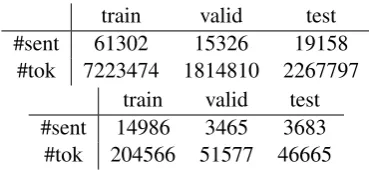
Statistics about the recipe and the CoNLL 2003 dataset are presented in Table1.
train valid test #sent 61302 15326 19158
#tok 7223474 1814810 2267797 train valid test #sent 14986 3465 3683
[image:5.595.323.508.126.211.2]#tok 204566 51577 46665
Table 1: Statistics of recipe and CoNLL 2003 datasets The information about the entities in each of the KBs is shown in Table 2. The recipe KB is provided along with the recipe dataset3 as a con-glomeration of typed ingredients. The KB used by CoNLL 2003 is extracted from WikiText-2. We filtered the entities which are not belonging to the 4 types of CoNLL 2003 task.
type dairy drinks fruits grains
#entities 80 84 110 158
type proteins seasonings sides vegetables
#entities 316 180 140 156
type LOC MISC ORG PER
#entity words 1503 1211 3005 5404
Table 2: Statistics of recipe and CoNLL 2003 KBs
5.2 Implementation details
We implement KALM by extending the AWD-LSTM4language model in the following ways:
Vocabulary We use the entity words in
Ta-ble 2to form V1, ..., VK We extract 51,677
gen-eral words in the recipe dataset, and17,907 gen-eral words in CoNLL 2003 to formV0. Identical
words that fall under different entity types, such asWashington in George Washingtonand Wash-ington D.C., share the same input embeddings.
Model The model has an embedding layer
of400dimensions, LSTM cell and hidden states of1,150dimensions, and3stacked LSTM layers. We scale the final LSTM’s hidden and cell states to 400 dimensions, and share weights between the projection layerWpand the word embedding layer. Each entity type in the knowledge base is represented by a trainable 100-dimensional em-bedding vector. When concatenating the weighted
3
The KB can be found in https://github.com/ uclanlp/NamedEntityLanguageModel
4https://github.com/salesforce/
[image:5.595.310.524.348.414.2]average of the type embeddings to the input, we expand the input dimension of the first LSTM layer to500. All trainable parameters are initial-ized uniformly randomly between−0.1 and0.1, except for the bias terms in the decoder linear layer, which are initialized to0.
For regularization, we adopt the techniques in AWD-LSTM, and use an LSTM weight dropout rate of 0, an LSTM first-layers locked dropout rate of 0.3, an LSTM last-layer locked dropout rate of0.4, an embedding Bernoulli dropout rate of0.1, and an embedding locked dropout rate of
0.65. Also, we impose L2 penalty on LSTM pre-dropout weights with coefficient1, and L2 penalty on LSTM dropout weights with coefficient2, both added to the cross entropy loss.
Optimization We use the same loss penalty,
dropout schemes, and averaged SGD (ASGD) as
inMerity et al. (2017). The initial ASGD
learn-ing rate is 10, weight decay rate is 1.2×10⁻⁶, non-monotone trigger for ASGD is set to 5, and gradient clipping happens at0.25. The models are trained until the validation set performance starts to decrease.
5.3 Language modeling
First, we test how good KALM is as a language model compared to two baselines.
5.3.1 Baselines
• AWD-LSTM (Merity et al., 2017) is the
state-of-the-art word-level language model as measured on WikiText-2 and Penn Treebank. It uses ASGD optimization, a new dropout scheme and novel penalty terms in the loss function to improve over vanilla LSTM LMs.
• Named-entity LM (NE-LM) (Parvez
et al., 2018) consists of a type model
that outputs P(τi+1|τi, τi−1, ...) and
an entity composite model that outputs
P(yi+1|{yi, τi},{yi−1, τi−1}, ...). The type
modelis trained on corpora with entity type labels, whereas the entity composite model
has an input for words and another input for the corresponding types, and so needs to be trained on both the labeled corpus and the unlabeled version of the same corpus. At inference time, a joint inference heuristic aggregates type model and entity composite model predictions into a word prediction. Since both models require type labels as
input, each generation step of NE-LM requires not only the previously generated words [yi, yi−1, ...], but also the type labels
for these words[τi, τi−1, ...].
5.3.2 Results
For language modeling we report word prediction perplexity on the recipe dataset and CoNLL 2003. Perplexity is defined as the following.
P P =e−
N
P
t=1
1
NlogP(yt)
= N
v u u t
N
Y
t=1
1
P(yt)
(12)
We use publicly available implementations to pro-duce the two baseline results. We also compare the language models in the bidirectional setting, which the reference implementations do not sup-port. In that setting, we transform both models in NE-LM to be bidirectional.
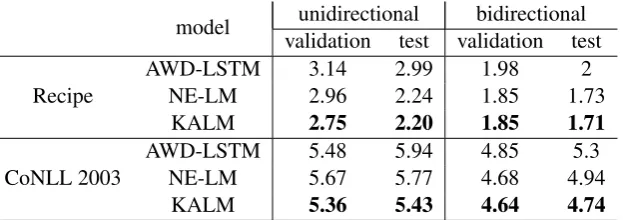
Discussion Table3 shows that KALM
out-performs the two baselines in both unidirectional and bidirectional settings on both datasets. The improvement relative to NE-LM is larger in the unidirectional setting compared to the bidirec-tional setting. We conjecture that this is because in that setting NE-LM trains a bidirectional NER in a supervised way. The improvement relative to NE-LM is larger on CoNLL 2003 than on the recipe dataset. We believe that the inference heuristic used by NE-LM is tuned specifically to recipes and is less suitable to the CoNLL setting.
We also find that training KALM on more unla-beled data further reduces the perplexity (see Table
4), and study how the quality of the KB affects the perplexity. We discuss both these results in Sec-tion5.4.
5.4 NER
In this section, we evaluate KALM in NER against two supervised baselines.
5.4.1 Baselines
We train two supervised models for NER on the CoNLL 2003 dataset: a biLSTM and a
CRF-biLSTM. We replicate the hyperparameters used
by Lample et al. (2016), who demonstrate the
state-of-the-art performance on this dataset. We use a word-level model, and 100 dimensional pretrained GloVe embeddings (Pennington et al.,
model unidirectional bidirectional validation test validation test
Recipe
AWD-LSTM 3.14 2.99 1.98 2 NE-LM 2.96 2.24 1.85 1.73
KALM 2.75 2.20 1.85 1.71
CoNLL 2003
AWD-LSTM 5.48 5.94 4.85 5.3 NE-LM 5.67 5.77 4.68 4.94
[image:7.595.146.458.62.172.2]KALM 5.36 5.43 4.64 4.74
Table 3: Language modeling results on the recipe and CoNLL 2003 datasets
5.4.2 Results
We evaluate the unsupervised KALM model under the following configurations:
• Basic: bidirectional model with aggregated type embeddings fed to the input at the next time step;
• With type priors: using P(τt|yt) in the two
ways described in Section4.2;
• Extra data: Since KALM is unsupervised, we can train it on extra data. We use the WikiText-2 corpus in addition to the original CoNLL training data.
WikiText-2 is a standard language modeling dataset released withMerity et al.(2016). It con-tains Wikipedia articles from a wide range of top-ics. In contrast, the CoNLL 2003 corpus con-sists of news articles. Table 4 show statistics about the raw / characer level WikiText-2 and the CoNLL 2003 corpora. Despite the domain mis-match between the WikiText and CoNLL corpora, the WikiText coverage of the entity words that ex-ist in the CoNLL dataset is high. Specifically, most of the person, location and organization en-tity words that appear in CoNLL either have a Wikipedia section, or are mentioned in a Wiki ar-ticle. Therefore, we expect that the addition of WikiText can guide the unsupervised NER model to learn better entity type regularities. Indeed, the result presented in the rightmost column of Table
4shows that when adding WikiText-2 to CoNLL 2003, the perplexity for the KALM model for the news text of CoNLL 2003 is decreased: from4.69
down to2.29.
We show NER results in Table5. The table lists the F1 score for each entity types, as well as the overall F1 score.
Discussion Even the basic KALM model
learns context well – it achieves an overall F1
score of0.72for NER. This illustrates that KALM has learned to model entity classes entirely from surrounding context. Adding prior information as to whether a word represents different entity types helps to bring the F1 score to0.76.
The strength of an unsupervised model is that it can be trained on large corpora. Adding the Wikitext-2 corpus improves the NER score of KALM to0.84.
To give a sense of how the unsupervised mod-els compare with the supervised model with re-spect to training data size, we trained biLSTM and CRF-biLSTM on a randomly sampled subset of the training data of successively decreasing sizes. The resulting F1 scores are shown in Figure2.
Our best model scores 0.86, same as a CRF-biLSTM trained on around 40% of the training data. It is less than0.03behind the best supervised CRF-biLSTM. The best KALM model almost al-ways scores higher than biLSTM without the CRF loss.
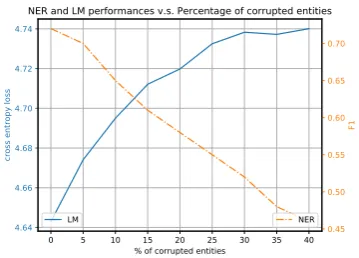
Lastly, we perform an ablation experiment to gauge how sensitive KALM is to the quality of the knowledge base. Previous studies (Liu et al.,
2016; Zhang et al., 2012) have shown that the
amount of knowledge retrieved from KBs can im-pact the performance of NLP models such as rela-tion extracrela-tion systems substantially. In this ex-periment, we deliberately corrupt the entity vo-cabularies V0, ..., VK−1 by moving a certain
per-centage of randomly selected entity words from
Vi to the general vocabulary Vg. Figure3 shows
language modeling perplexities on the validation set, and NER F1 scores on the test set as a func-tion of the corrupfunc-tion percentage. The language modeling performance stops reacting to KB cor-ruption beyond a certain extent, whereas the NER performance keeps dropping as the number of en-tities removed fromV1, V2, ...increases. This
entity unique entity size LM ratio ratio ratio perplexity 92.80% 82.56% 2.62 2.29 : 4.69
Table 4: Characterization of WikiText-2 relative to CoNLL 2003 training set. Entities extracted from WikiText cover92.80%of the entities in CoNLL 2003 overall, and cover82.56%of the unique entities. WikiText’s size is
2.62times as large. And adding WikiText to CoNLL training reduces the perplexity from4.69to2.29.
LOC MISC ORG PER overall
unsupervised
basic0 0.75 0.67 0.64 0.83 0.72 +P(τ|y)in dec1 0.81 0.67 0.65 0.88 0.76 +wiki-concat2 0.83 0.83 0.76 0.95 0.84 +wiki-concat+P(τ|y)in dec3 0.84 0.84 0.77 0.96 0.86
[image:8.595.101.497.164.261.2]supervised biLSTM 0.88 0.71 0.81 0.95 0.86 CRF-biLSTM 0.90 0.76 0.84 0.95 0.89
Table 5: Results of KALM (above the double line in the table) and supervised NER models (under the double line). Superscript annotations: 0: The basic bidirectional KALM with type embedding features as described in Section4.1.1: AddingP(τ|y)in decoding, as described in Section4.2.1, whereαandβare tuned to be0.4and
0.6.2: The basic model trained on CoNLL 2003 concatenated with WikiText-2.3: Adding(τ|y)in decoding, with the model trained on CoNLL 2003 concatenated with WikiText-2.
0.2 0.4 0.6 0.8 1.0
% of training 0.81
0.82 0.83 0.84 0.85 0.86 0.87 0.88
F1
F1 v.s. Percentage of labeled training
BiLSTM CRF-biLSTM KALM
Figure 2: Unsupervised v.s. supervised NER trained on different portions of training data
0 5 10 15 20 25 30 35 40
% of corrupted entities
4.64 4.66 4.68 4.70 4.72 4.74
cross entropy loss
LM
0.45 0.50 0.55 0.60 0.65 0.70
F1
NER and LM performances v.s. Percentage of corrupted entities
NER
Figure 3: NER and LM performances on different portions of mislabeled entities
to KALM.
6 Conclusion
We propose Knowledge Augmented Language Model (KALM), which extends a traditional RNN LM with information from a Knowledge Base. We show that real-world knowledge can be used suc-cessfully for natural language understanding by using a probabilistic extension. The latent type in-formation is trained end-to-end using a predictive objective without any supervision. We show that the latent type information that the model learns can be used for a high-accuracy NER system. We believe that this modeling paradigm opens the door for end-to-end deep learning systems that can be enhanced with latent modeling capabilities and trained in a predictive manner end-to-end. In ways this is similar to the attention mechanism in ma-chine translation where an alignment mechanism is added and trained latently against the overall translation perplexity objective. As with our NER tags, machine translation alignments are empiri-cally observed to be of high quality.
[image:8.595.82.263.351.485.2] [image:8.595.83.263.529.658.2]References
Sungjin Ahn, Heeyoul Choi, Tanel P¨arnamaa, and Yoshua Bengio. 2016. A neural knowledge lan-guage model.arXiv preprint arXiv:1608.00318. Dzmitry Bahdanau, Kyunghyun Cho, and Yoshua
Ben-gio. 2014. Neural machine translation by jointly learning to align and translate. arXiv preprint arXiv:1409.0473.
Antoine Bordes, Nicolas Usunier, Alberto Garcia-Duran, Jason Weston, and Oksana Yakhnenko. 2013. Translating embeddings for modeling multi-relational data. In Advances in neural information processing systems, pages 2787–2795.
Michael Collins and Yoram Singer. 1999. Unsuper-vised models for named entity classification. In
1999 Joint SIGDAT Conference on Empirical Meth-ods in Natural Language Processing and Very Large Corpora.
Jacob Devlin, Ming-Wei Chang, Kenton Lee, and Kristina Toutanova. 2018. Bert: Pre-training of deep bidirectional transformers for language understand-ing. arXiv preprint arXiv:1810.04805.
Oren Etzioni, Michael Cafarella, Doug Downey, Ana-Maria Popescu, Tal Shaked, Stephen Soderland, Daniel S Weld, and Alexander Yates. 2005. Un-supervised named-entity extraction from the web: An experimental study. Artificial intelligence, 165(1):91–134.
Yihong Gu, Jun Yan, Hao Zhu, Zhiyuan Liu, Ruobing Xie, Maosong Sun, Fen Lin, and Leyu Lin. 2018. Language modeling with sparse product of sememe experts.arXiv preprint arXiv:1810.12387.
Sepp Hochreiter and J¨urgen Schmidhuber. 1997. Long short-term memory. Neural computation, 9(8):1735–1780.
Guillaume Lample, Miguel Ballesteros, Sandeep Sub-ramanian, Kazuya Kawakami, and Chris Dyer. 2016. Neural architectures for named entity recognition.
arXiv preprint arXiv:1603.01360.
Angli Liu, Stephen Soderland, Jonathan Bragg, Christopher H Lin, Xiao Ling, and Daniel S Weld. 2016. Effective crowd annotation for relation ex-traction. InProceedings of the 2016 Conference of the North American Chapter of the Association for Computational Linguistics: Human Language Tech-nologies, pages 897–906.
Stephen Merity, Nitish Shirish Keskar, and Richard Socher. 2017. Regularizing and optimizing lstm lan-guage models. arXiv preprint arXiv:1708.02182. Stephen Merity, Caiming Xiong, James Bradbury, and
Richard Socher. 2016. Pointer sentinel mixture models. arXiv preprint arXiv:1609.07843.
Robert Munro and Christopher D Manning. 2012. Ac-curate unsupervised joint named-entity extraction from unaligned parallel text. InProceedings of the 4th Named Entity Workshop, pages 21–29. Associa-tion for ComputaAssocia-tional Linguistics.
David Nadeau, Peter D Turney, and Stan Matwin. 2006. Unsupervised named-entity recognition: Generating gazetteers and resolving ambiguity. InConference of the Canadian Society for Computational Studies of Intelligence, pages 266–277. Springer.
Md Rizwan Parvez, Saikat Chakraborty, Baishakhi Ray, and Kai-Wei Chang. 2018. Building language models for text with named entities. arXiv preprint arXiv:1805.04836.
Jeffrey Pennington, Richard Socher, and Christopher Manning. 2014. Glove: Global vectors for word representation. InProceedings of the 2014 confer-ence on empirical methods in natural language pro-cessing (EMNLP), pages 1532–1543.
Matthew E Peters, Waleed Ammar, Chandra Bhagavat-ula, and Russell Power. 2017. Semi-supervised se-quence tagging with bidirectional language models.
arXiv preprint arXiv:1705.00108.
Matthew E Peters, Mark Neumann, Mohit Iyyer, Matt Gardner, Christopher Clark, Kenton Lee, and Luke Zettlemoyer. 2018. Deep contextualized word rep-resentations. arXiv preprint arXiv:1802.05365. Erik F Tjong Kim Sang and Fien De Meulder.
2003. Introduction to the conll-2003 shared task: Language-independent named entity recognition. In
Proceedings of the seventh conference on Natural language learning at HLT-NAACL 2003-Volume 4, pages 142–147. Association for Computational Lin-guistics.
Ji Xin, Hao Zhu, Xu Han, Zhiyuan Liu, and Maosong Sun. 2018. Put it back: Entity typing with language model enhancement. In Proceedings of the 2018 Conference on Empirical Methods in Natural Lan-guage Processing, pages 993–998.
Bishan Yang and Tom Mitchell. 2017. Leveraging knowledge bases in lstms for improving machine reading. In Proceedings of the 55th Annual Meet-ing of the Association for Computational LMeet-inguistics (Volume 1: Long Papers), volume 1, pages 1436– 1446.
Zichao Yang, Phil Blunsom, Chris Dyer, and Wang Ling. 2016. Reference-aware language models.
arXiv preprint arXiv:1611.01628.