Topic Analysis Using a Finite Mixture Model
H a n g Li a n d K e n j i Y a m a n i s h i N E C C o r p o r a t i o n
{lihang,yamanisi} @ccm.cl.nec.co.jp
A b s t r a c t
We address the issue of 'topic analysis,' by which is determined a text's topic structure, which indicates what topics are included in a text, and how topics change within the text. We propose a novel approach to this issue, one based on statistical modeling and learning. We represent topics by means of word clusters, and employ a finite mixture model to repre- sent a word distribution within a text. Our experimental results indicate that our method significantly outperforms a method that com- bines existing techniques.
1 I n t r o d u c t i o n
-:We consider here the issue of 'topic analysis,'
by which is determined a text's topic struc-
ture, which indicates what topics are included in a text and how topics change within the
text. Topic analysis consists of two main
tasks: topic identification and text segmen- tation (based on topic changes).
Topic analysis is extremely useful in a vari- ety of text processing applications. For exam- plea it can be used in the automatic indexing of texts for purposes of information retrieval. With it, one can understand what the main topics and subtopics of a text are, and where those subtopics lie within the text.
To the best of our knowledge, however, no previous study has so far dealt with the topic
analysis problem in the above sense. The
most closely related are key word extraction and text segmentation. A keyword extrac- tion method (e.g., that using tf-idf (Salton and Yang, 1973)) generally extracts from a text key words which represent topics within the text, but it does not conduct segmenta- tion. A segmentation method (e.g., TextTil- ing (Hearst, 1997)) generally segments a text into blocks (paragraphs) in accord with topic changes within the text, but it does not iden- tify (or label) by itself the topics discussed in
each of the blocks.
The purpose of tMs paper is to provide a single framework for conducting topic analy- sis, i.e., performing both topic identification and text segmentation.
The key characteristics of our framework
are 1) representing a topic by means of a clus-
ter of words that are closely related to the
topic, and 2) employing a stochastic model,
called a .finite mixture model (e.g., (Everitt
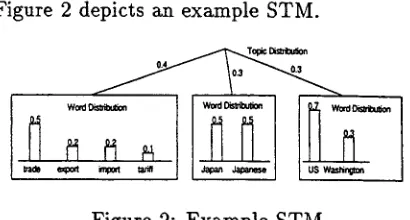
and Hand, 1981)), to represent a word dis- tribution within a text. The finite mixture model has a hierarchical structure of probabil- ity distributions. The first level is a probabil- ity distribution of topics (topic distribution). The second level consists of probability distri- butions of words included within topics (word distributions). These word distributions are linearly combined to represent a word distri- bution within a text, with the topic distribu- tion being used as the coefficient vector. Here- after we refer to a finite mixture model hav-
ing this structure as a stochastic topic model
(STM).
Before conducting topic analysis, we create word clusters (topics) on the basis of word co- occurrence in corpus data. We have devel- oped a new m e t h o d for word clustering using
stochastic complexity (or the MDL principle) (Rissanen, 1996).
In topic analysis, we estimate a sequence of STMs that would have given rise to a given text, assuming that each block of a text is gen- erated by an individual STM. We perform text segmentation by detecting significant differ- ences between STMs and perform topic iden- tification by means of estimation of STMs. With the results, we obtain the text's topic structure which consists of segmented blocks and their topics.
mentation m e t h o d (e.g., TextTiling). Specif- ically, one can extract key words from a text using tf-idf, view these extracted key words as topics, segment t h e text into blocks us- ing TextTiling, and e s t i m a t e the distribution of topics (key words) within each block. Ex- perimental results indicate, :however, that our method significantly outper~brms such a com- bined m e t h o d in topic identification and out- performs it in text segmentation, because it utilizes word cluster information and employs a well-defined probability framework.
Finite m i x t u r e models have been employed in a n u m b e r of text processing applications, such as text classification (e.g., (Li and Ya- mauishi, 1997; Nigam et al., 2000)) and infor- mation retrieval (e.g., (Hofmann, 1999)). As will be discussed, however, our definition of a finite mixture model and the way we use it here .differs significantly.
2 S t o c h a s t i c T o p i c M o d e l
2.1 T o p i c
While the t e r m 'topic' is used in different ways in different linguistic theories, we simply view it here as a subject within a text. We rep- resent a topic by means of a cluster of words t h a t are closely related to the topic, assum- ing that a cluster has a seed word (or several seed words) which indicates a topic. Figure 1 shows an example topic with the word 'trade' being the seed word.
I trade:
trade export import tariff trader G A T T protectionist II
Figure 1: Example topic
2.2 D e f i n i t i o n o f S T M
Let W denote a set of words, and K a set of topics. We first define a distribution of topics
(clusters) P(k) : ~kEIK P(k) = 1. Then, for
each topic k E K , we define a probability dis-
tribution of words P(wik) : ~ , e w P(wlk) =
1. Here the value of P(wik) will be z e r o i f w is
not included in k. We next define a Stochas- tic Topic Model (STM) as a finite mixture model, which is a linear combination of the
word probability distributions P(w[k), with
the topic distribution P ( k ) being used as the
coefficient vector. T h e probability of word w in W is, then,
P(w) = ~ P ( k ) P ( w l k ) w e W.
kEK
Figure 2 depicts an example STM.
Figure 2: Example STM
For t h e purposes of statistical modeling, it is advantageous to conceive of a text (i.e., a word sequence) as having been generated by some 'true' STMs, which we t h e n seek to esti- mate as closely as possible. A text may have a number of blocks, and each block is assumed to be generated by an individual STM. T h e STMs within a text are assumed to have t h e same set of topics, but have different param- eter values.
From the linguistic viewpoint, a text gener- ally focuses on a single main topic, but it m a y discuss different subtopics in different blocks. While a text is discussing any one topic, it will more frequently use words strongly related to that topic. Hence, STM is a n a t u r a l represen- tation of statistical word occurrence based on topics.
3 W o r d C l u s t e r i n g
Before conducting topic analysis, we create word clusters using a large d a t a corpus. More precisely, we treat all words in a vocabulary as seed words, and for each seed word we collect from the d a t a those words which frequently co-occur with it and group t h e m into a cluster. As one example, the word-cluster in Figure 1 has been constructed with the word ' t r a d e ' as the seed word.
We have developed a new m e t h o d for reli- ably collecting frequently co-occurring words
on the basis of stochastic complexity, or t h e
MDL principle. For a given d a t a sequence
z m = x l . . . z m and for a fixed probability model M , 1 the stochastic complexity of x m
relative to M , which we denote as S C ( x m :
M ) , is defined as the least code length re- quired to encode x rn with M (Rissanen, 1996).
S C ( x m : M ) can be interpreted as the a m o u n t information included in x n relative to M . T h e
[image:2.596.350.555.66.176.2]MDL (Minimum Description Length) princi- ple is a model selection criterion which asserts that, for a given d a t a sequence, the lower a model's SC value, the greater its likelihood of being a model which would have actually gen- erated the data. MDL has m a n y good prop- erties as a criterion for model selection. 2
For a fixed seed word s, we take a word w as a frequently co-occurring word if the presence of s is a statistically significant indicator of the presence of w.
Let a d a t a sequence: ( s l , w l ) , (s2,w2), .-.,
(Sin,Win)
be given where(si, wi) denotes the
state of co-occurrence of words s and w in
the i-th text in the corpus data. Here,
sl E
{1,O},wi e {1,0},(i = 1 , . - . , r n ) , 1 denotes the presence of a word, while 0 the absence
of it. We further denote s TM =
s l . . . s m , and
W TM ~.. W 1 • . . W m .
Then as in (Rissanen, 1996), the SC value of
w TM relative to a model I in which the presence
or absence of w is independent from those of s (i.e., a Bernoulli model), is calculated as
SC(w
TM: I) = m H
+ ~ log ~ + log 7r,where m + denotes the number of l ' s in
wm.
Here, log denotes the logarithm to the base
2, ~- the circular constant, and
H(z) deJ
- z l o g z - (1 - z)log(1 - z), when 0 < z < 1;
H(z) des
= 0, w h e n z = 0 o r z = 1.Let
w m"
be the sequence of all wi's (wi Ew rn) such that its corresponding si is 1, where ms denotes the number of l ' s in s ~. Let w rn'' be the sequence ofaU wi's (wi E w m) such that its corresponding si is 0, where rn.~s denotes the number O's in s m. The SC value of w m relative to a model D in which the presence or absence of w is dependent on those of s is then calculated as
SC(w
: =( s.u
+ ~logT~ +
log )
+ (m"sH (-m'-'~'~'~ W ½1°g-m-='~ W l°gr)
2~
where ms + denotes the number of l's in
wm',
and w~+s the number of l ' s in
w m~,.
2For an introduction to M D L , see (Li, 1998).
We can then calculate
6SC = "~(SC(wm : I) - SC(wm : D))
[ ( )
m \ m . ~ / jf l I O a r n ~ r n - , , ~ /
- 1 o j"
(I)
According to the MDL principle, the largerthe
6SC
value, the more likely t h a t the pres-ence or absence of w is dependent on those of 8. 3
Actually, we m a y think of a word w for which the value of 6 S C is larger than a pre-
determined threshold 3' and
P(wls ) > P(w)
is satisfied as that which occurs significantly frequently with the seed word s.
Note that the word clustering process is
independent of topic analysis. While one
could employ other m e t h o d s (e.g., (Hofmann, 1999)) here for word clustering, our clus- tering algorithm is more efficient than con- ventional ones. For example, Hofmann's is
of order
O(]DIIWI2),
while ours is only ofO(ID I + ]WI2),
where IDI denotes the numberof texts and IW] the n u m b e r of words. T h a t means that our m e t h o d is more practical when a large amount of text d a t a is available.
4 T o p i c A n a l y s i s
4.1 I n p u t a n d O u t p u t
In topic analysis, we use STM to parse a given text and o u t p u t a topic structure which consists of segmented blocks and their top- ics. Figure 3 shows an example topic struc- ture as o u t p u t with our method. The text has been segmented into five blocks, and to each block, a number of topics having high prob- ability values have been assigned (topics axe represented by their seed words). The topic structure clearly represents what topics are in- cluded in the text and how the topics change within the text.
4.2 O u t l i n e
Our topic analysis consists of three processes: a pre-process called 'topic spotting,' text seg- mentation, and topic identification. In topic
SNote that the quantity within [---] in (1) is ( e m - p i r i c a l ) m u t u a l i n y o r m a t i o n , which is an effective mea-
sure for word co-occurrence calculation (cf.,(Brown et
al., 1992)). When the sample size is small, mutual
information values tend to be undesirably large. The
quantity within {-..} in (1) can help avoid this unde- sirable tendency because its value will become large
ASIAI SXPOITERS PSAk DAEAOS Fit05 U . S . - I A P A | RIFT (25-HAE-1987)
block 0 . . . t r a d e - e x p o r ~ - c a r i ~ t - i m p o : r t ( O , 1 2 ) Japan-Japa.l~ese(O.07) U $ ( 0 . 0 6 )
0 S o u n t i n S t r a d e f r i c t i o n between t h e U.:3. and $opau has r a i s e d f e a r s amen S many of l s i a * s e x p o r t i n g n a t i o n s c h a t t h e row could i n f l i c t . . . 1 They t o l d R o u t e r c o r r e s p o n d e n t s i n A s i a n c a p i t a l s a U.S. move a g a i n s t Japan m i g h t b o o s t p r o t e © t i o n i s t s e n t i m e n t i n she U.S. ~nd l e a d t o . . . 2 But some e x p o r t e r s s a i d Chat w h i l e t h e c o n f l i c t would h u r t them i n t h e l e n s - r u n , i n t h e s h o r t - t e r m T o k y o ' s l o s s m i g h t be t h e i r g a i n . 3 The U.S. Xas s a i d i t s i l l ~apose 300 ~ t n d l r s of t a r i f f s on i m p o r t s of J a p a n e s e e l e c t r o n i c s s e e d s on A p r i l 17. i n r e t a l i a t i o n f o r Japa~*s . . . 4 U n o f f i c i a l J a p a n e s e ost~Jnates put t h e i m p a c t of t h e t a r i f f s a t 10 b i l l i o n d l r o and spokesmen f o r m a j o r e l e c t r o n i c s 1irma s a i d t h e y would . . . 5 "go w o u l d n ' t be a b l e t o do b u s i n e s s , " Isaid a spokesman f o r l . o d i n S ; a p a n e s e e l e c t r o n i c s ~ i r m S a t a n o h i t a E l e c t r i c I n d u s t r i a l ¢o Lad t l t . 6 " I f t h e t a r i f f s remain i n p l a c e f o r any l e n g t h of t i m e beyond a ~eg months i t s i l l ~ a n t h e c o m p l e t e e r o s i o n of e x p e r t s (o~ good8 s u b j e c t . . .
b l o c k I . . . t r a d e - e x p o r t - t a ~ v i f ~ - I m p o : r t ( O . l T ) US(O.Og) Taiwan(O.05) d l r s ( O . O $ ) T In T a i g a n . businessmen and o f f i c i a l s ~ r e a l s o w o r r i e d .
$ "We i r e agLre of t h e s e r i o u s n e s s ot t h e U . 5 . t h r e a t a g a i n s t Japan b e c a u s e i t s e r v e s as a warning t o o | , " s a i d • s e n i o r T a i g a n e s e t r a d e . . . g Taiu&n had z t r a d e t r a d e s u r p l u s of 15~6 b i l l i o n d i r e l a s t y e a r ° gS pot of i t u i t b t h e U . $ .
10 The s u r p l u s h e l p e d s g e l l 7 a i w a n ' s f o r e i g n exchange r e s e r v e s t o 53 b i l l i o n d l r s . ninon S t h e w o r l d ' s l a r g e s t .
11 "Re must q u i c k l y open our m a r k e t s , remove t r a d e b a r r i e r s and c u t Import t a r i f f s to a l l o w i m p o r t s o~ U . S . p r e d i c t s , i f ue want t o de~nse . . . 12 I s e n i o r o f f i c i L 1 e f South [ o r e a ' s tr~Lde promotion a s s o c i a t i o n s a i d t h e t r a d e d i s p u t e between t h e U . S . and Japan might a l s o l e a d to . . . 13 L i s t y e a r South | u r e a had a t r a d e s u r p l u s e f 7 . 1 b i l l i o n d l r o u i t h t h e U . S . . np ~ r o n t . 9 b i l l i o n d l r s i n 1985.
1~ In H a l a y s i a . erode o f f i c e r s and b u s i n e s s m e n s a i d ~ou~h curbs a g a i n s t Japan m i g h t a l l e n h a r d - h i t p r o d u c e r s o~ anuLicondnctors i n t h i r d . . .
b l o c k 2 . . . H o n g - | e n $ ( 0 . 1 6 ) t r a d o - e x p o r t - t a ~ i f f - i m p e r t ( O . 10) U 5 ( 0 . 0 6 )
15 In Hung l o n g , where nauspaporo have a l l e g e d Japan has been n a i l i n g b a l e r - c o s t s e m i c o n d u c t o r s , some e l e c t r o n i c s m a n u ~ a c t u r n r n s h a r e . . . 16 " T h a t i s a v e r y s h o r t - t e r m v i e s . " s a i d Lawrn~ce R i l l s , d i r e c t o r - g e n e r a l o~ t h e F e d e r a t i o n of Hung Eerie I n d u s t r y .
17 " I ~ t h e uhole purpose i s t e p r e v e n t i m p o r t s , one day i t g i l l be e x t e n d e d t o o t h e r s o u r c e s . Hush more s e r i o u s f o r Hsng I o n s i s t h e . . . 18 The U . S . l a s t y e a r g a s Hon K E o n g ' s h i o g e s t e x p e r t m a r k e t , a c c o u n t i n g f o r e v e r 30 p o t of d o m e s t i c a l l y produced e x p o r t s .
b l o c k 3 . . . t r a d e - e x p o r t - t a r i f f - i m p o r t ( 0 . 1 4 ) B u t t o n ( O . 0 8 ) ~ a p a n - l a p a n e o e ( O . 0 7 )
19 ~ho A u s t r a l i a n government i s a n a i t i n g t h e outcome of t r a d e t a l k s botmean t h e U.S. and Japan u i t b i n t e r e s t and c o n c e r n , I n d u s t r y . . . 20 *'1his k i n d o~ d e t e r i o r a t i o n i n t r a d e r e l a t i o n s between sue c o u n t r i e s n h i c h & r ~ m a j e r t r a d i n g p a r t n e r s of ours i s a v e r y . . . 21 He s a i d l o s t r a l i a * s c o n c e r n s c e n t r e d en c o a l and b e e f , A n s t r n l i a : 8 t e e l a r s e s t e x p o r t s t o Japan and a l s o s i g n i f i c a n t U.S . . . . 22 Heanwhile U . S . - J a p a n a S e " d i p l o m a t i c manoeuvmes to s o l v e t h e t r a d e s t a n d - o f f c o n t i n u e .
b l o c k 4 . . . Japan-Japanese(O,12) m e a s u r e ( O . 0 6 ) t r a d e - e x p o r t - t a r i f f - i ~ p o r t ( O . O 5 )
23 J a p a n ' s r u l i n g L i b e r a l D e m o c r a t i c P a r t y y e s t e r d a y o u t l i n e d a package of economic measuru8 to b o o s t t h e ~apananu $csnony.
24 The Measures proposed i n c l u d e • l a p s e s u p p l e m e n t a r y b u d g e t and r e c o r d p u b l i c works s p e n d i n g i n t h e f i r s o h a l f of ohe f i n a n c i a l y e a r . 25 ] h e y a l s o c a l l g o r s t e p p e d - u p s p e n d i n g a s an emergency measure to s t i m u l a t e t h e economy d a n p i t e Prime S i n i s t e r Yasuhiro HaJ~asome . . . 26 Deputy U.S. Trade k e p r e a n u t a g i v e 5 i c h a e l Sunth and H~koto l n r r d a , J a p a n ' s d e p u t y m i n i s t e r of I n t e r n a t i o n a l Trade ~nd Z n d u s t r y (BZTZ) . . . . 0-26; s e n t e n c e i d
( . . ) : p r o b a b i l i t y value
Figure 3: Topic structure of text
spotting, we select topics discussed in a given text. We can then construct STMs on the basis of the topics. In text segmentation, we segment the text on the basis of the STMs, assuming that each block is generated by an individual STM. In topic identification, we es- timate the parameters of the STM for each segmented block and select topics with high probabilities for the block. In this way, we obtain a topic structure for the text.
4.3 T o p i c S p o t t i n g
In topic spotting, we first select key words from a given text. We calculate what we call
the
Shannon information
of each word in thetext. The Shannon information of word w in text t is defined as
I(w) = -N(w)logP(w),
where
N(w) denotes the frequency of w in t,
and P(w) the probability of the occurrence of
w as estimated from corpus data.
I(w)
maybe interpreted as the amount of information represented by w. We select as key words the top I words sorted in descending order of I.
While Shannon information is similar to the tf-idf widely used in information retrieval (e.g., (Salton and Yang, 1973)), the use of
Shannon information can be justified on the basis of information theory, but that of tf-idf cannot. Our preliminary experimental results indicate that Shannon information performs better than or at least as well as tf-idf in key word extraction. 4
From the results of word clustering, we next select any cluster (topic) whose seed word is included among the selected key words.
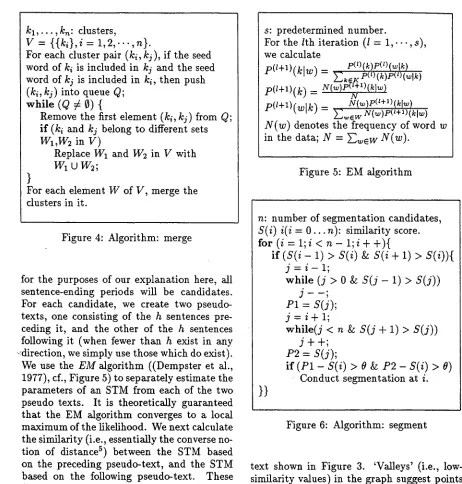
We next merge any two clusters if one of their seed words is included in the other's clus- ter. For example, when a cluster with seed word 'trade' contains the word 'import,' and a cluster with seed word 'import' contains the word 'trade,' we merge the two. After two such merges, we may obtain a relatively large cluster with, for example, ~trade-import-tariff- export' as its seed words, as is shown in Fig- ure 3. Figure 4 shows the merging algorithm. In this way, we obtain the most conspicuous and mutually independent topics discussed in a given text.
4.4 T e x t S e g m e n t a t i o n
In segmentation, we first identify candidates for points of segmentation within the given text. When we assume a relatively short text
kl,
• • • ,kn:
clusters,V = {{ki},i = 1 , 2 , . . . , n } .
For each cluster pair
(ki,
kj),
if the seed word of ki is included inkj
and the seed word ofkj
is included inki,
then push (ki,kj)
into queue Q;while (Q # 0) {
Remove the first element
(kl,
kj)
from Q; if (kl andkj
belong to different setsW1,W2
in V)Replace W1 and W2 in V with
w~ u w2 ;
}
For each element W of V, merge the clusters in it.
Figure 4: Algorithm: merge
for the purposes of our explanation here, all sentence-ending periods will be candidates. For each candidate, we create two pseudo- texts, one consisting of the h sentences pre- ceding it, and the other of the h sentences following it (when fewer than h exist in any ..:direction, we simply use those which do exist). We use the
EM
algorithm ((Dempster et al., 1977), cL, Figure 5) to separately estimate the parameters of an STM from each of the two pseudo texts. It is theoretically guaranteed that the EM algorithm converges to a local maximum of the likelihood. We next calculate the similarity (i.e., essentially the converse no- tion of distance s) between the STM based on the preceding pseudo-text, and the STM based on the following pseudo-text. These STMs axe denoted, respectively, asPL(W)
andPR(w).
The similarity betweenPL(W) and
PR(w)
is defined asS(LI[R)
= 1 - E ~ w [ P L ( w ) -PR(w)[
2
The numerator is referred to in statistics as
variational distance
and has good propertiesas a distance between two probability dis- tributions (cf., (Cover and Thomas, 1991),
p.299).
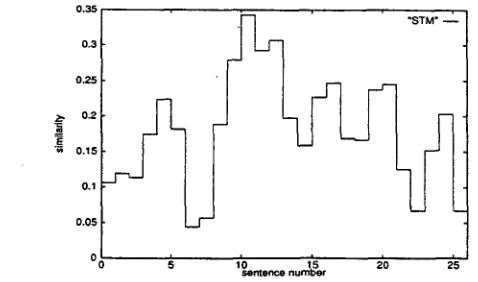
Figure 7 shows a graph of calculated simi- laxity values for each of the candidates in the
5We use similarity rather than distance here in or- der to simplify comparison between our method and TextTiling (Hearst, 1997).
s: predetermined number.
For the lth iteration (I = 1 , - . . , s), we calculate
PU)(k)PU)(wlk)
P(Z+l)(klw) = Ek~P(')(k)P(')(wlk)
p(l+l)(k)
= N(w)PU+l)(klw)
N
P(Z+l)(w]k)
= N(w)P(l+l)(k[ w)~ w e w g(w)P(~+ l )(k[w)
N(w)
denotes the frequency of word win the data;
N = ~ e w N(w).
Figure 5: EM algorithm
n: number of segmentation candidates,
S(i) i(i
= 0 . . . n): similarity score.for (i = 1;i < n - 1;i + +){
if
(S(i -
1) >S(i) & S(i +
1) > S(i)){j = i - 1 ;
w h i l e (j > 0 &
S(j -
1) >S(j))
j - - ;
P1 = S(j);
j = i + l;
w h i l e ( j
< n & S(j +
1) >S(j))
j + + ;
P2 = S(j);i f ( P 1 - S ( i ) > ~ & P 2 - S ( i ) > 8)
Conduct segmentation at i.
})
Figure 6: Algorithm: segment
text shown in Figure 3. 'Valleys' (i.e., low- similarity values) in the graph suggest points for reasonable segmentations. In actual prac- tice, segmentation is performed for each valley whose similarity values is lower to a predeter- mined degree 0 than each of the values of its left 'peak' and right 'peak' (cf., Figure 6) For example, for the text in Figure 3, segmenta- tion was performed at candidates (i.e., end of sentences) 6, 14, 18, and 22, with 8 = 0.05.
4.5 Topic I d e n t i f i c a t i o n
[image:5.596.73.535.55.539.2] [image:5.596.326.537.128.478.2]0.35
0.3
0.25
0.2
0.15
0.1
0.05
% ;
' ' "STM" ~ ' t
i =
,o 15 2'o 2'5
s e n t e n c e nurn~,er
Figure 7: Similarity values for segmentation candidates
ture as in Figure 3 for the given text (topics are here represented by their seed words).
We can view topics appearing in all the blocks as main topics, and topics appearing
only in individual blocks as subtopics. In
the text in Figure 3, the topic represented by seed-words 'trade-export-tariff-import' is the main topic, and 'Japan-Japanese,' 'Hong Kong,' etc., are subtopics.
5 A p p l i c a t i o n s
Our method can be used in a variety of text processing applications.
For example, given a collection of texts (e.g., home pages), we can automatically con- struct an index of the texts on the basis of the extracted topics. We can indicate which topic is from which text or even which block of a text. Furthermore, we can indicate which top- ics are main topics of texts and which topics are subtopics (e.g., by displaying main topics in boldface, etc). In this way, users can get a fair sense of the contents of the texts simply by looking through the index. For a specific text, users can get a rough sense of the con- tent by looking at the topic structure as, for example, it is shown in Figure 3.
Our method can also be useful for text min- ing, text summarization, information extrac- tion, and other text processing, which require one to first analyze the structure of a text.
6 R e l a t e d W o r k
To the best of our knowledge, no previous study has so far dealt with topic identification and text segmentation within a single frame- work.
A widely used method for key word extrac- tion calculates the tf-idf value of each word in
a text and uses those words having the largest tf-idf values as key words for that text (e.g., (Salton and Yang, 1973)). One can view these extracted key words as the topics of the text. No keyword extraction m e t h o d by itself, how- ever, is able to conduct segmentation.
With respect to text segmentation, exist- ing methods can be classified into two groups. One is to divide a text into blocks (e.g., TextTiling (Hearst, 1997)), the other to di- vide a stream of texts into its original texts (e.g.,(Allan et al., 1998; Yamron et al., 1998; Beeferman et al., 1999; tteynar, 1999)). The former group generally employs unsupervised learning, while the latter supervised one. No existing segmentation m e t h o d , however, has
attempted topic identification.
TextTiling creates for each segmentation candidate two pseudo-texts, one preceding it and the other following it, and calculates as similarity the cosine value between the word frequency vectors of the two pseudo texts. It then conducts segmentation at valley points in a similar way to that of our method. Since the problem setting of TextTiling (in general the former group) is most close to t h a t of our study, we use TextTiling for comparison in our experiments.
Our m e t h o d by its nature performs topic identification and segmentation within a sin- gle framework. While it is possible with a combination of existing methods to extract key words from a given text by using tf-idf, view the extracted key words as topics, seg- ment the text into blocks by employing Text- Tiling, estimate distribution of topics in each block, and identify topics having high prob- abilities in each block. Our m e t h o d outper: forms such a combination (referred to here- after as 'Corn') for topic identification, be- cause it utilizes word d u s t e r information. It also performs better t h a n Com in text seg- mentation because it is based on a well-defined probability framework. Most importantly is that our m e t h o d is able to o u t p u t an easily understandable topic structure, which has not been proposed so far.
[image:6.596.88.327.61.202.2]sification is a label representing a category. Furthermore, text classification is generally based on supervised learning, which uses la- beled text data 6. By way of contrast, topic analysis is based on unsupervised learning,
which uses only
unlabeled
text data.Finite mixture models have been used in a variety of applications in text processing (e.g., (Li and Yamanishi, 1997; Nigam et al., 2000; Hofmann, 1999)), indicating that they are essential to text processing. We should note, however, that their definitions and the ways they use t h e m axe different from those for STM in this paper. For example, Li and Yamanishi propose to employ in text classi- fication a mixture model (Li and Yamanishi,
1997)
defined over categories:
P(WIC) = ~ P ( k l c ) P ( w l k ) , w e W,c e C,
kEK
where W denotes a set of words, and C a set of categories. In their framework, a new text d is assigned into a category c* such that
c* = argmaxeee
P(c]d)
is satisfied. I-Iofmannproposes using in information retrieval a joint distribution which he calls 'an aspect model,' .Aefined as (Hofmann, 1999)
P(w,d) = P(d)P(wld)
= P(d) EkeK P(kld)P(wlk),
w E W , d E D
where D denotes a set of texts. Furthermore, he proposes extracting in retrieval those texts
whose estimated word distributions
P(w[d)
are similar to the word distribution of a query.
7 E x p e r i m e n t a l R e s u l t s
We have evaluated the performance of our topic analysis method (STM) in terms of three aspects: topic structure adequacy, text seg- mentation accuracy, and topic identification accuracy.
7.1 D a t a S e t
We know of no data available for the pur- pose of evaluation of topic analysis. We thus utilized Reuters news articles referred to as 'Reuters-21578,' which has been widely used in text classification v. We used a prepared
SAn exception is the method proposed in (McCal- lure and Nigam, 1999), which, instead of labeled texts,
u s e s unlabeled texts, pre-determined categories, and
keywords defined by humans for each category. rAvailable at http://www.reseaxch.att.com/lewis/.
split of the d a t a 'Apte split,' which consists of 9603 texts for training and 3299 texts for test. All of the texts had already been classi- fied into 90 categories by human subjects.
For each text, we used the Oxford Learner's Dictionary s to conduct stemming, and re- moved 'stop words' (e.g., 'the,' 'and') that we had included on a previously prepared list. The average length of a text was about 115 words. (We did not use phrases, however, which would further improve experimental re-
sults.)
7.2 W o r d C l u s t e r i n g
We conducted word clustering with 9603 training texts. 7340 individual words had a total frequency of more than 5, and we used them as seeds with which to collect frequently co-occurring words. The threshold for clus- tering 7 was set at 0.005, and this yielded 970 word clusters having more than one word (i.e., not simply containing a seed word alone). Note t h a t the category labels of the training texts need not be used in clustering.
We next conducted a topic analysis on all the 3299 texts. The thresholds of l, h, and 0 were set at 20, 3, and 0.05, respectively, on the basis of preliminary experimental results.
7.3 T o p i c S t r u c t u r e
We looked at the topic structures of the 3299 texts obtained by our m e t h o d to determine how well they conformed to human intuition. For topic identification in this experiment, clusters in each block were sorted in descend- ing order of their probabilities, and the top 7 seed words were extracted to represent the topics of the block.
Figure 3 show results for the text with ID 14826; they generally agree well with human intuition. The text has been segmented into 5 blocks and the topics of each block is rep- resented by 7 seed words. The main topic is represented by the seed-words 'trade-export- tariff-import.' The subtopics are represented by 'Japan-Japanese,' 'Taiwan,' 'Hong Kong,' etc. There were, however, a small number of errors. For example, the text should also have been segmented after sentences 11 and 13, but, due to limited sentence content, it was not. Furthermore, assigning subtopic of 'But- ton' (from 'Mr. Button') into block 3 (due to the high Shannon information value of the word 'Button') was also undesirable.
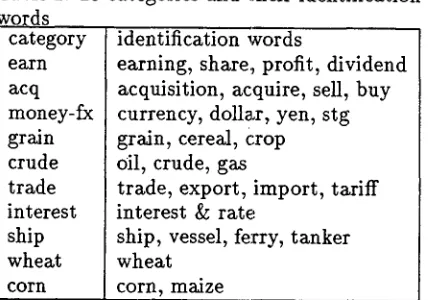
Table 1:10 categories and their identification words
category
e a r n
acq money-fx grain crude trade interest ship wheat corn
identification vcords
earning, share, profit, dividend acquisition, acquire, sell, buy currency, dollar, yen, stg grain, cereal, crop oil, crude, gas
trade, export, import, tariff interest & rate
ship, vessel, ferry, tanker wheat
cori1, maize
7.4 M a i n T o p i c I d e n t i f i c a t i o n
We conducted an evaluation to determine whether or not the main topics in the topic structures obtained for the 3299 test texts could be approximately matched with the la- bels (categories) assigned to the test texts.
Note that here labels are used only for eval- uation, not for training. This is in contrast to the situation in most text classification ex- periments, in which labels are generally used both for training and for evaluation. It is not particularly meaningful, then, to compare the results for main topic identification obtained here with those for text classification.
With STM, clusters in each block were sorted in descending order of their probabil- ities, and the top k seed words were extracted to represent the topics of the block. Further- more, a seed word appearing in all the blocks of the text was considered to represent a main topic. When a text had not been segmented (i.e., has only one block), all top k seed words were considered to represent main topics.
Table 1 lists the largest 10 categories in the Reuters data. On the basis of the definition of each of the 10 categories, we assigned based on our intuition to each of them the identification words that are listed in Table 1.
For the evaluation, when the seed words for main topics contained at least one of the iden- tification words, we considered our method to have identified the corresponding main topic equivalent to a human-determined category.
We then evaluated these in terms of preci-
sion and recall. Here, precision is defined as the ratio of the number of decisions correctly made to the total number of decisions made. Recall is defined as the ratio of the mrmber of decisions correctly made to the total number
Table 2: Main topic identification results with respect to 7 top words
category
earn acq money-fx grain crude trade interest ship wheat corn
STM
rec. pre.
Com
rec. pre.
0.790 0.971
0.245 0.854
0.436 0.456
0.322 0.750
0.487 0.676
0.667 0.473
0.107 0.700
0.247 0.957
0.620 0.936
0.429 0.960
0.526 0.976
0.184 0.841
0.285 0.421
0.174 0.650
0.407 0.664
0.590 0.356
0.084 0.733
0.270 0.828
0.408 0.967
0.446 1.00
micro-average 0.515 0.824 0.365 0.774
Table 3: Main topic identification results with respect to 5 top words
category
earn acq money-fx grain crude trade interest ship wheat corn
micro-average
STM
rec. pre.
0.742 0.971
0.184 0.868
0.413 0.503
0.295 0.759
0.471 0.718
0.479 0.505
0.053 0.700
0.169 1.000
0.577 0.953
0.357 0.952
0 . 4 6 1 0 . 8 5 0
Corn
rec. pre.
0.348 0.977
0.120 0.869
0.268 0.471
0.121 0.600
0.333 0.656
0.513 0.403
0.069 0.818
0.180 0.762
0.282 0.952
0.321 1.000
0.257 0.767
of decisions which should have been correctly made.
We also looked at the performance of Corn (cf., Section 6). For Corn, we extracted from a text the key words with the 20 largest Shan- non information values, segmented the text using TextTiling, and extracted in each block the key words having the largest k probabil- ity values. Any key word extracted in all blocks was considered to represent a main topic. When the key words for main top- ics contained at least one of the identification words, we viewed that text as having the cor- responding main topic.
Table 2 shows the results achieved with STM and Corn in the case of k ~-- 7. 9 Table 3
[image:8.596.120.334.81.231.2] [image:8.596.349.577.333.499.2]T i t l e : gOYPY BUYS PL 480 RHSAT FLOU! - U.S. YRADSItS
"Body: ggyp1 bought 125,723 sonnet o~ U.S. shoat ~lour in i t s PL
480 t e n d e r yesterdxy, t r a d e ooQrceo s a i d . The purchase i n c l u d e d
$t,880 t o n n e s ~ e r Say s h i p n ~ n t ~ d 73,843 t e n n e s f o r June s b i p n e n t . P r i c e d e t a i l s gere n o t a v a i l a b l e .
Content Words (Freq.): t o n e ( S ) shipment(2) buy(t) d e t a i l ( I ) ggypt(1) t l o u r ( l ) i n c l u d e ( I ) June(l) PL(I) p r i c e ( t ) purchase(l)
s o u r c e ( l ) t r a d e ( l ) US(l) 9heat(l)
Icy Bordo (ShLn. I n g . ) : tonne(17.5) ohi~4nent(1S.3) PL(IO.6) f l o u r ( 9 . 8 ) Sgypt(9.3) d e t a i l ( 7 . S ) Juno(7.2) uheat(6.8) purchas¢(6.6) source(S.S) U$(6.1) buy(6.0) inclnde(6.O) trade(B.3) price (S.l)
Con Yopics (Prob.): tonn¢(O.17) s h i p n e n t ( O . l l ) price(O.06) June(O.O6) in¢lude(O.00) purcbaoe(O.06) source(O.O6)
BIB Iopico (Prob.) : ilour~sheat(O.IB) tonn4(0.12) shipmont(O.tl) purchaoe-buy(O.tl) Egypt(O.O6)
C l u s t e r : ( S i e u r - w h e a t : ghent tonne ~lour)
( p u r c h a s e - b u y : p u r c h a s e bny)
Figure 8: Topic Identification Example
shows the results in the case of k = 5. The comparison may be considered fair in that it requires each of the two methods to provide the same number of words to represent top- ics. Results indicate that STM significantly outperforms Corn, particularly in terms of re- call.
The main reason for the higher performance achieved by STM is that it utilizes word clus- ter information. Figure 8 shows topic analysis results for the text with ID 15572 labeled with 'wheat.' The text contains only 15 content words (word types), thus all of the 15 words were extracted as key words and the text was not segmented by either method. Corn was unable to identify the main topic 'wheat,' be- cause the probability of each of the relevant key words 'wheat' and 'flour' was low. In contrast, STM successfully identified the topic because the relevant key words were classified into the same cluster, and its probability was relatively high.
7.5 S e g m e n t a t i o n a n d S u b t o p i c
I d e n t i f i c a t i o n
We collected the 50 longest test texts (re- ferred to here as 'seed texts') from each of the 10 categories, and combined each with a test text randomly selected from other categories to produce 500 pseudo-texts. Placement of the seed text within its pseudo-text (i.e., be- fore or after the other text) was determined randomly.
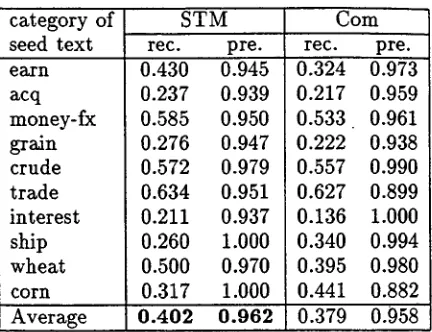
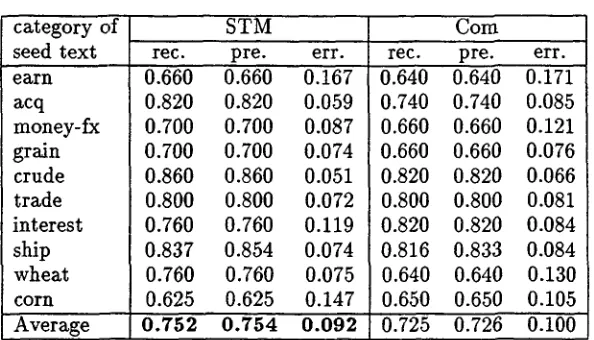
We used both STM and Corn to segment each of the pseudo-texts into two blocks and identify subtopics. Table 4 shows the segmen- tation results for the two method evaluated
ample, (Lewis and Ringnette, 1994).
Table 5: Subtopic identification results
category of seed text
e a x n
acq money-fx grain crude trade interest ship wheat
c o r n
Average
STM
rec. pre.
0.430 0.945
0.237 0.939
0.585 0.950
0.276 0.947
0.572 0.979
0.634 0.951
0.211 0.937
0.260 1.000
0.500 0.970
0.317 1.000
Corn
rec. pre.
0.324 0.973
0.217 0.959
0 . 5 3 3 0.961
0.222 0.938
0.557 O.990
0.627 0.899
0.136 1.000
0.340 0.994
0.395 0.980
0.441 0.882
0 . 4 0 2 0 . 9 6 2 0.379 0.958
in terms of recall, precision, and error prob- ability. Table 5 shows the results of subtopic identification as evaluated in terms of recall
and precision.
Error probability
is a metricfor evaluating segmentation results proposed in (Allan et ai., 1998; Beeferman e t a l . , 1999). It is defined here as the probability that a ran- domly chosen pair of sentences a distance of k sentence apart is incorrectly segmented. 1°
Experimental results indicate that STM outperforms Corn in both segmentation and identification, n
8 C o n c l u s i o n s
We have proposed a new m e t h o d of topic analysis that employs a finite mixture model, referred to here as a stochastic topic model (STM).
Topic analysis consists of two main tasks: text segmentation and topic identification. With topic analysis, one can obtain a topic structure for a text.
Our method addresses topic analysis within a single framework. It has the following novel features: 1) it represents topics by means of word dusters and employs a finite mixture model (STM) to represent a word distribution within a text; 2) it constructs topics on the basis of corpus data before conducting topic analysis; 3) it segments a text by detecting significant differences between STMs; and 4) it identifies topics by estimating parameters
1°Here, k was set to 5 because t h e average l e n g t h of
a t e x t was a b o u t 10 sentences. ....
[image:9.596.321.537.107.273.2]Table 4: Text segmentation results
category of seed text earn acq money-fx grain crude trade interest ship wheat corn Average
STM
0.660
0.820 0.820 0.059
0.700 0.700 0.087
0.700 0.700 0.074
0.860 0.860 0.051
0.800 0.800 0.072
0.760 0.760 0.119
0.837 0.854 0.074
0.760 0.760 0.075
0.625 0.625 0.147
Corn
rec. pre. err. rec. pre. err.
0.660 0.167 0.640 0.640 0.171
0.740 0.740 0.085
0.660 0.660 0.121
0.660 0.660 0.076
0.820 0.820 0.066
0.800 0.800 0.081
0.820 0.820 0.084
0.816 0.833 0.084
0.640 0.640 0.130
0.650 0.650 0.105
0.725 0.726 0.100
0 . 7 5 2 0 . 7 5 4 0 . 0 9 2
of STMs.
Experimental results indicate that our method outperforms a m e t h o d that combines existing techniques. More specifically, it sig- nificantly outperforms the combined m e t h o d in topic identification.
R e f e r e n c e s
J. Allan, J. Carbonell, G. Doddington, J. Yam- ron, and Y. Yang. 1998. Topic detection and
tracking pilot study: Final report. Proc. of the
DARPA Broadcast News Transcription and Un- derstanding Workshop, pages 194-218.
D. Beeferman, A. Berger, and J. Lafferty. 1999. Statistical models for text segmentation.
Machi. Lrn., 34:177-210.
P. F. Brown, V. J. Della Pietra, P. V. deSouza, J. C. Lai, and R. L. Mercer. 1992. Class-based
n-gram models of natural language. Comp.
Ling., 18(4):283-298.
T. M. Cover and J. A. Thomas. 1991. Elements of
Information Theory. John Wiley & Sons Inc., New York.
A.P. Dempster, N.M. Laird, and D.B. Rubin. 1977. Maximum likelihood from incomplete
data via the em algorithm. Journ. of Roy. Star.
Soci., Ser. B, 39(1):1-38.
B. Everitt and D. Hand. 1981. Finite MiNute Dis-
tribntions. Chapman and Hall.
M. Hearst. 1997. Texttiling: Segmenting text
into multi-paragraph subtopic passages. Comp.
Ling., 23(1):33-64.
Thomas Hofmann. 1999. Probabilistic latent se-
mantic indexing. Proc. of SIGIR '99, pages 50-
57.
T. Joachirns. 1998. Text categorization with sup- port vector machines: Learning with many rel-
evant features. Proc. of ECML '98.
D. D. Lewis and M. Ringuette. 1994. A compar- ison of two learning algorithms for test catego-
rization. Proc. of 3rd Ann. Syrup. on Doc. Ana.
and Info. Retr., pages 81-93.
D. D. Lewis, R. E. Schapire, J. P. Callan, and R. Papka. 1996. Training algorithms for linear
text classifiers. Proc. of SIGIR'96.
H. Li and K. Yamanishi. 1997. Document classi-
fication using a finite mixture model. Proc. of
A CL '97, pages 39-47.
H. Li and K. Yamanishi. 1999. Text classification
using ESC-based stochastic decision lists. Proc.
of ACM-CIKM'99, pages 122-130.
H. Li. 1998. A Probabilistic Approach to Lezical
Semantic Knowledge Acquisition and Structural Disambignation. Ph.D. Thesis, Univ. of Tokyo. A. K. McCallum and K. Nigam. 1999. Text clas- sification by bootstrapping with keywords, em
and shrinkage. Proc. of ACL'g9 Workshop Un-
supervised Learning in NLP.
K. Nigarn, A. K. McCallum, S. Thrun, and T. Mitchell. 2000. Text classification from labeled and unlabeled documents using era.
Maehi. Lrn., 39:103-134.
J. C. Reynar. 1999. Statistical models for topic
segmentation. Proc. of ACL '99, pages 357-364.
J. Rissanen. 1996. Fisher information and
stochastic complexity. 1EEE Trans. on Info.
Thry., 42(1):40-47.
G. Salton and C.S. Yang. 1973. On the speci- fication of term values in automatic indexing.
Journ. of Doc., 29(4):351-372.
S. M. Weiss, C. Apte, F. Damerau, F. J. Oles, T. Goers, and T. Hampp. 1999. Maximiz-
ing text-mining performance. IEEE Intel. Sys.,
14(4):63-69.
J.P. Yamron, I. Carp, L. Gillick, S. Lowe, and P. van Mulbregt. 1998. A Hidden Markov Model approach to text segmentation and event
[image:10.596.190.487.90.260.2]