Deep Neural Networks with Massive Learned Knowledge
Zhiting Hu, Zichao Yang, Ruslan Salakhutdinov, Eric P. Xing
School of Computer Science Carnegie Mellon University
{zhitingh,zichaoy,rsalakhu,epxing}@cs.cmu.edu
Abstract
Regulating deep neural networks (DNNs) with human structured knowledge has shown to be of great benefit for improved accuracy and in-terpretability. We develop a general frame-work that enables learning knowledge and its confidence jointly with the DNNs, so that the vast amount of fuzzy knowledge can be incor-porated and automatically optimized with lit-tle manual efforts. We apply the framework to sentence sentiment analysis, augmenting a DNN with massive linguistic constraints on discourse and polarity structures. Our model substantially enhances the performance using less training data, and shows improved inter-pretability. The principled framework can also be applied to posterior regularization for regu-lating other statistical models.
1 Introduction
Deep neural networks (DNNs) have achieved re-markable success in a large variety of application domains (Krizhevsky et al., 2012; Hinton et al., 2012; Bahdanau et al., 2014). However, the power-ful end-to-end learning comes with limitations, in-cluding the requirement on massive amount of la-beled data, uninterpretability of prediction results, and difficulty of incorporating human intentions and domain knowledge.
To alleviate these drawbacks, recent work has fo-cused on training DNNs with extra domain-specific features (Collobert et al., 2011), combining ora-cle similarity constraints (Karaletsos et al., 2016), modeling output correlations (Deng et al., 2014), and others. Recently, Hu et al. (2016) proposed a
general distillation framework that transfers knowl-edge expressed as first-order logic (FOL) rules into neural networks, where FOL constraints are inte-grated via posterior regularization (Ganchev et al., 2010). Despite the intuitiveness of FOL rules and the impressive performance in various tasks, the approach, as with the previous posterior constraint methods (Ganchev et al., 2010; Liang et al., 2009; Zhu et al., 2014), has been limited to simplea pri-orifixed constraints with manually selected weights, lacking the ability of inducing and adapting abstract knowledge from data. This issue is further exacer-bated in the context of regulating DNNs that map raw data directly into the label space, leaving a huge semantic gap in between, and making it unfeasible to express rich human knowledge built on the inter-mediate abstract concepts.
In this paper, we introduce a generalized frame-work which enables a learning procedure for knowl-edge representations and their weights jointly with the regulated DNN models. This greatly extends the applicability to massive structures in diverse forms, such as structured models and soft logic rules, fa-cilitating practitioners to incorporate rich domain expertise and fuzzy constraints. Specifically, we propose amutualdistillation method that iteratively transfers information between DNN and structured knowledge, resulting in effective integration of the representation learning capacity of DNN and the generalization power of structured knowledge. Our method does not require additional supervision be-yond raw data-labels for knowledge learning.
We present an instantiation of our method in the task of sentence sentiment analysis. We
ment a base convolutional network with linguis-tic knowledge that encourages coherent sentiment transitions across the clauses in terms of discourse relations. All uncertain modules, such as clause relation and polarity identification, are automati-cally learned from data, freeing practitioners from exhaustive specification. We further improve the model by integrating thousands of soft word polar-ity and negation rules, with their confidence directly induced from the data.
Trained with only sentence level supervisions, our model substantially outperforms plain neural net-works learned from both sentence and clause labels. Our method also shows enhanced generalization on limited data size, and improved interpretability of predictions.
Our work enjoys general versatility on diverse types of structured knowledge and neural architec-tures. The principled knowledge and weight learn-ing approach can also be applied to the posterior constraint frameworks (Ganchev et al., 2010; Liang et al., 2009) for regulating other statistical models.
2 Related Work
Deep Networks with Structured Knowledge
Combining the powerful deep neural models with structured knowledge has been of increasing interest to enhance generalization and improve interpretabil-ity (Li et al., 2015; Deng et al., 2014; Johnson et al., 2016). Recently, Hu et al. (2016) proposed to trans-fer logical knowledge information into neural net-works with diverse architectures (e.g., convolutional networks and recurrent networks). They devel-oped an iterative distillation framework that trains the neural network to emulate the predictions of a “teacher” model which is iteratively constructed by imposing posterior constraints on the network. The framework has shown to be effective in regulating different neural models. However, the method has required fixed constraints and manually specified weights, making it unsuitable to incorporate large amount of fuzzy human intuitions where adaptation to data is necessary to obtain meaningful knowledge representations.
The limitation is in fact shared with the general-purpose posterior regularization methods (Ganchev et al., 2010; Liang et al., 2009; Zhu et al., 2014).
Though attempts have been made to learn the con-straint weights from additional supervisions (Mei et al., 2014) or for tractability purposes (Steinhardt and Liang, 2015), learning and optimizing knowledge expressions jointly with the regulated models from data is still unsolved, and critically restricting the application scope.
Sentiment Analysis Sentence level sentiment classification is to identify the sentiment polarity (e.g., positive or negative) of a sentence (Pang and Lee, 2008). Recently, a number of neural models have been developed and achieved new levels of per-formance (Kim, 2014; Socher et al., 2013; Lei et al., 2015). Despite the impressive success, most of the existing neural network approaches require large amount of labeled data while encoding very lim-ited linguistic knowledge, making them inefficient to handle sophisticated linguistic phenomena, such as contrastive transitions and negations (Choi and Cardie, 2008; Bhatia et al., 2015).
Hu et al. (2016) combines a neural network with a logic rule that captures contrastive sense by ob-serving the word “but” in a sentence. However, such simple deterministic rules suffer from limited gener-ality and robustness. This paper develops a new sen-timent neural model that combines a large diverse set of linguistic knowledge through our enhanced framework. Our method efficiently captures com-plex linguistic patterns from limited data, and yields highly interpretable predictions.
3 Mutual Distillation
This section introduces the proposed framework that enables joint learning of knowledge components and their weights with the neural network models. In particular, we generalize the one-sided distillation method of (Hu et al., 2016) (section 3.1), and pro-pose to mutually transfer information between the neural network and the structured constraints for ef-fective knowledge learning (section 3.2), and opti-mize the weights by considering jointly all compo-nents (section 3.3).
We consider input variable x ∈ X and target
variable y ∈ Y. For clarity we focus on classifi-cation where y is a one-hot encoding of the class
A neural network defines a conditional probability pθ(y|x)parameterized byθ. We will omit the
sub-scriptθwhen there is no ambiguity. 3.1 Network Learning with Knowledge
Distillation
We first review the iterative distillation method (Hu et al., 2016) that transfers structured knowledge into neural networks. Consider constraint functions fl ∈ X × Y → R, indexed by l, that encode the
knowledge and we want to satisfy (i.e., maximize by optimizing the predictions y) with confidence
weightsλl∈R. Given the current state of the neural
network parametersθ at each iteration, a
structure-enriched teacher networkqis obtained by solving
min
q∈P KL(q(Y)kpθ(Y|X))−C
X
lλlEq[fl(X,Y)], (1)
whereP denotes the appropriate distribution space;
andC is the regularization parameter. Problem (1) is convex and has a closed-form solution
q∗(Y)∝pθ(Y|X) exp
n
CX
lλlfl(X,Y)
o
, (2)
whose normalization term can be calculated ef-ficiently according to how the constraints factor-ize (Hu et al., 2016). The neural networkpθ at
it-eration t is then updated with a distillation objec-tive (Hinton et al., 2015) that balances between im-itating soft predictions of teacher q and predicting true hard labels:
θ(t+1)= arg min θ∈Θ
1
N N
X
n=1
(1−π)`(yn,σθ(xn))
+π`(s(nt),σθ(xn)),
(3)
where ` denotes the loss function (e.g., cross en-tropy loss for classification); σθ(x) is the softmax
output of pθ on x; s(nt) is the soft prediction
vec-tor of q on training point xn at iteration t; N is
the training size; and π is the imitation parameter calibrating the relative importance of the two objec-tives. The training procedure iterates between Eq.(2) and Eq.(3), resulting in the richly structured teacher modelqand the knowledge distilled student network p. Whileq generally provides better accuracy, pis more lightweight and applicable to many different contexts (Hu et al., 2016; Liang et al., 2008).
In (Hu et al., 2016), the constraintfl(X,Y)has
been limited to be of the formrl(X,Y)−1, where
rlis an FOL function yielding truth values in[0,1],
and is required to be fully-specified a priori and fixed throughout the training. Besides, the constraint weightλlhas to be manually selected. This severely
deviates from the characters of human knowledge which is usually abstract, fuzzy, built on high-level concepts (e.g., discourse relations, visual attributes) as opposed to low-level observations (e.g., word sequences, image pixels), and thus incomplete in the sense of end-to-end learning that maps raw in-put directly into target space of interest. This ne-cessitates expressing structured knowledge allowing some modules unknown and induced automatically from observations.
3.2 Knowledge Learning
To substantially extend the scope of knowledge used in the framework, we introduce learnable modules
φin the knowledge expression denoted asfφ. The
moduleφis general, and can be, e.g., free
parame-ters of structured metrics, or dependency structures over semantic units. We assumefφcan be optimized
in terms ofφagainst a given objective (e.g., through
gradient descent for parameter updating). We aim to learn the knowledge by determiningφfrom data.
For clarity we consider one knowledge constraint and omit the indexl. We further assume the con-straint factorizes over data instances. Note that our method can straightforwardly be applied to the case of multiple constraints and constraints span-ning multiple instances. As any measpan-ningful knowl-edge is expected to be consistent with the ob-servations, a straightforward way is then to di-rectly optimize against the training data: φ∗ = arg maxφN1 Pnfφ(xn,yn), and insert the
result-ing fφ∗ in Eq.(1) for subsequent steps. However,
such a pipelined method fails to establish interac-tions between the knowledge and network learning, and can lead to a sub-optimal system, as shown in our experiments.
To address this, we inspect the posterior regular-ization objective in Eq.(1), and write it in an anal-ogous form to the variational free energy of some model evidence. Specifically, letloghφ(X,Y) ,
Cλfφ(X,Y), then the objective can be written as
−X Y
q(Y) logp(Y|X)hφ(X,Y)
Intuitively, we can view the output distribution of the neural networkp(Y|X)as a prior distribution over the labels, while consideringhφ(X,Y)as defining
a “likelihood” metric w.r.t the observations, making the objective analogous to a (negative) variational lower bound of the respective “model”. This natu-rally inspires an EM-type algorithm (Neal and Hin-ton, 1998) to optimize relevant parameters and im-prove the “evidence”: the E-step optimizes overq, yielding Eq.(2); and the M-step optimizes over φ.
Further incorporating the true training labels with balancing parameterπ0, we obtain the update forφ:
φ(t+1)= arg max φ∈Φ
1
N N
X
n=1
(1−π0)hφ(xn,yn)
+π0Eq(t)(y)[hφ(xn,y)]
(5)
The update rule resembles the distillation objective for learning parametersθin Eq.(3). Indeed, the
ex-pectation term in Eq.(5) in effect optimizes hφ on
examples labeled by q(y), i.e., forcing the
knowl-edge function to mimic the predictions of the teacher model and distill encoded information. Thus, be-sides transferring from structured knowledge to a neural model by Eq.(3), we now further bridge from the neural network to the knowledge constraints for joint learning and better integrating the best of both worlds. We call our framework with the symmet-ric objectives asmutual distillation. In fact, we can view Eq.(4) as a single joint objective and we are alternating optimization ofθandφ, resulting in the
update rules in Eq.(3) and Eq.(5) with the supervised loss terms included, respectively (and with the loss function in Eq.(3) being cross-entropy loss).
Additionally, the resemblance of the two objec-tives indicates that we can readily translate the suc-cessful neural learning method to knowledge learn-ing. For instance, the expectation term in Eq.(5), as the second loss term in Eq.(3), can be evaluated on rich unlabeled data in addition to labeled exam-ples, enabling semi-supervised learning which has shown to be useful (Hu et al., 2016). Empirical stud-ies show superiority of the proposed method over several potential alternatives (section 5).
3.3 Weight Learning
Besides optimizing the knowledge representations, we also aim to automate the selection of constraint
weights by learning from data. This would enable us to incorporate massive amount of noisy knowl-edge, without the need to worry about the confidence which is usually unfeasible to set manually.
As the constraint weights serve to balance be-tween the different components of the whole frame-work, we learn the weights by optimizing the regu-larized joint modelq(see Eq.(2)):
λ(t+1)= arg max
λ≥0
1
N N
X
n=1
qλ(yn) (6)
This is also validated in the view of regularized Bayes (Zhu et al., 2014) where q is a generalized posterior function by regularizing the standard pos-terior p (see Eq.(1)). Although here, we omit the Bayesian treatment of the weights λ and instead
optimize them directly to find the posterior. It is straightforward to impose priors over λ to encode
preferences. In practice, Eq. (6) can be carried out through gradient descent.
The training procedure of the proposed mutual distillation is summarized in Algorithm 1.
Algorithm 1Mutual Distillation
Input: Training dataD={(xn,yn)}Nn=1,
Initial knowledge constraintsF ={fφ,l}Ll=1,
Initial neural networkpθ,
Parameters:π,π’ – imitation parameters C– regularization parameters
1: Initialize neural network parametersθ
2: Initialize knowledge parametersφand weightsλ
3: whilenot convergeddo
4: Sample a minibatch(X,Y)⊂ D
5: Build the teacher modelqwith Eq.(2) and Eq.(6) 6: Updatepθwith distillation objective Eq.(3) 7: Updatefl(l = 1, . . . , L)with distillation
objec-tive Eq.(5) 8: end while
Output: Learned networkp, knowledge modulesF, and
the joint teacher networkq
4 Sentiment Classification
CCWKRXJKRFFDVLRQDOO\IXQLWLVDVWXSLGILOP¶¶ CCWKRXJKRFFDVLRQDOO\IXQ¶¶ CCLWLVDVWXSLGILOP¶¶
Ͳ ͳ Ͳ Ͳ
convolutional network discourse relation & sentiment transition Ͳ Ͳ
ͳ Ͳ ǥ transition matrixes
discourse relation clause sentiment
student model () prediction
teacher model (ݍ) prediction
ZRUGSRODULW\ QHJDWLRQUXOHV
FRQMXQFWLRQ UXOHV
shared conv params
[image:5.612.129.503.59.245.2]distillation distillation
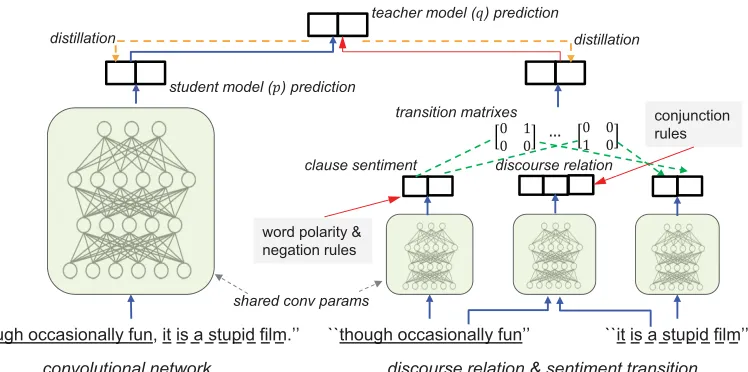
Figure 1:Our sentiment classification model. The left part is the base convolutional network over sentences, and the right part is the knowledge component over clauses. Blue arrows denote neural feed-forwards; red arrows denote knowledge incorporation steps; and the orange dashed arrows denote the distillation processes. The convolutional parameters are shared across all the networks.
for improving discourse relation identification, and 3) word polarity rules for tackling negations. These knowledge structures are fulfilled with neural net-work modules that are learned jointly within our framework. The resulting model efficiently captures sophisticated linguistic patterns from limited data, and produces interpretable predictions.
Figure 1 shows an overview of our model. We assume binary sentiment labels (i.e., positive-1 and negative-0). The left part of the figure is the base neural network for sentence classification. Since our framework is agnostic to the neural architecture, we can use any off-the-shelf neural models such as con-volutional network and recurrent network. Here we choose the simple yet effective convolutional net-work proposed in (Kim, 2014). The netnet-work takes as input the word embedding vectors of a given sen-tence, and extracts feature maps with a convolutional layer followed by max-over-time pooling. A final fully-connected layer with softmax activation trans-forms the extracted features into a prediction vector. We next introduce the three types of domain knowledge, which leverage rich fine-grained level structures, from clauses to words, to guide sentence level prediction. The clause segmentation of sen-tences is obtained using the public Stanford parser1. Sentiment transition by discourse relation Dis-course structures characterize how the clauses (i.e.,
1http://nlp.stanford.edu/software/openie.html
discourse units) of a sentence are connected with each other and thereby provide clues for coher-ent scoher-entence and clause labeling. Instead of us-ing standard general-purpose discourse relation sys-tem, we define three types of relations between ad-jacent clauses (denoted as ci and ci+1) specific to
sentiment change, namely, consistent (ci and ci+1 have the same polarity), contrastive (ci+1 opposes ci and is the main part), and concessive (ci+1 op-posesci and is secondary). The relations also
indi-cate the connections between clauses and the whole sentence. For instance, a contrastive relation typi-cally indicatesci+1 has the same polarity with the full sentence (we reasonably assume a sentence has contrastive sense in at most one position). To en-code these dependencies we define sentiment tran-sition matrices conditioned on discourse relationr and sentence polarity y, denoted as Mr,y. For
in-stance, givenr =contrastiveandy = 0, we expect the sentiment change between two adjacent clauses to follow
Mr=contrastive,y=0=
0 0 1 0
, (7)
i.e., transiting from positive polarity ofcito negative
ofci+1. We list all transition matrices in supplement.
We now design a constraint on sentence predic-tions leveraging the above knowledge. Using the identification modules presented shortly, we first get the discourse relation probabilitiespr
the sentiment polarity probabilities pci andpci+1 of
adjacent clauses(ci, ci+1). For a given sentence la-belys, we then compute the expected transition
ma-trix at each position byM¯i,ys =Epr
i,i+1[Mr,ys]. The
value of the constraint function ony = ys is then
defined as the probability of the most likely clause polarity configuration according to the clause pre-dictionspc
· and the averaged transitionsM¯·,ys:
fst(x, y
s) = max
a∈{0,1}m
Y
ip r
i,ai·M¯i,ys,aiai+1, (8)
where a is the polarity configuration andm is the number of clauses. We use the Viterbi algorithm for efficient computation.
We need the clause relation and polarity proba-bilitiespr andpc, which are unfeasible to identify
from raw text with only simple deterministic rules. We apply a convolutional network for each module, with similar network architectures to the base net-work (we describe details in the supplement). For ef-ficiency, we tie the convolutional parameters across all the networks, while leaving the parameters of the fully-connected layers to be learned individually.
Conjunction word rules We enhance the dis-course relation neural network with robust clues from explicit discourse connectives (e.g., “but”, “and”, etc.) that occur in the sentence. In particular, we collect a set of conjunction words (listed in the supplement) and specify a rule constraint for each of them. For instance, the conjunction “and” results in the following constraint function:
frel(ci, ci+1, r) = (1and(ci, ci+1)⇒r=consistent),
where 1and(ci, ci+1) is an indicator function that
takes 1 if the two clauses are connected by “and”, and0otherwise. Note that these rules are soft, with the confidence weights learned from data. We use the regularized joint model over the base discourse network for predicting the relations.
Negation and word polarity rules Negations re-verse the polarity of relevant statements. Identifying negation sense has been a challenging problem for accurate sentiment prediction. We address this by incorporating rich lexicon rules at the clause level. That is, if a polarity-carrying word (e.g., “good”) occurs in the scope of a negator (e.g., “not”), then the sentiment prediction of the clause is encouraged
to be the opposite polarity. We specify one separate rule for each polarity-carrying word from public lex-icons (see the supplement), e.g.,
flex(ci, yc) = 1good(ci)⇒yc=negative, (9)
where 1good(ci) is an indicator function that takes
1if word “good” occurs in a negation scope in the clause text, and 0 otherwise. This results in over 3,000 rules, and our automated weight optimization frees us from manually selecting the weights ex-haustively. We define the negation scope to be the 4 words following a negator (Choi and Cardie, 2008). Though polarities of single words can be brit-tle features for determining the sentiment of a long statement due to complex semantic compositions, they are more robust and effective at the level of clauses which are generally short and simple. More-over, inaccurate rules will be downplayed through the weight learning procedure.
We have presented our neural sentiment model. We tackle several long-standing challenges by di-rectly incorporating linguistic knowledge. Comping to previous work that designs various neural ar-chitectures and relies on substantial annotations for specific issues (Socher et al., 2013; Bhatia et al., 2015), our knowledge framework is more straight-forward, interpretable, and general, while still pre-serving the power of neural methods.
Notably, even with several additional compo-nents to be learned for knowledge representation, our method does not require extra supervision sig-nals beyond the raw sentence-labels, making our framework generally applicable to many different tasks (Neelakantan et al., 2016).
The sentiment transition knowledge is expressed in the form of structured model with features ex-tracted using neural networks. Though apparently similar to recent deep structured models such as neural-CRFs (Durrett and Klein, 2015; Ammar et al., 2014; Do et al., 2010), ours is different since we parsimoniously extract features that are neces-sary for precise and efficient knowledge expression, as opposed to neural-CRFs that learn as rich repre-sentations as possible for final prediction.
5 Experiments
Model Accuracy (%)
sentences
1 CNN (Kim, 2014) 86.6
2 CNN+REL q: 87.8; p: 87.1
3 CNN+REL+LEX q:88.0; p:87.2
sentences 45 MC-CNN (Kim, 2014)Tensor-CNN (Lei et al., 2015) 86.887.0
6 CNN+But-q(Hu et al., 2016) 87.1
+phrases
7 CNN (Kim, 2014) 87.2
8 Tree-LSTM (Tai et al., 2015) 88.0
9 MC-CNN (Kim, 2014) 88.1
10 CNN+But-q(Hu et al., 2016) 89.2
[image:7.612.354.491.56.166.2]11 MVCNN (Yin and Schutze, 2015) 89.4
Table 1: Classification performance on SST2. The top and second blocks use only sentence-level annotations for training, while the bottom block uses both sentence- and phrases-level annotations. We report the accuracy of both the regularized teacher modelqand the student modelpafter distillation.
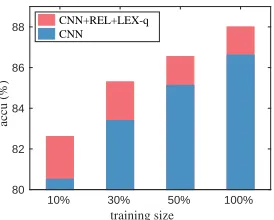
enriched model significantly outperforms plain neu-ral networks. We obtain even higher improvements with limited data sizes. Comparison with extensive other potential knowledge learning methods shows the effectiveness of our framework. Our model also shows improved interpretability.
5.1 Setup
Datasets Two classification benchmarks are used: 1) Stanford Sentiment Treebank-2 (SST2) (Socher et al., 2013) is a binary classification dataset that consists of 6920/872/1821 moview review sentences in the train/dev/test sets, respectively. Besides sentence-level annotations, the dataset also provides exhaustive gold-standard labels at fine-grained lev-els, from clauses to phrases. The resulting full train-ing set includes 76,961 labeled instances. We train our model using only thesentence-levelannotations, and compare to baselines learned from either train-ing set. 2) Customer Reviews (CR) (Hu and Liu, 2004) consists of 3,775 product reviews with pos-itive and negative polarities. Following previous work we use 10-fold cross-validation.
Model configurations We evaluate two variants of our model: CNN+REL leverages the knowledge of sentiment transition and discourse conjunctions, and CNN+REL+LEX additionally incorporates the negation lexicon rules.
Throughout the experiments we set the regulariza-tion parameter toC= 10. The imitation parameters π andπ0 decay as π(t) = π0(t) = 0.9t wheret is
training size
10% 30% 50% 100%
accu (%)
80 82 84 86
88 CNN+REL+LEX-q
CNN
Figure 2:Performance with varying sizes of training examples.
the iteration number (Bengio et al., 2015; Hu et al., 2016). For the base neural network, we choose the “non-static” version from (Kim, 2014) and use the same configurations.
5.2 Classification Results
Table 1 shows the classification performance on the SST2 dataset. From rows 1-3 we see that our pro-posed sentiment model that integrates the diverse set of knowledge (section 4) significantly outper-forms the base CNN (Kim, 2014). The improve-ment of the student network p validates the effec-tiveness of the iterative mutual distillation process. Consistent with the observations in (Hu et al., 2016), the regularized teacher modelqprovides further per-formance boost, though it imposes additional com-putational overhead for explicit knowledge repre-sentations. Note that our models are trained with only sentence-level annotations. Compared with the baselines trained in the same setting (rows 4-6), our model with the full knowledge, CNN+REL+LEX, performs the best. CNN+But-q (row 6) is the base CNN augmented with a logic rule that identifies con-trastive sense through explicit occurrence of word “but” (section 3.1) (Hu et al., 2016). Our enhanced framework enables richer knowledge and achieves much better performance.
[image:7.612.73.297.60.200.2]Model Accuracy (%) 1 CNN (Kim, 2014) 84.1±0.2
2 CNN+REL q: 85.0±0.2; p: 84.7±0.2
3 CNN+REL+LEX q:85.3±0.3; p:85.0±0.2
[image:8.612.341.510.58.172.2]4 MC-CNN (Kim, 2014) 85.0 5 Bi-RNN (Lai et al., 2015) 82.6 6 CRF-PR(Yang and Cardie, 2014) 82.7 7 AdaSent (Zhao et al., 2015) 86.3
[image:8.612.70.303.59.166.2]Table 2: Classification performance on the CR dataset. We report the average accuracy±one standard deviation with 10-fold CV. The top block compares the base CNN (row 1) with the knowledge-enhanced CNNs by our framework.
Table 2 shows model performance on the CR dataset. Our model again surpasses the base net-work and several other competitive neural methods by a large margin. Though falling behind AdaSent (row 7) which has a more specialized and complex architecture than standard convolutional networks, the proposed framework indeed is general enough to apply on top of it for further enhancement.
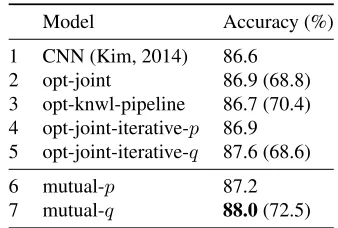
To further evaluate the proposed mutual distilla-tion framework for learning knowledge, we compare to an extensive set of other possible knowledge op-timization approaches. Table 3 shows the results. In row 2, the “opt-joint” method optimizes the reg-ularized joint model of Eq.(2) directly in terms of both the neural network and knowledge parameters. Row 3, “opt-knwl-pipeline”, is an approach that first optimizes the standalone knowledge component and then inserts it into the previous framework of (Hu et al., 2016) as a fixed constraint. Without interaction between the knowledge and neural network learn-ing, the pipelined method yields inferior results. Fi-nally, rows 4-5 display a method that adapts the knowledge component at each iteration by optimiz-ing the joint modelqin terms of the knowledge pa-rameters. We report the accuracy of both the student network p (row 4) and the joint teacher network q (row 5), and compare with our method in row 6 and 7, respectively. We can see that both models per-forms poorly, achieving the accuracy of only 68.6% for the knowledge component, similar to the accu-racy achieved by the “opt-joint” method.
In contrast, our mutual distillation framework of-fers the best performance. Table 3 shows that the knowledge component as a standalone classi-fier does not achieve high accuracy (the numbers in
Model Accuracy (%)
1 CNN (Kim, 2014) 86.6 2 opt-joint 86.9 (68.8) 3 opt-knwl-pipeline 86.7 (70.4) 4 opt-joint-iterative-p 86.9 5 opt-joint-iterative-q 87.6 (68.6)
6 mutual-p 87.2
7 mutual-q 88.0(72.5)
Table 3: Comparisons between our mutual distillation (rows 4-5) and other knowledge optimization methods, on SST2. See the text for details. The numbers in parentheses are the accuracy of the learned knowledge component (Figure 1, right part) if we take it as a standalone classifier. All knowledge is used.
it 's all very cute , though notterribly funnyif you 're …
0.4 0.6 0.8 0.2
concessive: 0.9
Figure 3: An example sentence and the results of the learned knowledge modules applied on it. Red denotespositive, and blue denotesnegative. The snippet “not ... funny” triggers the negation rule.
enough, good, strong,
engaging, great awful, loses, fakedoubt, bad
Table 4: The top 5 positive (left) and negative (right) words with the largest weights of the negation rules.
parentheses). As discussed in section 4, this is be-cause of the parsimonious formulation for the pre-cise knowledge expression, while leaving the ex-pressive base NN to extract rich representations. The enhanced performance of the combination indicates complementary effects of the two parts.
5.3 Qualitative Analysis
Our model not only provides better classification performance, but also shows improved interpretabil-ity due to the learned structured knowledge repre-sentation. Figure 3 illustrates an example sentence from test set. We see that the clause sentiments as well as the discourse relation are correctly captured. The negation rule of “not ... funny” (Eq.(9)) also helps to identify the right polarity.
[image:8.612.326.524.255.293.2]6 Conclusion
In this paper we have developed a framework that learns structured knowledge and its weights for reg-ulating deep neural networks through mutual distil-lation. We instantiated our framework for the senti-ment classification task. Using massive learned lin-guistic knowledge, our neural model provides sub-stantial improvements over many of the existing ap-proaches, especially in the limited data setting. In the future work, we plan to apply our framework to other text and vision applications.
Acknowledgments
We thank the anonymous reviewers for their valu-able comments. This work is supported by NSF IIS1218282, NSF IIS1447676, Air Force FA8721-05-C-0003.
References
Waleed Ammar, Chris Dyer, and Noah A Smith. 2014. Conditional random field autoencoders for unsuper-vised structured prediction. In Proc. of NIPS, pages 3311–3319.
Dzmitry Bahdanau, Kyunghyun Cho, and Yoshua Ben-gio. 2014. Neural machine translation by jointly learning to align and translate. arXiv preprint arXiv:1409.0473.
Samy Bengio, Oriol Vinyals, Navdeep Jaitly, and Noam Shazeer. 2015. Scheduled sampling for sequence pre-diction with recurrent neural networks. In Proc. of NIPS, pages 1171–1179.
Parminder Bhatia, Yangfeng Ji, and Jacob Eisenstein. 2015. Better document-level sentiment analysis from rst discourse parsing. InProc. of EMNLP.
Yejin Choi and Claire Cardie. 2008. Learning with com-positional semantics as structural inference for subsen-tential sentiment analysis. InProc. of EMNLP, pages 793–801. Association for Computational Linguistics. Ronan Collobert, Jason Weston, L´eon Bottou, Michael
Karlen, Koray Kavukcuoglu, and Pavel Kuksa. 2011. Natural language processing (almost) from scratch. JMLR, 12:2493–2537.
Jia Deng, Nan Ding, Yangqing Jia, Andrea Frome, Kevin Murphy, Samy Bengio, Yuan Li, Hartmut Neven, and Hartwig Adam. 2014. Large-scale object classifica-tion using label relaclassifica-tion graphs. InECCV 2014, pages 48–64. Springer.
Trinh Do, Thierry Arti, et al. 2010. Neural conditional random fields. InProc. of AISTATS, pages 177–184.
Greg Durrett and Dan Klein. 2015. Neural CRF parsing. Kuzman Ganchev, Joao Grac¸a, Jennifer Gillenwater, and Ben Taskar. 2010. Posterior regularization for struc-tured latent variable models.JMLR, 11:2001–2049. Geoffrey Hinton, Li Deng, Dong Yu, George E Dahl,
Abdel-rahman Mohamed, Navdeep Jaitly, Andrew Se-nior, Vincent Vanhoucke, Patrick Nguyen, Tara N Sainath, et al. 2012. Deep neural networks for acous-tic modeling in speech recognition: The shared views of four research groups. Signal Processing Magazine, IEEE, 29(6):82–97.
Geoffrey Hinton, Oriol Vinyals, and Jeff Dean. 2015. Distilling the knowledge in a neural network. arXiv preprint arXiv:1503.02531.
Minqing Hu and Bing Liu. 2004. Mining and summa-rizing customer reviews. InProc. of KDD, pages 168– 177. ACM.
Zhiting Hu, Xuezhe Ma, Zhengzhong Liu, Eduard Hovy, and Eric Xing. 2016. Harnessing deep neural net-works with logic rules. InProc. of ACL.
Matthew J. Johnson, David K. Duvenaud, Alex B. Wiltschko, Sandeep R. Datta, and Ryan P. Adams. 2016. Composing graphical models with neural net-works for structured representations and fast inference. Arxiv preprint arXiv:1603.06277.
Theofanis Karaletsos, Serge Belongie, Cornell Tech, and Gunnar R¨atsch. 2016. Bayesian representation learn-ing with oracle constraints. InProc. of ICLR.
Yoon Kim. 2014. Convolutional neural networks for sen-tence classification. Proc. of EMNLP.
Alex Krizhevsky, Ilya Sutskever, and Geoffrey E Hinton. 2012. Imagenet classification with deep convolutional neural networks. InProc. of NIPS, pages 1097–1105. Siwei Lai, Liheng Xu, Kang Liu, and Jun Zhao. 2015.
Recurrent convolutional neural networks for text clas-sification. InAAAI, pages 2267–2273.
Tao Lei, Regina Barzilay, and Tommi Jaakkola. 2015. Molding cnns for text: non-linear, non-consecutive convolutions. InProc. of EMNLP.
Jiwei Li, Dan Jurafsky, and Eudard Hovy. 2015. When are tree structures necessary for deep learning of rep-resentations?
Percy Liang, Hal Daum´e III, and Dan Klein. 2008. Structure compilation: trading structure for features. InProc. of ICML, pages 592–599. ACM.
Percy Liang, Michael I Jordan, and Dan Klein. 2009. Learning from measurements in exponential families. InProc. of ICML, pages 641–648. ACM.
Radford M Neal and Geoffrey E Hinton. 1998. A view of the em algorithm that justifies incremental, sparse, and other variants. InLearning in graphical models, pages 355–368. Springer.
Arvind Neelakantan, Quoc V Le, and Ilya Sutskever. 2016. Neural programmer: Inducing latent programs with gradient descent. InProc. of ICLR.
Bo Pang and Lillian Lee. 2008. Opinion mining and sentiment analysis. Foundations and trends in infor-mation retrieval, 2(1-2):1–135.
Richard Socher, Alex Perelygin, Jean Y Wu, Jason Chuang, Christopher D Manning, Andrew Y Ng, and Christopher Potts. 2013. Recursive deep models for semantic compositionality over a sentiment treebank. InProc. of EMNLP, volume 1631, page 1642. Citeseer. Jacob Steinhardt and Percy S Liang. 2015. Learning with relaxed supervision. In Proc. of NIPS, pages 2809– 2817.
Kai Sheng Tai, Richard Socher, and Christopher D Man-ning. 2015. Improved semantic representations from tree-structured long short-term memory networks. In Proc. of ACL.
Bishan Yang and Claire Cardie. 2014. Context-aware learning for sentence-level sentiment analysis with posterior regularization. InProc. of ACL, pages 325– 335.
Wenpeng Yin and Hinrich Schutze. 2015. Multichan-nel variable-size convolution for sentence classifica-tion. Proc. of CONLL.
Han Zhao, Zhengdong Lu, and Pascal Poupart. 2015. Self-adaptive hierarchical sentence model. arXiv preprint arXiv:1504.05070.