Human-in-the-Loop Parsing
Luheng He Julian Michael Mike Lewis Luke Zettlemoyer
Computer Science&Engineering University of Washington
Seattle, WA
{luheng,julianjm,mlewis,lsz}@cs.washington.edu
Abstract
This paper demonstrates that it is possible for a parser to improve its performance with a hu-man in the loop, by posing simple questions to non-experts. For example, given the first sentence of this abstract, if the parser is un-certain about the subject of the verb “pose,” it could generate the questionWhat would pose something? with candidate answersthis pa-per and a parser. Any fluent speaker can answer this question, and the correct answer resolves the original uncertainty. We apply the approach to a CCG parser, converting un-certain attachment decisions into natural lan-guage questions about the arguments of verbs. Experiments show that crowd workers can an-swer these questions quickly, accurately and cheaply. Our human-in-the-loop parser im-proves on the state of the art with less than 2 questions per sentence on average, with a gain of 1.7 F1 on the 10% of sentences whose parses are changed.
1 Introduction
The size of labelled datasets has long been recog-nized as a bottleneck in the performance of nat-ural language processing systems (Marcus et al., 1993; Petrov and McDonald, 2012). Such datasets are expensive to create, requiring expert linguists and extensive annotation guidelines. Even rela-tively large datasets, such as the Penn Treebank, are much smaller than required—as demonstrated by improvements from semi-supervised learning (Søgaard and Rishøj, 2010; Weiss et al., 2015).
We take a step towards cheap, reliable annotations by introducing human-in-the-loop parsing, where
Temple also said Sea Containers’ plan raises numer-ous legal, regulatory, financial and fairness issues, but didn’telaborate.
Q: What didn’telaborate? [1]**** Temple
[2]* Sea Containers’ plan [3] None of the above.
Table 1: An automatically generated query from CCGbank. 4 out of 5 annotators correctly answeredTemple, providing a signal that can be used to improve parse predictions.
non-experts improve parsing accuracy by answering questions automatically generated from the parser’s output. We develop the approach for CCG parsing, leveraging the link between CCG syntax and seman-tics to convert uncertain attachment decisions into natural language questions. The answers are used as soft constraints when re-parsing the sentence.
Previous work used crowdsourcing for less struc-tured tasks such as named entity recognition (Wer-ling et al., 2015) and prepositional phrase attach-ment (Jha et al., 2010). Our work is most related to that of Duan et al. (2016), which automatically generates paraphrases from n-best parses and gained significant improvement by re-training from crowd-sourced judgments on two out-of-domain datasets. Choe and McClosky (2015) improve a parser by cre-ating paraphrases of sentences, and then parsing the sentence and its paraphrase jointly. Instead of using paraphrases, we build on the approach of QA-SRL (He et al., 2015), which shows that untrained crowd workers can annotate predicate–argument structures by writing question–answer pairs.
Our experiments for newswire and biomedical
text demonstrate improvements to parsing accuracy of 1.7 F1 on the sentences changed by re-parsing, while asking only less than 2 questions per sentence. The annotations we collected1are a
representation-independent resource that could be used to develop new models or human-in-the-loop algorithms for related tasks, including semantic role labeling and syntactic parsing with other formalisms.
2 Mapping CCG Parses to Queries
Our annotation task consists of multiple-choice what-questions that admit multiple answers. To gen-erate them, we produce question–answer (QA) pairs from each parse in the 100-best scored output of a CCG parser and aggregate the results together.
We designed the approach to generate queries with high question confidence—questions should be simple and grammatical, so annotators are more likely to answer them correctly—and highanswer
uncertainty—the parser should be uncertain about
the answers, so there is potential for improvement. Our questions only apply to core arguments of verbs where the argument phrase is an NP, which account for many of the parser’s mistakes. Preposi-tional phrase attachment mistakes are also a large source of errors—we tried several approaches to generate questions for these, but the greater ambi-guity and inconsistency among both annotators and the gold parses made it difficult to extract meaning-ful signal from the crowd.
Generating Question–Answer Pairs Figure 1
shows how we generate QA pairs. Each QA pair cor-responds to a dependency such that if the answer is correct, it indicates that the dependency is in the cor-rect parse. We determine a verb’s set of arguments by the CCG supertag assigned to it in the parse (see Steedman (2000) for an introduction to CCG). For example, in Figure 1 the wordputtakes the category
((S\NP)/PP)/NP(not shown), indicating that it has
a subject, a prepositional phrase argument, and an object. CCG parsing assigns dependencies to each argument position, even when the arguments are re-ordered (as withput→pizza) or span long distances
(as witheat→I).
1Our code and data are available athttps://github. com/luheng/hitl_parsing.
I want to eat the pizza you put on the table subj xcomp
subj
obj obj
subj prep pobj
subj Verb obj prep xcomp
you put the pizza on the table
I want to eat the pizza I eat the pizza
Dependency Question Answer
want→I What wants to eat something? I eat→I What would eat something? I eat→pizza What would something eat? the pizza put→you What put something? you put→pizza What did something put? the pizza
on→table What did something put something on? the table
Figure 1:From a labeled dependency graph, we extract phrases corresponding to every argument of every verb using sim-ple heuristics. We then create questions about dependencies, adding awouldmodal to untensed verbs and placing arguments to the left or right of the verb based on its CCG category. We only generate QA pairs forsubj, obj, andpobjdependencies. To identify multiple answer options, we create QA pairs from all parses in the 100-best list and pool equivalent questions with different answers. See Table 2 for example queries.
To reduce the chance of parse errors causing non-sensical questions (for example,What did the pizza put something on?), we replace all noun phrases withsomethingand delete unnecessary prepositional phrases. The exception to this is with copular predi-cates, where we include the span of the argument in the question (see Example 4 in Table 2).
Grouping QA Pairs into Queries After
Sentence Question Votes Answers
(1) Structural Dynamics Research Corp. . . . said it introduced new technology in mechanical design automation that willimprovemechanical engineering productivity.
What willimprove
something?
0 Structural Dynamics Research Corp
5 new technology
0 mechanical design automation (2) He said disciplinary proceedings are confidential
and declined tocommenton whether any are being held against Mr. Trudeau.
What would
comment?
5 he
0 disciplinary proceedings
(3) Toavoidthese costs, and a possible default, immediate action is imperative.
What would somethingavoid?
4 these costs
3 a possible default
(4) The price is a new high for California Cabernet
Sauvignon, but itisnot the highest. Whathighest?isnot the 23 the priceit
(5) Kalipharma is a New Jersey-based pharmaceuticals concern thatsellsproducts under the Purepac label.
Whatsells
something?
5 Kalipharma
0 a New Jersey-based pharma-ceuticals concern
(6) Further, he said, the company doesn’t have the capital needed tobuildthe business over the next year or two.
What wouldbuild
something?
4 the company 1 the capital
(7) Timex had requested duty-free treatment for many types of watches,coveredby 58 different U.S. tariff classifications.
What would be
covered?
0 Timex
0 duty-free treatment 2 many types of watches
3 watches (8) You either believe Seymour can do it again or you
don’t . Whatdoes?
3 you
0 Seymour
[image:3.612.78.535.53.334.2]2 None of the above
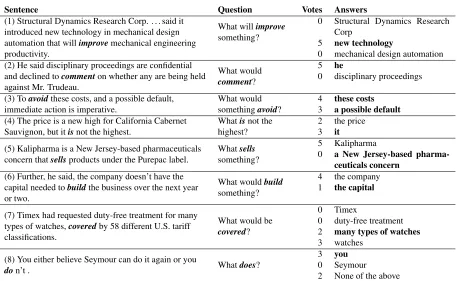
Table 2:Example annotations from the CCGbank development set. Answers that agree with the gold parse are in bold. The answer choiceNone of the abovewas present for all examples, but we only show it when it was chosen by annotators.
From the resulting queries, we filter out questions and answers whose marginalized scores are below a certain threshold and queries that only have one an-swer choice. This way we only ask confident ques-tions with uncertain answer lists.
3 Crowdsourcing
We collected data on the crowdsourcing platform CrowdFlower.2 Annotators were shown a sentence,
a question, and a list of answer choices. Annota-tors could choose multiple answers, which was use-ful in case of coordination (see Example 3 in Ta-ble 2). There was also a None of the aboveoption for when no answer was applicable or the question was nonsensical.
We instructed annotators to only choose options that explicitly and directly answer the question, to encourage their answers to closely mirror syn-tax. We also instructed them to ignore who/what and someone/something distinctions and overlook mistakes where the question was missing a nega-tion. The instructions included 6 example queries
2www.crowdflower.com
with answers and explanations. We used Crowd-Flower’s quality control mechanism, displaying pre-annotated queries 20% of the time and requiring an-notators to maintain high accuracy.
Dataset Statistics Table 3 shows how many
sen-tences we asked questions for and the total number of queries annotated. We collected annotations for the development and test set for CCGbank (Hock-enmaier and Steedman, 2007) as in-domain data and the test set of the Bioinfer corpus (Pyysalo et al., 2007) as out-of-domain. The CCGbank devel-opment set was used for building question genera-tion heuristics and setting hyperparameters for re-parsing.
Dataset Sentences Covered Queries Q/S CCG-Dev 1913 1155 1904 1.7 CCG-Test 2407 1460 2511 1.7
[image:4.612.72.300.56.107.2]Bioinfer 500 360 680 1.9
Table 3:Sentence coverage, number of queries annotated, and average number of queries per sentence (Q/S).
k-Agreed CCG-Dev CCG-Test Bioinfer
5 48.0% 40.2% 47.7%
≥4 76.6% 68.0% 75.0%
≥3 94.9% 91.5% 94.0%
Table 4: The percentage of queries with at leastkannotators agreeing on the exact same set of answers.
Qualitative Analysis Table 2 shows example
queries from the CCGbank development set. Exam-ples 1 and 2 show that workers could annotate long-range dependencies and scoping decisions, which are challenging for existing parsers.
However, there are some cases where annota-tors disagree with the gold syntax, mostly involv-ing semantic phenomena which are not reflected in the syntactic structure. Many cases involve co-reference, where annotators often prefer a proper noun referent over a pronoun or indefinite (see Ex-amples 4 and 5), even if it is not the syntactic ar-gument of the verb. Example 6 shows a complex control structure, where the gold CCGbank syntax does not recover the true agent ofbuild. CCGbank also does not distinguish between subject and object control. For these cases, our method could be used to extend existing treebanks. Another common error case involved partitives and related constructions, where the correct attachment is subtle—as reflected by the annotators’ split decision in Example 7.
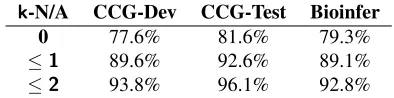
Question Quality Table 5 shows the percentage of
questions that are answered withNone of the above (writtenN/Abelow) by at mostkannotators. On all domains, about 80% of the queries are considered answerable by all 5 annotators. To have a better understanding of the quality of automatically gen-erated questions, we did a manual analysis on 50 questions for sentences from the CCGbank devel-opment set that are marked N/A by more than one annotator. Among the 50 questions, 31 of them are either generated from an incorrect supertag or unan-swerable given the candidates. So the N/A answer
k-N/A CCG-Dev CCG-Test Bioinfer
0 77.6% 81.6% 79.3%
≤1 89.6% 92.6% 89.1%
≤2 93.8% 96.1% 92.8%
Table 5: The percentage of queries with at mostkannotators choosing theNone of the above(N/A) option.
can provide useful signal that the parses that gen-erated the question are likely incorrect. Common mistakes in question generation include: bad argu-ment span in a copula question (4 questions), bad modality/negation (3 questions), and missing argu-ment or particle (5 questions). Example 8 in Table 2 shows an example of a nonsensical question. While the parses agreed with the gold categoryS\NP, the question they generated omitted the negation and the verb phrase that was elided in the original sentence. In this case, 3 out of 5 annotators were able to an-swer with the correct dependency, but such mistakes can make re-parsing more challenging.
Cost and Speed We paid 6 cents for each answer.
With 5 judgments per query, 20% test questions, and CrowdFlower’s 20% service fee, the average cost per query was about 46 cents. On average, we col-lected about 1000 judgments per hour, so we were able to annotate all the queries generated from the CCGbank test set within 15 hours.
4 Re-Parsing with QA Annotation
To improve the output of the parser, we re-parse each sentence with an augmented scoring function that penalizes parses for disagreeing with annota-tors’ choices. Ifqis a question,ais an answer toq,d is the dependency that produced the QA pairhq, ai, andv(a)annotators chosea, we add re-parsing con-straints as follows:
• If v(None of the above) ≥ T+, penalize parses
that agree withq’s supertag on the verb bywt
• Ifv(a)≤T−, penalize parses containingdbyw−
• Ifv(a)≥T+, penalize parses that do not contain dbyw+
where T+, T−, wt, w−, and w+ are
[image:4.612.326.523.57.106.2]Data L16 HITL CCG-Dev 87.9 88.4 CCG-Test 88.1 88.3 Bioinfer 82.2 82.8
Table 6:CCG parsing accuracy with human in the loop (HITL) versus the state-of-the-art baseline (L16) in terms of labeled F1 score. For both in-domain and out-domain, we have a modest gain over the entire corpus.
Some errors are predictable: for example, if ais a non-possessive pronoun and is closer to the verb than its referenta0, annotators often choosea0 when ais correct (See Example 4 in Table 2). Ifais a sub-span of another answera0and their votes differ by at most one (See Example 7 in Table 2), it is unlikely that both a and a0 are correct. In these cases we use disjunctive constraints, where the parse needs to have at least one of the desired dependencies.
Experimental Setup We use Lewis et al. (2016)’s
state-of-the-art CCG parser for our baseline. We chose the following set of hyperparameters based on performance on development data (CCG-Dev): w+ = 2.0,w− = 1.5,wt= 1.0,T+ = 3,T− = 0.
In the Bioinfer dataset, we found during develop-ment that the pronoun/subspan heuristics were not as useful, so we did not use them in re-parsing.
Results Table 6 shows our end-to-end parsing
re-sults. The larger improvement on out-of-domain sentences shows the potential for using our method for domain adaptation. There is a much smaller improvement on test data than development data, which may be related to the lower annotator agree-ment reported in Table 4.
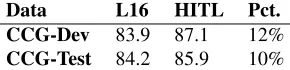
There was much larger improvement (1.7 F1) on the subset of sentences that are changed after re-parsing, as shown in Table 7. This suggests that our method could be effective for semi-supervised learn-ing or re-trainlearn-ing parsers. Overall improvements on CCGbank are modest, due to only modifying 10% of sentences.
5 Discussion and Future Work
We introduced a human-in-the-loop framework for automatically correcting certain parsing mistakes. Our method identifies attachment uncertainty for core arguments of verbs and automatically generates
[image:5.612.129.238.58.106.2]Data L16 HITL Pct. CCG-Dev 83.9 87.1 12% CCG-Test 84.2 85.9 10%
Table 7: Improvements of CCG parsing accuracy on changed sentences for in-domain data. We achieved significant improve-ment over the 10%–12% (Pct.) sentences that were changed by re-parsing.
questions that can be answered by untrained annota-tors. These annotations improve performance, par-ticularly on out-of-domain data, demonstrating for the first time that untrained annotators can improve state-of-the-art parsers.
Sentences modified by our framework show sub-stantial improvements in accuracy, but only 10% of sentences are changed, limiting the effect on overall accuracy. This work is a first step towards a com-plete approach to human-in-the-loop parsing.
Future work will explore the possibility of asking questions about other types of parsing uncertainties, such as nominal and adjectival argument structure, and a more thorough treatment of prepositional-phrase attachment, including distinctions between arguments and adjuncts. We hope to scale these methods to large unlabelled corpora or other lan-guages, to provide data for re-training parsers.
Acknowledgments
This work was supported by the NSF (IIS-1252835, IIS-1562364), DARPA under the DEFT program through the AFRL (FA8750-13-2-0019), an Allen Distinguished Investigator Award, and a gift from Google. We are grateful to Chlo´e Kiddon for help-ful comments on the paper, and Kenton Lee for help with the CCG parser. We would also like to thank our workers on Crowdflower for their annotation and the anonymous reviewers for their valuable feed-back.
References
Do Kook Choe and David McClosky. 2015. Parsing paraphrases with joint inference. In Proceedings of the 53rd Annual Meeting of the Association for Com-putational Linguistics.
struc-turally ambiguous sentences. In Proceedings of the 10th Linguistic Annotation Workshop.
Luheng He, Mike Lewis, and Luke Zettlemoyer. 2015. Question-answer driven semantic role labeling: Using natural language to annotate natural language. In Pro-ceedings of the 2015 Conference on Empirical Meth-ods in Natural Language Processing.
Julia Hockenmaier and Mark Steedman. 2007. Ccgbank: a corpus of ccg derivations and dependency structures extracted from the penn treebank. Computational Lin-guistics.
Mukund Jha, Jacob Andreas, Kapil Thadani, Sara Rosen-thal, and Kathleen McKeown. 2010. Corpus creation for new genres: A crowdsourced approach to pp at-tachment. In Proceedings of the NAACL HLT 2010 Workshop on Creating Speech and Language Data with Amazon’s Mechanical Turk.
Mike Lewis, Kenton Lee, and Luke Zettlemoyer. 2016. Lstm ccg parsing. InProceedings of the Human Lan-guage Technology Conference of the North American Chapter of the Association of Computational Linguis-tics.
Mitchell P Marcus, Mary Ann Marcinkiewicz, and Beat-rice Santorini. 1993. Building a large annotated cor-pus of english: The penn treebank. Computational Linguistics.
Slav Petrov and Ryan McDonald. 2012. Overview of the 2012 Shared Task on Parsing the Web. Notes of the First Workshop on Syntactic Analysis of Non-Canonical Language (SANCL).
Sampo Pyysalo, Filip Ginter, Juho Heimonen, Jari Bj¨orne, Jorma Boberg, Jouni J¨arvinen, and Tapio Salakoski. 2007. Bioinfer: a corpus for information extraction in the biomedical domain. BMC bioinfor-matics.
Anders Søgaard and Christian Rishøj. 2010. Semi-supervised dependency parsing using generalized tri-training. In Proceedings of the 23rd International Conference on Computational Linguistics.
Mark Steedman. 2000.The syntactic process.
David Weiss, Chris Alberti, Michael Collins, and Slav Petrov. 2015. Structured training for neural network transition-based parsing. In Proceedings of the 53rd Annual Meeting of the Association for Computational Linguistics and the 7th International Joint Conference on Natural Language Processing.