Question Relevance in VQA:
Identifying Non-Visual And False-Premise Questions
Arijit Ray1, Gordon Christie1, Mohit Bansal2, Dhruv Batra3,1, Devi Parikh3,1 1Virginia Tech 2UNC Chapel Hill 3Georgia Institute of Technology
{ray93,gordonac,dbatra,parikh}@vt.edu
Abstract
Visual Question Answering (VQA) is the task of answering natural-language questions about images. We introduce the novel
prob-lem of determining therelevance of questions
to imagesin VQA. Current VQA models do
not reason about whether a question is even related to the given image (e.g., What is the capital of Argentina?) or if it requires infor-mation from external resources to answer cor-rectly. This can break the continuity of a dia-logue in human-machine interaction. Our ap-proaches for determining relevance are com-posed of two stages. Given an image and a question, (1) we first determine whether the question is visual or not, (2) if visual, we de-termine whether the question is relevant to the given image or not. Our approaches, based on LSTM-RNNs, VQA model uncertainty, and caption-question similarity, are able to outper-form strong baselines on both relevance tasks. We also present human studies showing that VQA models augmented with such question relevance reasoning are perceived as more in-telligent, reasonable, and human-like.
1 Introduction
Visual Question Answering (VQA) is the task of predicting a suitable answer given an image and a question about it. VQA models (e.g., (Antol et al., 2015; Ren et al., 2015)) are typically discriminative models that take in image and question representa-tions and output one of a set of possible answers.
Our work is motivated by the following key ob-servation – all current VQA systems always output an answerregardless of whether the input question
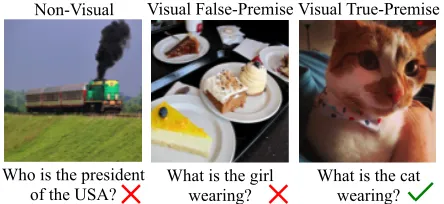
makes any sense for the given image or not. Fig. 1
Non-Visual Visual True-Premise
Who is the president
of the USA? What is the girl wearing?
[image:1.612.316.538.219.321.2]What is the cat wearing? Visual False-Premise
Figure 1: Example irrelevant (non-visual, false-premise) and relevant (visual true-premise) questions in VQA.
shows examples of relevant and irrelevant questions. When VQA systems are fed irrelevant questions as input, they understandably produce nonsensical an-swers (Q:“What is the capital of Argentina?” A:
“fire hydrant”). Humans, on the other hand, are
unlikely to provide such nonsensical answers and will instead answer that this is irrelevant or use an-other knowledge source to answer correctly, when possible. We argue that this implicit assumption by all VQA systems – that an input question is always relevant for the input image – is simply untenable as VQA systems move beyond standard academic datasets to interacting with real users, who may be unfamiliar, or malicious. The goal of this work is to make VQA systems more human-like by providing them the capability to identify relevant questions.
While existing work has reasoned about cross-modal similarity, being able to identify whether a question is relevant to a given image is a novel prob-lem with real-world applications. In human-robot interaction, being able to identify questions that are dissociated from the perception data available is im-portant. The robot must decide whether to process the scene it perceives or query external world knowl-edge resources to provide a response.
As shown in Fig. 1, we study three types of question-image pairs:Non-Visual. These questions are not questions about images at all – they do not require information fromanyimage to be answered
(e.g., “What is the capital of Argentina?”). Visual
False-Premise. While visual, these questions do not apply to the given image. For instance, the
ques-tion“What is the girl wearing?” makes sense only
for images that contain a girl in them.Visual True-Premise. These questions are relevant to (i.e.,have a premise which is true) the image at hand.
We introduce datasets and train models to rec-ognize both non-visual and false-premise question-image (QI) pairs in the context of VQA. First, we identify whether a question is visual or non-visual; if visual, we identify whether the question has a true-premise for the given image. For visual vs. non-visual question detection, we use a Long Short-Term Memory (LSTM) recurrent neural network (RNN) trained on part of speech (POS) tags to capture visual-specific linguistic structure. For true vs. false-premise question detection, we present one set of ap-proaches that use the uncertainty of a VQA model, and another set that use pre-trained captioning mod-els to generate relevant captions (or questions) for the given image and then compare them to the given question to determine relevance.
Our proposed models achieve accuracies of92%
for detecting non-visual, and 74% for detecting
false-premise questions, which significantly outper-form strong baselines. We also show through human studies that a VQA system that reasons about ques-tion relevance is picked significantly more often as being more intelligent, human-like and reasonable than a baseline VQA system which does not. Our code and datasets are publicly available on the au-thors’ webpages.
2 Related Work
There is a large body of existing work that reasons about cross-modal similarity: how well an image matches a query tag (Liu et al., 2009) in text-based image retrieval, how well an image matches a cap-tion (Feng and Lapata, 2013; Xu et al., 2015; Or-donez et al., 2011; Karpathy and Fei-Fei, 2015; Fang et al., 2015), and how well a video matches a de-scription (Donahue et al., 2015; Lin et al., 2014a).
In our work, if a question is deemed irrelevant, the VQA model says so, as opposed to answering the question anyway. This is related to perception systems that do not respond to an input where the system is likely to fail. Such failure prediction sys-tems have been explored in vision (Zhang et al., 2014; Devarakota et al., 2007) and speech (Zhao et al., 2012; Sarma and Palmer, 2004; Choularton, 2009; Voll et al., 2008). Others attempt to provide the most meaningful answer instead of suppressing the output of a model that is expected to fail for a given input. One idea is to avoid a highly specific prediction if there is a chance of being wrong, and instead make a more generic prediction that is more likely to be right (Deng et al., 2012). Malinowski and Fritz (2014) use semantic segmentations in their approach to question answering, where they reason that objects not present in the segmentations should not be part of the answer.
To the best of our knowledge, our work is the first to study the relevance of questions in VQA. Chen et al. (2012) classify users’ intention of questions for community question answering services. Most re-lated to our work is Dodge et al. (2012). They extract visual text from within Flickr photo captions to be used as supervisory signals for training image cap-tioning systems. Our motivation is to endow VQA systems the ability to detect non-visual questions to respond in a human-like fashion. Moreover, we also detect a more fine-grained notion of question rele-vance via true- and false-premise.
3 Datasets
For the task of detecting visual vs. non-visual questions, we assume all questions in the VQA dataset (Antol et al., 2015) are visual, since the Amazon Mechanical Turk (AMT) workers were specifically instructed to ask questions about a dis-played image while creating it. We also col-lected non-visual philosophical and general knowl-edge questions from the internet (see supplementary material). Combining the two, we have 121,512 vi-sual questions from the validation set of VQA and 9,9521 generic non-visual questions collected from the internet. We call this dataset Visual vs. Non-1High accuracies on this task in our experiments indicate
Visual Questions (VNQ).
We also collect a dataset of true- vs. false-premise questions by showing AMT workers images paired with random questions from the VQA dataset and asking them to annotate whether they are applicable or not. We had three workers annotate each QI pair. We take the majority vote as the final ground truth label.2 We have 10,793 QI pairs on 1,500 unique images out of which79%are non-applicable
(premise). We refer to this visual true- vs. false-premise questions dataset as VTFQ.
Since there is a class imbalance in both of these datasets, we report the average per-class (i.e., nor-malized) accuracy for all approaches. All datasets are publicly available.
4 Approach
Here we present our approaches for detecting (1) vi-sual vs. non-vivi-sual QI pairs, and (2) true- vs. false-premise QI pairs.
4.1 Visual vs. Non-Visual Detection
Recall that the task here is to detect visual questions from non-visual ones. Non-visual questions, such
as“Do dogs fly?” or“Who is the president of the
USA?”, often tend to have a difference in the
lin-guistic structure from that of visual questions, such
as“Does this bird fly?” or“What is this man
do-ing?”. We compare our approach (LSTM) with a
baseline (RULE-BASED):
1. RULE-BASED. A rule-based approach to detect non-visual questions based on the part of speech (POS)3 tags and dependencies of the words in the question. E.g.,if a question has a plural noun with no determiner before it and is followed by a singular verb (“Do dogs fly?”), it is a non-visual question.4 2. LSTM. We train an LSTM with 100-dim hid-den vectors to embed the question into a vector and predict visual vs. not. Instead of feeding question words ([‘what’, ‘is’, ‘the’, ‘man’, ‘doing’, ‘?’]), the input to our LSTM is embeddings of POS tags of the words ([‘pronoun’, ‘verb’, ‘determiner’, ‘noun’, ‘verb’]). Embeddings of the POS tags are learnt end-to-end. This captures the structure of
image-278% of the time all three votes agree.
3We use spaCy POS tagger (Honnibal and Johnson, 2015). 4See supplement for examples of such hand-crafted rules.
grounded questions, rather than visual vs. non-visual topics. The latter are less likely to generalize across domains.
4.2 True- vs. False-Premise Detection
Our second task is to detect whether a question Q en-tails a false-premise for an image I. We present two families of approaches to measure this QI ‘compat-ibility’: (i) using uncertainty in VQA models, and (ii) using pre-trained captioning models.
Using VQA Uncertainty. Here we work with the hypothesis that if a VQA model is uncertain about the answer to a QI pair, the question may be irrele-vant for the given image since the uncertainty may mean it has not seen similar QI pairs in the training data. We test two approaches:
1. ENTROPY. We compute the entropy of the soft-max output from a state-of-the art VQA model (An-tol et al., 2015; Lu et al., 2015) for a given QI pair and train a three-layer multilayer perceptron (MLP) on top with 3 nodes in the hidden layer.
2. VQA-MLP. We feed in the softmax output to a three-layer MLP with 100 nodes in the hidden layer, and train it as a binary classifier to predict whether a question has a true- or false-premise for the given image.
Using Pre-trained Captioning Models. Here we utilize (a) an image captioning model, and (b) an image question-generation model – to measure QI compatibility. Note that both these models generate natural language capturing the semantics of an im-age – one in the form of statement, the other in the form of a question. Our hypothesis is that a given question is relevant to the given image if it is similar to the language generated by these models for that image. Specifically:
Visual vs. Non-Visual True- vs. False-Premise
RULE-BASED LSTM ENTROPY VQA-MLP Q-GEN SCORE Q-C SIM Q-Q’SIM
[image:4.612.74.539.61.113.2]75.68 92.27 59.66 64.19 57.41 74.48 74.58
Table 1: Normalized accuracy results (averaged over 40 random train/test splits) for visual vs. non-visual detection and
true- vs. false-premise detection.RULE-BASEDandQ-GEN SCOREwere not averaged because they are deterministic.
We now describe our learned Q-C similarity func-tion (the Q-Q’ similarity is analogous). Our Q-C similarity model is a 2-channel LSTM+MLP (one channel for Q, another for C). Each channel se-quentially reads word2vec embeddings of the cor-responding language via an LSTM. The last hid-den state vectors (40-dim) from the 2 LSTMs are concatenated and fed as inputs to the MLP, which outputs a 2-class (relevant vs. not) softmax. The entire model is learned end-to-end on the VTFQ dataset. We also experimented with other represen-tations (e.g.,bag of words) for Q, Q’, C, which are included in the supplement for completeness.
Finally, we also compare our proposed models above to a simpler baseline (Q-GEN SCORE), where we compute the probability of the input question Q under the learned question-generation model. The intuition here is that since the question generation model has been trained only on relevant questions (from the VQA dataset), it will assign a high proba-bility to Q if it is relevant.
5 Experiments and Results
The results for both experiments are presented in Ta-ble 1. We present results averaged over 40 random train/test splits. RULE-BASED andQ-GEN SCORE were not averaged because they are deterministic. Visual vs. Non-Visual Detection. We use a ran-dom set of 100,000 questions from the VNQ dataset for training, and the remaining 31,464 for testing. We see thatLSTM performs 16.59% (21.92% rela-tive) better thanRULE-BASED.
True- vs. False-Premise Detection. We use a ran-dom set of 7,195 (67%) QI pairs from the VTFQ
dataset to train and the remaining 3,597 (33%) to
test. While the VQA model uncertainty based ap-proaches (ENTROPY, VQA-MLP) perform reason-ably well (with the MLP helping over raw entropy), the learned similarity approaches perform much
bet-ter (10.39%gain in normalized accuracy). High un-certainty of the model may suggest that a similar QI pair was not seen during training; however, that does not seem to translate to detecting irrelevance. The language generation models (Q-C SIM, Q-Q’ SIM) seem to work significantly better at modeling the semantic interaction between the question and the image. The generative approach (Q-GEN SCORE) is outperformed by the discriminative approaches (VQA-MLP, Q-C SIM, Q-Q’ SIM) that are trained explicitly for the task at hand. We show qualitative examples of Q-Q’ SIM for true- vs. false-premise detection in Fig. 2.
6 Human Qualitative Evaluation
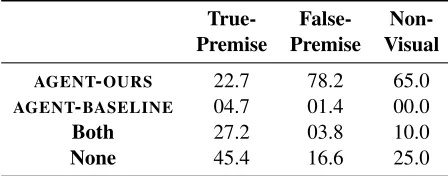
We also perform human studies where we compare two agents: (1)AGENT-BASELINE– always answers every question. (2) AGENT-OURS– reasons about question relevance before responding. If question is classified as visual true-premise,AGENT-OURS an-swers the question using the same VQA model as AGENT-BASELINE(using (Lu et al., 2015)). Other-wise, it responds with a prompt indicating that the question does not seem meaningful for the image.
A total of 120 questions (18.33% relevant, 81.67% irrelevant, mimicking the distribution of the VTFQ dataset) were used. Of the relevant ques-tions, 54% were answered correctly by the VQA model. Human subjects on AMT were shown the response of both agents and asked to pick the agent that sounded more intelligent, more reasonable, and more human-like after every observed QI pair. Each QI pair was assessed by 5 different subjects. Not all pairs were rated by the same 5 subjects. In total, 28 unique AMT workers participated in the study.
Q":"Is"the"event"indoor"or"outdoor? Q'#:#What"is"the"elephant"doing?
US GT
(a)
Q":"What"type"of"melon"is"that?
Q':"What"color"is"the"horse?
US GT
(b)
Q:"Is"this"man"married? Q':"What"is"the"man"holding?
US GT
(c)
Q:"Is"that"graffiti"on"the"wall?" Q':"What"is"the"woman"holding?
US GT
[image:5.612.78.537.66.239.2](d)
Figure 2: Qualitative examples forQ-Q’ SIM. (a) and (b) show success cases, and (c) and (d) show failure cases.
Our model predicts true-premise in (a) and (c), and false-premise in (b) and (d). In all examples we show the original question Q and the generated question Q’.
by the workers for true-premise, false-premise, and non-visual questions. These percentages are shown in Table 2.
True-Premise PremiseFalse- Visual
Non-AGENT-OURS 22.7 78.2 65.0
AGENT-BASELINE 04.7 01.4 00.0
Both 27.2 03.8 10.0
None 45.4 16.6 25.0
Table 2: Percentage of times each robot gets picked by AMT workers as being more intelligent, more reasonable, and more human-like for true-premise, false-premise, and non-visual questions.
Interestingly, humans often prefer AGENT-OURS overAGENT-BASELINEeven whenboth models are
wrong – AGENT-BASELINE answers the question
incorrectly and AGENT-OURS incorrectly predicts that the question is irrelevant and refuses to answer a legitimate question. Users seem more tolerant to mistakes in relevance prediction than VQA.
7 Conclusion
We introduced the novel problem of identifying ir-relevant (i.e., non-visual or visual false-premise) questions for VQA. Our proposed models signifi-cantly outperform strong baselines on both tasks. A VQA agent that utilizes our detector and refuses to answer certain questions significantly outperforms a
baseline (that answers all questions) in human stud-ies. Such an agent is perceived as more intelligent, reasonable, and human-like.
There are several directions for future work. One possibility includes identifying the premise entailed in a question, as opposed to just stating true- or false-premise. Another is determining what exter-nal knowledge is needed to answer non-visual ques-tions.
Our system can be further augmented to com-municate to users what the assumed premise of the question is that is not satisfied by the image, e.g.,
respond to“What is the woman wearing?” for an image of a cat by saying“There is no woman.”
Acknowledgements
[image:5.612.74.298.347.435.2]References
Stanislaw Antol, Aishwarya Agrawal, Jiasen Lu, Mar-garet Mitchell, Dhruv Batra, C. Lawrence Zitnick, and Devi Parikh. 2015. VQA: Visual Question
Answer-ing. InICCV.
Long Chen, Dell Zhang, and Levene Mark. 2012. Un-derstanding User Intent in Community Question
An-swering. InWWW.
Stephen Choularton. 2009. Early Stage Detection of
Speech Recognition Errors. Ph.D. thesis, Macquarie University.
Jia Deng, Jonathan Krause, Alexander C Berg, and Li Fei-Fei. 2012. Hedging Your Bets: Optimizing Accuracy-Specificity Trade-offs in Large Scale Visual
Recognition. InCVPR.
Pandu R Devarakota, Bruno Mirbach, and Bj¨orn Otter-sten. 2007. Confidence estimation in classification decision: A method for detecting unseen patterns. In ICAPR.
Jesse Dodge, Amit Goyal, Xufeng Han, Alyssa Men-sch, Margaret Mitchell, Karl Stratos, Kota Yamaguchi, Yejin Choi, Hal Daum´e, III, Alexander C. Berg, and Tamara L. Berg. 2012. Detecting Visual Text. In NAACL HLT.
Jeffrey Donahue, Lisa Anne Hendricks, Sergio Guadar-rama, Marcus Rohrbach, Subhashini Venugopalan, Kate Saenko, and Trevor Darrell. 2015. Long-term Recurrent Convolutional Networks for Visual
Recog-nition and Description. InCVPR.
Hao Fang, Saurabh Gupta, Forrest Iandola, Rupesh K. Srivastava, Li Deng, Piotr Dollar, Jianfeng Gao, Xiaodong He, Margaret Mitchell, John C. Platt, C. Lawrence Zitnick, and Geoffrey Zweig. 2015.
From Captions to Visual Concepts and Back. In
CVPR.
Yansong Feng and Mirella Lapata. 2013. Automatic
Caption Generation for News Images.PAMI, 35(4).
Matthew Honnibal and Mark Johnson. 2015. An Im-proved Non-monotonic Transition System for
Depen-dency Parsing. InEMNLP.
Andrej Karpathy and Li Fei-Fei. 2015. Deep Visual-Semantic Alignments for Generating Image
Descrip-tions. InCVPR.
Dahua Lin, Sanja Fidler, Chen Kong, and Raquel Ur-tasun. 2014a. Visual Semantic Search: Retrieving
Videos via Complex Textual Queries. InCVPR.
Tsung-Yi Lin, Michael Maire, Serge Belongie, James Hays, Pietro Perona, Deva Ramanan, Piotr Doll´ar, and C Lawrence Zitnick. 2014b. Microsoft COCO:
Com-mon objects in context. InECCV.
Dong Liu, Xian-Sheng Hua, Meng Wang, and HongJiang Zhang. 2009. Boost Search Relevance for Tag-based
Social Image Retrieval. InICME.
Jiasen Lu, Xiao Lin, Dhruv Batra, and Devi Parikh. 2015. Deeper LSTM and normalized CNN Visual
Question Answering model. https://github.
com/VT-vision-lab/VQA_LSTM_CNN.
Mateusz Malinowski and Mario Fritz. 2014. A Multi-World Approach to Question Answering about
Real-World Scenes based on Uncertain Input. InNIPS.
Vicente Ordonez, Girish Kulkarni, and Tamara L. Berg. 2011. Im2Text: Describing Images Using 1 Million
Captioned Photographs. InNIPS.
Mengye Ren, Ryan Kiros, and Richard Zemel. 2015. Ex-ploring models and data for image question answering.
InNIPS.
Arup Sarma and David D Palmer. 2004. Context-based Speech Recognition Error Detection and Correction.
InNAACL HLT.
Kimberly Voll, Stella Atkins, and Bruce Forster. 2008. Improving the Utility of Speech Recognition Through
Error Detection. Journal of Digital Imaging, 21(4).
Kelvin Xu, Jimmy Ba, Ryan Kiros, Aaron Courville, Ruslan Salakhutdinov, Richard Zemel, and Yoshua Bengio. 2015. Show, Attend and Tell: Neural Image
Caption Generation with Visual Attention. InICML.
Peng Zhang, Jiuling Wang, Ali Farhadi, Martial Hebert, and Devi Parikh. 2014. Predicting Failures of Vision
Systems. InCVPR.
Tongmu Zhao, Akemi Hoshino, Masayuki Suzuki, Nobuaki Minematsu, and Keikichi Hirose. 2012. Au-tomatic Chinese Pronunciation Error Detection Using
SVM Trained with Structural Features. In Spoken