30
Evaluating Textual Representations through Image Generation
Graham Spinks
Department of Computer Science KU Leuven, Belgium
Marie-Francine Moens Department of Computer Science
KU Leuven, Belgium
Abstract
We present a methodology for determining the quality of textual representations through the ability to generate images from them. Contin-uous representations of textual input are ubiq-uitous in modern Natural Language Process-ing techniques either at the core of machine learning algorithms or as the by-product at any given layer of a neural network. While current techniques to evaluate such represen-tations focus on their performance on partic-ular tasks, they don’t provide a clear under-standing of the level of informational detail that is stored within them, especially their abil-ity to represent spatial information. The cen-tral premise of this paper is that visual inspec-tion or analysis is the most convenient method to quickly and accurately determine informa-tion content. Through the use of text-to-image neural networks, we propose a new technique to compare the quality of textual representa-tions by visualizing their information content. The method is illustrated on a medical dataset where the correct representation of spatial in-formation and shorthands are of particular im-portance. For four different well-known tex-tual representations, we show with a quanti-tative analysis that some representations are consistently able to deliver higher quality vi-sualizations of the information content. Addi-tionally, we show that the quantitative analy-sis technique correlates with the judgment of a human expert evaluator in terms of alignment.
1 Introduction
In this paper, a method is proposed to evaluate the quality of a textual representation by conditioning an image generation network on it.
Neural networks implicitly construct represen-tations of a textual input by learning which fea-tures are important for the task at hand. It is not immediately possible however to assess the level
of detail and structure that is retained in such a rep-resentation. Many systems often complement or replace the input with pre-trained representations that have the advantage of being constructed with a larger unlabeled corpus. Depending on the task, this practice sometimes significantly improves the performance of the network (Turian et al.,2010). On the one hand, this is due to the use of a larger unlabeled corpus which reduces data sparsity and thus improves generalization accuracy. On the other hand, representations often contain higher-level features that are fundamental for the task they are trained for. A neural network in a sep-arate task can thus rely on those features without having to discover them all over again.
com-plexity as they often lack syntactic structure and employ many shorthands.
Images differ from texts in the sense that the retained information and generalization of a rep-resentation are immediately apparent for a human observer. It is not surprising that the ’human per-ceptual score’ is a frequently used metric to eval-uate image generation systems (Borji, 2018). In this paper we propose a novel method to assess the quality of textual representations. By creat-ing images from different textual representations we show that some representations lack the nec-essary information to lead to detailed high-quality images. The textual representations are evaluated both by comparing the quality of the produced im-ages compared to the imim-ages in the test data, as well as the alignment between images and cap-tions. The outcome is determined both by a quali-tative (human perceptual scores) as well as a quan-titative (divergence scores) measure. To calculate the divergence scores, we rely on the methodol-ogy that estimates distance between two distribu-tions as introduced by (Danihelka et al.,2017) and extend it to estimate how well image and text are aligned in the generated content.
As we show in the results, text-to-image archi-tectures are indeed suitable to get an immediate visual estimate of the quality of the representa-tion and the informarepresenta-tion contained within. We will evaluate several common textual represen-tations that were constructed with unsupervised learning techniques on both a relatively straight-forward conditional GAN as well as on a more ad-vanced StackGan (Zhang et al.,2017) which uses several stages and a conditioning mechanism that augments the textual representation.
The contributions of this paper are:
• The formulation of a methodology to visual-ize and evaluate the information and quality of different textual representations.
• The extension of a GAN evaluation measure to evaluate alignment of output with condi-tional information.
2 Motivation and background
To understand the motivation of this paper, it is necessary to understand some background on the different types of textual representations and why better evaluation methods are necessary. As we
use text-to-image models for evaluation purposes, we also discuss related research in that area.
2.1 Textual Representations
A textual representation is usually a vector associ-ated with a piece of text, which may be a charac-ter, word, sentence, paragraph or document. In its simplest form, a representation can be a symbolic ID, such as in a one-hot vector where each dimen-sion represents an ID. This is essentially a discrete, symbolic representation that is very sparse in in-formation as by definition only one dimension is non-zero. They are also somewhat arbitrary in the sense that two texts that are near each other in the code space don’t necessarily share a similar mean-ing or syntax.
More efficient methods assign particular hand-engineered or automatically extracted features to a lower-dimensional vector. One feature can be stored in exactly one dimension or it could be shared over many. In this paper we will focus on the latter, also referred to as distributed rep-resentations or word embeddings, which is the traditional method to represent sentences in re-cent neural network related research. They are dense, low-dimensional and real-valued (Turian et al.,2010). Texts that contain similar concepts or meaning for a typical task end up near each other in such a distributed representation space which serves as a proxy for generalized, semantic infor-mation storage. Word embeddings can be built with unsupervised training, for example by lever-aging positional information of texts in a corpus; with weakly supervised training, for example in an adversarial setting; or with supervision of output labels. While this paper focuses on unsupervised and weakly supervised methods only, the methods that are described here are applicable to supervised representations as well.
levels such as sentences, paragraphs or documents. (e.g. skipthought vectors (Kiros et al., 2015) or doc2vec (Le and Mikolov,2014)).
While these methods usually are trained on tasks that reproduce the context of a textual com-ponent, autoencoders (AE) are trained to recre-ate the original text in its entirety while implic-itly learning a compact, distributed representation as well of the input text along the way. A re-cent method that builds on the autoencoder ap-proach is an Adversarially Regularized Autoen-coder (ARAE) (Kim et al.,2017). Here, the repre-sentation is built explicitly from an encoder that is trained as part of an autoencoder as well as a conventional Generative Adversarial Network (GAN). Such representations contain semantic in-formation about the sentence but also discrimina-tive information that allows the adversarial net-work to distinguish real samples from fake ones. As a result, a smoother semantic transition is ap-parent while traversing the representation space when compared to an autoencoder. Spinks and Moens(2018) have applied this technique to cre-ate textual representations of X-Ray captions and generate textual output with low perplexity.
The quality of distributed vectors can be as-sessed with similarity tasks that give a rough measure of semantic and syntactic information (Mikolov et al., 2013a,c) but studies by Faruqui et al.(2016) andLinzen(2016) indeed suggest that the use of word similarity tasks for the evaluation of word vectors is problematic and may lead to incorrect inferences. Schnabel et al.(2015) have evaluated embeddings with a range of methods, both intrinsic, such as semantic and syntactic sim-ilarity, and extrinsic, such as noun phrase chunk-ing and sentiment classification. For the extrin-sic tasks, they found that different representations performed best for different tasks, suggesting that perhaps there isn’t one optimal representation for all tasks. Such studies suggest that better method-ologies and more research is needed into meth-ods that accurately assess the value of different continuous representations. This paper addresses this by focusing on the evaluation of the informa-tion content of the representainforma-tion rather than any task-oriented metric. Lazaridou et al.(2015) also worked towards a visualization method for text representations by averaging images of the near-est neighbors vectors after a cross-modal mapping. Contrary to this work, their approach did not
in-clude any evaluation mechanism of the outcome and only focused on individual words.
In this paper, we construct distributed repre-sentations of sentences with severalunsupervised methodsmentioned above. Subsequently, we pro-pose a new methodology to evaluate the quality of the learned word embeddings by generating im-ages from them, thus visualizing the level of detail and information retained in the different embed-dings. To understand our methodology, it is use-ful to discuss some background on text-to-image models and, more in general, generative models.
2.2 Generative models
Recent text-to-image models rely on advances in generative models, which are probabilistic mod-els that estimate a distribution given a certain in-put. Such generative systems have shown impres-sive progress in the creation of realistic data, most notably with Generative Adversarial Networks (GANs) (Goodfellow et al., 2014). In the origi-nal formulation, GANs are trained by alternately improving a generator network,G, which aims to create realistic samples and a discriminator net-work, D, which tries to distinguish real samples from generated ones. As training such an archi-tecture tends to be unstable, several improvements have been proposed, for example the Wasserstein GAN (WGAN) (Arjovsky et al.,2017). In this for-mulation the discriminator is replaced by a critic,
f, that is trained to approximate the Earth-Mover distance (EM). The EM is an estimate of the mini-mum amount of effort that is necessary to displace one distribution to another (Arjovsky et al.,2017). The loss function to train a GAN with the Wasser-stein Distance is presented in Equation1.
min
G W(G) =
min
G maxf Ex∼Pr[f(x)]−E¯x∼Pg[f(¯x)] (1)
whereGis the generator,f is the critic,W is the Wasserstein distance, andPr andPg are the real
and generated data distributions respectively. To ensure that the approximation to the earth mover distance is valid, the criticf should be enforced to be 1-Lipschitz continuous. (Arjovsky et al.,2017) achieve this by clipping the critic weights between [−c, c], wherecis typically smaller than 1.
grown GANs (Zhang et al., 2017; Karras et al., 2017) which have made detailed high resolu-tion category-dependent image generaresolu-tion possi-ble. During the training of conditional GANs, the class or label is passed along to both generator and discriminator so that the networks implicitly learn relevant auxiliary information which leads to more detailed outputs. Progressively grown GANs rely on low-resolution outputs to learn out-lines and structures of images that are refined into smooth visual output at higher resolutions. This approach is also the essence of cross-modal text-to-image architectures. Zhang et al. (2017), for example, have demonstrated how to produce real-istic images conditioned on textual captions with a progressive GAN network called StackGAN.
In this paper, we use the StackGAN to visual-ize textual representations, as well as a simplified text-to-image architecture based on a GAN. The information and quality of the produced images al-low us to evaluate the quality of the different tex-tual representations. With that goal we will dis-cuss some methods to evaluate the visual output of such text-to-image GANs.
2.3 Evaluation measures
As we produce images from text to determine the quality of the textual representations, accurate evaluation measures are needed to assess the gen-erated images. We focus on evaluation measures for GANs as it is the only type of architecture that is used to create images in this paper.
Besides human perceptual scores, some recent advances have been made to assess the quality of the distribution of the generated output of GANs. Some of the most widely adopted measures are the Inception Score (IS) (Salimans et al., 2016) and the Fr´echet Inception Distance (FID) (Heusel et al., 2017). Both measures have a reasonable correlation with image quality but also contain un-desirable properties as explained byBorji(2018). One large problem is that both use a third-party network that was trained on a different dataset to measure the quality of the generated data. It there-fore assumes that the distribution of the dataset used in the generation task is similar to the dataset that the third-party network was trained on. This assumption is often not fulfilled, particularly if specialized medical datasets are used.
To solve these issues, Danihelka et al. (2017) propose using divergence and distance functions
that are normally used for training a GAN.Im et al. (2018) show that these metrics exhibit consistency across various models and find that they better reflect human perceptual scores than the IS and FID. To calculate how well the generated distribu-tion has approached the data distribudistribu-tion, an inde-pendent critic is trained until convergence to dis-tinguish between generated samples and samples from the validation set. The WGAN loss is used and the weights of the original generator are no longer updated. When applied to output images, the Wasserstein distance thus can give an estimate of the divergence between the generated and real images. This quantity is expressed asWqual image
in Equation2.
Wqual image(G, Pr,v) =
max
f1
(Ex∼Pr,v[f1(x)]−E¯x∼Pg[f1(¯x)]) (2)
wherePr,vrefers to the real distribution of the val-idation data.
Additionally, by evaluating the model that is trained in Equation 2on the training and test set, Danihelka et al.(2017) suggest a method to esti-mate whether overfitting has occurred. Indeed, if the model generalizes well to the unseen examples in the testset, the expected values in Equation 3 should be roughly the same. In this equationPr,te
andPr,tr refer to the real distributions of the test and training set respectively.
E[Wqual image(G, Pr,te)] =
E[Wqual image(G, Pr,tr)] (3)
While this method allows us to judge the output quality of the images, and by extension the tex-tual representations, in the following section we will explain how our methodology extends this ap-proach in order to evaluate the alignment between image and text.
3 Method
This paper proposes a methodology that evalu-ates the quality of textual representations by vi-sualizing them with text-to-image models. This is achieved in three separate stages as described in the following subsections.
3.1 Train and create a textual representation
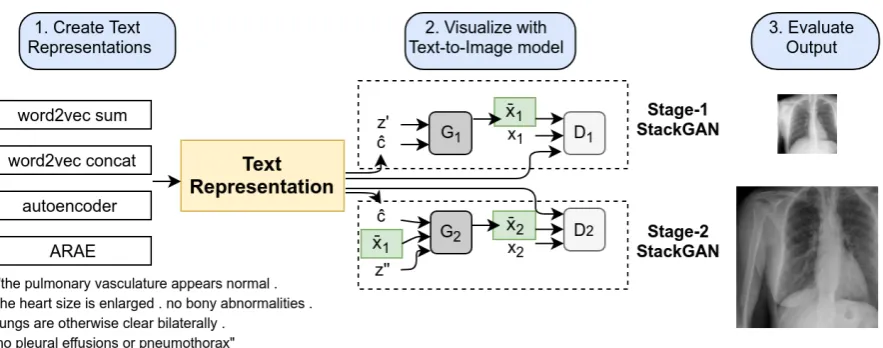
Figure 1. Overview of the methodology. A textual representation is first trained and then fed as a con-ditional input to a text-to-image model, in this figure a StackGAN. The textual representation is fed to both the first and second stage of an image StackGAN with the goal of creating low- and high-resolution images x1¯ andx2¯ respectively. From the representation, the augmented conditioning embedding ˆcis formed. In a final step, the visual output is evaluated.
training set using unsupervised training methods. As these representations are compared afterwards, they each need to have the same, fixed dimension. For the first 2 representations, the typical word2vec skip-gram word embeddings are used to build the vectors. A representation for a sen-tence is built by respectively summing and con-catenating the individual word embeddings for the entire sequence. Such a comparison is interesting as summing (or averaging) word vectors allows to use high-dimensional word representations, yet sacrifices word order. Concatenating on the other hand, requires the use of low-dimensional word embeddings as the sentence dimension is fixed, but maintains word order and has been shown to work well at the input of convolutional networks (Kim, 2014), such as the text-to-image models used in this paper.
Additionally, the hidden state representation of an autoencoder is built. The autoencoder, that con-sists of a 1-layer LSTM encoder and a 1-layer LSTM decoder, is trained to recreate the input text with a cross-entropy loss at the word-level.
Finally, we also use the representation produced by an ARAE, as in section 2.1. The ARAE con-tains a 1-layer LSTM encoder and 1-layer LSTM decoder. The generator and discriminator consist of 3-layer feedforward networks.
3.2 Create images from text
From these representations, images are created with a text-to-image model, which can be a simple
conditional GAN or a more complex StackGAN. In the latter, a textual representation tis fed into a fully-connected net that creates a mean µ and a varianceσ2 from which augmented conditional
representations ˆc are generated. The Kullback-Leibler divergence (KL-loss) is used to coerceˆcto approach a normal distributionN(0, I). This en-sures smoothness between different input texts and avoids overfitting when generating images from captions (Doersch,2016;Larsen et al.,2015). The conditional vectorˆcis then concatenated to a noise vectorz0, sampled from a normal distribution, and fed to the generator.
Such a StackGAN model is trained in two stages: at a first stage the features of real and generated images are matched to produce low-resolution images that lack detail. During the sec-ond stage, the generator produces larger images, conditioned on both the augmented conditional vector ˆc as well as the image output of the first stage. The training is broken up into the maxi-mization of the loss ofDand the minimization of the loss ofGas shown in Equations4and5for the first stage. Note that a traditional GAN formula-tion is used in the StackGAN model.
max
D1
LD1 =Ex1∼pd[logD1(x1, t)]+
min
G1
LG1 =
Ez∼pz,t∼pd[log(1−D1(G1(z,cˆ), t))]+
λDKL(N(µ1(t),Σ1(t))||N(0, I)) (5)
wherepz andpdrepresent the random normal and
data distribution respectively. tis the textual rep-resentation and λis a regularization parameter to balance the loss between the two terms. Subfix 1 indicates that these equations relate to stage 1.
Note that the StackGAN model is distinct from more conventional text-to-image architectures not only in the sense that the former progressively constructs higher resolution images but also be-cause of the conditioning augmentation. This mechanism is particularly important for this exper-iment, as it essentially augments the different tex-tual representations. For the simple text-to-image GAN, which we refer to as TTI-GAN, we use a GAN architecture without separate stages that passes the textual representation to both the gen-erator and discriminator without modifications.
Both generator and discriminator for all text-to-image architectures (i.e. the TTI-GAN and both stage-I and stage-II StackGAN) consist of a series of convolutional up- and down-sampling blocks respectively. As the text embedding t is passed to the discriminator it is compressed with a fully-connected network and replicated to match the di-mensions of the image.
3.3 Evaluate the output quality
Evaluating the output quality will let us judge the textual representation quality. In order to do so, we can rely on Equation 2 to calculate Wqual image. However, we would also like to have a rough idea of how well the conditional information is assimi-lated in the output. We therefore extend the pre-viously mentioned setup to calculate the diver-gence between an additional pair of distributions.
Walign im txtin Equation6measures the distance between the aligned image-text distributions by also feeding the conditional information, in this case the textual representations, to the critic.
Walign im txt(G, Pr,v) = max
f2
(Ex∼Pr,v[f2(x, c)]−E¯x∼Pg[f2(¯x, c)]) (6)
where c is conditional information that corre-sponds to the current data sample. f2 is distinct and independent from the criticf1 in Equation2
but is also trained until convergence on the vali-dation set. The intuition behind Equation6is that
Walign im txtis a measure of the distance between
the real and generated distributions with their con-ditional information. Thus, Walign im txt should be smaller for models that take the conditional in-formation into account when creating the output.
Note that the value of Walign im txt also
de-pends on the chosen textual representation and can therefore not be used to evaluate alignment of the TTI-GAN model across different representations. It can be used in the case of the StackGAN how-ever as the representations are coerced to approach a normal distribution with the conditioning aug-mentation mechanism.
We would also like to get an estimate for the amount of overfitting that occurs for each textual representation. For this we rely on the insights of Equation 3. In Equations 7 and 8 we suggest a simple method to compare how much overfitting occurs on both the quality of the images itself, as well as on the alignment to the captions. By tak-ing the quotient of the expected values of the eval-uation of Wqual image andWalign im txt, we can
compare how much overfitting happened for each entity.
Oqual image =E[Wqual image(G, Pr,te)]/ E[Wqual image(G, Pr,tr)]−1
(7)
Oalign im txt=E[Walign im txt(G, Pr,te)]/
E[Walign im txt(G, Pr,tr)]−1
(8)
The entire setup of the methodology is illustrated in Figure 1 where the StackGAN architecture is used as the text-to-image architecture.
4 Experiments
Representation Wqual image σ
w2v sum 0.598 0.033
w2v concat 0.239 0.049
AE (*) 0.243 0.032
[image:7.595.313.522.61.131.2]ARAE (*) 0.219 0.072
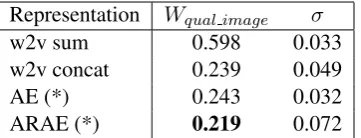
Table 1. Quantitative results of 10 runs for the TTI-GAN visualization method for each of the representations. A lower Wqual image implies a better image quality. (*) For both the autoencoder and ARAE, an outlier was removed.
words are padded to equal length, with a maxi-mum of 30 words. All words are lowercase and words with a frequency of less than 5 occurrences are removed and replaced by an out-of-vocabulary marker. While the dataset also contains diagnosis labels for each image, they are not used in this pa-per. The dataset is divided into training, validation and test set with 80%,10% and10% of the data respectively.
For the experiments we first create four differ-ent textual represdiffer-entations on the captions of the training set, as detailed in section3.1. Those rep-resentations are referred to as word2vec (sum), word2vec (concat), autoencoder and ARAE. To illustrate the methodology, we set the fixed di-mension of each representation to 300, which is a standard dimension for such embeddings, initially used byMikolov et al.(2013b) in their analysis of distributed vectors. For the autoencoder and the ARAE, training is stopped when the validation er-ror of the reconstruction is minimal.
To generate images from the text, the TTI-GAN and StackTTI-GAN models are used as explained in section 3.2. The latter produces images with higher resolution than the former approach. This is important as a higher resolution is required to make an accurate assessment about the alignment of the X-Ray images to the captions. The expected outcome is that a textual representation that main-tains sequential information performs better than one that does not. Additionally we expect a code that lies on a regularized smooth space, such as the code produced by the ARAE, to be more use-ful than a code that does not.
Finally, we perform two types of experiments, for which the concrete setup is as follows.
1. As GAN training can be unstable, the TTI-GAN is trained 10 times for each
represen-Representation Wqual image Walign im txt
w2v sum 2.242 2.239
w2v concat 2.343 2.360
AE 2.360 2.344
ARAE 2.229 2.279
Table 2. Quantitative results for the trained Stage-2 StackGAN visualization method for each of the representations. A lower Wqual image and
Walign im txt imply a better image quality and
alignment respectively.
tation. From the evaluation of each, we ob-tain measures for Wqual image, Oqual image
andOalign im txtwhich allow us to compare the value of the different representations. The TTI-GAN in our setup produces images with a resolution of 64x64 pixels.
2. For the StackGAN, we train one model for each representation, and train an indepen-dent critic 5 times for each model. As GAN training can be quite unstable, this experiment does not allow us to judge the value of the representations from just one run. However, we compare our estimates for
Wqual image andWalign im txt to the
evalua-tion of a trained clinician, to confirm that our methodology correlates with human judg-ment, both in terms of quality and alignment. For the first stage of the StackGAN we pro-duce 64x64 pixel images, while the second stage outputs higher resolution 256x256 pixel images. For this experiment, λ was set to 0.05andcwas set to0.01.
The text-to-image architectures are each trained during 120 epochs for each of the textual represen-tations of the captions in the training set. The im-age quality is then assessed on the imim-ages that are generated from the captions of the validation and test set. This ensures that we check whether the learned representations can generalize well to cap-tions that were never seen during their construc-tion.
5 Results
[image:7.595.93.274.62.131.2]Textual Results Representation #C/#N #U
Ground Truth 20/1=20 4
w2v sum 15/4=3.75 6
w2v concat 12/8=1.5 5
AE 8/8=1.0 9
[image:8.595.102.265.60.160.2]ARAE 11/7=1.57 7
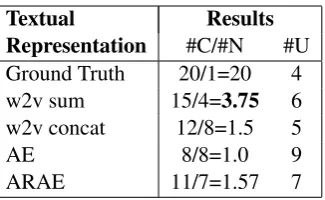
Table 3. Qualitative assessment by clini-cians for the produced images of the Stack-GAN Stage-2 model. Are the caption and the image congruent? (Congruent(C)/Not congru-ent(N)/Unclear(U). Higher values of the propor-tion #C/#N indicate better alignment.
ARAE and autoencoder representations. As those runs were clear outliers originating from the col-lapse of GAN training, they were removed from the results in Table 1. As expected, the ARAE results do appear to lead to the best overall im-age quality, followed by the word2vec (concat) and autoencoder models. The word2vec (sum) consistently leads to worse solutions. In terms ofOqual image, the word2vec (concat) model
ex-periences less overfitting in terms of image qual-ity than the other representations (11.4% versus 15 − 50%), suggesting that such concatenated word2vec representations, that maintain word or-der, generalize well.
While the Stage-2 StackGAN results in Table 2 show that the ARAE representations achieve the highest image quality again, they don’t en-tirely agree with the TTI-GAN results. This can be attributed to several causes: 1. The results for Stage-2 StackGAN only include results for 1 trained model as we would like to compare the metrics for such a model with the human judg-ment scores; 2. The Stage-2 StackGAN training produces more detailed images of higher resolu-tion so consistent training is more difficult; 3. The augmented conditioning adds to the original rep-resentation, likely making the outcome for each representation more similar. With the exception of the autoencoder representation, the outcome of the Stage-2 model, which relies on the outcome of the first stage, exhibit a lot more overfitting in terms of bothOqual image andOalign im txt with values that range from126%to498%.
In order to assess the validity of the quantitative assessment, a trained clinician carries out a visual assessment of the produced image samples. We
randomly pick 25 produced images of the Stack-GAN stage-2 models for each of the textual repre-sentations. We also selected 25 true caption-image pairs to compare the models to. The evaluator was asked to determine for each sample:
• Are the caption and the generated image con-gruent or conflicting? (Concon-gruent/ Conflict-ing/ Unclear)
The evaluator was also asked for each image if it was clearly not a real but generated X-Ray, but didn’t find that to be the case for any of the images. This reflects the fact that allWqual imageappear to
be quite similar in Table 2. Note that while our model produces an output of 256 by 256 pixels, a higher resolution is still desirable to make accu-rate judgments about the content of such X-Rays. In cases where the clinician found that additional information would be necessary to judge whether the alignment is correct, the clinician was able to respond with ”unclear”. Note that this does not mean that the quality of the image was bad.
The results are shown in Table3. From the re-sults, we find that indeed the word2vec summa-tion model and the ARAE model, that obtained the best alignment scoresWalign im txtaccording
to our quantitative measures, also appear to be the best aligned in the human judgment. While the word2vec concatenation model achieved a slightly worse Walign im txt score, the clinician
still judged its alignment to be better than the au-toencoder model for the selected samples, perhaps reflecting its slightly improved Wqual image over
the autoencoder model.
In Figure 1, a generated image of stage-I and stage-II is presented along the architecture. While the Stage-I images capture the structure and main features of the X-Rays, there is a clear improve-ment in quality for the stage-II images.
6 Conclusion
a trained clinician. While only unsupervised rep-resentations were used in this paper, the method-ology can be applied to other types of textual rep-resentations. The results in this paper constitute a new methodology to evaluate textual represen-tations through visualization and offer an inter-esting path for future work. The application of the method to more complex sentences, different fields or topics as well as the development of al-ternative alignment measures are interesting pos-sibilities for such research.
Acknowledgments
We thank Dr. Erwin Str¨oker from the UZ Brussel-VUB for sharing his expertise in the qualitative as-sessment of generated samples.
References
Martin Arjovsky, Soumith Chintala, and L´eon Bot-tou. 2017. Wasserstein gan. arXiv preprint arXiv:1701.07875.
Ali Borji. 2018. Pros and cons of gan evaluation mea-sures. arXiv preprint arXiv:1802.03446.
Ivo Danihelka, Balaji Lakshminarayanan, Benigno Uria, Daan Wierstra, and Peter Dayan. 2017. Com-parison of maximum likelihood and gan-based train-ing of real nvps.arXiv preprint arXiv:1705.05263.
Dina Demner-Fushman, Marc D Kohli, Marc B Rosen-man, Sonya E Shooshan, Laritza Rodriguez, Sameer Antani, George R Thoma, and Clement J McDon-ald. 2015. Preparing a collection of radiology ex-aminations for distribution and retrieval. Journal of the American Medical Informatics Association, 23(2):304–310.
Carl Doersch. 2016. Tutorial on variational autoen-coders.arXiv preprint arXiv:1606.05908.
Manaal Faruqui, Yulia Tsvetkov, Pushpendre Rastogi, and Chris Dyer. 2016. Problems with evaluation of word embeddings using word similarity tasks. arXiv preprint arXiv:1605.02276.
Ian Goodfellow, Jean Pouget-Abadie, Mehdi Mirza, Bing Xu, David Warde-Farley, Sherjil Ozair, Aaron Courville, and Yoshua Bengio. 2014. Generative ad-versarial nets. In Advances in Neural Information Processing Systems, pages 2672–2680.
Martin Heusel, Hubert Ramsauer, Thomas Unterthiner, Bernhard Nessler, G¨unter Klambauer, and Sepp Hochreiter. 2017. Gans trained by a two time-scale update rule converge to a nash equilibrium. arXiv preprint arXiv:1706.08500.
Daniel Jiwoong Im, He Ma, Graham Taylor, and Kristin Branson. 2018. Quantitatively evaluating gans with divergences proposed for training. arXiv preprint arXiv:1803.01045.
Tero Karras, Timo Aila, Samuli Laine, and Jaakko Lehtinen. 2017. Progressive growing of gans for improved quality, stability, and variation. arXiv preprint arXiv:1710.10196.
Yoon Kim. 2014. Convolutional neural net-works for sentence classification. arXiv preprint arXiv:1408.5882.
Yoon Kim, Yacine Jernite, David Sontag, and Alexan-der M Rush. 2016. Character-aware neural language models. InAAAI, pages 2741–2749.
Yoon Kim, Kelly Zhang, Alexander M Rush, Yann LeCun, et al. 2017. Adversarially regularized au-toencoders for generating discrete structures. arXiv preprint arXiv:1706.04223.
Ryan Kiros, Yukun Zhu, Ruslan R Salakhutdinov, Richard Zemel, Raquel Urtasun, Antonio Torralba, and Sanja Fidler. 2015. Skip-thought vectors. In Ad-vances in Neural Information Processing Systems, pages 3294–3302.
Anders Boesen Lindbo Larsen, Søren Kaae Sønderby, Hugo Larochelle, and Ole Winther. 2015. Autoen-coding beyond pixels using a learned similarity met-ric.arXiv preprint arXiv:1512.09300.
Angeliki Lazaridou, Dat Tien Nguyen, and Marco Ba-roni. 2015. Do distributed semantic models dream of electric sheep? visualizing word representations through image synthesis. In Proceedings of the Fourth Workshop on Vision and Language, pages 81–86.
Quoc Le and Tomas Mikolov. 2014. Distributed rep-resentations of sentences and documents. In Inter-national Conference on Machine Learning, pages 1188–1196.
Tal Linzen. 2016. Issues in evaluating seman-tic spaces using word analogies. arXiv preprint arXiv:1606.07736.
Tomas Mikolov, Kai Chen, Greg Corrado, and Jef-frey Dean. 2013a. Efficient estimation of word representations in vector space. arXiv preprint arXiv:1301.3781.
Tomas Mikolov, Ilya Sutskever, Kai Chen, Greg S Cor-rado, and Jeff Dean. 2013b. Distributed representa-tions of words and phrases and their compositional-ity. InAdvances in neural information processing systems, pages 3111–3119.
Augustus Odena, Christopher Olah, and Jonathon Shlens. 2016. Conditional image synthesis with auxiliary classifier gans. arXiv preprint arXiv:1610.09585.
Tim Salimans, Ian Goodfellow, Wojciech Zaremba, Vicki Cheung, Alec Radford, and Xi Chen. 2016. Improved techniques for training gans. InAdvances in Neural Information Processing Systems, pages 2234–2242.
Tobias Schnabel, Igor Labutov, David Mimno, and Thorsten Joachims. 2015. Evaluation methods for unsupervised word embeddings. InProceedings of the 2015 Conference on Empirical Methods in Nat-ural Language Processing, pages 298–307.
Graham Spinks and Marie-Francine Moens. 2018. Generating continuous representations of medical texts.NAACL HLT 2018, page 66.
Joseph Turian, Lev Ratinov, and Yoshua Bengio. 2010. Word representations: a simple and general method for semi-supervised learning. InProceedings of the 48th Annual Meeting of the Association for Compu-tational Linguistics, pages 384–394. Association for Computational Linguistics.