Learning Field Compatibilities
to Extract Database Records from Unstructured Text
Michael Wick, Aron Culotta and Andrew McCallum
Department of Computer Science University of Massachusetts
Amherst, MA 01003
{mwick, culotta, mccallum}@cs.umass.edu
Abstract
Named-entity recognition systems extract entities such as people, organizations, and locations from unstructured text. Rather than extract these mentions in isolation,
this paper presents arecord extraction
sys-tem that assembles mentions into records
(i.e. database tuples). We construct a
probabilistic model of the compatibility between field values, then employ graph partitioning algorithms to cluster fields into cohesive records. We also investigate
compatibility functions oversetsof fields,
rather than simply pairs of fields, to ex-amine how higher representational power can impact performance. We apply our techniques to the task of extracting contact records from faculty and student home-pages, demonstrating a 53% error reduc-tion over baseline approaches.
1 Introduction
Information extraction (IE) algorithms populate a database with facts discovered from unstructured text. This database is often used by higher-level tasks such as question answering or knowledge discovery. The richer the structure of the database, the more useful it is to higher-level tasks.
A common IE task is named-entity recognition (NER), the problem of locating mentions of en-tities in text, such as people, places, and organi-zations. NER techniques range from regular ex-pressions to finite-state sequence models (Bikel et al., 1999; Grishman, 1997; Sutton and McCallum, 2006). NER can be viewed as method of populat-ing a database with spopulat-ingle-tuple records, e.g. PER
-SON=Cecil Conneror ORGANIZATION=IBM.
We can add richer structure to these single-tuple records by extracting the associations among en-tities. For example, we can populate multi-field
records such as a contact record [PERSON=Steve
Jobs, JOBTITLE = CEO, COMPANY = Apple, CITY =Cupertino, STATE =CA]. The relational information in these types of records presents a greater opportunity for text analysis.
The task of associating together entities is
of-ten framed as a binary relation extraction task:
Given a pair of entities, label the relation
be-tween them (e.g. Steve JobsLOCATED-IN
Cuper-tino). Common approaches to relation extraction
include pattern matching (Brin, 1998; Agichtein and Gravano, 2000) and classification (Zelenko et al., 2003; Kambhatla, 2004).
However, binary relation extraction alone is not well-suited for the contact record example above, which requires associating together many fields into one record. We refer to this task of piecing
together many fields into a single record asrecord
extraction.
Consider the task of extracting contact records from personal homepages. An NER system may label all mentions of cities, people, organizations, phone numbers, job titles, etc. on a page, from both semi-structured an unstructured text. Even with a highly accurate NER system, it is not obvi-ous which fields belong to the same record. For example, a single document could contain five names, three phone numbers and only one email. Additionally, the layout of certain fields may be convoluted or vary across documents.
Intuitively, we would like to learn the
compat-ibility among fields, for example the likelihood
that the organization University of North Dakota
is located in the stateNorth Dakota, or that phone
numbers with area code 212 co-occur with the
city New York. Additionally, the system should take into account page layout information, so that nearby fields are more likely to be grouped into the same record.
In this paper, we describe a method to induce a probabilistic compatibility function between sets
of fields. Embedding this compatibility
func-tion within a graph partifunc-tioning method, we de-scribe how to cluster highly compatible fields into records.
We evaluate our approach on personal home-pages that have been manually annotated with contact record information, and demonstrate a 53% error reduction over baseline methods.
2 Related Work
McDonald et al. (2005) present clustering
tech-niques to extractcomplex relations, i.e. relations
with more than two arguments. Record extraction can be viewed as an instance of complex relation extraction. We build upon this work in three ways: (1) Our system learns the compatibility between
setsof fields, rather than just pairs of field; (2) our system is not restricted to relations between en-tities in the same sentence; and (3) our problem domain has a varying number of fields per record, as opposed to the fixed schema in McDonald et al. (2005).
Bansal et al. (2004) present algorithms for the related task ofcorrelational clustering: finding an optimal clustering from a matrix of pairwise com-patibility scores. The correlational clustering ap-proach does not handle compatibility scores calcu-lated over sets of nodes, which we address in this paper.
McCallum and Wellner (2005) discriminatively train a model to learn binary coreference deci-sions, then perform joint inference using graph partitioning. This is analogous to our work, with two distinctions. First, instead of binary
coref-erence decisions, our model makes binary
com-patibility decisions, reflecting whether a set of fields belong together in the same record. Second, whereas McCallum and Wellner (2005) factor the coreference decisions into pairs of vertices, our compatibility decisions are made between sets of vertices. As we show in our experiments, factoring decisions into sets of vertices enables more power-ful features that can improve performance. These higher-order features have also recently been in-vestigated in other models of coreference, both
discriminative (Culotta and McCallum, 2006) and generative (Milch et al., 2005).
Viola and Narasimhan (2005) present a prob-abilistic grammar to parse contact information
blocks. While this model is capable of
learn-ing long-distance compatibilities (such asCityand
Staterelations), features to enable this are not ex-plored. Additionally, their work focuses on la-beling fields in documents that have been pre-segmented into records. This record segmentation is precisely what we address in this paper.
Borkar et al. (2001) and Kristjannson et al. (2004) also label contact address blocks, but ig-nore the problem of clustering fields into records. Also, Culotta et al. (2004) automatically extract contact records from web pages, but use heuristics to cluster fields into records.
Embley et al. (1999) provide heuristics to de-tect record boundaries in highly structured web documents, such as classified ads, and Embley and Xu (2000) improve upon these heuristics for slightly more ambiguous domains using a vector space model. Both of these techniques apply to data for which the records are highly contiguous and have a distinctive separator between records. These heuristic approaches are unlikely to be suc-cessful in the unstructured text domain we address in this paper.
Most other work on relation extraction focuses only on binary relations (Zelenko et al., 2003; Miller et al., 2000; Agichtein and Gravano, 2000; Culotta and Sorensen, 2004). A serious difficulty in applying binary relation extractors to the record extraction task is that rather than enumerating over all pairs of entities, the system must enumerate
over all subsets of entities, up to subsets of size
k, the maximum number of fields per record. We
address this difficulty by employing two sampling methods: one that samples uniformly, and another that samples on a focused subset of the combina-torial space.
3 From Fields to Records
3.1 Problem Definition
Let a fieldFbe a pairha, vi, whereais an attribute
(column label) andvis a value, e.g. Fi =hCITY,
San Franciscoi. Let record R be a set of fields,
R ={F1. . . Fn}. Note thatRmay contain
named-entity recognizer, which labels tokens in a
doc-ument with their attribute type (e.g. NAME or
CITY). Thus, a document initially contains a set
of fields,{F1. . . Fm}.
The task is to partition the fields in each anno-tated document into a set of records {R1. . . Rk}
such that each recordRi contains exactly the set
of fields pertinent to that record. In this paper, we assume each field belongs to exactly one record.
3.2 Solution Overview
For each document, we construct a
fully-connected weighted graphG = (V, E), with
ver-ticesV and weighted edgesE. Each field in the
document is represented by a vertex inV, and the
edges are weighted by the compatibility of adja-cent fields, i.e. a measure of how likely it is that
FiandFj belong to the same record.
PartitioningV intokdisjoint clusters uniquely
maps the set of fields to a set of k records.
Be-low, we provide more detail on the two principal steps in our solution: (1) estimating the
compati-bility function and (2) partitioningV into disjoint
clusters.
3.3 Learning field compatibility
Let F be a candidate cluster of fields forming a
partial record. We construct a compatibility
func-tionCthat maps two sets of fields to a real value,
i.e. C :Fi × Fj → R. We abbreviate the value
C(Fi,Fj)asCij. The higher the value ofCij the
more likely it is thatFiandFjbelong to the same record.
For example, in the contact record domain,Cij
can reflect whether a city and state should co-occur, or how likely a company is to have a certain job title.
We representCij by a maximum-entropy
clas-sifier over the binary variableSij, which istrueif
and only if field setFibelongs to the same record
as field set Fj. Thus, we model the conditional
distribution
PΛ(Sij|Fi,Fj)∝exp
X
k
λkfk(Sij,Fi,Fj)
!
where fk is a binary feature function that
com-putes attributes over the field sets, andΛ = {λk}
is the set of real-valued weights that are the pa-rameters of the maximum-entropy model. We set
Cij = PΛ(Sij =true|Fi,Fj). This approach can
be viewed as a logistic regression model for field compatibility.
Examples of feature functions include
format-ting evidence (Fi appears at the top of the
docu-ment, Fj at the bottom), conflicting value
infor-mation (Fi andFj contain conflicting values for
thestatefield), or other measures of compatibility
(acityvalue inFi is known to exist in a state in
Fj). A feature may involve more than one field,
for example, if a name, title and university occurs consecutively in some order. We give a more de-tailed description of the feature functions in Sec-tion 4.3.
We propose learning theΛweights for each of
these features using supervised machine learning.
Given a set of documents D for which the true
mapping from fields to set of records is known, we wish to estimateP(Sij|Fi,Fj)for all pairs of
field setsFi,Fj.
Enumerating all positive and negative pairs of field sets is computationally infeasible for large datasets, so we instead propose two sampling methods to generate training examples. The first simply samples pairs of field sets uniformly from the training data. For example, given a document
D containing true records {R1. . . Rk}, we
sam-ple positive and negative examsam-ples of field sets of varying sizes from{Ri. . . Rj}. The second
sam-pling method first trains the model using the exam-ples generated by uniform sampling. This model is then used to cluster the training data. Additional training examples are created during the clustering process and are used to retrain the model parame-ters. This second sampling method is an attempt to more closely align the characteristics of the train-ing and testtrain-ing examples.
Given a sample of labeled training data, we set the parameters of the maximum-entropy classi-fier in standard maximum-likelihood fashion, per-forming gradient ascent on the log-likelihood of
the training data. The resulting weights
indi-cate how important each feature is in determin-ing whether two sets of fields belong to the same record.
3.4 Partitioning Fields into Records
One could employ the estimated classifier to con-vert fields into records as follows: Classify each
pair of fields aspositiveornegative, and perform
transitive closure to enforce transitivity of
deci-sions. That is, if the classifier determines thatA
andB belong to the same record and thatB and
A and C must belong to the same record. The drawback of this approach is that the compatibility
betweenAandC is ignored. In cases where the
classifier determines thatA andC are highly
in-compatible, transitive closure can lead to poor pre-cision. McCallum and Wellner (2005) explore this issue in depth for the related task of noun corefer-ence resolution.
With this in mind, we choose to avoid transitive closure, and instead employ a graph partitioning method to make record merging decisions jointly.
Given a document D with fields {F1. . . Fn},
we construct a fully connected graphG= (V, E),
with edge weights determined by the learned com-patibility functionC. We wish to partition vertices
V into clusters with high intra-cluster
compatibil-ity.
One approach is to simply use greedy agglom-erative clustering: initialize each vertex to its own cluster, then iteratively merge clusters with the highest inter-cluster edge weights. The compati-bility between two clusters can be measured using single-link or average-link clustering. The clus-tering algorithm converges when the inter-cluster edge weight between any pair of clusters is below a specified threshold.
We propose a modification to this approach. Since the compatibility function we have
de-scribed maps twosetsof vertices to a real value,
we can use this directly to calculate the compati-bility between two clusters, rather than performing average or single link clustering.
We now describe the algorithm more concretely.
• Input: (1) GraphG = (V, E), where each vertexvirepresents a fieldFi. (2) A threshold
valueτ.
• Initialization:Place each vertexviin its own
cluster Rˆi. (The hat notation indicates that
this cluster represents a possible record.)
• Iterate:Re-calculate the compatibility
func-tionCij between each pair of clusters. Merge
the two most compatible clusters,Rˆ∗i,Rˆ∗j.
• Termination:If there does not exist a pair of clustersRˆi,Rˆj such thatCij > τ, the
algo-rithm terminates and returns the current set of clusters.
A natural threshold value isτ = 0.5, since this
is the point at which the binary compatibility clas-sifier predicts that the fields belong to different
records. In Section 4.4, we examine how
perfor-mance varies withτ.
3.5 Representational power of cluster compatibility functions
Most previous work on inducing compatibility
functions learns the compatibility betweenpairsof
vertices, not clustersof vertices. In this section,
we provide intuition to explain why directly mod-eling the compatibility of clusters of vertices may be advantageous. We refer to the cluster
compat-ibility function as Cij, and the pairwise (binary)
compatibility function asBij.
First, we note that Cij is a generalization of
single-link and average-link clustering methods
that use Bij, since the output of these methods
can simply be included as features inCij. For
ex-ample, given two clusters Rˆi = {v1, v2, v3} and
ˆ
Rj = {v4, v5, v6}, average-link clustering
calcu-lates the inter-cluster score betweenRˆiandRˆj as
SAL( ˆRi,Rˆj) =
1
|Rˆi||Rˆj|
X
a∈Ri,bˆ ∈Rjˆ
Bab
SAL( ˆRi,Rˆj) can be included as a feature for
the compatibility functionCij, with an associated
weight estimated from training data.
Second, there may exist phenomena of the data that can only be captured by a classifier that con-siders “higher-order” features. Below we describe two such cases.
In the first example, consider three vertices of mild compatibility, as in Figure 1(a). (For these
examples, let Bij, Cij ∈ [0,1].) Suppose that
these three phone numbers occur nearby in a doc-ument. Since it is not uncommon for a person to have two phone numbers with different area codes, the pairwise compatibility function may score any pair of nearby phone numbers as relatively com-patible. However, since it is fairly uncommon for
a person to have three phone numbers with three
different area codes, we would not like all three numbers to be merged into the same record.
Assume an average-link clustering algorithm.
After merging together the333and444numbers,
Bij will recompute the new inter-cluster
compat-ibility as 0.51, the average of the inter-cluster
edges. In contrast, the cluster compatibility
func-tionCij can represent the fact that three numbers
333-555-5555
666-555-5555 444-555-5555
.6 .49
.53
333-555-5555
666-555-5555 444-555-5555
.6 C = 0.1
B = 0.51
(a)
Univ of North Dakota, Pleasantville
Pleasantville North
Dakota
.48 .49
.9
Univ of North Dakota, Pleasantville
Pleasantville North
Dakota
C = 0.8 B = 0.485
.9
[image:5.595.76.535.79.169.2](b)
Figure 1: Two motivating examples illustrating why the cluster compatibility measure (C) may have
higher representational power than the pairwise compatibility measure (B). In (a), the pairwise measure
over-estimates the inter-cluster compatibility when there exist higher-order features such asA person
is unlikely to have phone numbers with three different area codes. In (b), the pairwise measure under -estimates inter-cluster compatibility when weak features like string comparisons can be combined into a more powerful feature by examining multiple field values.
this example, the pairwise compatibility function over-estimates the true compatibility.
In the second example (Figure 1(b)), we
con-sider the opposite case. Consider three edges,
two of which have weak compatibility, and one of which has high compatibility. For example, per-haps the system has access to a list of city-state
pairs, and can reliably conclude thatPleasantville
is a city in the stateNorth Dakota.
Deciding that Univ of North Dakota,
Pleas-antville belongs in the same record as North Dakota and Pleasantville is a bit more difficult. Suppose a feature function measures the string
similarity between the city fieldPleasantvilleand
the company field Univ of North Dakota,
Pleas-antville. Alone, this string similarity might not be very strong, and so the pairwise
compatibil-ity is low. However, afterPleasantvilleandNorth
Dakota are merged together, the cluster compat-ibility function can compute the string similarity
of the concatenation of the city and state fields,
resulting in a higher compatibility. In this
ex-ample, the pairwise compatibility function under-estimates the true compatibility.
These two examples show that the cluster com-patibility score can have more representational power than the average of pairwise compatibility scores.
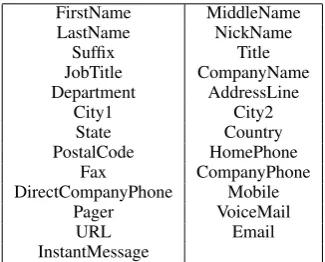
FirstName MiddleName LastName NickName
Suffix Title JobTitle CompanyName Department AddressLine
City1 City2
State Country PostalCode HomePhone
Fax CompanyPhone DirectCompanyPhone Mobile
Pager VoiceMail
URL Email
InstantMessage
Table 1: The 25 fields annotated in the contact record dataset.
4 Experiments
4.1 Data
We hand-labeled a subset of faculty and student
homepages from the WebKB dataset1. Each page
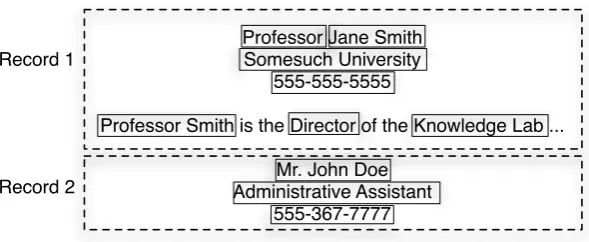
was labeled with the 25 fields listed in Table 1. In addition, we labeled the records to which each field belonged. For example, in Figure 2, we la-beled the contact information for Professor Smith into a separate record from that of her administra-tive assistant. There are 252 labeled pages in total, containing 8996 fields and 16679 word tokens. We perform ten random samples of 70-30 splits of the data for all experiments.
4.2 Systems
We evaluate five different record extraction
sys-tems. With the exception ofTransitive Closure,
all methods employ the agglomerative clustering
1
[image:5.595.335.498.294.425.2]Professor Jane Smith Somesuch University
555-555-5555
Professor Smith is the Director of the Knowledge Lab ...
Mr. John Doe Administrative Assistant
555-367-7777 Record 1
[image:6.595.152.447.71.192.2]Record 2
Figure 2: A synthetic example representative of the labeled data. Note that Record 1 contains information both from an address block and from free text, and that Record 2 must be separated from Record 1 even though fields from each may be nearby in the text.
algorithm described previously. The difference is in how the inter-cluster compatibility is calculated.
• Transitive Closure: The method described in the beginning of Section 3.4, where hard classification decisions are made, and transi-tivity is enforced.
• Pairwise Compatibility: In this approach, the compatibility function only estimates the
compatibility betweenpairsof fields, notsets
of fields. To compute inter-cluster compat-ibility, the mean of the edges between the clusters is calculated.
• McDonald: This method uses the pairwise compatibility function, but instead of calcu-lating the mean of inter-cluster edges, it cal-culates the geometric mean of all pairs of edges in the potential new cluster. That is,
to calculate the compatibility of records Ri
andRj, we construct a new record Rij that
contains all fields ofRi andRj, then
calcu-late the geometric mean of all pairs of fields
inRij. This is analogous to the method used
in McDonald et al. (2005) for relation extrac-tion.
• Cluster Compatibility (uniform): Inter-cluster compatibility is calculated directly by the cluster compatibility function. This is the method we advocate in Section 3. Training examples are sampled uniformly as described in Section 3.3.
• Cluster Compatibility (iterative): Same as above, but training examples are sampled
us-ing the iterative method described in Section 3.3.
4.3 Features
For the pairwise compatibility classifier, we ex-ploit various formatting as well as knowledge-based features. Formatting features include the number of hard returns between fields, whether the fields occur on the same line, and whether the fields occur consecutively. Knowledge-based fea-tures include a mapping we compiled of cities and states in the United States and Canada. Addition-ally, we used compatibility features, such as which fields are of the same type but have different val-ues.
In building the cluster compatibility classifier, we use many of the same features as in the bi-nary classifier, but cast them as first-order existen-tial features that are generated if the feature exists between any pair of fields in the two clusters. Ad-ditionally, we are able to exploit more powerful compatibility and knowledge-base features. For example, we examine if a title, a first name and a last name occur consecutively (i.e., no other fields occur in-between them). Also, we examine multi-ple telephone numbers to ensure that they have the same area codes. Additionally, we employ count features that indicate if a certain field occurs more than a given threshold.
4.4 Results
For these experiments, we compare performance
on thetruerecord for each page. That is, we
this record as the canonical record and measure performance in terms of precision, recall and F1 for each field in the canonical record.
Table 2 compares precision, recall and F1 across
the various systems. The cluster compatibility
method with iterative sampling has the highest F1, demonstrating a 14% error reduction over the next best method and a 53% error reduction over the transitive closure baseline.
Transitive closure has the highest recall, but it comes at the expense of precision, and hence ob-tains lower F1 scores than more conservative com-patibility methods. The McDonald method also has high recall, but drastically improves precision over the transitivity method by taking into consid-eration all edge weights.
The pairwise measure yields a slightly higher F1 score than McDonald mostly due to precision
improvements. Because the McDonald method
calculates the mean of all edge weights rather
than just the cluster edge weights, inter-cluster weights are often outweighed by
intra-cluster weights. This can cause two
densely-connected clusters to be merged despite low inter-cluster edge weights.
To further investigate performance differences, we perform three additional experiments. The first measures how sensitive the algorithms are to the
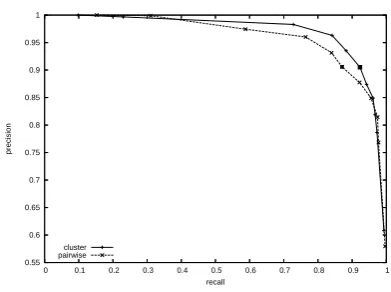
threshold value τ. Figure 3 plots the
precision-recall curve obtained by varyingτ from1.0to0.1.
As expected, high values ofτ result in low recall
but high precision, since the algorithms halt with a large number of small clusters. The highlighted
points correspond toτ = 0.5. These results
indi-cate that settingτ to 0.5 is near optimal, and that
the cluster compatibility method outperforms the
pairwise across a wide range of values forτ.
In the second experiment, we plot F1 versus the size of the canonical record. Figure 4 indi-cates that most of the performance gain occurs in smaller canonical records (containing between
6 and 12 fields). Small canonical records are
most susceptible to precision errors simply be-cause there are more extraneous fields that may be incorrectly assigned to them. These precision errors are often addressed by the cluster compati-bility method, as shown in Table 2.
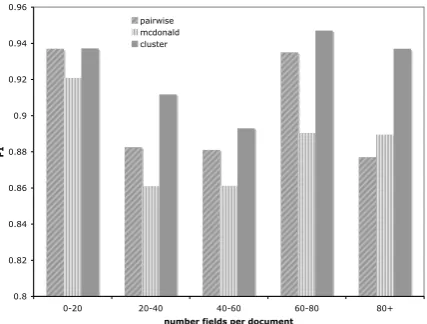
In the final experiment, we plot F1 versus the total number of fields on the page. Figure 5 indi-cates that the cluster compatibility method is best at handling documents with large number of fields.
F1 Precision Recall
Cluster (I) 91.81(.013) 92.87 (.005) 90.78 (.007)
Cluster (U) 90.02 (.012) 93.56 (.007) 86.74 (.011)
Pairwise 90.51 (.013) 91.07 (.004) 89.95 (.006)
McDonald 88.36 (.012) 83.55 (.004) 93.75 (.005)
[image:7.595.321.517.201.347.2]Trans Clos 82.37 (.002) 70.75 (.009) 98.56(.020)
Table 2: Precision, recall, and F1 performance for the record extraction task. The standard error is calculated over 10 cross-validation trials.
0.55 0.6 0.65 0.7 0.75 0.8 0.85 0.9 0.95 1
0 0.1 0.2 0.3 0.4 0.5 0.6 0.7 0.8 0.9 1
precision
recall cluster
pairwise
Figure 3: Precision-recall curve for cluster, pair-wise, and mcdonald. The graph is obtained by
varying the stopping thresholdτ from1.0to0.1.
The highlighted points correspond toτ = 0.5.
When there are over 80 fields in the document, the performance of the pairwise method drops dramat-ically, while cluster compatibility only declines slightly. We believe the improved precision of the cluster compatibility method explains this trend as well.
We also examine documents where cluster com-patibility outperforms the pairwise methods. Typ-ically, these documents contain interleaving con-tact records. Often, it is the case that a single pair of fields is sufficient to determine whether a
clus-ter shouldnotbe merged. For example, the cluster
0.74 0.76 0.78 0.8 0.82 0.84 0.86 0.88 0.9 0.92 0.94 0.96
6-9 9-12 12+
number fields per record
F1
[image:8.595.74.292.62.227.2]pairwise mcdonald cluster
Figure 4: Field F1 as the size of the canonical record increases. This figure suggests that clus-ter compatibility is most helpful for small records.
0.8 0.82 0.84 0.86 0.88 0.9 0.92 0.94 0.96
0-20 20-40 40-60 60-80 80+
number fields per document
F1
pairwise mcdonald cluster
Figure 5: Field F1 as the number of fields in the document increases. This figure suggests that cluster compatibility is most helpful when the doc-ument has more than 80 fields.
names. These errors are particularly prevalent in interleaving contact records since adjacent fields often belong to the same record.
5 Conclusions and Future Work
We have investigated graph partitioning methods for discovering database records from fields anno-tated in text. We have proposed a cluster compat-ibility function that measures how likely it is that
two setsof fields belong to the same cluster. We
argue that this enhancement to existing techniques provides more representational power.
We have evaluated these methods on a set of hand-annotated data and concluded that (1) graph
partitioning techniques are more accurate than per-forming transitive closure, and (2) cluster compat-ibility methods can avoid common mistakes made by pairwise compatibility methods.
As information extraction systems become more reliable, it will become increasingly impor-tant to develop accurate ways of associating dis-parate fields into cohesive records. This will en-able more complex reasoning over text.
One shortcoming of this approach is that fields are not allowed to belong to multiple records, because the partitioning algorithm returns non-overlapping clusters. Exploring non-overlapping clus-tering techniques is an area of future work.
Another avenue of future research is to consider syntactic information in the compatibility func-tion. While performance on contact record extrac-tion is highly influenced by formatting features, many fields occur within sentences, and syntactic information (such as dependency trees or phrase-structure trees) may improve performance.
Overall performance can also be improved by increasing the sophistication of the partitioning
method. For example, we can examine “block
moves” to swap multiple fields between clusters in unison, possibly avoiding local minima of the greedy method (Kanani et al., 2006). This can be especially helpful because many mistakes may be made at the start of clustering, before clusters are large enough to reflect true records.
Additionally, many personal web pages con-tain a time-line of information that describe a per-son’s educational and professional history. Learn-ing to associate time information with each
con-tact record enables career path modeling, which
presents interesting opportunities for knowledge discovery techniques, a subject of ongoing work.
Acknowledgments
[image:8.595.77.291.312.474.2]opin-ions, findings and conclusions or recommenda-tions expressed in this material are the author(s) and do not necessarily reflect those of the sponsor.
References
Eugene Agichtein and Luis Gravano. 2000. Snow-ball: Extracting relations from large plain-text col-lections. InProceedings of the Fifth ACM Interna-tional Conference on Digital Libraries.
Nikhil Bansal, Avrim Blum, and Shuchi Chawla. 2004. Correlation clustering. Machine Learining, 56:89– 113.
Daniel M. Bikel, Richard Schwartz, and Ralph M. Weischedel. 1999. An algorithm that learns what’s in a name. Machine Learning, 34:211–231.
Vinayak R. Borkar, Kaustubh Deshmukh, and Sunita Sarawagi. 2001. Automatic segmentation of text into structured records. InSIGMOD Conference.
Sergey Brin. 1998. Extracting patterns and rela-tions from the world wide web. In WebDB Work-shop at 6th International Conference on Extending Database Technology.
Aron Culotta and Andrew McCallum. 2006. Practical Markov logic containing first-order quantifiers with application to identity uncertainty. In HLT Work-shop on Computationally Hard Problems and Joint Inference in Speech and Language Processing, June.
Aron Culotta and Jeffrey Sorensen. 2004. Dependency tree kernels for relation extraction. InACL.
Aron Culotta, Ron Bekkerman, and Andrew McCal-lum. 2004. Extracting social networks and contact information from email and the web. InFirst Con-ference on Email and Anti-Spam (CEAS), Mountain View, CA.
David W. Embley and Lin Xu. 2000. Record location and reconfiguration in unstructured multiple-record web documents. InWebDB, pages 123–128.
David W. Embley, Xiaoyi Jiang, and Yiu-Kai Ng. 1999. Record-boundary discovery in web docu-ments. InSIGMOD Conference, pages 467–478.
Ralph Grishman. 1997. Information extraction: Tech-niques and challenges. InSCIE, pages 10–27.
Nanda Kambhatla. 2004. Combining lexical, syntac-tic, and semantic features with maximum entropy models for extracting relations. InACL.
Pallika Kanani, Andrew McCallum, and Chris Pal. 2006. Improving author coreference by resource-bounded information gathering from the web. Tech-nical note.
Trausti Kristjannson, Aron Culotta, Paul Viola, and Andrew McCallum. 2004. Interactive information extraction with conditional random fields. Nine-teenth National Conference on Artificial Intelligence (AAAI 2004).
Andrew McCallum and Ben Wellner. 2005. Condi-tional models of identity uncertainty with applica-tion to noun coreference. In Lawrence K. Saul, Yair Weiss, and L´eon Bottou, editors,Advances in Neu-ral Information Processing Systems 17. MIT Press, Cambridge, MA.
Ryan McDonald, Fernando Pereira, Seth Kulick, Scott Winters, Yang Jin, and Pete White. 2005. Simple algorithms for complex relation extraction with ap-plications to biomedical ie. In43rd Annual Meeting of the Association for Computational Linguistics.
Brian Milch, Bhaskara Marthi, and Stuart Russell. 2005. BLOG: Probabilistic models with unknown objects. InIJCAI.
Scott Miller, Heidi Fox, Lance A. Ramshaw, and Ralph Weischedel. 2000. A novel use of statistical parsing to extract information from text. InANLP.
Charles Sutton and Andrew McCallum. 2006. An in-troduction to conditional random fields for relational learning. In Lise Getoor and Ben Taskar, editors, Introduction to Statistical Relational Learning. MIT Press. To appear.
Paul Viola and Mukund Narasimhan. 2005. Learning to extract information from semi-structured text us-ing a discriminative context free grammar. InSIGIR ’05: Proceedings of the 28th annual international ACM SIGIR conference on Research and develop-ment in information retrieval, pages 330–337, New York, NY, USA. ACM Press.