Hedge Detection and Scope Finding by Sequence Labeling
with Normalized Feature Selection
∗Shaodian Zhang12, Hai Zhao123†, Guodong Zhou3 and Bao-Liang Lu12 1Center for Brain-Like Computing and Machine Intelligence
Dept of Computer Science and Engineering, Shanghai Jiao Tong University
2MOE-Microsoft Key Laboratory for Intelligent Computing and Intelligent Systems
Shanghai Jiao Tong University
3School of Computer Science and Technology, Soochow University
[email protected], [email protected] [email protected], [email protected] Abstract
This paper presents a system which adopts a standard sequence labeling technique for hedge detection and scope finding. For the first task, hedge detection, we formu-late it as a hedge labeling problem, while for the second task, we use a two-step la-beling strategy, one for hedge cue label-ing and the other for scope findlabel-ing. In par-ticular, various kinds of syntactic features are systemically exploited and effectively integrated using a large-scale normalized feature selection method. Evaluation on the CoNLL-2010 shared task shows that our system achieves stable and competi-tive results for all the closed tasks. Fur-thermore, post-deadline experiments show that the performance can be much further improved using a sufficient feature selec-tion.
1 Introduction
Hedges are linguistic devices representing spec-ulative parts of articles. Previous works such as (Hyland, 1996; Marco and Mercer, 2004; Light et al., 2004; Thompson et al., 2008) present research on hedge mainly as a linguistic phenomenon. Meanwhile, detecting hedges and their scopes au-tomatically are increasingly important tasks in nat-ural language processing and information extrac-tion, especially in biomedical community. The shared task of CoNLL-2010 described in Farkas et al. (2010) aims at detecting hedges (task 1) and finding their scopes (task 2) for the literature
∗This work is partially supported by the National
Natural Science Foundation of China (Grants 60903119, 60773090, 90820018 and 90920004), the National Basic Re-search Program of China (Grant No. 2009CB320901), and the National High-Tech Research Program of China (Grant No.2008AA02Z315).
†corresponding author
from BioScope corpus (Szarvas et al., 2008) and Wikipedia. This paper describes a system adopt-ing sequence labeladopt-ing which performs competitive in the official evaluation, as well as further test. In addition, a large-scale feature selection proce-dure is applied in training and development. Con-sidering that BioScope corpus is annotated by two independent linguists according to a formal guide-line (Szarvas, 2008), while Wikipedia weasels are tagged by netizens who are diverse in background and various in evaluation criterion, it is needed to handle them separately. Our system selects fea-tures for Wikipedia and BioScope corpus indepen-dently and evaluate them respectively, leading to fine performances for all of them.
The rest of the paper is organized as follows. The next section presents the technical details of our system of hedge detection and scope finding. Section 3 gives information of features. Section 4 shows the evaluation results, including official results and further ones after official outputs col-lection. Section 5 concludes the paper.
2 Methods
Basically, the tasks are formulated as sequence la-beling in our approach. The available label set dif-fers between task 1 and 2. In addition, it is needed to introduce an indicator in order to find scopes for the multi-hedge sentences properly.
2.1 Hedge detection
The valid label set of task 1, hedge detection, con-tains only two labels: “Hedge” and “ ”, which represent that a word is in a hedge cue or not respectively. Since results of hedge detection in this shared task are evaluated at sentence level, a sentence will be classified as “uncertain” in the post-process if it has one or more words labeled “Hedge” in it and otherwise “certain”.
2.2 Scope finding
The second task is divided into two steps in our system. The first step is quite the same as what the system does in task 1: labeling the words as in hedge cues or not. Then the scope of each hedge will be labeled by taking advantage of the result of the first step. A scope can be denoted by a beginning word and an ending word to represent the first and the last element. In scope finding the available label set contains “Begin”, “End”, “Mid-dle” and “ ”, representing the first and last word in the scope, in-scope and out-of-scope. As an exam-ple, a sentence with hedge cue and scope labeling is given in Table 1. Hedge cue “indicating” with its scope from “indicating” itself to “transcription” are labeled. While evaluating outputs, only “Be-gin”s and “End”s will be taken into consideration and be treated as the head and tail tokens of the scopes of specific hedge cues.
Furthermore ...
, ...
inhibition ...
can ...
be ...
blocked ...
by ...
actinomycin ...
D ...
, ...
indicating ... Hedge Begin
a ... Middle
requirement ... Middle
for ... Middle
de ... Middle
novo ... Middle
transcription ... End
[image:2.595.112.254.341.519.2]. ...
Table 1: A sentence with hedge cue and scope la-beling
It seems that the best labeling result of task 1 can be used directly to be the proper intermediate representation of task 2. However, the complexity of scope finding for multi-hedge sentences forces us to modify the intermediate result of task 2 for the sake of handling the sentences with more than one hedge cue correctly. Besides, since task 1 is a sentence classification task essentially, while the goal of the first step of task 2 is to label the words as accurately as possible, it is easy to find that the optimal labeling results of task 1 may not be optimal to be the intermediate representations for task 2. This problem can be solved if sentence-level hedge detection and intermediate
representa-tion finding are treated as two separate tasks with independent feature selection procedures. The de-tails of feature selection will be given in section 3.
2.3 Scope finding for multi-hedge cases
Sentences with more than one hedge cue are quite common in both datasets of BioScope corpus and Wikipedia. By counting hedges in every sentence, we find that about one fourth of the sentences with hedges have more than one hedge cue in all three data sources (Table 2). In Morante and Daele-mans (2009), three classifiers predict whether each token is Begin, End or None and a postprocess-ing is needed to associate Begins and Ends with their corresponding hedge cues. In our approach, in order to decrease ambiguous or illegal outputs e.g. inequivalent numbers of Begins and Ends, a pair of Begin and End without their correspond-ing hedge cue between them, etc., sentences with more than one hedge cue will be preprocessed by making copies as many as the number of hedges and be handled separately.
The sentence which is selected as a sample has two hedge cues: “suggesting” and “may”, so our system preprocesses the sentence into two single-hedge ones, which is illustrated in Table 3. Now it comes to the problem of finding scope for single-hedge sentence. The two copies are labeled sep-arately, getting one scope from “suggesting” to “mitogenesis” for the hedge cue “suggesting” and the other from “IFN-alpha” to “mitogenesis” for “may”. Merging the two results will give the final scope resolution of the sentence.
Dataset # Sentence # No-hedge ratio # One-hedge ratio # Multi-hedge ratio Biomedical Abstracts 11871 9770 82.3% 1603 13.5% 498 4.2%
Biomedical Fulltexts 2670 2151 80.6% 385 14.4% 134 5.0%
[image:3.595.82.514.59.392.2]Wikipedia 11111 8627 77.6% 1936 17.4% 548 4.9%
Table 2: Statistics of hedge amount
IFN-alpha IFN-alpha
also also
sensitized sensitized
T T
cells cells
to to
IL-2-induced IL-2-induced proliferation proliferation
, ,
further further
suggesting Hedge suggesting
that that
IFN-alpha IFN-alpha
may may Hedge
be be
involved involved
in in
the the
regulation regulation
of of
T-cell T-cell
mitogenesis mitogenesis
. .
Table 3: An example of 2-hedge sentence before scope finding
“suggesting” to “mitogenesis” are put in the scope of cue “suggesting”, these words should be tagged “Indicator” in the second copy, whose result is il-lustrated in Table 4. If not in a scope, any word is tagged “ ” as the indicator. The “Indicator”s tag-ging from “suggesting” to “mitogenesis” in Table 4 mean that no other than the situations of a) “Be-gin” is after or at “suggesting” and “End” is before or at “mitogenesis” b) Both “Begin” and “End” are before “suggesting” c) Both next “Begin” and next “End” are after “mitogenesis” can be accepted. In other words, new labeling should keep the projec-tions of scopes in the result. Although it is only an instructional indicator and does not have any coerciveness, the evaluation result of experiment shows it effective.
3 Feature selection
Since hedge and scope finding are quite novel tasks and it is not easy to determine the effective features by experience, a greedy feature selection is conducted. As it mentioned in section 2, our system divides scope finding into two sub-tasks:
IFN-alpha ...
also ...
sensitized ...
T ...
cells ...
to ...
IL-2-induced ... proliferation ...
, ...
further ...
suggesting ... Indicator that ... Indicator
IFN-alpha ... Indicator Begin may ... Indicator Hedge Middle
be ... Indicator Middle
involved ... Indicator Middle
in ... Indicator Middle
the ... Indicator Middle
regulation ... Indicator Middle
of ... Indicator Middle
T-cell ... Indicator Middle
mitogenesis ... Indicator End
. ...
Table 4: Scope resolution with instructional fea-ture: “Indicator”
a) Hedge cue labeling
b) Scope labeling
The first one is the same as hedge detection task in strategy, but quite distinct in target of feature set, because hedge detection is a task of sentence classification while the first step of scope find-ing aims at high accuracy of labelfind-ing hedge cues. Therefore, three independent procedures of fea-ture selection are conducted for BioScope corpus dataset. As Wikipedia is not involved in the task of scope finding, it only needs one final feature set.
About 200 feature templates are initially con-sidered for each task. We mainly borrow ideas and are enlightened by following sources while initial-izing feature template sets:
[image:3.595.84.516.62.109.2]b) Related works such as named entity recog-nition (Collins, 1999) and text chunking (Zhang et al., 2001);
c) Some literature on dependency parsing (Nivre and Scholz, 2004; McDonald et al., 2005; Nivre, 2009; Zhao et al., 2009c; Zhao et al., 2009a);
3.1 Notations of Feature Template
A large amount of advanced syntactic features in-cluding syntactic connections, paths, families and their concatenations are introduced. Many of these features come from dependency parsing, which aims at building syntactic tree expressed by depen-dencies between words. More details about de-pendency parsing are given in Nivre and Scholz (2004) and McDonald et al. (2005). The parser in Zhao et al. (2009a) is used to construct de-pendency structures in our system, and some of the notations in this paper adopt those presented in Zhao et al. (2009c). Feature templates are from various combinations or integrations of the follow-ing basic elements.
Word Property. This part of features includes word form (form), lemma (lemma), part-of-speech tag (pos), syntactic dependency (dp) , syntactic de-pendency label (dprel).
Syntactic Connection. This includes syntactic head (h), left(right) farthest(nearest) child (lm, ln, rm andrn) and high (low) support verb, noun or preposition. Here we specify the last one as an example, support verb(noun/preposition). From a given word to the syntactic root along the syntac-tic tree, the first verb/noun/preposition that is met is called its low support verb/noun/preposition, and the nearest one to the root(farthest to the given word) is called as its high support verb/noun/preposition. The concept of support verb was broadly used (Toutanova et al., 2005; Xue, 2006; Jiang and Ng, 2006), and it is extended to nouns and prepositions in Zhao et al. (2009b). In addition, a slightly modified syntactic head, pp-head, is introduced, it returns the left most sibling of a given word if the word is headed by a prepo-sition, otherwise it returns the original head.
Path. There are two basic types of path. One is the linear path (linePath) in the sequence, the other is the path in the syntactic parsing tree ( dp-Path). For example, m:n|dpPath represents the dependency path from word m to n. Assuming that the two paths from m and n to the root are
pm and pn, m:n|dpPathShare, m:n|dpPathPred
andm:n|dpPathArgu represent the common part ofpm andpn, part of pm which does not belong
topnand part ofpnwhich does not belong topm,
respectively.
Family. A children set includes all syntactic children(children) are used in the template nota-tions.
Concatenation of Elements. For all collected elements according todpPath,childrenand so on, we use three strategies to concatenate all those strings to produce the feature value. The first is
seq, which concatenates all collected strings with-out doing anything. The second is bag, which removes all duplicated strings and sort the rest. The third isnoDup, which removes all duplicated neighbored strings.
Hedge Cue Dictionary and Scope Indicator.
Hedge cues in the training set are collected and put in a dictionary. Whether a word in the training or testing set is in the dictionary (dic) is introduced into feature templates. As the evaluation is non-open, we do not put in any additional hedge cues from other resources. An indicator (indicator) is given for multi-hedge scope finding, as specified in section 2.At last, in feature set for scope label-ing, hedgerepresents that the word is in a hedge cue.
At last, we takexas current token to be labeled, andxm to denote neighbor words. m > 0
repre-sents that it is a word goesmthafter current word
andm <0for word−mthbefore current word.
3.2 Feature template sets for each task
As optimal feature template subsets cannot be ex-pected to be extracted from so large sets by hand, greedy feature selections according to Zhao et al. (2009b) are applied. The normalized feature selec-tion has been proved to be effective in quite a lot of NLP tasks and can often successfully select an optimal or very close to optimal feature set from a large-scale superset. Although usually it needs 3 to 4 loops denoted by “While” in the Algorithm 1 of Zhao et al. (2009b) to get the best template set, we only complete one before official outputs col-lection because of time limitation, which to a large extent hinders the performance of the system.
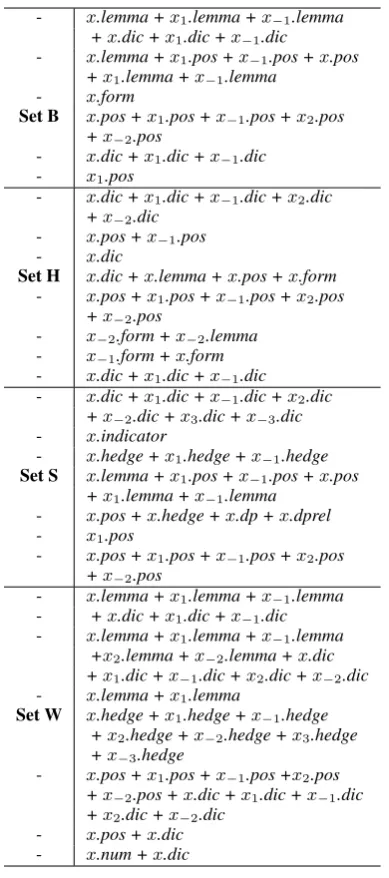
la-beling (Set H) and another one with the maximal F-score for scope finding (Set S). In addition, one set is discovered for sentence-level hedge detec-tion of Wikipedia (Set W)1 . Table 52 lists some selected feature templates which are basic word or hedging properties for the three sets of BioScope corpus and Wikipedia. From the table we can see it is clear that the combinations of lemma, POS and word form of words in context, which are usu-ally basic and common elements in NLP, are also effective for hedge detection. And as we expected, the feature that represents whether the word is in the hedge list or not is very useful especially in hedge cue finding, indicating that methods based on a hedge cue lists (Light et al., 2004) or keyword selection (Szarvas, 2008) are quite significant way to accomplish such tasks.
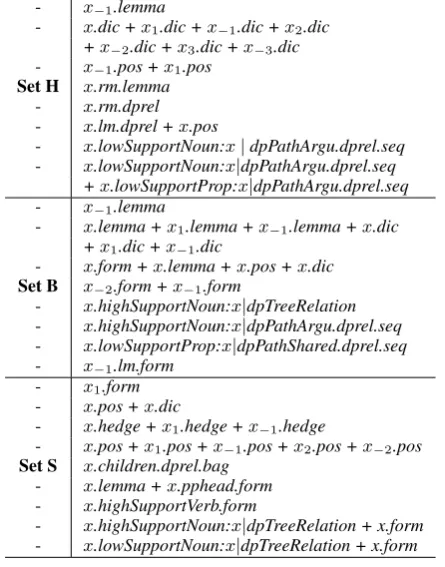
Some a little complicated syntactic features based on dependencies are systemically exploited as features for tasks. Table 6 enumerates some of the syntactic features which proves to be highly effective. We noticed thatlowSupportNoun, high-SupportNounand features derived fromdpPathis notably useful. It can be explained by the aware-ness that hedge labeling and scope finding are to process literatures in the level of semantics where syntactic features are often helpful.
We continue our feature selection procedures for BioScope corpus after official outputs collec-tion and obtain feature template sets that bring bet-ter performance. Table 7 gives some of the fea-tures in the optimized sets for BioScope corpus resolution. One difference between the new sets and the old ones is the former contain more syntac-tic elements, indicating that exploiting syntacsyntac-tic feature is a correct choice. Another difference is the new sets assemble more information of words before or after the current word, especially words linearly far away but close in syntax tree. Appear-ance of combination of these two factors such as x−1.lm.form seems to provide an evidence of the insufficiency training and development of our sys-tem submitted to some extent.
4 Evaluation results
Two tracks (closed and open challenges) are pro-vided for CoNLL-2010 shared task. We partici-pated in the closed challenge, select features based 1num in the set of Wikipedia represents the sequential number of word in the sentence
2Contact the authors to get the full feature lists, as well as entire optimized sets in post-deadline experiment
- x.lemma +x1.lemma +x−1.lemma
+x.dic +x1.dic +x−1.dic
- x.lemma +x1.pos +x−1.pos +x.pos
+x1.lemma +x−1.lemma
- x.form
Set B x.pos +x1.pos +x−1.pos +x2.pos
+x−2.pos
- x.dic +x1.dic +x−1.dic
- x1.pos
- x.dic +x1.dic +x−1.dic +x2.dic
+x−2.dic
- x.pos +x−1.pos
- x.dic
Set H x.dic +x.lemma +x.pos +x.form - x.pos +x1.pos +x−1.pos +x2.pos
+x−2.pos
- x−2.form +x−2.lemma
- x−1.form +x.form
- x.dic +x1.dic +x−1.dic
- x.dic +x1.dic +x−1.dic +x2.dic
+x−2.dic +x3.dic +x−3.dic
- x.indicator
- x.hedge +x1.hedge +x−1.hedge
Set S x.lemma +x1.pos +x−1.pos +x.pos
+x1.lemma +x−1.lemma
- x.pos +x.hedge +x.dp +x.dprel - x1.pos
- x.pos +x1.pos +x−1.pos +x2.pos
+x−2.pos
- x.lemma +x1.lemma +x−1.lemma
- +x.dic +x1.dic +x−1.dic
- x.lemma +x1.lemma +x−1.lemma
+x2.lemma +x−2.lemma +x.dic
+x1.dic +x−1.dic +x2.dic +x−2.dic
- x.lemma +x1.lemma
Set W x.hedge +x1.hedge +x−1.hedge
+x2.hedge +x−2.hedge +x3.hedge
+x−3.hedge
- x.pos +x1.pos +x−1.pos +x2.pos
+x−2.pos +x.dic +x1.dic +x−1.dic
+x2.dic +x−2.dic
- x.pos +x.dic
[image:5.595.320.515.181.621.2]- x.num +x.dic
- x.lowSupportNoun:x|dpPathArgu.dprel.seq - x.lowSupportNoun:x|dpPathArgu.dprel.seq
+x.lowSupportProp:x|dpPathArgu.dprel.seq - x.lowSupoortNoun.pos
- x.pos +x.children.dprel.bag
- x.rm.dprel +x.form
Set B x.pphead.lemma
- x.form +x.children.dprel.bag - x.lowSupportNoun:x—dpTreeRelation - x.lowSupportProp.lemma
- x.form +x.children.dprel.noDup
- x.highSupportNoun:x|dpTreeRelation + x.form - x.lowSupportVerb.form
- x.lowSupportProp:x|dpPathShared.dprel.seq - x.lowSupportProp:x|dpPathShared.pos.seq - x.highSupportNoun.pos
- x.highSupportNoun:x|dpTreeRelation - x.highSupportNoun:x|dpPathArgu.dprel.seq Set H +x.highSupportProp:x|dpPathArgu.dprel.seq
- xlowSupportProp.lemma - x.rm.dprel
- x.lm.form
- x.lemma +x.pphead.form - x.lowSupportVerb.form - x.rm.lemma +x.rm.form - x.children.dprel.noDup
- x.children.dprel.bag
- x.highSupportNoun:x|dpTreeRelation - x.lemma +x.pphead.form
Set S x.highSupportNoun:x|dpTreeRelation + x.form - x.lowSupportVerb.form
- x.lowSupportVerb.lemma - x.h.children.dprel.bag - x.highSupportVerb.form - x.lm.form
- x.lemma +x.pphead.form
- x.lm.dprel +x.pos
- x.lowSupportProp:x|dpPathPred.dprel.seq - x.pphead.lemma
Set W x.rm.lemma
[image:6.595.306.529.64.348.2]- x.lowSupportProp:x|dpTreeRelation - x.lowSupportVerb:x|dpPathPred.dprel.seq - x.lowSupportVerb:x|dpPathPred.pos.seq - x.lowSupportVerb:x|dpPathShared.pos.seq - x.lowSupportProp:x|dpPathShared.pos.seq - x.lowSupportProp.form
Table 6: Syntactic features
- x−1.lemma
- x.dic +x1.dic +x−1.dic +x2.dic
+x−2.dic +x3.dic +x−3.dic
- x−1.pos +x1.pos
Set H x.rm.lemma - x.rm.dprel - x.lm.dprel +x.pos
- x.lowSupportNoun:x|dpPathArgu.dprel.seq - x.lowSupportNoun:x|dpPathArgu.dprel.seq
+x.lowSupportProp:x|dpPathArgu.dprel.seq - x−1.lemma
- x.lemma +x1.lemma +x−1.lemma +x.dic
+x1.dic +x−1.dic
- x.form +x.lemma +x.pos +x.dic Set B x−2.form +x−1.form
- x.highSupportNoun:x|dpTreeRelation - x.highSupportNoun:x|dpPathArgu.dprel.seq - x.lowSupportProp:x|dpPathShared.dprel.seq - x−1.lm.form
- x1.form
- x.pos +x.dic
- x.hedge +x1.hedge +x−1.hedge
- x.pos +x1.pos +x−1.pos +x2.pos +x−2.pos
Set S x.children.dprel.bag - x.lemma +x.pphead.form - x.highSupportVerb.form
- x.highSupportNoun:x|dpTreeRelation + x.form - x.lowSupportNoun:x|dpTreeRelation + x.form Table 7: Selected improved feature template sets for BioScope corpus
on the in-domain data and evaluated our system on the in-domain and cross-domain evaluation set. All the experiments are implemented and run by Maximum Entropy Markov Models (McCallum, 2000).
4.1 Official results
The official results for tasks are in Table 8, in which three in-domain tests and cue matching result for biomedical texts are listed. For the first task for BioCorpus, our system gives F-score 0.8363 in in-domain test and for Wikipedia we give F-score 0.5618 in closed evaluation. For the second task, our system gives results in closed and open test, with F-score 0.4425 and 0.4441 respec-tively.
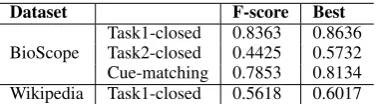
We compare the F-score of our system with the best in the final result in Table 9. We rank pretty high in Wikipedia hedge detection, while other three are quite steady but not prominent. This is mainly due to two reasons:
1. Feature selection procedures are not perfectly conducted.
[image:6.595.71.291.169.631.2]only fulltext literature, since abstract and full-text are quite different in terms of hedging.
Dataset F-score Best
[image:7.595.88.277.119.171.2]Task1-closed 0.8363 0.8636 BioScope Task2-closed 0.4425 0.5732 Cue-matching 0.7853 0.8134 Wikipedia Task1-closed 0.5618 0.6017
Table 9: Comparing results with the best
4.2 Further results
Intact feature selection procedures for BioScope corpus are conducted after official outputs collec-tions. The results of evaluation with completely selected features compared with the incomplete one are given in Table 7. The system performs a higher score on evaluation data (Table 10), which is more competitive in both tasks on BioScope cor-pus. The improvement for task 2 is significant, but the increase of performance of hedge cue detec-tion is less remarkable. We believe that a larger fulltext training set and a more considerate train-ing plan will help us to do better job in the future work.
Dataset Complete Incomplete
Task1-closed 0.8522 0.8363 BioScope Task2-closed 0.5151 0.4425 Cue-matching 0.7990 0.7853
Table 10: Comparing improved outputs with the best
5 Conclusion
We describe the system that uses sequence label-ing with normalized feature selection and rich fea-tures to detect hedges and find scopes for hedge cues. Syntactic features which are derived from dependencies are exploited, which prove to be quite favorable. The evaluation results show that our system is steady in performance and does pretty good hedging and scope finding in both Bio-Scope corpus and Wikipedia, especially when the feature selection procedure is carefully and totally conducted. The results suggest that sequence la-beling and a feature-oriented method are effective in such NLP tasks.
References
Michael Collins. 1999. Head-Driven Statistical Mod-els for Natural Language Parsing. Ph.D. thesis, University of Pennsylvania.
Rich´ard Farkas, Veronika Vincze, Gy¨orgy M´ora, J´anos Csirik, and Gy¨orgy Szarvas. 2010. The CoNLL-2010 Shared Task: Learning to Detect Hedges and their Scope in Natural Language Text. In Proceed-ings of the Fourteenth Conference on Computational Natural Language Learning (CoNLL-2010): Shared Task, pages 1–12, Uppsala, Sweden, July. Associa-tion for ComputaAssocia-tional Linguistics.
Viola Ganter and Michael Strube. 2009. Finding hedges by chasing weasels: Hedge detection using Wikipedia tags and shallow linguistic features. In
Proceedings of the ACL-IJCNLP 2009 Conference Short Papers, pages 173–176, Suntec, Singapore, 4, August.
Ken Hyland. 1996. Writing without conviction: Hedg-ing in science research articles. Applied Linguistics, 17:433–54.
Zheng Ping Jiang and Hwee Tou Ng. 2006. Semantic role labeling of NomBank: A maximum entropy ap-proach. InProceedings of the EMNLP-2006, pages 138–145, Sydney, Australia.
Halil Kilicoglu and Sabine Bergler. 2008. Recogniz-ing speculative language in biomedical research ar-ticles: a linguistically motivated perspective. BMC Bioinformatics, 9.
Marc Light, Xin Ying Qiu, and Padimini Srinivasan. 2004. The language of bioscience: Facts, specula-tions, and statements in between. In Proc. of the BioLINK 2004, pages 17–24.
Chrysanne Di Marco and Robert E. Mercer. 2004. Hedging in scientific articles as a means of classify-ing citations. InWorking Notes of the AAAI Spring Symposium on Exploring Attitude and Affect in Text: Theories and Applications, pages 50–54.
Andrew McCallum. 2000. Maximum entropy markov models for information extraction and segmentation. InProceedings of ICML 2000, pages 591–598, Stan-ford, California.
Ryan McDonald, Fernando Pereira, Kiril Ribarov, and Jan Hajic. 2005. Non-projective dependency pars-ing uspars-ing spannpars-ing tree algorithms. In Proceed-ings of HLT/EMNLP 05, pages 523–530, Vancouver, Canada, October.
Ben Medlock and Ted Briscoe. 2008. Weakly super-vised learning for hedge classification in scientific literature. In Proceedings of 45th Annual Meeting of the ACL, pages 992–999, Prague, Czech Repub-lic, June.
Dataset TP FP FN precision recall F-score
BioScope Task1-closed 669 141 121 0.8259 0.8468 0.8363 Task2-closed 441 519 592 0.4594 0.4269 0.4425 Cue-matching 788 172 259 0.8208 0.7526 0.7853 Wikipedia Task1-closed 991 303 1243 0.7658 0.4436 0.5618
Table 8: Official results of our submission for in-domain tasks
Roser Morante and Walter Daelemans. 2009. Learning the scope of hedge cues in biomedical texts. In Pro-ceedings of the Workshop on BioNLP, pages 28–36, Boulder, Colorado, June.
Joakim Nivre and Mario Scholz. 2004. Deterministic dependency parsing of English text. InProceedings of COLING-2004, pages 64–70, Geneva, Switzer-land, August 23rd-27th.
Joakim Nivre. 2009. Non-projective dependency pars-ing in expected linear time. InProceedings of ACL-IJCNLP 2009, pages 351–359, Suntec, Singapore, 2-7 August.
Gy¨orgy Szarvas, Veronika Vincze, Rich´ard Farkas, and J´anos Csirik. 2008. The BioScope corpus: anno-tation for negation, uncertainty and their scope in biomedical texts. InProceedings of BioNLP 2008, pages 38–45, Columbus, Ohio, USA, June.
Gy¨orgy Szarvas. 2008. Hedge classification in biomedical texts with a weakly supervised selection of keywords. InProceedings of ACL-08, pages 281– 289, Columbus, Ohio, USA, June.
Paul Thompson, Giulia Venturi, John McNaught, Simonetta Montemagni, and Sophia Ananiadou. 2008. Categorising modality in biomedical texts. In
Proc. of the LREC 2008 Workshop on Building and Evaluating Resources for Biomedical Text Mining, pages 27–34, Marrakech.
Kristina Toutanova, Aria Haghighi, and Christopher D. Manning. 2005. Joint learning improves semantic role labeling. In Proceedings of ACL-2005, pages 589–596, Ann Arbor, USA.
Nianwen Xue. 2006. Semantic role labeling of nom-inalized predicates in Chinese. In Proceedings of the Human Language Technology Conference of the NAACL (NAACL-2006), pages 431–438, New York City, USA, June.
Tong Zhang, Fred Damerau, and David Johnson. 2001. Text chunking using regularized winnow. In Pro-ceedings of the 39th Annual Meeting on Associa-tion for ComputaAssocia-tional Linguistics, pages 539–546, Toulouse, France.
Hai Zhao, Wenliang Chen, Jun’ichi Kazama, Kiyotaka Uchimoto, and Kentaro Torisawa. 2009a. Multi-lingual dependency learning: Exploiting rich fea-tures for tagging syntactic and semantic dependen-cies. In Proceedings of CoNLL-2009, June 4-5, Boulder, Colorado, USA.
Hai Zhao, Wenliang Chen, and Chunyu Kit. 2009b. Semantic dependency parsing of NomBank and PropBank: An efficient integrated approach via a large-scale feature selection. In Proceedings of EMNLP-2009, pages 30–39, Singapore.
[image:8.595.114.484.62.132.2]