Using Second-order Vectors in a
Knowledge-based Method for Acronym Disambiguation
Bridget T. McInnes∗ College of Pharmacy University of Minnesota Minneapolis, MN 55455
Ted Pedersen
Department of Computer Science University of Minnesota
Duluth, MN 55812 Ying Liu
College of Pharmacy University of Minnesota Minneapolis, MN 55455
Serguei V. Pakhomov College of Pharmacy University of Minnesota Minneapolis, MN 55455
Genevieve B. Melton Institute for Health Informatics
University of Minnesota Minneapolis, MN 55455 Abstract
In this paper, we introduce a knowledge-based method to disambiguate biomedical acronyms using second-order co-occurrence vectors. We create these vectors using information about a long-form obtained from the Unified Medical Language System and Medline. We evaluate this method on a dataset of 18 acronyms found in biomedical text. Our method achieves an overall accuracy of 89%. The results show that using second-order features provide a dis-tinct representation of the long-form and po-tentially enhances automated disambiguation.
1 Introduction
W ord Sense Disambiguation(WSD) is the task of automatically identifying the appropriate sense of a word with multiple senses. For example, the word culture could refer to anthropological culture (e.g., the culture of the Mayan civilization), or a laboratory culture(e.g., cell culture).
Acronym disambiguation is the task of automat-ically identifying the contextually appropriate long-form of an ambiguous acronym. For example, the acronym MS could refer to the disease Multiple Scle-rosis, the drug Morphine Sulfate, or the state Missis-sippi, among others. Acronym disambiguation can be viewed as a special case of WSD, although, un-like terms, acronyms tend to be complete phrases or expressions, therefore collocation features are not as easily identified. For example, the feature ratewhen disambiguating the terminterest, as in
∗Contact author : [email protected].
interest rate, may not be available. Acronyms also tend to be noun phrases, therefore syntactic features do not provide relevant information for the purposes of disambiguation.
Identifying the correct long-form of an acronym is important not only for the retrieval of information but the understanding of the information by the re-cipient. In general English, Park and Byrd (2001) note that acronym disambiguation is not widely studied because acronyms are not as prevalent in lit-erature and newspaper articles as they are in specific domains such as government, law, and biomedicine. In the biomedical sublanguage domain, acronym disambiguation is an extensively studied problem. Pakhomov (2002) note acronyms in biomedical lit-erature tend to be used much more frequently than in news media or general English literature, and tend to be highly ambiguous. For example, the Uni-fied Medical Language System (UMLS), which in-cludes one of the largest terminology resources in the biomedical domain, contains 11 possible long-forms of the acronym M S in addition to the four examples used above. Liu et al. (2001) show that 33% of acronyms are ambiguous in the UMLS. In a subsequent study, Liu et al. (2002a) found that 80% of all acronyms found in Medline, a large repository of abstracts from biomedical journals, are ambigu-ous. Wren and Garner (2002) found that there exist 174,000 unique acronyms in the Medline abstracts in which 36% of them are ambiguous. The authors also estimated that the number of unique acronyms is increasing at a rate of 11,000 per year.
Supervised and semi-supervised methods have been used successfully for acronym disambiguation
but are limited in scope due to the need for sufficient training data. Liu et al. (2004) state that an acronym could have approximately 16 possible long-forms in Medline but could not obtain a sufficient number of instances for each of the acronym-long-form pairs for their experiments. Stevenson et al. (2009) cite a similar problem indicating that acronym disam-biguation methods that do not require training data, regardless if it is created manually or automatically, are needed.
In this paper, we introduce a novel knowledge-based method to disambiguate acronyms using second-order co-occurrence vectors. This method does not rely on training data, and therefore, is not limited to disambiguating only commonly occurring possible long-forms. These vectors are created us-ing the first-order features obtained from the UMLS about the acronym’s long-forms and second-order features obtained from Medline. We show that us-ing second-order features provide a distinct repre-sentation of the long-form for the purposes of ambiguation and obtains a significantly higher dis-ambiguation accuracy than using first order features.
2 Unified Medical Language System
The Unified Medical Language System (UMLS) is a data warehouse that stores a number of distinct biomedical and clinical resources. One such re-source, used in this work, is the Metathesaurus. The Metathesaurus contains biomedical and clin-ical concepts from over 100 disparate terminol-ogy sources that have been semi-automatically in-tegrated into a single resource containing a wide range of biomedical and clinical information. For example, it contains the Systematized Nomencla-ture of Medicine–Clinical Terms (SNOMED CT), which is a comprehensive clinical terminology cre-ated for the electronic exchange of clinical health information, the Foundational Model of Anatomy (FMA), which is an ontology of anatomical concepts created specifically for biomedical and clinical re-search, and MEDLINEPLUS, which is a terminol-ogy source containing health related concepts cre-ated specifically for consumers of health services.
The concepts in these sources can overlap. For example, the concept Autonomic nerve exists in both SNOMED CT and FMA. The Metathesaurus assigns
the synonymous concepts from the various sources a Concept Unique Identifiers (CUIs). Thus both the Autonomic nerve concepts in SNOMED CT and FMA are assigned the same CUI (C0206250). This allows multiple sources in the Metathesaurus to be treated as a single resource.
Some sources in the Metathesaurus contain ad-ditional information about the concept such as a concept’s synonyms, its definition and its related concepts. There are two main types of relations in the Metathesaurus that we use: the parent/child and broader/narrower relations. A parent/child re-lation is a hierarchical rere-lation between two con-cepts that has been explicitly defined in one of the sources. For example, the concept Splanchnic nerve has an is-a relation with the concept Autonomic nerve in FMA. This relation is carried forward to the CUI level creating a parent/child relations be-tween the CUIs C0037991 (Splanchnic nerve) and C0206250 (Autonomic nerve) in the Metathesaurus. A broader/narrower relation is a hierarchical relation that does not explicitly come from a source but is created by the UMLS editors. We use the entire UMLS including the RB/RN and PAR/CHD rela-tions in this work.
3 Medline
Medline (Medical Literature Analysis and Retrieval System Online) is a bibliographic database contain-ing over 18.5 million citations to journal articles in the biomedical domain which is maintained by the National Library of Medicine (NLM). The 2010 Medline Baseline, used in this study, encompasses approximately 5,200 journals starting from 1948 and is 73 Gigabytes; containing 2,612,767 unique uni-grams and 55,286,187 unique biuni-grams. The majority of the publications are scholarly journals but a small number of newspapers, and magazines are included.
4 Acronym Disambiguation
di-rectly to the initial letters in the possible long-forms and, therefore, would have difficulties in distin-guishing between acronyms with similar long-forms (e.g., RA referring to Refractory anemia or Rheuma-toid arthritis).
In contrast, context-based methods disambiguate between acronyms based on the context in which the acronym is used with the assumption that the context surrounding the acronym would be different for each of the possible long-forms. In the remainder of this section, we discuss these types of methods in more detail.
4.1 Context-based Acronym Disambiguation Methods
Liu et al. (2001) and Liu et al. (2002b) introduce a semi-supervised method in which training and test data are automatically created by extracting ab-stracts from Medline that contain the acronym’s long-forms. The authors use collocations and a bag-of-words approach to train a Naive Bayes algorithm and report an accuracy of 97%. This method be-gins to treat acronym disambiguation as more of a WSD problem by looking at the context in which the acronym exists to determine its long-form, rather than the long-form itself. In a subsequent study, Liu et al. (2004) explore using additional features and machine learning algorithms and report an accuracy of 99% using the Naive Bayes.
Joshi (2006) expands on Liu, et al’s work. They evaluate additional machine learning algorithms us-ing unigrams, bigrams and trigrams as features. They found that given their feature set, SVMs ob-tain the highest accuracy (97%).
Stevenson et al. (2009) re-recreate this dataset us-ing the method described in Liu et al. (2001) to auto-matically create training data for their method which uses a mixture of linguistics features (e.g., colloca-tions, unigrams, bigrams and trigrams) in combina-tion with the biomedical features CUIs and Medi-cal Subject Headings, which are terms manually as-signed to Medline abstracts for indexing purposes. The authors evaluate the Naive Bayes, SVM and Vector Space Model (VSM) described by Agirre and Martinez (2004), and report that VSM obtained the highest accuracy (99%).
Pakhomov (2002) also developed a semi-supervised method in which training data was
automatically created by first identifying the long-form found in the text of clinical reports, replacing the long-form with the acronym to use as training data. A maximum entropy model trained and tested on a corpus of 10,000 clinical notes achieved an accuracy of 89%. In a subsequent study, Pakhomov et al. (2005) evaluate obtaining training data from three sources: Medline, clinical records and the world wide web finding using a combination of instances from clinical records and the web obtained the highest accuracy.
Joshi et al. (2006) compare using the Naive Bayes, Decision trees and SVM on ambiguous acronyms found in clinical reports. The authors use the part-of-speech, the unigrams and the bi-grams of the context surrounding the acronym as features. They evaluate their method on 7,738 manually disambiguated instances of 15 ambiguous acronyms obtaining an accuracy of over 90% for each acronym.
5 Word Sense Disambiguation
Many knowledge-based WSD methods have been developed to disambiguate terms which are closely related to the work presented in this paper. Lesk (1986) proposes a definition overlap method in which the appropriate sense of an ambiguous term was determined based on the overlap between its definition in a machine readable dictionary (MRD). Ide and V´eronis (1998) note that this work provided a basis for most future MRD disambiguation meth-ods; including the one presented in this paper.
Banerjee and Pedersen (2002) use the Lesk’s overlap method to determine the relatedness be-tween two concepts (synsets) in WordNet. They ex-tend the method to not only include the definition (gloss) of the two synsets in the overlap but also the glosses of related synsets.
0
.3
0 0 0 0 0 0
disphosphoric
glucose fructose
phosphoric
esters
changed
effect
0 0 0 0 0
glycolyte enzymes combined decreases intensity
acid
0
metabolites FEATURES
0 0 0
0
.20
acid
0 0 0
.10 0
0 0 0 0
.50 0
esters
0 0 0 0 0 0
0
.10 0 0 0 0 0 0 0 0 0 0
0 0 0 0 0 0 0
fructose
0 0 0 0 0 0
0 0 0 0 0 0 0
diphosphate
0 0 0 0 0 0
isomer
0 0 0 0 0 0 0
prevalent
0 0 0 0 0 0
0
.10
.3 .5 .20
2nd order vector forFructose Diphosphate
0 0 0
.10 0
Extended Definition
[image:4.612.163.426.85.292.2]for Fructose Diphosphate
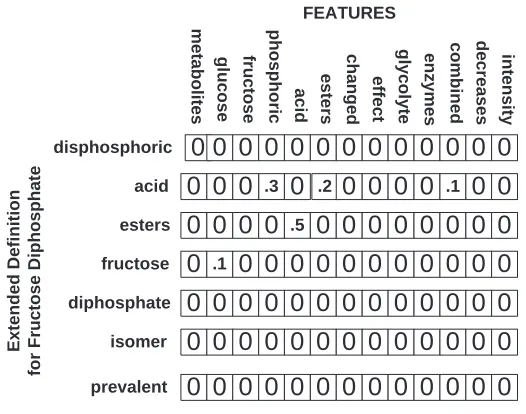
Figure 1: 2nd Order Vector for Fructose Diphosphate (FDP)
Patwardhan and Pedersen (2006) introduce a vec-tor measure to determine the relatedness between pairs of concepts. In this measure, a second order co-occurrence vector is created for each concept us-ing the words in each of the concepts definition and calculating the cosine between the two vectors. This method has been used in the task of WSD by calcu-lating the relatedness between each possible sense of the ambiguous word and its surrounding context. The context whose sum is the most similar is as-signed to the ambiguous word.
Second-order co-occurrence vectors were first in-troduced by Sch¨utze (1992) for the task of word sense discrimination and later extended by Puran-dare and Pedersen (2004). As noted by Pedersen (2010), disambiguation requires a sense-inventory in which the long-forms are known ahead of time, where as in discrimination this information is not known a priori.
6 Method
In our method, a second-order co-occurrence vec-tor is created for each possible long-form of the
acronym, and the acronym itself. The appropriate long-form of the acronym is then determined by computing a cosine between the vector represent-ing the ambiguous acronym and each of the vectors representing the long-forms. The long-form whose vector has the smallest angle between it and the acronym vector is chosen as the most likely long-form of the acronym.
To create a second-order vector for a long-form, we first obtain a textual description of the long-form in the UMLS, which we refer to as the extended defi-nition. Each long-form, from our evaluation set, was mapped to a concept in the UMLS, therefore, we use the long-form’s definition plus the definition of its parent/children and narrow/broader relations and the terms in the long-form.
fructose diphosphate is: “ Diphosphoric acid esters of fructose. The fructose diphosphate isomer is most prevalent. fructose diphosphate.”
After the extended definition is obtained, we cre-ate the second-order vector by first creating a word by word co-occurrence matrix in which the rows represent the content words in the long-forms, ex-tended definition, and the columns represent words that co-occur in Medline abstracts with the words in the definition. Each cell in this matrix contains the Log Likelihood Ratio (Dunning (1993)) of the word found in the row and the word in the column. Sec-ond, each word in the long-forms, extended defini-tion is replaced by its corresponding vector, as given in the co-occurrence matrix. The centroid of these vectors constitutes the second order co-occurrence vector used to represent the long-form.
For example, given the example corpus contain-ing two instances: 1) The metabolites, glucose fruc-tose and their phosphoric acid esters are changed due to the effect of glycolytic enzymes, and 2) The phosphoric acid combined with metabolites de-creases the intensity. Figure 1 shows how the second-order co-occurrence vector is created for the long-form fructose diphosphate using the extended definition and features from our given corpus above. The second-order co-occurrence vector for the ambiguous acronym is created in a similar fashion, only rather than using words in the extended defini-tion, we use the words surrounding the acronym in the instance.
Vector methods are subject to noise introduced by features that do not distinguish between the differ-ent long-forms of the acronym. To reduce this type of noise, we select the features to use in the second order co-occurrence vectors based on the following criteria: 1) second order feature cannot be a stop-word, and 2) second order feature must occur at least twice in the feature extraction dataset and not occur more than 150 times. We also experiment with the location of the second-order feature with respect to the first-order feature by varying the window size of zero, four, six and ten words to the right and the left of the first-order feature. The experiments in this paper were conducted using CuiTools v0.15.1
Our method is different from other context-based
1http://cuitools.sourceforge.net
acronym disambiguation methods discussed in the related work because it does not require annotated training data for each acronym that needs to be dis-ambiguated. Our method differs from the method proposed by Wilks et al. (1990) in two fundamen-tal aspects: 1) using the extended def inition of the possible long-forms of an acronym, and 2) using second-order vectors to represent the instance con-taining the acronym and each of the acronym’s pos-sible long-forms.
7 Data
7.1 Acronym Dataset
We evaluated our method on the “Abbrev” dataset2 made available by Stevenson et al. (2009). The acronyms and long-forms in the data were initially presented by Liu et al. (2001). Stevenson et al. (2009) automatically re-created this dataset by iden-tifying the acronyms and long-forms in Medline ab-stracts and replacing the long-form in the abstract with its acronym. Each abstract contains approxi-mately 216 words. The dataset consists of three sub-sets containing 100 instances, 200 instances and 300 instances of the ambiguous acronym referred to as Abbrev.100, Abbrev.200, Abbrev.300, respectively. The acronyms long-forms were manually mapped to concepts in the UMLS by Stevenson, et al.
A sufficient number of instances were not found for each of the 21 ambiguous acronyms by Steven-son et al. (2009). For example, “ASP” only con-tained 71 instances and therefore not included in any of the subsets. “ANA” and “FDP” only contained just over 100 instances and therefore, are only in-cluded in the Abbrev.100 subset. “ACE”, “ASP” and “CSF” were also excluded because several of the acronyms’ long-forms did not occur frequently enough in Medline to create a balanced dataset.
We evaluate our method on the same subsets that Stevenson et al. (2009) used to evaluate their super-vised method. The average number of long-forms per acronym is 2.6 and the average majority sense across all subsets is 70%.
7.2 Feature Extraction Dataset
We use abstracts from Medline, containing ambigu-ous acronym or long-form, to create the
order co-occurrence vectors for our method as de-scribed in Section 6. Table 1 shows the number of Medline abstracts extracted for the acronyms.
Acronyms # Abstracts Acronym # Abstracts
ANA 3,267 APC 11,192
BPD 3,260 BSA 10,500
CAT 44,703 CML 8,777
CMV 13,733 DIP 2,912
EMG 16,779 FDP 1,677
LAM 1,572 MAC 6,528
MCP 2,826 PCA 11,044
PCP 5,996 PEG 10,416
PVC 2,780 RSV 5,091
Table 1: Feature Extraction Data for Acronyms
8 Results
Table 2 compares the majority sense baseline and the first-order baseline with the results obtained using our method on the Acronym Datasets (Abbrev.100, Abbrev.200 and Abbrev.300) using a window size of zero, four, six and ten. Differences between the means of disambiguation accuracy produced by var-ious approaches were tested for statistical signifi-cance using the pair-wise Student’s t-tests with the significance threshold set to 0.01.
Window Abbrev Size 100 200 300 Maj. Sense Baseline 0.70 0.70 0.70 1-order Baseline 0.57 0.61 0.61
Our Method
0 0.83 0.83 0.81 4 0.86 0.87 0.86 6 0.88 0.90 0.89 10 0.88 0.90 0.89
Table 2: Overall Disambiguation Results
The majority sense baseline is often used to evalu-ate supervised learning algorithms and indicevalu-ates the accuracy that would be achieved by assigning the most frequent sense (long-form) to every instance. The results in Table 2 demonstrate that our method is significantly more accurate than the majority sense baseline(p≤0.01).
We compare the results using second-order vec-tors to first-order vecvec-tors. Table 2 shows that ac-curacy of the second-order results is significantly higher than the first-order results(p≤0.01).
The results in Table 2 also show that, as the win-dow size grows from zero to six, the accuracy of the
system increases and plateaus at a window size of ten. There is no statistically significant difference between using a window size of six and ten but there is a significant difference between a window size of zero and six, as well as four and six (p≤0.01).
Acronym # Long Abbrev Abbrev Abbrev forms 100 200 300
ANA 3 0.84
APC 3 0.88 0.87 0.87 BPD 3 0.96 0.95 0.95 BSA 2 0.95 0.93 0.92 CAT 2 0.88 0.87 0.87 CML 2 0.81 0.84 0.83 CMV 2 0.98 0.98 0.98
DIP 2 0.98 0.98
EMG 2 0.88 0.89 0.88
FDP 4 0.65
LAM 2 0.86 0.87 0.88 MAC 4 0.94 0.95 0.95 MCP 4 0.73 0.67 0.68 PCA 4 0.78 0.79 0.79 PCP 2 0.97 0.96 0.96 PEG 2 0.89 0.89 0.88
PVC 2 0.95 0.95
[image:6.612.341.506.136.354.2]RSV 2 0.97 0.98 0.98
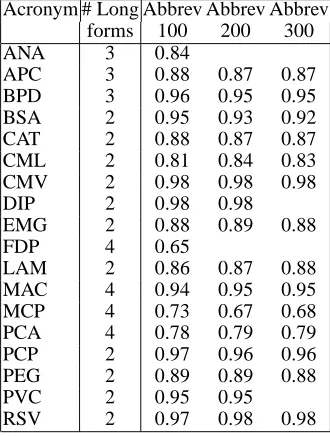
Table 3: Individual Results using a Window Size of 6.
[image:6.612.72.292.412.503.2]9 Error Analysis
Table 3 shows the results obtained by our method for the individual acronyms using a window size of six, and the number of possible long-forms per acronym. Of the 18 acronyms, three obtain an accuracy below 80 percent: FDP, MCP and PCA.
FPD has four possible long-forms: Fructose Diphosphate (E1), Formycin Diphosphate (E2), Fib-rinogen Degradation Product (E3) and Flexor Dig-itorum Profundus (E4). The confusion matrix in Table 4 shows that the method was unable to dis-tinguish between the two long-forms, E1 and E2, which are both diphosphates, nor E2 and E3.
Long-Form E1 E2 E3 E4
E1: Fructose Diphosphate
[image:6.612.316.529.582.643.2]E2: Formycin Diphosphate 5 2 11 19 E3: Fibrinogen Degradation Product 4 E4: Flexor Digitorum Profundus 59
Table 4: FDP Confusion Matrix
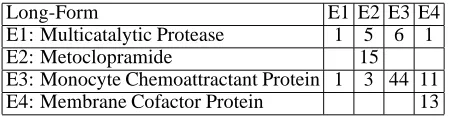
Cofactor Protein (E4). The confusion matrix in Ta-ble 5 shows that the method was not aTa-ble to distin-guish between E3 and E4, which are both proteins, and E1, which is a protease (an enzyme that breaks down a protein).
Long-Form E1 E2 E3 E4
E1: Multicatalytic Protease 1 5 6 1
E2: Metoclopramide 15
E3: Monocyte Chemoattractant Protein 1 3 44 11 E4: Membrane Cofactor Protein 13
Table 5: MCP Confusion Matrix
PCA has four possible long-forms: Passive Cu-taneous Anaphylaxis (E1), Patient Controlled Anal-gesia (E2), Principal Component Analysis (E3), and Posterior Cerebral Artery (E4). The confusion ma-trix in Table 6 shows that the method was not able to distinguish between E2 and E3. Analyzing the extended definitions of the concepts showed that E2 includes the definition to the concept Pain Manage-ment. The words in this definition overlap with many of the words used in E3s extended definition.
Long-Form E1 E2 E3 E4
[image:7.612.71.296.137.197.2]E1:Passive Cutaneous Anaphylaxis 18 6 1 E2:Patient Controlled Analgesia 5 15 E3:Principal Component Analysis 48 E4:Posterior Cerebral Artery 7
Table 6: PCA Confusion Matrix
10 Comparison with Previous Work
Of the previously developed methods, Liu et al. (2004) and Stevenson et al. (2009) evaluated their semi-supervised methods on the same dataset as we used for the current study. A direct comparison can not be made between our method and Liu et al. (2004) because we do not have an exact duplication of the dataset that they use. Their results are com-parable to Stevenson et al. (2009) with both report-ing results in the high 90s. Our results are directly comparable to Stevenson et al. (2009) who report an overall accuracy of 98%, 98% and 99% on the Abbrev.100, Abbrev.200 and Abbrev.300 datasets respectively. This is approximately 10 percentage points higher than our results.
The advantage of the methods proposed by Stevenson et al. (2009) and Liu et al. (2004) is that
they are semi-supervised which have been shown to obtain higher accuracies than methods that do not use statistical machine learning algorithms. The dis-advantage is that sufficient training data are required for each possible acronym-long-form pair. Liu et al. (2004) state that an acronym could have approxi-mately 16 possible long-forms in Medline but a suf-ficient number of instances for each of the acronym-long-form pairs were not found in Medline and, therefore, evaluated their method on 15 out of the original 34 acronyms. Stevenson et al. (2009) cite a similar problem in re-creating this dataset. This shows the limitation to these methods is that a suffi-cient number of training examples can not be ob-tained for each acronym that needs to be disam-biguated. The method proposed in the paper does not have this limitation and can be used to disam-biguate any acronym in Medline.
11 Discussion
In this paper, we presented a novel method to disam-biguate acronyms in biomedical text using second-order features extracted from the UMLS and Med-line. The results show that using second-order fea-tures provide a distinct representation of the long-form that is useful for disambiguation.
We believe that this is because biomedical text contains technical terminology that has a rich source of co-occurrence information associated with them due to their compositionality. Using second-order information works reasonably well because when the terms in the extended definition are broken up into their individual words, information is not being lost. For example, the term Patient Controlled Anal-gesia can be understood by taking the union of the meanings of the three terms and coming up with an appropriate definition of the term (patient has con-trol over their analgesia).
We evaluated various window sizes to extract the second-order co-occurrence information from, and found using locally occurring words obtains a higher accuracy. This is consistent with the finding reported by Choueka and Lusignan (1985) who conducted an experiment to determine what size window is needed for humans to determine the appropriate sense of an ambiguous word.
second-order features for each ambiguous acronym varied depending on its occurrence in Medline. Table 1 in Section 7.2 shows the number of abstracts in Med-line used for each acronym. We compared the accu-racy obtained by our method using a window size of six on the Abbrev.100 dataset with the number of ab-stracts in the feature extraction data. We found that the accuracy was not correlated with the amount of data used (r= 0.07). This confirms that it is not the quantity but the content of the contextual informa-tion that determines the accuracy of disambiguainforma-tion. We compared using second-order features and first-order features showing that the second-order re-sults obtained a significantly higher accuracy. We believe that this is because the definitions of the pos-sible concepts are too sparse to provide enough in-formation to distinguish between them. This find-ing coincides to that of Purandare and Pedersen (2004) and Pedersen (2010) who found that with large amounts of data, first-order vectors perform better than second-order vectors, but second-order vectors are a good option when large amounts of data are not available.
The results of the error analysis indicate that for some acronyms using the extended definition does not provide sufficient information to make finer grained distinctions between the long-forms. This result also indicates that, although many long-forms of acronyms can be considered coarse-grained senses, this is not always the case. For example, the analysis of M CP showed that two of its possible long-forms are proteins which are difficult to differ-entiate from given the context.
The results of the error analysis also show that indicative collocation features for acronyms are not easily identified because acronyms tend to be com-plete phrases. For example, two of the possible long-forms of DF are Fructose Diphosphate and Formycin Diphosphate.
Two main limitations of this work must be men-tioned to facilitate the interpretation of the results. The first is the small number of acronyms and the small number of long-forms per acronym in the dataset; however, the acronyms in this dataset are representative of the kinds of acronyms one would expect to see in biomedical text. The second limita-tion is that the dataset contains only those acronyms whose long-forms were found in Medline abstracts.
The main goal of this paper was to determine if the context found in the long-forms, extended definition was distinct enough to distinguish between them us-ing second-order vectors. For this purpose, we feel that the dataset was sufficient although a more ex-tensive dataset may be needed in the future for im-proved coverage.
12 Future Work
In the future, we plan to explore three different avenues. The first avenue is to look at obtaining contextual descriptions of the possible long-forms from resources other than the UMLS such as the MetaMapped Medline baseline and WordNet. The second avenue is limiting the features that are used in the instance vectors. The first-order features in the instance vector contain the words from the entire abstract. As previously mentioned, vector methods are subject to noise, therefore, in the future we plan to explore using only those words that are co-located next to the ambiguous acronym. The third avenue is expanding the vector to allow for terms. Currently, we use word vectors, in the future, we plan to extend the method to use terms, as identified by the UMLS, as features rather than single words.
We also plan to test our approach in the clinical domain. We believe that acronym disambiguation may be more difficult in this domain due to the in-crease amount of long-forms as seen in the datasets used by Joshi et al. (2006) and Pakhomov (2002).
13 Conclusions
Our study constitutes a significant step forward in the area of automatic acronym ambiguity resolu-tion, as it will enable the incorporation of scalable acronym disambiguation into NLP systems used for indexing and retrieval of documents in specialized domains such as medicine. The advantage of our method over previous methods is that it does not re-quire manually annotated training for each acronym to be disambiguated while still obtaining an overall accuracy of 89%.
Acknowledgments
References
E. Agirre and D. Martinez. 2004. The Basque Country University system: English and Basque tasks. In
Pro-ceedings of the 3rd ACL workshop on the Evaluation of Systems for the Semantic Analysis of Text (SENSE-VAL), pages 44–48.
S. Banerjee and T. Pedersen. 2002. An adapted lesk al-gorithm for word sense disambiguation using Word-Net. In Proceedings of the 3rd International
Confer-ence on Intelligent Text Processing and Computational Linguistics, pages 136–145.
Y. Choueka and S. Lusignan. 1985. Disambiguation by short contexts. Computers and the Humanities,
19(3):147–157.
T. Dunning. 1993. Accurate methods for the statistics of surprise and coincidence. Computational Linguistics, 19(1):61–74.
N. Ide and J. V´eronis. 1998. Introduction to the special issue on word sense disambiguation: the state of the art. Computational Linguistics, 24(1):2–40.
M. Joshi, S. Pakhomov, T. Pedersen, and C.G. Chute. 2006. A comparative study of supervised learning as applied to acronym expansion in clinical reports. In
Proceedings of the Annual Symposium of AMIA, pages
399–403.
M. Joshi. 2006. Kernel Methods for Word Sense Disam-biguation and Abbreviation Expansion. Master’s the-sis, University of Minnesota.
M. Lesk. 1986. Automatic sense disambiguation using machine readable dictionaries: how to tell a pine cone from an ice cream cone. Proceedings of the 5th Annual
International Conference on Systems Documentation,
pages 24–26.
H. Liu, YA. Lussier, and C. Friedman. 2001. Disam-biguating ambiguous biomedical terms in biomedical narrative text: an unsupervised method. Journal of
Biomedical Informatics, 34(4):249–261.
H. Liu, A.R. Aronson, and C. Friedman. 2002a. A study of abbreviations in MEDLINE abstracts. In
Proceed-ings of the Annual Symposium of AMIA, pages 464–
468.
H. Liu, S.B. Johnson, and C. Friedman. 2002b. Au-tomatic resolution of ambiguous terms based on ma-chine learning and conceptual relations in the UMLS.
JAMIA, 9(6):621–636.
H. Liu, V. Teller, and C. Friedman. 2004. A multi-aspect comparison study of supervised word sense dis-ambiguation. JAMIA, 11(4):320–331.
D. Nadeau and P. Turney. 2005. A supervised learning approach to acronym identification. In Proceedings
of the 18th Canadian Conference on Artificial Intelli-gence, pages 319–329.
S. Pakhomov, T. Pedersen, and C.G. Chute. 2005. Ab-breviation and acronym disambiguation in clinical dis-course. In Proceedings of the Annual Symposium of
AMIA, pages 589–593.
S. Pakhomov. 2002. Semi-supervised maximum en-tropy based approach to acronym and abbreviation normalization in medical texts. In Proceedings of
the 40th Annual Meeting on Association for Compu-tational Linguistics, pages 160–167.
Y. Park and R.J. Byrd. 2001. Hybrid text mining for find-ing abbreviations and their definitions. In Proceedfind-ings
of the Conference on Empirical Methods in Natural Language Processing, pages 126–133.
S. Patwardhan and T. Pedersen. 2006. Using WordNet-based context vectors to estimate the semantic related-ness of concepts. In Proceedings of the EACL 2006
Workshop Making Sense of Sense - Bringing Com-putational Linguistics and Psycholinguistics Together,
pages 1–8.
T. Pedersen. 2010. The effect of different context repre-sentations on word sense discrimination in biomedical texts. In Proceedings of the 1st ACM International IHI
Symposium, pages 56–65.
A. Purandare and T. Pedersen. 2004. Word sense dis-crimination by clustering contexts in vector and sim-ilarity spaces. In Proceedings of the Conference on
Computational Natural Language Learning (CoNLL),
pages 41–48.
J. Pustejovsky, J. Castano, B. Cochran, M. Kotecki, M. Morrell, and A. Rumshisky. 2001. Extraction and disambiguation of acronym-meaning pairs in medline.
Unpublished manuscript.
H. Sch ¨utze. 1992. Dimensions of meaning. In
Proceed-ings of the 1992 ACM/IEEE Conference on Supercom-puting, pages 787–796.
A.S. Schwartz and M.A. Hearst. 2003. A simple algorithm for identifying abbreviation definitions in biomedical text. In Proceedings of the Pacific
Sym-posium on Biocomputing (PSB), pages 451–462.
M. Stevenson, Y. Guo, A. Al Amri, and R. Gaizauskas. 2009. Disambiguation of biomedical abbreviations. In Proceedings of the ACL BioNLP Workshop, pages 71–79.
K. Taghva and J. Gilbreth. 1999. Recognizing acronyms and their definitions. ISRI UNLV, 1:191–198.
Y. Wilks, D. Fass, C.M. Guo, J.E. McDonald, T. Plate, and B.M. Slator. 1990. Providing machine tractable dictionary tools. Machine Translation, 5(2):99–154. J.D. Wren and H.R. Garner. 2002. Heuristics for
iden-tification of acronym-definition patterns within text: towards an automated construction of comprehensive acronym-definition dictionaries. Methods of