doi:10.4236/ijcns.2009.25049 Published Online August 2009 (http://www.SciRP.org/journal/ijcns/).
Improved C-V Level Set Algorithm and its Application in
Video Segmentation
Jinsheng XIAO, Benshun YI, Xiaoxiao QIU
School of Electronic Information, Wuhan University, Wuhan, China Email: js_xiao@tom.com
Received March 23, 2009; revised May 15, 2009; accepted June 21, 2009
ABSTRACT
Image segmentation method based on level set model has wide potential application for its excellent seg-mentation result. However its complex computing restricts its application in video segseg-mentation. In order to improve the speed of image segmentation, this paper presents a new level set initialization method based on Chan-Vese level set model. After a simple iterative, we can separate out the outline of objects. Experiments show that the method is simple and efficient, with good separation effects. The improved Chan-Vese method can be applied in video segmentation.
Keywords: Image Segmentation, Level Set, C-V Model, Video Segmentation
1. Introduction
Image segmentation is intended to separate objects from the image, and the corresponding border is gained at the same time. In recent years, Researchers in the the-ory and technology of image segmentation has achieved fruitful research results, and active contours extraction is one of the important research results. The research of active contour can be divided into two groups: param-eterized active contour based on Snake model which was proposed by Kass [1]; geometric active contour based on Level set methods which were first introduced by Osher and Sethian [2] for capturing moving fronts. Level set methods overcome the weaknesses of other algorithms. Its segmentation results are not sensitive to the initial position and the topology adaptability is strong. Level set method is a powerful tool of curve evolution, which can effectively deal with cusp and has a strong ability to separate complex structure of objects.
Chan-Vese level set model (C-V model) proposed by Chan and Vese [3] was integrated with the ideal of level set and Mumford-Shah model [4]. Being different from the traditional model based on the deformation parame-ters and geometry active contour model, this model does not rely on the gradient of image when extracting the boundary of objects, so the images with gradient edge
meaningless and ambiguous verge can get a good seg-mentation. However, it has a weakness like general level set model, amount of computation. At this stage, works on C-V model mainly concentrate on revising its model, such as J. Li [5], etc, through improved C-V model, up-graded the capture of outline from local to the whole image; Y. Y. Gong [6], etc, by amending the C-V mo- del, multi-objects can be extracted based on single level set, and so on. In this paper, we propose a improved C-V model, which can greatly improve the efficiency of seg-mentation, and can be applied to real-time video image segmentation.
2. Description of C-V Model
C-V model, which is integrated with the thinking of level set and Mumford-Shah model, does not take advantage of gradient information, but minimizes the energy func-tion to evolve curve [3]. Assume that image I
x,y is formed by two regions: objects (Co) and background (Cb), which is separated by the evolving curve C in. The constants , depending on C, are the averages of image I inside C (Co) and outside C (Cb) respectively.b o c
c ,
) , ,co cb
Chan and Vese introduced the energy
C I c dxdy I c dxdy S C L c c C E b o C b b C o o b o 2 ( ) 2
) , ,
(
(1)where is the length of the cure C, and
) (C
L S
C is thearea of Co ,, 0, o,b0 are fixed pa eters. Therefore the energy function minimized if the curve is on the boundary of the object. Optimization (1), we can get the ultimate location of segmentation line C, as well as the unknownco,cb.
o o ram is ) , , ( inf } , , { ,
,c c o b C
o b
o c EC c c
c C
b o
(2)
Using the Heaviside function , and the one-dime- ns
z Hional Dirac measure
z , and defined, respectively, by
0 , 0 0 , 1 z z zH ,
H(z)dz d z
(3)
Partial differential equations, gotten by Chan and Vese using Euler-Lagrange method, are as follows: (4)-(7)
dxdy y x H dxdy y x H y x I co , , , (4)
dxdy y x H dxdy y x H y x I cb , 1 , 1 , (5)
2 2
b b o
o I c I c
div
t
0,x,y
0
x,y, in (7)
2 2 1 arctan 2 1 2 1 z z z z H (8)In the numerical calculations, regularizing Function (8) is used to replace H(z),(z) respectively. So that the gradient flow Equatio les in all of the level set, and we can automatically monitor the empty goal with the internal region, and make the overall energy function to the minimum.
Let’s disperse
n (6) ro
the equation in, use a finite differ-ences implicit scheme. Recall first the usual notations: let
h be the space step, t be the time step, and
xi,yj
ih,jh
be the grid oints, where p 1i,jM .Let n
xi,yj
be an approximation oj i, nt,
f
t,x,y
.Knowingn, we can get andco
n,cbn using (5). The finite differences are), (
x
(4) and
)
( , 1 ,
, ,
, 1
,j i j ij y ij ij i j i
(6) Chan and Vese compute n1through (11).
2 , 2 , , 2 , 2 , , ) ( ) ( ) ( )
( x inj y inj
n j i y y n j i y n j i x n j i x x h h L (9) (10) 2 , , , 0 2 , , ,
0 ( )) ( ( ))
( ij o inj b ij b inj
o u c u c
v
R
L
R
t
n j i h n j i n ji
)
(
, , 1 ,
(11)From the Equation (6), can be seen, the definition of
a
3. Improved C-V Model
know that C-V method has effectively reduce the ount of computation, C-V method can be more widely p rtial differential equations involving image function
x yI , is domain-wide map data, and the definition of o unknown co,cb is also image definition of the region, with the overall characteristics. Hence, updating level set function is in the entire defined region, the computation is large [3].
From the above analysis, we
other tw a grate calculation. If we can
am
se del. troduce this idea into C-V m
function0. Curve C divides the plane into internal and external regions.
x,y d,d is the distance from point (x, y) to curve C. Generally, the distance of internal and external points are negative and positive respectively and signed distanc ds to be re-initialized. C-V method generally defines the symbol distance func-tion (SDF) as a cone, with particularly complex calcula-tion.Lie [8] demonstrates that the presence of signed dis-tance function is not inevitable. Lie imposed a binary level
e function nee
We will in t mo
ethod. Define radius of the closed curve C as infinite, C represents a straight line in plane , which will be divided into upper regional u and lower regional
d
. Initialization function
0 is defined as:
,, ,
, , ,
0
u d
d d
u u
y x
y x y
x
0
set evolution, the lified curve of th culation of c,c
he re
(12)
So fi curve of the i
and ex simp e upper and lo
gions, t are very simple, The
rst level ternal
he cal
nternal wer re-b
o
calculation of difference operator is very simple too, as only points on the boundary of upper and lower region are non-zero constant, and t maining places are zero value; The initialization level set function is fixed con-stants, as well as
z . In a linear mesh C at the point, follow the Reference [7] approach, iterative Formula (9) can be transformed as follows:
1 ,
) ( ) (
, ) ( )
(
, 1 ,
) (
0 ,
0 ,
0 0
, ,
1 ,
j j R sign
h u
j j R sign
h u
j j j j R
t
d u n
j i h
d u n
j i h
n j i h n
j i n
j i
(13) Obviously, compared with the traditional C-V method, the calculation of our method is much smaller in the first level set iterative.
In order to ensure the level set method not departure from SDF, the time step must be very small, usually 0.1 s, which increasing the evolution of time. Since the exis-tence of SDF is not inevitable, we appropriately increase the time step. Using larger time step can speed up the evolution, but may cause error in the boundary location if the time step is chosen too large. There is a tradeoff between choosing larger time step and accuracy in boundary location. Usually, we use ≤ 10.0 for the most images.
t
We list out some of the experimental results in the following paper. In our numerical experiments, we gen-erally choose the parameters as follows: ob 1, =0, h1 (the space step), t=2 (the time step),
1
.
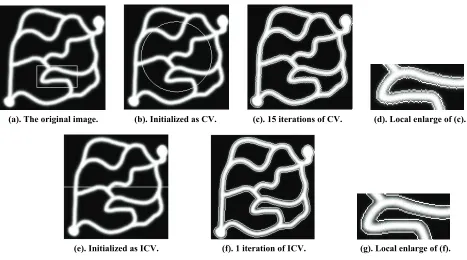
In the first experiment, we chose the test image cavern. Jpg (Figure 1(a)), whose size is 200 × 200. The region of
(a). orig (b). Initialized as CV. (c). 15 iterations of CV. (d). Local enlarge of (c).
The inal image.
(e). Initialized as ICV. (f). 1 iteration of ICV. (g). Local enlarge of (f).
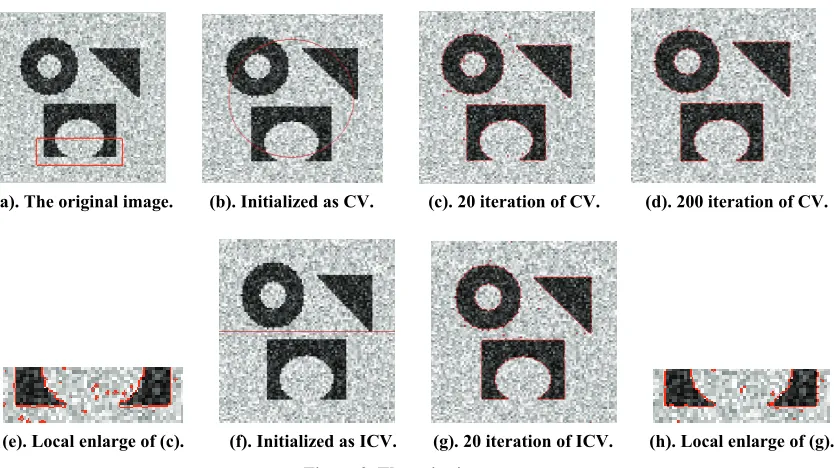
[image:3.595.66.533.449.709.2](a). The original image. (b). Initialized as CV. (c). 20 iteration of CV. (d). 200 iteration of CV.
[image:4.595.95.512.76.310.2]
(e). Local enlarge of (c). (f). Initialized as ICV. (g). 20 iteration of ICV. (h). Local enlarge of (g).
Figure 2. T image.
interest is specified by the white box. It need
ve to achieve the ideal state of division when the level
he noisy
s 15 itera-ti
set function is initialized as 0 x,y 67 2 2
100
100
y
x ,
and time-consuming is 1.578 s. Figures 1(b),1(c) show the traditional method of in
the final result of division. With our improved method (ICV method), u1, d1
itialization(CV method) and
, we can get the desired effect of split after one iterative and the time-consuming is 0.016s (Figures To compare the segmentation results of the two methods in more detail, we show a zoomed version of the results in Figure (d) and Figure (g) for a region delineated by the white box in Figure (a). It’s clear to see that we can get a smoother curve split with our approach.
In Figure 2, we show how our arithmetic and tradi-tional C-V methods work on a noisy synthetic image. Th
1(e),1(f)).
e region of interest is specified by the white box (Fig-ure 2(a)). Bose of the two methods can automatically detect the objects. If we use traditional C-V model
ini-tialization method,
2
20x,y 33 x50 y50
, the
outline of objectives are separated after 20 times of
itera-tive, but the rig
sepa-rated(Figures 2(c), 2(e)). After 200 iterative, the situation is improved. However, it spends 20 times iteration to achieve a perfect result with our method. The rectangular region is also divided perfect (Figures 2(g), 2(h)).
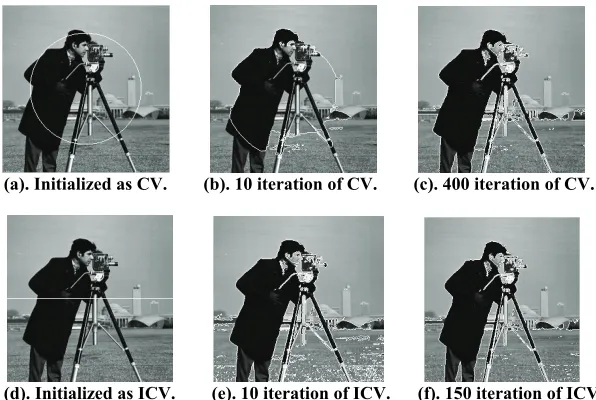
The test results of cameraman.tif are showed in Figure 3. Size of the picture is 256×256. In Figure 3(a), the level se
ht-angle region isn’t well
t function was initialized as signed distance function:
,
128
2 128
2 850 x y x y
. Figure 3(b) and
Figure 3(c) are results of 10 iterations and 400 iterations
gradually reduce after multiple iterations. Figure 3(e) is the result of 10 iterations. After 150 iterations, we get a stable state. We can see that the noise has been significantly reduced, but not completely filtered out.
4. Video Image Segmentation Based on ICV
C-V model is the key to resolve the two issues separate, nd categories of backgro
respectively. In Figure 5(d) level set function was initial-ized as a linear curve. We can get the photographer’s out-line after only one time of iteration. But there is a lot of noise divisions on the lake, noises would
unds and objectives in the ideo images are unknown. C-V model can not be
di-ea by analyzing the characteristics of H.264 codec first
acro bl
a v
rectly applied to the whole map. So we get the movement ar
of all, and then the improved C-V model is applied to the movement region which was detected. This article fo-cuses on the moving target in the same scene, the video image processing and experimental data are based on a single static camera, so the background image is static. According the principles of H.264 video codec, motion vector of macro block as a background is usually zero value, and only motion vector of macro block in the movement region is non-zero, so we can get the moving region through the distribution of motion vector.
When inter coding being chosen, the coding frame need to use the frame before (reference frame) for movement searching, and then motion vector of each block is get. We illustrate in Figure 4 the above remarks. In Figure 4(a), the large box represents 16 × 16 m
(a). Initialized as CV. (b). 10 iteration of CV. (c). 400 iteration of CV.
(d). Initialized as ICV. (e). 10 iteration of ICV. (f). 150 iteration of ICV. Figure 3. The complex background image.
(a). Distribution of vector. (b). Regional campaign. (c). Separated results.
tion map, we can frame the regional camp Figure 4(b).
of the system and tracking algo-rit
Figure 4. Moving target separated.
aign, as shown in
Figure 4(c) is a real-time video segmentation results map, target detection
hm and real-time are tested respectively. We choose the parameters as follows: 0 ,ob1 , 0.01
255
255 ,1,t=2,h1,u1,d1. The regional campaign is extrac nd the ng
ry Figure ), ho an see
that the outline of some of the goal in frame is not very ideal, sometimes the background is also included. It is because the delimitation of regional campaign is mainly based on motion estimation which processed by video coding. If light is changed, or other factors, the reference block selecting is inaccurate in motion estimation, re-sulting in the coding block is mistakenly believed as campaign block, so the error division is produced. The brightness weight of hands is very close to the brightness weight of the wall. As target tracking algorithm uses the brightness information of pixel, when the goal and back-ground have similar brightness information, the algo-rithm will get the wrong track.
formation of decoder is an important factor of computing time, which affect the moving
tracking module. Larger the regional campaign is, more time the target detection and tracking module need. We have real-time measured the running time of the module, which is in 15-19 ms range. When the ICV model is evolved in the whole frame, the time-consuming is not more than 20 ms, fully meet the real-time requirements.
5. Conclusions
In this paper, we have improved the image segmentation ted, a movi target is
tracked ve well. In 4(c wever, we c
e rate of 25 fps. The size of the regional movement we get by the motion vector
target detection and
ficiency based on the C-V model from initialization lifying. The improved C-V model uarantees the division in effect while greatly improves H.264 codec set the fram
ef
and algorithms simp g
[image:5.595.151.449.89.289.2] [image:5.595.230.478.329.430.2]contour models [J],” International Journal of Computer No. 4, pp. 321-331, 1987.
] S. Osher and J. A. Sethian, “Fronts propagating with
munication of Pure Applied
Mathe-. 11, ppMathe-. 1175
Journal of Computers, Vol. 30, No. 1, pp.
uhan University, Natural Sciences
Edi-age Processing,
high efficiency segmentation, using the methods pro-posed in this paper. However, for the complex back-ground image, the outline of objects can be accurately divided, but there will be some regional background mistakenly separated. How to filter this noise fast is the next step that we need to improve. This article improves the C-V method to separate video images, which can be used to real-time detect and track the moving targets.
6. References
1] M. Kass, A. Witkin, and D. Terzopoulos, “Snakes: Ac
[ tive
120-128, 2007.
[7] J. S. Xiao, H. Feng, and B. S. Yi, “Finite difference method for semilinear parabolic differential inclusions [J],” Journal of W
Vision, Vol. 1,
[2 tio
curvature dependent speed: Algorithms based on hamil-ton-jacobi formulations [J],” Journal of Computational Physics, Vol. 79, pp. 12-49. 1988.
[3] F. T. Chan and L. Vese, “Active contours without edges [J],” IEEE Transaction Image Processing, Vol. 10, No. 2, pp. 266-277, 2001.
[4] D. Mumford and J. Shah, “Optimal approximations by piecewise smooth functions and associated variational problems [J],” Com
matics, Vol. 42, No. 5, pp. 577-685, 1989.
[5] J. Li, X. Yang, and P. F. Shi, “A fast level set approach to image segmentation based on mumford-shah model [J],” Chinese Journal of Computers, Vol. 25, No
-1183. 2002.
[6] Y. Y. Gong, X. N. Luo, H. Huang, G. J. Liao, and Y. Zhang, “Multi-objects extracted based on single level set [J],” Chinese
n, Vol. 52, No. 3, pp. 262-266, 2006.
[8] J. Lie, M. Lysaker, and X. C. Tai, “A binary level set model and some applications to mumford-shah image segmentation,” IEEE Transactions on Im