Solid-state physics
An historic experiment redesigned
Large quasiparticles known as Rydberg excitons have been detected in a natural crystal of copper oxide found at the Tsumeb mine in Namibia. The result may find use in applications such as single-photon logic devices. See Letter p.000
An exciton is a quasiparticle in a solid-state system comprising an electron and a hole — the absence of an electron. It has an energy spectrum akin to that of the hydrogen atom, so it may be considered as an artificial hydrogen atom in a solid-state environment, with the hole playing the part of the proton. The concept of excitons has first been formulated in the early 1930s by Yakov Frenkel, who predicted their existence in molecular crystals. A few years later, Gregory Wannier2 and Nevil Mott3 described these electron–hole bound states for inorganic semiconductors. In 1952 Evgeniy Gross and Nury Karryjew discovered4 such Wannier–Mott excitons experimentally in a copper oxide semiconductor. On page 000 of this issue, Kazimierczuk et al.5 now report how they have redesigned this historic experiment to find excitons in a natural crystal of copper oxide that extend more than tens of billions of lattice sites of the crystal.
hydrogen-like quasiparticles, the excitons, can be generated in these semiconductor crystals by photoabsorption.
In their study, Kazimierczuk et al. performed high-resolution transmission spectroscopy of a record-quality natural crystal of copper oxide found at the Tsumeb mine in Namibia usinglaser light of tunable frequency and ultralow spectral linewidth (corresponding to roughly 1.2 megahertz). Taking advantage of such narrow linewidth and the extremely high purity of the crystal, which has a thickness of 34 micrometres, the authors have been able to measure transmission spectra of the material with a spectral resolution of 5 nanoelectronvolts — a value that is extremely high for optical spectroscopy experiments. Analysis of the spectra revealed spectral absorption lines associated with the formation of excitons that have principal quantum numbers as large as n = 25. The size of an exciton increases as the second power of n, with n= 25 corresponding to a huge quasiparticle filling a sphere that has a diameter of more than 2 µm — that is, ten times the wavelength of light which is needed to create this exciton (see Figure 1 of the paper5). Moreover, the authors found that excitons formed at different locations in the crystalhad, within the experimental accuracy of the measurements, identical spectral lines. This observation confirmed the extraordinary quality of the sample.
Rydberg blockade means that only a limited number of large Rydberg excitons is permitted within a given volume in the crystal. The effect could be used to make nonlocal all-optical switches and single-photon logic devices.
There is no doubt that Kazimierczuk and colleagues’ discovery of giant Rydberg excitons opens new avenues for the field of excitonics. Standard descriptions of light–matter interaction in a regime where the size of the exciton that results from the interaction exceeds the wavelength of light used to create it need to be revised. The old ansatz of additional boundary conditions on the exciton wavefunction, such as Pekar boundary conditions8, that must be included into the classical calculation of optical excitations in crystal slabs acquires new importance in view of the nonlocal electrical properties of the slabs introduced by giant Rydberg excitons: creation of such an exciton by light at a point A in a crystal may strongly modify the electrical properties of the crystal at a point B separated from A by more than a micrometre. Furthermore, the fine structure of the absorption lines associated with excitons of large n may be rich and unusual owing to multiple emission and absorption of virtual photons by the excitons9 and interactions between the spins and orbital momenta of the excitons’ electrons.
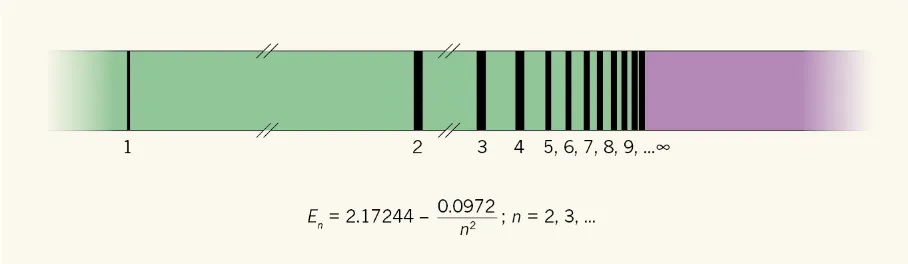
Figure 1 | The spectral signatures of excitons. This diagram shows the spectral absorption dips (black) associated with the hydrogen-like transitions of Wannier–Mott excitons in a copper oxide crystal. In their historic 1952 experiment, Gross and Karryjew identified4 the eight dips that correspond to transition energies En with n= 2, 3, … , 9. The transition with the energy E1 is
forbidden by optical selection rules and could not be observed. Kazimierczuk et al.5 have observed excitons in this crystal with n as large as 25. The energies are given in electronvolts. Questions/comments about the figure/caption that need to be addressed:
1) Who should the credit for this graphic be? Alexey Kavokin? And on which of the Gross papers is it based? Please clarify.
Yes, based on Ref. 4. See also email and remark on Prof. Ruben Seisyan..
2) The paper seems to give different values for the numbers in the formula: 2.17208 eV and 92 meV. Please clarify as the reader will wonder.
Gross and Karryjew used slightly different energies to fit their spectra
3) Why are there two different colours in the spectrum, green and violet? Please clarify in the caption.
The violet colour shows energies of the interband optical absorption. The spectrum darkens at these energies.
Done
Sven Höfling is is in the Scottish Universities Physics Alliance, School of Physics and Astronomy, University of St Andrews, St Andrews, KY169SS UK. Alexey Kavokin is at the Saint-Petersburg State University, St-Petersburg, Russia, and the Physics and Astronomy
School, University of Southampton, Southampton SO171BJ, UK.
e-mails: [email protected]; [email protected]
1. Frenkel, J. Phys. Rev. 37, 1276–1294 (1931).
2. Wannier, G. H. Phys. Rev. 52, 191–197 (1937).
3. Mott, N. F. Trans. Faraday Soc. 34, 500–506 (1938).
4. Gross, E. F. & Karryjew, N. A. Dokl. Akad. Nauk SSSR 84, 471–474 (1952).
5. Kazimierczuk, T., Fröhlich, D., Scheel, S., Stolz, H. & Bayer, M. Nature 000, 000–000 (2014).
6. Baldo, M. & Stojanović, V. Nature Photon. 3, 558–560 (2009).
7. Gross, E. F., Zakharchenia, B. P. & Reinov, N. M. Dokl. Acad. Sci. USSR 111, 564–568 (1956).
8. Pekar, S. I. J. Exp. Teor. Fiz. USSR 33, 1022–1036 (1957).