Knowledge-Based Interoperability for
Mathematical Software Systems
Michael Kohlhase1 Luca De Feo5Dennis M¨uller1Markus Pfeiffer3 Florian Rabe2 Nicolas M. Thi´ery4 Victor Vasilyev3Tom Wiesing1
1 FAU Erlangen-N¨urnberg 2
Jacobs University Bremen 3
University of St Andrews 4
Universit´e Paris-Sud 5
Universit´e Versailles St Quentin
Abstract. There is a large ecosystem of mathematical software sys-tems. Individually, these are optimized for particular domains and func-tionalities, and together they cover many needs of practical and theo-retical mathematics. However, each system specializes on one particular area, and it remains very difficult to solve problems that need to involve multiple systems. Some integrations exist, but the are ad-hoc and have scalability and maintainability issues. In particular, there is not yet an interoperability layer that combines the various systems into a virtual research environment (VRE) for mathematics.
The OpenDreamKit project aims at building a toolkit for such VREs. It suggests using a central system-agnostic formalization of mathematics (Math-in-the-Middle, MitM) as the needed interoperability layer. In this paper, we report on a case study that instantiates the MitM paradigm the systems GAP, SageMath, and Singular to perform computation in group and ring theory.
Our work involves massive practical efforts, including a novel formaliza-tion of computaformaliza-tional group theory, improvements to the involved soft-ware systems, and a novel mediating system that sits at the center of a star-shaped integration layout between mathematical software systems.
1
Introduction
There is a large and vibrant ecosystem of open-source software systems for math-ematics. These range from calculators, which perform simple computations, via mathematical databases, which curate collections of a mathematical objects, to powerful modeling tools and computer algebra systems (CAS).
Most of these systems are very specific – they focus on one or very few aspects of mathematics. For example, among databases, the “Online Encyclope-dia of Integer Sequences” (OEIS) focuses on sequences over Zand their prop-erties, and the “L-Functions and Modular Forms Database” (LMFDB) [Cre16;
and SageMath [Sage] aims to be a general purpose software for computational pure mathematics by loosely integrating many systems including the aforemen-tioned ones.
For a mathematician, however, (a user, which we call Jane) the systems them-selves are not relevant. Instead, she only cares about being able to solve problems. Because it is typically not possible to solve a mathematical problem using only a single program, Jane has to work with multiple systems and combine the results to reach a solution. Currently there is very little tool support for this practice, so Jane has to isolate sub-problems that the respective systems are amenable to, formulate them in the respective input language, collect intermediate results and reformulate them for the next system – a tedious and error-prone process at best, a significant impediment to scientific progress at worst. Solutions for some situations certainly exist, which can help get Jane unstuck, but these are ad-hoc and only for specific often-used system combinations. Moreover, each of these ad hoc solutions requires a lot of maintenance and scales badly to multi-system integration.
One goal of the OpenDreamKit project is tackling these problems system-atically by building virtual research environments (VRE) on top of the exist-ing systems. To build a VRE from individual systems, we need a joint user interface – the OpenDreamKit project adopts Jupyter [Jup] and active docu-ments [Koh+11] – and an interoperability layer that allows passing problems and results between the disparate systems. For the latter, it proposes the Math-in-the-Middle (MitM [Deh+16]) paradigm, an interoperability framework based on a central, system-independent ontology of mathematical knowledge. In this paper we instantiate the MitM paradigm in a concrete case study using a dis-tributed computation involving GAP,SageMath, andSingular.
We will use the following running example from computational group theory: Jane wants to experiment with invariant theory of finite groups. She works in the polynomial ringR=Z[X1, . . . , Xn], and wants to construct an idealIin this
ring that is fixed by a groupG≤Sn acting on the variables, linking properties
of the group to properties ofI and the quotient ofR byI.
To construct an ideal that is invariant under the group action, it is natural to pick some polynomial pfromR and consider the ideal I of R that is gener-ated by all elements of the orbitO =Orbit(G, R, p)⊆R. For effective further computation withI, she needs a G¨obner base ofI.
Jane is a SageMath user and wants to receive the result in SageMath, but she wants to use GAP’s orbit algorithm andSingular’s Gr¨obner base algorithm, which she knows to be very efficient. For the sake of example, we will work with
n= 4, G=D4 (the dihedral group1), and p= 3·X1+ 2·X2, but our results apply to arbitrary values.
In Section2, we recap the MitM paradigm. MitM solutions consist of three parts: a central ontology, specifications of the abstract languages of the involved systems (which we callsystem dialects), and the distributed computation
infras-1
tructure that connects the systems via the ontology as an intermediate repre-sentation. The rest of the paper develops these three parts for our case study: In Section3, we contribute a fragment to the MitM ontology that formalizes com-putational group theory. In Section4, we specify the abstract languages of GAP, SageMath, and Singularand their relation to the ontology. Finally in Section5, we present the resulting virtual research environment built on these systems in action. Section6concludes the paper and compares MitM-based interoperability with other approaches.
2
Math-in-the-Middle Interoperability
A B
C D E F
G
H
MitM
a b
c d e f g
h
Fig. 1.MitM Paradigm Figure 1 shows the basic MitM design. We want
to make the systemsAtoH with system dialects
a to h interoperable. A P2P translation regime (n(n−1) translations between n systems) is al-ready intractable for the systems in the Open-DreamKit project (more than a dozen). Alterna-tively, an “industry standard” regime, where one system dialect is declared as the standard is infea-sible because no system dialect subsumes all oth-ers – not to mention the political problems such a standardization would induce. Instead, MitM uses a central mathematical ontology that provides an independent mediating language, via which
all participating systems are aligned. All mathematical knowledge shared be-tween the systems and exposed to the high-level VRE user is expressed using the vocabulary of this ontology. Crucially, while every system dialect makes implementation-driven, system-specific design choices, the MitM ontology can remain close to the knowledge published in the mathematical literature, which already serves as an informal interoperability layer.
The following sections describe the three components of the MitM paradigm in more detail.
2.1 The MitM Ontology
In the center, we have the MitM Ontology, which is a formalization of the mathematical knowledge behind the systemsAtoH. As a formalization frame-work, it uses the OMDoc/MMT format [Koh06; RK13; MMT], which was de-signed with this specific application in mind. We do not go into the details of OMDoc/MMT here – for our purposes, it suffices to assume that an OM-Doc/MMTtheory graph formalizes a language for mathematical objects as a set of typed symbols with a (formal or informal) specification of their semantics. For example, the MitM-symbolPolynomialRingtakes a ringrof coefficients and a number nof variables and returns the ringr[X1, . . . , Xn] of polynomials.
to act as a pivot point for integrating systems. This means that it can be much nearer to the informal but rigorous presentation of mathematical knowledge in the literature. While each system dialect makes compromises and optimizations needed for a particular application domain, the MitM ontology follows the exist-ing and already informally standardized mathematical knowledge and can thus serve as a standard interface layer between systems.
Importantly, the MitM ontology does not have to include any definitions2
or proofs – it only has to declare the types of all relevant symbols and state (but not prove) the relevant theorems. This makes it possible for users like Jane to extend the MitM ontology quickly whereas extending formalizations usually requires extensive efforts by specialists.
2.2 Specifying System Dialects
System Dialects It is unavoidable that each system induces its own language
for mathematical objects. This is the cause of much incompatibility because even subtle differences make naive integration impossible. Moreover, due to the difficulty of the involved mathematics and the effort of maintaining the imple-mentations, such differences are aplenty.
Fortunately, we can at least easily abstract from the user-facing surface syn-tax of these languages: scalable interoperability can anyway only be achieved by acting on the internal data structures of the systems. Thus, only the much simpler internal abstract syntax needs to be considered.
The symbols that build the abstract syntax trees can be split into two kinds: constructorsbuild primitive objects without involving computation, and op-erations compute objects from other objects (including predicates, which we see as operations that return booleans). For purposes of interoperability it is desirable to abstract from this distinction and consider both as typed symbols. This abstraction is important because systems often disagree on the choice of constructors. Thus, we can represent the interfaces of the systems A to H as OMDoc/MMT theory graphs a to h that declare the constructors and opera-tions (but omit all implementaopera-tions of the operaopera-tions) of the respective system. Given the theory grapha representing the system dialect of A, we can ex-press all objects in the language of systemAasOMDoc/MMTobjects using the symbols ofa. We refer to these objects asA-objects. It is conceptually straight-forward to write (or even automatically generate) the theory graph a and to implement a serializer and parser for A-objects as a part of A.3 This is
be-cause no consideration of interoperability and thus no communication with the developers of other systems is needed.
Alignments with the Ontology The above reduces the interoperability problem to
relating each system dialect to the MitM ontology. Each system dialect overlaps with the language of the ontology, but no system implements all ontology sym-bols and every system implements idiosyncratic operations that are not useful
2
Of course, definitions are one possible way to specify the semantics of MitM-symbols. 3
as a part of the ontology. Therefore, some system dialect symbols are related to corresponding symbols in the MitM ontology. We use these symbols of the MitM ontology as an intermediate representation to bridge between any two systems, e.g., by translating A-objects to the corresponding ontology objects and then those to the correspondingB-objects.
However, even whenA and B deal with the “same mathematical objects”, these may be constructed and represented differently, e.g., symbols can differ in name, argument order/number, types, etc. A major difficulty for system inter-operability is correctly handling these subtle differences. To formalize the details of this relation, [M¨ul+17b] introducedOMDoc/MMT alignments. Technically, these are pairs of OMDoc/MMT symbol identifiers decorated by a set of key-value pairs. The alignments of a-symbols with the MitM ontology determine whichA-objects correspond to MitM-objects.
The alignment ofa-symbols to ontology symbols must be spelled out manu-ally. But this is usually straightforward and easy even for inexperienced users. For example, the following line aligns GAP’s symbol IsCyclic(in the filelib/grp.gd) with the corresponding symbolcyclicin the MitM ontology. The key-value pairs are used to signify that this alignment is part of a group of alignments called “VRE” and can be used for translations in both directions.
gap:/lib?grp?IsCyclic mitm:/smglom/algebra?group?cylic direction="both" type="VRE"
Thus we can reduce the problem of interfacing n systems to i) curating the MitM ontology for the joint mathematical domain, ii) generatingn theory graphs for the system dialects, iii) maintaining ncollections of alignments with the MitM ontology.
Alignments form an independent part of the MitM interoperability infras-tructure. Incidentally, they obey a separate development schedule: the MitM ontology is developed by the community as a whole as the understanding of a mathematical domain changes. The system dialects are released together with the systems according to their respective development cycle. The alignments bridge between them and have to mediate these cycles.
2.3 MitM-based Distributed Computation
The final missing piece for a system interoperability layer for a VRE toolkit is a practical way of transporting objects between systems. This requires two steps. Firstly, if the system dialects and alignments are known, we can automatically translateA-objects toB-objects in two steps:Ato ontology and ontology toB. This two-step translation has been implemented in [M¨ul+17a] based on theMMT system [Rab13; MMT], which implements theOMDoc/MMT format along with logical and knowledge management algorithms.
-objects to anSCSCPclients/server by implementing theSCSCPprotocol on top of, e.g., sockets or using an existingSCSCP library.
3
The MitM Ontology for Computational Group Theory
Jane’s use case involves groups and actions, polynomials, rings and ideals, and Gr¨obner bases, all of which must be formalized in the MitM ontology. Due to space restrictions, we only describe the ontology for computational group theory (CGT) as an example. This formalization can be found at [Mitb].
3.1 Type Theory and Logic
OMDoc/MMT formalizations must be relative to foundational logic, which is itself formalized inOMDoc/MMT. As foundation for all formalizations in MitM [Mita], we use a polymorphic dependently typed λ-calculus with two universes typeand kind (roughly analogous to sets and proper classes in set theory) and subtyping. It provides dependent function types{a:A}B(a), representing the type of all functions mapping an argument a:A to some element of type B(a). If B does not depend on the argumenta, we obtain the simple function typeA→B.
For formulas, we use a typepropand a higher order logic where quantifiers range over any type. We furthermore follow the judgments-as-type paradigm by declaring a function `:prop→type mapping propositions to the type of their proofs, which allows us to declare proof rules as functions mapping proofs (of the premises) to a proof (of the conclusion).
The judgmentA<:Bexpresses thatAis a subtype ofB. We use power types (the type of subtypes of a type) and predicate subtyping{’a:A| P(a)’}. The latter makes type-checking undecidable, but that is necessary for natural formalizations in many areas of mathematics.
Fig. 2.MitM ontology Fragment Additionally we extend our type
theory with record types, which is critical for formalizing mathematical structures. In particular, ModelsOf T is the record type of models of the theory T. This lets us, e.g., define groups by the theory of operations and its signature and axioms, while group=ModelsOf group theory is the
3.2 Group Theory
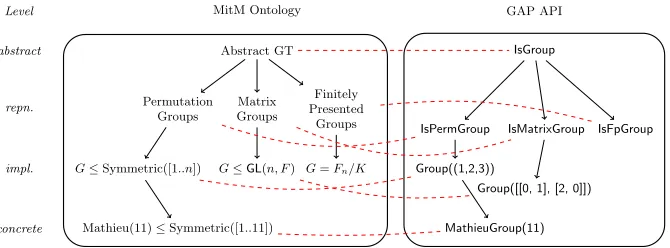
Our formalization of CGT follows the template of its implementation in GAP, and requires different levels of abstraction – currently abstract, representation,
implementation, and concrete. From our experience, we expect this pattern to
be applicable across computational algebra, possibly with additional levels of abstraction. The left box in Figure3 shows the levels and their relation to the constructors and operations of GAP.
Level
abstract
repn.
impl.
concrete
MitM Ontology
Abstract GT
Permutation Groups
Matrix Groups
Finitely Presented
Groups
G≤Symmetric([1..n]) G≤GL(n, F) G=Fn/K
Mathieu(11)≤Symmetric([1..11])
GAP API
IsGroup
IsPermGroup IsMatrixGroup IsFpGroup
Group((1,2,3))
Group([[0, 1], [2, 0]])
[image:7.612.143.478.220.344.2]MathieuGroup(11)
Fig. 3.Alignments between the MitM Ontology and theGAP API
Abstract Level This contains the theory ofGroups: the group axioms, generating sets, homomorphisms, group actions, stabilisers, and orbits. This also easily leads into definitions of centralisers – i.e. stabilisers of elements under conjugation – and normalisers – i.e. stabilisers of subgroups under conjugation, stabiliser chains, Sylow-psubgroups, Hall subroups, and many other concepts.
OMDoc/MMT also allows expressing that there are different equivalent def-initions of a concept: We defined group actions in two ways and usedviews to express their equivalence.
Representation Level Abstract groups are represented in different ways as
con-crete objects suitable for computation: as groups of permutations, groups of matrices, finitely presented groups, algebraic constructions of groups, or using polycyclic presentations.
Many representations arise naturally fromgroup actions: If we are consider-ing symmetry in a settconsider-ing where we want to apply group theory, we start with a group action, for example a group acting on a graph by permuting its vertices.
The universal tool to bridge the gap between groups, representations and canonical representatives are group homomorphisms, particularly embeddings and isomorphisms, which are used extensively in GAP. This is reflected in our approach.
Implementation Level At this level we encode implementation details:
defined by providing a set of generating permutations. GAP then computes a stabiliser chain for a group that was defined this way, and naturally considers the group to be a subgroup ofS[1..n], where nis the largest point moved.
Concrete Level It is at the concrete level where the computation happens: while
the higher levels are suitable for mathematical deduction and inference, this level is whereGAP(or any other system providing computational group theory) does its work. If a group (or a group action) has been constructed by giving generators through MitM, GAP can now compute the size of the group, its isomorphism type, and perform all the other operations that are available via theGAPsystem dialect.
4
The System Dialects of
GAP
,
SageMath
, and
Singular
We now show how we produce OMDoc/MMT theory graphs that specify the system dialects of GAP, Singular, and SageMath. The three systems are suffi-ciently different that we can consider the development presented in this section a meaningful case study in the methodology and difficulty of exposing the APIs of real-world systems as of formally described system dialects.
In each case, we had to overcome major implementation difficulties and invest significant manpower. In fact, even the serialization of internal abstract syntax trees asOMDoc/MMTobjects proved difficult, for different system-specific rea-sons. In the following, we summarize these efforts.
4.1 SageMath
We first consider our previous work [Deh+16] regarding a direct (i.e., with-out MitM) integration of SageMathandGAP. HereSageMath’s native interface to GAP is upgraded from the handle paradigm to the semantic handles paradigm. In the former, when a system A delegates a calculation to a system
B, the resultr of the calculation is not converted to a nativeA object (unless it is of some basic type); insteadB just returns a handle h(i.e., some kind of reference) to the B-object r. Later, A can run further calculations with r by passing it as argument to functions or methods implemented by B. Addition-ally, with a semantichandle, hbehaves inAas if it was a nativeA object. In other words, one adapts the API satisfied by rin B to match the API for the same kind of objects inA. For example, the method callh.cardinality()on a SageMathhandlehto aGAPgroupGtriggers inGAPthe corresponding function call Size(G).
This approach avoids the overhead of back and forth conversions betweenA
API In [Deh+16] we describe the extraction of some of SageMath’s API from itscategories. This exploited the mathematical knowledge explicitly embedded in the code to cover a fairly large area of mathematics (hundreds of kinds of algebraic structures such as groups, algebras, fields, ...), with little additional efforts or need to curate the output. This extraction did not cover the construc-tors, knowledge about which is critical for (de)serialization, nor other areas of mathematics (graph theory, elliptic curves, ...) whereSageMathdevelopers cur-rently do not use categories (usually because the involved hierarchies of abstract classes are shallow and easily maintained by hand).
To extract more APIs, we took the following approach: 1. We constructed a list of typicalSageMathobjects.
2. We used introspection to analyze those objects, crawling recursively through their hierarchy of classes to extract constructors and available methods to-gether with some mathematical knowledge.
At this stage, the list of objects was crafted by hand to cover Jane’s scenarios and some others. In a later stage, we plan to take advantage of one ofSageMath’s coding standards: every concrete type must be instantiated at least once in SageMath’s tests and the instance passed trough a generic test suite that runs sanity checks for its advertised properties (e.g. associativity, ...). Therefore, by a simple instrumentation ofSageMath’s test framework, we could run our exporter on a fairly complete collection of SageMathobjects.
The process remains brittle and the export will eventually require much cu-ration:
– The signature of methods is incomplete: it specifies the number and names of the arguments, but only the type of the first argument.
– For constructors, the type of all the arguments is known, but only for the specific call that led to the construction of the introspected object.
– There is no distinction between mathematically relevant methods and purely technical ones like data structure manipulation helpers.
– The export is very large and seems of limited use without alignments with the MitM ontology. At this stage we do not foresee much opportunities to produce such alignments other than manually.
Nonetheless, we consider this an important first step toward fully automatic extraction of the SageMath API. Moreover, we expect further improvements by code annotations in SageMath (e.g., the ongoing porting of SageMath from Python 2 to Python 3 will enable gradual typing, which we hope to become widely adopted by the community) or using type inference inSageMathand/or MitM.
Serialization and Deserialization Because SageMathis based onPython, it benefits from its native serialization support. For example, the dihedral group
D4 is serialized as a binary string, which encodes the following straight line program to be executed upon deserialization:
pg unreduce = unpickle global(’sage.structure.unique representation’, ’unreduce’) pg DihedralGroup =
pg make integer = unpickle global(’sage.rings.integer’, ’make integer’) pg unreduce(pg DihedralGroup, (pg make integer(’4’),),{})
The first three lines recover the constructors for integers and for dihedral groups fromSageMath’s library. The last line applies them to construct successively the integer 4 andD4.
Up to concrete syntax, this serialization is already close to the desired Sage-Math system dialect. We can therefore extend Python’s native (de)serializer to use OMDoc/MMT as an alternative serialization format (using the Python li-brary [POMa]). This has the advantage of using optimizations implemented in Python’s serialization, e.g., structure sharing for identical subexpressions.
Still, systematically expandingOMDoc/MMTserialization to theentire Sage-Math library requires significant manpower and can only be a long-term goal. To increase community support, our design elegantly decouples the problem into (i) instrumenting the serialization to generate OMDoc/MMT as an alternative target format, and (ii) structural improvements of the serialization that benefit SageMathin general.
In particular, our serialization of SageMath objects is by construction rather thanby representation, i.e., we serialize the constructor call that was used to build an object instead of the low-level Python representation of the resulting object. This is important to hide implementation details and allow for straightforward alignments. From the origin, theSageMathcommunity has inter-nally promoted good support for serialization as this is a fundamental building block for communication between parallel processes, databases, etc. Thus, it al-ready values serialization by construction as superior because it is usually more concise and more robust under changes toSageMath. Therefore, independent of the purposes of this paper, we expect a synergy with theSageMathcommunity toward improving serialization.
4.2 GAP
In [Deh+16], we already described our general approach to extract APIs from theGAPsystem. We have now improved on this work considerably.
Firstly, we improved the MitM foundation so that the primitives of GAP’s type system can be expressed in the MitM ontology.4GAP’s type system heavily
uses subtyping: filters express finer and finer subtypes of the universal type IsObject. Moreover, an object inGAPcan learn about its properties, meaning its type is refined at runtime: a group can learn that it is Abelian or nilpotent and change its type accordingly.
Secondly, we devised and implemented a special treatment ofGAP’s construc-tors during serialization. AsGAPonly has a weak notion of object construction, we achieved this by manually identifying and annotating all functions that cre-ate objects in the GAP code base and then instrumenting them to store which arguments they were called with. With the constructor annotation in place, it is possible to have GAP represent any object in a running session as either a
4
primitive type (integers, permutations, transformations, lists, floats, strings), or as a constructor applied to a list of arguments.
The instrumentation itself is minimal – 57 lines ofGAP code, plus 100 lines for serializing and parsing. The main – and indeed considerable – challenge was to identify the constructors and their arguments. In GAP, objects are created by calling the function Objectify with a type and some arguments. Hence we analyzed all call-sites to this function and some light inference of the enclosing function. This amounted to 665 call sites in theGAP library and an additional 1664 in the standard package distribution. The instrumentation will be released as part of a future version of GAP, makingGAP fully MitM capable.
As a major positive side-effect of our work, this instrumentation led to general improvements of the type infrastructure inGAP. For example, it enables static type analysis, which can be used to optimize the dynamic method dispatch and thus hopefully lead to efficiency gains in the system.
4.3 Singular
As we only need a very small part of Singularfor our case study, we were able to use the existing OpenMath content dictionaries for polynomials [OMCP] as the Singularsystem dialect. These are part of a standard group of content dictionaries that describe (some) mathematical objects at a high level of abstraction to be universally applicable. OMDoc/MMT understands OpenMath, i.e., it can use these content dictionaries asOMDoc/MMTtheories.
Building on the OpenMath toolkits for OpenMath phrasebooks [POMa] and SCSCP communication [POMb] inPython– which were developed forSageMath in the OpenDreamKit project, we wrapped Singular in a thin layer of Python code that provides SCSCP communication. This work was undertaken by the sixth author as part of a summer internship in about a week without prior expert knowledge of the system. Of course, if we want to achieve a more comprehensive coverage of theSingular dialect, we will have to either manually write a theory graph or instrumentSingularfor extraction as we did forSageMathorGAPabove.
4.4 Alignments
Finally we have to curate the alignments between the system dialects and the MitM ontology. These alignments are currently produced and curated manually using the approach, repository, and syntax described in [M¨ul+17b; M¨ul+17a]. In the future, we will also consider automatically extracting alignments from the existing ad-hoc SageMath-to-X translations. These are (mainly) given as SageMath code annotations that relate SageMath operations and constructors with those of systemX.
5
Distributed Computational Group Theory
theory graphs MitM Server
MMT
GAPServer GAP
Singular Server Singular SageMathClient
SageMath
load 1
6
4 3
[image:12.612.156.462.103.209.2]5 2
Fig. 4.MitM Interaction in Jane’s Use Case
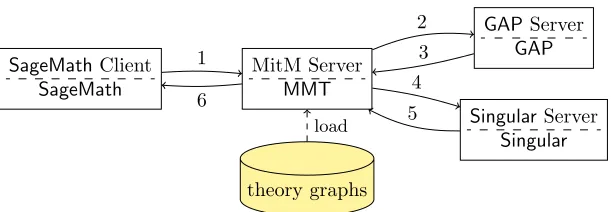
Critically, the MitM server also maintains the alignments and uses them to con-vert between system dialects.
We have extended the MMT system [Rab13] with an SCSCP server/client so that it can receive/send objects from/to computation systems. For theGAP server, we built on pre-existing SCSCPsupport. To obtain anSCSCP server for Singular, which does not have nativeSCSCPsupport, we wrapped Singular in a python script that includes thepyscscplibrary [POMb]. InSageMath, we directly programmed the client interface to the MitM server.
The resulting system forms the nucleus of the OpenDreamKit interoperabil-ity layer. It can already delegate computations between the three participating systems as long as the exchanged objects are covered by the MitM ontology, the alignments, and the formalizations of the system dialects.
Jane’s Use Case Initially, Jane has already built in SageMath the ring R =
Z[X1, X2, X3, X4], the groupG=D4, the actionAofGonRthat permutes the variables, and the polynomialp= 3·X1+ 2·X2. She now calls
MitM.Singular(MitM.Gap.orbit(G, A, p)).Ideal().Groebner().sage()
which results in the following steps (the numbers on the edges of the graph of Figure4indicate the order of communications when processing Jane’s use case): 1. Jane usesSageMathto call the MitM server with the command above, which includes both the computation to be performed and information about which system to use at which step.
2. The MitM server translates MitM.Gap.orbit(G, A, p)to the GAPsystem di-alect and sends it toGAP.
3. GAPreturns the orbit:
O= [3X1+ 2X2,2X3+ 3X4,3X2+ 2X3,3X3+ 2X4,
2X2+ 3X3,3X1+ 2X4,2X1+ 3X4,2X1+ 3X2].
4. The MitM server translates MitM.Singular(O).Ideal().Groebner() to the Sin-gularsystem dialect and sends it toSingular.
5. Singularreturns the Gr¨obner baseB.
6. The MitM server translatesB to theSageMathsystem dialect and sends it toSageMath, where the result is shown to Jane.
Alternative Use Case Suppose Jon, one of Jane’s colleagues, prefers working in GAP, and he wants to compute the Galois group of the rational polynomial
p=x5−2. He discovers theGAP package
radiroot, which promises this func-tionality, but unfortunately the package does not work for this polynomial and thusGAPalone cannot solve Jon’s problem.
Jon hears from Jane that he should useSageMath, because she knows it can compute Galois groups. So, fromGAP, he calls
G := MitM(”Sage”, ”GaloisGroup”,p)
which gives him the desired Galois group as aGAP permutation group. Having heard of Jane’s experiments, he can further run her orbit and Gr¨obner basis calculation starting from this new group, without leaving his favorite computing environment.
Finally, Jon, being a proficientGAPuser, also knows that he can now install a methodinGAP by calling
InstallMethod(GaloisGroup, ”for a polynomial”, [IsUnivariatePolynomial], p−>MitM(”Sage”, ”GaloisGroup”, p))
that will compute the Galois group of any rational polynomial transparently for him whenever he calls GaloisGroup for a rational polynomial inGAP. And thus (at the price of using multiple systems) a significant part of the 1800-line radirootpackage can be replaced by a few lines in GAP, taking advantage of the work of theSageMathcommunity and participating in any future improvements of SageMath. In fact, Sage itself delegates to the PARI system – another one of the OpenDreamKit systems – for this computation. So in the futureGAPmight directly delegate to PARI instead, bypassing the need of iterated translations.
6
Conclusion
We have implemented the MitM approach to integrating mathematical software system based on formalizations of the underlying mathematical knowledge. The main investment here was the curation of an MitM Ontology, the generation of formal specifications of system APIs forSageMath,GAP, andSingular, identifying the alignments of these APIs with the ontology, implementing an MitM server that can use alignments to translate between systems, and implementing the SCSCPprotocol for all involved systems.
Our case study showed that MitM-based integration is an achievable goal. Delegation-based workflows can either be programmed directly or embedded into the interaction language of the mathematical software systems.
The main advantages and challenges claimed by the MitM framework come from its loosely coupled and knowledge-based nature. Compared to ad-hoc trans-lations, MitM-based interoperability is relatively expensive as objects have to be serialized into (possibly large)OMDoc/MMTobjects, transferred viaSCSCP to MMT, parsed, translated into another system dialect, serialized and transferred, and parsed again. On the other hand, instead of implementing and maintaining
APIs and their alignments to the MitM ontology. This makes the management of interoperability much more tractable:
1. The MitM ontology is developed and maintained as a shared resource by the community. We expect it to be well-maintained, since it can directly be used as a documentation of the functionality of the respective systems.
2. All the workflows are star-shaped: instead of requiring expert knowledge in two systems – a rare commodity even in open-source projects, and even for the system experts involved in this paper – and keeping up with their changes, the MitM approach only needs expertise and change management for single systems.
All in all, these translate into a “business model” for MitM-based cooperation in terms of the necessary investment and achievable results, which is based on the well-knownnetwork effects: the joining costs are in the size of the respective system, whereas the rewards – i.e. the functionality available by delegation – is in the size of the network.
This network effect can be enhanced by technical refinements we are cur-rently studying: For instance, if we annotate alignments with a “priority” value that specifies how canonically/efficiently/powerfully a given system implements a given MitM operation, then we can let theMMTmediator automatically choose a suitable target system for a requested computation (as opposed to our cur-rent setup where Jane specifies which systems she wants to use). On the other hand, for workflows where we do not need or want service-discovery, alignments can be “compiled” inton2 transport-efficient direct translations that may even eliminate the need for serialization and parsing.
Acknowledgements The authors gratefully acknowledge the fruitful discus-sions with other participants of work package WP6, in particular Alexander Konovalov on SCSCP, Paul Dehaye on the SageMath export and the organiza-tion of the MitM ontology, and Luca de Feo on OpenMath phrasebooks and theSCSCPlibrary in python. We acknowledge financial support from the Open-DreamKit Horizon 2020 European Research Infrastructures project (#676541) and DFG project RA-18723-1 OAF.
References
[Cre16] John Cremona. “The L-Functions and Modular Forms Database Project”. In:Foundations of Computational Mathematics16.6 (2016), pp. 1541–1553. doi:10.1007/s10208-016-9306-z.
[Deh+16] Paul-Olivier Dehaye et al. “Interoperability in the OpenDreamKit Project: The Math-in-the-Middle Approach”. In: Intelligent
Com-puter Mathematics 2016. Ed. by Michael Kohlhase et al. LNAI
[Fre+] Sebastian Freundt et al. Symbolic Computation Software
Compos-ability Protocol (SCSCP). Version 1.3.url:https://github.com/
OpenMath/scscp/blob/master/revisions/SCSCP_1_3.pdf (vis-ited on 08/27/2017).
[GAP] The GAP Group. GAP – Groups, Algorithms, and Programming.
url:http://www.gap-system.org(visited on 08/30/2016).
[Jup] Project Jupyter.url:http://www.jupyter.org(visited on 08/22/2017). [Koh+11] Michael Kohlhase et al. “The Planetary System: Web 3.0 & Active
Documents for STEM”. In: Procedia Computer Science 4 (2011):
Special issue: Proceedings of the International Conference on
Com-putational Science (ICCS). Ed. by Mitsuhisa Sato et al. Finalist
at the Executable Paper Grand Challenge, pp. 598–607. doi: 10. 1016/j.procs.2011.04.063.
[Koh06] Michael Kohlhase. OMDoc – An open markup format for
mathe-matical documents [Version 1.2]. LNAI 4180. Springer Verlag, Aug.
2006.url:http://omdoc.org/pubs/omdoc1.2.pdf.
[LMFDB] The LMFDB Collaboration. The L-functions and Modular Forms
Database.url:http://www.lmfdb.org(visited on 02/01/2016).
[Mita] MitM/Foundation.url:https://gl.mathhub.info/MitM/Foundation
(visited on 09/01/2017).
[Mitb] MitM/groups. url: https : / / gl . mathhub . info / MitM / groups
(visited on 09/01/2017).
[MMT] MMT – Language and System for the Uniform Representation of
Knowledge. project web site. url: https://uniformal.github.
io/(visited on 08/30/2016).
[M¨ul+17a] Dennis M¨uller et al. “Alignment-based Translations Across Formal Systems Using Interface Theories”. In: Fifth Workshop on Proof
eXchange for Theorem Proving - PxTP 2017. 2017. url: http :
//jazzpirate.com/Math/AlignmentTranslation.pdf.
[M¨ul+17b] Dennis M¨uller et al. “Classification of Alignments between Con-cepts of Formal Mathematical Systems”. In: Intelligent Computer
Mathematics (CICM) 2017. Ed. by Herman Geuvers et al. LNAI
10383. Springer, 2017.doi:10.1007/978-3-319-62075-6. [OMCP] OpenMath CD Group: polygrp. url:http://www.openmath.org/
cdgroups/polygrp.html(visited on 09/01/2017).
[POMa] An OpenMath 2.0 implementation in Python.url:https://github. com/OpenMath/py-openmath(visited on 09/04/2016).
[POMb] An SCSCP module for Python.url:https://github.com/OpenMath/ py-scscp(visited on 09/04/2016).
[Rab13] Florian Rabe. “The MMT API: A Generic MKM System”. In: In-telligent Computer Mathematics. Ed. by Jacques Carette et al. Lec-ture Notes in Computer Science 7961. Springer, 2013, pp. 339–343.
doi:10.1007/978-3-642-39320-4.
[Sage] The Sage Developers. SageMath, the Sage Mathematics Software
System.url:http://www.sagemath.org (visited on 09/30/2016).