Daniel John Rough
A Thesis Submitted for the Degree of PhD
at the
University of St Andrews
2018
Full metadata for this item is available in
St Andrews Research Repository
at:
http://research-repository.st-andrews.ac.uk/
Please use this identifier to cite or link to this item:
http://hdl.handle.net/10023/18611
This item is protected by original copyright
Jeeves: A Blocks-Based Approach to End-User
Development of Experience Sampling Apps
Daniel John Rough
This thesis is submitted in partial fulfilment for the degree of
Doctor of Philosophy (PhD)
at the University of St Andrews
Abstract
Professional programmers are significantly outnumbered by end-users of software, and cannot possibly predict the diverse and dynamic needs of user groups in advance. This thesis is concerned with the provision of an end-user development (EUD) approach, allowing end-users to independently create and modify their own software. EUD activities are particularly applicable to the work practices of psychology re-searchers and clinicians, who are increasingly dependent on software for assessment of participants and patients, but must also depend on developers to realise their requirements. This thesis targets these professionals, with an EUD solution to creating assessment software.
The Experience Sampling Method (ESM) is one such means of assessment that takes place in participants’ everyday lives. Through regular completion of subjective self-reports, participants provide rich detail of their ongoing physical and emotional well-being. However, lack of engagement with such studies remains a prevalent issue. This thesis investigates features for maximising engagement with experience sampling smartphone apps.
Such apps are becoming accepted as standard practice for remote assessment, but researchers are stifled by the complexity and cost of implementation. Moreover, existing EUD tools are insufficient for development of ESM apps that include engaging features. This thesis presents the development of Jeeves, an EUD tool with a blocks-based programming paradigm that empowers non-programmers to rapidly develop tailored, context-sensitive ESM apps.
Acknowledgements
Where do I begin? I’d better start with Aaron as he’s helped out with this thesis now and again. Thank you to Aaron Quigley, my supervisor, for being a pat on the back, and a kick up the arse when necessary; for always making the time for me; for your contagious energy; for not wringing my neck when it was probably justified; and for your compassion and understanding through all my ups and downs. You’re a star. Thank you also to my second supervisor, David Harris-Birtill, for always having a smile; for finding the good in everything; for your boundless enthusiasm; and for having patience that warrants a Nobel Peace Prize.
Big thanks to everyone in the School of Computer Science for being lovely folk these past 8 years and making me feel at home. I won’t name anyone specific because you’re all special in your own way, and honestly I’m struggling to remember any of you off the top of my head.
Last, and most importantly, thank you to my family. This thesis is almost 80,000 words. I could double that and then some if I tried to thank them for everything they’ve done, but I think we can agree it’s probably long enough already.
Thank you Mam and Dad. For always being there; for your endless love; for never giving up on me; for doing everything you can to help; for always trying to understand, even when I can’t understand myself.
Thank you Katie for picking me up at my lowest points; for always being there for chats, for inspiring me with your determination in everything you do; for being bloody hilarious; for being the best sister I could ever ask for.
...
To everyone else, I hate to be rude but you probably could’ve been a bit more helpful. Buy me a dram and all is forgiven.
Funding
Candidate’s Declarations
I, Daniel John Rough, do hereby certify that this thesis, submitted for the degree of PhD, which is approximately 79,000 words in length, has been written by me, and that it is the record of work carried out by me, or principally by myself in collaboration with others as acknowledged, and that it has not been submitted in any previous application for any degree.
I was admitted as a research student at the University of St Andrews in September 2013.
I received funding from an organisation or institution and have acknowledged the funder in the full text of my thesis.
Date Signature of candidate
Supervisor’s Declaration
I hereby certify that the candidate has fulfilled the conditions of the Resolution and Regulations appropriate for the degree of PhD in the University of St Andrews and that the candidate is qualified to submit this thesis in application for that degree.
Permission for Publication
In submitting this thesis to the University of St Andrews we understand that we are giving permission for it to be made available for use in accordance with the regulations of the University Library for the time being in force, subject to any copyright vested in the work not being affected thereby. We also understand, unless exempt by an award of an embargo as requested below, that the title and the abstract will be published, and that a copy of the work may be made and supplied to any bona fide library or research worker, that this thesis will be electronically accessible for personal or research use and that the library has the right to migrate this thesis into new electronic forms as required to ensure continued access to the thesis. I, Daniel John Rough, have obtained, or am in the process of obtaining, third-party copyright permissions that are required or have requested the appropriate embargo below.
The following is an agreed request by candidate and supervisor regarding the publication of this thesis:
Printed copy
No embargo on print copy.
Electronic copy
No embargo on electronic copy.
Date Signature of candidate
Underpinning Research Data or Digital Outputs
Candidate’s declaration
I, Daniel John Rough, understand that by declaring that I have original research data or digital outputs, I should make every effort in meeting the University’s and research funders’ requirements on the deposit and sharing of research data or research digital outputs.
Date Signature of candidate
Permission for publication of underpinning research data or digital outputs
We understand that for any original research data or digital outputs which are deposited, we are giving permission for them to be made available for use in accordance with the requirements of the University and research funders, for the time being in force.
We also understand that the title and the description will be published, and that the underpinning research data or digital outputs will be electronically accessible for use in accordance with the license specified at the point of deposit, unless exempt by award of an embargo as requested below.
The following is an agreed request by candidate and supervisor regarding the publication of underpinning research data or digital outputs:
No embargo on underpinning research data or digital outputs.
Date Signature of candidate
Research Publications
Some of the ideas presented in this thesis have already been published in the following papers:
D. Rough and A. Quigley, “An end-user interface for behaviour change intervention development,” in Proceedings of the 2014 International Working Conference on Advanced Visual Interfaces, pp. 377–378, ACM, 2014
D. Rough and A. Quigley, “Jeeves - a visual programming environment for mobile experience sampling,” inVisual Languages and Human-Centric Computing (VL/HCC), 2015 IEEE Symposium on, pp. 121–129, IEEE, 2015.[Chapter 6]
D. Rough and A. Quigley, “Jeeves - an experience sampling study creation tool,” BCS Health Informatics Scotland (HIS), 2017. [Chapter 6]
D. Rough and A. Quigley, “Overcoming mental blocks: a blocks-based approach to experience sampling studies,” inBlocks and Beyond Workshop (B&B), 2017 IEEE, pp. 45–48, IEEE, 2017.[Chapter 5]
D. Rough and A. Quigley, “TAPping into mental models with blocks,” inBlocks and Beyond Workshop (B&B), 2017 IEEE, pp. 115–116, IEEE,2017.[Chapter 5]
D. Rough and A. Quigley, “End-user development in social psychology research: fac-tors for adoption,” inVisual Languages and Human-Centric Computing (VL/HCC), 2018 IEEE Symposium on. IEEE, 2018. [Chapter 7]
D. Rough and A. Quigley, “Towards end-user development for chronic disease management,” inDesigning Technologies to Support Human Problem Solving. 2018.
C
ONTENTS
Contents i
1 Introduction 1
1.1 Research Context . . . 1
1.1.1 Smartphones in healthcare . . . 2
1.1.2 Smartphones in research . . . 2
1.1.3 Experience sampling . . . 3
1.2 Problem Statement . . . 4
1.3 Research Questions and Objectives . . . 6
1.3.1 Research methods . . . 7
1.3.2 What difficulties do researchers and clinicians face? . . . 8
1.3.3 What are the necessary features of apps? . . . 8
1.3.4 How can the development effort be reduced? . . . 8
1.3.5 How can a development tool be used in practice? . . . 9
1.4 Contributions . . . 9
1.5 Thesis Overview . . . 10
2 Experience Sampling 13 2.1 Overview . . . 13
2.1.1 Benefits . . . 14
2.1.2 Challenges . . . 17
2.1.3 Sampling strategies . . . 20
2.1.4 Evolution of implementation . . . 21
2.2 Recent ESM Studies Review . . . 25
2.2.1 Study parameters . . . 26
2.2.2 Limitations . . . 31
2.2.3 Discussion . . . 32
2.3 Implications . . . 33
2.4 Chapter Summary . . . 33
3 Smartphone Data Collection 35 3.1 Smartphone ESM Developments . . . 35
3.1.1 Participatory sensing . . . 36
3.1.2 Ecological Momentary Interventions . . . 38
3.1.3 Context-sensitive ESM . . . 40
3.2 Introducing ESM to Research and Practice . . . 41
II CONTENTS
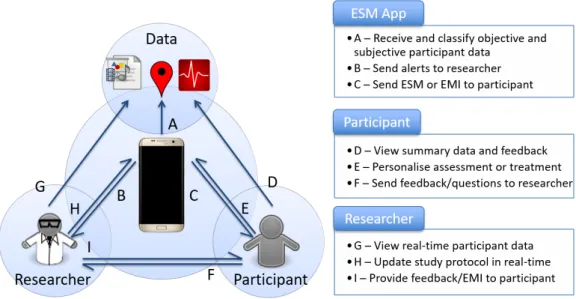
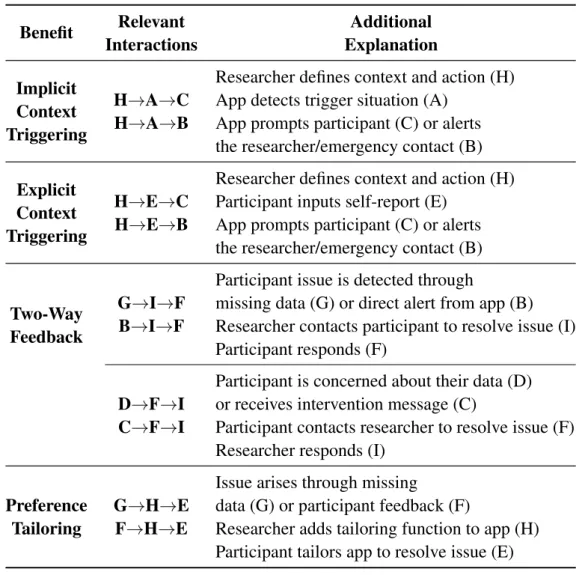
3.2.1 A model of interactions . . . 42
3.2.2 Features of interaction model . . . 51
3.3 Design Implications . . . 54
3.4 Chapter Summary . . . 55
4 End-User Development 57 4.1 EUD and Visual Programming . . . 57
4.1.1 Levels of programming complexity . . . 59
4.1.2 Programming paradigms . . . 61
4.1.3 Evolution of visual programming . . . 63
4.1.4 Organisational factors . . . 67
4.1.5 EUD evaluation . . . 68
4.2 End-User Development of ESM Studies . . . 70
4.2.1 Pioneering tools . . . 71
4.2.2 Modern tools . . . 73
4.2.3 Features and limitations . . . 79
4.2.4 Summary . . . 82
4.3 Design Implications . . . 82
4.4 Chapter Summary . . . 83
5 Design of Jeeves 85 5.1 Introduction to Jeeves . . . 87
5.2 Design Requirements . . . 88
5.2.1 Sampling strategies . . . 88
5.2.2 End-user tailoring . . . 91
5.2.3 Assessment and intervention . . . 94
5.2.4 Communication . . . 98
5.2.5 Summary . . . 100
5.3 Visual Syntax and Semantics . . . 101
5.3.1 Writability - Cognitive Dimensions . . . 102
5.3.2 Readability - Physics of Notations . . . 109
5.3.3 Design principles not applied . . . 112
5.3.4 Summary . . . 114
5.4 Android Application . . . 115
5.4.1 Overview . . . 115
5.4.2 Designing for efficiency . . . 116
5.4.3 Designing for battery life . . . 117
5.4.4 Designing for security . . . 119
5.5 Platform Overview . . . 119
5.5.1 Firebase . . . 119
5.5.2 Update procedure . . . 120
5.6 Discussion . . . 123
5.7 Chapter Summary . . . 123
CONTENTS III
6.1 Research Methods . . . 126
6.1.1 How important is usability? . . . 127
6.2 Study #1: Feasibility and Quantitative Measures . . . 128
6.2.1 Participants . . . 128
6.2.2 Data collection and analysis . . . 129
6.2.3 Description . . . 129
6.2.4 Quantitative results . . . 131
6.2.5 Qualitative results . . . 134
6.2.6 Discussion . . . 141
6.3 Study #2: Health Psychology Student Workshop . . . 142
6.3.1 Participants . . . 142
6.3.2 Workshop structure . . . 142
6.3.3 Data collection and analysis . . . 143
6.3.4 Quantitative results . . . 146
6.3.5 Qualitative results . . . 147
6.3.6 Discussion . . . 150
6.4 Study #3: Think-aloud and Feature Evaluations . . . 152
6.4.1 Participants . . . 152
6.4.2 Procedure . . . 152
6.4.3 Tasks . . . 153
6.4.4 Data collection and analysis . . . 154
6.4.5 Usability issues analysis . . . 156
6.4.6 Positive features analysis . . . 167
6.5 Chapter Summary . . . 171
7 Effectiveness Analyses 175 7.1 Perceived Usefulness of ESM . . . 176
7.1.1 Research methods . . . 177
7.2 Clinician Interviews . . . 178
7.2.1 Perceived potential . . . 179
7.2.2 Initial requirements . . . 184
7.2.3 Facilitating conditions . . . 188
7.2.4 Summary . . . 190
7.3 Researcher Interviews . . . 190
7.3.1 Perceived potential . . . 191
7.3.2 Initial requirements . . . 195
7.3.3 Facilitating conditions . . . 202
7.3.4 Summary . . . 204
7.4 Discussion . . . 205
7.4.1 End-users and their difficulties . . . 205
7.4.2 Overcoming difficulties . . . 208
7.4.3 Necessary features . . . 210
7.4.4 Organisational factors . . . 210
7.4.5 Extending the Technology Acceptance Model . . . 212
IV CONTENTS
8 Observational Research 215
8.1 Research Methods . . . 216
8.1.1 Diffusion of Innovations Theory . . . 218
8.2 Case Studies . . . 220
8.2.1 Research questions . . . 220
8.2.2 Data collection methods . . . 221
8.3 Case Study 1 - ESM During Sport Events . . . 223
8.3.1 Background . . . 223
8.3.2 Timeline . . . 224
8.3.3 Interview . . . 230
8.3.4 Discussion . . . 231
8.4 Case Study 2 - ESM in the Menstrual Cycle . . . 234
8.4.1 Background . . . 235
8.4.2 Timeline . . . 235
8.4.3 Discussion . . . 239
8.4.4 Summary . . . 243
8.5 Clinical Observation . . . 243
8.5.1 Research questions . . . 244
8.5.2 Process . . . 244
8.5.3 Diabetes management clinic . . . 245
8.5.4 Hypertension management . . . 247
8.5.5 GP clinic . . . 249
8.6 Implications for Design . . . 251
8.6.1 Information viscosity . . . 251
8.6.2 Forgetfulness . . . 252
8.6.3 Realistic adoption . . . 252
8.7 Chapter Summary . . . 253
9 Conclusion and Future Work 255 9.1 Summary . . . 255
9.1.1 Research sub-questions . . . 256
9.1.2 Implications . . . 259
9.1.3 Design guidelines . . . 261
9.2 Contributions . . . 262
9.3 Limitations . . . 263
9.4 Future Work . . . 265
Appendix A Appendix-A ESM Survey Publications 267 A.1 ESM Survey Statistics . . . 268
A.2 ESM Survey Table . . . 269
A.3 ESM Table References . . . 274
Appendix B Appendix-B Ethical Approval Documents 283 B.1 Lab Usability Studies . . . 284
CONTENTS V
B.3 ESM in Sporting Events Case Study . . . 286
Appendix C Appendix-C Study Materials 287 C.1 Usability Study 1 . . . 288
C.1.1 Pre-study Questionnaire . . . 288
C.1.2 Jeeves Introduction . . . 289
C.1.3 Study Tasks . . . 297
C.1.4 Post-Study Survey . . . 304
C.2 Usability Study 2 . . . 305
C.2.1 Pre-study Questionnaire . . . 305
C.2.2 Jeeves Presentation . . . 306
C.2.3 Jeeves Walkthrough . . . 309
C.2.4 Study Tasks . . . 311
C.2.5 Post-Study Surveys . . . 314
C.3 Usability Study 3 . . . 316
C.3.1 Pre-study Questionnaire . . . 316
C.3.2 Study Tasks . . . 317
C.3.3 Post-study Questions . . . 319
C.4 Interviews . . . 320
C.4.1 Clinician Interview Script . . . 320
C.4.2 Psychologist Interview Script . . . 322
C.4.3 Post-Case Study Interview Script . . . 324
Appendix D Appendix-D Previous Jeeves Screenshots 325
1
C
HAPTER
O
NE
I
NTRODUCTION
Software is everywhere. Today, in activities such as writing a letter, driving a car, or cooking, it is highly likely that we are software end-users. In a relatively short space of time, computers have evolved from enormous mainframes owned by large organisations, to personal desktop machines in a moderate percentage of households, to the present day, where computers are forever with us, on us and around us. While the number of professional programmers has grown significantly with this evolution, it is dwarfed by the number of software end-users. To satisfy the increasingly diverse and dynamic requirements of these user groups, programmers can no longer remain the gatekeepers to software modifications, and instead must ensure that applications are flexible and customisable to the populations that use them. In short, software must becomesoft.
1.1 Research Context
The definition of soft with respect to software is its adaptability to a variety of end-users, providing each with a tailored experience. Perhaps the most pertinent example of this is the smartphone. Our smartphones are increasingly ubiquitous, yet are far removed from the original vision of ubiquitous computing. In 1991, Mark Weiser imagined that our technologies would “weave themselves into the fabric of everyday life until they are indistinguishable from it”[1, p. 94]. While they are undeniably part of our everyday lives, they do not disappear, and are still inherentlypersonalcomputers. We have a certain attachment to our smartphones as personal devices, and to some extent, they are our digital identities [2], tailored to our preferences and lifestyles.
Smartphones and similar devices are not just personal toys, and in practically every field of research and industry, smartphone apps are becoming the standard for maintaining engagement with, and collecting data from, research participants and customers. From influencing consumer
2 CHAPTER 1. INTRODUCTION
purchases through location-aware advertising, to encouraging healthy exercise and dietary habits, it is increasingly likely that“there’s an app for that”.
1.1.1 Smartphones in healthcare
“The use of mobile and wireless technologies to support the achievement of health objectives
(mHealth) has the potential to transform the face of health service delivery across the globe” -World Health Organization, 2011
This quote from the WHO’s report on mHealth innovations [3, p. 1] exemplifies how app-based solutions to health service issues are being taken seriously by global organisations. Smartphone apps are well-placed to transform healthcare. The variety and popularity of health-related apps available for download are testament to the fact that health consumers are interested in managing and monitoring their health outside of the clinic, with a growing body of evidence demonstrating the beneficial health outcomes from supporting patients to manage their health independently.
This growth has occurred in parallel with that of the prevalence of mobile health apps, giving rise to the practice of ‘mHealth’. mHealth is defined by the World Health Organization as “medical and public health practice supported by mobile devices”[3, p. 6]. Indeed, at the time of writing, there are now over 325,000 health apps available [4], provoking concerns about the lack of evidence-based information in the majority of these apps, and the associated dangers of misinforming their users [5]. In order to maximise the utility and minimise potential harm of app-based healthcare, the NHS currently provides a library of evaluated, NHS-certified apps in which“trusted digital tools for patients and the public to manage and improve their health” are available for download1. This thesis focuses on mHealth apps that are intended for patient
use, and their benefits. Although most apps are intended to be used independent of clinician involvement, other apps are intended to be used as a means of communication between clinician and patient.
1.1.2 Smartphones in research
“It would border on scientific malpractice if we were still giving paper-and- pencil questionnaires
to a few hundred local college students, recruiting a few dozen people to participate in laboratory
tasks, or running Internet studies for people just sitting at desks”[6, p. 222].
This quote from Geoffrey Miller’sSmartphone Psychology Manifestoexemplifies researchers’ interest in the potential to capture rich, informative behavioural data with smartphones. Miller advocates a re-evaluation of psychology research methods in the wake of new possibilities
1.1. RESEARCH CONTEXT 3
afforded by smartphones. This section thus describes how smartphone apps have exposed psychological processes in ways previously impossible using traditional research methods.
While physiological data captured through smartphones can expose participants’ physical health, smartphone apps are also employed to capturepsychologicalinformation. With a growing number of mental disability diagnoses, the ability to understand thoughts and feelings of individuals and groups in different contexts has never been more valuable. Observing participants in their natural environments is the gold standard for capturing their everyday experiences with high ecological validity, free from bias inherent in self-report. However, the process of doing so is both burdensome for the researcher and intrusive for the participant. In lieu of this, smartphone sensors, including GPS chips and accelerometers, as well as data streams such as phone call frequency and social media interactions, can be used to provide a naturalistic insight into participants’ lives. Miller describes how such sensors have enabled automatic collection of user information, free from the need for direct observation or manual self-report [6]. Adams et al. further elaborate on these capabilities in a recent review, describing how both physiological and behavioural characteristics of smartphone users could be passively captured [7].
Sensor-based inference is not always accurate nor appropriate for capturing psychological states. As a compromise, diary studies have participants complete timely self-reports in their everyday contexts, but these raise their own validity questions. For example, participants may not want to carry paper diaries around, they may not fill them in at the right times. Further, the laborious process of transcribing paper data can introduce its own human errors [8]. In light of this, smartphones are increasingly used for remote, repeated data collection. By employing smartphones in this way, psychological data can augment physiological measures, while minimising the burden on participants. This research method is known as experience sampling, and is a focal point of this thesis.
1.1.3 Experience sampling
4 CHAPTER 1. INTRODUCTION
Table 1.1: Terminology of remote, repeated data capture methods, with definitions from literature
Term Field Definition
Experience Sampling
Method Psychology
“A method in which recording of feelings and activities is done on-line at the moment, either at randomly selected
moments or at predetermined times” [12, p. 157] Ecological Momentary
Assessment Medicine “Repeated sampling of subjects’ current behaviors and experiencesin real time, in subjects’ natural environments” [13, p. 1]
Ambulatory Assessment Both “A wide range of assessment methods to study people in theirnatural environment, including self-report, observational, and biological/physiological/behavioral” [14, p. 151]
advantage, the focus of this thesis is primarily on applications that can be run without external hardware such as blood pressure monitors, for example. These definitions, and their fields of origin, are summarised in Table 1.1. For the purposes of this thesis, the term ESM will be used exclusively to refer to any application of the methodology for improving research or clinical practice.
ESM attempts to minimise recall bias and enhance ecological validity- the extent to which the findings of a research study are able to be generalised to real-world settings. Conceptually, participants in ESM studies are instructed to provide details on their current physical or mental state, at various times, as they go about their daily lives. This contrasts with typical laboratory-based assessments, where participants are asked to recall such details that may have occurred days before, or to perform short, rigorously controlled experiments that fail to capture the natural contexts of emotions or symptoms.
Preceding the advent of cheap personal computing, ESM studies were conducted with paper diaries that participants would fill in at various times during the day. These would often be accompanied by a basic signalling device that would randomly prompt participants to fill in a diary. Since then, smartphones have become increasingly ubiquitous across all ages and demographics, providing an opportunity to overcome many of the limitations of paper, by deploying ESM applications directly onto participants’ smartphones. Using this method, the phone acts as both the signalling device and the medium for delivering surveys, through which participants can complete and send their survey results to researchers in real-time.
1.2 Problem Statement
1.2. PROBLEM STATEMENT 5
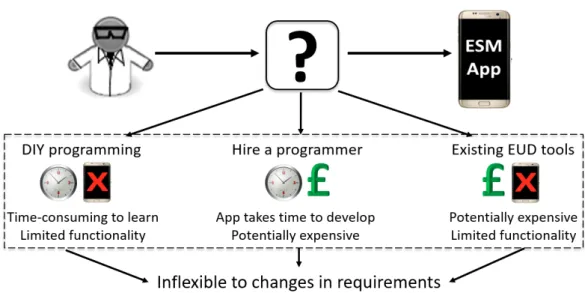
Figure 1.1:Time, cost, limited functionality, and inflexibility may inhibit ESM app creation
from ESM apps generally do not have this experience, nor the time and motivation to acquire it. Similarly, professional programmers are unlikely to have the domain-specific knowledge to understand researchers’ requirements. Irrespective of the financial cost of professional development, further modifications to an app are then dependent on a programmer, and will incur additional time and cost to realise. Another alternative is to use commercially available tools that provide interfaces for creating simple ESM studies, a number of which are discussed in Chapter 4. In addition to their cost, particularly for medium to large-scale studies, all currently available commercial tools are still inflexible in terms of allowing a researcher to capitalise on the full potential of real-time, personalised, context-sensitive ESM apps.
Free and open-source tools are also available for use in the development of smartphone ESM apps, but as the review of recent ESM studies in Chapter 2 highlights, the majority of studies do not reference the use of such software. Indeed, with the lack of standardisation caused by research groups continuing to implement custom apps from scratch, this contributes to the difficulty in replicating their results, defined as a “replicability crisis” [15]. In the literature reviewed in Chapter 2, publications of studies focus on results and statistical analyses. While this is indisputably important, it comes at the expense of brief, generalised descriptions of study specifications. Although textual descriptions of these specifications could be verbose, their omission prevents accurate replication by other researchers in future. With inconsistencies in the implementation and reporting of ESM studies, researchers will encounter issues that others have already faced, and repeat mistakes in data collection and analysis that could have been avoided.
6 CHAPTER 1. INTRODUCTION
smartphone ESM apps are derived, but despite the clear utility of such features, their availability in existing creation tools is highly limited, as is their use in recent ESM studies. In summary, as illustrated in Figure 1.1, it appears that the uptake of smartphone-based ESM in research and practice is currently hindered by difficulty in implementing studies, and the high cost and inflexibility of existing tools to facilitate this implementation. However, there is no hard evidence to confirm that this is the case, and it may be that custom implementations of basic ESM study specifications are satisfactory for researchers, alleviating the need for EUD solutions. As such, the work of this thesis is not simply tool development, but rather the investigation of reasons behind why other tools are not consistently adopted, and what would motivate researchers to do so. This is addressed through answering the research questions defined in the following section.
1.3 Research Questions and Objectives
The work in this thesis focuses onend-user development (EUD), a field of human-computer interaction research that investigates how end-users of software can be empowered to create and modify such software to satisfy their own diverse and dynamic requirements [16]. The underlying motivation is that, by allowing researchers to develop and deploy their ESM apps independent of a professional programmer, this will significantly lower the existing barriers to addressing research questions and healthcare issues that could benefit from such apps.
Towards understanding these existing barriers and how they could be overcome, this thesis describes the design, development and analysis ofJeeves(Java End-user Environment for Visual Experience Sampling) a desktop-based end-user development tool that allows researchers with no programming skills to create their own ESM apps, couple them to participants’ smartphones, and receive results in real-time. By deriving design requirements from previous literature, implementing a prototype and evaluating it in terms of usefulness and usability, the following research question is addressed:
Research Question
What factors influence the adoption of technology for researchers and clinicians to develop experience sampling smartphone apps?
1.3. RESEARCH QUESTIONS AND OBJECTIVES 7
not take into account whether the technology would actually be useful, nor whether it could be feasibly deployed in practice.
From this overarching question, four sub-questions have been derived that, while not mutually independent, can be separately investigated. These sub-questions are defined below, followed by the methods applied in this thesis to answer them.
Research Sub-Questions
• What difficulties do researchers and clinicians face that allowing them to develop experience sampling apps could alleviate?
• What are the necessary features of apps that facilitate remote assessment of research participants or clinical patients in their natural environments?
• How can the development effort be reduced to allow rapid creation of experience sampling apps without requiring programming experience?
• How can researchers and clinicians employ an experience sampling app end-user development tool in practice?
1.3.1 Research methods
The research methods undertaken to answer this question can be classified using the scheme developed by Kjeldskov and Graham for categorising research methods in Mobile HCI [17]. Five different research purposes are described as follows, with definitions taken from work by Tetteroo and Markopoulos [18]:
• Understanding:Research aimed at understanding the particulars of a phenomenon studied • Engineering:Research aimed at the original development of a tool or technology
• Re-engineering: Research aimed at the engineering of modifications or extensions to an existing tool or technology
• Evaluating:Research aimed at the assessment, validation and assurance of tools, technology, models and frameworks
• Describing:Research aimed at describing the ideal properties of a system or situation
8 CHAPTER 1. INTRODUCTION
1.3.2 What difficulties do researchers and clinicians face?
Objective 1 -Gather feedback from end-users with a potential interest in ESM studies, namely researchers in social psychology and practising clinicians. Through semi-structured interviews, gain insight into their current working practices, use of technology to support research and practice, and difficulties in doing so. This means of understanding will be accomplished throughsurvey research.
Objective 2 - Observe the working practices of potential end-users of Jeeves, in order to determine any barriers related to usage context. This observation should be as naturalistic as possible, and is again a type ofunderstandingresearch, achieved through afield study.
1.3.3 What are the necessary features of apps?
Objective 3 -Review recent publications that describe a study utilising experience sampling. Extract the different technologies used, sampling strategies, compliance rates and other study-specific factors where they have been appropriately described. In this objective, one goal is
understandinghow ESM studies are currently conducted, with a further goal of describing
useful properties of ESM apps. As a literature review, it is classified asbasic research.
Objective 4 - Review the current state-of-the-art in ESM app creation software. A source of such tools will be publications reviewed as part of the previous objective, but will also take into account commercial tools found via web search engines, and in particular, tools found from searching computer science literature databases. Again, as a literature review, this isbasic
research, with the purpose ofdescribingthe minimum requirements of a novel tool.
1.3.4 How can the development effort be reduced?
Objective 5 -Utilising interdisciplinary knowledge of EUD and ESM studies, both theoretical and practical, design and implement a prototype application (Jeeves) allowing non-programmers to create their own ESM smartphone apps. This is an objective with the purpose ofengineering, achieved through the method ofapplied research.
1.4. CONTRIBUTIONS 9
1.3.5 How can a development tool be used in practice?
Objective 7 - Following usability feedback gathered from the previous objective, conduct interviews with researchers and clinicians addressing the perceived usefulness of Jeeves in their domain of research or practice. Again, this isevaluatingresearch, focused on the real-world utility of Jeeves, throughsurvey researchwith potential end-users.
Objective 8 -To evaluate researchers’ practical application of Jeeves, rather than simply their perceivedutility, conductcase studieswith researchers in which they apply Jeeves in addressing their own research questions. This is furtherevaluatingresearch, demonstrating the utilityand usability of Jeeves in its context of use.
1.4 Contributions
Through the interdisciplinary work described in this thesis, the following theoretical contributions are of value to human-computer interaction, as well as psychology research and clinical practice.
• A literature review of user-centred design studies and strategies for maximising ESM study utility, from which guidelines for future ESM tools are derived (Chapter 3)
• A series of user studies that demonstrate the usability of the Jeeves blocks-based programming paradigm, with implications for domain-specific EUD and blocks-based programming (Chapter 6)
• A qualitative analysis of interviews, observations and case studies involving researchers and clinicians, from which a set of requirements are derived for ESM app EUD, with implications for other novel technology deployed in such domains (Chapters 7 & 8)
• A set of design guidelines for the development of future EUD-ESM tools, consolidated from the results of analytical and empirical research (Chapter 9)
Further, the Jeeves platform represents a practical contribution, which can be utilised by non-programmers interested in running ESM studies. It consists of:
• The Jeeves blocks-based programming tool, allowing non-programmers to specify tailored, context-sensitive ESM apps, collect data and monitor compliance in real-time
• A dynamic Android ESM app (JeevesAndroid) that has been developed in parallel with the visual programming environment that can run any apps created with the Jeeves tool
10 CHAPTER 1. INTRODUCTION
Table 1.2:Objectives addressed in each of the primary thesis chapters
Chapter Objectives Addressed
2 O3 - Review recent ESM studies in psychology and medicine,compare and contrast with ESM studies in computer science
3/4 O4 - Review state-of-the-art EUD tools and address limitations
5 O5 - Implement Jeeves, JeevesAndroid and the overall framework
6 O6 - Conduct targeted, task-based usability evaluations of Jeeves
7 O1 - Understand working practices of researchers and cliniciansO7 - Evaluate researchers’ and clinicians’ perceived utility of Jeeves
8 O2 - Observe working practices of potential clinician end-usersO8 - Conduct case studies with psychology researchers using Jeeves
1.5 Thesis Overview
This thesis is organised into nine chapters. Table 1.2 describes where the objectives outlined in previous sections are addressed in each of these chapters. As can be seen from this table, the objectives are not addressed in order. Further, the working practices of researchers and clinicians, and associated requirements, were not addressed until after implementation of a fully-working prototype. Justification for this limitation is described in Chapter 9.
Chapter 2provides detailed background information on ESM, explaining the various benefits and challenges of ESM, its use in research as well as clinical practice, and the evolving contribution of technology to ESM. Further, a review of recent ESM studies is presented, demonstrating the current challenges.
Chapter 3 reviews background literature on the use of smartphone apps in healthcare and psychology, deriving guidelines for future ESM tools from their stakeholders’ perspectives. From this, a model is synthesised that represents these features as interactions between apps, researchers and participants.
Chapter 4reviews background literature related to EUD. From this, a review of tools for ESM study creation is presented, analysing each tool with respect to the app features identified in the previous chapter, providing motivation for the implementation of Jeeves.
1.5. THESIS OVERVIEW 11
and overall architecture.
Chapter 6 describes three studies that were conducted to investigate the usability of Jeeves for non-programmers, and the iterative development improvements that were made as a result of feedback from these studies. Additionally, design guidelines for domain-specific visual programming environments are derived from this study feedback.
Chapter 7 details a qualitative analysis of interviews that assess the potential contribution of Jeeves to psychology research and clinical practice. These interviews discuss current working practices and associated difficulties of researchers and clinicians, and elicit their preliminary feedback on the Jeeves prototype. From these interviews, further factors addressing the utility of a tool for ESM app creation are derived.
Chapter 8 describes case studies that validate the efficacy of Jeeves for creating a study specification and running it with participants, with further feedback on real-world usability and utility. It also describes an observation session that was conducted in a local clinic to determine further factors for adoption in this domain.
2
C
HAPTER
T
WO
E
XPERIENCE
S
AMPLING
This chapter describes the Experience Sampling Method (ESM) in more detail, including the general methodology, its advantages and disadvantages, and relevant domain-specific concepts. ESM, and the closely related method of Ecological Momentary Assessment, have their roots in psychology and clinical research respectively. In human-computer interaction, the methodology has been borrowed for evaluating how users interact with technology in natural contexts, just as ethnographic methods have been borrowed from social science for the same purpose. As a contribution to the method, human-computer interaction researchers can develop interfaces that facilitate the creation of ESM smartphone apps - the overarching goal of this thesis.
This chapter defines ESM in more detail, describes its benefits and limitations, and how it has contributed to research in a variety of fields. Further, a review of recent ESM literature has been conducted, providing insights of relevance to this thesis.
2.1 Overview
Experience sampling studies involve asking participants to complete assessments on their current thoughts, feelings or context, as they go about their everyday lives. Indeed, the aforementioned Ecological Momentary Assessmentsummarises the defining features of the method in its title:
• Ecological:Data collection takes placein situ, as participants go about their everyday lives, as opposed to an artificial lab environment.
• Momentary:Participants are asked to report their statein-the-moment, rather than summarise over many hours, days or weeks.
• Assessment: Participants provide data through explicit self-report of their current states (although implicit data is also used as a secondary source, as described in Section 3.1).
14 CHAPTER 2. EXPERIENCE SAMPLING
Table 2.1:Summary of main benefits and challenges of experience sampling
Benefits Challenges
Participants are assessed in their natural environments -high ecological validity
Implementation can be difficult, costly and burdensome for researchers and participants Participants are asked about events close to
their occurrence,minimising recall bias
Continuous assessment can influence variables of interest -assessment reactivity
Repeated assessment allows observation of
dynamic and contextual associations
Repeated assessment places high burden on participants, provokingnon-compliance
These features of ESM provide benefits over other qualitative research methods of data collection such as retrospective self-report, or face-to-face interviews. Nevertheless, these benefits also present challenges that require further research and interdisciplinary knowledge to overcome. This section will discuss both these benefits and challenges, and their implications for research, with a summary shown in Table 2.1.
2.1.1 Benefits
The benefits of ESM for capturing the intricacies of daily life as they occur have been widely acknowledged and described in various reviews on the methodology. This section summarises these benefits, which have justified its continued use in psychology and medicine, and its novel application in other fields. The following benefits are agnostic to the technology used, and are thus applicable to paper-based applications of ESM as well as mobile technology. (More specific advantages of smartphones for ESM are detailed further in Section 3.1.)
2.1.1.1 Ecological Validity
The validity of ESM self-reports are enhanced by both the temporal constraints on assessments, as well as the contexts in which these assessments take place. Having participants report on experiences, feelings, or other variables in their natural environment increases the ecological validity of assessments [19]. Conversely, participants in an unfamiliar laboratory or clinic are less likely to disclose sensitive information. In medicine, a relevant phenomenon is that of “white-coat hypertension”, where patients experience raised blood pressure in direct response to
the clinical environment.
2.1. OVERVIEW 15
whereas experience sampling measures can be used to acquire this context at the time of assessment. This is necessary for monitoring certain behaviours; for example, substance use is highly dependent on situational cues and social context [20].
2.1.1.2 Minimal Recall Bias
Themomentaryaspect of experience sampling alleviates participants from relying on recollection of past experiences. When asked to recall emotions or physical symptoms from a previous point in time, responses are inherently subjected to “recall bias”. The passage of time can distort one’s perception of a particular incident, and indeed one’s current state can influence recollection of past state. Research has also shown that participants may employ a “peak-end rule”, whereby summaries of experience over time are biased towards the most salient and recent experiences [21].
Experience sampling minimises this bias by reducing the time between an event of interest and the time at which this event is assessed. Further, summaries of experience are largely unnecessary, as only participants’ immediate state is requested at each repeated assessment [13]. Studies have indeed identified the discrepancy between real-time data collection and retrospective self-report methods [22, 23], emphasising their importance for researchers in capturing less biased, contextually relevant data from participants.
2.1.1.3 Dynamic and Contextual Associations
The longitudinal aspect of experience sampling enables the collection of ecologically valid data for sustained periods of time and in a variety of contexts. In contrast, other assessment methods involving cross-sectional data collection limit possible analyses to differences between participants at specific contexts or instances of time. In capturing within-participant differences across time and contexts, ESM data offers a variety of analysis opportunities. Shiffman et al. characterise four such uses [13], which are explained and justified with additional examples.
Individual differences
16 CHAPTER 2. EXPERIENCE SAMPLING
Myin-Germeys et al. used experience sampling to distinguish levels of emotional reactivity between participants with three different psychological disorders [24]. Trull et al. similarly distinguished emotional instability between participants with borderline personality disorder (BPD) and those with depressive disorder [25]. While the emotional instability of the BPD participants in comparison to the depressed participants was known prior to the study, these results validated experience sampling for exposing such differences.
Describing history
While aggregation of ESM data is useful for obtaining accurate between-participant variation, a key benefit of experience sampling is that the resulting longitudinal data exposes within-participant differences. This is particularly important for assessing traits that can fluctuate rapidly over time, allowing researchers to study dynamic processes. Ebner-Priemer and Trull discuss this in their review of ESM in mood disorders, where studies were used to quantify the instability of individuals with BPD over a period of time [26].
Scollon et al. refer to within-participant analyses as idiographic research, as opposed to nomotheticresearch [12], which investigates group variations. In the clinical research domain, repeated, idiographic assessments are necessary to capture the dynamic factors of certain conditions. For example, instability cannot be observed in cross-sectional assessments of other conditions characterised by rapid fluctuations, such as psychosis and bipolar disorder.
Temporal sequences
Insights obtained from within-participant variations in idiographic research are largely inde-pendent of the sequence in which these variations occur. However, Shiffman et al. describe how the temporal sequence of states, in addition to their length and magnitude, can provide a further source of analysis. A number of studies have investigated the contextual factors that surround the occurrence of events in particular domains. For example, Haedt-Matt and Keel present a meta-analysis of studies using ESM to investigate the precursors and consequences of binge eating [27]. A study by Mitchell et al. found significant antecedents and consequences of smoking behaviour through experience sampling, with implications for clinical practice [28].
Contextual factors
self-2.1. OVERVIEW 17
report [20]. Additionally, certain contextual information can be captured through external devices. For example, Dunton et al. were able to investigate the contextual factors of physical activity by employing accelerometers [29]; Ilies et al. found associations between affect and cardiovascular functioning in a workplace environment with a wearable heart-rate monitor [30]. In recent years, contextual variables have also been captured by sensors embedded in smartphones, the capabilities and advantages of which have been revered for behavioural and clinical research [7, 31]. Further detail on sensor use in ESM is discussed in Section 3.1.
Treatment monitoring
Shiffman et al. do not explicitly mention treatment monitoring in their applications of experience sampling, instead focusing on its usage in research. However, such an application offers unique advantages in clinical practice. For example, frequent travel to appointments is time-consuming and costly, as well as physically difficult for patients with disabilities. As a potential solution, the remote monitoring of symptoms through ESM could reduce the number of routine face-to-face appointments that are required. This reciprocally benefits clinicians themselves, for whom time is saved through supporting patients’ independence in monitoring their own health.
In one study, Wichers et al. reviewed the potential for ESM to assist in the treatment of patients with clinical depression, with quantified, visualised feedback on symptomatic states allowing for “patients and clinicians alike to understand, modify and track the experiences that are currently
subsumed under the ‘black box’ diagnosis of depression”[32, p. 264]. A recent review by van Os et al. further discusses the advantages of smartphone technology to ESM in practice [33]. Examples include the regular assessment of symptoms and emotions to identify optimal doses of medication, and to uncover correlations between co-existing symptoms. ESM can even promote positive mental states, where the simple act of self-monitoring and receiving feedback can act as a form of behavioural intervention [34].
2.1.2 Challenges
18 CHAPTER 2. EXPERIENCE SAMPLING
2.1.2.1 Participant burden
The completion of assessments at various times of the day can interrupt the normal activities of participants’ lives. Traditional paper diary studies are particularly burdensome, where in addition to mental disruption caused by unexpected prompts, participants are physically encumbered with these paper diaries, which must be on-hand for the duration of a study. Indeed, physical burden is not limited to paper-based methods; electronically administered ESM studies often require that participants carry cumbersome, bespoke study devices. Furthermore, if an assessment schedule is too intense, or does not fit with participants’ own personal schedules, study attrition (drop-out) is a risk. Participants’ compliance is contingent on a number of external factors, but studies tend to show a significant decrease in both data quantity and quality over as little as seven days [35]. Attrition and non-compliance are major issues that require a careful balance of assessment frequency, length, and timings that will vary between and within groups of participants. Christensen et al. propose that the intensiveness of the sampling schedule and the length of each requested assessment are the greatest contributing factors to participant compliance. As a general guideline, they suggest that each assessment should take no longer than two minutes to maximise completion rates [8].
Due to the onerous nature of experience sampling studies, it has been hypothesised that a “self-selection bias” may occur, whereby those who volunteer to participate in such studies are more likely to be motivated, technologically adept individuals [12]. Experience sampling studies may be particularly burdensome to certain populations, especially when they are administered on smartphones [13]. Elderly populations, children, and those with low socio-economic status, are potentially problematic groups for applying ESM with. Although smartphone-based assessments are designed to lower participant burden, this depends on familiarity with such devices. For example, a study by Harrison et al. showed that the uptake and adherence to a smartphone-based self-help program was inhibited by older adults, who would only use their smartphone for emergencies. Access by those in rural areas with poor network coverage was also limited [36].
2.1. OVERVIEW 19
2.1.2.2 Reliability of reports
Although experience sampling is intended to minimise the time between an event of interest and its subsequent reporting, recall bias can still be a problem. When paper methods are used, it is common for participants to complete a number of missed diary entries at the same time - a phenomenon known as “backfilling”. This issue was potently highlighted in a study by Stone et al. where participants were given paper diaries to complete, which were secretly instrumented to log when they were opened, and for how long. The results were a serious concern to the validity of previous diary studies, in that while 90% of entries were completed, only 11% were completed within the allotted 30 minute time slot. Indeed, 45% of participants “forward-filled” entries in order to alleviate themselves of future burden [39]. Periods of backfilling time were prevalent immediately before weekly updates with the study researchers.
In addition to issues of honesty, there is evidence that regularly prompting participants to answer questions on particular experiences of their life can invokereactivity, where the perception of these experiences are altered by the act of their assessment. In some fields of research, this has been termed the “Hawthorne Effect” and is a significant detriment to the validity of participant research [40]. For example, if participants are frequently asked to monitor their food cravings, the constant reminder of food could make these cravings more salient, thus affecting further reports. This negative reactivity occurs when a participant reacts to continuous prompts in potentially harmful ways [41]. Conversely,positivereactivity occurs when a participant engages in healthy behaviour in response to prompts. A critical review of alcohol treatment assessment reactivity was undertaken by Clifford and Davis [42], demonstrating moderate to strong effects of repeated assessment on the decreased consumption of alcohol. Clearly this can be an advantage in treatment, in that the simple act of self-reporting a behaviour can invoke positive change.
Although participants may be out of control of their reactivity to continuous assessment, they may also deliberately change their responses in order to positively present themselves. This is a type of reactivity known associal desirability bias, which in addition to threatening the validity of research data, can result in significantly worse health outcomes in practical applications, for those who falsely report positive results [43, 44]. Such a bias may also be contingent on the particular area of study. For example, the study of aggressive behaviours or excessive overeating may cause participants to feel self-conscious about reporting such behaviours [45].
2.1.2.3 Practical implementation
20 CHAPTER 2. EXPERIENCE SAMPLING
acquiring bespoke study devices is costly for researchers, and burdensome for participants, who are inconvenienced by carrying an additional device. Cost and burden are also inherent in the implementation of software on chosen devices. The development of ESM software can incur financial cost, whether through hiring a professional programmer, or relying on the services of a commercial company. While free software and services are currently available, many are restricted to obsolete devices, such as theExperience Sampling Programfor PDAs [46]. Others are unsupported research projects, or have functionality limitations that impact participants’ experience and thus reduce compliance.
In summary, these challenges serve to show that experience sampling is not a straightforward methodology. Nevertheless, its advantages are such that it continues to be frequently employed in psychology and clinical research. There are no rigorous guidelines to the schedule of assessments, and studies take a variety of approaches, as described in the following section.
2.1.3 Sampling strategies
The schedule of assessments is a critical factor in experience sampling studies. The strategy must be chosen to match the research question, and often combinations of strategies are utilised to maximise the chance of collecting relevant data. The sampling frequency and duration of a study must be balanced between capturing rich, informative data and minimising participant burden. The frequency of assessments may depend on the number and complexity of questions to be answered at each assessment, the number of days over which a study takes place, or the compensation given to participants for their compliance. Generic sampling strategies that do not rely on particular technology are defined by Wheeler and Reis as interval-contingent, signal-contingent, and event-contingent, described as follows [47].
2.1.3.1 Interval-contingent
With interval-contingent sampling, participants respond to prompts at specific times of the day, or at predictable, regular intervals. For example, participants may complete an assessment every morning upon waking, or receive prompts spaced two hours apart.
2.1. OVERVIEW 21
2.1.3.2 Signal-contingent
With signal-contingent sampling, participants respond to prompts that come at unpredictable times. Such studies generally have participants receive a set number of prompts that are randomly distributed in their waking hours. Signal-contingent sampling is therefore more appropriate for studying phenomena that could be susceptible to recall bias, and to states that may change due to conscious emotion regulation [8].
One potential disadvantage of this schedule is that prompts can be clustered within a short space of time, increasing participant burden. To minimise this burden, prompts are often scheduled to occur once within given time windows, with a constraint on the minimum time between two prompts. Even then, random prompts are burdensome when they occur at a time that is inconvenient for a participant, such as when driving or showering.
2.1.3.3 Event-contingent
Finally, temporal sampling schedules are not always appropriate for monitoring particular events or behaviours. For example, assessing participants’ experience during or directly after smoking could require an obtrusive number of prompts in order to catch the event with reasonable accuracy. Instead, event-contingent sampling has participants self-initiate assessments on the occurrence of these particular events. This is advantageous in that experiences are captured with no time delay, resulting in minimal recall bias. Further, as participants choose the times at which they complete surveys, it is the least burdensome of the sampling strategies.
One problem with event-contingent sampling is that participants may be inclined to under-report events. Although attempts are being made to capture events of interest implicitly, such studies may require participants to wear obtrusive hardware such as a wrist-worn accelerometer, or a bio-harness to monitor heart rate and blood pressure [48]. (Initiating assessments based on automatically sensed context is known ascontext-contingent sampling, and will be discussed in Chapter 3.) Event-contingent sampling is also inappropriate for capturing the antecedents and consequences of behaviours of interest, or for mapping out participants’ history.
These three sampling schedules remain central to present-day experience sampling studies, whereas the technology upon which they are deployed has evolved significantly, as explained in the following section.
2.1.4 Evolution of implementation
22 CHAPTER 2. EXPERIENCE SAMPLING
Table 2.2:Media for ESM data collection, their advantages and disadvantages
Medium Advantages Disadvantages
Paper Diaries
Cheap Flexible
Familiar to all participants No programming required
Cumbersome Can’t monitor compliance
Participants can backfill Requires transcription
PDA
Cheap
Less bulky than paper diary Easily distributed Data in digital form
Cumbersome Can’t monitor compliance
Requires programming
SMS with online survey
Can use participant’s device Real-time data transfer No programming required
Requires Internet connection Requires mobile signal
Potentially expensive if multiple SMS messages are sent
Tedious if SMSs must be sent manually
Smartphone
Can use participant’s device Capture implicit context
Real-time data transfer Sophisticated sampling strategies
Potentially expensive if participants must be loaned devices Requires programming
integrating sophisticated technology into an ESM study is beyond the programming capabilities and financial resources of researchers. Due to these constraints, they may be required to default to more simplistic or cheaper methods. Media upon which ESM studies have been employed are detailed as follows, and summarised in Table 2.2.
2.1.4.1 Pen and paper
2.1. OVERVIEW 23
could itself reduce the validity of data. Further, infrequent diary entries preclude the detection of short-term, rapid fluctuations throughout the day as they unfold.
Prior to the beginning of this century, nearly all ESM studies were conducted with paper diaries. At previously set times, or on occurrence of particular events, participants would fill out paper forms and return them to researchers at the end of the assessment period. As previously discussed, backfilling of these diaries is a particular problem, with no direct means of determining exactly when the participant initiated and completed the diary entry.
Nevertheless, in their simplicity, paper diaries still have potential advantages over more advanced implementations; paper is cheap, easily replicable, and intuitive for all literate participants. From the researcher’s perspective, setting up a study does not require any additional technology or knowledge of programming. However, participants must still incur the burden of carrying around these paper forms, and possibly an additional signalling device. Researchers are also burdened by this medium of data collection, as further analysis of collected data requires manual transcription of paper entries into a digital form.
2.1.4.2 Bespoke devices
Electronic ESM was reported as early as 1985, where portable “microcomputers”, carried on a shoulder strap, were pre-installed with experience sampling software, distributed to participants, and returned at the end of the study for data download and analysis [49]. Intended for proof-of-concept studies, such devices were more physically burdensome to participants than paper diaries, although the central data storage and ability to timestamp entries for determining compliance was appreciated by researchers in these early studies.
As technology evolved, bespoke handheld devices such as PDAs became the state-of-the-art in ESM study devices. Much like their paper diary counterparts, these devices were loaned to participants and collected at the end of the study for data download. At the present time, these devices are cheap and as such pose significantly less financial cost to researchers. However, they may still be cumbersome to carry, particularly given that participants are likely to be carrying a separate mobile device simultaneously.
Many of the free tools allowing researchers to create ESM study applications are intended for these bespoke devices. For example, theExperience Sampling Programis designed to be run on PDA devices [46]. Other commercial tools such asSatellite Forms1andPendragon Forms2 are also used in PDA-administered studies. (Further tools are discussed in detail in Section 4.2.)
24 CHAPTER 2. EXPERIENCE SAMPLING
Although PDAs are still prevalent in recent ESM research, their use is declining in favour of more sophisticated smartphone applications. For example, thePsyMate platform initially provided software that would run on bespoke devices. However, this has now been replaced by a smartphone app for Android and iOS devices3.
2.1.4.3 Phone/SMS services
Other common techniques that do not require a bespoke device or app are those that utilise the call and messaging functionality of participants’ mobile devices. In such studies, participants are either called and asked to respond to survey questions vocally [50, 51], or sent assessments in an SMS message. In the former case, phone calls may be initiated directly by a researcher, or automatically through a pre-programmed schedule combined with an Interactive Voice Response (IVR) program. Using an SMS protocol, participants may receive the survey questions directly, to which they respond with another text message containing their answers [52, 53], or alternatively, the message provides a link to an online survey [54, 55].
If, in the case of the phoning protocol, participants talk directly to a researcher, this could be particularly sensitive to social desirability bias. Further, vocally responding in a public place is less private than completing a written diary entry. Another disadvantage to both phone and SMS protocols is that they rely on participants having sufficient network coverage, which may not be the case in rural areas. Finally, if participants are required to respond to surveys via SMS, this incurs financial burden on these participants, which they must be compensated for.
2.1.4.4 Smartphones
Smartphones are increasingly popular across all age groups and cultures, making them a viable option for deploying experience sampling applications to a wide audience. Indeed, a recent survey suggests that smartphones are beginning to penetrate the senior population, with over 70% of surveyed users aged 55-75 reportedly using a smartphone4. By developing apps that can
run on participants’ own devices, this alleviates the burden of carrying a bespoke device, or paper diaries. If native apps are used for assessment prompts and completion, this also eliminates the problem of network coverage, and financial cost of sending SMS messages to researchers.
Smartphones are powerful computers, with functionality extending far beyond the basic calling and messaging features of their predecessors. They are thus ideal platforms for providing and collecting contextual information from their owners [6]. Further advantages of smartphones are discussed in the following chapter, and in particular their contribution to state-of-the-art
3http://psymate.be/psymate–en-.html Accessed 17/03/18
2.2. RECENT ESM STUDIES REVIEW 25
ESM studies. As a short summary, sensor capabilities, web connectivity and widespread mass adoption are some of the strongest advantages. Smartphones contain a wealth of sensors and data streams that can be probed to provide additional contextual information, independent of external hardware or user input. Additionally, smartphone web connectivity allows data to be instantly accessible by researchers as a participant records it, such that compliance can be monitored and data analysed in real-time.
2.2 Recent ESM Studies Review
In order to determine the current state of ESM in research, a literature review was conducted, with a similar structure to that of van Berkel et al. in a recent survey of ESM on mobile devices [56]. Their systematic review used digital libraries focused on computer science literature, providing an excellent overview of ESM in this domain. Instead, the following review is intended to assess the use of ESM in general research, where the focus is on participants as opposed to the technology used to assess them. This review is not systematic - to select a tractable number of publications with the broad scope of available literature, significant constraints had to be applied. For example, the search term “‘experience sampling’ OR ‘ecological momentary’” returns 17,700 hits on Google Scholar, with 7,320 since 2017 alone.
The final search was modified to only include publications withexperience samplingorecological momentaryin the title, limiting the returned results to 318 since 2017. With this constraint, the following review only covers a small fraction of relevant publications. For a systematic review, in addition to surveying all 7,320 results returned in Google Scholar, other digital libraries would have had to be used, as well as additional keywords. For example,ambulatory assessment, a phrase often applied to studies recording physiological measurements, can also represent studies that repeatedly collect self-reported data [26]. Nevertheless, employing this filter means that a broad range of literature is covered, including publications from psychology, medicine, computer science, and business journals, while keeping reviewed publications to a reasonable number. Further, this strategy ensured that experience sampling was a focal point of the publication. Studies were removed if they were meta-analyses of ESM, described ESM as a potential research method in a particular domain, proposed a protocol for a randomised control trial, or the full text of the publication was unavailable for access. After this filtering process, a total of 121 publications remained.
26 CHAPTER 2. EXPERIENCE SAMPLING
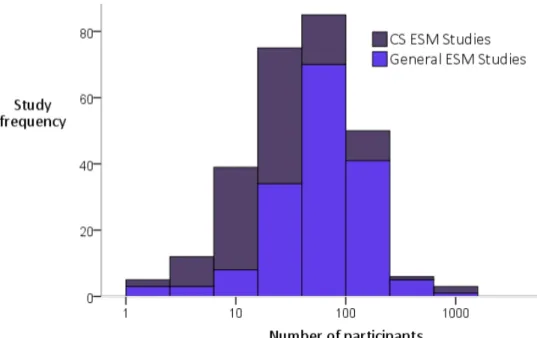
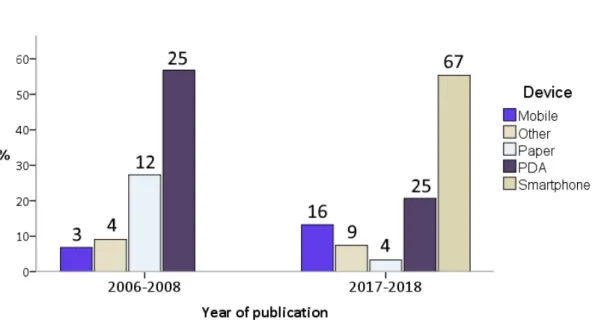
in this 10 year period. From the search process, a total of 177 hits were returned that, after the same filtering process, resulted in 43 publications being included, for a total of 164 publications. (However, there are 165 studies due to one publication containing two separate ESM studies.) A table of these publications with their parameters and references is included in Appendix A. The broad research area of each of these publications is almost exclusively psychology or medicine, with all studies designed to capture participants’ emotional or physical states across a set time period. In order to represent the spread of publications more specifically, high-level categorisation was employed, based on publications’ titles and abstracts. For example, 29 studies focus on participants with addiction to drugs, alcohol or smoking. 18 studies focus on participants engaging in weight management, where diet or exercise habits are tracked. 10 studies focus on participants tracking the symptoms of physical impairments and diseases, including HIV and cancer. 48 studies involved participants with varying degrees of specific mental disorders, including depression (11), eating disorders (10), schizophrenia (9), psychosis (7), borderline personality disorder (4), post-traumatic stress disorder (4) and ADHD/autism spectrum disorders (3). In addition to such studies published in psychology and medicine journals, six were published in the domain of education (with four related to students’ learning and engagement, and two related to teachers’ stress and emotional experiences). Finally, of particular relevance to this thesis, three publications address HCI issues towards increasing compliance in ESM, including visualisation [58], gamification [59] and use of wearables [60].
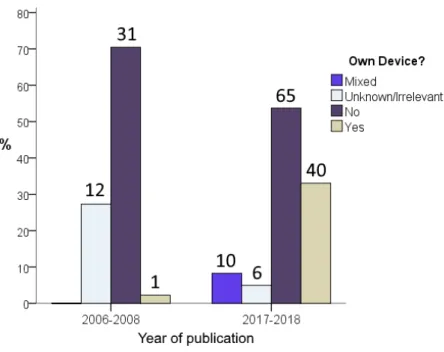
The systematic review by van Berkel et al. of studies in computer science (hereby referred to as “CS studies”) collected various parameters, on which the studies included in this review are compared, including: number of participants, duration, compliance, compensation, trigger type, use of sensors, and device ownership. In addition, the type of device used (ranging from smartphones to paper diaries) is included. Finally, the total number of assessments prompted over the course of a study is also included to assess the level of impact this had on compliance.

![Table 3.2: Selected rows of table in [57], describing the state of context-sensitive ESM](https://thumb-us.123doks.com/thumbv2/123dok_us/8755182.390238/63.892.168.740.215.554/table-selected-rows-table-describing-state-context-sensitive.webp)