Distance transform: a tool for the study of animal colour
patterns
Christopher H. Taylor*, Francis Gilbert and Tom Reader
School of Biology, University of Nottingham, University Park Campus, Nottingham, NG7 2RD, UK
Summary
1. The information in animal colour patterns plays a key role in many ecological interactions; quantification would help us to study them, but this is problematic. Comparing patterns using human judgement is subjective and inconsistent. Traditional shape analysis is unsuitable as patterns do not usually contain conserved land-marks. Alternative statistical approaches also have weaknesses, particularly as they are generally based on summary measures that discard most or all of the spatial information in a pattern.
2. We present a method for quantifying the similarity of a pair of patterns based on the distance transform of a binary image. The method compares the whole pattern, pixel by pixel, while being robust to small spatial variations among images.
3. We demonstrate the utility of the distance transform method using three ecological examples. We generate a measure of mimetic accuracy between hoverflies (Diptera: Syrphidae) and wasps (Hymenoptera) based on abdominal pattern and show that this correlates strongly with the perception of a model predator (humans). We calculate similarity values within a group of mimetic butterflies and compare this with proposed pairings of M€ullerian comimics. Finally, we characterise variation in clypeal badges of a paper wasp (Polistes dominula) and compare this with previous measures of variation.
4. While our results generally support the findings of existing studies that have used simplerad hocmethods for measuring differences between patterns, our method is able to detect more subtle variation and hence reveal previously overlooked trends.
Key-words: image analysis, individual recognition, MATLAB, mimicry, signalling, similarity
Introduction
Colour patterns play a key role in many animal interactions (Cott 1940). Signal receivers must discriminate among patterns with significant information content, such as social dominance (Møller 1988) or toxicity (Brodie 1993). To understand such decisions fully, we need a way of extracting the information contained in the colour pattern observed. There exist effective standardised methods for comparing colours (Endler & Mielke 2005; Stoddard 2012), but ways of quantifying the spatial aspect of a pattern are less well developed.
Humans have extremely good visual capabilities and cogni-tion (Pinker 1984) and hence, when studying colour patterns, often find it easy to make qualitative decisions about the infor-mation in a signal and classify the patterns appropriately. However, if asked to articulate rigorously and precisely the reasons behind such decisions, we find this far more difficult. This means that the outcome of such comparisons is subjective and inconsistent. Furthermore, humans, like all species, perceive the world in a way that is subtly constrained by their sensory and cognitive abilities. Differences in factors such as spatial resolution and spectral sensitivity, as well as higher
processing, mean that the human perception on which a judge-ment is based may not accurately reflect that of the most relevant signal receiver (Endler 1990).
An alternative is therefore to use automated, computer-based methods for comparing patterns. Traditional methods of shape analysis are inappropriate, as they rely on the selection, either manual or automatic (Boyeret al.2011), of homologous landmarks. These are unlikely to exist in colour patterns, espe-cially when comparing disparate taxa, such as will often be the case in examples of mimicry. To capture pattern information in a more flexible way, there are two main types of approach, both well developed in computer science. The first involves ‘feature extraction’: creating a statistical summary for each of the patterns under study, often based on properties of the image in the frequency domain using Fourier transforms (Zhang & Lu 2002), or on ‘moment invariants’ (Khotanzad & Yaw Hua 1990). A simple measure such as Euclidean distance between two summary vectors can then give the dissimilarity between two patterns (Zhang & Lu 2003). This type of method is commonly used in image retrieval algorithms, where an image is sought within a large database that shares similar properties to a target image (Rui, Huang & Chang 1999).
The second approach involves direct comparison of individ-ual pixels or regions of pixels through, for example, cross-correlation (Briechle & Hanebeck 2001) or the sum of absolute
*Correspondence author. E-mail: [email protected]
©2013 The Authors. Methods in Ecology and Evolution©2013 British Ecological Society
differences (Goshtasby 2005). This method, known as template matching, is commonly used for image registration (Zitova & Flusser 2003). The key point here is that it compares whole images, pixel by pixel, before the information is summarised. By contrast, in feature extraction, the images are first summar-ised and then compared. Thus, template matching is sensitive to differences in specific features within the pattern (e.g. partic-ular spots or stripes), while feature extraction is based on the overall attributes of the pattern.
In a biological context, several authors have used Fourier transforms to facilitate comparison of general pattern proper-ties, such as in striped coats of mammals (Godfrey, Lythgoe & Rumball 1987), cuttlefish displays (Barbosaet al. 2008) and spots on bird eggs (Stoddard & Stevens 2010). Endler (2012) suggests a slightly different approach, counting the number of transitions from one colour to another in ‘adjacency analysis’. However, all of these cases adopt an ‘image retrieval’-type approach, in which the image is simplified to a few summary values before the comparison with another image takes place. In doing so, specific spatial information regarding the location of particular pattern features is discarded.
In some cases, this is not a problem and could even be an advantage. For example, in egg mimicry, the pattern on each host egg is unique. The mimetic egg therefore resembles the overall features and type of pattern of a host egg rather than the exact locations of pigment blotches (Stoddard & Stevens 2010), and so the use of summary variables is more appropriate than a consideration of individual pattern elements. On the other hand, for strongly stereotyped patterns, such as those seen in many insect mimicry complexes (see e.g. Cott 1940; Ruxton, Sherratt & Speed 2004), the precise shape and posi-tion of pattern features may be important. In summarising, we risk discarding pertinent information, and what is retained will depend upon the statistics chosen, increasing subjectivity.
By contrast, the ‘template matching’ approach of comparing specific features within an image has very rarely been applied to biological colour patterns. A simple version was used by Williams (2007), who subdivided bumblebee patterns into 27 regions, each of which, within individuals, is usually occupied by a uniform colour. The patterns can then be compared region by region. This approach can be effective, but is limited by the fact that colour boundaries in a given individual may not exactly coincide with the predefined regions; it relies upon creating discrete homologous categories in patterns which are often continuous in nature. Williams’ (2007) division of a bum-blebee pattern into 27 regions is able to detect the presence or absence of a spot or stripe, but not its exact outline.
To make the subdivision method more sensitive, we can use more regions. The logical extreme is to divide the pattern into as many separate regions as possible; in practical terms, for a pattern recorded as a 2D digital image, regions would be the individual pixels of the image. We can then score the dissimi-larity at each pixel location and take the sum of all such values; this method is known as the sum of absolute differences (Goshtasby 2005). The dissimilarity score could be a simple match or mismatch for binary images or a difference in bright-ness for greyscale. Unfortunately, increasing the number of
regions introduces a different problem, which is that common features between the two images must line up exactly to be recognised as similar. A stripe offset by just a few pixels would be counted as just as strong a mismatch as its complete absence–in fact more so, since both locations will count as mismatches. Although the method has been used to produce a rough measure of mimetic accuracy in hoverflies (Dittrich et al.1993; Azmehet al.1998), it gives several anomalies. For example, Azmeh (1999) observed that all-black hoverflies are given unrealistically high measures of similarity to wasps.
Here, we describe a new, holistic method for the measure-ment of similarity between two or more biological colour pat-terns. The method is similar to the sum of absolute differences in that it uses information from the whole pattern at the level of the individual pixel, but it is more robust to small spatial variations among images because it is based on the distance transform (Borgefors 1986). In the distance transform of a bin-ary image, each pixel is weighted by the minimum distance to the nearest white pixel. Distance transforms have been used on one previous occasion to analyse biological colour patterns (Andersonet al.2010) but to make qualitative decisions (iden-tification) rather than the quantitative comparisons of similar-ity we seek. The method we describe is applicable to any pattern that consists of clearly separated colours (as opposed to colours blending from one to another), for example, those seen in the abdominal patterns of many insects, cetacean mark-ings, wing patterns of many butterflies and moths, amphibian aposematic signals and body patterns of reef fish. We demon-strate the utility and versatility of the method by applying it to three ecological examples.
General methods
We carried out automated image analysis in MATLAB (2010); for the full code along with detailed annotations and instruc-tions, see Appendices S3 and S4. Some early steps in image pre-processing (such as alignment of images and selection of the region of interest) required user input, but this was kept to a minimum and rarely exceeded a couple of minutes for a single image.
IM A G E PR E P R O C ES S I N G
The distance transform method assumes that good-quality 2D images of the patterns of interest are available. These images should reflect the pattern as seen by the relevant signal receiver (see e.g. Endler & Mielke 2005). For simplicity, we have used RGB digital photographs, but our method is equally applica-ble to images produced using other methods, such as those including ultraviolet (UV) components.
automatically to line up these ‘control points’ as closely as pos-sible –see Heliconiusexample below. In other cases, more approximate visual landmarks such as the line of symmetry can be used. This may add a small level of subjectivity to the analysis, but we show our method to be robust to small errors of rotation and scaling, as well as to noise (see Appendix S2, Figs S1–4).
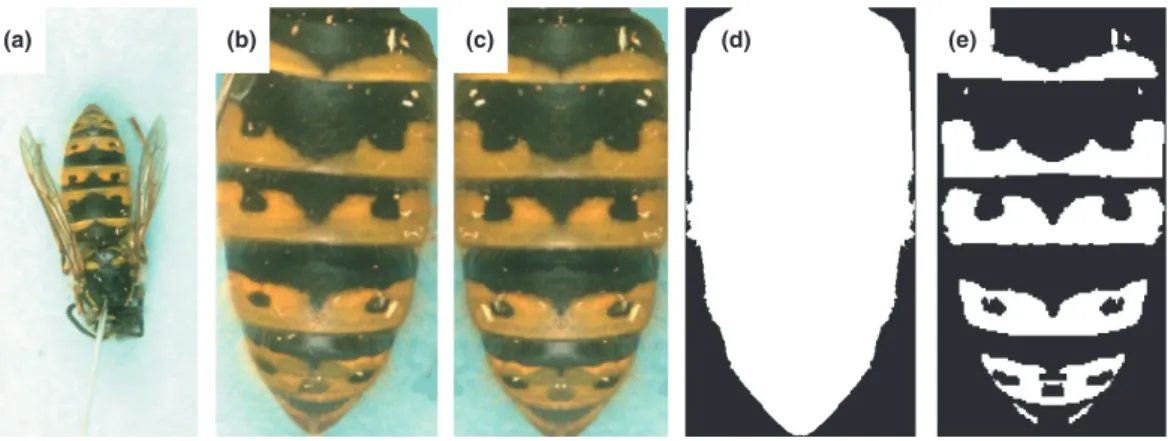
Next, each image must be simplified by converting into a set of binary images, hereafter ‘segments’, one for each distinct colour, with values 1 for presence and 0 for absence (Fig. 1e; see also Fig. 2b). A key assumption here is that each segment represents a distinct colour category in the perception of the signal receiver. To define segments appropriately, it is neces-sary to understand both the properties of the device used to acquire the image (Stevenset al.2007) and the sensory capabil-ities of the receiver (Endler & Mielke 2005). We have chosen examples in which the lack of UV sensitivity of standard digital cameras, and differences in colour perception between humans and the most important signal receivers, are unlikely to have an important effect on the definition of the segments, but these issues must be considered carefully. For example, if the receiver and its visual properties are known, then it is possible to calcu-late what constitutes a ‘just noticeable difference’ in colour and to separate the pattern into regions differing by at least this amount (two ways of doing this are suggested by Endler 2012). If a typical viewing distance can be estimated, the image could also be converted to a resolution equivalent to that experienced by the receiver (again, see Endler 2012).
The methods used to separate a pattern into its segments will vary according to the organisms under study and the source and quality of the images. Consequently, specific details are to be found accompanying the three examples; see also Appendix S1.
P A IR W I S E D IS S IM IL A R IT Y C A L C U L A T I O N
For the sake of simplicity, we describe here how to compare two images, A and B, each with two different segments (A1 and A2, B1 and B2; see example in Fig. 2); the method is easily
extended to cases with more than two segments. A distance transform of A1 is carried out, such that all pixel locations are assigned a value calculated as the smallest distance to a pixel of value 1 (Borgefors 1986). This distance is zero for pixels which have a value of 1 in A1, and a real number, at least one, for all other pixels, calculated using Euclidean distance (Fig. 2c). The distance transform values for all pixels are then multiplied by the raw values for equivalent pixels in B1. The result is that any pixel locations that are the same in both images (a match) will carry a value of 0, while any nonmatching pixel locations will be weighted in proportion to the minimum distance to a matching pixel (Fig. 2e). Total mismatch for the whole image is simply the sum of these pixel values.
Next, the process is repeated with image roles reversed (A1 multiplied by the distance transform of B1), and repeated in both directions for A2 and B2. To standardise the dissimilarity value between zero and one, we take the mean of these four values and divide it by the maximum possible total for that size of image. The greatest mismatch should in theory be between an entirely white and an entirely black image of the same size as A and B, but a distance transform cannot be obtained from an image which is composed entirely of zeros. A single white pixel is therefore placed in the corner of the otherwise black image, and vice versa, before calculation of the dissimilarity as described above, giving the maximum value obtainable.
O P T IM I S A T I O N
Two very similar patterns might not be classified as such if they are misaligned. An optimisation procedure is therefore used whereby one image is shifted relative to the other by varying small amounts horizontally and vertically, to find the lowest possible dissimilarity value given these various alignments. For example, in Fig. 2, if image B is translated one pixel upwards, the total mismatch of the yellow segments would be reduced from 74 to 4, giving a more optimal alignment. In preliminary testing, a maximum translation of 15% of the image size was sufficient to include the optimum value in the vast majority of cases. If the images are symmetrical and have already been
(a) (b) (c) (d) (e)
aligned along their lines of symmetry, then translation perpen-dicular to that line is not necessary.
A further possibility is to vary the aspect ratio of the image, as well as horizontal and vertical alignment. This involves stretching or compressing one image relative to the other. In repeating patterns, such as stripes, this accounts for slight vari-ation in scale. Again, a maximum of 15% change in height was sufficient in preliminary testing. Other forms of transformation could potentially be used in order to optimise image alignment further; for example, rotation of the images could be useful in cases without clear landmarks by which the images can be aligned.
S T A T IS T IC A L M E T H O D S
The output of the process this far will be a dissimilarity value between a pair of images. If a similarity value is required, we can use similarity=1–dissimilarity. In the likely case that more than two images are to be compared, the process is repeated for all possible pairs, leading to a matrix of pairwise dissimilarity values (such as Table 1). For more than a few pat-terns, this matrix is very difficult to interpret directly, and it is useful to summarise the information using a form of ordina-tion. Using nonmetric multidimensional scaling (NMDS; Legendre & Legendre 1998), each pattern is represented by a point in Euclidean space, with the distance between any two points being approximately equal to their dissimilarity value. Usually, the first two dimensions represent an appropriate vi-sualisation (see Fig. 4). Note that, while useful for visualising trends, ordinations of relationships between multiple patterns are approximations of the true situation, and reference should also be made to the raw dissimilarity values.
Applications
H O V E R F L Y A N D W A S P A B D O M IN A L P A T T E R N S
Many species of hoverfly (Diptera: Syrphidae) are thought to gain protection through resemblance to stinging Hymenoptera such as wasps (Rotheray & Gilbert 2011). This is an example of Batesian mimicry–predators mistake the palatable mimic (hoverfly) for an unpalatable model (wasp), and thus, the attack rate on the mimic is reduced (Bates 1862). Although we would expect natural selection to favour those with the highest level of mimetic accuracy, some hoverflies seem to resemble wasps better than others. Why are some hoverflies inaccurate mimics of wasps (Edmunds 2000; Gilbert 2005)?
Of course, we cannot answer this question without being able to define what we mean by ‘inaccurate mimic’: some authors have used human judgement (Penney et al. 2012), pigeonColumba liviajudgement (Dittrichet al.1993) or the sum of absolute differences (see above; Dittrichet al. 1993; Azmehet al.1998). The most successful approach to date has been the multivariate method used by Penney et al. (2012). They calculated a dissimilarity value from a combination of six
1·4 1 0 1 0
0 0 0 0 0
0 0 0 0 0
0 0 0 0 0
0 0 0 0 0
1·4 1 0 1 2
1 0 0 1 2
1 0 0 1 2
1 0 1 1·4 2·2
1·4 1 1·4 2·2 2·8
0 0 0 0 1
1 0 0 1 1·4
1·4 1 1 1·4 2·2
2·2 2 2 2·2 2·8
3·2 3 3 3·2 3·6
0 0 0 0 0
0 0 0 0 0
0 1 1 0 0
0 2 0 0 0
0 0 0 0 0
1 1 1 1 0
0 1 1 0 0
0 0 0 0 0
0 0 0 0 0
0 0 0 0 0
0 0 1 0 0
0 1 1 0 0
0 1 1 0 0
0 1 0 0 0
0 0 0 0 0
1 1 0 1 0
0 0 0 0 0
0 0 0 0 0
0 0 0 0 0
0 0 0 0 0
0 0 0 0 0
0 0 0 0 0
0 1 1 0 0
0 1 0 0 0
0 0 0 0 0
(a)
(b)
(c)
(d)
(e)
Image A
Image B
different morphometric features plus summary pattern fea-tures such as mean red, green and blue values from the RGB image. This difference measure was found to correlate with human estimates of similarity and enabled the authors to test a number of the proposed explanations for the existence of inac-curate mimicry. However, abdominal pattern was only approximately represented in the form of six summary values, possibly a major shortcoming given that pattern is one of the most immediately recognisable features of a wasp. The dis-tance transform method enables us to examine in more detail the similarities and differences between wasp and hoverfly colour patterns.
Materials and methods
We obtained 39 high-resolution photographs (in TIFF format) of 10 species of hoverfly and eight photographs of the wasps Vespula vulgarisL. 1758 andV. rufaL. 1758 (images used previ-ously by Dittrichet al.1993). In order to facilitate comparison with the study by Penneyet al.(2012), we also took high-resolu-tion scans of illustrahigh-resolu-tions of 20 hoverfly species from a field guide (Stubbs & Falk 2002), chosen to correspond to as many as possible of the ‘wasp mimics’ in Penneyet al.’s Fig. S1 (2012).
The abdomen was selected as the region of interest, and images aligned along their lines of symmetry. Hoverfly and wasp patterns typically appear to have two discrete colours to the human eye, well represented in RGB digital photographs. Spectrometry suggests that the patterns do not include hidden
UV elements (Gilbert 2005) and hence that likely predators (birds) also perceive them as consisting of two colour classes. We therefore segmented the images into yellow and black components (for full details, see Appendix S1; see also Fig. 1).
Similarity was calculated as described in ‘General methods’ above, with optimisation using vertical translation and vertical scaling. The lowest similarity toVespulaspp. in the data set came from the hoverflySyritta pipiens(L. 1758), and for ease of interpretation, this was assigned a similarity value of 0 in relation to Vespula spp., with all other similarity values expressed relative to this. This scaling has no effect on the outcome of the statistical tests. Correlation with similarity estimates from other sources was calculated using one-tailed Pearson’s correlation.
Results
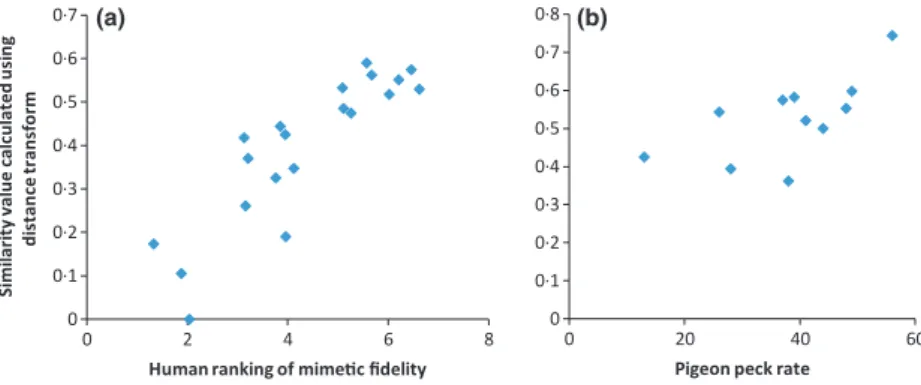
Mean similarity values between images of each species of hoverfly and the eight wasp images, calculated with the dis-tance transform method, correlate strongly with human esti-mates of similarity, which were based on separate photographs of hoverflies and V. vulgaris(Fig. 3a; r=087,P<00001, n=20; human data from Penneyet al.2012). There is also a significant correlation between distance transform similarity and similarity as assessed by pigeons in the form of peck rates (Fig. 3b; r=065, P=0014, n=11; pigeon data from Dittrichet al.1993).
Table 1. Similarity matrices for images of 10 butterfly wings taken from Joronet al.’s (2006) study. (a) Images scaled to a height of 350 pixels with shape unchanged. (b) Shape standardised using control point registration (see Appendix S2)
Hnarc Mpha Hnaur Mril Hnbic Mmot Hnsil Mlud Hntar Mmen
(a)
Hnarc 07504 06154 05844 02062 03577 04240 02774 03036 03024 Mpha 07504 04062 06959 00140 03858 03800 02277 02879 03698 Hnaur 06154 04062 06102 06157 06056 03801 04037 03337 03560 Mril 05844 06959 06102 04357 06657 05309 03968 02265 04818 Hnbic 02062 00140 06157 04357 08411 00622 00220 00000 01058 Mmot 03577 03858 06056 06657 08411 02614 01404 02543 04005 Hnsil 04240 03800 03801 05309 00622 02614 08031 02889 03692 Mlud 02774 02277 04037 03968 00220 01404 08031 03671 04305 Hntar 03036 02879 03337 02265 00000 02543 02889 03671 07679 Mmen 03024 03698 03560 04818 01058 04005 03692 04305 07679
(b)
Hnarc 08127 07490 05971 03983 04144 04505 03128 03379 03898 Mpha 08127 07062 07577 03108 04916 03737 03454 03926 05458 Hnaur 07490 07062 08332 06474 06642 05385 04279 03822 05025 Mril 05971 07577 08332 05912 07298 04711 04463 03090 05614 Hnbic 03983 03108 06474 05912 08675 01854 00335 02009 03480 Mmot 04144 04916 06642 07298 08675 02489 01691 02790 04871 Hnsil 04505 03737 05385 04711 01854 02489 08550 03366 04775 Mlud 03128 03454 04279 04463 00335 01691 08550 03599 05349 Hntar 03379 03926 03822 03090 02009 02790 03366 03599 08120 Mmen 03898 05458 05025 05614 03480 04871 04775 05349 08120
MUL L E RIA N M IM IC RY IN HE L I CO NI IN A E€
A number of tropical butterfly species (Lepidoptera: Nymphalidae) are highly distasteful to predators and employ aposematic coloration on their wings to advertise their unprofitability (Brown 1981). In a given geographical location, we often see convergent evolution of patterns from well-separated taxa, sometimes to an extraordinary degree. This convergence first led M€uller (1879) to formulate the theory of mimicry that bears his name.
The butterflyHeliconius numata(Cramer 1780; Nymphalidae: Heliconiinae) exists in a number of distinct forms, each with its own characteristic colour pattern (Joronet al.1999; Helico-nius Genome Consortium 2012). Each form is thought to mimic a particular species or subspecies of another group of butterflies, the genusMelinaea. However, to our knowledge, mimetic pairings have always been chosen simply on the basis of the author’s perception and geographical coincidence. Simi-larities between proposed M€ullerian comimics certainly appear striking to the human eye, but it would be informative to take a more objective view of their similarities and differences.
Materials and methods
Images of five forms ofH. numataand five species/subspecies ofMelinaeawere taken from Fig. 1 in the study of Joronet al. (2006). Nomenclature follows Lamas et al.’s (2004) study. Each image was cropped to a rectangle just large enough to contain both the fore- and hind-wing of the right-hand side. Other features such as antennae or parts of the head encroach-ing on the defined area were removed. Two alternative meth-ods were used to register the images, giving slightly different results. In one case, images were scaled to a standard height of 350 pixels, preserving aspect ratio, with no other transforma-tion. In the other, four control points were selected, using wing veins as landmarks, and images were transformed to match the control points to each other as closely as possible (see Appendix S1).
The pattern was segmented into black and red, and a third category of yellow/white that was present in only six of 10
images. Yellow and white were not separated, as they appeared much less distinct to the human eye than the other major col-our divisions, and often shaded from one into the other. The most important signal receivers in this system (most likely avian predators) may perceive the boundaries between the colours on the wing differently. In the absence of more complete information, however, we focus here on illustrating how the results of our technique for comparing the spatial arrangement of colour patches on the wing compare with the existing classification of mimetic pairs, which was based on human perceptions of the patterns. For full details of image preprocessing, see Appendix S1.
Since not all patterns contained a yellow component, pairwise dissimilarity measures were calculated using the black and red segments only. However, this did still allow for variation in the yellow parts to be considered, since these were represented as areas scoring zero on both the red and the black segments. Optimisation was carried out using horizontal and vertical translation. For ease of interpretation, similarity values were scaled to span the range 0–1.
Results
Figure 4a shows the ordination of the 10 species/morphs based on images with a preserved shape. The similarity values (Table 1) show that in eight out of 10 cases, the highest similar-ity value for a given pattern corresponds to the proposed comimic. However,M. marsaeus rileyiis more similar to its sister subspeciesphasianaandmothonethan to the proposed comimicH. numataf.aurora, and likewise, the latter is slightly more similar to both conspecific formsbicoloratusandarcuella than toM. m. rileyi.
By inspection, the main feature driving this result appears to be the shape of the wing rather than the colour pattern itself, and this can be confirmed through control point registration. If, during the preprocessing stage, the images are transformed to line up wing landmarks, then the results are slightly different (Fig. 4b). Importantly, comimics are now much more closely associated, with the highest similarity value in each case corre-sponding to the comimic.
0 0·1 0·2 0·3 0·4 0·5 0·6 0·7 0·8
0 20 40 60
Pigeon peck rate
0 0·1 0·2 0·3 0·4 0·5 0·6 0·7
0 2 4 6 8
Si
m
ila
ri
ty
v
al
u
e
cal
cul
ate
d
usi
n
g
di
stance
transf
orm
Human ranking of mimeƟc fidelity
(a) (b)
F AC E B A D G E S OFP O L I S T E S D O M I N U L A
The front of the head of many wasp species of the genusPolistes (Hymenoptera: Vespidae) bears a black-and-yellow pattern that varies greatly among individuals. For example,P. dominu-la(Christ 1791) generally has a black ‘badge’ on its otherwise yellow clypeus (except in some cases where the clypeus is entirely yellow; see examples in Fig. 5). This badge is highly var-iable both within and among populations (Tibbettset al.2011), and it has been proposed that the badge is a signal of com-petitive ability (Tibbetts & Dale 2004; Tibbetts & Curtis 2007).
Variation in badge size and shape has so far been quanti-fied almost exclusively by the use of a single summary vari-able: the ‘brokenness’ of the black region. Brokenness is defined (Tibbetts & Dale 2004) as the variation in the vertical extent of the central section of the badge. However, this mea-sure has had mixed success in capturing an association between pattern and social dominance, depending on the population studied (Cervo et al.2008; Green & Field 2011; Tibbettset al. 2011). It may be that the clypeal badge is a signal of quality in some populations and not in others, but it is also possible that the brokenness summary measure is Hnarc
Hnaur
Hnbic Hnsil
Hntar Mlud
Mmen
Mmmot Mmpha
Mmril
–0·5 –0·4 –0·3 –0·2 –0·1 0 0·1 0·2 0·3 0·4
–0·6 –0·4 –0·2 0 0·2 0·4 0·6
Hnarc
Hnaur
Hnbic Hnsil
Hntar Mlud
Mmen
Mmmot Mmpha
Mmril
–0·5 –0·4 –0·3 –0·2 –0·1 0 0·1 0·2 0·3 0·4 0·5
–0·6 –0·4 –0·2 0 0·2 0·4 0·6
(a)
(b)
not sufficient to capture the relevant signal variation in all cases.
We need a more robust way of quantifying badge variation if we are to understand fully the geographical differences between populations ofP. dominula. Even within a single pop-ulation, it is conceivable that a more holistic pattern measure might be able to account for more of the variation in characters such as body size (which is a useful predictor of dominance; Tibbetts & Dale 2004). We have therefore compared the use of the distance transform method with the brokenness measure on images from a Portuguese population ofP. dominula.
Materials and methods
Fifty-seven foundresses ofP. dominulawere taken from their nests at Quinta de Sao Pedro, Portugal. Wet body mass was measured using an electronic balance immediately after cap-ture. Their faces were photographed with an Olympus E420 DSLR. The image was cropped to a rectangle containing the clypeus and segmented into black and yellow components; for full details, see Appendix S1. As with the hoverfly/wasp exam-ple above, it seems reasonable to assume that the two-colour (black and yellow) pattern, which is clear to the human eye when viewing theP. dominulaclypeus in both living specimens and RGB photographs, is also perceived by the intended receivers of the signal (other wasps) in this system. Wasp pat-terns appear not to have any UV components (Gilbert 2005).
Dissimilarity values were calculated as described in General methods, but with one modification. Some individual wasps had no black badge on the clypeus whatsoever, making a dis-tance transform of the black segment of the image impossible. The dissimilarity for all image pairs was therefore calculated from the yellow segment alone rather than the mean of the
values from both the yellow and the black segments. Optimisa-tion was carried out using horizontal and vertical translaOptimisa-tion. Two-dimensional NMDS was then used to providexandy scores, giving a bivariate summary of the facial pattern.
Brokenness values were calculated as described in the study of Tibbettset al.(2011)–see Appendix S1. A second summary variable, proportion of clypeus that is black, was also calcu-lated. Correlations between variables were calculated using two-tailed Pearson’s correlation tests.
Results
Brokenness and proportion black both correlate significantly with bothxandyaxes from NMDS (P<001 for each pairing; Table 2 and Fig. 5), showing that the distance transform mea-sure is sensitive to the type of variation captured by the other summary measures. Indeed, since thexandyaxes are orthogo-nal, we can combine thervalues in two dimensions to give r=093 between brokenness and the 2D ordination, and r=098 for proportion black and the ordination (both –0·015
–0·01 –0·005 0 0·005 0·01 0·015
–0·015 –0·01 –0·005 0 0·005 0·01 0·015 0·02 0·025
Brokenness r = 0·93
% Black r = 0·98
Fig. 5.Nonmetric multidimensional scaling (NMDS) ordination of dissimilarity data from shapes of clypeal badges of 56 individuals ofPolistes do-minula(one extreme outlier is omitted for the sake of clarity). Red arrows show the direction and relative strengths of correlation of the axis scores with two variables: brokenness and proportion of the clypeus that is black (% black). Inserts show the clypeal badge for six data points as examples.
Table 2. Pearson correlation coefficients between variables relating to clypeal badges ofPolistes dominulaand the body mass of the wasp.x andyare the axis scores from NMDS of dissimilarity data; percentage black is the proportion of the clypeus that is black
x y % Black Brokenness
Mass 0097 0122 0030 0065 Brokenness 0699*** 0620*** 0901*** % Black 0898*** 0400**
y 0000
NMDS, nonmetric multidimensional scaling.
P<00001). However, none of the measures correlate signifi-cantly with body mass (brokenness:r=007,P=063; propor-tion black:r= 003,P=082;xaxis:r= 010,P=047;y axis:r=012,P=037, alln=57). Mass is a useful proxy for social dominance (Tibbetts & Dale 2004). Therefore, in this population, no association between pattern and dominance is detected by any of the methods used, despite the extra informa-tion contained in the two-dimensional ordinainforma-tion compared with the one-dimensional summary measures.
Discussion
We have demonstrated the use of distance transforms to gener-ate a measure of similarity between two colour patterns. This is not the first use of distance transforms for image comparison in biology. However, in the only other instance of which we are aware, it was used in the context of individual recognition, to detect whether two patterns of spots were the same or different (Andersonet al.2010). In this qualitative approach, the pat-tern variation was used as a means for identifying individuals rather than being of interest in itself. We have sought to show that there is much more potential in the method for studying variation in patterns. To our knowledge, this is the first such study to use distance transforms where the magnitude of the difference is biologically relevant.
Our method captures far more pattern information than in previous analyses of the three systems studied here, since it does not characterise a pattern using summary variables. Instead, it uses the full pattern, pixel by pixel, to calculate a similarity value. The advantage gained is clear when we look at the hoverfly example: despite using information only from the abdominal colour pattern, the distance transform method gave an assessment of similarity that correlated extremely well with human perception of whole insect similarity (r=087). The multivariate measure from Penney et al. (2012), which included summary variables for the pattern, as well as morpho-metric data from other body parts, still gave a significant corre-lation but explained a lower proportion of the variance (r=056, from Penneyet al.2012). It is worth noting, though, that even if the calculated dissimilarity did not correlate with a predator’s perception of the pattern, it would still form a useful comparison; we could then ask the question: why does the predatornotmake use of the available information to distin-guish models from mimics?
Similarly, in the case ofPolistesclypeal badges, the broken-ness measure (Tibbetts & Dale 2004) captures only a limited amount of information about the shape of the badge. In the case of the Portuguese population used in this study, the dis-tance transform method retains almost all of the brokenness information, while adding more detail along a second dimen-sion (Fig. 5). Despite the extra information, we still detect no association between mass and badge shape. As the measure we have used is more comprehensive, it strengthens the conclusion that the lack of a detected association is due to the genuine absence of a link rather than failure to capture the relevant var-iation. This supports the findings of Cervoet al.(2008) and Greenet al.(2013) in other European populations. A further
advantage of the distance transform method is that, because it is based on an image of the whole clypeus rather than just the badge, it captures variation in clypeus outline as well as the badge itself. This may be especially useful in populations where a large proportion of individuals have no black badge at all (Cervoet al.2008).
The relatively objective nature of our technique helps mini-mise a researcher’s reliance on assumptions based on their own perception. The data we present on Mullerian mimicry in heli-€ coniines largely confirm previous assumptions (Joron et al. 1999), but do reveal that in absolute terms, a few mimetic pair-ings may not be as clear cut as they initially appear. In particu-lar, a consistent difference is picked up between subspecies of Melinaea marseus and their Heliconius numata comimics (Fig. 4a). This difference is connected largely with shape rather than pattern, since it is reduced considerably when shape is standardised (Fig. 4b). The difference may or may not be rele-vant to a consideration of mimicry since predators may not attend to shape information, difficult to interpret reliably with different wing angles at rest. Predators, such as birds, may well perceive the same striking pairings as suggested by humans, but this should be explicitly tested, given that alternative groupings, or a more continuous mimicry ring, also form plau-sible descriptions. This example is also a good demonstration of the potential scope of the technique; it can compare patterns with more than two colours and detect differences of outline as well as pattern.
We recognise that in our example analyses, the use of RGB photographs and illustrations may introduce a bias towards the human perception of colour patterns and that a more thor-ough analysis would take into account the visual abilities of the likely signal receivers. However, our focus is on the method of pattern comparison, whatever technique was used to collect and prepare the images. Furthermore, there is no evidence in any of the examples to suggest that human perception of the colour boundaries is any different from that of other animals. In the case of hoverflies, for example, responses of pigeons were no different when presented with naturally lit specimens (Greenet al.1999) as opposed to RGB photographs (Dittrich et al.1993).
While we have aimed to develop an objective and consistent similarity measure, it will never be possible to remove subjec-tivity from the process entirely. The very process of represent-ing a 3D colour pattern in a 2D digital image inevitably changes the nature of the pattern in some ways. The choice of colours used to segment the pattern (as in the Heliconius example) will also inevitably alter the outcome.
Conclusions
The use of distance transforms to calculate dissimilarity is a broadly applicable, consistent, powerful tool in the compara-tive study of animal colour patterns. It is able to cast new light on well-studied systems, to challenge assumptions and has the potential to open up new avenues of investigation.
Acknowledgements
Thanks to Heather Booth, Chloe Gordon, Robert Habgood and Laura Jeffery
for their photographs ofP. dominulaface badges and data on body mass that
were used in this study; Damien Garcia for his MATLAB script for finding multiple Otsu thresholds; Chris Brignell for discussions of pattern recognition and image registration methods; and Elizabeth Tibbetts for comments on the ‘brokenness’ metric.
References
Anderson, C.J.R., Lobo, N., Roth, J.D. & Waterman, J.M. (2010) Computer-aided photo-identification system with an application to polar bears based on
whisker spot patterns.Journal of Mammalogy,91, 1350–1359.
Azmeh, S. (1999)Mimicry and the Hoverflies. PhD, University of Nottingham,
Nottingham, UK.
Azmeh, S., Owen, J., Sørensen, K., Grewcock, D. & Gilbert, F. (1998) Mimicry
profiles are affected by human-induced habitat changes.Proceedings of the
Royal Society. B, Biological Sciences,265, 2285–2290.
Barbosa, A., M€athger, L.M., Buresch, K.C., Kelly, J., Chubb, C., Chiao, C.-C. &
Hanlon, R.T. (2008) Cuttlefish camouflage: the effects of substrate contrast
and size in evoking uniform, mottle or disruptive body patterns.Vision
Research,48, 1242–1253.
Bates, H.W. (1862) XXXII. Contributions to an Insect Fauna of the Amazon
Valley. Lepidoptera: Heliconidæ.Transactions of the Linnean Society of
London,23, 495–566.
Borgefors, G. (1986) Distance transformations in digital images.Computer
Vision, Graphics, and Image Processing,34, 344–371.
Boyer, D., Lipman, Y., Clair, E.S., Puente, J., Funkhouser, T., Patel, B., Jernvall, J. & Daubechies, I. (2011) Algorithms to automatically quantify the geometric
similarity of anatomical surfaces.Proceedings of the National Academy of
Sci-ences,108, 18221–18226.
Briechle, K. & Hanebeck, U.D. (2001) Template matching using fast normalized
cross correlation.SPIE Proceedings,4387, Optical Pattern Recognition XII,
95–102.
Brodie, E.D.I. (1993) Differential avoidance of coral snake banded patterns by
free-ranging avian predators in Costa Rica.Evolution,47, 227–235.
Brown, K.S. (1981) The biology ofHeliconiusand related genera.Annual Review
of Entomology,26, 427–457.
Cervo, R., Dapporto, L., Beani, L., Strassmann, J.E. & Turillazzi, S. (2008) On
status badges and quality signals in the paper waspPolistes dominulus: body
size, facial colour patterns and hierarchical rank.Proceedings of the Royal
Society. B, Biological Sciences,275, 1189–1196.
Cott, H.B. (1940) Adaptive Coloration in Animals. John Dickens & Co,
Northampton, UK.
Dittrich, W., Gilbert, F., Green, P., Mcgregor, P. & Grewcock, D. (1993)
Imperfect mimicry: a pigeon’s perspective.Proceedings of the Royal Society. B,
Biological Sciences,251, 195–200.
Edmunds, M. (2000) Why are there good and poor mimics?Biological Journal of
the Linnean Society,70, 459–466.
Endler, J.A. (1990) On the measurement and classification of colour in
stud-ies of animal colour patterns.Biological Journal of the Linnean Society,
41, 315–352.
Endler, J.A. (2012) A framework for analysing colour pattern geometry: adjacent
colours.Biological Journal of the Linnean Society,107, 233–253.
Endler, J.A. & Mielke, P.W.J. (2005) Comparing entire colour patterns as birds
see them.Biological Journal of the Linnean Society,86, 405–431.
Gilbert, F. (2005) The evolution of imperfect mimicry.Insect Evolutionary
Ecol-ogy(eds M. Fellowes, G. Holloway & J. Rolff), pp. 231–288. CABI,
Walling-ford, UK.
Godfrey, D., Lythgoe, J.N. & Rumball, D.A. (1987) Zebra stripes and tiger stripes: the spatial frequency distribution of the pattern compared to that of
the background is significant in display and crypsis.Biological Journal of the
Linnean Society,32, 427–433.
Goshtasby, A.A. (2005)2-D and 3-D Image Registration. Wiley, Hoboken, New
Jersey, USA.
Green, J.P. & Field, J. (2011) Interpopulation variation in status signalling in the
paper waspPolistes dominulus.Animal Behaviour,81, 205–209.
Green, P.R., Gentle, L., Peake, T.M., Scudamore, R.E., McGregor, P.K., Gilbert, F. et al. (1999) Conditioning pigeons to discriminate naturally lit insect
specimens.Behavioural processes,46, 97–102.
Green, J.P., Leadbeater, E., Carruthers, J.M., Rosser, N.S., Lucas, E.R. & Field,
J. (2013)Clypeal Patterning in the Paper Wasp Polistes dominulus: No Evidence
of Adaptive Value in the Wild. Behavioral Ecology,24, 623–633.
Heliconius Genome Consortium. (2012) Butterfly genome reveals promiscuous
exchange of mimicry adaptations among species.Nature,487, 94–98.
Joron, M., Wynne, I., Lamas, G. & Mallet, J. (1999) Variable selection and the
coexistence of multiple mimetic forms of the butterflyHeliconius numata.
Evolutionary Ecology,13, 721–754.
Joron, M., Papa, R., Beltran, M., Chamberlain, N., Mavarez, J., Baxter, S. et al.
(2006) A conserved supergene locus controls colour pattern diversity in
Helico-niusbutterflies.PLoS Biology,4, e303.
Khotanzad, A. & Yaw Hua, H. (1990) Invariant image recognition by Zernike
moments.IEEE Transactions on Pattern Analysis and Machine Intelligence,12,
489–497.
Lamas, G., Callaghan, C., Casagrande, M.M., Mielke, O., Pyrcz, T., Robbins, R.
et al. (2004)Hesperioidea–Papilionoidea. Scientific Publishers, Gainesville,
Florida, USA.
Legendre, P. & Legendre, L. (1998)Numerical Ecology, 2nd English edn. Elsevier,
Amsterdam.
MATLAB. (2010)MATLAB. The Mathworks, Natick, Massachusetts, USA.
Møller, A.P. (1988) Badge size in the house sparrowPasser domesticus.Behavioral
Ecology and Sociobiology,22, 373–378.
Muller, F. (1879) Ituna and Thyridia: a remarkable case of mimicry in butterflies.€
Proceedings of the Entomological Society,1879, 20–29.
Penney, H.D., Hassall, C., Skevington, J.H., Abbott, K.R. & Sherratt, T.N.
(2012) A comparative analysis of the evolution of imperfect mimicry.Nature,
483, 461–464.
Pinker, S. (1984) Visual cognition: an introduction.Cognition,18, 1–63.
Rotheray, G.F. & Gilbert, F. (2011)The Natural History of Hoverflies. Forrest
Text, Cardigan, UK.
Rui, Y., Huang, T.S. & Chang, S.-F. (1999) Image retrieval: current techniques,
promising directions, and open issues.Journal of Visual Communication and
Image Representation,10, 39–62.
Ruxton, G.D., Sherratt, T.N. & Speed, M.P. (2004)Avoiding Attack: The
Evolu-tionary Ecology of Crypsis, Warning Signals, and Mimicry. Oxford University Press, Oxford.
Stevens, M., Parraga, C.A., Cuthill, I.C., Partridge, J.C. & Troscianko, T.S.
(2007) Using digital photography to study animal coloration.Biological
Jour-nal of the Linnean Society,90, 211–237.
Stoddard, M.C. (2012) Mimicry and masquerade from the avian visual perspec-tive.Current Zoology,58, 630–648.
Stoddard, M.C. & Stevens, M. (2010) Pattern mimicry of host eggs by the
common cuckoo, as seen through a bird’s eye.Proceedings of the Royal
Soci-ety. B, Biological Sciences,277, 1387–1393.
Stubbs, A.E. & Falk, S.J. (2002)British Hoverflies: An Illustrated Identification
Guide. British Entomological and Natural History Society, Reading, UK. Tibbetts, E.A. & Curtis, T.R. (2007) Rearing conditions influence quality signals
but not individual identity signals inPolisteswasps.Behavioral Ecology,18,
602–607.
Tibbetts, E.A. & Dale, J. (2004) A socially enforced signal of quality in a paper
wasp.Nature,432, 218–222.
Tibbetts, E.A., Skaldina, O., Zhao, V., Toth, A.L., Skaldin, M., Beani, L. et al.
(2011) Geographic variation in the status signals ofPolistes dominuluspaper
wasps.PLoS ONE,6, e28173.
Zhang, D. & Lu, G. (2002) Shape-based image retrieval using generic Fourier
descriptor.Signal Processing: Image Communication,17, 825–848.
Zhang, D. & Lu, G. (2003) Evaluation of similarity measurement for image retrie-val.Proceedings of the 2003 International Conference on Neural Networks and Signal Processing, pp. 928–931.
Zitova, B. & Flusser, J. (2003) Image registration methods: a survey.Image and
Vision Computing,21, 977–1000.
Received 3 January 2013; accepted 17 April 2013 Handling Editor: Andrew Tatem
Supporting Information
Additional Supporting Information may be found in the online version of this article.
Appendix S1.Supplementary methods.
Appendix S2.Testing robustness of the distance transform method. Includes Figs S1–S4.
Appendix S3.MATLABcode.