University of Warwick institutional repository: http://go.warwick.ac.uk/wrap
A Thesis Submitted for the Degree of PhD at the University of Warwick
http://go.warwick.ac.uk/wrap/45392
This thesis is made available online and is protected by original copyright. Please scroll down to view the document itself.
The Creative Processes in Video Game
Development:
A Model Set Illustrating the Creative Processes with Theoretical and
Practical implications
By
W. Paul Kohler
A thesis submitted in partial fulfilment of the requirements for the degree of Doctor of Philosophy (Ph.D.) in Creative Industries
Table of Contents
List of Figures, Charts and Tables, and Drawings...ix
List of Abbreviations ...x
Acknowledgements...xi
Declaration...xii
Abstract ... xiii
CHAPTER ONE...1
THESIS INTRODUCTION...1
Introduction...1
Section One: Research and Researcher’s background...2
Section Two: Thesis Outline...5
Section Three: Contribution to Knowledge ...9
SUMMARY...10
CHAPTER TWO...11
METHODOLOGY...11
Introduction...11
Section One: Ontological Assumptions and Thesis limitations...11
Limitations...13
Section Two: Methodology – Theory ...15
Section Three: Methodology – in Practice...18
Section Four: Interview Phases...20
Phase One ...20
Phase Two...21
Phase Three...22
CONCLUSION...23
CHAPTER THREE...24
VIDEO GAMES AND THEIR INDUSTRY...24
Introduction...24
Section One:...25
The Industry...28
Section Two: ...34
The Nature of Video Games ...34
Section Three: ...39
The Judgement of Creativity and Quality...39
Statistical analysis of Metacritic ratings and sales ...44
Taking the Next Step ...44
Section Four: ...47
An Outline of the Game Development Process...47
Concept Phase...49
Production...51
Post-Production ...52
The Production Team ...54
Section Five: ...59
The Economic Models...59
Section Six: ...62
Recognizing the Risks ...62
SUMMARY...64
CHAPTER FOUR...66
LITERATURE REVIEW...66
Introduction...66
Section One:...68
The Problem in Defining Creativity ...68
The Problem Specifics...69
Definition Examples ...71
The 4 Ps ...75
A Working Definition...76
1. Ideas ...77
2. Individual ...78
3. New ...78
4. Add Value ...79
Judgement ...82
Creativity and Innovation ...83
Section Two: ...83
Literature Overview...83
Creativity in the Field of Psychology ...85
Section Three: ...89
Organizational Creativity ...89
Drazin et al...93
Csikszentmihályi ...94
Social Validation ...96
Section Four: Video game literature review ...98
Section Five: Review of the Models ...101
Section Six: Literature Critique ...105
SUMMARY...109
CHAPTER FIVE...111
THE CREATIVE PROCESS MODELS...111
Introduction...111
PART ONE...112
Section One: The Creative Schema ...112
Section Two: Ideas...114
Idea Generation...117
Idea Sources in Games ...118
Hierarchy of Game Ideas ...120
Timing ...122
Are More Ideas Better?...123
Section Three: The Core Creating Mechanism...126
Evolutionary Approach...126
The Core Creating Mechanism...128
Critical BVSR - Core Creating Mechanism Differences...131
An Implicit Assumption ...133
Section Four: Decisions ...134
No Overall Theory...136
Gated Process ...142
Gaining Approval ...142
Constraints ...145
Multiple Criteria ...148
Assumption of Rationality...148
Evaluation, Errors, Why Decisions Fail ...149
The Decision Continuum, Risk, Ambiguity, and Uncertainty ...151
Section Five: Execution ...153
Section Six: Iteration...154
Section Seven: The Four Operating Modes of the Core Creating Mechanism ...157
1. The Idea Mode: ...160
2. The Execution to Target Mode: ...162
3. The Creating Mode: ...164
4. The Serendipity Mode:...167
The Creative Spectrum ...169
Summary of Part One...171
PART TWO...172
Section One: The Creative Continuum ...172
Section Two: Comments on the Creative Continuum ...174
Segments...176
Along the Creative Continuum...179
Always Change and Decay...182
The Ends of the Continuum: Chaos and Negative Creativity ...183
Critical Differences in Domains ...184
SUMMARY...186
CHAPTER SIX...188
EMPIRICAL ILLUSTRATION...188
Introduction...188
Section One: What is Creativity?...189
Section Two: Core Creative Mechanism ...192
Ideation ...192
Iteration...196
Section Three: The Modes of the CCM ...201
Mode 1 (Ideas)...202
Mode 2 (Execution to Target) ...205
Mode 3 (Creating Mode) ...207
Mode 4 (Serendipity)...209
Section Four: The Creative Continuum ...211
C3 (Combination) ...212
C2 (Synthesis)...213
C1 (Unknown) ...214
Section Five: Illustrating Significant Findings ...215
Quality ...216
Bimodal ...217
The Organizational Tension between Ideation and Execution...219
Constraints ...220
SUMMARY...224
CHAPTER SEVEN...225
DISCUSSION AND IMPLICATIONS...225
Introduction...225
Section One: Definition of Creativity, Revisited ...225
Definition is contextual ...230
Section Two: Integration...231
Mix and Matched to Task ...233
Continuum ...235
Section Three: Four Key Findings ...238
Not all about Ideas, Decisions are Key...239
Maximization is not always the Optimum...242
Discovery is Different ...247
Bimodal and Build Model ...251
Section Four: Implications...253
Theoretical Implications ...254
Comments on the factors that influence the Creative Process...258
Leadership Implications ...260
Organizational Tension in Real Time...265
CCM as a Tool Kit...268
SUMMARY...271
CHAPTER EIGHT...273
Chapter Summaries ...274
Themes ...276
Thesis Limitations...278
Future Research ...279
1. Fundamental Research ...280
2. Implications of the Model Set to Other Domains ...281
3. Specific Model Set Research...282
Surprises...283
CONTRIBUTION TO KNOWLEDGE...283
CONCLUSION...285
APPENDIX A...286
List of Figures, Charts and Tables, and Drawings
List of Figures
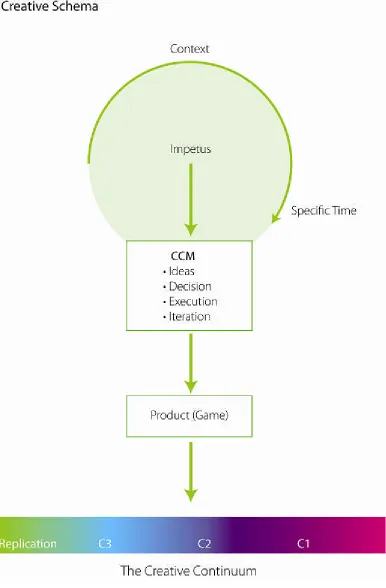
Figure 1 the Creative Schema...115
Figure 2 The Creative Spectrum...169
Figure 3 The Creative Continuum...176
Figure 4 The Model Set...232
Figure 5 Maximum Creativity...243
Figure 6 Conceptual Tension Curve...243
Figure 7 Management and Leadership Model...263
List of Charts and Tables Table 1 Ontological Assumptions...12
Table 2 Worldwide video game sales...29
Table 3 Console Manufacturers and Independent Publishers...31
Table 4 Unit Sales Chart...32
Table 5 Metacritic Ratings Chart...40
Table 6 Pre-Production Phases...50
Table 7 Video Game Manpower Development Chart...56
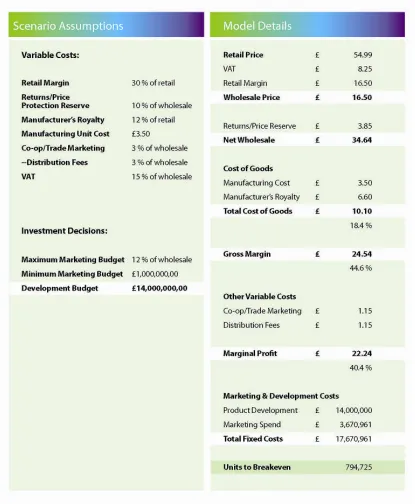
Table 8 PS3-Xbox 360 Breakeven Model...61
Table 9 Summary of Creative definition perspectives...75
Table 10 Sternberg’s Creativity Paradigms...92
Table 11 Hierarchy of Ideas...121
Table 12 Strategic Decision Elements...138
Table 13 The Creative Process as Decision Steps...140
Table 14 The Decision process as Creative Steps...141
List of Drawings Drawing 1 Iterations during Game Development...198
Drawing 2 Mode 1 (Ideas)...204
List of Abbreviations
BAFTA British Academy of Film and Television Arts
GMC Gold Master Candidate
GTM Grounded Theory Method
CCM Core Creating Mechanism
CC Creative Continuum
CS Creative Spectrum
DLC Downloadable Content
CBC Create-Build-Create building process
CB Create-Build building process
C&B Create-and-Build simultaneous building process
CM Creating Mode
RPG Role Playing Game - a specific game genre P&L Profit and Loss (statement)
OED Oxford English Dictionary
ROI Return on Investment
Acknowledgements
This thesis would not have been possible without the immense help from a number of people.
First is Dr. Christopher Bilton, who took on an unusual student and provided superb guidance during the whole PhD journey. He made the right comment at the perfect time, which thereafter guided the results to a far better conclusion.
When a major financial crisis threatened this project, a number of individuals provided monetary assistance to see the project through to completion. In this regard, my heartfelt gratitude goes to Rod Cousens of Codemasters, Anton Bruehl of International Development Group, and Jay Obernolte of Far Sight Studios, as well as The Centre of Cultural Policy Studies, University of Warwick providing additional support. I could not have done it without your help.
Recognition and appreciation needs to be given to the companies and interviewees that provided the material from which the thesis is constructed.
Credit for their support and comments is given to Dr. David Patterson, and Mike Moore. Lauretta De Feo provided editorial assistance.
Declaration
Except for commonly understood and accepted ideas, or where
specific reference is made, the work reported in the dissertation is the
result of my own work and includes nothing that is the outcome of
work done in collaboration. No part of the dissertation is the same as
any work that has previously been submitted to any university for any
degree, diploma, or other qualification.
____________________________ W. Paul Kohler
Centre for Cultural Policy Studies University of Warwick
Abstract
This thesis sets out to examine the creative process in developing large TV console video games. Using methods based on the philosophy of Grounded Theory, interviews were conducted at four game development studios. From these interviews and the extant literature, a Model Set was constructed to reflect the creative process. The underlying premise of the Model Set is that a Darwinian process of variation, selection, and retention, is the kernel of the creating process. The Model Set is comprised of four components: a rigorous domain specific definition of the creative process, a defined perspective, a Core Creating Model, and a Creative Continuum. The Core Creating Model is the mechanism of the creating process, while the Creative Continuum provides a platform to evaluate the video game in terms of the creative definition. Following from the Model Set are four key research findings as contributions to knowledge and current research directions. These findings are:
1) Creativity is not all about ideas, as commonly perceived. Decision-making is a fundamental element of creativity,
2) The Core Creating Mechanism provides a distinction between Creativity and Discovery, while placing both within an understandable context,
3) The Model Set challenges the common assumption that more creativity is better,
4) The creative process is structured in multiple ways. It is of critical
importance to understand these difference structures when researching and managing the creative process.
CHAPTER ONE
THESIS INTRODUCTION
We all have a creative side, and it can flourish if you spawn a culture to encourage it, one that embraces risks and wild ideas and tolerates the occasional failure. We’ve seen it happen.
Tom Kelley, General Manager IDEO
The Art of Innovation(p. 13)
Introduction
The thesis sets out to examine the video game development process.1 This creative
process occurs at the intersection of two large cultural currents within Western Society
that have come together over the past thirty years. First is the fascination with creativity,
particularly in the business world. Naturally, all companies on the cutting edge of their
domains, aspire to (if not acquire) the label of ‘creative’. Indeed, it seems that old,
well-established companies must re-invent themselves to acquire this magic accolade.
However, if you cannot be creative, being ‘innovative’ will do – but either way, it is
important to generate the ambiance and enthusiasm of being different and exciting, and
deliver it in the form of new and valuable products and services. The second cultural
current is the now ubiquitous combination of young people and video games. Today,
having a TV video game console in the household is a natural part of raising children;
there is the expectation by them and their peers that it will be in the lounge. Furthermore,
a new gaming wave is in the process of breaking. These are social games played on-line
in real time between friends: on Facebook, on our iPads, iPhones, or any
connected device. The industry is at a new gaming frontier, pushing gaming deeper into
the social fabric. At a convergent point of these two sweeping currents, is an impressive
£25 billion worldwide retail industry. The core of the market consists of large,
expensive-to-produce video games. The research sets out to understand and model the creative
process used in developing these video games for the home TV consoles.
We all know what creativity means, we use the word all the time. We know what is
creative when we see it, and we know what we like. The concept is ubiquitous. Creative
products are ubiquitous and aspiring creative and innovative companies are ubiquitous.
Yet when we start defining the concept for research as a prelude to understanding the
creative process, it becomes a slippery, over-used concept, with multiple meanings that
shift from context to context. Some researchers believe it is indefinable (Torrance
1988:43). For this research, a rigorous definition required development that was
appropriate to the context under study. The definition of creativity and the creative
process is a topic returned to more than once in the thesis.
Section One: Research and Researcher’s background
In the autumn of 2006, the original research proposal included in my University
application was:
What are the central elements of the creative process, or processes in game development companies? When, how, and where do these elements work most effectively?
In the autumn of 2007, at the beginning of the research, the topic had expanded
somewhat to recognize that there were tensions existing between the creative process
elements, and how were these tensions influencing the video game development. A
supplemental comment went with the revised proposal that expressed more of the
A holistic analysis of the multiple aspects of creativity in entrepreneurial video game companies as it involves the leaders, the teams, the technologists, and the artists.
The intent was to understand more about ‘creativity’ and the factors (i.e. specific
identifiable manageable influences) that influenced the development of video games at
various levels of the organization. Leaders and managers could use the subsequent
understanding to increase the creative quality and output of their organizations. There
was the intuitive feeling that leaders and managers were as creative as the commonly
accepted ‘creatives’ (e.g. designers, artists.) were in an organization, but were so in a
different manner with different objectives. That is, ‘creativity’ was omnipresent
throughout the organization; but different organizational levels dealt with different
subject matter, and creatively operated in different ways. The intent, therefore, was to
identify what ‘creativity’ was at the different organizational levels in the organization,
and identify the factors that influenced that creativity.
As the research progressed, the latter proved an impossible task. The main obstacle was
that the research topic was too broad, as it involved leadership, group and team dynamics,
and studying the organization as a single entity. Furthermore, there was enormous
complexity involved in multi-level understanding and analysis. The second obstacle was
the lack of a comprehensive framework, or over-arching theory that reflected an
understanding of the creative process in project specific environments. At the end of the
second year, a decision was taken to build a model of the creative process as the focus of
the research. Subsequently, a four-part Model Set evolved that provided perspective on
the creating process of video game development incorporating a rigorous and
context-workable definition of creativity and the creative process. The Model Set includes a
In a circuitous manner, the result of the research was to return to the core of the original
2006 research question:
What are the central elements of the creative process, or processes in game development companies? When, how, and where do these elements work most effectively?
The research for the most part answers these questions. It identifies the elements of the
creative process as ideas, decisions, execution, and iteration. These four elements
combine into a mechanism (the Core Creating Mechanism, or CCM), which while
operating in a distinct set of methods (Modes) describes the kernel of the creating
process. The mechanism, paired with a method to evaluate creative products, provides a
framework to understand the creative process in video game development.
The reasons for conducting the research were twofold. I have been interested in creativity
from my graduate MBA work, when creativity was something very mysterious, little
studied and very little understood. I was intrigued, and remained so throughout my long
business career. The second reason is somewhat more straightforward. Prior to starting
the research project, for the past seventeen years my business was as agent and business
affairs manager to more than twenty-five independent video game development studios.
Some of these companies were very successful; some were marginal, and some failed. I
had some understanding ofhow these outcomes occurred from a business and leadership
perspective, based on my earlier extensive business experience. The intriguing question
was why these outcomes occurred, and from a creative perspective,. The video game
business is all about delivering creative games. The research sets out, in part to answer
My background has relevance to the research. I am seventy years old with over forty
years successful business experience. The first twenty years was with one of the early
Silicon Valley electronic companies, where I held positions in international finance,
marketing, and senior management. The latter was as General Manager of a sophisticated
technical ceramics production organization with responsibility for a one hundred-person
factory. The following five years were with a major US video game publisher, starting in
International finance, and concluding as an International Vice President. This company
was engaged in the same core game business as the publishing company of the research.
Subsequently, as an entrepreneur, I established a very successful agency representing
independent video game studios to the game publishers. Consequently, there is an
extensive understanding of the video game business from multiple viewpoints, residing
on a deep general management background.
Section Two: Thesis Outline
The thesis develops over eight chapters.
Chapter One describes the research question and its background, as well as that of the
researcher. The thesis chapters are briefly outlined, and the chapter concludes outlining
the four contributions to knowledge.
Chapter Two first identifies some of the key research assumptions, and the ontological
premises of the research are articulated. To clarify further these key assumptions, the
limitations of the research are noted. The chapter then addresses the research
methodology, both in theory and in practice. The three field interview phases are
Chapter Three provides the background to understand the nature of the video game
business, the publishing companies that develop these games, and the large financial risks
inherent in publishing video games. Judging the quality and value of a product is a
critical aspect of understanding the creative process. The industry has an unusual source
available to it for judging game quality: an independent third party provides game ratings,
and the industry participants generally accept the results. After discussing the quality
rating mechanism, a statistical study establishes the relationship between sales and the
quality ratings. Maximizing sales and profits is the raison d’etre for publishers, generally
the higher the quality, the higher the sales, and hence the higher value to publishers.
Video games development uses a staged-gate process, which is then outlined. To
publishers, video games are expensive high-risk projects. To the individuals engaged in
the development process, the risks are high at the reputational level. These risks are
clearly articulated; they are background winds that constantly circulate through the
creative game development process.
Chapter Four covers the theoretical literature supporting the research analysis. A
discussion of the critically important task of establishing a definition of creativity and the
creative process is undertaken. I propose a working definition for the research context,
with clarification of the components. An overview of the psychology creativity domains
and organizational creativity domains provides a research background. From the
literature, four foundational models are discussed. These models are the work of
Campbell (1960), Simonton (1999a), Sternberg (1999), Drazin et al (1999), and
Csikszentmihályi (1999). Campbell, as further developed by Simonton, provides an
evolutionary Darwinian based mechanism in order to explain the mechanics of the
creative process – how creativity occurs. At the core, it is a variation, selection, and
contribution. After reclassification, his observations form the basis of a continuum of
creative products. Drazin et al’s (1999) observations provide an expansion of certain core
elements of the creative mechanism, and their method of operation in a real world
context. The system’s view of Csikszentmihályi (1999) provides a linkage and overall
interactive context between the creative mechanism, the field that judges the creative
efforts, and the domain into which the creative product is absorbed. The contribution to
knowledge that the thesis makes is the integration and expansion of these four models
into an integrated Model Set, resulting in theoretical and practical insights. Four key
research findings are presented. The specific theoretical literature on video game
development is sparse. The chapter concludes with a review of F. T. Tschang’s writings
to provide additional contextual material on the practical and theoretical understanding of
video game creative development.
Chapter Five examines the individual parts of the creative process, and develops these
into two models – the Core Creative Mechanism (CCM), and the Creative Continuum
(CC). Part One of the chapter covers the four discrete creating elements of the first model
– Ideation, Decision, Execution, and Iteration – the Core Creating Mechanism (CCM).
The critical aspect of decision-making receives extensive discussion. Part One concludes
with the deconstruction of the CCM into four operating Modes, which reflect the manner
in which the CCM operates in practice. The analysis moves the understanding of the
CCM to a deeper level in the form of an operating toolset – tools used for specific tasks
in the creating process. The individual tools are familiar in theory and practice, but now
presented in an integrated framework that enhances the understanding of the complete
creating process. Part Two presents the Creative Continuum, a model to suggest an idea’s
path of incremental changes. The Creative Continuum is segmented to label and describe
definition of creativity as ordinal (degree of value) and nominal values (degree of
newness). The concepts of chaos and negative creativity at the ends of the Creative
Continuum are introduced. The chapter concludes noting that the creative process is not
only about ideas; it is the interaction of the four elements of ideas, decision-making,
execution, and iteration. The critical nature of decisions becomes apparent. The creating
process is fraught with decision errors, a number of which are discussed. Of critical
importance, is that only by decisions releasing ideas into action, does the creative process
occur.
Chapter Six provides the interviewees’ comments and illustrations of the Creative
Continuum, the CCM and the four operating modes. The interviewees comment in their
own words, on the parts of the Model Set and the Creative Continuum. In addition to
commenting on the Model Set, three significant findings emerged from the field
interviews: the bimodal nature of video game development, the tension between the
ideation (by the creatives) and execution (by the suits) elements of the CCM, and the
critical nature of leadership in setting the creative process constraints.
Chapter Sevensets out to address the implications of the Model Set. The chapter begins
by returning to the question of the definition of creativity and the creative process in light
of the Model Set, and the field observations.
Subsequently discussed are the implications of the research on the current theoretical
literature. The primary conclusion is that much of the current literature is overtly
constricted in light of the dynamic nature and breadth (reflecting the four Modes) of the
creating process and the variability of the creative product. There is no single creative
processes and a range of creative products. The chapter concludes on a pragmatic note.
The four CCM Modes are presented as a specific set of tools – as management
instructions to drive the creating process.
Chapter Eight presents a short synopsis of the individual thesis chapters. Suggestions
are made for future research along three planes: fundamental research into
decision-making process and the creating process, horizontal research to examine the operation of
the CCM into different domains and different build processes, and lastly research into
specific operations of the CCM Modes. The chapter concludes with an assessment of the
research results against the research question.
Section Three: Contribution to Knowledge
The thesis contributes to knowledge, both from theoretical and practical viewpoints in a
number of ways. At the centre of the thesis is a four-part Model Set. The Model Set
provides an integrated framework to understand the creative process. Part One provides a
working definition of creativity and the creative process appropriate for the research
context. With the ambiguity surrounding the definition and meaning of creativity, the
working definition provides the keystone. Part Two constrains the framework by
providing a single perspective or lens, by focusing on the creative process, rather than the
creative individual, the creative environment, or the creative product. Part Three of the
Model Set, suggests a creative mechanism, the Core Creative Mechanism (CCM), the
mechanism by which the creative process occurs. Part Four, situates the product of the
CCM on the Creative Continuum, a substrate for understanding the ‘creativeness’ of a
product, while at the same time incorporating a value component. The ‘creativeness’ and
Following from the Model Set are four key research findings that both reflect and give
elucidation to the creating process. These key research findings and contributions to
knowledge are:
1) Creativity is not all about ideas, as commonly perceived. Decision-making is a fundamental element of creativity,
2) The Core Creating Mechanism provides a distinction between Creativity and Discovery, while placing both within an understandable context, 3) The Model Set challenges the common assumption that more creativity is
better,
4) The creative process is structured in multiple ways. It is of critical
importance to understand these difference structures when researching and managing the creative process.
The Model Set and four key research findings are more fully developed in the body of the
thesis.
Additionally, a number of important operating observations were developed:
1) The ideation element and execution element of the Core Creating Mechanism reflect the organizational tension between the creative (idea) individuals, and the business (execution) individuals. This tension is both is in flux during development, and is dynamically manageable by the organizations leadership.
2) It is the organization’s leadership to ensure the ‘value’ and ‘newness’ constraints for the game.
3) The modes of the Core Creating Mechanism can be used as an operating toolkit.
SUMMARY
The chapter has described the background and development of the research question and
the background of the researcher. The thesis’ chapters were outlined to provide an
overview of the work. The chapter concluded with the presentation of the contribution to
knowledge as the four key research findings and three important operating observations.
The following chapter address the underlying ontological assumptions, thesis limitations,
CHAPTER TWO
METHODOLOGY
Introduction
The chapter opens outlining the ontological assumptions of this thesis. Creativity as a
concept is both unclear (as discussed in the following chapter), and has developed many
myths in its usage (Berkum 2007). The articulation of these assumptions removes
potential layers of ambiguity. The limitations of the thesis are then noted.
Ground Theory was chosen as the most appropriate framework for this research. The
Grounded Theory Method (GMT) is outlined in theory and practice. In field work
interviewing and analysis, the theory’s standard research methods were not effective in
developing the thesis’ ideas. However, the philosophy underlying the GMT was most
effective. Within the GMT general philosophical framework, it allowed the researcher’s
experience and knowledge of the industry to gain a deeper understanding, and to develop
the models of the creative process.
The field research went through three distinct phases, the latter stages building on the
contributions of the former, as the iterative practical aspects of the GMT made their
contributions.
Section One: Ontological Assumptions and Thesis limitations
A number of premises are foundational to the research. Ideas are the source of all
creativity, and individuals are the source of all ideas. At the individual level, Sawyer has
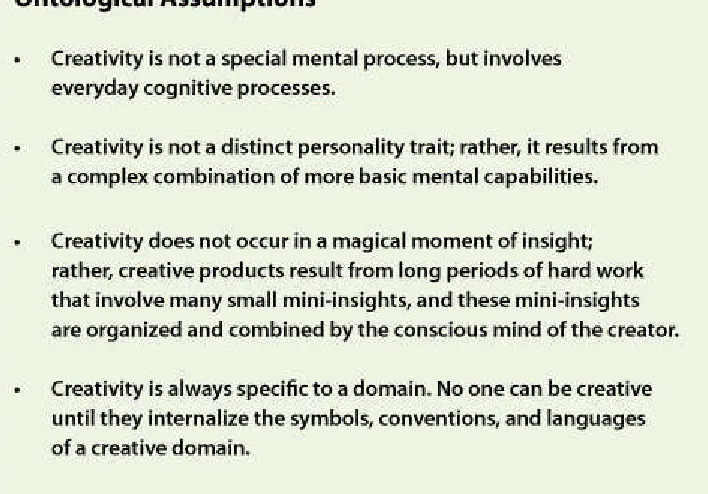
expressed these attributes of creativity very eloquently (2006:74). They are tabulated
Table 1 Ontological Assumptions
Creativity is not the sole domain of geniuses, although some people are better at
generating creative products than others (Simonton 2010a). One of our most important
bedrock premises is that anyone can be creative (Mumford, Whetzel and Reiter-Palmon
1997, Smith and Finke 1999, Ward 2004, Mumford et al. 2002, Runco 2004b):
Creativity in the context of work is possible in any job or by any employee (Shalley, Gilson and Blum 2000), given the appropriate conditions. (Shalley 2008b:3)
Therefore, no specific group of individuals could or should be omitted in the
organizations studied. Leaders and managers were as much a part of the field research as
generally accepted creatives such as artists and designers. The research was not about, or
restricted to a special group of individuals. The only limitation was that they worked for
an organization developing large video games. Again, a foundational premise is that
anyone can be creative.
Limitations
This research concerns defined projects, that is, specifically closed-ended products –
video games. Constraints, such as, budget, time requirements, resources (including talent)
are identified in advance, or become established during the product’s early
Pre-Production phase. This is in contrast to an on-going production process, such as in an
automobile factory or oil refinery where there is the relatively constant output of similar
products. The observations and models may not be as valid, or require modification, in
process production environments as distinct to a project-based environment.
As part of the thesis research design, there are very few references to individual video
games. For the most part, readers of the thesis may not be familiar with individual games
that date rapidly. In the early stages of the field research, while discussing a current hit
video game, two knowledgeable individuals articulated diametrically opposed answers.
One indicated the game was ‘very creative,’ the other that it was ‘just’ a recombination of
old game elements, and no ‘big deal.’ It was not productive for the research to venture
into individual products. References to individual video games have thus been
minimized.
The thesis does not address the creative aspects of individuals, either as individual talent
or in the creative dynamics of groups. Excluded are the internal individual ‘mechanisms
of the mind’ – those processes, which generate ideas and make decisions. As recently as
2009, Colin Martindale pointed out ‘let us remember that psychology is a young science,
and we know very little about the manner in which the mind works’ (2009:117).
Specialist sociologists, psychologists, and neurologists are more appropriately able to
make progress in understanding the mechanisms of the mind. The research does not
and organizational levels.2 These perspectives are also important and influence aspects
of the creative process, but are outside the scope of the research.
Both a limitation and strength of the research, is the extensive experience of the
researcher. A pragmatic orientation, games industry experience, general business
background and optimistic orientation come from the creative cradle of California’s
Silicon Valley. On the positive side, the experience has acted as a filter to select those
ideas, in the literature and the field interviews, which are relevant to getting a creative
product shipped to market. It permits insight into issues – the insight ranges from ‘That is
not the way it really happens,’ to ‘This is the way we/I did it.’ Many ideas, however
interesting and insightful, but marginal or irrelevant to creative tasks, were filtered out
and bypassed. The criterion for relevance was how importance and effective these ideas
were in an operating context – that context based on the researcher’s long experience.
Certainly grey hairs, industry background, and an ability to get to the essence of any
issue, were invaluable in the field research interviews.
On the less effective side, the internal dynamics of today’s organization tone is far
different from the researcher’s early career: it was very much ‘command and control’ as
opposed to today’s more consensus management style. This tended to place more
decision-making authority and accountability with the senior individuals, rather than the
taking into account the influence of group and team members. Further, with significant
experience, there is a tendency to ‘jump’ to conclusions, reflecting a ‘been there, done
that attitude,’ which can shut down avenues of thinking and dialogue, and thereby
potentially missing significant insight and understanding.
2Anderson et al (2004) argued that all the facilitators of innovation at the individual, group, and
The ideas and models presented in this research are empirical, in the sense that they
reflect the real creative problems in developing video games. However, they are not
empirical in the ‘rigorous sense of methodically categorizing and selecting cases on
which to examine and test the full range of possible hypotheses’ (Heifetz 1994:7). They
provide insight and perspective into the creative process in video game development
based on field research and personal experience, rather than a rigorous scientific research
process based on the stating and testing of hypothesises.
Section Two: Methodology – Theory
As there was no overarching theory found relevant to the research topic to develop or
extend. The Grounded Theory Method (GTM), an inductive qualitative approach, was
chosen as the most appropriate research method. It was an excellent method to use
starting from a de minimis position in regard to field interviewing and the creating
process. The case study approach within the qualitative paradigm was not deemed
appropriate, as to study a single game development project would take eighteen to
thirty-six months, which was outside the time frame of the study. There were a number of
appealing aspects for the GTM method:
a) It provided a detailed understanding of the research context, and took advantage of the field research opportunity available.3
b) The approach was qualitative rather than quantitative. It is based on an interview process.
c) As the approach was open-ended, it allowed a change in research emphasis as the research progressed.
d) The researcher is part of the research process, that is, my experience could be a contribution to the findings (based on Saunders, Lewis and Thornhill 2007:120).
An important feature of the GTM was that during and after the field collection, there is a
process of re-interacting with the field with the knowledge earlier gained to further refine
and develop the research understanding. Karen Locke describes this as a ‘conception of
knowledge as emergent’ (2001:34). The foundational literature theories were of some
considerable assistance in the development of the Model Set. As Eisenhardt has
suggested, ‘An essential feature of theory building is comparison of the emergent
concepts, theory, or hypothesis with extant literature’ (1989:544).
One of the important aspects of the GTM process is achieving ‘theoretical sensitivity.’
Locke notes that researchers need to be:
…sufficiently ‘theoretically sensitive’ in order to be able to conceptualize their data (Glaser and Strauss, 1967: 46). They emphasize that ‘the root sources of all significant theorizing is the sensitive insights of the observer himself ‘(1967:252) … The notion of theoretical sensitivity, it seems to me, rests on the premise that researchers cannot apprehend something unless they are equipped with a perceptual apparatus, including the language terms, that allows them to discern and pay attention to it: an apparatus that is sensitive to it … Theoretical sensitivity, also, can be derived from sources outside of the researchers’ disciplinary domain, for example, from personal experiences outside the research situation. (Locke 2001:89)4
My seventeen years in the video game industry was essential and irreplaceable in
establishing theoretical sensitivity in the research situation. This prior experience was
invaluable in placing me within context, and answering the self-question ‘What did we/I
do’ in working through some of the theoretical questions that arose during the research.
4Barney Glaser and Anselm Strauss were the originators of the Grounded Theory Method with the 1967
The GMT is a formal method starting with data collection, then:
1) Naming data incidents (coding) 2) Comparing data incidents 3) Creating conceptual categories
4) Integrating categories and their properties 5) Delimiting the theory
6) Theory development (Lock 2001)
Each stage is building in complexity and understanding on the prior stage. As mentioned
earlier, knowledge emerges from the data into theory. A key aspect of the GMT is ‘data
sampling’ whereby the emergent knowledge is sampled back into the data collection
process to test robustness and assist in further knowledge development. As explained
below, the formal GMT method was abandoned in the second interview phase, as this
structured approach was not developing robust categories. However, in an informal
intuitive manner the categories and subsequent theory development were occurring. The
result was the development of the Model Set. Data sampling was extensively used during
the second and third interview phases. What can be observed is that although the formal
structured GMT process was not followed, the GMT philosophy was definitely used.
However, the critical question is ‘Did the GTM philosophy and underlying methodology
work?’ I am of the opinion that the answer to that is yes – having developed the Model
Set from the field research and considering the foundations in the extant literature. Locke
posed the question this way:
Grounded theory acknowledges its pragmatic philosophical heritage in insisting that a good theory is one that will be practically useful in the course of daily events, not only to social scientists, but also to laymen. In a sense, a test of a good grounded theory is whether or not it works ‘on the ground,’ so to speak. (2001:59)
Chapter Seven (Discussion), addresses the ‘practically useful’ question to both social
How did the GTM work in practice during the field and theoretical model development?
Section Three: Methodology – in Practice
With the assistance of a very senior industry executive, two video game organizations
were made available for in-depth interviews. The first was a large independent game
development studio (240 employees), where the first six interviews were conducted. The
second was a major international publishing company (500 plus employees), where the
remaining interviews were conducted. The latter had three development studios, two of
which were some distance from the headquarters and significantly possessed their own
cultures. Essentially four different organizations were interviewed, with one studio being
interviewed twice, once early in the schedule with the second interview session
conducted at the end of the schedule. The research had the support of both organizations’
CEOs, which was important in arranging the interviews and as regards the attention and
focus given by the interviewees.
Thirty-one interviews were conducted over an eleven-month period starting in November
2008 and finishing in November 2009. Six individuals were interviewed a second time.
One senior manager was interviewed three times. The interviewed individuals were:
CEOs 2
Exec/Sr. Managers 11
Directors/Managers 10 Programmers/Artists 2
Total 25
The interviews were primarily with senior level individuals, stemming from the request
that the interviewees have at least ten years’ industry experience reflecting the Hayes
Rule (Hayes 1989). Hayes found that it took ten years immersed in a domain before
making any creative contribution. The objective was to ensure the interviewees had
one to one and half hours. Agendas were always prepared in advance and at the start of
the interviews, and shared with the interviewees. The interviews were audio recorded,
professionally transcribed, and then personally audited against the master tape for
accuracy, local dialects, and industry jargon. In every first interview, a photograph was
taken of the interviewee and included in the transcriptions. It was a helpful aid in keeping
an intimate and personal contact with the person and material in subsequent research
work. A pad and pencil were always available during the interviews. It proved very
successful in assisting the interviewees to express their thoughts in drawings and charts.
I maintained confidentiality in three ways. A Confidentiality and Non-Disclosure
agreement was signed with each of the organizations participating in the research.
Second, at the start of first interviews it was explained and emphasized that anything
mentioned in the interview was subject to ‘four-walls,’ and would not be further
discussed with any other member of the organization. Lastly, during the interviews at any
time that sensitive material came into the discussion, the interview content was carefully
steered away as not being relevant to the subject under discussion.
The interview style was assertive; at times ‘pushing’ the interviewees to expand their
thoughts by asking them ‘what did they mean,’ ‘asking them to expand further,’ ‘playing
back what I thought I heard,’ and ‘proposing ideas/frameworks/charts.’ In the excitement
of discussing ideas, this tended on occasion to cut off an interviewee’s thoughts, but
overall, it significantly expanded and deepened the subject areas under discussion. It also
Section Four: Interview Phases
Phase One
The interviews went through a number of phases. The first phase was the six interviews
with the independent development studio. In many ways it was an invaluable interview
learning experience – the questions were very broad and there were too many. The
subsequent interviews had smaller and better-focused agendas. In these early interviews,
the questions revolved around general questions of creativity in the organization, the
interviewees’ department, the current project and its processes, and the interviewees’
creative process. A number of significant findings came from these interviews. The
significant findings were firstly the bimodal aspect of the game developing process,
which came out in the first interview. That is, there was high creative effort at both ends
of the development (start and finish), with a less creative period in the middle. The
second significant finding was the importance of game ‘Vision’ at all production levels of
the teams became apparent. This was a very early indication of the hierarchy of Ideas, an
important concept developed in the research that is discussed in Chapter Five (The
Creative Process Models).
Different levels of the organization dealt with different aspects of the creating process
that affected the final product. It was an early indication that in the creative process,
leaders and managers have different creative functions, a significant topic developed in
the thesis.
The interviews were transcribed into NVivo 7, a computer software program for
qualitative research, to begin the process of developing early concepts. Coding, an
This part of the process allowed me to begin to identify the emergent themes in the
research, in particular the bimodality of the creative process with the implication of
different creating processes, and iterative nature of game development.
Phase Two
In the second phase, from interviews number eight to number sixteen, an early version of
Core Creating Mechanism (CCM), was discussed in the interviews. During the course of
these interviews, the central Core Creating Model significantly matured – the most
important development was the central role that decision-making is to the creating
process.
The formal Grounded Theory Method (GTM) methods employing NVivo 7 was no
longer used, as this was not producing the necessary synthesis to higher levels of
understanding.5 It is also likely that a high level of ‘theoretical sensitivity’ had been
achieved, and Nvivo 7 was therefore no longer necessary. However, the core precepts of
the GTM philosophy continued to be followed. A central tenet of the GTM was utilized
extensively, being the testing of tentative findings with the interviewee – the data
sampling process. During this and the subsequent phase, an intuitive approach6 was
taken, relying on experience to guide research development, and using core theoretical
concepts of Campbell (1960), Simonton (1999a), Sternberg (1999), Drazin et al (1999),
and Csikszentmihályi (1999) as an underlying foundation to build understanding and
development of the Model Set.7
5There is the possibility that I was not using the software correctly, or was inappropriately trained even
after taking a training class. There is also the possibility that NVivo was inappropriate to my learning and research style.
6That is, while staying within the planned agendas, allowing the interviews to be more open in following
up interesting and relevant discussion topics. Confidence was also increasing that these interesting topics were highly productive for the central research themes.
Phase Three
Langley suggests that there are three ways in which theory is built: induction (data-driven
generalizations), deduction (theory driven hypothesis testing), and inspiration (driven by
creativity and insight).
“Inspiration” may be stimulated by empirical research, by reading, by thought experiments, and by mental exercises (Weick 1979, 1989), but its roots are often untraceable. It draws indiscriminately on formal data, experience, a priori theory, and common sense. It works when it succeeds in creating new and plausible connections between all of these that can be made explicit as theoretical products … (Langley 1999:708)
In coming to research conclusions, the methodology was a combination of the inductive
use of the GTM philosophy, some deduction based on the extant literature, and the
inspiration derived from experience.
The remaining interviews followed a central theme, with a number of subthemes. The
central theme explored was the Creative Continuum, which became a major part of the
Model Set. The subthemes were: decision-making, the tension between the creating
functions (creatives) and the execution functions (suits), leadership in the setting of
constraints, and the operation of the creative process segmented by functions (i.e., design,
art, programming, and management) during the different phases of the development
process. The latter was not successful in directly developing the Models as no definitive
conclusions could be developed and it turned out to be a poor research trail to follow, as
each function (e.g., design, programming, and art) saw their creative task differently
during the central Production Phase. The other subthemes became important elements in
the overall findings. In reviewing the individual interviewee agendas, the research themes
and findings were becoming more focused and refined. This was particularly true in the
which because of the excellent rapport established from the prior interviews, made for
very direct and productive discussions. A core model, the Creative Continuum, was
discussed extensively, and a number of the key findings continued to be explored.
The integration of the two individual models, the Core Creating Model and the Creative
Continuum Model, into the four-part Model Set occurred during the writing of Chapter
Six (Empirical Support) and Chapter Seven (Discussions and Implications) when it
became clear that they were part of a larger integrated framework. In addition to the
Model Set, the key four findings became clarified in the writing of these chapters.
CONCLUSION
The chapter opened articulating the ontological premises on which this thesis rests, to
minimize the inference of the many myths surrounding the concept of creativity. The
limitations inherent in the thesis were noted. The Grounded Theory Method was the
method chosen for the research, but it was found that the broader GMT philosophy was
effective in guiding the research, rather than the more prescriptive detailed GMT
methods. The GMT in theory and practice were discussed.
The chapter closed with a description of the three distinct phases of the research. From
the theoretical perspective, the thesis now addresses the structure of the games industry,
an outline of the game development process, and the implications for the creative process
CHAPTER THREE
VIDEO GAMES AND THEIR INDUSTRY
Game development is [creative], I would be hard pressed to find another industry that is creative as games, people that work in games are just so creative all the time, it is ridiculous how creative they are, they are thinking in a creative way constantly.
Art Manager (Interviewee 1:8)
Introduction
The chapter examines the video game industry and game development to provide context
for subsequent chapters.8 As with any large and dynamic industry, it has unique
characteristics. The chapter opens with a discussion of the industry’s nature. Major points
emphasized are the size and competitive nature of the games market. The special nature
of games is explored, as interactive experiential products that are fun and engaging.
The chapter then turns to addressing ‘quality’ and ‘creativity’ in games by describing
how they are judged by the marketplace. A statistical analysis demonstrates the
relationship between these ratings and sales. The analysis then turns to how these market
ratings may be used, and how the notion of quality as ‘production values’ is conceptually
different from creativity in the game development environment.
The chapter then proceeds to an outline of the stage-gate development process, an
understanding of which is important in the discussions of the game creating process
8Henceforth the thesis will use the singular ‘game’ as a representative example of a large team based TV
covered in Chapters Five and Six. The chapter closes with an example of a game’s profit
and loss statement (P&L), which then leads into a discussion of the business risks of
game development.
Apart from setting the context of game development, a theme running through the chapter
is the difficulty of developing a successful game in a competitive, high-risk environment.
Section One:
The Nature of the Video Games Industry
In 1998, the UK Government’s Department of Culture Media and Sport Creative
Industries Mapping Document defined the video games industry, as well as software in
general, as part of the ‘creative industries’ (DCMS 1998:4) as Leisure Software. The
definition of the ‘creative industries’ has been generally accepted to mean ‘creativity is
an input and content or intellectual property is the output’ (Potts and Cunningham
2008:233; Galloway and Dunlop 2007). Recognition has both legitimized and defined the
game industry as ‘creative.’ Some contemporary writers have gone further to suggest that
games may now be considered an art form (Smuts 2005). For the industry participants
there is no question but that the industry is creative. It is the central reason for their career
choice, and they would be slighted by any suggestion otherwise.
A distinguishing feature of games, as with many other cultural products, is that they are
approachable and relatively easy to relate to on a personal level. That is, with a little
game experience, an observer can see a game being played and can generally understand
the nature of what is happening. Observers are capable of making product judgements
such as ‘That is a good game,’ and ‘That is not the kind of game I like, but I can see why
for most people, are outside the realm that they relate to on an emotional level. There is a
different from many ‘artistic’ products, which require a higher level of expertise or
educations (i.e., ‘cultural capital’) to appreciate, highlighting the difference between ‘art’
and ‘popular culture.’ One does not have to play games (even just watching them being
played is enough) to understand their aesthetics, their ability to engage players, or their
commercial potential.
Organizations that compete in creative industries must deal with a combination of
ambiguity and dynamism, both of which are intrinsic to goods that serve an aesthetic or
expressive rather than a utilitarian purpose. Managers involved with the creation,
production, marketing, and distribution of cultural goods must navigate a set of tensions
that arise from opposing imperatives from these industry characteristics. Lampel and his
colleagues (2000) have beautifully articulated the core tensions that leaders and managers
must address in the creative industries. In the games industry, the first challenge is to
resolve the differences in outlook and objectives between artistic values (as seen by the
industry ‘creatives’) and the economics of entertainment (as seen by the suits). The
artistic or creative individuals are striving to maximize game aesthetics and gameplay,
while the resources available are severely constrained by the overall risk profile and the
need to meet organizational revenue and profit objectives. Secondly, the games must
have enough creative differences to distinguish them from others in the market and yet
stay centred on meeting the mass market to maximize potential sales. Thirdly, the leaders
and managers need to develop the ability to anticipate future developments in the market
and build the necessary resources to address these future creative, commercial, and
economic requirements in a competitive manner. A distinguishing feature of these games
is their multi-year development cycles to reach the market in two or three years’ time.
That is, the tasks are to deliver the current game in development while simultaneously
developing resources for the following game. The resource requirements over the
extended period will need to include creative, technical, marketing, management, and
production talent, as well as assembling the required economic resources. Fourthly, they
must balance needs of vertical integration within the organization; that is to say, they
must build the necessary core competencies, and at the same time, explore the
opportunity to use advanced external resources. For example, does the organization
develop its own proprietary in-house technology, or obtain it from an external supplier? It
is the classic ‘make or buy’ decision with all the risks and complexities involved. Finally,
but not least, they must build a culture that supports the creative desires and goals of all
individuals. This is no easy task. And, while building the culture, they must at the same
time grow an organization that can efficiently deliver a continuing stream of games, on
time and on budget (Lampel, Lant and Shamsie 2000).
These tensions are common to most creative industries whose leaders and managers cope
with them on a day-in-day-out basis, and are just the facts of any creative industry. From
a particular individual’s perspective engaged on one side of a particular tension,
frustration may often develop. It is the job of the organization’s leaders and managers to
resolve any organizational problems caused by these tensions. It is not a choice between
one side and the other of a particular tension, but maximization of ‘both’ and ‘all’ that is
necessary for a successful game production and organizational development. The
leadership of any creative organization must then: balance the tension between artist
values and entertainment economics, be creative enough (but not too creative) to meet
mass market entertainment requirements, meet both the short term product delivery tasks
nurtures all the necessary creative talents. All the while, meeting the required
organization’s revenue and profit requirements.
The following section discusses the context in which these games and organizations are
situated.
The Industry
The video games industry was born in the mid-1970s with entry into the home of
inexpensive cartridge games played on the television set in the family lounge. In the late
1970s and early 1980s, the video games industry was commercially ‘hot’ with the overall
market leader Atari carrying the accolade of the fastest growing company in the history
of the United States. The leading companies were the darlings of California’s Silicon
Valley and Wall Street. Then in 1982-3, the retail market crashed and closed its doors to
video games, and the industry all but went into oblivion. One of the most famous game
failures was E.T., the Extra Terrestrial, a game based on the movie’s success. The game
was rushed to market anticipating taking advantage of the 1982 Christmas selling season.
The results were a commercial disaster. It is reported that of the five-to-six million copies
produced, only one and a half million sold and the balance were dumped into a New
Mexico landfill along with other titles the market would no longer accept. Game
machines saturated household penetration; there was no innovation in terms of either
hardware of software. The public became bored and the market vanished.9 Industry
observers were declaring the industry dead (Schilling 2003:8). Shortly thereafter, the
market began to grow again with the very successful NES machine from Nintendo. From
this nadir, the industry is now a $41 billion dollar (£25 billion) worldwide behemoth.
During the succeeding years, the hardware companies Microsoft, Sony and Nintendo
marketed a series of ever more powerful consoles, with a stream of interesting and
creative games (Williams 2002). Game console sales for software and hardware for 2009
[image:43.595.127.453.146.380.2]were10:
Table 2 Worldwide video game sales
From the 1985 low point, this represents an impressive record of industry growth. In
terms of number of users, over the last seven years, it is estimated the growth has been
from 230 million gamers to 1.3 billion, a four hundred per cent growth rate.11In contrast
worldwide box office (including Asia Pacific and Latin America) for all movie films
reached $29.9 billion in 2009, according to the Motion Picture Association of American
in a recent report.12 That is, within the last twenty-five years the game business in the
10International Development Group. April 2010.The PC and Video Game Markets: North
America/Europe/Japan.
11Electronic Arts financial presentation 10 March 2010
http://files.shareholder.com/downloads/ERTS/804149742x0x357925/38d47ff2-13f1-4bce-9203-cb7d8d2ce916/Wedbush%20Presentation%203.10.10.pdf (accessed 1 May 2010)
Western World and Japan has achieved greater sales than the film industry with its long
history. This considerable accomplishment is not generally recognized.
Quite apart from the economic impact, game consoles have achieved impressive
household penetration. In 2009 in the approximately 114 million13 US households, the
penetration rate is Wii with 29.5 million units (26%), Xbox 360 with 20.3 million units
(18%), and PS3 with 12.4 million units (18%). The comparable figures for UK household
penetration of approximately 18 million14households is even deeper, with the Wii at 6.5
million units (36%), Xbox at 4.5 million units (25%), and the PS3 at 3.0 million units
(16%).15 Many households have more than one game machine so the household
penetration figures are not net additive. However, we can probably say that in both the
US and UK households, somewhere between a third and a half have video game
consoles. Thus, in one way or another, games are a large factor in the life of many
individuals and families.
Three large companies manufacture consoles: Nintendo with the Wii (31% total hardware
market), Microsoft with the Xbox 360 (26%) and Sony with the PS3 (16%) in 2009 for
the US market.16The remaining market is Nintendo’s hand-held players (DS series) with
a market share of 15%. Both the console manufactures and independent publishers fund
development, manufacture finished goods, inventory finished games, and market games
into the home market. The software shares of US market are as follows:
13http://www.census.gov/prod/1/pop/p25-1129.pdf (accessed 15 April 2010) 14http://www.statistics.gov.uk/cci/nugget.asp?id=8 (accessed 27 May 2010) 15International Development Group. April 2010 for installed base figures.
16International Development GroupUS Video Game Market Update: ’09 in Review and 2010-’14 Outlook,
Table 3 Console Manufacturers and Independent Publishers
There is market concentration on the software sales with the three largest players
collectively controlling a dominating fifty-five per cent of the market. Nintendo
dominates among the hardware manufacturers, Activision/Blizzard and Electronic Arts
are dominant in the independent software market, and three smaller publishers tag along
with each less than 5% market share. The overall characteristics of the market show both
concentration of market power in the major companies and intense competition in both
hardware and software.
As with the other entertainment industries, the game software segments into a number of
genres. While the industry does not completely agree on the description of the genre
Strategy Sports Simulations Shooter Role-playing Racing Fighting Adventure Arcade
Not only is there intense competition within each of the genres but the unit sales volume
is concentrated at the top of the market with a few titles taking the majority of the sales.
Of the approximately 67017Xbox, Playstation 3, and Wii titles that were in the market in
2009, the sales concentration was: top 5 titles took 27% market share, the top 10 titles
took 36% market share, and the top 20 titles took 48% market share.18
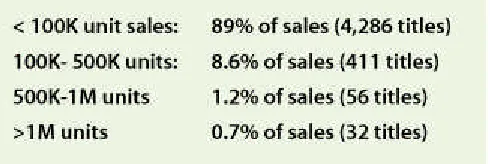
As a further indication of the ‘hits driven’ market, the following US 2009 sales funnel
[image:46.595.173.418.426.508.2]shows the same result from a different perspective.19
Table 4 Unit Sales Chart
As a rough guide on the investment cost of large games concentrated at the top of the
sales charts, the development costs alone (without marketing and corporate overheads)
can run to anywhere from £15,000,000 to £25,000,000 with profitability requirements of
1,000,000 to 2,000,000 unit software sales.20 It is an understatement to say that few
17Source International Development Group direct communication 18Electronic Arts 10 March 2010 presentation.
19International Development GroupUS Video Game Market Update: ’09 in Review and 2010-’14 Outlook,
January 2010.
games meet the necessary unit sales volumes. The concentration of a few titles at the top
of the sales ranking is a further reflection of the nature of this intensively competitive
industry.
As mentioned above, the growth has come from the continued enhancement of the TV
home consoles in terms of raw processor speed, improved graphics and, most importantly
from the flow of ever more interesting and market successful games. In the past, there
have been generational upgrades in the hardware every four to six years. The present
generation of hardware (Xbox 360, PS3, and Wii) seem to be in a longer cycle, with a full
new hardware cycle not expected to start for a number of years.
Currently, the industry is moving into a potentially disruptive phase as the impact of the
internet begins to encroach on the existing retail business models. In the past, the industry
has successfully embraced the internet with on-line multi-player functions becoming an
essential component of many games. The industry is now assessing the potential of direct
distribution to the consumer (bypassing retail) of both full games and/or downloadable
content (DLC). The DLC can potentially take the form of incremental game
enhancements (e.g., purchasing a more powerful sword) or episodic content. Looming
out there somewhere are the unknown impacts of 3D digital imaging21 and cloud
computing,22 which have the further potential of significantly disrupting the industry. In
many ways the games industry is similar to the film industry where a few large generalist
firms dominate the business (Mezias and Mezias 2000). Both these industries are hits
driven businesses (i.e., where a few titles dominate total sales). In both industries, the
product life cycle in the marketplace is short. If the film or game is unsuccessful, they are
21Similar to the current production of 3D films now in theatres worldwide.