
University of Warwick institutional repository:
http://go.warwick.ac.uk/wrap
A Thesis Submitted for the Degree of PhD at the University of Warwick
http://go.warwick.ac.uk/wrap/69575
This thesis is made available online and is protected by original copyright.
Please scroll down to view the document itself.
M A
E
G
NS
I
T A T MOLEM
U N
IV
ER
SITAS WARWICEN
SIS
Marker-less Human Body Part Detection, Labelling
and Tracking for Human Activity Recognition
by
FAISAL AZHAR
Thesis
Submitted to the University of Warwick
for the degree of
Doctor of Philosophy
School of Engineering and Department of Computer Science
Abstract
This thesis focuses on the development of a real-time and cost effective
marker-less computer vision method for significant body point or part detection
(i.e., the head, arm, shoulder, knee, and feet), labelling and tracking, and its
ap-plication to activity recognition. This work comprises of three parts: significant
body point detection and labelling, significant body point tracking, and activity
recognition. Implicit body models are proposed based on human anthropometry,
kinesiology, and human vision inspired criteria to detect and label significant body
points. The key idea of the proposed method is to fit the knowledge from the
im-plicit body models rather than fitting the predefined models in order to detect and
label significant body points. The advantages of this method are that it does not
require manual annotation, an explicit fitting procedure, and a training (learning)
phase, and it is applicable to humans with different anthropometric proportions.
The experimental results show that the proposed method robustly detects and
la-bels significant body points in various activities of two different (low and high)
resolution data sets. Furthermore, a Particle Filter with memory and feedback is
proposed that combines temporal information of the previous observation and
esti-mation with feedback to track significant body points in occlusion. In addition, in
order to overcome the problem presented by the most occluded body part, i.e., the
arm, a Motion Flow method is proposed. This method considers the human arm as
ABSTRACT
since it is the most occluded body part. The former method is invoked as default
and the latter is used as per a user’s choice. The experimental results show that
the two proposed methods, i.e., Particle Filter and Motion Flow methods, robustly
track significant body points in various activities of the above-mentioned two data
sets and also enhance the performance of significant body point detection. A
hierar-chical relaxed partitioning system is then proposed that employs features extracted
from the significant body points for activity recognition when multiple overlaps
ex-ist in the feature space. The working principle of the proposed method is based
on the relaxed hierarchy (postpone uncertain decisions) and hierarchical strategy
(group similar or confusing classes) while partitioning each class at different levels
of the hierarchy. The advantages of the proposed method lie in its real-time speed,
ease of implementation and extension, and non-intensive training. The experimental
results show that it acquires valuable features and outperforms relevant
state-of-the-art methods while comparable to other methods, i.e., the holistic and local feature
approaches. In this context, the contribution of this thesis is three-fold:
• Pioneering a method for automated human body part detection and labelling.
• Developing methods for tracking human body parts in occlusion.
Acknowledgments
I owe a great thanks to my supervisors, Dr. Tardi Tjahjadi at Image Processing and
Expert Systems (IPES) Laboratory, School of Engineering, and Prof. Chang-Tsun
Li at Image Processing Laboratory, Department of Computer Science, University
of Warwick. It is a pleasure to have worked under their supervision and I consider
myself lucky for having been their student.
Thanks to Graduate School for awarding me full time Warwick Postgraduate
Research Scholarship, and special thanks to my supervisor Dr. Tardi Tjahjadi for
arranging the School of Engineering Bursary, which allowed me to fulfil my dream
of pursuing a PhD research in computer vision and machine learning.
Thanks to Prof. Alison Rodger at Molecular Organisation and Assembly
in Cells (MOAC), Department of Chemistry, University of Warwick, for providing
moral support and motivation to complete my research in time. She is a wonderful
person, and I have been inspired by her unconditioned dedication to students.
Thanks to my colleagues from Image Processing and Expert Systems (IPES)
Laboratory, School of Engineering, and Image Processing Laboratory, Department
of Computer Science, with whom I enjoyed insightful discussions on research topics.
Thanks to Mr. Faisal Khan who has been like a brother during my first year of PhD.
Thanks to my closest friend Mr. Salman Shahid who gave me wonderful company
during this PhD journey.
And thanks to my parents, i.e., Zarina Azhar and Azhar Ali, my wife, i.e.,
Declarations
I hereby declare that I have produced this thesis without the prohibited assistance
of third parties and without making use of aids other than those specified; notions
taken over directly or indirectly from other sources have been identified as such.
This thesis has not previously been presented in identical or similar form to any
other publication unless otherwise specified. The thesis work was conducted from
2010 to 2014 under the supervision of Dr. Tardi Tjahjadi at Image Processing and
Expert Systems (IPES) Laboratory, School of Engineering, and Prof. Chang-Tsun
Li at Image Processing Laboratory, Department of Computer Science, University of
Warwick.
Contents
Abstract i
Acknowledgments iii
Declarations iv
List of Tables ix
List of Figures x
Chapter 1 Introduction 1
1.1 Justification for the research . . . 1
1.2 Research problem and objectives . . . 2
1.3 Major contributions . . . 5
1.4 Outline of the thesis . . . 6
Chapter 2 Related Work and Datasets 8 2.1 Human body part detection . . . 8
2.1.1 Marker-based approach . . . 8
2.1.1.1 Pros and Cons . . . 9
2.1.2 Marker-less approach . . . 10
2.1.2.1 Pros and Cons . . . 12
2.1.2.2 Classification of Marker-less approach . . . 13
2.2 Human body part tracking . . . 15
2.2.1 Single hypothesis tracking . . . 16
2.2.2 Multiple hypotheses tracking . . . 18
2.3 Activity recognition . . . 20
CONTENTS
2.3.2 Local feature approach . . . 22
2.3.3 Model-free or Model-based approach . . . 25
2.4 Datasets . . . 28
2.4.1 Weizmann data set . . . 29
2.4.2 MuHAVi data set . . . 30
Chapter 3 Human Body Part Detection and Labelling 32 3.1 Introduction . . . 32
3.2 Literature review . . . 33
3.2.1 Model-free approach . . . 33
3.2.2 Model-based approach . . . 34
3.3 Foundation of proposed framework . . . 36
3.3.1 Implicit Body Models (IBMs) . . . 36
3.3.2 Inverse pendulum and contour moments . . . 39
3.4 The proposed framework . . . 42
3.4.1 Silhouette feature extraction . . . 44
3.4.1.1 Human movement categorization . . . 45
3.4.1.2 Human posture categorization . . . 46
3.4.1.3 Human body side categorization . . . 48
3.4.1.4 Body part segmentation . . . 49
3.4.2 Silhouette feature reduction . . . 51
3.4.3 Significant Body Point (SBP) labelling . . . 51
3.4.3.1 Stand . . . 52
3.4.3.2 Sit . . . 52
3.4.3.3 Lie . . . 53
3.4.3.4 Smart Search Algorithm (SSA) . . . 53
3.4.4 2D Stick figure . . . 54
3.5 Experimental Results . . . 55
3.5.1 Qualitative evaluation . . . 58
3.5.2 Quantitative evaluation . . . 61
3.5.2.1 Accuracy of localization . . . 61
3.5.2.2 Accuracy of detected SBPs vs observed . . . 63
CONTENTS
Chapter 4 Human Body Part Tracking 68
4.1 Introduction . . . 68
4.2 Literature review . . . 69
4.2.1 Particle Filter . . . 69
4.3 Foundation of proposed methods . . . 74
4.3.1 Concept of proposed Particle Filter tracking . . . 74
4.3.2 Concept of Motion Flow (MFL) tracking . . . 76
4.4 Overview of proposed SBP tracking . . . 78
4.4.1 Particle Filter with memory and feedback for SBP prediction 78 4.4.2 Motion flow for SBP prediction . . . 81
4.5 Experimental Results . . . 83
4.5.1 Qualitative Evaluation . . . 83
4.5.2 Quantitative Evaluation . . . 89
4.5.2.1 Localization accuracy of predicted arm SBP . . . . 89
4.5.2.2 Accuracy of detected SBPs with prediction vs observed 90 4.5.2.3 Comparative evaluation of SBP labelling and tracking 92 4.5.2.4 Comparative evaluation of Stick figure generation . 92 4.5.2.5 Computational complexity . . . 94
4.6 Summary . . . 96
Chapter 5 Activity Recognition 97 5.1 Introduction . . . 97
5.2 Literature review . . . 99
5.2.1 Holistic and local feature approaches . . . 99
5.2.2 Model-free and model-based approaches . . . 100
5.3 Foundation of proposed method . . . 101
5.4 HRPS for Activity Recognition . . . 104
5.4.1 Feature extraction . . . 104
5.4.2 Classification: HRPS for Weizmann data set . . . 108
5.4.2.1 Majority Voting Scheme (MVS) . . . 110
5.4.3 Classification: HRPS for the MuHAVi data set . . . 112
5.5 Experimental results . . . 115
5.5.1 Feature extraction evaluation . . . 115
5.5.2 Classification evaluation . . . 119
CONTENTS
Chapter 6 Conclusions and Future Work 124
Appendix A Publications 129
List of Tables
3.1 Acronyms for activities. . . 44
3.2 Acronyms for body movement and body side. . . 46
3.3 Normalised segment values for Stand, Sit and Lie IBM. . . 50
3.4 Average Error in pixels of SBPs w.r.t Ground Truth. Mean Height is 68 and 200 pixels for Weizmann and MuHAVi data set respectively. 62 3.5 Precision and Recall of SBP detection with no prediction. . . 64
4.1 Parameters and their value for Motion flow based arm prediction. . 82
4.2 Particle Filter with memory and feedback (denoted byp), and Motion flow (denoted by m) prediction error in pixels unit. Mean height is 68 and 200 pixels for Weizmann and MuHAVi data set respectively. 89 4.3 Precision and Recall of five SBPs detection of proposed framework. . 91
4.4 SBP detection: Proposed vs CBHM and FS. . . 93
4.5 SBP detection: Proposed vs SKEL and CVHSP. . . 95
4.6 Proposed approach versus Related approaches. . . 96
5.1 Comparison on the Weizmann data set. . . 122
List of Figures
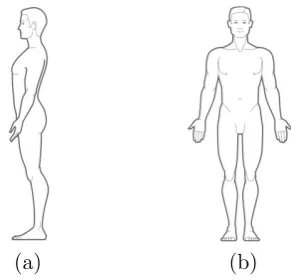
1.1 (a) Profile view and (b) Front view. . . 3
2.1 Marker-based approach. (a) An actor wearing a suit with reflective
infra-red markers, i.e., the small white balls in the middle of the black patches. The motion of the actor is recorded by several cameras,
(b) HumanEva data set subject performing an activity, and (c) the
corresponding model fitting that detects body parts such as head, torso, arms, legs, etc. [2]. . . 9
2.2 Marker-less approach. Cameras are used to relay information about
the subjects, i.e., humans, cars, etc., and servers store the videos. The video analysis software provides real-time alerts [28]. . . 10
2.3 Smart camera node architecture (reprinted from [29]). . . 11
2.4 Marker-less model approach applications. (a) Sit to stand motion
analysis between young and elderly person [4], (b) Stick figure
gen-eration for stand to sit activity and (c) Stick figure construction for sport activities [30]. . . 12
2.5 Marker-less model based approach. (a) Top-down method, and (b)
Bottom-up methods [36]. . . 14
2.6 Models for tracking human body parts. (a) Stick figure model, (b)
2-D model, (c) 3D volumetric model, and (d) 3D surface model [3]. 15
2.7 Combining prior knowledgeN(xk−1, σk−1) with the measurement
LIST OF FIGURES
2.8 (a) The unimodal (Gaussian) distribution that can be represented by
the Kalman Filter and (b) multimodal (non-Gaussian) distribution that cannot be represented by Kalman Filter but can be represented
by a set of particles whose density approximates the represented
dis-tribution [9]. . . 18
2.9 Holistic approach. (a) Motion energy images and motion history im-ages [57], (b) Actions as space-time shape (from left to right) for Two
Hand Wave, Walk, and Run activities [58] and (c) 3D shape context descriptor (from left to right) for Bend and Skip activities [59]. . . . 21
2.10 Holistic approach. (a) Bounding box, (b) Scaled and aligned
bound-ing boxes, (c) Optical flow, (d) Accumulation Regions and (e) Action
descriptor. . . 21
2.11 (a) Difference-of-Gaussian is convolved with image for each scale
space and (b) Maxima and minima of the difference-of-Gaussian
im-ages by comparing a sample point (pixel) in 3x3 region at a scale above and below [63]. . . 23
2.12 SIFT descriptor computed from 16x16 neighbourhood represented
by using 4x4 quadrants described as 8 orientations, i.e., 4x4x8=128, feature vector [63]. . . 24
2.13 (a) Bag of semantic words for human action recognition [67]. . . 26
2.14 (a) Model-free approach that uses extremities as limb points [21, 22,
34], (b) Model based approach that uses a pre-defined body model to locate limbs [71]. . . 27
2.15 Complementary features and different challenges of Weizmann and
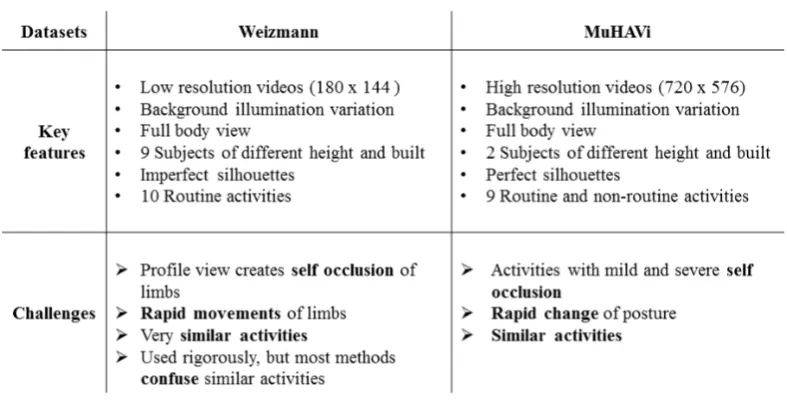
MuHAVi datasets. . . 28
2.16 Weizmann data set. Jack, Run, Walk and Side from top to bottom row [58]. . . 29
2.17 MuHAVi data set. Walk, Run, Collapse and Kick from top to bottom
row [73]. . . 30
2.18 MuHAVi data set two views, i.e., camera 3 (left column) and camera
4 (right column) [73]. . . 31
3.1 Block diagram of the proposed method versus related approaches. . 33
LIST OF FIGURES
3.3 IBMs for Head (H), Arm (A), and Feet (F) SBP labelling and
anthro-pometry based segmentation [G1-G7] (see Section 3.4.1.4 Table 3.3) of silhouette contour using bounding rectangle minimum (ubr, vbr) and
maximum points (wbr, hbr) for: (a) Stand (α activities in Table 3.1,
convex hull in shaded region); (b) Sit; and (c) Lie. . . 38
3.4 IBMs based on cues in Section 3.4.1.4 with Smart Search Algorithm
(see Section 3.4.3.4) for locating and labelling Head (H), Arm (A),
and Feet (F) SBPs inβ activities (see Table 3.1): (a) Wave; (b) Kick and (c) Bend. . . 40
3.5 Front and Side view: (a) Elbow range of motion, (b)-(c) Arm range
of motion and (d) Leg range of motion based on anthropometric and kinesiology studies [90–92]. . . 40
3.6 (a) Body planes and orientation based on anatomy [91, 92] and (b)
Human body inverse pendulum model draws an arc in Walk motion [93]. 41
3.7 The global angle θ and angle ϕ from the vertical axis of the inverse pendulum human body model. . . 41
3.8 The components and work flow of the proposed framework for
Signif-icant Body Point (SBP) labelling. . . 43
3.9 (a) Freeman Chain Code contour (b) Chain direction. . . 45
3.10 Trunk extension and flexion range based on biomechanical basis [92])
of human movement. . . 45
3.11 (a)α significant movement from right to left, and left to right; (b)β
no significant movement . . . 46
3.12 Biomechanical analysis of trunk flexion due to rotation of lumbar vertebrae and pelvic [92]. . . 47
3.13 Stand, Sit, and Lie posture classification using ellipse global angle
θ(t) (see Section 3.4.1.2) in movements from: (a) Stand to Lie and (b) Lie to Stand. . . 47
3.14 Stand, Sit, and Lie posture orientation and categorization concept. . 48
3.15 Human body side categorization (a) Stand, (b) Sit, and (c) Lie. . . . 49
3.16 The intermediate human body postures. . . 50
3.17 Examples of annotated (blue target) SBPs (green circle) on the
Weiz-mann data set. Side, Run, Bend and Jack from top to bottom row. . 56
LIST OF FIGURES
3.19 Weizmann data set. (a)-(b) Walk, (c)-(d) Side, (e)-(f) Skip,
(g)-(h) Jump, (i)-(j) Jump-in-place-on-two-legs, (k)-(l) Run, (m)-(n) One Hand Wave, (o)-(p) Two Hand Wave, (q)-(r) Jack and (s)-(t) Bend
respectively (Contour, bounding rectangle, ellipse and stick figure).
SBPs labelled as Head (H), Shoulder (S), Arm (A), Knee (K) and Feet (F) in the corresponding activities. Note that S and K are displayed
in some cases to show that it is possible to determine more than 5
SBPs using the proposed framework. . . 59
3.20 MuHAVi data set. SBPs labelled as Head (H), Shoulder (S), Arm (A),
Knee (K) and Feet (F) in (a)-(b) Walk, (c)-(d) Run, (e)-(f) Punch, (g)-(h) Kick, (i)-(j) Collapse and (k)-(l) Standup. Note that S and K
are displayed in some cases to show that it is possible to determine
more than 5 SBPs using the proposed framework. . . 60
3.21 SBP detection error in pixels (%) using (Eq. 3.36) on (a) Weizmann
data set and (b) MuHAVi data set, with no prediction. . . 66
4.1 Concept of the Particle Filter for state prediction (a) No occlusion;
and (b) Occlusion. . . 74
4.2 Concept of proposed Particle Filter for state prediction in occlusion. 75
4.3 Motion flow based arm predictionAusing previous armApand
cur-rent arm Acduring occlusion (see Section 4.3.2). . . 77
4.4 Block diagram describing the tracking (operation) modes, i.e., no
occlusion and occlusion of the proposed Particle Filter with memory
and feedback. . . 80
4.5 Arm SBP predicted using the standard Particle Filter. The predicted
arm is shown in blue circle for (a) Walk, (b) Side, (c) Skip, (d) Jump and (e) Run activities. . . 84
4.6 Arm SBP tracking using the Particle Filter with memory and
feed-back shown in red circle (a) Walk, (b) Side, (c) Skip, (d) Jump and (e) Run. . . 85
4.7 SBP tracking using the Particle Filter with memory and feedback shown in red circle (a) Jump-in-place-on-Two-Legs, (b) Bend, (c)
One hand wave, (d) Two hand wave and (e) Jack. The reallocated
LIST OF FIGURES
4.8 SBP tracking using the motion flow prediction shown in green circle
(a) Walk, (b) Side, (c) Skip, (d) Jump and (e) Run. . . 87
4.9 SBP tracking using the motion flow prediction shown in green
cir-cle (a) Jump-in-place-on-Two-Legs, (b) Bend, (c) One hand wave, (d) Two hand wave and (e) Jack. The reallocated Head (H) and
Arm (A) points using Smart Search Algorithm in Section 3.4.3.4 are
superimposed in black bold. . . 88
5.1 (a) Example of three classes to illustrate multiple overlaps class sepa-ration problem, (b)-(e) Hierarchical relaxed partitioning system: (b),
(c) and (d) Partition non-overlapping samples from class A, B and
C respectively, (e) Remaining overlapping samples of all the three classes discerned using the majority voting scheme (see Section 5.4.2
for details), and (f) the corresponding class hierarchy structure. . . . 103
5.2 The main components and work flow of the proposed human activity
recognition. . . 104
5.3 Feature extraction. (a) 2D stick figure analysis for cyclic activities
and (b) The upper and lower body analysis based on the arm and feet movement. The SBPs labelled as Head (H), Front Arm (FA),
Back Arm (BA) and Feet (F). . . 105
5.4 High pass filter. (a) magnitude-frequency response and (b)
phase-frequency response. . . 106
5.5 Process of acquiringD1 feature descriptor for the cyclic activities. . 106
5.6 Hierarchical relaxed partitioning system for the Weizmann data set.
∆i, i=1,2,..10are the decision rules, andXαandXαare the unassigned
impure cyclic and non-cyclic activities, respectively, with significant multiple overlaps. . . 108
5.7 Proposed majority voting scheme for the unassigned impure activities Xα and Xβ using the mean ¯Di, i=1,2. . . 111
5.8 Hierarchical relaxed partitioning system for the MuHAVi data set.
∆i, i=11,12,..19 are the decision rules, and Xα and Xβ are the
unas-signed impure cyclic and non-cyclic activities, respectively, with sig-nificant multiple overlaps. . . 113
LIST OF FIGURES
5.10 3D scatter plots of the selected features that show the distribution of
the activities for the input Weizmann and MuHAVi data sets. . . 117 5.11 Significance of the extracted features for discerning activities.
Er-ror bars show 95% confidence intervals on selected features with two
standard deviation as an error metric. (a)-(e) Weizmann data set and (f) MuHAVi data set. . . 118
5.12 Confusion table. (a) Weizmann data set and (b) MuHAVi data set. 120
Chapter 1
Introduction
Videos are cheaply available and open up opportunities for developing computer vision based applications. Among so many potential applications my work will focus
on the recognition of human activities because this can enable applications such
as unusual activity detection, surveillance, home-based rehabilitation, behaviour recognition, location estimation, etc. The fact that humans are the most captured
objects in the majority of the videos provides a strong motivation for automated
analysis and interpretation of human activities. Therefore, this thesis focuses on developing computer vision methods for detecting, labelling and tracking significant
body points or parts (i.e., the head, arm, shoulder, knee, and feet), and recognizing
human activities.
1.1
Justification for the research
Computer vision methods provide automated, low cost, efficient and effective solu-tions to detect, label, and track human significant body parts, and recognize human
activities [1–3]. These methods do not require subject cooperation, large
experi-mental set-up time, specialized environment, etc., and thus can be used for various applications.
A real-time, accurate, fully automated, universal (applicable to different age,
gender, ethnicity, etc.), and complete method that is able to detect, label and track human significant body points, and then utilize them for the task of human activity
recognition does not exist. This is because most of the previous computer vision
1.2 Research problem and objectives
are computationally inexpensive or do not require training are not accurate. In
addi-tion, these methods are not always fully automated and often require some manual initialization. Moreover, the methods that use arbitrary predefined body models
might not be applicable to humans with different anthropometric proportions.
In this context, this research thesis aims to fill the above-mentioned gap in the literature by investigating novel computer vision methods in order to develop
a real-time, accurate, fully automated, universal, and complete human body part detection, labelling and tracking framework for human activity recognition.
1.2
Research problem and objectives
Computer vision methods use marker-less techniques to detect and label signifi-cant human body points. The previous research work on marker-less signifisignifi-cant
body point detection can be broadly divided into the model-based (prior model)
or model-free (no prior model) approaches [3, 4]. The former approach requires a fitting procedure, manual annotation, and numerous predefined models which are
time consuming processes, while the latter tends to be less accurate. The arbitrary
predefined models might not always be a proper fit for the human subjects as the human body proportions vary with respect to age, ethnicity, gender, etc. However,
the empirical studies on the human anthropometry [5,6] allow definition of more
ac-curate human body proportions that can cover the majority of the world population. So far, anthropometry has only been used in a semi-automated manner to detect
and label human body parts for merely stand postures [7, 8] since its application in
complex activities is not an easy task.
In order to address the above-mentioned drawbacks of the previous
marker-less methods, the objectives of the first part of this thesis, i.e., Human Body Part Detection and Labelling, are as follows:
• To investigate the application of the human anthropometry (measurement of human body proportions) and kinesiology (study of human movement) in order
to define more accurate human body models.
• To explore a novel, efficient, robust, and fully automated marker-less method that does not require explicit model fitting and manual annotation to detect
1.2 Research problem and objectives
[image:20.595.246.392.135.275.2](a) (b)
Figure 1.1: (a) Profile view and (b) Front view.
When observed from the profile view, the human activities such as Walk, Run, Bend, etc., might contain considerable rapid motion and self-occlusion of the
human body parts e.g., arms and legs. Also, the human body can attain various
postures and perform numerous activities due to its high dimensionality, i.e., degrees of freedom of its motion. Hence, the foreground segmentation of human body is
affected and might contain artefacts that will result in false detection of significant
body points. Therefore, the profile view in Fig. 1.1 (a) is chosen over the front view in Fig. 1.1 (b) since it presents a more challenging scenario to label and track significant
body points and human activity recognition. A robust method for significant body point detection and labelling should be able to recover the positions of the body parts
during occlusion. Thus, it is imperative to incorporate a tracking method that deals
with occlusion, variation of illumination, rapid motion, etc. The non-Gaussian, i.e., multimodal distribution, and non-linear, i.e., the system is a function of polynomial
degree higher than one, assumption of the Particle Filter method [9, 10] make them
suitable for visual tracking.
The Particle Filter draws samples/particles from the uniform distribution and assigns them equal weights. It then uses a model that represents the current
system to predict the new state. Finally, the new state is updated based on the
measurement, i.e., observation, to re-assign weights to the particles. However, the standard Particle Filter struggles to predict accurately when there are no
measure-ments, i.e., observation of significant body points, in the image.
In order to address the above-mentioned challenges and the inability of the
1.2 Research problem and objectives
• To examine new ways to enhance the capability of the standard Particle Filter to track during occlusion.
• To apply the pendulum physics in order to develop a new tracker for predicting the arm which is the most occluded significant body point and thus most challenging body part to track.
• To analyze whether the significant body point detection and labelling is im-proved by using a tracking method.
Significant body points can be utilized for various tasks such as activity recog-nition, motion analysis of sit-stand for elderly people, realistic animation of human
body models, surveillance, etc. Human activity recognition methods can be broadly
divided [1, 3, 11] into: holistic (a), local feature (b), and based (c) or model-free (d). The holistic method uses shape or optical flow information, while the local
feature method uses descriptors of local regions to define an activity. The extraction
of shape and optical information from each frame of video sequence is a computa-tionally expensive procedure. The learning of local descriptors require intensive
training phase in order to perform accurate recognition. In contrast, the
model-based approach fits a predefined model to human silhouette while the model-free uses body characteristics such as orientation, proportion, motion etc., to recognize
activities. They are computationally inexpensive in comparison to holistic and local feature methods but lack accuracy. Also, many human activity recognition
meth-ods [12–17], cannot accurately discern, without intensive training, similar activities
such as walk, run, jump, etc. This is due the fact that the feature space for very similar activities includes considerable overlaps. Previous methods such as relaxed
hierarchy [18], only deal with a two overlap class separation problem in the spatial
domain and hence are not applicable to multiple overlaps in the spatio-temporal domain.
In order to address these above-mentioned drawbacks of the previous activity
recognition methods, the objectives of the third part of this thesis, i.e., Human Activity Recognition, are as follows:
• To explore the use of the significant body points in order to build innovative feature descriptors that enable to discern human activities.
1.3 Major contributions
activity recognition.
1.3
Major contributions
The main contributions of this work are as follows.
• This is the first work to provide both quantitative and qualitative evaluation of significant body point detection. The quantitative evaluation of significant
body point detection, labelling and tracking has not been done in most of the
relevant previous works [19–22].
• This is also the first work to perform the ground truth mark-up of significant body points on both the Weizmann and MuHAVi data sets for quantitative evaluation. There was no state-of-the-art data set available that contained
ground truth significant body points.
• The novel proposition of the Implicit Body Models (IBMs) that are derived by combining the science from Anthropometry, Kinesiology, and Biomechanics studies. IBMs contain the knowledge of the body part positioning, range
of motion of human body parts and understanding of type of motion. The
knowledge from the Implicit Body Models are utilized to robustly detect and label significant body points and to achieve real-time efficiency. In contrast to
previous works, it does not require an explicit fitting procedure and a manual
annotation.
• An innovative Particle Filter method based on the temporal Markov chain framework to perform prediction during occlusion. The proposed Particle Filter utilizes the temporal information of the previous observation and
es-timation (kept in memory) via a feedback to predict human body parts in
occlusion. It predicts more accurately in occlusion than the standard Particle Filter.
• A new motion flow prediction method specifically designed for arm since it is the most occluded limb. It considers the human arm as a pendulum attached
to the shoulder joint producing curvilinear motion and derives linear equations from the pendulum physics to predict arm in occlusion.
1.4 Outline of the thesis
not require subject cooperation. It automatically determines significant body
points, create a 2D stick body model and extracts motion of the limbs.
• This significant body point detection, labelling and tracking proposed in this work is also an alternative to KINECT and has been shown to work on both low and high resolution videos without any depth information.
• The method in [21] is extended by introducing two features, i.e., the leg power and torso power, in addition to the leg angle and torso angle to create a robust
feature descriptor for recognizing very similar activities.
• A hierarchical relaxed partitioning system method that combines relaxed hi-erarchy and hierarchical strategy methods and uses an innovative majority voting scheme to discern easily confused activities with real-time speed and
without intensive training. Most of the previous methods [13, 15, 16, 22, 23]
confuse very similar activities and require either computationally expensive feature extraction or intensive training to overcome this issue.
1.4
Outline of the thesis
The outline of the entire thesis is as follows.
Chapter 2 covers the detailed literature review on human motion analysis
and tracking approaches. It also described the general approaches to human activity
recognition. In addition, it explains and illustrates the experimental data sets used in this thesis.
Chapter 3 describes the use of the anthropometry and kinesiology
informa-tion to develop novel implicit body models. It explains the proposed marker-less approach which uses computer vision methods based on implicit body models to
detect and label human significant body points, i.e., the head, arm, shoulder, knee,
and feet in various human activities. Next, it presents the procedure to construct 2D stick figures from the detected and labelled significant body points. The accuracy
of the proposed method is established by evaluating its ability to detect and label
significant body points in various activities of two different resolution data sets, i.e. low (180 x 144) and high (720 x 576).
Chapter 4 details the improvements made in the standard Particle Filter
1.4 Outline of the thesis
points during occlusion. It describes how the proposed Particle Filter addresses
the limitations of the standard Particle Filter to track in occlusion. In addition, it introduces the concept of using a pendulum for the human arm prediction based on
the motion flow. The accuracy of the proposed methods is established by evaluating
their ability to robustly predict the significant body points in occlusion or in missed detections. The impact of the tracking methods on the performance of the significant
body point detection and labelling is also demonstrated in this chapter.
Chapter 5 presents the proposed hierarchical relaxed partitioning system solution for human activity recognition. It explains the process of building feature
descriptors by using the human significant body points. In addition, it details
a hierarchical relaxed partitioning system method for human activity recognition. The discerning ability of the feature descriptors is shown on the training data set.
The accuracy of this proposed method is authenticated by evaluating its ability to
discern various very similar human activities that have significant multiple overlaps in the feature space.
Chapter 6 concludes the entire thesis by highlighting the efficiency of the
proposed computer vision methods for human activity recognition. It suggests the implications of the research undertaken and its various applications. It also
Chapter 2
Related Work and Datasets
2.1
Human body part detection
Human body part detection involves estimation of the location and orientation of
joints of a human body. This section focuses as to why out of the two broad ap-proaches to human body part detection, i.e., marker-based, and marker-less; the
latter is preferred over the former and builds up a discussion of pros and cons of the
two approaches. This section also explains the model-based technique of the marker-less human motion analysis approach and why this technique has been chosen in lieu
of the model-free based approach.
2.1.1 Marker-based approach
The marker-based approach estimates human body motion by determining
coordi-nates of a set of markers attached on particular points of the human body, as shown in Fig. 2.1 (a) and (b) [1–3]. The coordinates of a set of active or passive markers
at-tached on the anatomical landmarks of human body whose spatial trajectories are to
be estimated and computed by a stereo-photogrammetric method [1, 24]. The joint kinematics is estimated by reconstructing the 3D position of the attached markers
and conjecturing the fundamental human body model, as shown in Fig. 2.1 (c) [2]. In
the recent years, the marker-based human motion capture approach has been used commercially for biometrics (gait recognition), special effects in motion pictures,
clinical and rehabilitative fields, etc. [1]. The growing significance of healthcare for
2.1 Human body part detection
(a) (b) (c)
Figure 2.1: Marker-based approach. (a) An actor wearing a suit with reflective infra-red markers, i.e., the small white balls in the middle of the black patches. The motion of the actor is recorded by several cameras, (b) HumanEva data set subject performing an activity, and (c) the corresponding model fitting that detects body parts such as head, torso, arms, legs, etc. [2].
society [25,26]. Every year the number of casualties and injuries amongst the ageing
and disabled is increasing especially in household incidents while performing
rou-tine but difficult activities. Thus, applications such as surveillance, animation, and assisted living bring new challenges to the marker-based approach [4, 20, 25, 26].
2.1.1.1 Pros and Cons
The commercially available marker-based approaches are accurate with a root mean
square error below 6mm for 3D reconstruction of the position of markers [4]. The existing technologies use sensors to prevent injuries to persons [25] or to generate an
alarm to a surveillance team in case of suspicious/ abnormal beaviour. In order to
achieve this, the subject needs to wear an electronic sensor that keeps record of his or her movement. The difficulty with using sensors is that they are required to be
worn at all times which is not possible for any outdoor applications e.g., surveillance,
sports etc. An elderly person may forget to wear the sensor due to his or her age when going outside [25], while sensor fitting is unsuited for surveillance because it requires
subject cooperation. Moreover, attaching markers is not only a time consuming
exercise, but it also restricts the movement of the subject. In addition, it is not easy to use equipment for people of all ages and this requires inter-session repeatability of
measurement. The marker based approach requires expensive specialized hardware,
2.1 Human body part detection
Figure 2.2: Marker-less approach. Cameras are used to relay information about the subjects, i.e., humans, cars, etc., and servers store the videos. The video analysis software provides real-time alerts [28].
2.1.2 Marker-less approach
Marker-less approaches are employed by several researchers to make up for the
limitations of the marker based approaches [1, 3]. These are also available
commer-cially for private and public offices, defence installations, as well as domestic usage; therefore they are deemed preferable for this type of research. In the marker-less
approach, cameras are used to relay information about the movements and
where-abouts of the subjects, as shown in Fig. 2.2. A video analysis system is used in such systems to recognize human behaviours, anomalies, etc. [27]. Recently, smart
cam-era based systems have been proposed for surveillance, assisted living, behaviour
recognition, etc. [28]. These systems comprise of cameras, video storage servers, and a command centre. The video from a camera is converted into internet
pro-tocol stream by video encoders and accumulated on a server by a video managing
framework for controlling video storage. The event videos are stored in database with appropriate indexing with respect to the camera and event attributes for rapid
retrieval. The video analysis mechanism executes on the server and provides real-time alerts for user defined incidents and allows swift search of specified events, as
shown in Fig. 2.2 [28].
The deployment of smart camera based systems requires sophisticated
tech-nology, configuration and tuned alarm systems, and privacy protection mecha-nisms [28, 29]. The current sophisticated smart camera based systems comprise of
the following methods: plug-and-play analysis, object recognition and tracking,
statisti-2.1 Human body part detection
Figure 2.3: Smart camera node architecture (reprinted from [29]).
cal methods are utilized to differentiate foreground moving objects from background, tracking methods link the motion of the objects over time to generate a trajectory,
and features are extracted from the region of interest to recognize activities by using
a classifier engine as shown in Fig. 2.3 [29].
The commercially available smart camera based systems come with a monitor along with features such as a text message on a personal digital assistant, an email,
and alarm generation [29]. A graphical user interface allows the user to set specified
criteria, boundaries, and define regions of interest, etc. The video data storage is managed in these systems by recording video in case of an alarm generation due to
an abnormal activity. The basic paradigm of these systems is to hunt for relevant
video from a huge video data, correlate events of multiple cameras, and correlate events to other information [3]. Thus, a smart surveillance system provides efficient
location of video of required incidents, fast tracking of perpetrator with multiple
2.1 Human body part detection
(a) (b)
Figure 2.4: Marker-less model approach applications. (a) Sit to stand motion anal-ysis between young and elderly person [4], (b) Stick figure generation for stand to sit activity and (c) Stick figure construction for sport activities [30].
in charge to pin-point the location of the activity [3, 27, 29].
2.1.2.1 Pros and Cons
In the marker-less approach, the usage of cameras is to provide information on multiple events occurring concurrently. It alleviates the inconvenience of wearing
and remembering to wear a sensor [3]. The marker-less approaches present several
advantages such as cost effectiveness, use of conventional cameras, no requirement of particular attire and ease of application to numerous fields, e.g., surveillance, sports,
animation, and assisted living etc. The biggest advantage in using cameras, as a means of monitoring and providing information, is the production of richer semantic
information. The approaches using cameras for monitoring subjects can be easily
extended for several users. The only limitation of camera based monitoring is that it requires sophisticated computer vision algorithms to track and identify the scenario
occurring in a video. This makes the algorithms complex and computationally
expensive. However, the current hardware advancements have made it possible to implement sophisticated computer vision algorithms that are efficient. It is harder
to generate a stick figure for joint estimation and tracking, etc., using cameras as
shown in Fig. 2.4 [27, 31]. The cameras used for monitoring have limited view and require good resolution to apply computer vision algorithms. Also, a single camera
is not enough to keep track of persons for example in public spaces and private
2.1 Human body part detection
algorithms need to perform inter-camera communication and coordination. Despite
the complexity of the task, researchers have used camera based systems which use marker-less approach as a tool for analysing human subjects. The prime task is to
provide an alert in case of an anomaly such as intruder, restricted access to an area,
and in case of fall/injury [4, 29].
2.1.2.2 Classification of Marker-less approach
The marker-less approaches can broadly be classified into the model-free and model
based approaches [3, 4]. The model-free approach does not require a prior model while the model based approach uses prior models. The model-free approaches use
low level features on human silhouette such as contour, convex hull, edges, etc., to locate region of interest. In [20, 21, 32, 33], the local maximum of the distance
curve of human contour is used to construct a star shape. The star shape yields the
extremities, i.e., body parts, of the human contour. The method in [34] and [22] extends the method in [21] by creating two star and variable star, respectively. The
method in [35] applies heuristic rules to the human contour in order to detect body
parts. In [20], skin colour is combined with multiple contour and convex hull based cues to detect human body parts. The model-free approach is computationally
inexpensive because it does not require any fitting of predefined models on the
human body. However, it does not accurately locate the human body parts.
The model-based approaches use two major methods, i.e, Top-down and
Bottom-up, for model-based estimation, as shown in Fig. 2.5 [36]. The Top-down method in Fig. 2.5 (a) is an analysis-by-synthesis approach that compares a
pre-stored human body model with the image observation. It is prone to self occlusions,
computationally bulky, and requires manual initialization. The Bottom-up method in Fig. 2.5 (b) locates and assembles individual body parts onto a human body. The
manual initialization is not required but these methods are not accurate enough.
An amalgamation of these two model based estimation methods is proposed by re-searchers for robustness. The model-based method in [32] creates 2D stick figures
by using a Poisson equation solution and negative minimum curvature to locate
the torso, head, hand and feet. The Poisson equation solution considers silhouette contour as a boundary and computes the random walk of all the points that are
inside the silhouette till they hit the boundary [58]. In [37], pre-stored labelled
con-2.1 Human body part detection
(a) (b)
Figure 2.5: Marker-less model based approach. (a) Top-down method, and (b) Bottom-up methods [36].
vex hull of a silhouette contour to detect human body parts. The method in [19]
also uses a model-based method to detect and label human body parts by using dominant convex hull points. In [4], Gauss-Laguerre transform based method is
proposed to analyse Sit to Stand motion between young and old by manually
se-lecting shoulder, hip, knee and ankle joint as shown in Fig. 2.4 (a). A predefined model is matched to the selected joints in order to examine their trajectories. It
uses monocular vision and is extendible to stereo vision marker-less configurations. In [39], a 2D torso model detects the torso and skin colour is used to detect hands.
The method in [40] computes silhouette skeleton and decomposes it into segments
that represents human body parts. A graph that captures the topology of these segments is created and matched with a pre-stored 3D model of human skeleton to
label human body parts. In [30], the given joint locations (based on a predefined
model) in the training videos are matched to a test video based on anthropometric constraints (e.g., joint locations and linkage) in order to detect and track human
body parts, as shown in Fig. 2.4 (b) and (c). This research work shows the
poten-tial of human anthropometry to detect body parts in same activities observed from different viewpoints. The model-based approach has been considered for human
body part detection by most of the researchers due to its accuracy. For this very
2.2 Human body part tracking
(a) (b) (c) (d)
Figure 2.6: Models for tracking human body parts. (a) Stick figure model, (b) 2-D model, (c) 3D volumetric model, and (d) 3D surface model [3].
2.2
Human body part tracking
The model-based approaches use one of the following: a stick figure model, 2-D
model (rectangle or contour), 3D volumetric model, and 3D surface model, as shown
in Fig. 2.6 [3], to track body parts by fitting them to a 2D or 3D data of the subject. The articulated human body model such as stick figure provides rich information on
human motion analysis as shown in Fig. 2.6 (a). It is an effective way of representing
the physical human body structure and constraining its motion. The effectiveness of the articulated models for tracking has been shown both in 2D space and 3D
space. In some methods, a 3D model is fitted onto a 2D image for 3D joint angle
estimation [3, 41]. The volumetric 3D models represent the human body parts via cylinders and super-quadratics, as shown in Fig. 2.6 (c) [41]. A distance metric that
minimizes the error between the observed body parts and the 2D or 3D model is
used to determine the best fit. The 3D articulated model based tracking approaches are widely used because of the 3D nature of the human body. The 3D articulated
models in Fig. 2.6 (c) and (d) provide richer information and are more suitable to
track the human body. However, they also require specialized environment and ac-curate data from calibrated cameras [42]. The 3D model based tracking approach
is also computationally expensive and hence not suitable for real-time applications.
Thus, many researchers use 2D models instead of 3D models for tracking as shown in Fig. 2.6 (b). However, they are vulnerable to artefacts, occlusions, etc.
There-fore, 2D models present a challenge to develop a robust human body part tracking
method.
2.2 Human body part tracking
(2D or 3D) parameters. This state vector is estimated by fitting and tracking the
articulated body model on the human silhouette. Each state parameter represents one degree of freedom, e.g., joint angle of the human model [43]. The dimensionality
of the state vector increases with the number of parameters used to define the
model. A more complex model contains more parameters which in turn increase the computational complexity. Thus, several methods such as principal component
analysis based dimensional reduction have been proposed to reduce the state vector
by adding constraints [44]. However, these approaches limit the posture space and are not appropriate for universal motion analysis system [43].
Human body tracking is an estimation process which is performed from one frame to another by using a single or multiple hypotheses. In the following section,
the Kalman Filter which is based on single hypothesis (system being modelled has
one object, i.e., unimodal distribution) and the Particle Filter method which uses multiple hypotheses (multiple objects of the system can be modelled concurrently,
multimodal distribution) is described.
2.2.1 Single hypothesis tracking
The single hypothesis tracking methods comprise of the Kalman filtering, and local-optimization (an iterative procedure to minimize a distance function e.g., how far
a sample is from the mean of all samples). The Kalman Filter which was first
introduced in 1960 has been applied to various applications [9]. It is based on three underlying assumptions: (a) the system being modelled is linear, i.e., the state
parameters have unimodal distribution, (b) measurements contain white noise, and
(c) noise is Gaussian in nature [9, 45]. Given a history of measurements of a system, the Kalman Filter is used to build a model for the state of the system that maximizes
the a posteriori probability of those previous measurements. This means that the
newly constructed model is based on the previous model with its uncertainty and the new measurements with its uncertainty has the highest probability of being
accurate. In general, the Kalman Filter uses the following state description.
xk=F xk−1+Buk+wk (2.1)
Here, xk is an n-dimensional vector of state components and F is an n−by−n
transfer matrix,uk is a vector of control inputs,B relates the control inputs to the
2.2 Human body part tracking
Figure 2.7: Combining prior knowledge N(xk−1, σk−1) with the measurement
ob-servationN(zk, σk) to estimate the resultN(ˆxk,σˆk) [9].
zero mean. In general, the measurement (e.g., speed of a car) of the state variable xk is computed using
zk=Hxk+vk. (2.2)
Here,H is a matrix of measurements andvk is the measurement error represented
as a Gaussian distribution. Finally, the Kalman gain K = σk2/(σ2k+σ2k+1), with measurement errorσ, is used to predict the updated value for xk as follows.
xk=x−k +K(zk−−Hx−k) (2.3)
In order to achieve correct estimation N(ˆxk,σˆk), the Kalman Filter starts
with what is known N(xk−1, σk−1), then obtains the new information about it
N(zk, σk), and finally, decides to change what is known based on how certain it
is about the old and new information by using a weighted combination of the old
and the new as shown in Fig. 2.7 [9]. The first assumption, i.e., system being
mod-elled is linear, of the Kalman Filter restricts its applicability to non-linear systems. Thus, an extended Kalman Filter was proposed to cope with this limitation of the
standard Kalman Filter [9, 45]. It is a non-linear version of the standard Kalman
sys-2.2 Human body part tracking
(a) (b)
Figure 2.8: (a) The unimodal (Gaussian) distribution that can be represented by the Kalman Filter and (b) multimodal (non-Gaussian) distribution that cannot be represented by Kalman Filter but can be represented by a set of particles whose density approximates the represented distribution [9].
tem is incorrectly modelled. The Kalman Filter works well when the system being
modelled has a unimodel (Gaussian) probability distribution, i.e., single
hypothe-sis. However, in most real world applications this assumption does not hold true due to the presence of occlusions or cluttered background that yield multimodal
(non-Gaussian) distribution [9, 45].
2.2.2 Multiple hypotheses tracking
The Kalman Filter cannot represent multiple hypotheses simultaneously due to the
underlying assumption that the probability distribution of the system being
mod-elled is unimodal Gaussian as shown in Fig. 2.8 [9]. Although, a set of Kalman filters can be used to propagate multiple hypotheses, they are suitable only for linear
mo-tion and, hence, are not effective for human momo-tion which is nonlinear due to joint
acceleration. Thus, a more advanced method known as the Particle Filter [9, 10] addresses these limitations of the Kalman Filter and extended Kalman Filter. The
Particle Filter introduces a new parameter, i.e., the number of hypotheses
(parti-cles), that the Filter maintain at any given time. The collection of these individual hypothesis (particles) represent parametrized Gaussian probability distributions of
the Kalman Filter.
The main idea in the Particle Filter is to approximate the posterior dis-tribution p(xt|zt) of target state at time t by a weighted sample (particle) set
2.2 Human body part tracking
densityp(xt|zt) and the observation densityp(zt|xt) are often non-Gaussian.
Algorithm 2.2.1: Particle Filter Algorithm(x, z, s, π)
Construct a new weighted particle setS ={(st(n), πt(n))}N
n=1 for timet
from the old weighted particle setS={(s(t−n)1, π(t−n)1)}N
n=1 at timet−1.
SelectN particles from the setS ={(st(−n)1, πt(−n)1)}N
n=1 to give
S={(st′−(n1),1/N)}Nn=1.
Predicteach particle using the dynamic modelp(xt|xt−1) =s
′(n)
t−1 to give {(s′t−(n1),1/N)}Nn=1.
Measureand weight the particles asπ(tn)∝p(zt|xt=s
′(n)
t ) to give
S={(s(tn), π(tn))}nN=1. Normalizeπ(tn) so that ∑Nn πt(n)= 1. Estimatethe tracking result for time tasE[xt] =
∑N n=1π
(n)
t s
(n)
t .
Particle filtering has three operational steps: sampling (selection), prediction,
and observation. In the sampling step, N particles are selected from the prior
probability according to the set S = {(s(tn), πt(n))}Nn=1. In the prediction step the dynamic model p(xt|xt−1) is used to predict the state of the selected particles. In
the observation step, the weights of predicted particles are recomputed using the
observation modelp(zt|xt). The new state is estimated based on the newly weighted
particle set. PFs can cope with non-linear dynamics and non-linear observations,
by maintaining multiple hypotheses. Managing a multi-modal density allows PFs
to handle clutter and recover from failures in visual tracking. The standard particle filtering algorithm is described in Algorithm. 2.2.1.
The number of particles required for robust tracking is relatively large (e.g., 50 or 100) depending on the complexity of the system being modelled [9, 10]. Thus,
various improvements have been proposed to enhance the standard Particle Filter
to deal with increased complexity and reduce computational burden. The method in [46] uses sample importance re-sampling in which the particles are drawn from
prior and assigned importance weights. Next, the particles are drawn from this
im-portance weighted particles set. In [47–50], the standard Particle Filter is enhanced to reduce the search space (for detailed explanation see Chapter 4). In [51], the
uncertainty in the state model of the Particle Filter is adapted and balanced for
2.3 Activity recognition
The methods in [29, 43, 52] incorporate colour information to enhance the standard
Particle Filter to achieve robust tracking. In [53], mean shift method [54] which computes local maximum is embedded with Particle Filter for tracking. A
contin-uously adaptive mean shift method in [55] has been proposed to guide the Particle
Filter for robust and efficient tracking (see Chapter 4 for further explanation).
In [56], a gravity optimised Particle Filter method was proposed which is based on Newton’s law of universal gravitation. It uses the concept of gravity
along with weighted particles to attract nearby particles that are close to the local
maximum of the current observation. The new set of particles are replicated at the location nearer to where the particles are supposed to move. This process
results in increased sampling efficiency and a reduction in the number of particles
required for tracking. This method was applied to track the fingers of human hand while performing a linear motion, i.e., up and down bending of the finger. Thus,
its ability to track non-linear motion and high dimensional articulated models are
further research issues.
2.3
Activity recognition
This section reviews the state-of-the-art methods for human activity recognition. To
this aim, the existing research work on human activity recognition is categorised into the holistic, local feature, and human model-based (prior model) or model-free (no
prior model) approach [1, 3, 4, 11]. The holistic approach localises humans in videos
and subsequently learns activity models that capture local and global characteristics without any notion of body parts. The local feature approach extracts descriptors
from local regions in a video to learn activity models, without any knowledge about
human positioning and human body parts. The human model-based approach fits a 2D or 3D model to locate human body parts and consequently extract information
such as body part positioning, trajectory, etc., for activity recognition.
2.3.1 Holistic approach
The holistic approach uses shape (silhouette) and optical flow information to recog-nize activities. In [57], the human actions are represented by motion energy images
and motion history images, as shown in Fig. 2.9 (a). The motion energy images are
2.3 Activity recognition
(a) (b) (c)
Figure 2.9: Holistic approach. (a) Motion energy images and motion history images [57], (b) Actions as space-time shape (from left to right) for Two Hand Wave, Walk, and Run activities [58] and (c) 3D shape context descriptor (from left to right) for Bend and Skip activities [59].
(a) (b) (c) (d) (e)
Figure 2.10: Holistic approach. (a) Bounding box, (b) Scaled and aligned bounding boxes, (c) Optical flow, (d) Accumulation Regions and (e) Action descriptor.
occurred. The more recent images are given higher weight. In [58], human actions
are considered as three dimensional (3D) silhouettes in the space-time volume, as shown in Fig. 2.9 (b). The space-time shapes are computed from the video scene
by utilizing background subtraction. The properties of the solution to the Poisson
equation are used to extract features such as local space-time saliency, action dy-namics, shape structure and orientation. A similar method in [59] determines the
3D shape context, as shown in Fig. 2.9 (c), for action recognition.
Some of the other similar shape and optical flow based methods include
[12–14, 60]. In [12], an action descriptor is proposed based on aggregated local
motion estimates for human action recognition as shown in Fig. 2.10. First, the bounding boxes are extracted to localise the subject performing human actions.
Next, these bounding boxes are scaled and aligned, and the optical flow is
2.3 Activity recognition
use to recognise human actions. The method in [60] proposes a 3D motion context
descriptor for human action recognition. First, motion images similar to [57, 59] are obtained from the video sequences. Next, a motion context representation is
cre-ated for each human action by using the motion images. Subsequently, a 3D motion
context descriptor is formed for each motion context representation. Finally, all the 3D motion context descriptors are aggregated to generate one 3D motion context
descriptor to represent an action. The human actions are recognised by using
proba-bilistic latent semantic analysis and support vector machine. In [13], a shape-motion prototype-based method is presened for action recognition. In the training phase, it
extracts shape-motion descriptors to learn action prototypes which are represented
via a binary hierarchical tree. In the testing phase, the shape-motion descriptor is used to recognize human actions via tree-based prototype matching and look-up
table indexing. In [14], a learning-based method is proposed which uses time
se-ries of optical flow motion features for human action recognition. In the learning stage, the optical flow motion features extracted from the given action sequences
are concatenated to construct motion curves. Each human action is represented by
a cluster of motion curves which are clustered by using a Gaussian mixture model. In the recognition stage, the cluster of optical flow motion curves of the probe
se-quence is matched to the learned motion curves using a similarity function which computes the minimum distance between the motion curves. The shape and optical
flow based methods are computationally expensive.
2.3.2 Local feature approach
The local feature approach uses a feature detector and feature descriptor to extract
unique attributes for human activity recognition. The feature detector determines
interest points such as corners, edges, etc. The feature descriptor encodes shape and motion information in a local neighbourhood around the interest points. In [61], a
space-time interest point detector is proposed which detects local variations in both
space and time. It has been shown to be able to detect events such as detection and pose estimation of walking people. In [62], various feature descriptors such as
histogram of optical flow, histogram of 3D gradient, extended Speed-Up Robust
Feature (SURF), etc., are compared.
The Scale Invariant Feature Transform (SIFT) descriptor [63] has been widely
2.3 Activity recognition
(a)
[image:40.595.151.475.142.449.2](b)
Figure 2.11: (a) Difference-of-Gaussian is convolved with image for each scale space and (b) Maxima and minima of the difference-of-Gaussian images by comparing a sample point (pixel) in 3x3 region at a scale above and below [63].
their neighbourhood pixels as shown in Fig. 2.11 and Fig. 2.12. It is computed as
follows. First, the imageI(x, y) is convolved with variable-scale GaussianG(x, y, σ) to determine a scale space L(x, y, σ) of an image.
L(x, y, σ) =G(x, y, σ)∗I(x, y) (2.4)
where∗ is the convolution operation inx and y, and
G(x, y, σ) = 1 2πσ2e
−(x2+y2)
2σ2 . (2.5)
2.3 Activity recognition
(a)
Figure 2.12: SIFT descriptor computed from 16x16 neighbourhood represented by using 4x4 quadrants described as 8 orientations, i.e., 4x4x8=128, feature vector [63].
function is convolved with the image as
D(x, y, σ) = (G(x, y, kσ)−G(x, y, σ))∗I(x, y). (2.6)
where k is a constant multiplicative factor of scale. The keypoint is determined
by comparing each sample point of the difference-of-Gaussian images with its eight
neighbours, i.e., in a 3x3 region, in the scale above and below, i.e., 26 neighbours. A keypoint is selected if it is larger or smaller than all the neighbours. A keypoint
descriptor is created by first computing the gradientm(x, y) and orientationθ(x, y),
m(x, y) =√(L(x+ 1, y)−L(x−1, y))2+ (L(x, y+ 1)−L(x, y−1))2 (2.7)
θ(x, y) = arctan((L(x, y+ 1)−L(x, y−1))
(L(x+ 1, y)−L(x−1, y))). (2.8)
of each image sample point (pixel) in a 16x16 neighbourhood of pixels around the
keypoint. The orientations in the 16x16 neighbourhood is accumulated into 4x4
quadrants where each quadrant is represented using a 8 orientation histogram. This creates the 4x4x8= 128 element feature vector, i.e., SIFT descriptor, for each
key-point as shown in Fig. 2.12.
Recently, researchers focused more on the bag of word or bag of features
2.3 Activity recognition
(dictionary), (c) quantifying features using visual vocabulary, and (d) represent
an activity by frequency of visual words. The 3D (SIFT) descriptor is proposed in [64] for action recognition. The concept is similar to applying multiple 2D SIFT
descriptors [68] to several frames of a video sequence to create one 3D SIFT with
its 3D sub-volumes. A bag of words method using the proposed 3D SIFT is used to represent each action. A word co-occurrence based criteria is used for human
action recognition. The histograms of gradient and optical flow descriptors are
presented in [65] to determine local motion and appearance. The histograms are accumulated in the space-time neighbourhood of the interest points [61] by dividing
the local region into a grid of cells. A spatio-temporal bag of features representation
is constructed for human action classification. In [66], two local descriptors, i.e., SIFT and cuboids, are used to represent each action by using a bag of words method.
A multi-class support vector machine is used for classifying human actions. In [15],
the kinematic features from the optical flow extracted from videos are converted into kinematic modes using principal component analysis. These kinematic modes are
then used in a bag of kinematic mode representation for human action recognition.
In [67], a novel method is proposed to learn semantic vocabulary (bag of words) for efficient and robust human action recognition as shown in Fig. 2.13. In the training
phase, low-level spatio-temporal features are extracted around interest points in videos. These spatio-temporal features are clustered to obtain traditional video
word vocabulary which is represented as video-word matrix, i.e., mid-level features.
Next, diffusion maps ( see [69] for detail) are used to create semantic words, i.e., high-level features. A new action representation is formed by computing histogram
of semantic words, i.e., bag of semantic words. The training videos are used to
learn action models by using support vector machine. In the testing phase, for an unknown video the same procedure is repeated to generate bag of semantic word
which is compared with the learned action model for human action recognition.
2.3.3 Model-free or Model-based approach
The model-free or model-based approach detects humans and then extracts shape
and motion information from the silhouette contour to recognize human activities. The model-free approach in [21, 22, 34] uses star based methods to represent various
human postures, as shown in Fig. 2.14 (a), and subsequently extracts features for
![Figure 2.3: Smart camera node architecture (reprinted from [29]).](https://thumb-us.123doks.com/thumbv2/123dok_us/9520010.457420/28.595.125.513.141.414/figure-smart-camera-node-architecture-reprinted-from.webp)
![Figure 2.11: (a) Difference-of-Gaussian is convolved with image for each scale spaceand (b) Maxima and minima of the difference-of-Gaussian images by comparing asample point (pixel) in 3x3 region at a scale above and below [63].](https://thumb-us.123doks.com/thumbv2/123dok_us/9520010.457420/40.595.151.475.142.449/dierence-gaussian-convolved-spaceand-dierence-gaussian-comparing-asample.webp)
![Figure 2.13: (a) Bag of semantic words for human action recognition [67].](https://thumb-us.123doks.com/thumbv2/123dok_us/9520010.457420/43.595.129.515.144.351/figure-bag-semantic-words-human-action-recognition.webp)
![Figure 2.16: Weizmann data set. Jack, Run, Walk and Side from top to bottomrow [58].](https://thumb-us.123doks.com/thumbv2/123dok_us/9520010.457420/46.595.132.515.145.512/figure-weizmann-data-set-jack-run-walk-bottomrow.webp)
![Figure 2.17: MuHAVi data set. Walk, Run, Collapse and Kick from top to bottomrow [73].](https://thumb-us.123doks.com/thumbv2/123dok_us/9520010.457420/47.595.125.519.143.514/figure-muhavi-data-walk-run-collapse-kick-bottomrow.webp)
![Figure 2.18: MuHAVi data set two views, i.e., camera 3 (left column) and camera4 (right column) [73].](https://thumb-us.123doks.com/thumbv2/123dok_us/9520010.457420/48.595.145.497.245.598/figure-muhavi-views-camera-column-camera-right-column.webp)
![Figure 3.3: IBMs for Head (H), Arm (A), and Feet (F) SBP labelling and anthro-pometry based segmentation [G1-G7] (see Section 3.4.1.4 Table 3.3) of silhouettefor: (a) Stand (contour using bounding rectangle minimum (ubr, vbr) and maximum points (wbr, hbr)α activities in Table 3.1, convex hull in shaded region); (b) Sit; and(c) Lie.](https://thumb-us.123doks.com/thumbv2/123dok_us/9520010.457420/55.595.152.493.233.584/labelling-segmentation-section-silhouettefor-bounding-rectangle-maximum-activities.webp)
![Figure 3.5: Front and Side view: (a) Elbow range of motion, (b)-(c) Arm rangeof motion and (d) Leg range of motion based on anthropometric and kinesiologystudies [90–92].](https://thumb-us.123doks.com/thumbv2/123dok_us/9520010.457420/57.595.134.499.140.494/figure-elbow-motion-rangeof-motion-motion-anthropometric-kinesiologystudies.webp)
