INVESTIGATING THE EFFECT OF
PROCESS-ORIENTED WORKED EXAMPLES IN A
GAME-BASED PROBLEM-SOLVING ENVIRONMENT ON
KNOWLEDGE-ACQUISITION AND TRANSFER
AUTHOR
Sharanya Lal
S1893319
Department of Behavioural, Management and Social Sciences
EXAMINATION COMMITTEE
Dr. H. Leemkuil
Dr. H. van der Meij
28 February 2019
Table of Contents
Acknowledgments ... 2
Abstract ... 3
Introduction, Problem Statement and Conceptual Framework ... 4
Methods ... 8
Research Design and Method ...8
Participants and Sampling ...9
Materials ...9
Procedure ... 19
Operationalisation of Variables and Scoring... 20
Results ... 21
Effect of PoWEs on knowledge-acquisition ... 22
Effect of PoWEs on transfer ... 22
Interviews ... 22
Discussion... 24
Reflections, Limitations and Recommendations ... 24
Conclusion ... 28
References ... 29
APPENDICES ... 36
Appendix A. URLs ... 36
Appendix B. Narrowing down on design guidelines for PoWEs ... 37
Appendix C. Post-Test and Scoring Key ... 42
Acknowledgments
The past few months have been a beautiful learning experience. I owe a debt of gratitude to a large community of supporters and well-wishers, without whom this work could not have been completed. Thank you to all those who took the time to discuss ideas, review my work,
help me test out my prototypes or participate in the study – I am truly grateful for your
contribution.
There are a few to whom I would like to give a special mention. Firstly, I would like to thank my supervisor Dr Henny Leemkuil for critiquing all my drafts (the good, bad and ugly) with patience and good humour- I find this important because some of the old versions had more
ramblings than actual content, and in retrospect: “What was I thinking?!” More importantly,
I am thankful to him for being my sounding board and for being so Zen (God knows I needed that!). I would also like to thank Dr Hans van der Meij, not just for all the invaluable
comments and feedback that pushed my thinking, but for also engaging with me when I often barged into his office with my many questions.
Then, there is my personal cheerleading squad: friends who were always ready with a pep-talk or a firm kick up the backside depending on the situation- I am blessed to have you all in my life. A special thanks to Rahul- husband/life-coach/personal food-delivery guy- who has been by my side through all the highs and lows of the past year, and my folks back home: It has been a long two years. Thank you for understanding. Thank you for your unwavering belief in me.
This paper is dedicated to all of you. I am because you are.
Abstract
A long-standing question in the field of game-based learning (GBL) is that of knowledge-transfer, or how to enable players to apply what they have learned in gameplay to other contexts in real life (Girard et al., 2013; Perkins & Salomon, 1992). Given the parallelism of games and problem-based learning, previous studies have attempted to answer this question by adding worked examples (depictions of step-wise problem-solving procedures) to GBL environments with limited success. It was hypothesized that adding process-information would overcome the shortcomings of conventional worked examples and result in knowledge-acquisition and transfer. To investigate this, two versions of a game-based problem-solving environment (one with process-oriented worked examples and one without) were developed and tested on a sample of university students (N=49); the results matched our expectations. The findings of this study not only add to the current knowledge base on instructional support for games but also have implications for the design of effective process-oriented worked examples.
Keywords
Introduction, Problem Statement and Conceptual Framework
Games have probably been around since the beginning of humankind , yet it is the last couple of decades that have seen a steep rise in interest in game-based learning (GBL) (Oliver,
2017; Wouters & van Oostendorp, 2013). GBL is the use of games for learning purposes – this
can include the use of off-the-shelf commercial games in an educationally-relevant way or games specifically designed to educate (van Eck, 2006). A game in turn, may be defined as an activity involving one or more players, that takes place in an interactive and competitive (even
if the competition is with one’s self) environment within a framework of agreed rules and constraints to meet a challenging goal (Dempsey, Haynes, Lucassen, & Casey, 2002; Leemkuil, 2006; Craig, 2003; Prensky, 2001). GBL is based on the premise that games are fun and hence offer captivating experiences for learners (McGonigal, 2011). In fact, research shows that playing educational games can have a positive effect on learner motivation and engagement (Rosas et al., 2003) This makes GBL a powerful learning methodology. Consequently, it has drawn the interest of both practitioners and the scientific community.
However, the outcomes of research investigating the effectiveness of game-based learning environments (GBLEs) on learning outcomes are inconclusive (Bakhuys Roozeboom, Visschedijk, & Oprins, 2017; Clark, Tanner-Smith, & Killingsworth, 2016; Girard, Ecalle, & Magnan, 2013). A point that has often been raised is that of transfer of learning, or the ability to use one’s knowledge in a related or different context (Girard et al., 2013; Perkins & Salomon, 1992). Studies show that learners often find it difficult to apply learning gained through game-play to the real world. This is a major drawback and over the years, researchers have attempted to overcome it in various ways. One widely used approach is that of supplementing GBL with explicit instructional support that might aid transfer. Past studies have included the investigation of the impact of support such as metacognition strategies, feedback, provision of hints etc, but have met with limited success (Wouters & van Oostendorp, 2013). And so, the research community remains divided on what might be the most effective ways to support GBL, and the issue of transfer remains unresolved. Consequently, this necessitates further investigation into the matter and serves as the context for the present study.
Now, the point of departure for this investigation is the idea that one can draw parallels between GBL and problem-based learning (i.e. learning by working through a
seen as comprising of the following steps: a) the definition and construction of the problem space, b) generation of possible approaches/solutions, c) comparison of the different approaches/solutions and decision-making, d) implementation of a solution and e) evaluation of the outcome. These very elements double as game-play in most GBL environments, where the player is generally given well-structured rules to solve a possibly ill-structured problem with an unknown outcome, through one of multiple pathways to the solution (Cicchino, 2015; Ebner & Holzinger, 2007). Therefore, several researchers agree that games provide a germane environment for problem-solving (Kim, Park, & Baek, 2009). In fact, Kiili (2005) states that
games themselves may be seen as big problems that are “composed of causally linked
problems”. Consequently, one might deduce that instructional support in GBL that also
effectively complements problem-solving would be beneficial to learners, thus building the
case for the proposed intervention: process-oriented worked examples (PoWEs).
The plan to study the effects of PoWEs builds on past research on the use of worked examples (WEs) as a form of instructional support in GBL environments and elsewhere.
Conventionally, WEs are a representation of an expert’s problem-solving procedure; they
contain the problem, final solution and steps taken to arrive at this solution (Atkinson, Derry, Renkl, & Wortham, 2000; Booth, Mcginn, Young, & Barbieri, 2015; Sweller, 2006; Sweller & Cooper, 1985). Previous studies with worked examples in other domains have shown that they can improve transfer, especially among novice learners (Atkinson, Renkl, & Merrill, 2003; Atkinson & Renkl, 2007; Sweller & Cooper, 1985) and it is believed that support such as WEs can add value to GBLEs for reasons such as the following:
Firstly, games are generally complex environments; this needs to be taken into consideration while planning for instructional support for GBL. For instance, learners often find it difficult to discern learning content in games because it is ordinarily masked by other (distracting) elements (for example, gameplay or narrative) (ter Vrugte et al., 2017). Another challenge is that games often have multiple goals and learners often have difficulty in distinguishing between goals of the game and learning goals (Oyen and Bebko 1996). In their meta-study, Wouters and van Oostendorp (2013) find that instructional support that helps learners select relevant content can improve learning, and one such support is worked examples. Worked examples focus only on information related to the learning task and can
Mcfarlane, 2004). This can mean that learners resort to such practices to arrive at the correct solution without actually learning. WE-steps provide learners with the correct approach, that learners can study and emulate. This allows the learner to apply a tested approach, rather than shooting in the dark.
However, research with WEs in the domain of GBL has yielded mixed results for
transfer (Lang, 2007; Shen & O’Neil, 2006; ter Vrugte et al., 2017). To explain why this may
have happened, we turn to previous studies in process-oriented worked examples and designing instructional design for GBL, as discussed below.
Firstly, van Gog, Paas and van Merriënboer (2004) note that problem-solving a recurrent task requires one to simply identify the steps within the problem domain and hence have a narrow problem space. Whereas, non-recurrent tasks have multiple paths possible and this requires
a strategy to ‘narrow the search space’ and ‘select’ steps to arrive at the solution, i.e. one has
to know how to choose an optimum solution path. In other words, when there is only one way to solve a problem, the end goal can be achieved simply if one knows the procedure. But, if there are multiple ways to solve a problem (which is normally the case in games), the learner needs to know how to choose the best approach (Ebner & Holzinger, 2007; Cicchino, 2015). In this line of reasoning, one can also surmise that for effective problem-solving , the learner
should be able to make use of domain knowledge (‘if-then’ rules) for recurrent aspects of
performance and be able to use judgement to interpret this knowledge in the case of
non-recurrent aspect (van Merriënboer, 2013). In other words, ‘understanding’, or the knowledge
involved in the process is essential to the task of problem-solving and transfer to a new problem-space; procedural-knowledge alone does not suffice (Ohlsson & Rees, 1991; van Gog et al., 2008). In games, players are expected to display a certain level of astuteness while solving ill-structured problems. Most such problems cannot be solved with just the knowledge
of the ‘if-then’ rules and there is often a need for know-how (that comes with experience or expertise) to take non-recurrent decisions. This here is the limitation when using conventional WEs that provide only procedural knowledge in GBLEs.
knowledge can be made explicit by an intervention itself (direct instruction) or by eliciting explanation from the learner (self-explanation) and past studies find that not all learners (especially those with low experience or domain knowledge) are capable of this self-explanation (Chi, Bassok, Lewis, Reimann, & Glaser, 1989; Renkl, 1997; ter Vrugte et al., 2017; Vandercruysse et al., 2016). This applies to conventional WEs which require students to self-explain the logic behind choosing a problem-solving approach and the rationale for a step.
This study seeks to address the limitations of WEs in GBL by adding process-information to the intervention (and is in response to a call for future research by ter Vrugte
(2016)). ‘Process-information’ may be described as an expert’s problem-solving process or
rationale: a combination of a) principled information (the accepted rules and concepts of a problem-space on which predictions and actions are based), b) the purpose of an action (what it means to take a particular step while solving a problem), and c) expert-strategy (why an approach was chosen)(van Gog, Paas, & van Merriënboer, 2006; van Gog et al., 2008). Consequently, it is suggested that by explicitly providing procedural information and reasoning, PoWEs limit the need to self-explain, and foster knowledge-acquisition and transfer, particularly in novice-learners (ter Vrugte, 2016; van Gog et al., 2004).
Now while some studies in other domains partially or fully corroborate the notion of PoWE-effectiveness (Brooks, 2009; van Gog et al., 2006, 2008), there are some that do not (Darabi, Nelson, & Palanki, 2007; Hoogveld, Paas, & Jochems, 2005). We find that shortcomings in research or instructional design (discussed in various sections of this paper) may explain the unsatisfactory results of many of these studies and also seriously limit their generalizability. Moreover, the scarcity in literature on this topic especially in the context of GBL means that we find merit in investigating this line of thought and testing the veracity in the theory that PoWEs can facilitate transfer.
Present Study
The present study was conducted with students of the University of Twente, a research university in the Netherlands. It employed a game-based problem-solving
compared: a standard-design (play-only) and a version augmented with instructional support (worked example before play) (Clark et al., 2016).
The key research question of this study was:
Do process-oriented worked examples in a game-based problem-solving environment effectively support knowledge-transfer?
This encompassed a sub-question:
Do process-oriented worked examples in a game-based problem-solving environment effectively support knowledge-acquisition?
Following the line of reasoning detailed above, two hypotheses guided this study:
Hypothesis 1: Learners who received process-oriented worked examples would display greater
acquisition of knowledge than those who did not receive this support.
Hypothesis 2: Learners who received process-oriented worked examples would display greater
knowledge-transfer than those who did not receive this support.
Methods Research Design and Method
A Post-test Only Control Group design was adopted for this study. Such a design would prevent an over-estimation of the effects of the intervention due to practice or pre-test sensitization (Frey, 2018). The independent variable PoWE-support is binary with values
‘absent’ (for the control condition) and ‘present’ (for the experimental condition). The
dependent variables are the acquisition and transfer of knowledge; both are ratio variables. Knowledge-acquisition refers to understanding the why, what and how of the problem-solving process and being able to apply this knowledge in the same problem-space as that of the game, whereas knowledge-transfer is conceptualised as being able to apply this acquired knowledge to a) a different domain, and to b) a different problem category in the same domain (Amer, 2006; van Gog et al., 2004; Anderson, & Krathwohl, 2001).
Participants and Sampling
Forty-nine bachelor’s and master’s students aged between 18 and 39 years (M= 22.26;
SD= 4.68)1 at the department of Behavioural, Management and Social Sciences (BMS)
volunteered to participate in this study. Students of this department were approached because most of them do not have a background in electronics. The sample consisted of 37 Psychology, 9 Educational Sciences, 1 Communication Sciences and 2 Business Administration students. Of these, 14 were males and 35 females. Two participants self-reported high prior
knowledge in the game’s domain(see ‘Materials’ section); conveniently, they happened to
be in different test-conditions. Bachelor of Psychology Students were registered on the SONA system and received 1.25 course credits for participation in the study. All participants had sufficient computer and English skills. Participants were randomly assigned to the conditions; a balanced gender-division was found.
Materials
Domain. Process-oriented worked examples are most effective for learning of complex cognitive tasks (that include recurrent and non-recurrent components); this validates the usefulness of adding strategic information (van Gog. et al, 2004). Therefore, the concept of logic gates and circuits (electronics) was chosen as the domain for the problem-solving task. This is because problem-solving circuits requires complex cognitive skills that consist of multiple related skills (such as knowing how each logic gate works, selecting correct input combinations to obtain a specific output or tracing multiple combinations of logic gates to conclude the output).
The game. The self-developed game ‘Agent Monde: Operation Logic’ is based on the
concept of logic gates and combination circuits and is targeted primarily at high school or university students without a background in electronics. It is designed to be played individually.
Design & development.The game was developed on the graasp.eu2 authoring platform, uses circuitry created on a freely available online simulator called ‘The Logic Lab’ (Appendix A) and contains images and videos in compliance with Creative
1 The ages of two participants were not registered in the system.
2 This platform was chosen to comply with the data location requirements of the EU General Data Protection
Commons License. While it can be played on any internet browser, the simulation itself requires the installation of the software, Adobe Flash Player.
It was developed using a rapid prototyping process (Jones & Richey, 2000; Tripp & Bichelmeyer, 1990) in consultation with a high-school electronics teacher. Keeping the target audience into consideration and keeping away from gaming-stereotype, the game does not feature explicit language and is gender-, race- and age-neutral (Mitchell & Savill-Smith, 2004). It draws heavily from several GBL design guidelines (Cicchino, 2015; Malone, 1983; Prensky, 2001; Wilson et al., 2009). For instance, one design guideline is the need for one or more learning objectives. In the present study, the game had multiple learning goals, namely that students would be able to, a) recognize, recollect and understand the rules of the NOT and AND logic gates, and while applying this knowledge, b) use correct input values to get a particular output in a combination circuit, d) determine the output of a combination circuit, given a set of inputs. Another example is the fantasy storyline which is an important component of the game- the learner is given the role of a secret agent charged with a secret mission to retrieve a treasure of great importance. He/she must enter a heavily-guarded safehouse and crack codes to retrieve this treasure without setting off any alarm that may expose his/her presence. Such a narrative generates learner-interest, helps students connect prior knowledge to the new learning and provides an immersive learning environment (Barab et al., 2009). A frequently suggested guideline that was however consciously ignored was that of allowing collaborative learning through social-interaction of players. This was to ensure consistency in participant-experience for the sake of the study.
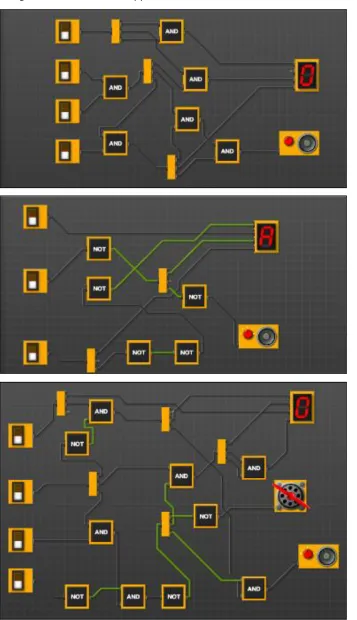
The circuits themselves were designed in such a way that there would be multiple possible ways of arriving at a solution, thus warranting the use of process-oriented worked examples (van Gog et al., 2004).
next one. The game ends when the codes to all the locks have been found. A link to the game can be found in Appendix A.
A note on game-progression: An observation from some previous GBL studies is that since game-progression generally requires a learner to complete the learning tasks at each level, players who are unable to do so, do not get exposed to new domain information present in subsequent levels (Ke, 2008). Thus, testing their knowledge on those topics is purposeless. Therefore in the present study, a conscious design-decision was taken to ensure that all study-participants had access to the same amount of domain knowledge: At each level of the game, it is possible to arrive at the solution after a few rounds of trial-and-error; this means that players can progress through the different levels even if they do not meet the learning objectives.
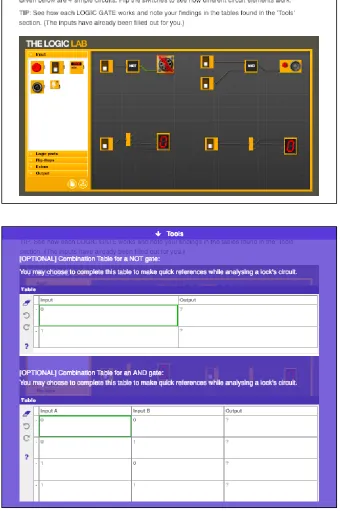
Figure 2. Demonstration circuit and partially-filled truth tables available in both game-versions
Process-oriented Worked Examples. The experimental version of the game contains three process-oriented videos. Here we discuss key characteristics of this intervention and the research that guided its development:
testing during the development process showed that when users were provided text-based PoWEs, they found the GBLE extremely text-heavy and hence missed a lot of important information. Consequently, this study employs the use of PoWEs in a video-format. The PoWEs are embedded YouTube videos that allow for user-control (a
‘slider bar’ that allows viewers to move to any point in the video, a pause/play button
and the options to speed up or slow down the video). Such functionalities that enable learner-control has been shown to be more beneficial for learning than system-pacing (Hasler, Kersten, & Sweller, 2007). This is an improvement from a previous study on the effect of PoWEs that utilised a unidirectionally linear video-format (Hoogveld et al., 2005).
Content. Content-creation was steered by guidelines on adding process-information to worked examples, an analysis of previously used PoWEs and research on facilitating problem-solving (Chang et al., 2004; van Gog et al., 2004, 2006). All the PoWEs are structurally similar and comprise of five steps that can be compared to the problem-solving process as described earlier by (Chang et al., 2004):
Step 1: Note down the rules of the logic gate(s) Step 2: Identify crucial tasks, if any
Step 3: Choose a strategy to complete the task Step 4: Identify path direction
Step 5: Apply the rules of the logic gate(s) to complete the task
In steps 1 and 2 the expert lists down the working of the logic gates that are present in the combination circuit and breaks down the problem statement to identify the key tasks, thus defining and constructing a problem space. In step 3, she compares different possible approaches and chooses one. Steps 4 and 5 comprise of orienting towards a problem-solving direction (forward or backward) and finally applying the domain principles and strategy. It is worth noting that feedback from the GBLE (for
example, in the form of the game’s alarm setting off or a code being accepted by the
system) provides an evaluation of the outcome (Chang et al., 2004)
These steps are accompanied by a description of the domain principles being used, specification of the rules of thumb, reasoning behind an action taken and the
expert’s preferred approach (van Gog et al., 2004). Thus, the content of the PoWEs
A noteworthy point here is that of fading. Studies with worked examples containing problem-solving procedures suggest that fading out steps little by little until the learner is problem-solving independently, elicits self-explanation and improves learning (Atkinson et al., 2003; Renkl, 1997). This is also one of the ideas van Gog et al. (2004) espouse. However, as discussed earlier, self-explanation is not a skill that we expect novice learners to display; therefore, it is decided to keep the content in the PoWEs complete and unfaded. It is expected
that as a learner’s skills and knowledge would increase, the amount of information they need
would decrease and thus support would have to be adapted accordingly (Atkinson et al., 2003). But this is beyond the scope of the present study.
consideration are the voice, personalization and image principles: the narration is
conversational and done in a human voice; the speaker’s image is not added to the
screen (Mayer, 2014). Moreover, Arguel and Jamet (2009) find that using static images limits the transient effect of animated videos. Therefore, the portion of the PoWEs explaining step 5 is accompanied by a static image of the rules of the logic gate (principled information), allowing the learner to make connections between the previously explained domain principles and the strategy-implementation being described in the step (Arguel & Jamet, 2009; Mayer, 2014, Temporal contiguity principle). (Another strategy employed to limit the effects of information-transience is listing all the process-steps at the end of the video.) Thus, the videos comprise of animation (to show actions to be taken, signal circuit-elements etc), spoken text and static pictures. This allows for effective integration of principled, process and strategic information (van Gog et al., 2004), multiple modalities of the information provided
(Mayer, 2014, Modality principle) , and maintaining the ‘depiction of micro-steps from
the procedure and its natural development’ (Arguel & Jamet, 2009). This is also in
agreement with the multimedia principle that states that a combination of words and pictures is more effective for instruction than words alone (Mayer, 2014, Multimedia principle). It is worth noting that to further make the content of the videos explicit,
they were prefaced with this text in the GBLE: “This video contains the a) domain
principles, b) procedure and c) strategy involved.”
Integration. There are two ways instructional support can be integrated with GBL – by incorporating it within the GBLE (internal integration) or offering it in addition to it (Vandercruysse et al., 2016). In a study investigating the impact of integration of conceptual information (a support that is very similar to PoWEs), Vandercruysse et al. (2016) found that learners who received internally integrated support performed poorly as compared to those who received externally integrated support. However, in their study, each conceptual clarification comprised of several steps and in the internal-integration version of the game, these steps were made visible only one at a
design of the support and could have affected the study’s outcome. Therefore, given the format of the PoWEs, we found merit in integrating them within the GBLE.
Placement. Each example corresponds to a circuit in the game that players are expected to solve and is consequently placed before the actual task. This is also in line with Tsai, Kinzer, Hung, Chen and Hsu (2013) who found it beneficial to provide learners with content-knowledge before and/or within a game so as to allow them to reflect on it during game-play. Secondly, previous research suggests that learners tend to ignore instructional support provided in games (Nelson, 2007). Hence, these PoWEs were positioned as an integral step within the gameplay, thus making it harder for players to ignore them.
Post-test. The test consisted of two sections (and can be found in Appendix C). The
first corresponded to the dependent variable, ‘knowledge-acquisition’ and comprised of four
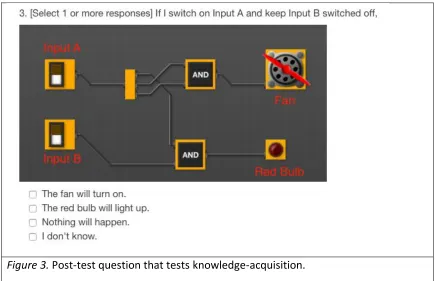
questions (multiple-choice and open-ended). Of these, two tested understanding of the learning-content, for example, “What logic gate would I use to reverse my input?”. The
remaining two questions tested the learner’s ability to apply their understanding in the same
[image:18.595.71.506.421.702.2]problem-space. Figure 3 shows an example of such a question.
The second section of the test consisted of seven questions that measured the second
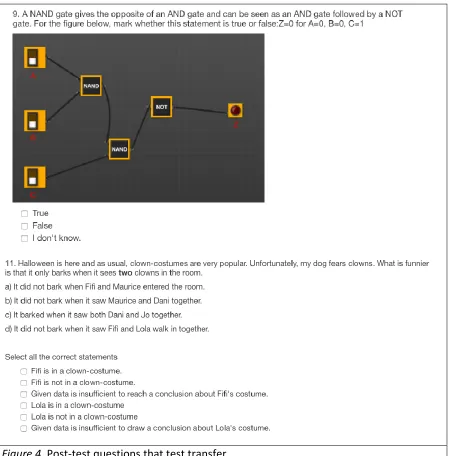
[image:19.595.76.526.178.634.2]dependent variable, ‘knowledge-transfer’. Of these, four questions tested the ability to apply acquired knowledge to a different problem-space in the same domain (question 9 in figure 4 shows an example). The remaining three questions tested transfer to a different domain (for example, question 11 in figure 4).
Figure 4. Post-test questions that test transfer.
Interview questions. The interview was structured around a set of three guiding
questions, namely: a) On a scale of 1 to 5 (1 being ‘not confident at all’ and 5 being ‘extremely
confident’), how confident does the participant feel about what they may have learned in the
game, and why? b) What was the participant’s game-experience? c) What was the
participant’s experience with the PoWEs? (For experimental condition only.)
The interview also included a probe into the participant’s prior knowledge on the
subject- whether they were familiar with the concepts of binary coding (i.e. 0 is ‘off’ and 1 is
‘on’) and logic gates, and if so, how much they had already known. This was in place of a pre -test.
Procedure
Ethics Committee Approval. Approval from the BMS (Behavioural, Management and
Social Sciences) faculty’s Ethics Committee was obtained at least a week prior to data collection.
Call for participation and communication with participants. Calls for participation were put out on various official and unofficial social networking platforms and the SONA system. Interested students signed up for a time-slot that was made available to them through the SONA credit system (Bachelor of Psychology Students) or an online form (other students). Depending on their preference, they then received an email or text message confirming their participation, followed by at least one reminder a few hours before the actual study.
The study. Each experimental study session consisted of the following elements: Orientation. Participants received an overview of the process, an introduction to the gamified environment and general instructions (for example, to inform the researcher
before they start the test and to keep their mobile phones on ‘Silent’) (see researcher’s
guidelines in Appendix D). They were encouraged to watch all the videos present in the game and follow the given game-progression. While participants were aware that the study investigated instructional support in game-based learning, they were not made aware of the kind of support or the condition they were assigned to. They then logged into the system with a unique user ID that they had been assigned and completed the consent form. This took no more than 5 minutes.
allocated for this was a maximum of 50 minutes- players were expected to finish the game within this timeframe, failing which the researcher would ask them to stop.
Post-test. When a participant finished the game, (s)he informed the researcher. The researcher then set the timer and the participant proceeded to complete the post-test (10 minutes).
Interview. Participants engaged in a one-on-one conversation with the researcher (that was also recorded). Since the interview was semi-structured, the guiding questions (mentioned in ‘Materials’ section) were used to frame the conversation, while probing-questions were used to clarify details. For example, if a participant used the term
“challenging” when asked to describe their game-experience or said that they found the PoWEs useful, the researcher would ask them what exactly they found challenging in the game or what elements of the PoWEs they found most value in. Similarly, while discussing gameplay, participants were encouraged to talk about the strategy they used. (approximately 5 minutes).
Close-out.Participants were asked not to discuss the details of the study with other students to ensure unbiased outcomes.
The role of the researcher during the gameplay and test was limited to supervision, procedural assistance (when required) and technical assistance when technology-related issues were encountered; this was done to ensure it was not a confounding variable (All, Nuñez Castellar, & van Looy, 2016).
Operationalisation of Variables and Scoring
Knowledge acquisition and transfer are operationalised as the scores received for the first four and last seven questions of the post-test respectively, hence each section of the post-test was scored separately. While the minimum score possible on either section was 0,
the maximum was 4 points and 6.99 points for the first (‘knowledge-acquisition’) and second
(‘knowledge-transfer’) sections respectively. The evaluation was done by two test-scorers to
ensure that there were no flaws. The scoring key can be found in Appendix C.
Data Analysis
The distributions of ‘knowledge-acquisition’ and ‘knowledge-transfer’ were found to
be multimodal implying that they comprised of more than one distribution each. This was an indication of more than one distinct group for each variable. So, both investigated variables
were measured condition-wise. Normality tests on ‘knowledge-acquisition’ for the control
condition revealed moderate skewness of 0.737 (SE= 0.481) and nearnormal kurtosis of
-0.125 (SE=0.935). ‘Knowledge-acquisition’ for the experimental group displayed high
skewness of -1.109 (SE=0.472) with a large kurtosis of 1.128 (SE=0.918). ‘Knowledge-transfer’
for the control group was found to have moderate skewness of 0.949 (SE=0.481) with
near-normal kurtosis of -0.315 (SE=0.935). ‘Knowledge-transfer’ for the experimental group
showed moderate skewness of 0.688 (SE=0.472) with kurtosis of -0.892 (SE=0.918).
Regardless, given that sample size n>40 and each group has over 15 participants, the sample
was considered ‘large enough’ to conduct parametric tests (The Minitab blog, 2015; Veaux, Velleman, & Bock, 2014).
Levene’s test for ‘knowledge-acquisition’ indicated equal variances (F = 0.043, p =
0.836), therefore a pooled sample t-test was performed. Whereas, Levene’s test on
‘knowledge-transfer’ indicated unequal variances in the two groups (F = 5.107, p = .029), so
degrees of freedom were adjusted from 45 to 42 and an independent samples t-test was performed. Given the range of scores possible on the post-test, existing participant-scores and the sample size, the outliers were deemed plausible and were hence not removed.
Results
Table 1 summarizes the descriptive statistics, per condition, for the participants' test
[image:22.595.69.524.606.692.2]scores on the variables ‘knowledge-acquisition’ and ‘knowledge-transfer’.
Table 1. Condition-wise descriptive statistics for acquisition’ and ‘knowledge-transfer’ scores on post-test
Test-Section/Variable Control condition (n=23) Experimental condition (n=24)
M SD M SD
Knowledge-acquisition 1.66 1.11 2.84 1.16
Effect of PoWEs on knowledge-acquisition
The pooled-samples t-test indicated that scores were significantly lower for the control condition (M = 1.66, SD = 1.11) than for the experimental (M = 2.84, SD = 1.16), t(45) = -3.547, p = 0.001, d = 1.035.
Effect of PoWEs on transfer
The independent-samples t-test indicated that scores were significantly lower for the control condition (M = 2.37, SD = 1.27) than for the experimental (M = 3.58, SD = 1.74), t(42) = -2.78, p= 0.009, d = 0.79.
Interviews
In this section, we present different samples of participant-interviews3 to shed light
on the quantitative results. Firstly, it was noted that when asked how confident, on a scale of 1 to 5, they felt about what they might have learned through the game, 21 experimental group participants and 10 control group participants reported a 3 or higher. Below, is an
illustration of participants’ experiences with the game ( and PoWEs, in the case of the
experimental group):
Control-condition. Participants in this condition were expected to unriddle learning objectives through exploration and observation, as is illustrated in the following interview-samples:
Participant ID 428: “I didn’t have the knowledge. I think when I first saw the circuits, I still didn’t know how they worked - what would the switch represent. Would I tell myself 1 is on and off is 0? And when I was progressing in the game, I realised
Yes, that's what I had to do…At the beginning it [the approach] was hitting all the
switches, but then seeing [sic] which gates were connected to the alarm. From there
I would go back and see what switches were connected to it.”
Participant ID 447: “Sometimes I didn’t get the logic right away. But with a little bit of time, I understood it very well…It took time to understand the logic behind it-
what I can do and how it works. In the first round, I just clicked around; I didn’t know
what I was doing. But in the second and third round, it got pretty well [sic], and then I
understood that I just have to follow the lines to control what's happening.”
While these two participants did report being able to uncover learning-content (both
answered 3 of the 4 ‘knowledge-acquisition’ questions correctly), there were others who
were less successful. For example, participant ID 422 stated, “After the third simulation, I
understood it [the game] better, but it finished. I think I got it but not in a really good way… [
I got that] in the NOT, there is one input and one output and [in] the AND there is [sic] two
inputs and one output.” While what this learner has understood is correct, it is hardly the key
concept.
Next, it was also gathered that not all participants in this condition were successful in extricating learning objectives from gameplay. For instance, participant ID 414 reported,
“During the game I wasn’t really paying attention to the logic gates. Just during the test [sic],
I noticed that that was the important bit.” Similarly, participant ID 438 noted, “I was writing which switches are on or off…I did not looked [sic]at AND or OR…As I said, I did not look at AND or NOT and the [test] questions were mainly about that.”
Finally, 13 of the 23 control condition participants reported employing hit-or-miss
methods to arrive at the solution. For instance, participant ID 455 stated: “I just pressed stuff
and was trying to make sense of it but couldn’t”.
Experimental-condition. Firstly, it was observed that the general perception of the learners in this condition was that the PoWE-support was useful. While all experimental-condition participants found value in at least one element of the support, twenty-one of the twenty-three experimental-condition participants interviewed, reported finding both, procedural and process information in the worked example as useful. As participant ID 433
put it, “[It was useful] seeing it [the problem-solving] before having to do [it] myself…seeing
where I could press without setting off the alarm, by seeing you [the expert in the video] do
it.” Moreover, all but three of these participants reported employing the problem-solving
strategy described in the PoWEs. As participant ID 449 who observed, “I just followed the
strategy of the video...because it was the most logic [sic] one, and the easiest one”. The
Discussion
The aim of the current study was to investigate the effectiveness of instructional support in the form of process-oriented worked examples in a GBLE based on the topic of logic gates and combination circuits for university students. It was found that on average, learners who received PoWEs displayed greater acquisition of topic knowledge than those
who did not receive this support. The intervention generated a Cohen’s d of 1.035 which may be deemed as a large effect. Secondly, it was found that learners with PoWEs were more successful in transferring learning from the game-based learning environment to another problem-space than learners who did not receive support. The difference in the mean scores on knowledge-transfer was found to be significant and generated a medium effect size of
Cohen's d=0.79. These findings are in line with our expectations and indicate that PoWEs can
indeed help improve game-based learning.
Reflections, Limitations and Recommendations
At this point, we find it relevant to revisit some literature that guided this investigation in an attempt to explain our findings. it had been suggested that PoWEs would help learners
because they not only contain procedural steps but also the expert’s problem-solving
rationale, thus providing them with the conceptual understanding required for transfer (van Gog et al., 2004). As reported above, learner-perception seems to align with this theory. The interviews also seem to support the thought (as discussed earlier) that without support, it can be difficult for learners to extricate learning objectives from gameplay in a GBLE (ter Vrugte et al., 2017). These reasons may well explain why the control group on average had relatively low post-test scores than the experimental group.
experimental condition directly guided learners to the learning material and therefore cannot be equated to unguided discovery.)
This paper had also discussed that not all learners, especially those with low prior knowledge, are capable of producing correct self-explanations (Renkl, 1997; ter Vrugte et al., 2017; Vandercruysse et al., 2016). This can result in incorrect or incomplete understanding (Booth et al., 2015). On the other hand, the PoWEs explicitly discuss the functioning of the logic gates and path-directions while solving a circuit (input to output or output to input), leaving little need for self-explanation. It is inferred that this has played a role in the better learning outcomes of the experimental condition as compared to the control.
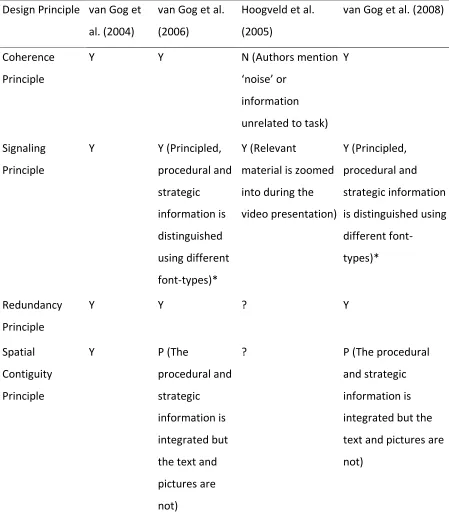
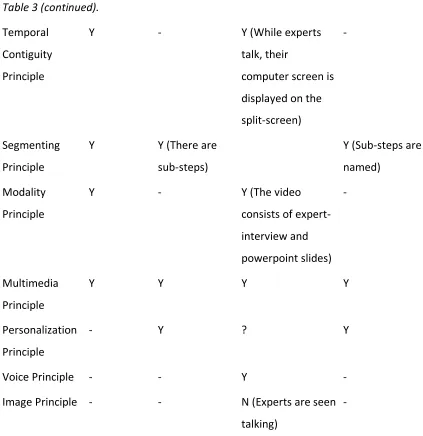
The results of this study corroborate our design-decisions for the instructional material. As discussed earlier, efforts were taken to mitigate the shortcomings of the worked examples used in previous studies. For instance, a drawback in the PoWE videos used by Hoogveld et al. (2005) was that the information was not explicitly verbalised and had to be extricated from expert-interviews. These interviews also contained information that was not directly relevant to the learning objective and the videos themselves offered no user-control. A design-flaw in the examples used by van Gog et al. (2006) was that they did not display an integrated view of text and pictures. These were some important points of consideration during the design of the PoWEs for this study. This might explain why PoWEs generated a positive effect on knowledge-acquisition and transfer in the present study, but not in the previous two. On the other hand, the examples in this study are structurally similar to those used by van Gog et al (2008), which could explain why the results of the two studies are in agreement. Clearly, this has implications for the design of effective PoWEs and future researchers are encouraged to bear in mind the importance of instructional design even if
that may not be their studies’ focus.
Though the overall effects of the intervention were positive and aligned with our expectations, it is essential to consider them in combination with other related research, while taking cognizance of the following limitations of this study:
Length of study. The game focuses on a very narrow topic in the field of electronics; therefore, a maximum playtime of 50 minutes was considered sufficient. This however, is relatively short as compared to the time players spend on games in the real world (days, if
not months) and therefore might limit the generalizability of this study’s findings (Loh, Sheng,
scope of this study did not cover a delayed post-test; such a step could have provided valuable information on the long-term effectiveness of the intervention (such as knowledge-retention) and generalizability (Brooks, 2009).
Technical difficulties. While developing the GBLE, different applications to capture in-game performance and player-system interactions were embedded. The motive was to use the game log files produced by these applications to glean information such as time taken on
each game-task, a player’s movements along the game (for instance, whether he/she
returned to a step), number of attempts to arrive at the correct solution, time taken per PoWE and the kind of interaction learners had with the PoWE videos (which parts were replayed and how many times). Unfortunately, due to technical glitches in the system, the log files were found to be inconsistent and unreliable and hence could not be used in the analysis. We believe that this data would have greatly enriched this study and recommend future researchers to pay special attention to collecting in-game data (All et al., 2016).
Post-test design.It is quite possible that participants who struggled in the first section of the post-test spent more time here and were hence unable to explore all the transfer questions. In retrospect, we feel that it would have been prudent to allocate time for each test-section separately to ensure that all participants spent the same time on each variable-measure. Secondly, it could be useful to know which questions a participant does not know the answer to and which he/she leaves unanswered due to time-constraints. In the present
test, only five of the eleven questions explicitly offered the option to select “I don’t know”
from a list of answers. While some questions were not multiple-choice, test-takers could have been encouraged to mark the questions that they had read but did not know the answer to.
Researchers are encouraged to improve upon these elements for future studies. Having said that, there are two significant aspects of this study that need to be noted in relation to previous research on PoWEs:
Firstly, it is crucial to note that the amount of information presented in the current
the explanation for the choice. This is in fact, a distinguishing feature of the present study. As
one participant noted, “They explained very elaborately…what are the options I could do
[sic]..and I think it was very handy as well that they put four different options and as this
person [the expert] was explaining, they would scratch off what we shouldn’t do”. We believe
that not providing learners with this crucial piece of information entails some self-explanation on the part of the learner (just as when only procedural information is provided) which may explain why some previous studies have not found PoWEs more effective than conventional WEs. However, further, and applied research is needed to investigate the strength of this claim.
Secondly, it is that in addition to concurring results on transfer, van Gog et al. (2008) also found that when learners’ understanding increased, the process information became redundant, and started to hamper learning. While there is no way of knowing whether this
‘redundancy’ actually impeded learning in the present study, the interviews do indicate (as was naturally expected when the decision to not fade the WEs was taken) that participants found the PoWEs repetitive and many resorted to skipping portions of the videos that they felt they had already understood.
It follows from above and Renkl (1997), that the ideal progression of support might be: unfaded process-oriented worked examples (such as the ones used in this study), followed by gradual fading of process-information to eventually arrive at conventional worked examples (with only procedural steps) that would in turn be gradually faded. Future research might explore such a sequence. Another interesting question worth exploring would be how
to balance this instructional support with players’ inherent tendency to explore GBLEs (as
illustrated in the ‘Results’ section by the responses of the three exceptional experimental
-condition participants).
The last thought we would like to present is that of two factors that are deemed pivotal in knowledge-transfer, and their role in GBL: motivation and perceived utility of support (Grossman & Salas, 2011). Within GBL, motivation may be described as the “the initiation and sustainment of engagement in a particular task or behavior” and is positively
(Grossman & Salas, 2011). In fact, Lowyck, Elen and Clarebout (2004) find that the effectiveness of games largely depended on the perception of utility by the learners themselves. This is a very interesting line of thought and future studies could look into
whether learners’ notions of the usefulness of PoWE-support in GBLEs does indeed affect
their learning outcomes. We therefore proffer the value in investigating the role of learner-characteristics in determining the effectiveness of instructional support in GBL.
Conclusion
References
Adkins, S. S. (2018). The 2018-2023 Global game-based learning market: Worldwide serious
game industry is in a boom phase. Paper presented at the Serious Play Conference. Retrieved from
http://seriousplayconf.com/wp- content/uploads/2018/07/Metaari_2018-2023_Global_Game-based_Learning_Market_Executive_Overview.pdf
All, A., Nuñez Castellar, E. P., & van Looy, J. (2016). Assessing the effectiveness of digital game-based learning: Best practices. Computers & Education, 92–93, 90–103.
https://doi.org/10.1016/J.COMPEDU.2015.10.007
Amer, A. (2006). Reflections on Bloom's revised taxonomy. Electronic Journal of Research in
Educational Psychology.. 4(8). http://dx.doi.org/10.25115/ejrep.v4i8.1217
Anderson, L. W., Krathwohl, D. R. (2001). A Taxonomy for learning , teaching , and
assessing : A revision of Bloom’s taxonomy of educational objectives. Spring, 41(4), 212-218 https://doi.org/10.1207/s15430421tip4104_2
Arguel, A., & Jamet, E. (2009). Using video and static pictures to improve learning of
procedural contents. Computers in Human Behavior, 25(2), 354–359.
https://doi.org/10.1016/J.CHB.2008.12.014
Atkinson, R. K., Derry, S. J., Renkl, A., & Wortham, D. (2000). Learning from examples:
Instructional Principles from the Worked Examples Research. Review of Educational
Research 70(2), 181-214. https://doi.org/10.3102/00346543070002181
Atkinson, R. K., & Renkl, A. (2007). Interactive example-based learning environments: Using
interactive elements to encourage effective processing of worked examples. Educational
Psychology Review, 19(3), 375–386. https://doi.org/10.1007/s10648-007-9055-2 Atkinson, R. K., Renkl, A., & Merrill, M. M. (2003). Transitioning from studying examples to
solving problems: Effects of self-explanation prompts and fading worked-out steps.
Journal of Educational Psychology, 95(4), 774–783. https://doi.org/10.1037/0022-0663.95.4.774
Bakhuys Roozeboom, M., Visschedijk, G., & Oprins, E. (2017). The effectiveness of three
serious games measuring generic learning features. British Journal of Educational
Technology, 48(1), 83–100. https://doi.org/10.1111/bjet.12342
science education. Journal of Science Education and Technology, 18, 305-320. https://doi.org/10.1007/s10956-009-9171-5
Booth, J. L., Mcginn, K. M., Young, L. K., & Barbieri, C. (2015). Worked examples: Simple
practice doesn’t always make perfect: evidence from the worked example effect. Policy Insights from the Behavioral and Brain Sciences, 2, 24-32.
https://doi.org/10.1177/2372732215601691 Brooks, C. D. (2009). Effects of
process-oriented and product-process-oriented worked examples and prior knowledge on learner problem solving and attitude: A study in the domain of Microeconomics. Retrieved from
https://eric.ed.gov/?id=ED515381
Chang, E. C., D’Zurilla, T. J., & Sanna, L. J. (Eds.). (2004). Social problem solving: Theory, research, and training. Washington: American Psychological Association.
https://doi.org/10.1037/10805-000
Chi, M. T. H., Bassok, M., Lewis, M. W., Reimann, P., & Glaser, R. (1989). Self-explanations:
How students study and use examples in learning to solve problems. Cognitive Science,
13(2), 145–182. https://doi.org/10.1207/s15516709cog1302_1
Chi, M. T. H., De Leeuw, N., Chiu, M.-H., & Lavancher, C. (1994). Eliciting self-explanations improves understanding. Cognitive Science, 18(3), 439–477.
https://doi.org/10.1016/0364-0213(94)90016-7
Cicchino, M. I. (2015). Using game-based learning to foster critical thinking in student discourse. Interdisciplinary Journal of Problem-Based Learning, 9(2).
https://doi.org/10.7771/1541-5015.1481
Clark, D. B., Tanner-Smith, E. E., & Killingsworth, S. S. (2016). Digital games, design, and
learning: A Systematic Review and Meta-Analysis. Review of Educational Research.
https://doi.org/10.3102/0034654315582065
Craig, L. A. (2003). Game taxonomies: A high level framework for game analysis and design.
Retrieved from http://www.gamasutra.com/features/20031003/lindley_pfv.htm
Creswell, J. W. (2013). Educational Research. (P. A. Smith, Ed.) (fourth). Pearson. Retrieved
from http://basu.nahad.ir/uploads/creswell.pdf
Darabi, A. A., Nelson, D. W., & Palanki, S. (2007). Acquisition of troubleshooting skills in a computer simulation: Worked example vs. conventional problem solving instructional
strategies. Computers in Human Behavior, 23(4), 1809–1819.
de Jong, T., & Lazonder, A. W. (2014). The guided discovery learning principle in multimedia
learning. In The Cambridge Handbook of Multimedia Learning, Second Edition.
https://doi.org/10.1017/CBO9781139547369.019
Dempsey, J. V., Haynes, L. L., Lucassen, B. A., & Casey, M. S. (2002). Forty simple computer
games and what they could mean to educators. Simulation and Gaming.
https://doi.org/10.1177/1046878102332003
Ebner, M., & Holzinger, A. (2007). Successful implementation of user-centered game based
learning in higher education: An example from civil engineering. Computers & Education,
49(3), 873–890. https://doi.org/10.1016/J.COMPEDU.2005.11.026
Frey, B. B. (2018). The SAGE Encyclopedia of Educational Research, Measurement, and
Evaluation. 2455 Teller Road, Thousand Oaks, California 91320 : SAGE Publications, Inc. https://doi.org/10.4135/9781506326139
Girard, C., Ecalle, J., & Magnan, A. (2013). Serious games as new educational tools: How
effective are they? A meta-analysis of recent studies. Journal of Computer Assisted
Learning. https://doi.org/10.1111/j.1365-2729.2012.00489.x
Grossman, R., & Salas, E. (2011). The transfer of training: what really matters. International Journal of Training and Development, 15(2), 103-120.
doi:10.1111/j.1468-2419.2011.00373.x
Hasler, B. S., Kersten, B., & Sweller, J. (2007). Learner control, cognitive load and instructional animation. Applied Cognitive Psychology, 21(6), 713–729. https://doi.org/10.1002/acp.1345
Hoogveld, A. W. M., Paas, F., & Jochems, W. M. G. (2005). Training higher education teachers for instructional design of competency-based education: Product-oriented
versus process-oriented worked examples. Teaching and Teacher Education, 21(3), 287–
297. https://doi.org/10.1016/j.tate.2005.01.002
Jones, T. S., & Richey, R. C. (2000). Rapid prototyping methodology in action: A
developmental study. Educational Technology Research and Development.
https://doi.org/10.1007/BF02313401
Ke, F. (2008). A case study of computer gaming for math: Engaged learning from gameplay?
Computers & Education, 51(4), 1609–1620.
Kiili, K. (2005). Digital game-based learning: Towards an experiential gaming model. The Internet and Higher Education, 8(1), 13-24. doi:10.1016/j.iheduc.2004.12.001
Kim, B., Park, H., & Baek, Y. (2009). Not just fun, but serious strategies: Using meta-cognitive strategies in game-based learning. Computers & Education, 52(4), 800-810.
doi:10.1016/j.compedu.2008.12.004
Kirriemuir, J., & Mcfarlane, A. (2004). Literature review in games and learning REPORT 8: FUTURELAB SERIES. Retrieved from
https://www.nfer.ac.uk/media/2755/futl27literaturereview.pdf
Lang, J. (2007). The effect of presenting worked examples for problem solving in a computer
game. Ph.D. Dissertation. University of Southern California, Los Angeles, CA, USA.
Advisor(s) Harold O'Neil. AAI3278432.
Leemkuil, H. (2006). Is it all in the game? Learner support in an educational knowledge
management simulation game. Ph.D. Dissertation. University of Twente. Retrieved from https://telearn.archives-ouvertes.fr/hal-00190181/document
Loh, C. S., Sheng, Y., & Ifenthaler, D. (2015). Serious games analytics: Theoretical framework. https://doi.org/10.1007/978-3-319-05834-4_1
Lowyck, J., Elen, J., & Clarebout, G. (2004). Instructional conceptions: Analysis from an
instructional design perspective. International Journal of Educational Research, 41(6),
429-444. https://doi.org/10.1016/j.ijer.2005.08.010
Malone, T. W. (1983). Guidelines for designing educational computer programs. Childhood
Education, 59(4), 241–247. https://doi.org/10.1080/00094056.1983.10520592
Mayer, R. (Ed.). (2014). The Cambridge handbook of multimedia learning. Cambridge:
Cambridge University Press. https://doi.org/10.1017/CBO9781139547369
McGonigal, J. (2011). Reality is broken: Why games make us better and how they can
change the world. In The Grasshopper: Games, Life and Utopia. Retrieved from
https://hci.stanford.edu/courses/cs047n/readings/Reality_is_Broken.pdf
Mitchell, A., & Savill-Smith, C. (2004). The use of computer and video games for learning A review of the literature. Retrieved from https://www.LSDA.org.uk
Nelson, B. C. (2007). Exploring the use of individualized, reflective guidance in an
educational multi-user virtual environment. Journal of Science Education and Technology,
16(1), 83–97. https://doi.org/10.1007/s10956-006-9039-x
arithmetic procedures. Cognition and Instruction, 8(2), 103–179. https://doi.org/10.1207/s1532690xci0802_1
Oliver, E. (2017). Gamification as transformative assessment in higher education. HTS
Teologiese Studies / Theological Studies, 73(3), 1–15. https://doi.org/10.4102/hts.v73i3.4527
Oyen, A., & Bebko, J. M. (1996). The effects of computer games and lesson contexts on
children's mnemonic strategies. Journal of Experimental Child Psychology, 62(2), 173-189.
doi:10.1006/jecp.1996.0027
Perkins, D. N., & Salomon, G. (1992). Transfer of learning. Retrieved from
https://pdfs.semanticscholar.org/fb86/245e6623502017940c796c01ed508c3d8208.pdf Prensky, M. (2001). Fun, Play and Games: What makes games engaging. McGraw-Hill.
Retrieved from http://www.autzones.com/din6000/textes/semaine13/Prensky(2001).pdf Renkl, A. (1997). Learning from worked-out examples: A study on individual differences.
Cognitive Science. https://doi.org/10.1207/s15516709cog2101_1
Rosas, R., Nussbaum, M., Cumsille, P., Marianov, V., Correa, M., Flores, P., Valeska, G., Lagos, F. , Lopez, X., Lopez, V., Rodriguez, P., Salinas, M. (2003). Beyond Nintendo: design and assessment of educational video games for first and second grade students.
Computers & Education, 40(1), 71–94. https://doi.org/10.1016/S0360-1315(02)00099-4
Shen, C. Y., & O'Neil, H. (2006). The effectiveness of worked examples in a game-based
learning environment. A Paper presented at the Annual Meeting of the AERA. San Fransisco, CA. Retrieved from https://files.eric.ed.gov/fulltext/ED491961.pdf
Sweller, J. (2006). The worked example effect and human cognition. Learning and
Instruction. https://doi.org/10.1016/j.learninstruc.2006.02.005
Sweller, J., & Cooper, G. A. (1985). The Use of worked examples as a substitute for problem solving in learning algebra. Cognition and Instruction, 2(1), 59–89.
https://doi.org/10.1207/s1532690xci0201_3
ter Vrugte, J. (2016). Serious support for serious gaming: enhancing knowledge acquisition in
a game for prevocational mathematics education. Enschede: Universiteit Twente. https://doi.org/10.3990/1.9789036541060
ter Vrugte, J., & de Jong, T. (2017). Self-Explanations in game-based learning: From tacit to
transferable knowledge. In Instructional Techniques to Facilitate Learning and Motivation
https://doi.org/10.1007/978-3-319-39298-1_8
ter Vrugte, J., de Jong, T., Vandercruysse, S., Wouters, P., van Oostendorp, H., & Elen, J. (2017). Computer game-based mathematics education: Embedded faded worked examples facilitate knowledge acquisition. Learning and Instruction, 50, 44–53. https://doi.org/10.1016/J.LEARNINSTRUC.2016.11.007
The Minitab blog. (2015, February 19). Choosing between a nonparametric test and a parametric test [Blog post]. Retrieved from http://blog.minitab.com/blog/adventures-in-statistics-2/choosing-between-a-nonparametric-test-and-a-parametric-test
Tripp, S. D., & Bichelmeyer, B. (1990). Rapid prototyping: An alternative instructional design
strategy. Educational Technology Research and Development.
https://doi.org/10.1007/BF02298246
Tsai, F.H., Kinzer, C., Hung, K.-H., Chen, C.-L.A, & Hsu, I.-Y. (2013) The importance and use of targeted content knowledge with scaffolding aid in educational simulation games, Interactive Learning Environments, 21:2, 116-128,
https://doi.org/10.1080/10494820.2012.705852
van der Meij, H., Leemkuil, H., & Li, J.-L. (2013). Does individual or collaborative
self-debriefing better enhance learning from games? Computers in Human Behavior, 29(6),
2471–2479. https://doi.org/10.1016/J.CHB.2013.06.001
van Eck, Richard. (2006). Digital Game Based Learning: It's not just the digital natives who
are restless. EDUCAUSE Review, vol. 41, no. 2 (March/April 2006): 16–30.
Retrieved from https://er.educause.edu/articles/2006/1/digital-gamebased-learning-its-not-just-the-digital-natives-who-are-restless
van Gog, T., Paas, F., & van Merriënboer, J. J. (2004). Process-oriented worked examples:
Improving transfer performance through enhanced understanding. Instructional
Science, 32(1/2), 83-98. doi:10.1023/b:truc.0000021810.70784.b0
van Gog, T., Paas, F., & van Merriënboer, J. J. G. (2006). Effects of process-oriented worked
examples on troubleshooting transfer performance. Learning and Instruction, 16(2), 154–
164. https://doi.org/10.1016/J.LEARNINSTRUC.2006.02.003
van Gog, T., Paas, F., & van Merriënboer, J. J. G. (2008). Effects of studying sequences of process-oriented and product-oriented worked examples on troubleshooting transfer efficiency. Learning and Instruction, 18(3), 211–222.
van Merriënboer, J. J. G. (2013). Perspectives on problem solving and instruction. Computers and Education. https://doi.org/10.1016/j.compedu.2012.11.025
Vandercruysse, S., ter Vrugte, J., de Jong, T., Wouters, P., van Oostendorp, H., Verschaffel, Moeyaert, M., W., Elen, J. (2016). The effectiveness of a math game: The impact of
integrating conceptual clarification as support. Computers in Human Behavior, 64, 21–33.
https://doi.org/10.1016/J.CHB.2016.06.004
Veaux, R. D., Velleman, P. F., & Bock, D. E. (2014). Stats: Data and Models. London, England: Pearson.
Wilson, K. A., Bedwell, W. L., Lazzara, E. H., Salas, E., Burke, C. S., Estock, J. L., Orvis, K. L., Conkey, C. (2009). Relationships between game attributes and learning outcomes: Review and research proposals. Simulation & Gaming, 40, 217–266.
https://doi.org/10.1177/1046878108321866
Wouters, P., & van Oostendorp, H. (2013). A meta-analytic review of the role of instructional support in game-based learning. Computers & Education, 60(1), 412–425.
APPENDICES Appendix A. URLs
1. The Logic Lab- http://www.neuroproductions.be/logic-lab/
2. Agent Monde: Operation Logic-
Appendix B. Narrowing down on design guidelines for PoWEs
Step 1: Common design guidelines for worked examples derived from van Gog et al. (2004), Chi et al. (2004) and Sweller and Cooper (1985):
1. The example should focus only at the task at hand and be directed towards the goal.
2. Distinguishing steps and sub-steps is important.
Step 2: Design guidelines for PoWEs compiled by van Gog et al. (2004) :
1. Use words and pictures.
2. Avoid split-attention i.e. integrate words and words, words and picture effectively.
The ‘How’ and‘Why’ information of the PoWE should be integrated.
3. Avoid redundancy of information.
4. Use multiple modalities (oral and visual) to present information.
Step 3: Comparison of guidelines with multimedia design principles (Mayer, 2014) as seen in Table 2.
Table 2. Design guidelines and related principles
Guideline Related Principle (Mayer, 2014)
Use words and pictures Multimedia principle
The example should focus only at the task at hand and be directed towards the goal.
Coherence Principle
Distinguishing steps and sub-steps is important.
Segmenting Principle
Avoid split-attention i.e. integrate text and
text, text and picture effectively. The ‘How’ and ‘Why’ information of the PoWE should
be integrated.
Spatial contiguity Principle Temporal contiguity Principle
Avoid redundancy of information Redundancy Principle
Use multiple modalities (oral and visual) to present information
Stage 4: Analysis of previous PoWE designs
[image:39.595.72.521.185.710.2]Previous designs were analysed on the basis of multimedia instructional design principles (Mayer, 2014). Some examples exemplified additional design principles and so these have been added to the list as well (see table 3).
Table 3. Analysis of previous worked examples
Design Principle van Gog et al. (2004)
van Gog et al. (2006)
Hoogveld et al. (2005)
van Gog et al. (2008)
Coherence Principle
Y Y N (Authors mention
‘noise’ or
information unrelated to task)
Y
Signaling Principle
Y Y (Principled,
procedural and strategic information is distinguished using different font-types)* Y (Relevant
material is zoomed into during the video presentation)
Y (Principled, procedural and strategic information is distinguished using different
font-types)*
Redundancy Principle
Y Y ? Y
Spatial Contiguity Principle
Y P (The
procedural and strategic information is integrated but the text and pictures are not)
? P (The procedural
Table 3 (continued).
Temporal Contiguity Principle
Y - Y (While experts
talk, their
computer screen is displayed on the split-screen)
-
Segmenting Principle
Y Y (There are
sub-steps)
Y (Sub-steps are named)
Modality Principle
Y - Y (The video
consists of expert-interview and powerpoint slides)
-
Multimedia Principle
Y Y Y Y
Personalization Principle
- Y ? Y
Voice Principle - - Y -
Image Principle - - N (Experts are seen
talking)
-
Note: Y= Yes (i.e. example aligns with principle), N= No (i.e. example does not align with
principle, P= partial alignment, ‘?’ means that the paper does not provide sufficient information to make a decision, ‘-‘ means that the principle is not applicable for the corresponding example.
Guidelines derived:
1. Distinguish between principled, procedural and strategic information.
2. Signal key concepts
3. Highlight the organization of steps and use a common skeletal structure.
[image:40.595.72.495.74.510.2]