Mitigation of DDoS Attack using a
Probabilistic Approach
&
End System based Strategy
A thesis submitted in partial fulfillmentof the requirements for the degree of
Master of Technology
inComputer Science and Engineering
Specialization: Information Securityby
Biswa Ranjan Swain
Department of Computer Science and Engineering
National Institute of Technology
Mitigation of DDoS Attack using a
Probabilistic Approach
&
End System based Strategy
A thesis submitted in partial fulfillmentof the requirements for the degree of
Master of Technology
in
Computer Science and Engineering
Specialization: Information Security by
Biswa Ranjan Swain
under the guidance ofProf. Bibhudatta Sahoo
Department of Computer Science and Engineering
National Institute of Technology
Rourkela-769 008, Orissa, India
Department of Computer Science and Engineering
National Institute of Technology Rourkela
Rourkela-769 008, Orissa, India.
Certificate
This is to certify that the work in the thesis entitled Mitigation of DDoS Attack using a Probabilistic Approach & End System based Strategy
submitted by Mr.Biswa Ranjan Swain in partial fulfillment of the require-ments for the award of the degree of Master of Technology in Computer Science and Engineering, Specialization: Information Security during the session 2008– 2009 in the department of Computer Science and Engineering, National Institute of Technology, Rourkela (Deemed University) is an authentic work carried out by him under my supervision and guidance.
To the best of my knowledge, the matter embodied in the thesis has not been submitted to any other University/Institute for the award of any Degree or Diploma.
Prof. Bibhudatta Sahoo
Senior Lecturer Dept. of Computer Science & Engineering Place: NIT Rourkela National Institute of Technology Date: 26 May 2009 Rourkela-769008 Orissa (India)
Acknowledgment
My first thanks are to the Almighty, without whose blessings I wouldn’t have been writing this “acknowledgments”.
I then would like to express my heartfelt thanks to my supervisor, Sr. Lecturer Bibhudatta Sahoo, for his guidance, support, and encouragement during the course of my master study at the National Institute of Technology, Rourkela. I am especially indebted to him for teaching me both research and writing skills, which have been proven beneficial for my current research and future career. Without his endless efforts, knowledge, patience, and answers to my numerous questions, this research would have never been possible.The experimental methods and results presented in this thesis have been influenced by him in one way or the other. It has been a great honor and pleasure for me to do research under Prof. Bibhudatta’s supervision.
I am very much indebted to Dr. B. Majhi, Head of the Department, Computer Science engineering, National Institute of Technology, Rourkela for his support during my work.
I am also thankful to Dr. S. K. Rath, Dr. S. K. Jena, Dr. D. P. Mohapatra, Dr. R. Baliarsingh, Dr. A.K. Turuk, Dr. P. M. Khillar for giving encouragement during my thesis work.
I thank Mr. Pushpendra Kumar Chandra for his helping hand during the preparation of thesis and learning of simulation tools.
I thank my friends & all the members of the Department of Computer Science and Engineering, and the Institute, who helped me by providing the necessary resources, and in various other ways, in the completion of my work.
Finally, I want to dedicate this thesis to my parents,my family members and my beloved one for their unlimited support and strength. Without their dedication and dependability, I could not have pursued my MTech. degree at the National Institute of Technology Rourkela.
Abstract
From the very begining of Internet Technology, the attacks are the undetatchable element of it. This Distributed Denial-of-Service attack is very much harmful as our systems are vulnerable to this. Many mitigation strategies were proposed but these all need the help of network services for mitigation. Also these need the administrative support to continue the mitigation technique beyond own network if the attacker is outsider of own network. But it is very hard to meet all these con-straint at a time. That’s why we need the help of ”end system” based mitigation strategy. Very rare researches have been carried out on this type of method.
In this thesis, we have followed the end system based mitigation strategy to solve the problem of DDoS attack. Here neither we need the support of net-work services nor any administration facility. Here we proposed one probabilistic approach to find out the number of packets being malicious among the massive number of packets. Also we have proposed one algorithm to mitigate the attack based on the number of packets being malicious. We also analyzed our approach in a simulation environment against one existing end system based mitigation strategy. The result shows that our approach solves the problem DDoS and saves the computational resource in terms of CPU time.
Contents
Certificate i
Acknowledgement ii
Abstract iii
List of Figures vi
List of Tables vii
1 Introduction 2
1.1 Introduction . . . 2
1.2 DDoS Impact . . . 3
1.3 Problem Addressed . . . 6
1.4 Design Approach . . . 6
1.5 Layout of the Thesis . . . 7
2 Distributed Denial-of-Service Attack and Related Work 9 2.1 Denial-of-Service Attack (DoS) . . . 9
2.2 Distributed Denial-of-Service Attack (DDoS) . . . 10
2.3 DDoS Attack Network . . . 11
2.3.1 Agent-Handler Model . . . 11
2.3.2 IRC Based DDoS Attack Model . . . 12
2.4 DDoS Taxonomy . . . 14
2.4.1 Bandwidth Depletion Attacks . . . 14
2.4.2 Resource Depletion Attacks . . . 17
2.5 DDoS Countermeasures Taxonomy . . . 20
2.5.1 Prevent Secondary Victims . . . 20
2.5.3 Detect Potential Attacks . . . 22
2.5.4 Mitigate or Stop the Effects of DDoS Attacks . . . 23
2.5.5 Deflect Attacks . . . 23
2.5.6 Post-Attack Forensics . . . 24
2.6 Related Work . . . 27
3 Probabilistic Approach & HCF Method 30 3.1 Probabilistic Approach For Uncertainty Analysis . . . 30
3.2 The Probabilistic Approach . . . 31
3.3 Time-to-Live (TTL) . . . 33
3.4 The Hop Count Filtering Method . . . 33
3.4.1 Hop-Count Inspection . . . 35
3.5 Construction of HCF Table . . . 37
3.5.1 IP Address Aggregation . . . 37
3.5.2 Pollution proof Initialization and Update . . . 38
3.6 Running States of HCF . . . 39
3.6.1 Task in Two States . . . 40
4 Proposed System & Simulation Results 43 4.1 Introduction . . . 43
4.2 Proposed System . . . 45
4.3 Detailed Structure Overview . . . 46
4.4 Proposed Algorithm . . . 46
4.5 Simulation Results . . . 47
5 Conclusion and Future Work 53 5.1 Conclusion . . . 53
5.2 Future Enhancement . . . 54
Bibliography 55
Dissemination of Work 58
List of Figures
1.1 Implementation Model Structure . . . 7
2.1 DDoS Attack Network . . . 11
2.2 DDoS Agent Handler Attack Model . . . 12
2.3 DDoS IRC Based Attack Model . . . 13
2.4 DDoS Attack Taxonomy . . . 16
2.5 Amplification Attack . . . 16
2.6 (a) TCP Synchronization ,(b) TCP-SYN Attack . . . 18
3.1 Model Configuration of Proposed System . . . 31
4.1 The Detailed design of Proposed System . . . 45
4.2 Comparison between time taken by Proposed Algorithm and HCF method (Packet flow rate=8000 packets/second) . . . 48
4.3 Percentage of packets detected using Proposed Algorithm(Packet flow rate=8000 packets/second) . . . 49
List of Tables
2.1 Allocation of mitigation methods into underlying strategies . . . 26
3.1 Hop-Count Inspection Algorithm . . . 35
3.2 Operations of States of Hop-Count Filtering Method . . . 40
4.1 Proposed algorithm for mitigation of DDoS Attack . . . 47
4.2 Packet flow rate(λ)=3000 packets/second . . . 50
4.3 Packet flow rate(λ)=6000 packets/second . . . 50
4.4 Packet flow rate(λ)=10,000 packets/second . . . 51
Introduction
Introduction DDoS Impact Problem Addressed Design Approach Layout of the ThesisChapter 1
Introduction
1.1
Introduction
We are living in the information age. We need to keep the information about every aspect of our life. In other words, information is an asset that has a value like any other asset. As an asset, information needs to be secured from attacks. To be secured information needs to be hidden from unauthorized access (confi-dentiality), protected from unauthorized changes (integrity), and available to an authorized entity when it is needed (availability) [1]. With the advent of com-puters, information storage became electronic instead of storing in physical files. The three security requirements, however, did not change. The files are stored in computers require confidentiality, integrity, and availability. The implementation of these requirements, however, is difficult and more challenging.
So Distributed Denial of Service (DDoS) attack will make the system not to be available for the legitimate purpose. So here one of the security goals is affected that is availability. DDoS attack is a threat to the availability. Our legitimate system is being unavailable to serve. This attack may slow down or totally interrupt the service of a system. The attacker can have several strategies to achieve this. It might send so many bogus requests to a server that the server crashes because of the heavy load. The attacker might intercept and delete a server’s response to a client, making the client to believe that the server is not responding. The attacker may also intercept requests from the clients, causing the clients to send requests many times and overload the system.
1.2 DDoS Impact
A Denial of Service (DoS) attack can be characterized as an attack with the purpose of preventing legitimate users from using a victim computing system or network resource [2]. A Distributed Denial of Service (DDoS) attack is a large-scale, coordinated attack on the availability of services of a victim system or network resource, launched indirectly through many compromised computers on the Internet. The services under attack are those of the ”primary victim”, while the compromised systems used to launch the attack are often called the ”secondary victims” [2]. The use of secondary victims in performing a DDoS attack provides the attacker with the ability to wage a much larger and more disruptive attack, while making it more difficult to track down the original attacker.
A Distributed Denial of Service (DDoS) attack uses many computers to launch a coordinated DoS attack against one or more targets. Using client/server tech-nology, the perpetrator is able to multiply the effectiveness of the Denial of Service significantly by harnessing the resources of multiple unwitting accomplice comput-ers which serve as attack platforms [3].
1.2
DDoS Impact
Distributed Denial-of-service (DoS) attacks have been around for a long time. In the computer network arena, DDoS attacks usually take one of two forms [4]: (1) exploiting bugs in network clients or server applications, in an attempt to crash the application (and possibly the host on which it is running) or (2) flooding a network server with fake traffic, making it difficult or impossible for the server to receive and process legitimate traffic. The former are typically carried out by using ’buffer overrun attacks’ in which a network application is sent a large amount of data which it fails to handle properly, instead overwriting critical information with the excess data.
Some companies do not take security seriously enough and their systems, in general, are easily compromised and pose a threat not only to the companies themselves but also to anyone else targeted by a hacker through their systems. Defending against DoS attacks involves using secure operating systems such as
1.2 DDoS Impact
Unix which offer process protection (to prevent an application crash from crash-ing the whole system), keepcrash-ing up-to-date with security patches and vulnerability alerts (to avoid running applications which are vulnerable to buffer overrun at-tacks) and monitoring and controlling network traffic (to handle flood atat-tacks). DDoS attacks are a new variation on this old theme. A DDoS attack uses net-work flooding, but is harder to defend against because the attack is launched from hundreds or even thousands of hosts simultaneously. Rather than appearing as an excess of traffic coming from a single host, a DDoS attack appears instead as normal traffic coming from a large number of hosts. This makes it harder to identify and control.
Even when an attack has been identified, it can be difficult if not impossible to trace back to its origins as so many compromised hosts are involved. When there are so many hosts involved, the logistical problems of stemming the attack and identifying its real origin are enormous. To make matters worse, the programs used by the attackers commonly use ’address spoofing’ [4] - that is, they put fake source addresses in the packets that they send out. In such a case, tracing the attack back involves examining the logs of all of the intermediate routers, one by one, to trace the packets back one hop at a time. This renders the task almost impossible, so it is no surprise that no arrests have yet been made for these attacks. Not only are these attacks hard to trace back, but there is no comprehensive defense against them either. The Internet was simply not designed with these vulnerabilities in mind, and a real solution would involve re-engineering the entire network architecture. This means it is critical to take pre-emptive measures to reduce the possibility of these attacks and minimize their impact.
It is vitally important to prevent your systems from being used to launch these attacks. The compromised systems are usually taken over by one of two methods, namely password cracking and buffer overruns [4]. Educating users about choosing good passwords is also necessary. Dictionary-based attack programs are common, so single word passwords are not a good choice. Passwords should contain a mix of letters and digits or punctuation, be hard to guess, kept secure and changed
1.2 DDoS Impact
regularly. Buffer overrun attacks used to compromise systems are a more sophis-ticated variation of the DDoS buffer overrun attacks, in which the excess data is carefully constructed to be meaningful instructions which are then executed by the host under attack. To protect against these, you need to use servers that have been well written and carefully audited for such bugs. A firewall can often provide a good defense here, if your servers are located behind it. A good firewall will have all buffer operations carefully controlled, and will identify, log and handle overrun attempts. A firewall can also issue alerts, for example by sending SMS messages to mobile phones, which will allow countermeasures to be taken as early as possible. Preventing address spoofing can also help to make the origins of attacks harder to conceal. Ingress and egress packet filtering should be used on firewalls or routers to prevent packets with spoofed addresses from crossing these boundaries. To defend yourself against being the victim of an attack, you need to ensure that you have ample network bandwidth, that your systems are not vulnerable to regular DDoS attacks, and that your systems provide redundancy.
Due to this DDoS attack there are very best possibilities to have an attack on the routing information at the various routers available in the route. The packets are entering to the router may have some codes which will changes the routing table so that the table can be maintained according to the attacker’s wish and the ongoing attack can not be caught.
Also this DDoS attack is very much harmful in case of the network components’ survivability. It may make busy the network components so that these can not respond to the legitimate requests and also will behave as malfunctioning. So the conclusion of the discussion is the impact of this attack is on three components of the system,
Consumption of computational resource, such as bandwidth, disk space, or CPU time, Disruption of configuration information, such as routing information, Disruption of physical network components.
1.3 Problem Addressed
1.3
Problem Addressed
From the above discussion it was assessed that how much dangerous the DDoS attack is. This attack hampers the server in two different modes. It hampers in terms of resources available at server side and the bandwidth of the channel used to avail the service from the server. This resource depletion attack is described in Chapter 2. Where the resources are likely to be tie up the network resources (i.e. misuse of the protocol execution) and the resources available at the server (i.e. the processing time will be increased). So many solutions to solve the problem to mitigate the attack from hampering the resources at server have been proposed. Amongst them so many are proposed for saving the server from being attacked is of having the support from network. But very rare proposals have been made to solve this problem without using the support from network. In HCF (Hop-count filtering) method they have focused upon the value of TTL in [5] in which an IP packet header is checked to know the TTL value, whether the packet is malicious or not. This checking of the TTL is done at the end system, so that we don’t need the help of network services. Detail about this method is discussed in Chapter 3. This approach is used to mitigate the attack as well as it saves some computational time of implementing it in comparison to other solution. As TTL value of a packet can’t be changed by any intruder in transit of a packet so this TTL will play a vital role through out this thesis. This HCF method was only mitigating the DDoS attack but saving the time was not in its concern. So we focused upon the mitigation of the DDoS attack as well as saving the computational time.
1.4
Design Approach
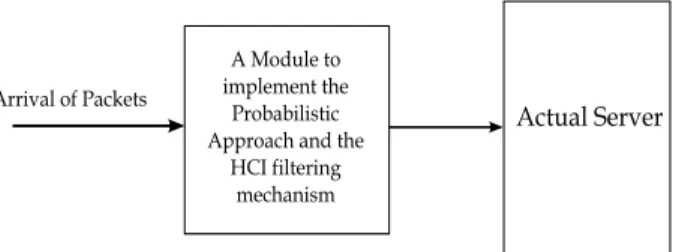
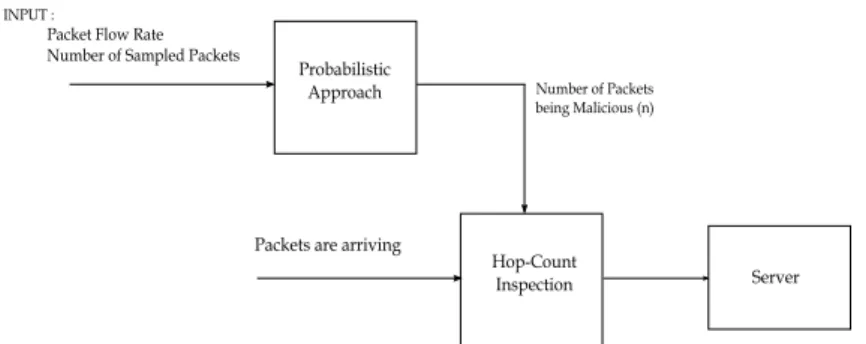
Implementation of one algorithm at server side is not much easy. This approach will be implemented at a port where all the packets coming to the server will be analyzed and then will be allowed to enter the server. A probabilistic approach and a filtering function will be maintained in the module to allow the packets into the server. Here we don’t need to bother about the queuing analysis as we are not checking the whole packet. We are just checking the header of the packet and that
1.5 Layout of the Thesis
Figure 1.1: Implementation Model Structure
is only the TTL value of the packet. So processing a large packet or processing a small packet doesn’t have any effect on the performance of the module for checking. From the probabilistic approach we are having the formula, which depends upon the arrival rate of packets and the error probability of a packet arriving at the server. This probabilistic approach is clearly described in Chapter 3. Then we are checking the TTL values to confirm the packet is spoofed or not using the algorithm described in Chapter 3. Our approach is saving the resource available at the server in terms of time.
1.5
Layout of the Thesis
This thesis is divided into five chapters. The Chapter 1, which is here, we have given an overview of the implementation of algorithms in a victim server and the resource saving analysis at the server. Chapter 2 describes the detailed overview of the related work had been done in this area and also the detailed classification of the attack and various mitigation methods. At the end of the chapter, we have just classified the various mitigation methods on the basis of comprehensive solution with its underlying strategies. Chapter 3 begins with the probabilistic approach to calculate the number of packets being malicious among the massive number of packets. And also the Hop-Count Filtering (HCF) method is discussed over there. Chapter 4 describes the solution to the problem addressed in the introductory part of this thesis. It also contains the experimental results to prove the proposed system. Chapter 5 contains the conclusion of this thesis and the future enhancements can be done to this work.
Distributed Denial-of-Service Attack
&
Related Work
Denial-of-Service Attack (DoS) Distributed Denial-of-Service Attack (DDoS) DDoS Attack Network DDoS Taxonomy DDoS Countermeasures Taxonomy Related WorkChapter 2
Distributed Denial-of-Service
Attack and Related Work
2.1
Denial-of-Service Attack (DoS)
A DoS attack can be described as an attack designed to render a computer or net-work incapable of providing normal services. A DoS attack is considered to take place only when access to a computer or network resource is intentionally blocked or degraded as a result of malicious action taken by another user. These attacks don’t necessarily damage data directly, or permanently, but they compromise the availability of the resources.
DoS attacks can be classified in [6] as follows:
Network Device Level: DoS attacks in the Network Device Level include at-tacks that might be caused either by taking advantage of bugs in software or by trying to exhaust the hardware resources of network devices.
OS Level: In the OS Level DoS attacks take advantage of the ways operating systems implement protocols.
Application-based attacks: A great number of attacks try to settle a machine or a service out of order either by taking advantage of specific bugs in network applications that are running on the target host or by using such applications to dram the resources of their victim.
Data Flooding: An attacker may attempt to use the bandwidth available to a network, host or device at its greatest extent, by sending massive quantities of data and so causing it to process extremely large amounts of data.
2.2 Distributed Denial-of-Service Attack (DDoS)
Attacks based on protocol features: DoS may take advantage of certain stan-dard protocol features, for example several attacks exploit the fact that source addresses can be spoofed.
2.2
Distributed Denial-of-Service Attack (DDoS)
A DDoS attack uses many computers to launch a coordinated DoS attack against one or more targets. Using client server technology, the perpetrator is able to multiply the effectiveness of the DoS significantly by harnessing the resources of multiple unwitting accomplice computers, which serve as attack platforms. A DDoS attack is composed of four elements in [6]:
1. The real attacker.
2. The handlers or master compromised hosts, who are capable of controlling multiple agents.
3. The attack daemon agents or zombie hosts, who are responsible for gener-ating a stream of packets toward the intended victim.
4. A victim or target host.
A DDoS attack can be described as follows:
Recruitment: The attacker chooses the vulnerable agents, which will he used to perform the attack.
Compromise: The attacker exploits the vulnerabilities of the agents and plants the attack code, protecting it simultaneously from discovery and deactivation.
Communication: The agents inform the attacker via handlers that they are ready.
Attack: The attacker commands the onset of the attack.
Sophisticated and powerful DDoS toolkits are available to potential attackers in-creasing the danger of becoming a victim in DoS or DDoS attack. Some of the most known DDoS tools are Trinoo, TFN, Stacheldraht, TFN2K, mstream and Shaft [6].
2.3 DDoS Attack Network
Figure 2.1: DDoS Attack Network
2.3
DDoS Attack Network
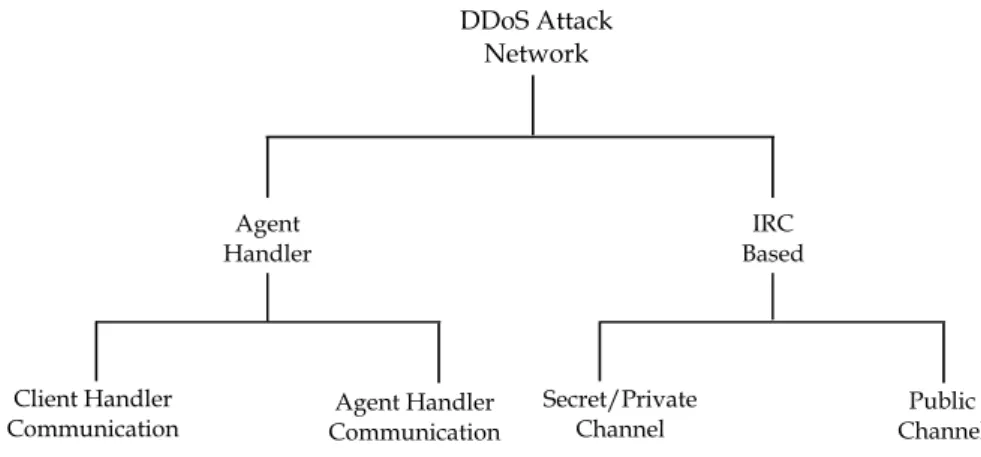
There are two main types of DDoS attack networks: The Agent-Handler model and The Internet Relay Chat (IRC-Based) [2] model (See Figure 2.1).
2.3.1
Agent-Handler Model
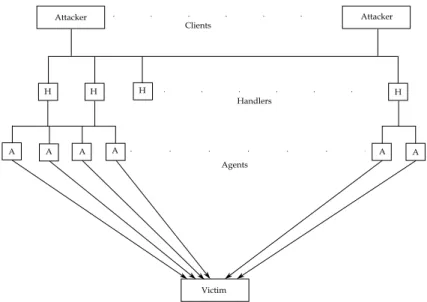
An Agent-Handler DDoS attack network consists of clients, handlers, and agents (see Figure 2.2). The client platform is where the attacker communicates with the rest of the DDoS attack network. The handlers are software packages located on computing systems throughout the Internet that the attacker uses to communicate indirectly with the agents. The agent software exists in compromised systems that will eventually carry out the attack on the victim system. The attacker communicates with any number of handlers to identify which agents are up and running, when to schedule attacks, or when to upgrade agents.
Depending on how the attacker configures the DDoS attack network, agents can be instructed to communicate with a single handler or multiple handlers. Usually, attackers will try and place the handler software on a compromised router or network server that handles large volumes of traffic. This makes it harder to identify messages between the client and handler and between the handler and agents. The communication between attacker and handler and between the handler and agents can be via TCP, UDP, or ICMP protocols. The owners and users of the agent systems typically have no knowledge that their system has been
2.3 DDoS Attack Network
Figure 2.2: DDoS Agent Handler Attack Model
compromised and will be taking part in a DDoS attack. When participating in a DDoS attack, each agent program uses only a small amount of resources (both in memory and bandwidth), so that the users of these computers experience minimal change in performance.
In descriptions of DDoS tools, the terms handler and agents are sometimes replaced with master and daemons respectively. Also, the systems that have been violated to run the agent software are referred to as the secondary victims, while the target of the DDoS attack is called the (primary) victim.
2.3.2
IRC Based DDoS Attack Model
Internet Relay Chat (IRC) is a multi-user, on-line chatting system. It allows com-puter users to create two-party or multi-party interconnections and type messages in real time to each other. IRC network architectures consist of IRC servers that are located throughout the Internet with channels to communicate with each other across the Internet. IRC chat networks allow their users to create public, private and secret channels. Public channels are channels where multiple users can chat and share messages and files. Public channels allow users of the channel to see all the IRC names and messages of users in the channel. Private and secret channels are set up by users to communicate with only other designated users. Both
2.3 DDoS Attack Network
vate and secret channels protect the names and messages of users that are logged on from users who do not have access to the channel. Although the content of private channels is hidden, certain channel locator commands will allow users not on the channel to identify its existence, whereas secret channels are much harder to locate unless the user is a member of the channel.
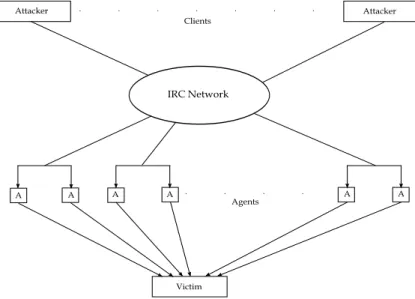
Figure 2.3: DDoS IRC Based Attack Model
An IRC-Based DDoS attack network is similar to the Agent-Handler DDoS at-tack model except that instead of using a handler program installed on a network server, an IRC communication channel is used to connect the client to the agents. By making use of an IRC channel, attackers using this type of DDoS attack ar-chitecture have additional benefits. For example, attackers can use ”legitimate” IRC ports for sending commands to the agents. This makes tracking the DDoS command packets much more difficult. Additionally, IRC servers tend to have large volumes of traffic making it easier for the attacker to hide his presence from a network administrator. A third advantage is that the attacker no longer needs to maintain a list of agents, since he can simply log on to the IRC server and see a list of all available agents. The agent software installed in the IRC network usually communicates to the IRC channel and notifies the attacker when the agent is up and running. A fourth advantage is that IRC networks also provide the benefit of easy file sharing. This makes it easier for attackers to secure secondary victims to
2.4 DDoS Taxonomy
participate in their attacks.
In IRC-based DDoS attack architecture, the agents are often referred to as ”Zombie Bots” or ”Bots”. In both IRC-based and Agent-Handler DDoS attack models, we will refer to the agents as ”secondary victims” or ”zombies”.
2.4
DDoS Taxonomy
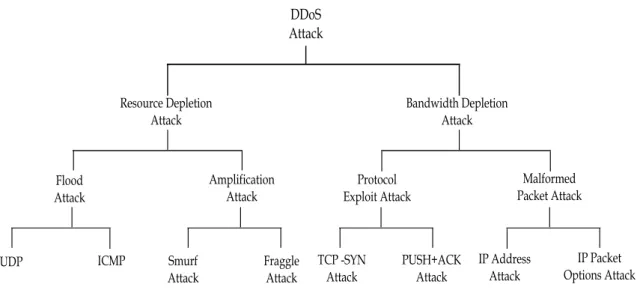
There are a wide variety of DDoS attack techniques. Taxonomy of the main DDoS attack methods was proposed in [2]. There are two main classes of DDoS attacks: bandwidth depletion and resource depletion attacks in figure 2.4. A bandwidth depletion attack is designed to flood the victim network with unwanted traffic that prevents legitimate traffic from reaching the (primary) victim system. A resource depletion attack is an attack that is designed to tie up the resources of a victim system. This type of attack targets a server or process on the victim system making it unable to process legitimate requests for service.
2.4.1
Bandwidth Depletion Attacks
There are two main classes of DDoS bandwidth depletion attacks [6]. A flood attack involves the zombies sending large volumes of traffic to a victim system, to congest the victim system’s bandwidth. An amplification attack involves either the attacker or the zombies sending messages to a broadcast IP address, using this to cause all systems in the subnet reached by the broadcast address to send a message to the victim system. This method amplifies malicious traffic that reduces the victim system’s bandwidth.
Flood Attacks: In a DDoS flood attack the zombies flood the victim system with IP traffic. The large volume of packets sent by the zombies to the victim system slows it down, crashes the system or saturates the network bandwidth. This prevents legitimate users from accessing the victim. Figures 2.2 and 2.3 indicate a flood attack for an Agent-Handler attack network and an IRC-based attack network.
2.4 DDoS Taxonomy
UDP flood attack: User Datagram Protocol (UDP) is a connectionless protocol. When data packets are sent via UDP, there is no handshaking required between sender and receiver, and the receiving system will just receive packets it must process. A large number of UDP packets sent to a victim system can saturate the network, depleting the bandwidth available for legitimate service requests to the victim system.
In a DDoS UDP Flood attack, the UDP packets are sent to either random or specified ports on the victim system. Typically, UDP flood attacks are designed to attack random victim ports. This causes the victim system to process the incoming data to try to determine which applications have requested data. If the victim system is not running any applications on the targeted port, then the victim system will send out an ICMP packet to the sending system indicating a ”destination port unreachable” message [7].
Often, the attacking DDoS tool will also spoof the source IP address of the attacking packets. This helps hide the identity of the secondary victims and it insures that return packets from the victim system are not sent back to the zombies, but to another computer with the spoofed address.
UDP flood attacks may also fill the bandwidth of connections located around the victim system (depending on the network architecture and line-speed). This can sometimes cause systems connected to a network near a victim system to experience problems with their connectivity.
ICMP Flood Attacks: Internet Control Message Protocol (ICMP) packets are designed for network management features such as locating network equipment and determining the number of hops or round-trip-time to get from the source lo-cation to the destination [8]. For instance, ICMP ECHO REPLY packets (”ping”) allow the user to send a request to a destination system and receive a response with the roundtrip time.
A DDoS ICMP flood attack occurs when the zombies send large volumes of ICMP ECHO REPLY packets to the victim system. These packets signal the victim system to reply and the combination of traffic saturates the bandwidth
2.4 DDoS Taxonomy
Figure 2.4: DDoS Attack Taxonomy
of the victim’s network connection. As for the UDP flood attack, the source IP address may be spoofed.
Amplification Attacks: A DDoS amplification attack is aimed at using the broadcast IP address feature found on most routers to amplify and reflect the attack (see Figure 2.5). This feature allows a sending system to specify a broadcast IP address as the destination address rather than a specific address. This instructs the routers servicing the packets within the network to send them to all the IP addresses within the broadcast address range.
Figure 2.5: Amplification Attack
For this type of DDoS attack, the attacker can send the broadcast message directly, or the attacker can use the agents to send the broadcast message to
2.4 DDoS Taxonomy
crease the volume of attacking traffic. If the attacker decides to send the broadcast message directly, this attack provides the attacker with the ability to use the sys-tems within the broadcast network as zombies without needing to infiltrate them or install any agent software. We further distinguish two types of amplification attacks, Smurf and Fraggle attacks [2].
Smurf Attacks: In a DDoS Smurf attack, the attacker sends packets to a net-work amplifier (a system supporting broadcast addressing), with the return ad-dress spoofed to the victim’s IP adad-dress. The attacking packets are typically ICMP ECHO REQUESTs, which are packets (similar to a ”ping”) that request the receiver to generate an ICMP ECHO REPLY packet. The amplifier sends the ICMP ECHO REQUEST packets to all of the systems within the broadcast address range, and each of these systems will return an ICMP ECHO REPLY to the target victim’s IP address. This type of attack amplifies the original packet tens or hundreds of times.
Fraggle Attacks: A DDoS Fraggle attack is similar to a Smurf attack in that the attacker sends packets to a network amplifier. Fraggle is different from Smurf in that Fraggle uses UDP ECHO packets instead of ICMP ECHO packets. There is a variation of the Fraggle attack where the UDP ECHO packets are sent to the port that supports character generation (chargen, port 19 in Unix systems), with the return address spoofed to the victim’s echo service (echo, port 7 in Unix sys-tems) creating an infinite loop. The UDP Fraggle packet will target the character generator in the systems reached by the broadcast address. These systems each generate a character to send to the echo service in the victim system, which will resend an echo packet back to the character generator, and the process repeats. This attack generates even more bad traffic and can create even more damaging effects than just a Smurf attack.
2.4.2
Resource Depletion Attacks
DDoS resource depletion attacks involve the attacker sending packets that mis-use network protocol communications or sending malformed packets that tie up network resources so that none are left for legitimate users.
2.4 DDoS Taxonomy
Protocol Exploit Attacks:
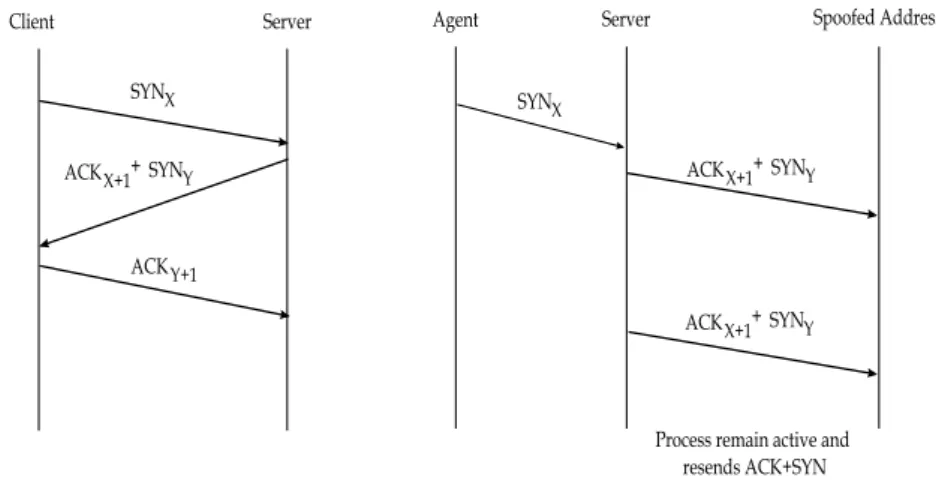
TCP SYN Attacks: The Transfer Control Protocol (TCP) includes a full hand-shake between sender and receiver, before data packets are sent. The initiating system sends a SYN (Synchronize) request (see Figure 2.6a). The receiving sys-tem sends an ACK (acknowledgement) with its own SYN request. The sending system then sends back its own ACK and communication can begin between the two systems. If the receiving system is sent a SYNX packet but does not receive an ACKY+1 to the SYNY it sends back to the sender, the receiver will resend a new ACK + SYNY after some time has passed (see Figure 2.6b). The processor and memory resources at the receiving system are reserved for this TCP SYN request until a timeout occurs.
Figure 2.6: (a) TCP Synchronization ,(b) TCP-SYN Attack
In a DDoS TCP SYN attack, the attacker instructs the zombies to send such bogus TCP SYN requests to a victim server in order to tie up the server’s proces-sor resources, and hence prevent the server from responding to legitimate requests. The TCP SYN attack exploits the three-way handshake between the sending sys-tem and the receiving syssys-tem by sending large volumes of TCP SYN packets to the victim system with spoofed source IP addresses, so the victim system responds to a non-requesting system with the ACK+SYN. When a large volume of SYN requests are being processed by a server and none of the ACK+SYN responses are returned, the server begins to run out of processor and memory resources. Eventually, if the volume of TCP SYN attack requests is large and they continue
2.4 DDoS Taxonomy
over time, the victim system will run out of resources and be unable to respond to any legitimate users.
PUSH + ACK Attacks: In the TCP protocol, packets that are sent to a desti-nation are buffered within the TCP stack and when the stack is full, the packets get sent on to the receiving system. However, the sender can request the receiv-ing system to unload the contents of the buffer before the buffer becomes full by sending a packet with the PUSH bit set to one. PUSH is a one-bit flag within the TCP header. TCP stores incoming data in large blocks for passage on to the receiving system in order to minimize the processing overhead required by the receiving system each time it must unload a non-empty buffer.
The PUSH + ACK attack is similar to a TCP SYN attack in that its goal is to deplete the resources of the victim system. The attacking agents send TCP packets with the PUSH and ACK bits set to one. These packets instruct the victim system to unload all data in the TCP buffer (regardless of whether or not the buffer is full) and send an acknowledgement when complete. If this process is repeated with multiple agents, the receiving system cannot process the large volume of incoming packets and it will crash.
Malformed Packet Attacks:
A malformed packet attack is an attack where the attacker instructs the zom-bies to send incorrectly formed IP packets to the victim system in order to crash the victim system. There are two types of malformed packet attacks. In an IP address attack, the packet contains the same source and destination IP addresses. This can confuse the operating system of the victim system and cause the victim system to crash. In an IP packet options attack, a malformed packet may ran-domize the optional fields within an IP packet and set all quality of service bits to one so that the victim system must use additional processing time to analyze the traffic. If this attack is multiplied using enough agents, it can shut down the processing ability of the victim system.
2.5 DDoS Countermeasures Taxonomy
2.5
DDoS Countermeasures Taxonomy
There are a number of proposals and partial solutions available today for miti-gating the effects of a DDoS attack. Many of these solutions and ideas assist in preventing certain aspects of a DDoS attack. However, there is no comprehensive solution to protect against all known forms of DDoS attacks. Also, many deriva-tive DDoS attacks are continually being developed by attackers to bypass each new countermeasure employed. More research is needed to develop more effective and encompassing countermeasures and solutions.
There are three essential components to DDoS countermeasures. There is the component for preventing the DDoS attack which includes preventing secondary victims and detecting and neutralizing handlers. There is the component for deal-ing with a DDoS attack while it is in progress, includdeal-ing detectdeal-ing or preventdeal-ing the attack, mitigating or stopping the attack, and deflecting the attack. Lastly, there is the post-attack component which involves network forensics.
2.5.1
Prevent Secondary Victims
Individual Users: One of the best methods to prevent DDoS attacks is for the secondary victim systems to prevent themselves from participating in the attack. This requires a heightened awareness of security issues and prevention techniques from all Internet users. If attackers are unable to break into and make use of secondary victim systems, then the attackers will have no ”DDoS attack network” from which to launch their DDoS attacks.
In order for secondary victims to not become infected with the DDoS agent software, users of these systems must continually monitor their own security. They must check to make sure that no agent programs have been installed on their systems and that they are not sending DDoS agent traffic into the network. The Internet is so de-centralized, and since there are so many different hardware and software platforms, it is quite difficult for typical users to implement the right protective measures. Typically this would include installing virus and anti-Trojan software and keeping these up to date. Also, all software patches for
2.5 DDoS Countermeasures Taxonomy
discovered vulnerabilities must be installed.
Since these tasks can be viewed as daunting for the average ”web-surfer”, re-cent work has proposed built-in mechanisms in the core hardware and software of computing systems that can provide defenses against malicious code insertion, for example through exploiting buffer overflow vulnerabilities [9]. This can sig-nificantly reduce the probability of a system being compromised as a secondary victim in setting up a DDoS attack network.
Network Service Providers: One strategy currently being discussed is for providers and network administrators to add dynamic pricing to their network usage, to encourage secondary victims to become more active in preventing them-selves from becoming part of a DDoS attack. Dynamic pricing policies allow the network service providers to charge a cost per time unit depending on the avail-ability of network resources; hence it regulates the arrival rate of calls of service to the network. This implies that network service requirements such as availabil-ity, reliabilavailabil-ity, securavailabil-ity, bandwidth, congestion, routing, stabilavailabil-ity, delays, etc are maintained at an optimum level. These are the parameters that define the net-work QoS both within the netnet-work and at the edge access points where customer services are offered, leading to significant improvement in the network manage-ment [10]. If providers chose to charge differently for the use of different resources, they could charge for access to certain services within their networks. This would allow the providers to only allow legitimate customers on to their networks. This system would make it easier to prevent attackers from entering the network [11]. By altering the pricing of services, secondary victims who would be charged for accessing the Internet may become more conscious of the traffic they send into the network and hence may do a better job of policing themselves to verify that they are not participating in a DDoS attack.
2.5.2
Detect and Neutralize Handlers
One important method for stopping DDoS attacks is to detect and neutralize handlers. Since the agent-handler DDoS attack tools require the handler as an intermediary for the attacker to initiate attacks, finding and stopping the handlers
2.5 DDoS Countermeasures Taxonomy
is a quick method to disrupt the DDoS attack network. This can possibly be done by studying the communication protocols and traffic patterns between handlers and clients or handlers and agents in order to identify network nodes that might be infected with a handler. Also, there are usually far fewer DDoS handlers deployed than there are agents, so neutralizing a few handlers can possibly render multiple agents useless, thus thwarting DDoS attacks.
2.5.3
Detect Potential Attacks
Egress Filtering: One method for detecting potential attacks is to use egress filtering. Egress filtering refers to the practice of scanning the packet headers of IP packets leaving a network (egress packets) and checking to see if they meet certain criteria. If the packets pass the criteria, they are routed outside of the sub-network from which they originated. If the filter criteria are not met, the packets will not be sent to the intended target. Since one of the features of DDoS attacks is spoofed IP addresses, there is a good probability that the spoofed source address of DDoS attack packets will not represent a valid source address of the specific sub-network. If the network administrator places a firewall or packet sniffer in the sub-network that filters out any traffic without an originating IP address from this subnet, many DDoS packets with spoofed IP source addresses will be discarded, and hence neutralized.
MIB Statistics: Another method currently being looked at to identify when a DDoS attack is occurring uses the Management Information Base (MIB) data from routers. The MIB data from a router includes parameters that indicate dif-ferent packet and routing statistics. Current research has focused on identifying statistical patterns in different parameters during a DDoS attack [12]. It looks promising for possibly mapping ICMP, UDP, and TCP packet statistical abnor-malities to specific DDoS attacks.
Accurate statistical models based on the MIB parameters from routers are still being studied to understand how accurately they can monitor DDoS attack traffic and predict when a DDoS attack is happening. Work in this area could provide important information and methods for identifying when a DDoS attack is starting
2.5 DDoS Countermeasures Taxonomy
and how to filter or adjust the network to compensate for the attacking traffic.
2.5.4
Mitigate or Stop the Effects of DDoS Attacks
Load Balancing: For network providers, there are a number of techniques used to mitigate the effects of a DDoS attack. Providers can increase bandwidth on critical connections to prevent them from going down in the event of an attack. Replicating servers can help provide additional failsafe protection in the event some go down during a DDoS attack. Balancing the load to each server in a multiple-server architecture can improve both normal performance as well as mitigate the effect of a DDoS attack.
Throttling: One proposed method to prevent servers from going down is to use Max-min Fair server-centric router throttles [13]. This method sets up routers that access a server with logic to adjust (throttle) incoming traffic to levels that will be safe for the server to process. This will prevent flood damage to servers. Ad-ditionally, this method can be extended to throttle DDoS attacking traffic versus legitimate user traffic for better results. This method is still in the experimental stage, however similar techniques to throttling are being implemented by network operators. The difficulty with implementing throttling is that it is still hard to decipher legitimate traffic from malicious traffic. In the process of throttling, le-gitimate traffic may sometimes be dropped or delayed and malicious traffic may be allowed to pass to the servers.
Drop Requests: Another method is to simply drop requests when the load increases. This can be done by the router or the server. Alternatively, the requester may be induced to drop the request by making the requester system solve a hard puzzle that takes a lot of compute power or memory space, before continuing with the request. This causes the users of zombie systems to detect performance degradation, and could possibly stop their participation in sending DDoS attack traffic.
2.5.5
Deflect Attacks
2.5 DDoS Countermeasures Taxonomy
that are set up with limited security to be an enticement for an attacker so that the attacker will attack the Honeypot and not the actual system. Honeypots typically have value not only in deflecting attacks from hitting the systems they are protecting, but also in serving as a means for gaining information about attackers by storing a record of their activity and learning what types of attacks and software tools the attacker is using. Current research discusses the use of honeypots that mimic all aspects of a legitimate network (such as web servers, mail servers, clients, etc.) in order to attract potential DDoS attackers [14]. The goal of this type of honeypot is to attract a DDoS attacker and get him to install either handler or agent code within the honeypot. This prevents some legitimate systems from getting compromised and allows the honeypot owner to track the handler or agent behavior and better understand how to defend against future DDoS installation attacks.
2.5.6
Post-Attack Forensics
Traffic Pattern Analysis: If traffic pattern data is stored during a DDoS attack, this data can be analyzed post-attack to look for specific characteristics within the attacking traffic. This characteristic data can be used for updating load balancing and throttling countermeasures to increase their efficiency and protection ability. Additionally, DDoS attack traffic patterns can help network administrators de-velop new filtering techniques for preventing DDoS attack traffic from entering or leaving their networks.
Packet Traceback: Another set of techniques assist in identifying the at-tackers using packet traces [15]. The concept of tracing is that Internet traffic could be traced back to the true source (rather than that of a potentially spoofed source IP address). This allows back tracing the attacker’s traffic and possibly identifying the attacker. Additionally, when the attacker sends vastly different types of attacking traffic, this method assists in providing the victim system with information that might help develop filters to block the attack.
A model for developing a Network Traffic Tracking System that would identify and track user traffic throughout a network has been proposed. This type of system
2.5 DDoS Countermeasures Taxonomy
has been identified as being very successful within a closed network environment, such as a corporate network where internal client systems can be fully managed by a central network administrator who can track individual end-user actions. This method begins to break down as the network becomes widely distributed. Traffic tracking on the Internet or large extranets is difficult to implement. Since different network administrators control different sections of the Internet, it would be difficult to determine who would be responsible for monitoring the traffic. Also, the loss of privacy on the Internet would meet with an unfavorable response from most network users.
Event Logs: Network administrators can keep logs of the DDoS attack infor-mation in order to do a forensic analysis and to assist law enforcement in the event the attacker does severe financial damage. Using both Honeypots as well as other network equipment such as firewalls, packet sniffers, and server logs, providers can store all the events that occurred during the setup and execution of the attack. This will allow the network administrators to discover what type of DDoS attack (or combination of attacks) was used.
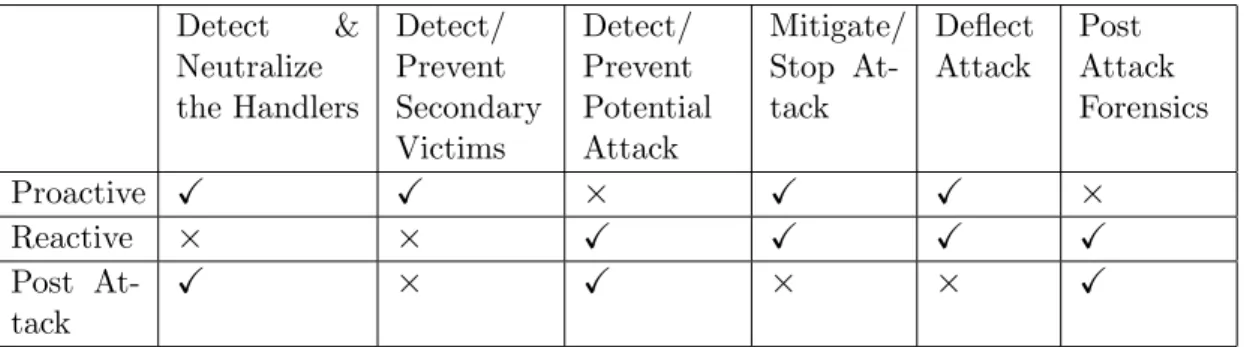
Also based on the underlying strategies, we can categorize current DDoS detec-tion and defense approaches into three categories: Proactive Mechanisms, Reactive Mechanisms and Post Attack Analysis [16].
Proactive defense mechanisms (Keromytis, Misra and Rubenstein, 2002)
The motivation for these approaches is based on the observation that it is hard to detect DDoS attacks. So instead of detecting the attacks by using signatures (attack pattern) or anomaly behavior, these approaches try to improve the relia-bility of the global Internet infrastructure by adding extra functionality to Internet components to prevent attacks and vulnerability exploitation. The primary goal is to make the infrastructure immune to the attacks and to continue to provide service to normal users under extreme conditions.
Reactive defense mechanisms using available IDS(Ioannidis and Bellovin, 2002)These mechanisms typically deploy third-party Intrusion Detection Systems (IDS) to obtain attack information and take action based on this information.
2.5 DDoS Countermeasures Taxonomy Detect & Neutralize the Handlers Detect/ Prevent Secondary Victims Detect/ Prevent Potential Attack Mitigate/ Stop At-tack Deflect Attack Post Attack Forensics
Proactive X X × X X ×
Reactive × × X X X X
Post At-tack
X × X × × X
Table 2.1: Allocation of mitigation methods into underlying strategies
Consequently their usefulness depends on the capability of the IDS systems. Dif-ferent strategies are used based on the assumptions made by the IDS systems. If the IDS system can detect the DDoS attack packets accurately, filtering mecha-nism are used, which can filter out the attack stream completely, even at the source network. If the IDS can not detect the attack stream accurately, rate limiting is used. This mechanism imposes a rate limit on the stream that is characterized as malicious by the IDS.
Post attack analysis (Song and Perrig, 2001) The purpose of post attack analysis is to either look for attack patterns that will be used by IDS or identify attackers using packet tracing. The goal of packet tracing is to trace Internet traffic back to the true source (not spoofed IP address). As attackers change their strategy frequently, analyzing huge amounts of traffic logs is time consuming and useless in detecting new attacks. Trace back mechanism can help to identify zom-bies in some situations; however, it is impractical to defend against DDoS attacks for the following reasons. First, during a DDoS attack, the attacker will control thousands of zombies (numbers will increase in the future) to launch an attack. As a result, identifying these zombies is expensive and infeasible. Second, since different network administrators control different sections of the global Internet, it would be difficult to determine who would be responsible for providing trace back information.
2.6 Related Work
2.6
Related Work
Our approach is related to reactive defense mechanism. Reactive mechanisms strive to alleviate the impact of an attack on the victim. To attain this goal they need to detect the attack and respond to it. The goal is to detect every attempted DDoS attack as early as possible and to have a low degree of false positives. Steps then can be taken to characterize the attack packets and provide this characterization to the response mechanism.
This reactive defense mechanism is classified into three mechanisms based on the attack detection strategies that deploy pattern detection, anomaly detection and third party detection. Mechanisms that deploy pattern detection store the signatures of known attacks in a database and monitor each communication for the presence of these patterns. The obvious drawback is that only known attacks can be detected, whereas new attacks or even slight variations of old attacks go unnoticed. On the other hand, known attacks are easily and reliably detected, and no false positives are encountered. A similar approach has been helpful in con-trolling computer viruses. Like in virus detection programs, signature databases must be regularly updated to account for new attacks.
Mechanisms that deploy anomaly detection have a model of normal system behavior, such as normal traffic dynamics or expected system performance. The current state of the system is periodically compared with the models to detect anomalies. Approaches presented in [17–19] provide examples of anomaly detec-tion approaches. The advantage of anomaly detecdetec-tion over pattern detecdetec-tion is that previously unknown attacks can be discovered. The disadvantage is that anomaly detectors must trade on their ability to detect all attacks against their tendency to misidentify normal behavior as an attack.
Mechanisms that deploy third-party detection do not handle the detection process themselves, but rely on an external message that signals the occurrence of the attack and provides attack characterization. Examples of third-party detection are easily found among trace back mechanisms [20, 21].
2.6 Related Work
on the attack response strategies. The goal of the attack response is to relieve the impact of the attack on the victim while imposing minimal collateral damage to legitimate clients. The four strategies are like agent identification, rate limiting, filtering and reconfiguration.
Agent identification mechanisms provide the victim with (somewhat accurate) information about the identity of the machines that are performing the attack. This information can be used by other approaches to alleviate the impact of the attack. Agent identification examples include numerous trace back techniques [20, 21].
Rate-limiting mechanisms impose a rate limit on a set of packets that have been characterized as malicious by the detection mechanism. It is a lenient response technique that is usually deployed when the detection mechanism has many false positives or cannot precisely characterize the attack stream. The disadvantage is that rate limiting will allow some attack traffic through, so extremely high-scale attacks might still be effective even if all traffic streams are rate limited. Examples of rate-limiting mechanisms are found in [18, 22].
Filtering mechanisms use the characterization provided by detection mecha-nisms to filter out the attack streams completely. Examples include dynamically deployed firewalls, and some commercial systems. Here the disadvantage is unless the characterization is very accurate, filtering mechanisms run the risk of acciden-tally denying service to legitimate traffic. Worse, clever attackers might leverage them as denial-of-service tools.
Reconfiguration mechanisms change the topology of the victim or the interme-diate network to either add more resources to the victim or to isolate the attack machines. Examples include reconfigurable overlay networks [19], resource repli-cation services, and attack isolation strategies [23]. In each and every case we have mentioned the demerit of mitigation mechanisms.
So we have proposed a probabilistic approach and a filtering method to mitigate the attack. As we are not depending upon the outside world to mitigate the attack we assume to solve this problem in place.
Probabilistic Approach & HCF Method
Probabilistic Approach For Uncertainty Analysis The Probabilistic Approach Time-to-Live (TTL) The Hop Count Filtering Method Construction of HCF Table Running States of HCFChapter 3
Probabilistic Approach & HCF
Method
3.1
Probabilistic Approach For Uncertainty
Anal-ysis
Probabilistic approach is the most widely used technique for uncertainty analysis of mathematical models. There are a number of text books that describe the con-cepts and application of probabilistic analysis in detail. Tsokos (1972) presents excellent introductory material for probabilistic analysis, Johnson (1972) explains the multivariate random variables, and Papoulis (1991) presents an excellent de-scription on probability and random variables from a mathematical view point. Additionally, Gardiner (1983) presents the applications of probabilistic analysis in modeling. This appendix attempts to merely summarize some basic information on probability and random variables, which can be found in more detail in the abovementioned texts.
In the probabilistic approach, uncertainties are characterized by the probabili-tiesassociated withevents[24]. An event corresponds to any of the possible states a physical system can assume, or any of the possible predictions of a model describ-ing the system. In the study of environmental pollution, the situation where the contaminant concentration exceeds a regulatory level can be an event. Similarly, in case of mathematical modeling, the situation where the model outputs fall in a certain range, is also an event. In short, any possible outcome of a given problem, such as the tossing of a coin, experimental measurement of contaminant
3.2 The Probabilistic Approach
tration, as and mathematical modeling of a physical system, is an event. The
probability of an event can be interpreted in terms of the frequency of occurrence of that event. When a large number ofsamplesorexperiments are considered, the probability of an event is defined as the ratio of the number of times the event occurs to the total number of samples or experiments. A probability of 0 for an event means that the event will never occur, and a probability of 1 indicates that the event will always occur. Examples of experiments or samples include repeated coin tossing, a large number of independent measurements of contaminant con-centration, or a large number of simulations using a mathematical model with randomly varying parameters.
The following examples illustrate the concept of probability based on a large number of samples: (a) if a coin is tossed, the probability of heads turning up is 0.5 and that of the tails is 0.5. This means that if the coin is tossed a large number of times, heads will turn up roughly half the time and tails half the time. (b) The statement that the probability that a pollutant concentration c lies between
c1 and c2 equals p means the following: from a large number of independent
measurements of the concentration c, under identical conditions, the number of times the value ofclies betweenc1 and c2 is roughly equal to the fraction pof the
total number of samples.
3.2
The Probabilistic Approach
As knowing the number of packet being malicious is a very uncertain problem, we have applied the probability theory to calculate that easily.
Suppose the number of packets arriving at the server with a poisson’s distribu-tion λ. Suppose further that each packet which reaches at server being malicious with probability ’p’ or non-malicious with probability ’1-p’.
3.2 The Probabilistic Approach
So now the joint probability of ’n’ packets among the total traffic are malicious and ’m’ packets among the total traffic are non-malicious is as follows,
Let N1 denotes the number of malicious packets.
N2 denotes the number of non-malicious packets. Also letN=N1+N2 be the total
number of traffic or packets which arrives at server. Now conditioning on N gives,
P{N1 =n, N2 =m}=
∞
X
i=0
P {N1 =n, N2 =m|N =i}P{N =i} (1)
BecauseP{N1 =n, N2 =m |N =i}= 0, wheni6=n+m, the preceding equation
yields that,
P {N1 =n, N2 =m}=P {N1 =n, N2 =m|N =n+m}e−λ
λn+m
(n+m)! (2) Also if it is clear that among that ‘n+m’ packets each packet of being malicious has the probability of ‘p’ and the conditional probability that ‘n’ of them are malicious is nothing but just thebinomial probability of ‘n’ successes out of‘n+m’
trials. Therefore,
P {N1 =n, N2 =m}=
m+n
n
pn(1−p)m
e−λ λn+m (n+m)!
=
µ
(m+n)!
m!n! p
n(1−p)m

e−λ λn+m (n+m)!
= p
n(1−p)m¡e−λpe−λ(1−p)¢λmλn
m!n!
=e−λp(λp) n
n! e
−λ(1−p)(λ(1−p))
m
m! (3)
Here equation (3) shows the probability of ‘n’ packets being malicious and ‘m’
packets being non-malicious. So by putting the value of probability to 1, by specifying the value of rate of arrival‘λ’ in‘number of packets per time unit’ and probability of error in a packet ‘p’ we can get the value of ‘n’ and ‘m’.
3.3 Time-to-Live (TTL)
3.3
Time-to-Live (TTL)
The time-to-live (TTL) is the number of hops that a packet is permitted to travel before being discarded by a router [25].
A packet is the fundamental unit of information transport in all modern com-puter networks, and increasingly in other communications networks as well. A router is a network layer electronic device and/or software that connects at least two networks, such as two LANs (local area networks) or WANs (wide area net-works), and forwards packets between them. A hop is the trip that a packet takes from one router to another as it traverses a network on the way to its destination. The TTL is set in an eight binary digit field in the packet header by the sending host and is used to prevent packets from endlessly circulating on the Internet or other network. When forwarding an IP packet, routers are required to decrease the TTL by at least one. If a packet’s TTL field reached zero, the router detecting it discards the packet and sends an ICMP (Internet control message protocol) message back to the originating host.
Theping and thetraceroute utilities both make use of the TTL [25]. The latter intentionally sends packets with low TTL values so that they will be discarded by each successive router in the destination path. The time between sending a packet and receiving the ICMP message that it was discarded is used to calculate the travel time for each successive hop.
A specific TTL number can indicate the maximum range for a packet. For example, 0 restricts it to the same host, 1 to the same subnet, 32 to the same site, 64 to the same region and 128 to the same continent; 255 is unrestricted.
3.4
The Hop Count Filtering Method
To thwart DDoS attacks, researchers have taken two distinct approaches. The first approach improves the routing infrastructure, while the second approach enhances the resilience of Internet servers against attacks. The first approach performs either off-line analysis of flooding traffic traces or on-line filtering of spoofed IP packets inside routers. Offline IP traceback [21] attempts to
estab-3.4 The Hop Count Filtering Method
lish procedures to track down flooding sources after occurrences of DDoS attacks. While it does help pinpoint locations of flooding sources, off-line IP traceback does not help sustain service availability during an attack. On-line filtering mech-anisms rely on IP router enhancements [26] to detect abnormal traffic patterns and foil DDoS attacks. However, these solutions require not only router support, but also coordination among different routers and wide-spread deployment. The end-system approach protects Internet servers with sophisticated resource man-agement to servers. This approach provides more accurate resource accounting, and fine-grained service isolation and differentiation.
End-system-based filtering that does not require router support is necessary to detect and discard spoofed traffic. We only utilize the information contained in the IP header for packet filtering. Although an attacker can forge any field in the IP header, he cannot falsify the number of hops an IP packet takes to reach its destination, which is solely determined by the Internet routing infrastructure. The hop-count information is indirectly reflected in the TTL field of the IP header, since each intermediate router decrements the TTL value by one before forwarding it to the next hop. The difference between the initial TTL (at the source) and the final TTL value (at the destination) is the hop-count between the source and the destination. By examining the TTL field of each arriving packet, the destination can infer its initial TTL value, and hence the hop-count from the source. Here we assume that attackers cannot sabotage routers to alter TTL values of IP packets that traverse them.
The rationale behind hop count filtering is that most spoofed IP packets, when arriving at victims, do not carry hop-count values that are consistent with legit-imate IP packets from the sources that have been spoofed. Hop-Count Filtering
(HCF) builds an accurate HCI (IP to hop-count) mapping table, while using a moderate amount of storage, by clustering address prefixes based on hop-count. To capture hop-count changes under dynamic network conditions, we also devise a “safe” update procedure for the HCI mapping table that prevents pollution by HCF aware attackers.
3.4 The Hop Count Filtering Method
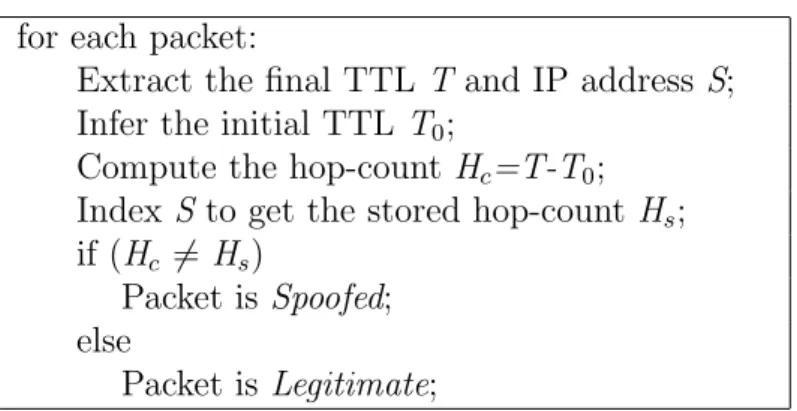
for each packet:
Extract the final TTL Tand IP address S; Infer the initial TTL T0;
Compute the hop-count Hc=T-T0;
Index S to get the stored hop-count Hs; if (Hc 6= Hs)
Packet isSpoofed; else
Packet isLegitimate;
Table 3.1: Hop-Count Inspection Algorithm
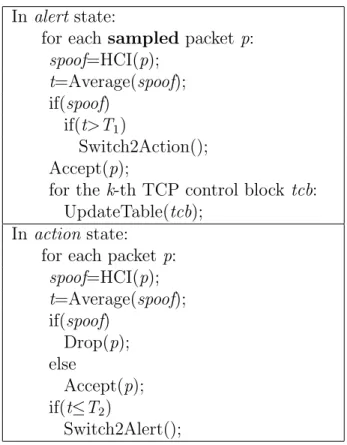
Two running states, alert and action, within HCF use this mapping to inspect the IP header of each IP packet. Under normal condition, HCF resides in alert
state, watching for abnormal TTL behaviors without discarding packets. Upon detection of an attack, HCF switches to action state, in which the HCF discards those IP packets with mismatching hop counts. Besides the HCI, several efficient mechanisms in [27] are available to detect DDoS attacks. Through analysis using network measurement data, we show that the HCF can recognize close to 90% of spoofed IP packets. Then, since our hop-count-based clustering significantly reduces the percentage of false positives, we can discard spoofed IP packets with little collateral damage.
3.4.1
Hop-Count Inspection
Central to HCF is the validation of the source IP address of each packet via hop-count inspection. In this section, we first discuss the hop-hop-count computation, then present the inspection algorithm in detail.
TTL based Hop-Count Computation Since hop-count information is not directly stored in the IP header, one has to compute it based on the TTL field of the IP header. TTL is an 8-bit field in the IP header, originally introduced to specify the maximum lifetime of IP packets in the Internet. During transit, each intermediate router decrements the TTL value of an IP packet by one before forwarding it to the next-hop router. The final TTL value when a packet reaches its destination is therefore the initial TTL subtracted by the number of intermediate hops (or simply hop-count). The challenge in hop-count computation is that a