ANNUAL REPORT
that all young children benefit
from early learning experiences
that affirm their individual,
family, and community assets,
fortify them against harmful
consequences arising from
poverty, racism, prejudice, and
discrimination, and strengthen
their developmental potential.
As the Chair of the Board for the Foundation for Child Development, it is an honor to work with my fellow board members to support the Foundation’s longstanding work in advancing research and scholarship that informs early care and education (ECE) policies and practices.
The Foundation is committed to supporting research, policy, and advocacy that has the potential to ensure that all children experience high-quality early learning. Embedded in the Foundation’s history and core is a doctrine of equity. The health care, education, and housing challenges that America faces today around the COVID-19 pandemic, instances of racial injustice, and social unrest are manifestations of enduring inequalities the Foundation has worked to address for over 120 years.
In June 2020, the Foundation’s Board of Directors unanimously resolved to revise our mission statement to explicitly address institutionalized poverty, racism, prejudice, and discrimination. These changes express our deep commitment that issues of equity will guide the Foundation’s programmatic strategies and grantmaking.
The Foundation’s current focus on the ECE workforce addresses inequities head-on: 40% of the workforce are women of color, the majority of whom are poorly compensated and have limited opportunities for higher education preparation and ongoing professional development.
Additionally, with our Young Scholars Program (YSP), we continue to invest in diversity and equity in scholarship through the work of early-career researchers. Beyond excellent research, our Young Scholars contribute great value to the field by providing a range of perspectives necessary to ask the right
questions and offer solutions that better meet the needs of the ECE workforce and the diverse children and families they serve.
Continuing to invest in research and advocacy—especially work that demonstrates the importance of the preparation, professional development, and compensation for educators—will fight poverty and institutional racism and create a future where all children have the opportunity to reach their full potential. I look forward to our continued work together.
H. Melvin Ming
As The Foundation for Child Development reflects on the policy- and practice-relevant research and scholarship highlighted in this 2019-2020 Annual Report, we do so in the context of health, economic, and social crises that were not realities when this work was conceived and funded. These realities are having a significant impact on the early care and education (ECE) workforce and underscore the importance of the Foundation’s programmatic focus.
Creating a future in which all young children have equal access to enriching and supportive ECE programs requires us to examine the role that systemic racism has played in denying access,
compensation, and professional advancement to the ECE workforce, nearly half of whom are women of color who are paid poverty-level wages. Promoting equity—for the ECE workforce, within ECE systems, and with scholarship—is of paramount importance to the Foundation in all of our work. Through our grantmaking, the Foundation renews its commitment to racial, social, and economic justice so that early educators receive the respect, professional preparation, and compensation that reflect the highly valuable work they do. Both the prior grantees and new awardees featured in this report exemplify this commitment and reflect the Foundation’s adherence to its core principles, particularly recognizing diversity as an asset. Partnership and collaboration—with our grantees and peer organizations—is a longstanding principle of the Foundation. We have put this principle into practice through our participation in the Early Educator Investment Collaborative (The Collaborative). Together with several of the nation’s leading early
childhood funders, we can be more effective in our mission to advance the ECE profession. In this report, we preview two initiatives launched in December 2019 and March 2020 that cultivated promising opportunities to improve the preparation of the ECE workforce.
We spotlight grantees whose work has the potential to affect policy and practice at the systems-level—a core constant of the Foundation’s grantmaking strategy. Investment in implementation research contributes valuable research-to-practice knowledge for the field—as demonstrated by the continuing work of the New York City Early Childhood Research Network. Advancements for the ECE profession are further realized through our support of policymakers as they make progress in improving policies supporting the workforce.
Our Young Scholars Program (YSP) continues to produce high-quality research by early-career
professionals across diverse racial, ethnic, and social backgrounds, academic disciplines, and research methods. Within YSP, I am pleased to highlight our new Promising Scholars Program that provides supports to hone the research skills of YSP applicants who demonstrate exceptional potential to conduct rigorous, high-quality implementation research. Equity in the research field—central to the Foundation’s mission—is advanced through our investment in mentorship and professional development efforts. We feature efforts that provide career-advancing opportunities for diverse early- and mid-career ECE practitioners, research scholars, and other ECE professionals.
I am also pleased to announce our new awardees in our 2019-2020 fiscal year. Their work aligns with the Foundation’s programmatic direction to strengthen the ECE workforce and helps us achieve our goals and fulfill the Foundation’s mission.
The Foundation also wishes to acknowledge the passing of past President and CEO Dr. Ruby Takanishi in August of 2020. Her formidable legacy continues to inspire us to work at the intersection of research, policy, and practice.
Jacqueline Jones, Ph.D. President and CEO
GRANTEE HIGHLIGHTS
APRIL 2019 - MARCH 2020
OUR PROGRAMMATIC STRATEGY:
SUPPORTING THE EARLY CARE AND EDUCATION WORKFORCE
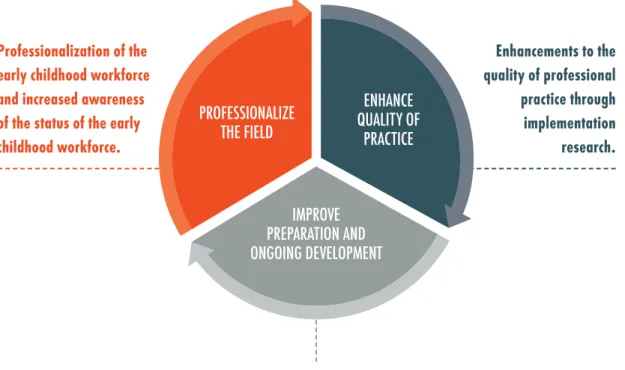
The Foundation for Child Development developed a programmatic strategy in 2014 focused on strengthening the early care and education (ECE) workforce. We define the ECE workforce as professionals who educate and care for young children from birth through age eight across a variety of settings and systems, as well as those who function in support and leadership roles. The Foundation first formulated a theory of action which proposed that investing in the professionalization, preparation, and ongoing support of the ECE workforce could lead to higher quality early learning experiences and a broad range of improved outcomes for all young children, especially those facing the challenges of poverty and racism. Three areas of focus for the ECE workforce were developed (see Figure 1):
Last year, we profiled a few initial grants implementing the current programmatic direction. This annual report highlights examples of the Foundation’s more recent efforts to support the ECE workforce and announces our new awardees for 2019-2020 fiscal year. The Foundation is spotlighting the work we do through the Early Educator Investment Collaborative and our direct grantees to promote all three ECE
PROFESSIONALIZE THE FIELD
ENHANCE QUALITY OF
PRACTICE
IMPROVE PREPARATION AND ONGOING DEVELOPMENT
Improvements to preparation and ongoing professional learning, with emphasis on institutions of higher education. Professionalization of the
early childhood workforce and increased awareness of the status of the early childhood workforce.
Enhancements to the quality of professional practice through implementation research. Figure 1: Foundation for Child Development’s Grantmaking Goals.
EARLY EDUCATOR INVESTMENT COLLABORATIVE:
FUNDER COLLABORATION IN ACTION
Part of the Foundation’s grantmaking strategy involves working in collaboration with seven1 other
foundations within the Early Educator Investment Collaborative2 (The Collaborative) to help early
educators achieve their full potential as professionals. The Foundation and The Collaborative share common interests in pursuing two ECE workforce goals: 1) further professionalizing the ECE workforce by enhancing competency and compensation and 2) improving preparation and ongoing professional learning of early educators. This fiscal year, The Collaborative announced two initiatives to ensure that every young child has access to high-quality ECE programs led by well-prepared and well-compensated educators.
First, in October of 2019, The Collaborative sought to understand the potential of establishing a competency-based national certification system for lead teachers to help early educators demonstrate their knowledge and skills in fostering young children’s learning and development, and to receive proper compensation. To examine the possibilities of this system change, The Collaborative funded the Council for Professional Recognition (CPR) and the National Board for Professional Teaching Standards (NBPTS) to conduct a feasibility study, Elevating the ECE Educator Workforce: Feasibility Study on the Viability of a National ECE Lead Teacher Certification. This groundbreaking study focuses on assessing the potential of a national certification amongst key stakeholders to strengthen and transform the ECE workforce. Second, in December of 2019, The Collaborative released a $10 million grant opportunity through a Request for Proposal solicitation to innovatively transform ECE lead teacher preparation programs. Institutions of higher education with a four-year bachelor’s degree program partnering with their state/ territory/Tribal Nation were eligible to participate. In the proposals, the partnerships developed ideas to improve programs across the continuum of early educator preparation, including but not limited to:
• Recruitment and retention of racially, ethnically, and linguistically diverse students; • Curricula informed by recent developmental science of child development and adult
learning, and that are culturally responsive in nature;
• High-quality, clinically-based practicum experience across ECE settings; • Induction supports provided in the early years of teaching;
• Financial supports for educators to access and complete a higher education program, including paid release time; and,
• A proposed or piloted strategy to increase financial assistance, remuneration, and
compensation across an individual’s educational and career pathway as a student and teacher.
1 TSNE MissionWorks serves as the fiscal sponsor for a funder collaboration including Ballmer Group, Bezos Family Foundation, Bill and Melinda Gates Foundation, Buffett Early
Childhood Fund, David and Lucile Packard Foundation, Foundation for Child Development, Heising-Simons Foundation, and Stranahan Foundation.
Through this opportunity, The Collaborative sought to elevate the ECE workforce and break down systemic barriers to higher education, particularly for early educators of color. To further promote the equity principles of diversity and inclusion, The Collaborative prioritizes funding for proposals that meaningfully demonstrate that their programs serve students who bring racial, ethnic, linguistic, and/or socioeconomic diversity to the field, and prepare educators to serve an equally diverse student population. In March, The Collaborative received 51 Letters of Intent (LOI) from more than 35 states, territories, and Tribal Nations, exceeding expectations and revealing a strong commitment to transforming early educator preparation across the country. Working with an external review committee, The Collaborative narrowed the initial applicant pool to 29 applicants who were invited to submit full proposals.
The infographic to the right offers more information about the
applicants who submitted LOIs and those advancing to the next stage.
PROFESSIONALIZING THE ECE FIELD
Council of Chief State School Officers
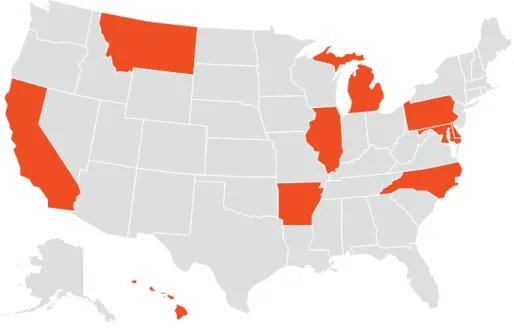
In our 2018-2019 Annual Report, the Foundation featured grants made to the National Association of State Boards of Education (NASBE) and the National League of Cities Institute (NLCI), which assisted in building state and local infrastructure systems needed to improve policies supporting ECE professionals. The grants implemented the Foundation’s multi-pronged approach to better target and influence policymaking by leveraging opportunities to support the ECE workforce across various levels of government. To continue to expand our approach, in 2018, the Foundation awarded a grant of $294,000 to the Council of Chief State School Officers (CCSSO) to help chief state school officers in California, Maryland, Michigan, and Pennsylvania to develop or reconsider their ECE workforce
policies. CCSSO partnered with the National Governors Association (NGA)3 to leverage existing efforts
so that in collaboration,10 state-based teams (see Figure 2) received technical assistance to consider state actions and strategies to enhance the ECE workforce.
Figure 2: CCSSO and NGA ECE Workforce Participating States
Through convenings, peer-to-peer learning, resource sharing, and consultation, both CCSSO and NGA worked to help the state teams address issues by aligning professional competencies with child developmental science, improving professional development opportunities, and advancing workforce credentialing and preparation through higher education systems.
Source: Council of Chief State School Officers (CCSSO)
3 The NGA’s Center for Best Practices received funding from the W.K. Kellogg Foundation, the Alliance for Early Success, and the Bill and Melinda Gates Foundation to help six
Examples of accomplishments within the four CCSSO states that created actionable strategies to improve educational outcomes for young children by focusing on preparing and supporting a high-quality ECE workforce include:
• California’s Addressing Equity and Success Along Professional Pathways project first created a unifying framework for career pathways, competencies, qualifications, and compensation for the ECE profession. A workforce survey identified key barriers addressing equity issues, especially for the ECE workforce members who are dual language learners and/or are from Tribal and immigrant communities. Another survey assessed supportive resources provided by the California Department of Education to the workforce. Data helped to inform efforts made to promote greater equitable opportunities for advancement in the Career Lattice and Quality Counts California Quality Rating Improvement System. California Governor Gavin Newsom also invested $245 million in one-time funding to support ECE workforce development.
• Maryland’s Early Childhood Career Pathway project included a collaboration between the Maryland Division of Early Childhood and the Division of Career and College Readiness. The partnership successfully developed a Career Technology Education (CTE) curriculum for high school students to obtain an Infants/Toddlers Child Development Associate (CDA), which is now used by Maryland CTE programs. Maryland also worked to develop a CTE curriculum for the Prekindergarten CDA for implementation in the fall of 2020.
• The Michigan Department of Education (MDE) formed Elementary Standards Stakeholder Committees to create an evidence-based Birth-3rd Grade workforce framework. The framework is utilized to inform state-level policy systems change aligned with the state’s “Top 10 in 10” goals and strategies, including sustaining a high-quality, well-prepared ECE workforce with access to equitable professional learning opportunities. In 2018, MDE implemented a Prekindergarten-3rd Grade elementary teacher certification and also developed Birth-Kindergarten (B-K) general and special education grade bands for Michigan State Board of Education approval.
• Pennsylvania’s Early Childhood Workforce: A Stronger Today, for a Stronger Tomorrow project increased statewide partnership through a higher education consortium to further support an existing Philadelphia-based apprenticeship program to elevate the skills of its ECE workforce. Governor Tom Wolf’s Pennsylvania Smart initiative helped move work forward in ECE career pathways as a funding priority and increased financing for the apprenticeship program. As the apprenticeship program model is scaled statewide, the consortium will continue to convene and inform course content for the ECE workforce.
The CCSSO/NGA partnership informed state teams’ perspectives on workforce issues and helped participants build a shared vision to pursue their ECE workforce policy goals. Their work also culminated in a joint policy brief with recommendations to inform other states about the implementation and impact of state strategies to strengthen the ECE workforce.
MEET OUR GRANTEES
Meet professionals doing the work and explore details about how they are leading efforts to strengthen and support the ECE workforce.
Council of Chief State School Officers (CCSSO)
Rolf Grafwallner, Program Director, Early Childhood Education, CCSSO
Dr. Rolf Grafwallner is Program Director for Early Childhood Initiatives at the Council of Chief State School Officers in Washington, D.C. where he works with states to improve learning opportunities and outcomes for young children. His team is working with more than 30 states on early education topics such as high-quality Pre-K, family engagement, ECE workforce, early learning network improvement communities, and effective implementation of ESSA early learning strategies. Prior to joining the Council, Dr. Grafwallner worked on early childhood policy and school reform as an Assistant State Superintendent at the Maryland State Department of Education.
ENHANCING THE QUALITY OF PROFESSIONAL PRACTICE
New York City Early Childhood Research Network
The Foundation formed the New York City Early Childhood Research Network (Research Network) in 2015, a research-to-practice partnership bringing together the perspectives of researchers and policymakers to better understand the implementation of the City’s Pre-K for All initiative. The eight implementation research studies supported by the Research Network continue to produce useful information on ECE workforce questions of importance to policymakers within the City’s continuous quality improvement efforts. The Foundation engaged Sherry Cleary, Executive Director, and Kate
Tarrant, Director of Research and Evaluation, at the New York Early Childhood Professional Development Institute at the City University of New York to support, convene, and manage the Research Network.
“The Early Childhood Education Workforce Academy, spearheaded by the membership organizations for state chiefs of education and governors, has given states the opportunity to translate into state policy the recommendations of the Transforming the Early Childhood Education Workforce report of the National Academy of Sciences. Informed by that report’s important recommendations, Workforce Academy state teams, representing state education chiefs and governors, focused on transforming the workforce of early educators in their states.” — Rolf Grafwallner, Program Director, Early Childhood Education, CCSSO
As part of the Research Network, the study “Examining Intrinsic and Extrinsic Factors Impacting Men’s Decisions to Teach Young Children,” by Jean-Yves Plaisir, Kirsten Cole, and Mindi Reich Shaprio at the Borough of Manhattan Community College was publicly released in October 2019. This research examines the factors that influence men’s decisions to pursue a career in ECE and subsequently how to increase male participation in the early childhood workforce. The study also illuminates the importance of providing professional development that focuses on the gender-specific experiences and challenges of male educators.
For more information about all eight studies or recent activities within the Research Network, please visit earlychildhoodresearchny.org.
MEET OUR GRANTEES:
Meet the researchers within the New York City Early Childhood Research Network.
Borough of Manhattan Community College (BMCC), The City University of New York (CUNY)
Jean-Yves Plaisir, Professor, Teacher Education, BMCC, CUNY
Jean-Yves Plaisir is a full professor in the Teacher Education Department at Borough of Manhattan Community College of the City University of New York. His research focuses on men’s experiences in the early childhood workforce as well as the academic achievements of minority children in the United States.
Kirsten Cole, Associate Professor, Teacher Education, BMCC, CUNY
Kirsten Cole is a teacher, researcher, and parent based in Brooklyn, NY. Cole has the pleasure to teach and learn from her students and colleagues as an Associate Professor of Early Childhood Education at the Borough of Manhattan Community College of the City University of New York. Her research has explored a variety of topics, including: how to achieve greater gender balance in the ECE workforce; how to address issues of race and racism in ECE; and, how teachers’ life histories shape their approach to working with families.
Mindi Reich-Shapiro, Assistant Professor, Teacher Education, BMCC, CUNY
Mindi Reich-Shapiro has worked in the field of early childhood education for more than 25 years. She began her career as a preschool teacher and has taught undergraduate and graduate education classes, supervised teacher candidates, and coached Pre-K teachers throughout Queens, Manhattan, and the Bronx. Her research focuses on how young children develop civic competence in early childhood classrooms, and how achieving greater gender equity can contribute to their understanding.
The Foundation is pleased to share outcomes of how these two grants aligned with the Foundation’s ECE workforce goals, how the grants have increased knowledge for the field, and/or how they have influenced policy and practice. As the work continues to be disseminated, the findings and their implications will continue to help researchers, policymakers, practitioners, and advocates in their work to improve policy and practice to better support the ECE workforce.
PROMOTING SCHOLARSHIP AND EQUITY
Another through line for the Foundation’s work is to support early- to mid-career scholarship while
addressing issues of equity. Though the Foundation previously supported work relevant to breaking down systemic barriers, recent events led the Foundation to be more explicit about the realities of poverty, racism, discrimination, and prejudice in our field. In the next pages, the Foundation highlights key efforts to promote the scholarship of racially, ethnically, socioeconomically, culturally, and linguistically diverse scholars, as well as scholars from diverse academic disciplines and those utilizing various research methods. Approaches taken to support scholarship vary from providing technical assistance and professional development supports to strengthen research skills, to one-on-one mentoring for career professional guidance, to direct support for research collaboration networks.
Young Scholars Program
The Foundation’s Young Scholars Program (YSP) supports early-career scholars to conduct policy- and practice-relevant implementation research that examines the preparation, competency, compensation, well-being, and ongoing professional learning of the ECE workforce. The Foundation views diversity as an asset for building a strong and productive society and thus seeks to increase the diversity of research perspectives.
Therefore, scholars from underrepresented groups, including researchers of color, first-generation college graduates, culturally and linguistically diverse scholars, and researchers from low-income communities are encouraged to apply, as well as scholars who represent a variety of disciplines and methodological approaches. Overall, the Foundation found that applications not advancing to subsequent stages or to award had low evaluation scores in the areas of research design, methodology, measures, and data analysis. It was also noted that a substantial number of scholars associated with one or more diversity factors (race, ethnicity, dual/multilingual, and family socioeconomic and immigration background) were eliminated early in the application process.
In 2019, in an effort to further increase equitable opportunity within the YSP application process, the Foundation began to provide technical assistance (TA) focused on mixed methods research to targeted applicants. Referrals are based on the same criteria regarding evaluation scores and account for several diversity factors as mentioned above.
While implementation research design is an essential criteria of YSP proposals, the use of mixed methods design is not required. Yet, many of the research projects submitted to YSP employ a mixed methods approach. Therefore, referred applicants may receive supportive consultation provided by the research team at the University of Michigan’s Mixed Methods Program, Drs. Michael Fetters, Tim Guetterman, and John Creswell ($30,000 grant). Providing applicants with additional professional development to sharpen their research knowledge and skills potentially strengthens the YSP proposals of targeted applicants between application stages.
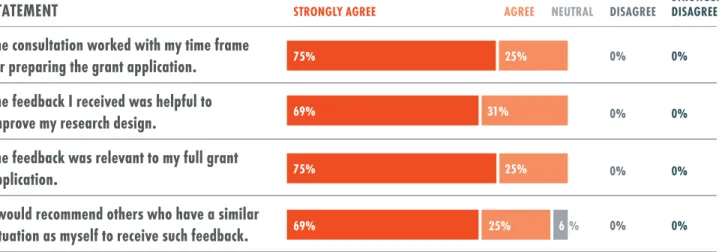
Through voluntary survey data, 16 of the 24 total applicants that received this targeted TA in 2019, and responded to the survey, reported limited experience with mixed methods research, initially affirming the TA focus. Early results also indicate that the same 16 applicants themselves (N=16/24) found the TA they received to be helpful (see Table 1).
Table 1: Targeted Technical Assistance Survey Data: Applicant Satisfaction, N=16
STATEMENT STRONGLY AGREE AGREE NEUTRAL
The consultation worked with my time frame for preparing the grant application.
The feedback I received was helpful to improve my research design.
The feedback was relevant to my full grant application.
I would recommend others who have a similar
75% 25%
69% 31%
75% 25%
DISAGREE STRONGLY DISAGREE
0% 0% 0% 0% 0% 0%
An additional indicator suggesting that the targeted TA is initially working to strengthen applications, is that two of the applicants that received TA advanced to the semi-finalist stage, and one advanced to the finalist stage.
Promising Scholars Program
In 2020, the Foundation launched the Promising Scholars Program to further increase the pipeline of diverse young scholars seeking to conduct strong implementation research on key questions related to the ECE workforce. Promising Scholars are applicants from our Young Scholars Program who demonstrate exceptional potential to conduct rigorous, high-quality implementation research. With a $15,000 award, the scholars receive salary support, mentorship, and professional development opportunities as they further refine and sharpen their research ideas in anticipation of competing in future YSP cycles. Similar to YSP, the Promising Scholars Program serves as another way for the Foundation to increase equitable opportunity for identified scholars representing underrepresented groups, varied academic disciplines, and/or utilizing different methodological approaches.
The Foundation is proud to announce our inaugural 2020 Cohort of Promising Scholars:
Tia N. Barnes
Assistant Professor, Human Development and Family Sciences University of Delaware
Research Interest Area: Professional development training and coaching in inclusive preschool classrooms to improve teacher-assistant teacher collaboration
Jayanti Owens
Senior Assistant Professor, International and Public Affairs and Sociology Brown University
Research Interest Area: Racial/ethnic disparities in elementary school disciplinary practices and professional development methods to reduce bias in teaching and disciplinary practices
“I am excited to be a part of the Foundation’s Promising Scholars Program because it will provide an opportunity to connect with mentors in my interest area and strengthen both my research and grant writing skills as an early career scholar.”
Margaret F. Quinn
Assistant Professor, Child and Family Studies University of Tennessee, Knoxville
Research Interest Area: Supporting preschool teachers in the promotion of children’s early writing skills using an online professional development platform
Katherine Zinsser
Associate Professor, Community and Prevention Research Program Department of Psychology
University of Illinois at Chicago
Research Interest Area: Teacher preparation models to better support children’s social-emotional learning and continued validation of a classroom observational measure of emotion-centered teaching practices
“I’m so excited to be part of this incredible group of multidisciplinary, policy-oriented scholars who care deeply about improving the lives of young children. I look forward to learning from and with the talented researchers and practitioners that the Foundation will be bringing together.” — Jayanti Owens, Ph.D., Senior Assistant Professor, Brown University
“I am so honored to be included in the Foundation for Child Development’s new Promising Scholars Program. I believe participation in the program will strengthen my research agenda and provide helpful opportunities for professional growth, networking, and mentorship. I look forward to taking part in the program and am greatly appreciative for this opportunity and honor.” — Margaret F. Quinn, Ph.D., Assistant Professor, University of Tennessee, Knoxville
“I’m thrilled to be a part of the Foundation’s Promising Scholars Program. At a time when it seems like the rest of our nation is finally realizing how critical our early care and education workforce is, it is exciting to be a part of a community that is already actively working to build capacity, increase diversity, and create effective systems to support these essential members of our society.” — Katherine Zinsser, Ph.D., Associate Professor, University of Illinois at Chicago
National Association for the Education of Young Children (NAEYC) Black Caucus Interest Forum
The Foundation provided a grant of $25,000 to the National Association for the Education of Young Children (NAEYC) Black Caucus Interest Forum in 2018 to connect early- to mid-career ECE professionals of color with mentors (18-20 pairs). In the pairs, mentees received career guidance towards advancing their leadership, practice, and research goals. Beyond the pairs, mentoring
“nuggets” (short video clips of expert advice on mentoring and/or professional guidance on ECE topics) were developed. Mentees also attended the one-day NAEYC Equity and Social Justice Leadership Academy. All of these efforts, but especially the Leadership Academy, created an energized community of practice among participants who remain connected virtually through ongoing follow-up activities organized by the caucus (e.g., webinars, discussion series). In a follow-up survey, 15 respondents (60% mentors, 40% mentees) reported that their mentoring relationships are continuing.
In addition, the mentoring projects, coupled with other efforts of the caucus, helped to rejuvenate the Black Caucus Interest Forum as membership grew from 100 to over 600 members.
HighScope Educational Research Foundation and the National Research Center on Hispanic Children & Families
Continuing the focus on mentorship in the promotion of scholarship and career advancement for early-career scholars, the Foundation made a grant of $15,000 to HighScope Educational Research Foundation (HighScope) in partnership with the National Research Center on Hispanic Children & Families in 2018. Funds supported mentoring and professional development activities for a diverse group of emerging research scholars, particularly scholars of color and/or from diverse cultural and linguistic backgrounds.
This grant provides scholars with expanded opportunities to engage mentors beyond attending specific in-person mentoring events that include: the National Research Conference on Early Childhood (2018), Society for Research in Child Development (2019), and Child Care and Early Education Policy Research Consortium (2019) conferences. Through this grant, scholars had the advantage of being paired with mentors before and after these events to receive enhanced mentoring supports.
“I was honored to be in a room full of magnificent people, Black women and men who had defined for me what it meant to find strength in one another through truth and candid discussions about education, equity, and the hope of our future through the experiences of young, marginalized children and families.” — Tara Ruth Voit, East Tennessee State University
Over 170 mentees were matched with more than 70 mentors. In addition to the traditional in-person events, pairs also participated in the follow-up activities such as one-on-one or small group discussions, review of and feedback on materials, and professional advising. Aiding the professional development of early-career researchers also expanded scholars’ professional networks.
Another approach to supporting scholarship is represented in a 2019 grant to the HighScope Educational Research Foundation ($30,000) to establish a small collaborative network of Black mid-career researchers focused on the study of the well-being of Black children. Researchers in this network sought to use a strengths-based approach in examining Black children’s development and learning, as well as disparities. As a result of the grant, the Researchers Investigating Sociocultural Equity and Race (RISER) Network was created.
Researchers in the network convened to develop a research agenda and coordinated several secondary analysis projects for specific papers. In doing so, the group realized that many of the existing datasets were not using asset-based framing that demonstrated the strengths of Black children, parents, families, or providers. Thus, while analyses using existing
data such as the U.S. Department of Education Early Childhood Longitudinal Study were conducted, such explorations articulated the need for new or revised framing on what matters for Black children, families, and communities. Thus far, three papers and a book proposal have been submitted for publication. As well, a prospectus for a research-policy coalition to co-construct in-depth, actionable research to support the optimal development of Black children prenatally through adolescence was developed. Finally, with support from the
“Dr. Smith and I met for the first time in 2018 at a mentor/networking luncheon hosted by National Research Center on Hispanic Children and Families and the National Research Conference on Early Childhood. That mentor/networking luncheon has led to an ongoing mentoring relationship filled with dialogue regarding ways to provide structural and social support. During our one-on-one discussions, she provides open and honest feedback and is always looking for ways for me to enhance my research experiences. This is particularly important to me as an early career, tenure-track scholar. Overall, her knowledge and understanding of mentorship is superb and I believe it will continue to serve me well in my professional work.”
the RISER Network continues to focus on exploring factors that lead to equitable opportunities for Black children within family, education, and health contexts.
MEET OUR GRANTEES:
Meet the co-founders of the Researchers Investigating Sociocultural Equity and Race (RISER) Network.
Researchers Investigating Sociocultural Equity and Race (RISER) Network
Iheoma U. Iruka, Research Professor, Department of Public Policy Fellow and Director, Early Childhood Health and Racial Equity Program, Frank Porter Graham Child Development Institute (FPG), University of North Carolina
Dr. Iruka is research professor in the Department of Public Policy and Director of the Early
Childhood Health and Racial Equity Program at Frank Porter Graham Child Development Institute. She examines how early experiences impact poor and ethnically marginalized children’s learning, development, and health, and the role of the family and education environments and systems.
Stephanie M. Curenton, Executive Director, Center on the Ecology of Early Development and Associate Professor, Boston University
Founder of the Center on the Ecology of Early Development and tenured associate professor in the Boston University Wheelock College of Education & Human Development, Dr. Curenton studies the social, cognitive, and language development of children within low-income families and marginalized children within various ecological contexts, such as parent-child interactions, early childhood education programs, early childhood workforce programs, and related state and federal policies.
“It is an uplifting experience to be in a place where we can put our burdens down to share, laugh, and cry, and have hard conversations, and then strategize about areas we want to lean into and push. Being in this space allows us to speak about things we rarely speak about and identify ways to do the research and disseminate.” — Iheoma U. Iruka, Ph.D. University of North Carlina at Chapel Hill
“The grant provided a safe space for us as scholars of color to convene and talk openly about where the science had failed Black children. Even more so, it provided an opportunity for Black scholars to be the leaders of this important conversation. So in some sense the grant is helping to dismantle the racist practices of scientific inquiry because it is allowing scholars of color to set the research agenda and ask the key questions.” — Stephanie M. Curenton, Ph.D., Boston University
The Foundation is pleased to share outcomes of how all of these small, discretionary grants (e.g., $30,000 or under) achieved promising positive outcomes to promote scholarship while addressing issues of equity. Such results indicate that even small grants have the potential to effect change in research and professional practice. Moreover, initial results suggest that targeted approaches providing research and practice supports can help to ensure that access to opportunity is equitably distributed. Furthermore, the outcomes suggest that mentoring across the professional career continuum of early- to mid-career scholars helps support the development of a diverse pipeline of scholars.
GRANTS SUMMARY
APRIL 2019 - MARCH 2020
As part of our continued focus on strengthening the early care and education (ECE) workforce, this fiscal year, the Foundation supported grants across our three ECE workforce goals. Awards aimed at professionalizing the field further implemented the Foundation’s approach of highlighting ECE across various levels of government to achieve systems change. Ongoing technical assistance and support are provided to municipal leaders, state boards of education members, and state administrators as they work to strategically address ECE workforce issues.
Relevant to enhancing the quality of professional practice, these awards support the growth and development of ECE research-practice-partnerships (RPP). Grant funds will build research expertise and advance collective knowledge around ECE-related issues in RPPs, as well as examine the specific local implementation of an expanding public preschool program in community-based settings.
Within the Young Scholars Program (YSP), three research grants were awarded focusing on early educators’ experience in implementing preschool discipline and expulsion policies, in understanding and instructing multilingual learners, and in supporting children’s social-emotional learning. The
Promising Scholars research areas include a focus on collaborative teaching models in special education classrooms, racial bias in early elementary school discipline referrals, incorporating social-emotional learning in early educator preparation, and professional development to support children’s writing skills. Finally, towards improving preparation and professional learning, one award focused on enhancing access to higher education and reducing barriers that early educators of color encounter as they work towards degree completion.
The following is a summary of our 2019-2020 grantees and their work.
Professionalizing the ECE Field
Bank Street College of Education, New York, NY
$30,000 over one year to support the development of a communications toolkit for their report, Investing in the Birth-to-Three Workforce (January 27, 2020), to engage key stakeholders in building public will for increased investment in the preparation, compensation, and well-being of the ECE workforce serving infants and toddlers.
National Association of Early Childhood Specialists in State Departments of Education (NAECS-SDE), Greensboro, NC
$250,000 over two years to further build organizational leadership and capacity to implement the 2018 strategic plan and to maximize the collective impact of members improving local and national ECE policies.
National Association of State Boards of Education (NASBE), Alexandria, VA
$200,000 over two years to enhance efforts of state boards of education to refine and implement policies to support the ECE workforce through the provision of technical assistance to previously and newly funded states. Additionally, NASBE will expand the National ECE Network and develop materials and resources to amplify their work.
National League of Cities Institute (NLCI), Washington, DC
$200,000 over two years to enhance efforts of municipal leaders to refine and implement policies to support the ECE workforce through the provision of technical assistance to previously and newly funded cities. A specific focus will be on developing financial empowerment solutions to address current ECE system inequities, including financing stability and ECE workforce compensation.
National Louis University, Chicago, IL
$203,000 over one year on behalf of the McCormick Center for Early Childhood Leadership to support building consensus on clearly defined administrative and pedagogical leadership competencies,
cohesive preparation pathways, and ongoing professional development of ECE program leaders and administrators.
Enhancing the Quality of Professional Practice
President and Fellows of Harvard College, Cambridge, MA
$500,000 over two years to support the research-to-practice partnership of the Boston Public Schools Department of Early Childhood (BPS), the Harvard Graduate School of Education, the University of Michigan, and MDRC to examine the implementation of the expansion of the city’s prekindergarten program to include community-based organizations.
Research Foundation of the City University of New York, New York, NY
$245,000 over one year to continue support for the New York Early Childhood Professional
Development Institute at the City University of New York to promote, grow, manage, and facilitate the New York City Early Childhood Research Network, as well as support the research funded within the Research Network.
Research Foundation of the City University of New York, New York, NY
$253,000 over three years on behalf of The City College of New York to extend the work of Dr. Beverly Falk in producing a set of online videos and professional development materials that demonstrate high-quality methods and techniques to enhance instructional practice across the birth-2nd grade continuum. The materials will also highlight best practices related to serving multilingual learners and children with special education needs.
William Marsh Rice University, Houston, TX
$75,000 over one year to form an Early Childhood Education Subnetwork within the National Network of Education Research-Practice Partnerships membership to build expertise and advance collective knowledge around ECE-related issues.
Young Scholars Program
Child Trends, Inc., Bethesda, MD
$225,000 over three years to investigate the implementation of Maryland’s 2017 law banning
suspension and/or expulsion as a discipline method in preschools. The extent to which the state and its districts have supported early educators to improve their discipline practices in compliance with the law will be examined.
The Curators of the University of Missouri, Columbia, MO
$225,000 over three years to examine preschool teachers’ understanding of multilingual learners and the use of multimodal literacy instruction through a university researcher-early educator collaborative inquiry model designed to improve early schooling for racially, ethnically, culturally, and linguistically diverse children.
New York University, New York, NY
$225,000 over three years to understand preschool teachers’ social-emotional learning (SEL) and examine associations between the teachers’ social-emotional competence and their classroom
practices to support children’s SEL. Additionally, the study investigates how three different professional development interventions, varying in content and approach, promote teachers’ SEL practices.
The Urban Institute, Washington, DC
$263,000 over two years to support the ongoing professional learning of the Foundation’s Young Scholars Program. In partnership with Child Trends, the Urban Institute will organize opportunities for scholars to engage in dialogue with policymakers and practitioners, to sharpen their implementation research skills, and to enhance their general knowledge of issues related to the ECE workforce. Funds will also provide additional mentoring and professional learning supports for Promising Scholars.
Improving Preparation and Professional Learning
Child Care Services Association, Chapel Hill, NC
$20,000 on behalf of Teacher Education and Compensation Helps (T.E.A.C.H.) to continue to support two previous and one new state teams in their efforts to implement a systems approach in reducing major barriers that early educators, especially those of color, face in accessing higher education.
Supporting a Foundation Priority Population
First Focus, Washington, DC
$50,000 over one year to disseminate the findings and recommendations of the 2019 National
Academies of Sciences, Engineering, and Medicine report, A Roadmap to Reducing Child Poverty.
Through multimedia communications and technical assistance, First Focus will work to increase state policymakers’ understanding of the report and to implement policy solutions to reduce child poverty.
TOTAL EARLY CARE AND EDUCATION WORKFORCE GRANTS $1,976,000 TOTAL YOUNG SCHOLARS PROGRAM GRANTS $938,000 TOTAL FOUNDATION PRIORITY POPULATION GRANTS $50,000 TOTAL ADDITIONAL DISCRETIONARY GRANTS (less than $30,000 each) $112,706 TOTAL GRANTS AWARDED FY 2019-2020 $3,076,706
*Please note that some grant awards cross multiple fiscal years.
It is with deep sadness and enormous gratitude that the Foundation for Child Development (the Foundation) reflects on the 1996-2012 leadership of former President/CEO Dr. Ruby Takanishi. Although Dr. Takanishi passed away in August of 2020, given the significance of her work on the legacy of the Foundation, it was essential to honor and acknowledge her in this April 2019-March 2020 report. Under Dr. Takanishi’s insightful leadership, the Foundation helped shape the field of early care and education and center its own work at the intersection of research, policy, and practice.
Dr. Takanishi developed and launched the Prekindergarten-3rd Grade Framework, which envisioned a coordinated and aligned system of standards, sequenced curricula, instructional strategies, child assessments, and professional development systems that would enhance and sustain young children’s learning across the Prekindergarten-3rd Grade
continuum. Foreshadowing the Foundation’s current programmatic focus, she argued that a well-prepared and compensated early childhood workforce was pivotal to the success of the preschool movement.
Reflecting her understanding that data could serve as an important tool in policymaking, in 1999 and throughout her tenure at the Foundation, Dr. Takanishi supported the development and use of the Child and Youth Well-Being Index (CWI) which tracked the quality of life of America’s children by providing an evidence-based measure of trends over time. The index used 28 national-level social indicators across key domains of family economic well-being, social relationships, health, safety/behavioral concerns, educational attainment, community engagement, and emotional/spiritual well-being.
area of study, Dr. Takanishi focused YSP grantmaking on research related to the health and well-being of children living within immigrant families. This work generated a much-needed research base that continues to inform research and policy within the current immigration climate. This work was grounded on the principle that the racial, ethnic, cultural, and linguistic diversity of America’s children should be celebrated as an asset and a strength for families, communities, and the larger society. Dr. Takanishi’s strong commitment to social justice was a constant thread woven throughout her work.
Dr. Takanishi’s mentorship was expansive, and numerous scholars and professionals were the recipients of her intellectual generosity. Always eager to share her time and wisdom, Dr. Takanishi provided abundant opportunities for mentees to gain invaluable professional experiences and exercise leadership roles. These opportunities frequently helped launch careers.
One of her final acts of leadership at the Foundation was to support the development and use of a framework for a dual-generation strategy. This strategy focused on supporting outcomes for both parents and children and fortifying the gains made within families.
Throughout her tenure at the Foundation, Dr. Takanishi’s astute approach to influencing policy was evident in her work to disseminate and translate research to key policy audiences. She worked to propel the Foundation and its grantees to the forefront of influence in the use of research knowledge to inform policies and practices.
The Foundation is deeply grateful for Dr. Takanishi’s leadership. Her legacy will continue through the research, policies, practices, and scholars that she supported. We send our sincerest condolences to her family.
Mahalo, Ruby.
FINANCIAL
STATEMENTS
YEAR ENDING 03/31/2020
SUPPORT AND REVENUE Without Donor With Donor Total
Restrictions Restrictions
Investment return
Dividends and interest 2,657,491 — 2,657,491
Realized gain on sale of investments 882,329 — 882,329
Unrealized loss on investments (10,859,270) — (10,859,270)
Capital gain distributions from mutual funds 379,433 — 379,433
Total Investment Return (6,940,017) — (6,940,017)
Direct investment expenses (283,607) — (283,607)
Current federal excise tax and other tax payments (48,250) — (48,250)
Net Investment Return (7,271,874) — (7,271,874)
Other income 38 — 38
Total Support and Revenue (7,271,836) — (7,271,836)
EXPENSES
Program services
Grants 3,800,000 — 3,800,000
Program development and direct charitable activities 1,392,310 — 1,392,310
Grants administration 158,778 — 158,778
Total Program Services 5,351,088 — 5,351,088
Operations and governance 1,034,713 — 1,034,713
Indirect investment management 55,423 — 55,423
Total Expenses 6,441,224 — 6,441,224
Changes in Net Assets (13,713,060) — (13,713,060)
NET ASSETS
Beginning of the year 99,670,549 3,058,538 102,729,087
End of the year 85,957,489 3,058,538 89,016,027
$ $ $
YEAR ENDING 03/31/2019
SUPPORT AND REVENUE Without Donor With Donor Total
Restrictions Restrictions
Investment return
Dividends and interest 2,386,055 — 2,386,055
Realized gain on sale of investments 11,337,606 — 11,337,606
Unrealized loss on investments (10,189,451) — (10,189,451)
Capital gain distributions from mutual funds 625,463 — 625,463
Total Investment Return 4,159,673 — 4,159,673
Direct investment expenses (214,008) — (214,008)
Current federal excise tax and other tax payments (111,250) — (111,250)
Net Investment Return 3,834,415 — 3,834,415
Other income 43 — 43
Total Support and Revenue 3,834,458 — 3,834,458
EXPENSES
Program services
Grants 4,300,000 — 4,300,000
Program development and direct charitable activities 771,160 — 771,160
Grants administration 97,568 — 97,568
Total Program Services 5,168,728 — 5,168,728
Operations and governance 834,573 — 834,573
Indirect investment management 54,625 — 54,625
Total Expenses 6,057,926 — 6,057,926
Changes in Net Assets (2,223,468) — (2,223,468)
NET ASSETS
Beginning of the year 101,894,017 3,058,538 104,952,555
End of the year 99,670,549 3,058,538 102,729,087
OFFICERS
H. Melvin Ming, Chair
Independent Media Consultant (Upper Marlboro, MD)
Vivian Gadsden, Vice-Chair
William T. Carter Professor of Child Development and Education, Professor of Africana Studies, University of Pennsylvania
(Philadelphia, PA)
Shampa Bhattacharya, Treasurer
(until June 2019) Financial Analyst (New York, NY)
Walter Frye, Treasurer
(as of June 2019) Chief Executive Officer The Fiscal Institute, LLC (Elizabeth, NJ)
Marilou Hyson, Secretary
Consultant, Early Childhood Development & Education Adjunct Professor
College of Education and Human Development, University of Massachusetts–Boston
(Boston, MA)
Jacqueline Jones, President & CEO
Foundation for Child Development (New York, NY)
BOARD MEMBERS
Cynthia García Coll
Adjunct Professor University of Puerto Rico (San Juan, PR)
Lynn Karoly
Senior Economist RAND Corporation (Philadelphia, PA)
Tammy Mann
President & CEO The Campagna Center (Alexandria, VA)
Velma McBride Murry
Lois Autrey Betts Chair of Education & Human Development, Professor, Human & Organizational Development
Vanderbilt University Peabody College (Nashville, TN)
Joseph Tobin
Elizabeth Garrard Hall Professor of Early Childhood Education
University of Georgia (Athens, GA)
STAFF
Sherice Brammer (as of October 2019) Communications Officer
Jacqueline Jones
President & CEO
Andrea Kent
(as of November 2019) Program Officer
Naomie Macena (until September 2019) Program Officer
Nelson Ortiz
Manager of Finance & Administration
Dorothy Pflager
Executive Assistant
Sara Vecchiotti