CHAPTER 1
SCOPE AND ADMINISTRATION
PART 1—GENERAL PROVISIONSSECTION 101
SCOPE AND GENERAL REQUIREMENTS [A] 101.1 Title. These regulations shall be known as the 2012 International Fire Code with PhoenixAmendments, hereinaf-ter referred to as “this code.”
[A] 101.2 Scope. The provisions of this code shall supple-ment any and all laws relating to fire safety and shall apply to all persons without restriction, unless specifically exempted. This code establishes regulations affecting or relating to facil-ities, structures, processes, premises and safeguards regard-ing:
1. The hazard of fire and explosion arising from the stor-age, handling or use of structures, materials or devices; 2. Conditions hazardous to life, property or public welfare
in the occupancy of structures or premises;
3. Fire hazards in the structure or on the premises from occupancy or operation;
4. Matters related to the construction, extension, repair, alteration or removal of fire suppression or alarm sys-tems; and
5. Authority to extinguish, mitigate and investigate fires, explosions, hazardous materials incidents, and other related emergency incidents.
6. Conditions affecting the safety of fire fighters and emergency responders during emergency operations.
Exception: The provisions of this code do not apply to off-site transportation of hazardous materials in accor-dance with DOT requirements.
[A] 101.2.1 Appendices. Provisions in the appendices shall not apply unless specifically adopted. Appendix B is adopted and is considered to be part of this code.
[A] 101.3 Intent. The purpose of this code is to establish the minimum requirements consistent with nationally recognized good practice for providing a reasonable level of life safety and property protection from the hazards of fire, explosion or dangerous conditions in new and existing buildings, struc-tures and premises, and to provide safety to fire fighters and emergency responders during emergency operations.
[A] 101.4 Severability. If a section, subsection, sentence, clause or phrase of this code is, for any reason, held to be unconstitutional, such decision shall not affect the validity of the remaining portions of this code.
[A] 101.5 Validity. In the event any part or provision of this code is held to be illegal or void, this shall not have the effect of making void or illegal any of the other parts or provisions hereof, which are determined to be legal; and it shall be pre-sumed that this code would have been adopted without such illegal or invalid parts or provisions.
101.6 Responsible party. For the purpose of this code, unless a particular section, subsection or clause places com-pliance responsibility upon a different person, the property owner, the tenant or occupant in responsible control of the premises and the person, firm or corporation performing the work all have the duty to ensure that all applicable require-ments of this code are complied with. Failure to comply with the provisions of this code or with a lawful order of the fire code official, subjects the owner, the tenant, or the occupant, and the firm or corporation performing the work to the crimi-nal pecrimi-nalties and civil remedies prescribed in Section 109.
SECTION 102 APPLICABILITY
[A] 102.1 Construction and design provisions. The con-struction and design provisions of this code shall apply to:
1. Structures, facilities and conditions arising after the adoption of this code.
2. Existing structures, facilities and conditions not legally in existence at the time of adoption of this code. 3. Existing structures, facilities and conditions when
required in Chapter 11.
4. Existing structures, facilities and conditions which, in the opinion of the fire code official, constitute a distinct hazard to life or property.
[A] 102.2 Administrative, operational and maintenance provisions. The administrative, operational and maintenance provisions of this code shall apply to:
1. Conditions and operations arising after the adoption of this code.
2. Existing conditions and operations.
[A] 102.3 Change of use or occupancy. No change shall be made in the use or occupancy of any structure that would place the structure in a different division of the same group or occupancy or in a different group of occupancies, unless such structure is made to comply with the requirements of this code and the International Building Code. Subject to the approval of the fire code official, the use or occupancy of an existing structure shall be allowed to be changed and the structure is allowed to be occupied for purposes in other
groups without conforming to all of the requirements of this code and the International Building Code for those groups, provided the new or proposed use is less hazardous, based on life and fire risk, than the existing use.
[A] 102.4 Application of building code. The design and construction of new structures shall comply with the Interna-tional Building Code, and any alterations, additions, changes in use or changes in structures required by this code, which are within the scope of the International Building Code, shall be made in accordance therewith.
[A] 102.5 Application of residential code. Where structures are designed, constructed and/or occupied in accordance with the International Residential Code, the provisions of this code shall apply as follows:
1. Construction and design provisions: Provisions of this code pertaining to the exterior of the structure shall apply including, but not limited to, premises identifica-tion, fire apparatus access and water supplies. Where interior or exterior systems or devices are installed, construction permits required by Section 105.7 of this code shall also apply.
2. Administrative, operational and maintenance provi-sions: All such provisions of this code shall apply.
[A] 102.6 Historic buildings. Historic buildings shall com-ply with this code.
[A] 102.7 Referenced codes and standards. The codes and standards referenced in this code shall be those that are listed in Chapter 80, and such codes and standards shall be consid-ered part of the requirements of this code to the prescribed extent of each such reference and as further regulated in Sec-tions 102.7.1 and 102.7.2.
[A] 102.7.1 Conflicts. Where conflicts occur between pro-visions of this code and referenced codes and standards, the provisions of this code shall apply.
[A] 102.7.2 Provisions in referenced codes and stan-dards. Where the extent of the reference to a referenced code or standard includes subject matter that is within the scope of this code, the provisions of this code, as applica-ble, shall take precedence over the provisions in the refer-enced code or standard.
[A] 102.8 Subjects not regulated by this code. Where no applicable standards or requirements are set forth in this code, or are contained within other laws, codes, regulations, ordi-nances or bylaws adopted by the jurisdiction, compliance with applicable standards of the National Fire Protection Association or other nationally recognized fire safety stan-dards, as approved, shall be deemed as prima facie evidence of compliance with the intent of this code. Nothing herein shall derogate from the authority of the fire code official to determine compliance with codes or standards for those activities or installations within the fire code official’s juris-diction or responsibility.
[A] 102.9 Matters not provided for. Requirements that are essential for the public safety of an existing or proposed activity, building or structure, or for the safety of the occu-pants thereof, which are not specifically provided for by this code, shall be determined by the fire code official.
[A] 102.10 Conflicting provisions. Where there is a conflict between a general requirement and a specific requirement, the specific requirement shall be applicable. Where, in a spe-cific case, different sections of this code specify different materials, methods of construction or other requirements, the most restrictive shall govern.
[A] 102.11 Other laws. The provisions of this code shall not be deemed to nullify any provisions of local, state or federal law.
[A] 102.12 Application of references. References to chapter or section numbers, or to provisions not specifically identi-fied by number, shall be construed to refer to such chapter, section or provision of this code.
102.13 Supplemental rules and regulations. The Fire Mar-shal is authorized to render interpretations of this code and to make and enforce rules and supplemental regulations in order to carry out the application and intent of its provisions. Such interpretations, rules and regulations shall be in compliance with the intent and purpose of this code and shall be available to the public during normal business hours.
Notice of intention to adopt proposed additions or revi-sions to the rules and regulations shall be published in one issue of a newspaper published in the City of Phoenix, 30 cal-endar days before becoming effective. The notice shall state the substance of the proposed additions or revisions. If the Fire Marshal received, within 30 calendar days of the publi-cation date, a written request for a public hearing, the Fire Marshal shall arrange within 15 calendar days of such request a hearing before the Fire Safety Advisory Board.
Any person who wishes to be heard concerning any adopted rule or regulation may make formal application for a hearing before the Fire Safety Advisory Board. See Section 108.
A minimum of one certified Phoenix copy of such rules and regulations shall be filed with the city clerk and shall be in effect immediately thereafter. Additional copies shall be kept in the office of the fire department for distribution to the public.
PART 2—ADMINISTRATIVE PROVISIONS
SECTION 103
DIVISION OF FIRE PREVENTION
[A] 103.1 General. The division of fire prevention is estab-lished within the jurisdiction under the direction of the Fire Marshal. The function of the department shall be the imple-mentation, administration and enforcement of the provisions of this code.
[A] 103.2 Fire Marshal. The Fire Marshalshall be appointed in accordance with the prescribed procedures of the jurisdic-tion. The Fire Marshal shall not be removed from office except in accordance with the prescribed procedures of this jurisdiction.
[A] 103.3 Deputies. In accordance with the prescribed proce-dures of this jurisdiction and with the concurrence of the
appointing authority, the Fire Marshalshall have the author-ity to appoint a deputy Fire Marshal, fire code official, other related technical officers, inspectors and other employees.
[A] 103.4 Liability. The fire chief and other individuals charged by the fire chief with the control or extinguishment of any fire, the enforcement of this code or any other official duties, acting in good faith and without malice in the dis-charge of their duties, shall not thereby be rendered person-ally liable for any damage that may accrue to persons or property as a result of any act or by reason of any act or omis-sion in the discharge of their duties. Any suit brought against the fire chief or such individuals because of such act or omis-sion performed in the enforcement of any proviomis-sion of such codes or other pertinent laws or ordinances implemented through the enforcement of this code or enforced by the code enforcement agency shall be defended by this jurisdiction until final termination of such proceedings, and any judgment resulting therefrom shall be assumed by this jurisdiction.
This code shall not be construed to relieve from or lessen the responsibility of any person owning, operating or control-ling any building, structure, facility or portion thereof for any damages to persons or property caused by defects, nor shall the code enforcement agency or its parent jurisdiction be held as assuming any such liability by reason of the inspections authorized by this code or any permits or certificates issued under this code. See also Section 104.12.
[A] 103.4.1 Legal defense. Any suit instituted against any officer or employee because of an act performed by that officer or employee in the lawful discharge of duties and under the provisions of this code shall be defended by the legal representative of the jurisdiction until the final termi-nation of the proceedings. The fire code official or any subordinate shall not be liable for costs in an action, suit or proceeding that is instituted in pursuance of the provisions of this code; and any officer of the department of fire pre-vention, acting in good faith and without malice, shall be free from liability for acts performed under any of its pro-visions or by reason of any act or omission in the perfor-mance of official duties in connection therewith.
SECTION 104
GENERAL AUTHORITY AND RESPONSIBILITIES [A] 104.1 General. The Fire Marshalis hereby authorized to enforce the provisions of this code and shall have the author-ity to render interpretations of this code, and to adopt poli-cies, procedures, rules and regulations in order to clarify the application of its provisions. Such interpretations, policies, procedures, rules and regulations shall be in compliance with the intent and purpose of this code and shall not have the effect of waiving requirements specifically provided for in this code.
[A] 104.2 Applications and permits. The Fire Marshal is authorized to receive applications, review construction docu-ments and issue permits for construction regulated by this code, issue permits for operations regulated by this code, inspect the premises for which such permits have been issued and enforce compliance with the provisions of this code.
[A] 104.3 Right of entry. Whenever it is necessary to make an inspection to enforce the provisions of this code, or when-ever the fire code official has reasonable cause to believe that there exists in a building or upon any premises any conditions or violations of this code which make the building or prem-ises unsafe, dangerous or hazardous, the fire code official shall have the authority to enter the building or premises at all reasonable times to inspect or to perform the duties imposed upon the fire code official by this code. If such building or premises is occupied, the fire code official shall present cre-dentials to the occupant and request entry. If such building or premises is unoccupied, the fire code official shall first make a reasonable effort to locate the owner or other personhaving charge or control of the building or premises and request entry. If entry is refused, the fire code official has recourse to every remedy provided by law to secure entry.
[A] 104.3.1 Warrant. A search warrant may be issued when a property is to be searched and inspected by the Fire Marshal or designated members of the fire department in the interest of public health, safety or welfare as part of an inspection required in accordance with Section 101.2. Search warrants shall be obtained, issued, served and returned to a magistrate in accordance with Title 13, Chap-ter 38, Article 8 of the Arizona Criminal Code.
[A] 104.4 Identification. The fire code official shall carry proper identification when inspecting structures or premises in the performance of duties under this code.
[A] 104.5 Orders, notices and tags. The fire code official is authorized to issue such notices or orders as are required to affect compliance with this code in accordance with Sections 109.3 and 109.3.2.
[A] 104.6 Official records. The Division of Fire Prevention shall keep official records as required by Sections 104.6.1 through 104.6.4. Such official records shall be retained for not less than five years or for as long as the structure or activ-ity to which such records relate remains in existence, unless otherwise provided by other regulations.
[A] 104.6.1 Approvals. A record of approvals shall be maintained by the Division of Fire Prevention and shall be available for public inspection during business hours in accordance with applicable laws.
[A] 104.6.2 Inspections. The Division of Fire Prevention shall keep a record of each inspection made, including notices and orders issued, showing the findings and dispo-sition of each.
[A] 104.6.3 Fire records. The fire department shall keep a record of fires occurring within its jurisdiction and of facts concerning the same, including statistics as to the extent of such fires and the damage caused thereby, together with other information as required by the Fire Marshal.
[A] 104.6.4 Administrative. Application for appeal, alter-native methods or materials and the final decision of the Fire Marshal shall be in writing and shall be officially recorded in the permanent records of the Division of Fire Prevention.
[A] 104.7 Approved materials and equipment. All materi-als, equipment and devices approved by the Fire Marshal
shall be constructed and installed in accordance with such approval.
[A] 104.7.1 Material and equipment reuse. Materials, equipment and devices shall not be reused or reinstalled unless such elements have been reconditioned, tested and placed in good and proper working condition and approved.
[A] 104.7.2 Technical assistance. To determine the acceptability of technologies, processes, products, facili-ties, materials and uses attending the design, operation or use of a building or premises subject to inspection by the fire code official, the fire code official is authorized to require the owner or agent to provide, without charge to the jurisdiction, a technical opinion and report. The opin-ion and report shall be prepared by a qualified engineer, specialist, laboratory or fire safety specialty organization acceptable to the fire code official and shall analyze the fire safety properties of the design, operation or use of the building or premises and the facilities and appurtenances situated thereon, to recommend necessary changes. The fire code official is authorized to require design submittals to be prepared by, and bear the stamp of, a registered design professional.
[A] 104.8 Modifications. Whenever there are practical diffi-culties involved in carrying out the provisions of this code, the Fire Marshal shall have the authority to grant modifica-tions for individual cases, provided the Fire Marshal shall first find that special individual reason makes the strict letter of this code impractical and the modification is in compliance with the intent and purpose of this code and that such modifi-cation does not lessen health, life and fire safety require-ments. The details of action granting modifications shall be recorded and entered in the files of the department of fire pre-vention.
[A] 104.9 Alternative materials and methods. The provi-sions of this code are not intended to prevent the installation of any material or to prohibit any method of construction not specifically prescribed by this code, provided that any such alternative has been approved. The Fire Marshal is authorized to approve an alternative material or method of construction where the Fire Marshal finds that the proposed design, use or operation is satisfactory and complies with the intent of the provisions of this code, and that the material, method or work offered is, for the purpose intended, at least the equivalent of that prescribed in this code in quality, strength, effectiveness, fire resistance, durability and safety.
Approvals issued by the Fire Marshal shall be subject to the approval of the building official whenever the alternate material or method involves matters regulated by the Phoenix Building Construction Code.
[A] 104.9.1 Research reports. Supporting data, when necessary to assist in the approval of materials or assem-blies not specifically provided for in this code, shall con-sist of valid research reports from approved sources.
[A] 104.9.2 Tests. Whenever there is insufficient evidence of compliance with the provisions of this code, or evi-dence that a material or method does not conform to the requirements of this code, or in order to substantiate
claims for alternative materials or methods, the fire code official shall have the authority to require tests as evidence of compliance to be made at no expense to the jurisdiction. Test methods shall be as specified in this code or by other recognized test standards. In the absence of recognized and accepted test methods, the fire code official shall approve the testing procedures. Tests shall be performed by an approved agency. Reports of such tests shall be retained by the Division of Fire Prevention for the period required for retention of public records.
[A] 104.10 Fire investigations. The Fire Marshal, the fire department or other responsible authority shall have the authority to investigate the cause, origin and circumstances of any fire, explosion or other hazardous condition. Information that could be related to trade secrets or processes shall not be made part of the public record, except as directed by a court of law.
[A] 104.10.1 Assistance from other agencies. Police and other enforcement agencies shall have authority to render necessary assistance in the investigation of fires when requested to do so.
104.11 Impersonation. No person shall use a badge, uniform or other credentials to impersonate any personnel of the Phoenix Fire Department.
104.12 False and misleading reports. No person shall will-fully submit to the fire department or any of its members any false, fraudulent, misleading, or unfounded reports or state-ments to misrepresent any fact for the purpose of interfering with the fire department or with the intention of misleading any fire department personnel.
104.13 Unauthorized tampering. Signs, tags or seals posted or affixed by the fire code official shall not be mutilated, destroyed, tampered with or removed without authorization from the fire code official.
[A] 104.14 Authority at fires and other emergencies. The fire chief or officer of the fire department in charge at the scene of a fire or other emergency involving the protection of life or property, or any part thereof, shall have the authority to direct such operation as necessary to extinguish or control any fire, perform any rescue operation, investigate the exis-tence of suspected or reported fires, gas leaks or other hazard-ous conditions or situations, or take any other action necessary in the reasonable performance of duty. In the exer-cise of such power, the fire chief is authorized to prohibit any person, vehicle, vessel or thing from approaching the scene, and is authorized to remove, or cause to be removed or kept away from the scene, any vehicle, vessel or thing which could impede or interfere with the operations of the fire department and, in the judgment of the fire chief, any person not actually and usefully employed in the extinguishing of such fire or in the preservation of property in the vicinity thereof.
[A] 104.14.1 Barricades. The fire chief or officer of the fire department in charge at the scene of an emergency is authorized to place ropes, guards, barricades or other obstructions across any street, alley, place or private prop-erty in the vicinity of such operation so as to prevent acci-dents or interference with the lawful efforts of the fire
department to manage and control the situation and to han-dle fire apparatus.
[A] 104.14.2 Obstructing operations. No person shall obstruct the operations of the fire department in connec-tion with extinguishment or control of any fire, or acconnec-tions relative to other emergencies, or disobey any lawful com-mand of the fire chief or officer of the fire department in charge of the emergency, or any part thereof, or any lawful order of a police officer assisting the fire department.
[A] 104.14.3 Systems and devices. No personshall render a system or device inoperative during an emergency unless by direction of the fire chief or fire department official in charge of the incident.
104.15 Authority for inspection and enforcement. Fire Marshal is authorized to administer and enforce this code. Under the fire chief's direction, the fire department is autho-rized to enforce all ordinances of the jurisdiction pertaining to:
1. The prevention of fires.
2. The suppression or extinguishment of dangerous or hazardous fires.
3. The storage, use and handling of hazardous materials. 4. The installation and maintenance of any and all fire
protection and life safety systems or equipment. 5. The maintenance and regulation of fire escapes. 6. The maintenance of fire protection systems or
equip-ment and the elimination of fire or life safety hazards on land and in buildings, structures and other property including those under construction.
7. The maintenance of means of egress.
8. The investigation of the cause, origin and circum-stances of fire and unauthorized releases of suspected hazardous materials.
9. Schools.
For authority related to control and investigation of emer-gency scenes see Sections 104.1 and 104.10.
104.16 Stopping or parking in fire apparatus access roads. Motor vehicles, with or without power, including trail-ers, shall not be stopped or parked in any fire apparatus access road (fire lane). Any vehicle stopped or parked within an approved fire apparatus access road may be issued a “Notice of Parking Violation” by the fire code official or any representative the fire chief or police chief designates.
Any vehicle stopped or parked within the fire apparatus access road (fire lane) may be removed at the expense of the vehicle’s owner. Removal of a vehicle under such circum-stances may be authorized by the person in lawful possession of the property or any representative the fire chief or police chief designates. The person in lawful possession of the prop-erty shall keep designated fire apparatus access roads free of vehicles and other obstructions. See also Sections 36-133 and 36-134 (4) of the Phoenix City Code.
104.17 Fire Prevention Division personnel and police.
Investigators in the Fire Investigation section of the Phoenix
Fire Department shall have powers of a police officer in per-forming their duties as a fire investigator under this code.
When requested to do so by the fire chief, Fire Marshal or the police chief is authorized to assign such available police officers as necessary to assist the fire department in enforcing the provisions of this code. See also A.R.S. 13-3883 (4).
SECTION 105
PERMITS AND ASSESSMENTS
[A] 105.1 General. Permits shall be in accordance with Sec-tions 105.1.1 through 105.9. Permits, fees, and annual assess-ment fees shall be in accordance with this chapter. The issuance or granting of a permit shall not be construed to be a permit for, or an approval of, any violation of any of the pro-visions of this code or of any other ordinance of the jurisdic-tion. Permits presuming to give authority to violate or cancel the provisions of this code or other ordinances of the jurisdic-tion shall not be valid. The issuance of a permit based on con-struction documents and other data shall not prevent the fire code official from requiring the correction of errors in the construction documents and other data. Additions or altera-tions of approved construction documents shall be approved by the fire code official.
Business certificates or competent party cards shall be required by persons or entities conducting a business or oper-ations related to fire protection systems. Certificates of fitness shall be required by persons who use or handle pyrotechnics or blasting materials. Certificates shall not be transferable.
[A] 105.1.1 Permits required. Any property owner or authorized agent who intends to conduct an operation or business, or install or modify systems and equipment which is regulated by this code, or to cause any such work to be done, shall first make application to the fire code official and obtain the required permit.
Permit fees, where required, shall be paid prior to issu-ance of the permit. Issued permits shall be kept on the premises designated therein at all times and shall be read-ily available for inspection by the fire code official. In instances where laws or regulations are enforceable by departments other than the fire department, approval from those departments shall be obtained.
Permits are not transferable and any change in occu-pancy, operation, tenancy or ownership shall require that a new permit be issued.
[A] 105.1.2 Types of permits. There shall be two types of permits as follows:
1. Operational permit. An operational permit allows the applicant to conduct an operation or a business for which a permit is required by Section 105.6 for either:
1.1. A prescribed period. 1.2. Until renewed or revoked.
2. Construction permit. A construction permit allows the applicant to install or modify systems and equip-ment for which a permit is required by Section 105.7. Fire protection system installation permits
shall only be issued to current business certificate holders.
[A] 105.1.3 Multiple permits for the same location.
When more than one permit is required for the same loca-tion, the fire code official is authorized to consolidate such permits into a single permit provided that each provision is listed in the permit.
105.1.4 Emergency repairs. Where equipment replace-ments and repairs requiring a permit must be performed in an emergency situation, the permit application shall be submitted, within 72 hours of identifying the emergency, to the fire code official.
105.1.5 Work without a permit. Operating or starting work without the applicable fire prevention permit is strictly prohibited. A penalty equal to 300 percent of the required permit fee(s) shall be applied.
105.1.6 Annexation. A building under construction with a permit issued by the state Fire Marshal’s office or Mari-copa County prior to the effective date of annexation shall not be required to be issued a new permit; however the fire department shall inspect for compliance with the docu-ments upon which the original permit was issued. A City of Phoenix permit shall be required for any construction remaining uncompleted 24 months after the effective date of annexation.
105.1.7 Fees. Fees for plan reviews, appeals to the Fire Safety Advisory Board, fire watch personnel, construction and operating permits, inspections, certificates and annual assessment fees shall be in accordance with Chapter 81.
[A] 105.2 Application. Application for a permit required by this code shall be made to the fire code official in such form and detail as prescribed by the fire code official. Applications for permits shall be accompanied by such plans as prescribed by the fire code official.
[A] 105.2.1 Refusal to issue permit. If the application for a permit describes a use that does not conform to the requirements of this code and other pertinent laws and ordinances, the fire code official shall not issue a permit, but shall return the application to the applicant with the refusal to issue such permit. Such refusal shall, when requested, be in writing and shall contain the reasons for refusal.
[A] 105.2.2 Inspection authorized. Before a new opera-tional permit is approved, the fire code official is autho-rized to inspect the receptacles, vehicles, buildings, devices, premises, storage spaces or areas to be used to determine compliance with this code or any operational constraints required.
[A] 105.2.3 Time limitation of application. An applica-tion for a permit for any proposed work or operaapplica-tion shall be deemed to have been abandoned 180 days after the date of filing, unless such application has been diligently prose-cuted or a permit shall have been issued; except that the fire code official is authorized to grant one or more exten-sions of time for additional periods not exceeding 180 days each. The extension shall be requested in writing and justifiable cause demonstrated.
[A] 105.2.4 Action on application. The fire code official shall examine or cause to be examined applications for permits and amendments thereto within a reasonable time after filing. If the application or the construction docu-ments do not conform to the requirements of pertinent laws, the fire code official shall reject such application in writing, stating the reasons therefor. If the fire code offi-cial is satisfied that the proposed work or operation con-forms to the requirements of this code and laws and ordinances applicable thereto, the fire code official shall issue a permit therefor as soon as practicable.
[A] 105.3 Conditions of a permit. A permit shall constitute permission to maintain, store or handle materials; or to con-duct processes which produce conditions hazardous to life or property; or to install equipment utilized in connection with such activities; or to install or modify any fire protection sys-tem or equipment or any other construction, equipment instal-lation or modification in accordance with the provisions of this code where a permit is required by Section 105.6 or 105.7. Such permission shall not be construed as authority to violate, cancel or set aside any of the provisions of this code or other applicable regulations or laws of the jurisdiction.
[A] 105.3.1 Expiration. Operational permits issued prior to July 1, 2013 shall remain in effect until reissued, renewed or revoked, or for such a period of time as speci-fied in the permit. Operational permits issued after July 1, 2013 shall expire triennially (every three years) from the date of issuance or such time as specified in the permit. Permits are not transferable and any change in occupancy, operation, tenancy or ownership shall require that a new permit be issued. When a permit has expired, all work authorized by that permit shall stop until the permit is rein-stated or a new permit issued.
105.3.2 Construction permits expiration. Construction permits shall automatically become invalid unless the work authorized by such permit is commenced within 180 days after its issuance, or if the work authorized by such permit is suspended or abandoned for a period of 180 days after the time the work is commenced. Before such work recommences, a new permit shall be first obtained and the fee to recommence work, if any, shall be one-half of the amount required for a new permit for such work, provided no changes have been made or will be made in the original construction documents for such work, and provided fur-ther that such suspension or abandonment has not exceeded one year.
A construction permit allows the applicant to install or modify systems and equipment for which a permit is required by Section 105.7.
The fire code official may require the permit holder to document these activities.
1. Requested one or more fire department inspections indicating substantial progress in construction; or 2. Pursued other activities deemed by the fire code
offi-cial to indicate intent to start and complete the proj-ect.
105.3.3 Removal permits expiration. Removal permits shall expire if the work authorized by such permit is not commenced within 30 days from the date of the permit and is not completed within 60 days from the date of the permit. Reasonable and continuous progress shall be made to complete all removal work as expeditiously as possible. Anyone holding an unexpired removal permit may apply for an extension of the time to commence work.
The fire code official may extend the time for action by the permit holder for a period not to exceed 30 days upon written request, demonstrating that circumstances beyond the control of the permit holder have prevented action from being taken. No permit shall be extended more than once. An expired removal permit may be reinstated in accordance with Section 105 of these administrative provi-sions.
105.3.4 Completing work and final inspection. Every construction permit issued by the fire code official, except removal permits, shall expire 24 months after the date of permit issuance. If the building or work authorized by such permit has not received final inspection approval prior to the permit expiration date, all work shall stop until a new permit is obtained.
Exception: The fire code official may approve a period exceeding 24 months for completion of work when the permit holder can demonstrate that the complexity or size of the project makes completing the project within 24 months unreasonable.
[A] 105.3.5 Extensions. A permittee holding an unexpired permit shall have the right to apply for an extension of the time within which the permittee will commence work under that permit when work is unable to be commenced within the time required by this section for good and satis-factory reasons. The fire code official is authorized to grant, in writing, one or more extensions of the time period of a permit for periods of not more than 180 days each. Such extensions shall be requested by the permit holder in writing and justifiable cause demonstrated. The fee for a permit time extension shall be 50 percent of the current permit fee.
105.3.6 Reinstatement. When a permit has expired, the permit can be reinstated and the work authorized by the original permit can be recommenced provided all the fol-lowing conditions are met:
1. The code and standards under which the original permit was issued and other laws which are enforced by the fire department have not been amended in any manner that affects the work authorized by the original permit; and
2. No changes have been made or will be made in the original plans and specifications for such work; and 3. The original permit expired less than one year from
the request to reinstate.
The fee for a reinstated permit shall be 50 percent of the amount required for a new permit. Where the request for reinstatement does not comply with the preceding criteria,
a new permit shall be required, including payment of full plan review and permit fees.
105.3.7 Revocation of a permit. The fire code official is authorized to revoke a permit issued under the provisions of this code when it is found by inspection or otherwise that there has been a false statement or misrepresentation as to the material facts in the application or construction documents on which the permit or approval was based, including, but not limited to, any one of the following:
1. The permit is used for a location or establishment other than that for which it was issued.
2. The permit is used for a condition or activity other than that listed in the permit.
3. Conditions and limitations set forth in the permit have been violated.
4. There have been any false statements or misrepre-sentations as to the material fact in the application for permit or plans submitted or a condition of the permit.
5. The permit is used by a different person or firm than the name for which it was issued.
6. The permittee failed, refused or neglected to comply with orders or notices duly served in accordance with the provisions of this code within the time pro-vided therein.
7. The permit was issued in error or in violation of an ordinance, regulation or this code.
8. The permit holder’s business certificate has expired.
[A] 105.3.8 Occupancy prohibited before approval. The facility, building or structure shall not be occupied prior to the building official issuing a certificate of occupancy per-mit and conducting associated inspections indicating the applicable provisions of this code have been met.
Exception: It shall be lawful to occupy portions of facilities, buildings or structures under a temporary cer-tificate of occupancy issued by the City of Phoenix, subject to the conditions stated therein.
105.3.8.1 Temporary certificate of occupancy. In accordance with Section 110 of the Phoenix Building Code, the fire code official, in conjunction with the building official, is authorized to approve the condi-tions necessary to occupy the premises or portion thereof before the entire work or operations on the premises is completed. When issued, such portion or portions shall be occupied safely prior to full comple-tion or installacomple-tion of equipment and operacomple-tions without endangering life or public welfare.
[A] 105.3.9 Conditional permits. Where permits are required and upon the request of a permit applicant, the fire code official is authorized to issue a conditional permit to occupy the premises or portion thereof before the entire work or operations on the premises is completed, provided that such portion or portions will be occupied safely prior to full completion or installation of equipment and opera-tions without endangering life or public welfare. The fire code official shall notify the permit applicant in writing of
any limitations or restrictions necessary to keep the permit area safe. The holder of a conditional permit shall proceed only to the point for which approval has been given, at the permit holder’s own risk and without assurance that approval for the occupancy or the utilization of the entire premises, equipment or operations will be granted.
[A] 105.3.10 Posting the permit. Issued permits shall be kept on the premises designated therein at all times and shall be readily available for inspection by the fire code official.
[A] 105.3.11 Compliance with code. The issuance or granting of a permit shall not be construed to be a permit for, or an approval of, any violation of any of the provi-sions of this code or of any other ordinance of the jurisdic-tion. Permits presuming to give authority to violate or cancel the provisions of this code or other ordinances of the jurisdiction shall not be valid. The issuance of a permit based on construction documents and other data shall not prevent the fire code official from requiring the correction of errors in the construction documents and other data. Any addition to or alteration of approved construction documents shall be approved in advance by the fire code official, as evidenced by the issuance of a new or amended permit.
[A] 105.3.11.1 Information on the permit. The fire code official shall issue all permits required by this code on an approved form furnished for that purpose. The permit shall contain a general description of the operation or occupancy and its location and any other information required by the fire code official. Issued permits shall bear the signature of the fire code official or other approved legal authorization.
[A] 105.3.11.2 Validity of permit. The issuance or granting of a permit shall not be construed to be a per-mit for, or an approval of, any violation of any of the provisions of this code or of any other ordinances of the jurisdiction. Permits presuming to give authority to vio-late or cancel the provisions of this code or other ordi-nances of the jurisdiction shall not be valid. The issuance of a permit based on construction documents, operational documents and other data shall not prevent the fire code official from requiring correction of errors in the documents or other data.
[A] 105.4 Construction documents. Construction docu-ments shall be in accordance with this section.
[A] 105.4.1 Submittals.Construction documents and sup-porting data shall be submitted in two or more sets with each application for a permit and in such form and detail as required by the fire code official. The construction doc-uments shall be prepared by a registered design profes-sional where required by the statutes of the jurisdiction in which the project is to be constructed.
Exception: The fire code official is authorized to waive the submission of construction documents and support-ing data not required to be prepared by a registered design professional if it is found that the nature of the work applied for is such that review of construction
documents is not necessary to obtain compliance with this code.
[A] 105.4.1.1 Over-the-counter submittals. The fol-lowing “over-the-counter” permits do not require plans submittal unless required by the fire code official:
1. Fire alarm modifications involving five or less devices with or without power booster.
2. Sprinkler system modifications involving the addition or relocation of 20 or less sprinkler heads.
Exception: Group H occupancies, covered malls and buildings with hard lids.
3. Installation of underground fire line stub-outs only.
4. The installation of a supervising station fire alarm system transmitter (SSFAST) in one building. An over-the-counter permit for a SSFAST is limited to a maximum of two water flow or pressure switches and related tamper switches, a maxi-mum of two audio/visual devices, one smoke detector and one manual pull station.
5. Special egress control devices tied into an exist-ing fire alarm panel only.
6. Any and all others as approved by the Fire Mar-shal.
[A] 105.4.2 Examination of documents. The fire code official shall examine or cause to be examined the accom-panying construction documents and shall ascertain by such examinations whether the work indicated and described is in accordance with the requirements of this code.
[A] 105.4.3 Information on construction documents.
Construction documents shall be drawn to scale upon suit-able material. Electronic media documents are allowed to be submitted when approved by the fire code official. Construction documents shall be of sufficient clarity to indicate the location, nature and extent of the work pro-posed and show in detail that it will conform to the provi-sions of this code and relevant laws, ordinances, rules and regulations as determined by the fire code official.
[A] 105.4.3.1 Fire protection system shop drawings.
Shop drawings for the fire protection system(s) shall be submitted to indicate compliance with this code and the construction documents, and shall be approved prior to the start of installation. Shop drawings shall contain all information as required by the referenced installation standards in Chapter 9. Fire protection system submit-tals shall be no smaller than 1
/8 inch in scale.
Modifica-tions to sprinkler systems with new supply lines shall require plan submittal.
105.4.3.2 Site plans. When required by this code, two sets of accurate and legible site plans scaled no smaller than 1 inch to 50 feet shall be submitted to the fire code official for approval.
105.4.4 Life safety report. Prior to submitting construc-tion drawings for high-rise buildings, hospitals, covered
mall buildings, buildings containing atriums, and other structures as determined by the fire code or building offi-cial, a life safety report shall provide a description of the fire protection systems in the building. This description shall include the basic concepts used for suppression, alarm, notification, egress, fire-resistive assemblies, smoke control, and other related systems, as well as the coordination of those systems. Upon completion of the project, a copy of the approved documentation shall be maintained at the site and by the fire department until demolition of the building.
[A] 105.4.5 Applicant responsibility. It shall be the responsibility of the applicant to ensure that the construc-tion documents include all of the fire protection require-ments and the shop drawings are complete and in compliance with the applicable codes and standards.
[A] 105.4.6 Approved documents. Construction docu-mentsapproved by the fire code official are approved with the intent that such construction documents comply in all respects with this code. Review and approval by the fire code official shall not relieve the applicant of the responsi-bility of compliance with this code.
[A] 105.4.6.1 Phased approval. The fire code official is authorized to issue a permit for the construction of part of a structure, system or operation before the con-struction documents for the whole structure, system or operation have been submitted, provided that adequate information and detailed statements have been filed complying with pertinent requirements of this code. The holder of such permit for parts of a structure, sys-tem or operation shall proceed at the holder’s own risk with the building operation and without assurance that a permit for the entire structure, system or operation will be granted.
[A] 105.4.7 Corrected documents. Where field condi-tions necessitate any substantial change from the approved construction documents, the fire code official shall have the authority to require the corrected construction docu-ments to be submitted for approval.
[A] 105.4.8 Retention of construction documents. One set of construction documents shall be retained by the fire code official for the life of the building. One set of approvedconstruction documents shall be returned to the applicant, and said set shall be kept on the site of the build-ing or work at all times durbuild-ing which the work authorized thereby is in progress.
[A] 105.5 Revocation. The fire code official is authorized to revoke a permit issued under the provisions of this code when it is found by inspection or otherwise that there has been a false statement or misrepresentation as to the material facts in the application or construction documents on which the per-mit or approval was based including, but not liper-mited to, any one of the following:
1. The permit is used for a location or establishment other than that for which it was issued.
2. The permit is used for a condition or activity other than that listed in the permit.
3. Conditions and limitations set forth in the permit have been violated.
4. There have been any false statements or misrepresenta-tions as to the material fact in the application for permit or plans submitted or a condition of the permit. 5. The permit is used by a different personor firm than the
name for which it was issued.
6. The permittee failed, refused or neglected to comply with orders or notices duly served in accordance with the provisions of this code within the time provided therein.
7. The permit was issued in error or in violation of an ordinance, regulation or this code.
[A] 105.6 Required operational permits. The fire code offi-cial is authorized to issue operational permits for the opera-tions set forth in Secopera-tions 105.6.1 through 105.6.44. A fee shall be assessed for operating permits in accordance with Chapter 81.
[A] 105.6.1 Aerosol products. An operational permit is required to manufacture, store or handle an aggregate quantity of Level 2 or Level 3 aerosol products in excess of 500 pounds (227 kg) net weight.
[A] 105.6.2 Amusement buildings, haunted houses and outdoor mazes. An operational permit is required to oper-ate a special amusement building.
105.6.3 Assisted living facilities. An operational permit for assisted living facilities shall be required upon opening and once every three years or upon change of ownership. This includes assisted living homes R-3 (1–5 beds), R-4 (6–10 beds), assisted living centers (11 or more beds), supervisory care and adult foster care.
105.6.4 Behavioral, developmentally disabled or cor-rectional facilities I-1. An operational permit shall be required for a thorough fire inspection which is conducted per year and upon change of ownership.
[A] 105.6.5 Bonfires. An operating permit is required to ignite and maintain a bonfire.
[A] 105.6.6 Carnivals and fairs. See Public Assembly— Outdoor Event Permit, Section 105.6.33.
[A] 105.6.7 Combustible fiber or dust-producing opera-tions. An operational permit is required to operate a grain elevator, flour starch mill, feed mill, or a plant pulverizing aluminum, coal, cocoa, magnesium, spices or sugar, or other operations producing combustible dusts as defined in Chapter 2.
An operational permit is required for the storage and handling of combustible fibers in quantities greater than 100 cubic feet (2.8 m3
).
Exception: A permit is not required for agricultural storage.
105.6.8 Commercial daycare facilities I-4. An opera-tional permit shall be required for a thorough fire inspection which is conducted per year and upon change of ownership.
[A] 105.6.9 Compressed gases. An operational permit is required for the storage, use or handling at normal
temper-ature and pressure (NTP) of compressed gases in excess of the amounts listed in Table 105.6.9.
Exception: Vehicles equipped for and using com-pressed gas as a fuel for propelling the vehicle.
TABLE 105.6.9
PERMIT AMOUNTS FOR COMPRESSED GASES
For SI: 1 cubic foot = 0.02832 m3.
[A] 105.6.10 Covered and open mall buildings. An oper-ational permit is required for:
1. The placement of retail fixtures and displays, con-cession equipment, displays of highly combustible goods and similar items in the mall.
2. The display of liquid- or gas-fired equipment in the mall.
3. The use of open-flame or flame-producing equip-ment in the mall.
4. The use of a covered mall as a place of assembly.
[A] 105.6.11 Cryogenic fluids. An operational permit is required to produce, store, transport on site, use, handle or dispense cryogenic fluids in excess of the amounts listed in Table 105.6.11.
Exception: Permits are not required for vehicles equipped for and using cryogenic fluids as a fuel for propelling the vehicle or for refrigerating the lading.
TABLE 105.6.11
PERMIT AMOUNTS FOR CRYOGENIC FLUIDS
For SI: 1 gallon = 3.785 L.
[A] 105.6.12 Cutting and welding. An operational permit is required to conduct cutting or welding operations within the jurisdiction.
[A] 105.6.13 Dry cleaning. An operational permit is required to engage in the business of dry cleaning or to change to a more hazardous cleaning solvent used in exist-ing dry cleanexist-ing equipment.
[A] 105.6.14 Exhibits and trade shows. An operational permit is required to operate exhibits and trade shows.
Exception: Exhibits less than 100 aggregate square feet (9240 mm2
).
[A] 105.6.15 Explosives. An operational permit is required for the manufacture, storage, handling, sale or use of any quantity of explosives, explosive materials, fire-works or pyrotechnic special effects within the scope of Chapter 56.
Exception: Storage in Group R-3 occupancies of smokeless propellant, black powder and small arms primers for personal use, not for resale and in accor-dance with Section 5606.
105.6.16 Fire performers. An operational permit is required for fire performers.
[A] 105.6.17 Flammable and combustible liquids. An operational permit is required:
1. To use or operate a pipeline for the transportation within facilities of flammable or combustible liq-uids. This requirement shall not apply to the off-site transportation in pipelines regulated by the Department of Transportation (DOTn) nor does it apply to piping systems.
2. To store, handle or use Class I liquids in excess of 5 gallons (19 L) in a building or in excess of 10 gallons (37.9 L) outside of a building, except that a permit is not required for the following:
2.1. The storage or use of Class I liquids in the fuel tank of a motor vehicle, aircraft, motorboat, mobile power plant or mobile heating plant, unless such storage, in the opinion of the fire code official, would cause an unsafe condition.
2.2. The storage or use of paints, oils, var-nishes or similar flammable mixtures when such liquids are stored for mainte-nance, painting or similar purposes for a period of not more than 30 days.
3. To store, handle or use Class II or Class IIIA liq-uids in excess of 25 gallons (95 L) in a building or in excess of 60 gallons (227 L) outside a building, except for fuel oil used in connection with oil-burning equipment.
4. To remove Class I or II liquids from an under-ground storage tank used for fueling motor vehi-cles by any means other than the approved, stationary on-site pumps normally used for dis-pensing purposes.
5. To operate refineries, distilleries, plants, terminals, wells and similar facilities where flammable and combustible liquids are produced, processed, transported, stored, dispensed or used.
6. To place temporarily out of service (for more than 90 days) an underground, protected above-ground
TYPE OF GAS AMOUNT
(cubic feet at NTP)
Corrosive 200 Flammable (except cryogenic fluids and
liquefied petroleum gases) 200 Highly toxic Any Amount Inert and simple asphyxiant 6,000 Oxidizing (including oxygen) 504
Pyrophoric Any Amount
Toxic Any Amount
TYPE OF CRYOGENIC FLUID
INSIDE BUILDING (gallons) OUTSIDE BUILDING (gallons)
Flammable More than 1 60
Inert 60 500
Oxidizing (includes oxygen) 10 50 Physical or health hazard not
or above-ground flammable or combustible liquid tank.
7. To change the type of contents stored in a flamma-ble or combustible liquid tank to a material that poses a greater hazard than that for which the tank was designed and constructed.
8. To manufacture, process, blend or refine flamma-ble or combustible liquids.
9. To engage in the dispensing of liquid fuels into the fuel tanks of motor vehicles at commercial, indus-trial, governmental or manufacturing establish-ments.
10. To utilize a site for the dispensing of liquid fuels from tank vehicles into the fuel tanks of motor vehicles, marine craft and other special equipment at commercial, industrial, governmental, construc-tion or manufacturing establishments.
11. To slurry fill an underground tank.
12. To abandon an underground or above-ground tank.
[A] 105.6.18 Flammable finishes. An operating permit is required to apply flammable finishes.
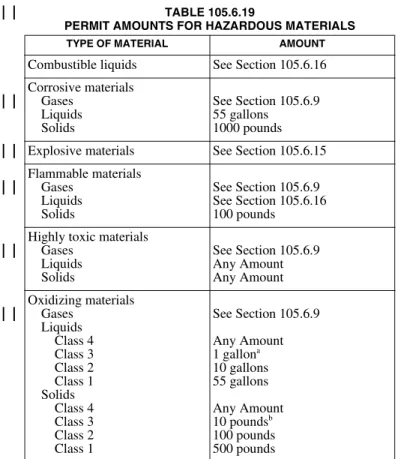
[A] 105.6.19 Hazardous materials. An operational per-mit is required to store, transport on site, dispense, use or handle hazardous materials in excess of the amounts listed in Table 105.6.18.
TABLE 105.6.19
PERMIT AMOUNTS FOR HAZARDOUS MATERIALS
(continued)
TABLE 105.6.19—continued
PERMIT AMOUNTS FOR HAZARDOUS MATERIALS
For SI: 1 gallon = 3.785 L, 1 pound = 0.454 kg.
a. 20 gallons when Table 5003.1.1(1) Note k applies and hazard identification signs in accordance with Section 5003.5 are provided for quantities of 20 gallons or less.
b. 200 pounds when Table 5003.1.1(1) Note k applies and hazard identification signs in accordance with Section 5003.5 are provided for quantities of 200 pounds or less.
[A] 105.6.20 HPM facilities. An operational permit is required to store, handle or use hazardous production materials.
[A] 105.6.21 High-piled storage. An operational permit is required to use a building or portion thereof as a high-piled storage area exceeding 500 square feet (46 m2
).
105.6.22 Hospital and nursing homes. An operational permit shall be required for hospitals and nursing homes.
[A] 105.6.23 Hot work operations. An operational permit is required for hot work including, but not limited to:
1. Public exhibitions and demonstrations where hot work is conducted.
TYPE OF MATERIAL AMOUNT
Combustible liquids See Section 105.6.16 Corrosive materials Gases Liquids Solids See Section 105.6.9 55 gallons 1000 pounds Explosive materials See Section 105.6.15 Flammable materials Gases Liquids Solids See Section 105.6.9 See Section 105.6.16 100 pounds Highly toxic materials
Gases Liquids Solids See Section 105.6.9 Any Amount Any Amount Oxidizing materials Gases Liquids Class 4 Class 3 Class 2 Class 1 Solids Class 4 Class 3 Class 2 Class 1 See Section 105.6.9 Any Amount 1 gallona 10 gallons 55 gallons Any Amount 10 poundsb 100 pounds 500 pounds Organic peroxides Liquids Class I Class II Class III Class IV Class V Solids Class I Class II Class III Class IV Class V Any Amount Any Amount 1 gallon 2 gallons No Permit Required Any Amount Any Amount 10 pounds 20 pounds No Permit Required Pyrophoric materials Gases Liquids Solids Any Amount Any Amount Any Amount Toxic materials Gases Liquids Solids See Section 105.6.9 10 gallons 100 pounds Unstable (reactive) materials
Liquids Class 4 Class 3 Class 2 Class 1 Solids Class 4 Class 3 Class 2 Class 1 Any Amount Any Amount 5 gallons 10 gallons Any Amount Any Amount 50 pounds 100 pounds
TYPE OF MATERIAL AMOUNT
Water-reactive materials Liquids Class 3 Class 2 Class 1 Solids Class 3 Class 2 Class 1 Any Amount 5 gallons 55 gallons Any Amount 50 pounds 500 pounds
2. Use of portable hot work equipment inside a struc-ture.
Exception: Work that is conducted under a con-struction permit or work conducted at one- and two-family dwellings.
3. Fixed-site hot work equipment, such as welding booths.
4. Hot work conducted within a wildfire risk area. 5. Application of roof coverings with the use of an
open-flame device.
6. When approved, the fire code official shall issue a permit to carry out a hot work program. This pro-gram allows approved personnel to regulate their facility’s hot work operations. The approved person-nel shall be trained in the fire safety aspects denoted in this chapter and shall be responsible for issuing permits requiring compliance with the requirements found in Chapter 35. These permits shall be issued only to their employees or hot work operations under their supervision.
[A] 105.6.24 Lumber yards and woodworking plants.
An operational permit is required for the storage or pro-cessing of lumber exceeding 100,000 board feet (8,333 ft3
) (236 m3
).
[A] 105.6.25 LP-gas. An operational permit is required for: 1. Flaring off LP-gas prior to the abandonment or
removal of an LP-gas container.
2. LP-gas containers used for liquid transfer service. 3. LP-gas containers greater than 2,000-gallon (7571 L)
water capacity used exclusively for vapor service.
[A] 105.6.26 Miscellaneous combustible storage. An operational permit is required to store in any building or upon any premises in excess of 2,500 cubic feet (71 m3
) gross volume of combustible empty packing cases, boxes, barrels or similar containers, rubber tires, rubber, cork or similar combustible material or to store outside 50 or more wooden or plastic idle pallets.
[A] 105.6.27 Open burning. An operational permit is required for the kindling or maintaining of an open fire or a fire on any public street, alley, road, or other public or private ground. Instructions and stipulations of the permit shall be adhered to. When burning is conducted on public property or the property of someone other than the permit applicant, the permit applicant shall demonstrate that per-mission has been obtained by the appropriate government agency, the owner, or the owner's authorized agent. When limits for atmospheric conditions or hours restrict burning, such limits shall be designated in the permit restrictions.
Exception:Recreational fires.
[A] 105.6.28 Open flames and torches. An operational permit is required to remove paint with a torch; or to use a torch or open-flame device in a wildfire risk area. When burning is conducted on public property or the property of someone other than the permit applicant, the permit appli-cant shall demonstrate that permission has been obtained
by the appropriate government agency, the owner, or the owner's authorized agent. When limits for atmospheric conditions or hours restrict burning, such limits shall be designated in the permit restrictions.
[A] 105.6.29 Organic coatings. An operational permit is required for any organic-coating manufacturing operation producing more than 1 gallon (4 L) of an organic coating in one day.
105.6.30 Pallet yard operations. An operational permit is required to store in any building or upon any premises in excess of 2,500 cubic feet (71 m3
) gross volume of com-bustible.
[A] 105.6.31 Public assembly—indoor event. An opera-tional permit is required to operate a place of assembly indoors.
[A] 105.6.32 Public assembly—open flames and can-dles. An operational permit is required to use open flames or candles in connection with assembly areas, dining areas of restaurants or drinking establishments.
105.6.33 Public assembly—outdoor event. An opera-tional permit is required to operate a place of assembly outdoors.
[A] 105.6.34 Public assembly—vehicle display. An operational permit is required to display, operate or dem-onstrate liquid-fueled, gas-fueled, or electric vehicles or equipment fueled in buildings. The fire code official shall be notified a minimum of 5 days prior to changing vehi-cles.
Exception: Auto dealerships.
[A] 105.6.35 Pyrotechnic special effects material. An operational permit is required for use and handling of pyrotechnic special effects material.
[A] 105.6.36 Refrigeration equipment. An operational permit is required to operate a mechanical refrigeration unit or system regulated by Chapter 6.
[A] 105.6.37 Repair garages and motor fuel-dispensing facilities. An operational permit is required for operation of repair garages, and automotive, marine and fleet motor fuel-dispensing facilities.
[A] 105.6.38 Rooftop heliports. An operational permit is required for the operation of a rooftop heliport.
[A] 105.6.39 Spraying or dipping. An operational permit is required to conduct a spraying or dipping operation uti-lizing flammable or combustible liquids, or the application of combustible powders regulated by Chapter 24.
[A] 105.6.40 Tents, canopies or temporary membrane structures. An operational permit is required to operate a tent or an air-supported temporary membrane structure having an area in excess of 800 square feet (74 m2
) or can-opies in excess of 1,200 square feet (111 m3
) aggregate.
Exceptions:
1. Tents used exclusively for recreational camping purposes.
2. Tents and curtains or extensions attached thereto when used for funeral services.
[A] 105.6.41 Tire-rebuilding plants. An operational per-mit is required for the operation and maintenance of a tire-rebuilding plant.
105.6.42 Used or waste tires and tire byproducts. An operating permit is required to establish, conduct or main-tain storage of 100 or more used tires or 100 or more waste tires or tire byproducts that exceed 2,500 cubic feet (71 m3
) of total volume of scrap tires.
[A] 105.6.43 Waste handling or recycling operations.
An operational permit is required for the operation of wrecking yards, junk yards, waste material-handling facil-ities and recycling facilfacil-ities.
[A] 105.6.44 Wood or mulch products. An operational permit is required to store mulch, chips or hogged material in excess of 2,500 cubic feet (71 m3
).
[A] 105.7 Required construction permits. The fire code official is authorized to issue construction permits for work as set forth in Sections 105.7.1 through 105.7.30.
105.7.1 Access gates, fire apparatus. A construction per-mit is required to install or modify manual or automatic fire apparatus access gates and their appurtenances. This also includes gates for auxiliary access openings.
105.7.2 Fire apparatus access roads. A construction per-mit is required to install or modify fire apparatus access roads.
105.7.3 Access. A construction permit is required for premise identification review, fire lane markings, identifi-cation of fire protection equipment, key boxes, stairwell identification and pedestrian gates.
105.7.4 Address directories. A construction permit is required to install or modify address directories.
105.7.5 Alternative surface access roads. A construction permit is required to install or modify alternative surface fire apparatus access roads.
105.7.6 Amusement buildings, haunted houses and mazes. A construction permit is required to construct or modify a special amusement building, haunted house or maze.
[A] 105.7.7 Automatic fire-extinguishing systems. A construction permit is required for installation of or modi-fication to an automatic fire-extinguishing system. Main-tenance performed in accordance with this code is not considered a modification and does not require a permit.
105.7.7.1 Automatic special fire-extinguishing sys-tem. A construction permit is required to install a water-based special fire-extinguishing system.
[A] 105.7.8 Battery systems. A construction permit is required to install stationary storage battery systems hav-ing a liquid capacity of more than 50 gallons (189 L) in a nonsprinklered building or 100 gallons (379 L) in a sprin-klered building used for facility standby power, emer-gency power or uninterruptible power supplies.
105.7.9 Combustible dust- or fiber-producing opera-tions. A construction permit is required to install, modify or alter a combustible dust-producing operation.
[A] 105.7.10 Compressed gases. When the compressed gases in use or storage exceed the amounts listed in Table 105.6.9, a construction permit is required to install, repair damage to, abandon, remove, place temporarily out of ser-vice, or close or substantially modify a compressed gas system.
Exceptions:
1. Routine maintenance.
2. For emergency repair work performed on an emergency basis, application for permit shall be made within two working days of commence-ment of work.
[A] 105.7.11 Cryogenic fluids. A construction permit is required for installation of or alteration to outdoor station-ary cryogenic fluid storage systems where the system capacity exceeds the amounts listed in Table 105.6.11. Maintenance performed in accordance with this code is not considered an alteration and does not require a con-struction permit.
[A] 105.7.12 Emergency responder radio coverage sys-tem. A construction permit is required for installation of or modification to emergency responder radio coverage systems and related equipment. Maintenance performed in accordance with this code is not considered a modification and does not require a permit.
[A] 105.7.13 Fire alarm and detection systems and related equipment. A construction permit is required for installation of or modification to fire alarm and detection systems and related equipment. Maintenance performed in accordance with this code is not considered a modification and does not require a permit.
105.7.14 Firefighter breathing air system. A construc-tion permit is required for installaconstruc-tion of or modificaconstruc-tion of a firefighter breathing air system.
[A] 105.7.15 Fire pumps and related equipment. A con-struction permit is required for installation of or modifica-tion to fire pumps and related fuel tanks, jockey pumps, controllers and generators. Maintenance performed in accordance with this code is not considered a modification and does not require a permit.
[A] 105.7.16 Flammable and combustible liquids. A construction permit is required:
1. To install, repair or modify a pipeline for the trans-portation of flammable or combustible liquids. 2. To install, construct or alter tank vehicles,
equip-ment, tanks, plants, terminals, wells, fuel-dispensing stations, refineries, distilleries and similar facilities where flammable and combustible liquids are pro-duced, processed, transported, stored, dispensed or used.
3. To install, alter, remove, abandon or otherwise dis-pose of a flammable or combustible liquid tank. 4. To temporarily or permanently install a storage tank
or above-ground storage tank or pressure vessel for Class I, II or III-A liquids with a nominal capacity of 125 gallons (473 L) outside a building.